KNOWLEDGE IN EDUCATION
Most companies of today are primarily run on the basis of the past manufacturing based and capital
intensive industrial economy. These companies are rapidly falling out of alignment with the evolutionary direction of the near future, as the economy tran-sits from the post-industrial era to what is rapidly
Knowledge based higher education
Znalostně orientované vysokoškolské vzdělávání
J. HAVLÍČEK, J. HRON, I. TICHÁ
Czech University of Agriculture, Prague, Czech Republic
Abstract: While data and/or information based education was built on pedagogic, psychology, philosophy of science and didactic disciplines, the new dimension of knowledge based education will involve new disciplines such as Knowledge Ma-nagement, Epistemology, Systems Theory, Artificial Knowledge Management Systems, Value Theory and Theory of Measu-rement. It is often assumed that data, information and knowledge are depicted as a pyramid. The data, the most plentiful type, are at the bottom, information, produced from data, is above it and knowledge, produced from information through the hard work of refining or mining, above it. This schema satisfies specific needs of an organisation of warehouse data systems but it does not explain the role of these objects in the educational process. In education, the distinctions among data, information and knowledge need to be distinguished from the complex pedagogical point of view. Knowledge is the engine asking for more information and more data. Knowledge life cycle produces more information, more information asks for more data – that is: there is “just information”. Data, information and knowledge can be considered as object ori-ented measures assigned to real objects (entities). The following measures can be assigned to the objects: Measure of the zero order – name. Measure of the first order – data. Measure of the second order – information. Metrics of the third order – knowledge. Knowledge based curriculum involves knowledge into study plans and it considers knowledge as a distinctive part of study. Knowledge becomes the engine starting cycle of new information acquisition, reproduction and integration. The following problems have to be solved in building of knowledge based curriculum: Methodology and organisation of educational process. Technical support for knowledge based education. Evaluation and assessment of the process.
Key words: data, information, knowledge, knowledge life cycle, measures and measuring, knowledge mining and elicitati-on, k-based curriculum
Abstrakt: Vzdělávaní založené na informacích využívá psychologii, filosofii vzdělávání, didaktiky a metodiky. Znalostně ori-entované vzdělávání zahrnuje řadu dalších oblastí jako např. znalostní management, epistemologii, teorii systémů, umělou inteligenci, teorii míry a teorii hodnoty. Data, informace a znalosti se často zobrazují jako pyramida, kde data tvoří základ, informace střed a znalosti získané data miningem a zpracováním informací vrchol. Toto schéma ale vyhovuje spíše organi-zaci a uspořádání v datových skladech než pedagogickým účelům. Ve vzdělávání je třeba rozlišit data, informace a znalosti z pedagogického hlediska. Znalosti jsou motorem, které vyžadují tvorbu dalších informací, tvorba dalších informací vyža-duje vyhledávání a zpracovávání nových dat. Životní cyklus znalosti vyžavyža-duje produkci více informací, tento proces zase více dat – tj. z pedagogického pohledu je v procesu prioritní tvorba informace. Data, informace a znalosti lze chápat jako měřitelné objekty, na které lze zavést metriku: míra nultého řádu – název (jméno), míra prvního řádu – data, míra druhého řádu – informace, míra třetího řádu – znalost. Znalostně orientované kurikulum zahrnuje znalosti do studijních plánů a představuje osobitou složku vzdělávacího procesu. Znalosti se zde stávají podnětem akvizice nových informací, jejich reprodukce a integrace. Ve znalostně orientovaném kurikulu se studují: metodologie a organizace vzdělávacího procesu, technická podpora znalostně orientovaného vzdělávání, evaluace a hodnocení vzdělávacího procesu.
Klíčová slova: data, informace, znalosti, životní cyklus znalosti, míry a měření, získávání a zpracování znalostí, znalostně orientované kurikulum
becoming a global knowledge economy and society. In this knowledge based society (k-society), most organisations depend for their value and competi-tiveness on the development, use and distribution of knowledge-based competences.
As knowledge increasingly becomes the key strategic source of the future development, the need of higher education to develop a comprehensive understanding of knowledge strategies in the courses is becoming critical. The aim is to educate potential managers to be able to nurture, harvest and manage the immense potential of knowledge hidden inside and outside of organisations, to teach them to create new maps and measures and to reinvent themselves in order to innovate and excel in the content of the knowledge economy.
The task of developing and applying knowledge management by creating university curriculum is crucial. This new curriculum must respond success-fully to the diverse needs of companies and institu-tions in the rapidly changing and globalizing world. Although hundreds of books, studies and reports were published, neither researchers, teachers and practi-tioners have an agreed definition of “knowledge” as well as “knowledge management”. The term is used loosely to refer to a broad collection of organisational practices and approaches related to generating, cap-turing and sharing knowledge that is relevant to the organisational business.
Knowledge is not a new category in education proc-ess. Long before knowledge became a driver of the contemporary production development and chal-lenge for managers, teachers defined education as a process “…to endow the student with knowledge and skills”. Knowledge in education was, and often is, defined more intuitively than precisely. The meaning of the word “knowledge” is one which all teachers and trainers have a good intuitive understanding, but which is hard to define in any formal way. The intuitive comprehension of knowledge in education carries forward. Seeing thousands of pages devoted to “knowledge based education” on the Internet, one can see a mixture of terms which do not distinguish between data, information and knowledge. In this article, we shall define – from the pedagogic point of view – differences among categories “data – in-formation – knowledge” and describe the life cycle of knowledge in education.
In education, the standard definition is still valid. But in this sense, the term “knowledge” is considered as a collection and mixture of data, information and knowledge. No precise distinguishing among these terms “data, information, knowledge” is applied in courses. The interchangeable use of terms “data,
information, knowledge” in higher education can be confusing if it is not clear that knowledge is be-ing used in a new and unusual sense. It can seem unscrupulous insofar as the intent is to attach the prestige of knowledge to mere information and data. It also tends to obscure that fact that while it can be easy and quick to transfer data and information from one place to another place and from one person to another person, it is very difficult and slow to transfer knowledge within the same way.
The change in the meaning of knowledge has changed the society and economy. Today, knowledge is the only meaningful resource available. Traditional categories like land, natural sources, labour and capital have not disappeared, but they become secondary in the process of development. They can be obtained providing knowledge in its new meaning as a utility. New discipline knowledge engineering offers the users scientific methodology, analysis and engineering of knowledge. In education, the application of knowl-edge engineering changes traditional conception of knowledge to an irreversible change: knowledge is now being applied to knowledge.
While data and/or information based education was built on pedagogic, psychology, philosophy of science and didactic disciplines, the new dimen-sion of knowledge based education will involve new disciplines such as Knowledge Management, Epistemology, Systems Theory, Artificial Knowledge Management Systems, Value Theory and Theory of Measurement. The main role of education is to mediate the process of knowledge sharing among these who “already know” and those who “want/need to know”. Knowledge based education is among the “hottest” current education methodology and education technology subjects.
EXPLICIT AND TACIT KNOWLEDGE IN EDUCATION
A definition that is suitable for our purposes is the one given by Davenport and Prusak (1998), who define knowledge as “a fluid mix of framed expe-rience, values, contextual information, and expert insight that provides a framework for evaluating and incorporating new experiences and information. It originates and is applied in the minds of knowers. In organisations, it often becomes embedded not only in documents or repositories but also in organisational routines, processes, practices, and norms”.
This definition highlights two important types of knowledge: explicit knowledge and tacit knowledge (Nonaka, Takeuchi 1995).
Tacit knowledge refers to that knowledge which is embedded in individual experience such as the per-spective and inferential knowledge. Tacit knowledge includes insights, hunches, intuition and skills that are highly personal and hard to formalize, making them difficult to communicate or share with others. Tacit knowledge is also deeply rooted in an individual’s commitment to a specific context as a craft or pro-fession, a particular technology or product market, or the activities of a work group or team. In other words, tacit knowledge is deeply ingrained into the context, i.e. the owner’s view and imagination of the world, and into his or her experience, which is the previously acquired knowledge.
Explicit knowledge is knowledge that has been arti-culated in formal language and can be easily transmitted among individuals. It can be expressed in scientific formulae, codified procedures or a variety of other forms. It consists of three components: a language, information and a carrier. The language is used to express and code knowledge. Information is coded externalized knowledge. It is potential knowledge, which is realized when information is combined with the context and the experience of humans to form new tacit knowledge. The carrier is capable of incorporating coded knowledge and storing, preserving and transporting knowledge through space and time independent of its human creators.
Both explicit knowledge and tacit knowledge are impor-tant for the educational process. Both must be recognized as providing value to the personal skills. It is through the conversion of tacit to explicit knowledge and explicit to tacit knowledge in the organization that creativity and innovation are released and the potential for value crea-tion arises. The goal, then, is to leverage both explicit knowledge and tacit knowledge and to reduce the size of the organizational knowledge gaps.
Knowledge as the dynamic information concerns
objects associated with the problem. No problem, no knowledge.
The business and education view
The origin of the contemporary interest in knowl-edge exploitation resides in business. Business is also the main driver of knowledge management develop-ment in organisations as well as in education and training. There are two substantial differences between the use of knowledge in business and education:
In business, knowledge is goods. Life cycle of know-ledge in the business is directly associated with the life of the company. It is shared within the company. In many cases, being the source of income and also asset of the company, knowledge is stored and hidden here. No other has free access to it.
In education, knowledge is considered as value. Life cycle of knowledge in education is associated with the life of the society. It is shared widely among the horizontal and vertical societal structures. Each person has or should have free access to it. Life cycle of knowledge never ends.
The business and education view focus role of knowledge management in educational process.
The product and process view
While business and education methodological ap-proaches differ in business and education, the prod-uct and process approaches do not differ in these areas. The product and process view focus the role of knowledge engineering in education.
The product approach to knowledge implies that knowledge is an object that can be located and ma-nipulated as an independent entity. Proponents of this approach claim that it is possible to capture, distribute, measure and manage knowledge. This approach mainly focuses on products and artefacts containing and representing knowledge. This means managing and elaborating of documents, creation of models, storage and management of databases and other memories. Examples include: best practice in the knowledge maps, case studies, case experiences archives. The main purpose of ICT in this process is to support elaboration of documents and to store knowledge.
purpose of ICT in this case is to help people to com-municate knowledge, not to store it. ICT tools in this case comprise e-mail, video-conferencing, workflow management systems, systems for the distributed authoring of hypertext documents, group-decision support systems, etc. This approach has also been referred to as the “collaboration” or “personalisation” approach.
Tacit knowledge in education
The nature of knowledge in the contemporary education is so specific that special procedures of control and management have to be used to exploit all the benefit of knowledge in the education system. In the area of knowledge management, the large part of knowledge is not explicit but tacit. Knowledge in education is often not explicitly describable by people who possess it, nor is it easy to explain and to formulate and formalize in study materials. Tacit knowledge is – from the education point of view – more important in the curriculum: partly uncon-scious and stemming from experience, it is often used in many soft problem-solving and common crucial human tasks.
The role of knowledge management in educations thus following: to provide production and implementation of knowledge to ensure in education four processes: 1. socialization
2. externalisation 3. combination 4. internationalisation.
The process of socialization represents production of knowledge in the frame “from tacit to tacit”. In the education process, we can teach each others by showing rather then speaking about problems and decisions.
The process of externalisation represents implementation of knowledge in the way “from tacit to explicit”. Knowledge practices are clarified by transforming them and putting down on paper, formalizing them into formal algorithms and procedures. Different sophisticated methods of trans-formation have to be used.
The combination represents pedagogical approaches in the form “from explicit to explicit”. This is an “old” proc-ess of creation of knowledge through the integration and up-dating of other explicit knowledge.
Internalisation is the process of “explicit to tacit” in which knowledge frequently used in practice tends to change into information. In education, performing a task frequently leads to a state where person can carry out a problem or decision making without much thinking about it.
In education, all four types of knowledge produc-tion and implementaproduc-tion are needed. The role of
knowledge management in education is to facilitate and stimulate these four processes in all levels of education – elementary, secondary, high and higher as well as in the many forms of education of adults. Knowledge engineering is used mainly in the pro-cesses of externalisation and combination.
The importance of tacit knowledge in the cur-riculum is nowadays widely acknowledged both in knowledge engineering and knowledge manage-ment.
Knowledge in informatics and education
It is often assumed that data, information and knowledge can be depicted in the form of a pyramid. The data, the most plentiful type, are at the bottom. Information, produced from data, is above it and knowledge, produced from information through the hard work of refining or mining, above it. This dia-gram satisfies the specific needs of an organisation of warehouse data systems, but it does not explain the role of these objects in the educational process. In education, the distinctions between data, informa-tion and knowledge need to be distinguished from the complex pedagogical point of view: methodological, methodical, didactical and psychological. If we take into account the process of education – provided both in schools and families – we have to work with another schema in which information is the core element in the educational process.
In the process of solving a problem, knowledge is created (e.g. information is used at the right place, in the right time and in the right way) and this process requires additional new information. It generates a search for additional new data. Knowledge is the engine asking for more information, and more information asks for more data. The knowledge life cycle produces more information; more information asks for more data – that is, there is “just information”. In the education process, knowledge can be seen as a special type of information, namely “information about infor-mation”, information “telling us something about other information”.
DATA, INFORMATION AND KNOWLEDGE IN RELATION TO EDUCATION SYSTEMS
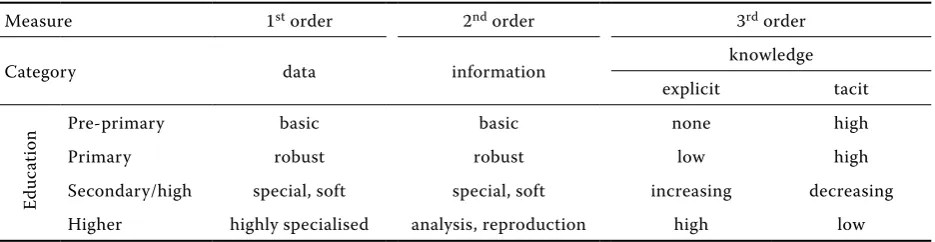
The triangle “data – information – knowledge” cor-responds directly to the ontogenesis of human psyche and follows the individual levels of the traditional education systems:
knowledge in their families, during meetings with relatives, and in kindergartens.
The primary school period stresses more special-ized data, and presents to pupils simple information. Sharing of tacit knowledge is slightly less.
Secondary schools present special data, stress infor-mation described both by robust and soft measures, whilst the basic explicit knowledge is presented in stories often derived from literature. There is a change of the environment in which tacit knowledge is shared: the students turn their attention to “virtual” models – actors, external heroes.
[image:5.595.65.533.644.765.2]Higher education is based on specialised data, system analysis of information sources, knowl-edge integration and reproduction. The level of “face to face” sharing of tacit knowledge is minimal (Table 1).
Formal distinguishing among data, information and knowledge
To introduce formal distinguishing among the cat-egories data, information and knowledge, we must define the basic unit we shall deal and it is an object. The object can be (1) an element or a collection of elements, (2) relation or collection of relations, (3) element and relation or a collection of elements and relations. Thus object is defined as a system. The object can represent very different things and events. Objects can be robust, for example physical entities, which are well measurable by the means of robust weights. Objects can be soft, for example philosophi-cal or societal categories, which do not allow the use of traditional robust measures.
Here are examples of the typical robust and soft ob-jects:
Robust objects: car, men, temperature, expected value of future profit, probability of an event, estimation of future interest rate …
Soft objects: smell of a rose, smile of a child, benefit of farmers, welfare a citizen gets from supermarkets …
Data
Process of object identification starts with the proc-ess of giving the name to the object or to its property. Names can be both robust and soft.
“Jane”, “day”, “4”, “Monday”, “atom”, “ladybird” are examples of robust names. “This strange thought”, “shocking weather”, “sweet smell”, “something like crocodile” are examples of soft names. Many names are listed in vocabularies but many soft names are hidden in our mind as feelings.
Mankind meets with the names of objects from the early infancy till old age. The older one is the more special names and terms one must learn. Specialists differ between themselves in the ability to use many special words and terms in practice.
The process of giving names can be considered as a measure of the “zero” order.
The categories “data, information, knowledge” can be given in relation to Jung’s system of human con-scious. Jung (1968) presents human consciousness as a synthesis of four functions: thinking, feeling, sensation and intuition.
According to Jung, the function “sensation” medi-ates communication between the ego and environ-ment: sensation tells the ego that “something exists”. Of course, this “something” is an object/entity and it can be grasped and put in mind if and only if it gets a name. The name of the object/entity – either robust or soft in the simple form of a feeling – maps the object in the mind. There exists nothing in the mind of men not having a name. Thus the function of sensation can be considered as a process of iden-tification of the object by name.
“In principio erat verbum” –“ In the beginning was the Word”. Word as an élite of the Spirit. This well known sentence of the New Testament articulated Jung’s idea.
The process continues with identification and de-scription of the object’s properties. Objects can have many properties, and alphanumerical signs are used for their description. These are called meta-data in informatics. After meta-data are structured we call
Table 1. Data, information, knowledge in education system
Measure 1st order 2nd order 3rd order
Category data information knowledge
explicit tacit
E
du
ca
tio
n Pre-primary basic basic none high
Primary robust robust low high
Secondary/high special, soft special, soft increasing decreasing
them data and store them in databases or data ware-houses. Data can be both robust and soft.
“$ 157,13”, “–10° centigrade”, “probability 0.95”, “UFO”, “not interesting” are examples of robust data. “Red”, “heavy”, “difficult to understand”, “no clearly remarkable” are ex-amples of soft data.
Data give answers on questions “what it is like?”: – it is heavy, it weights 5.4 pounds, it has two gaps, she never smiles.
Data concerns the selfsame object. We can really suppose that each object in our universe can have an infinite number of characteristics. We identify a small part of them in our daily life and learn about them in families, schools, jobs and during our social and cultural life. Much such data is standard and commonly agreed, whilst some we assign to objects individually, as a result of our own experience.
Data are thus the un-interpreted signals that reach our human senses or artificial sensors by the zillions. Data concerning the object can be stored in the vec-tor (database sentence). The process of description of an object by data can be considered as measure of the “first” order.
The function “thinking”, according to Jung, tells the ego “what is the object/entity like”. It describes the properties of an identified object: some proper-ties are directly visible, other must be revealed by means of various methods and procedures. Thus an object/entity is observed, examined, analysed, evaluated and the results of these performances are described as robust data by alpha-numeric symbols, or as soft data by means of words and vague word expressions. The function, thinking, represents the process of creation of data.
Information
Objects are in mutual relationships to other objects. These relationships are described asinformation. Information describes the relationship of an object to its environment. Generally, information concerns more objects. Information depends on data and is produced from data: at least two data must be available to create some information. Information can thus be considered as data with meaning. Information can also be produced from different data of the selfsame object.
The relationship among objects described by information can be expressed by means of questions like this: “Where it is?” – relation to place, “How much is it?” – relation to cost, “How far is it to Tipperary?” – relation between two points, “With what probability has event A realised?” – relation to population of events, “ How is the weight of Ms Slim connected to the colour of her eyes?” – relation between two data of the same object, etc.
While database for storage of data can be construct-ed as a vector, the frame of database for placement of information has the form of a table (database matrix). Information is derived from data using various algo-rithms, procedures and techniques. Information can be structured and unstructured. Structured information can be saved in the form of alphanumerical symbols and signs, functions and graphs. Unstructured con-tent of information refers to texts objects, electronic objects, messages, video records, documents, visual objects, media objects, etc. Expression of value of an object by information is process of the measure of the “second” order.
The third function of the human consciousness is “feeling”. According to Jung, the function feeling assigns the object/entity a value. To assign the ob-ject/entity a value, one must compare this object with other objects. The considered object/entity must be evaluated with respect to its environment. This is a process of creation of information.
Knowledge
Knowledge is directly associated with solution of a problem. According to Simon, there is equality between “decision making” and “problem solving”. Thus, although education is mainly concerned with “problem solving”, the final result of education leads to “decision making”. Each human being is perma-nently involved in many levels of decision making: in personal life, work and social life. The process of “decision making” – “problem solving” is a permanent process in human society. To decide on the right one, one has to solve problems and use information.
Dynamic information used for the successful (or unsuccessful) solution of a problem can be considered as a measure of the third order.
Knowledge gives answers to questions “Why/How” like this:
(1) “Why is it?”
– long, expensive, 1017 light years apart, unsolvable; (2) “Why?”
– does she suffer so much, are some people poor, does this rose smell so beautiful;
(3) “How to?”
– solve this maths example, increase the productiv-ity, reach the highest level of production, plan a good tour.
The fourth function – “intuition” – involves time and motion in human consciousness. Objects/entity (grasped by name, described by data, put into en-vironment and evaluated) have their past and have their future. Jung says that the function intuition is “the ability to see around the corner”. Objects create a time series, which makes it possible to estimate future behaviour. Each decision making concerns the future. Human beings use information, put it into action to find solutions to problems, and make decisions. This is the never-ending process of crea-tion of knowledge, with the engine asking for more information and more data.
There is a long tradition of the presentation of know-ledge in the form of stories (explicit knowknow-ledge). Parables in the New Testament are excellent examples of knowledge hidden in stories: e.g. The Parable of the Good Samaritan, Luke 10:25, is commonly known throughout the world, and has been an example of a good solution to problems for hundreds of years. Also the history and description of the life of Jesus and his disciples are examples of face to face shared tacit knowledge.
Sophisticated mathematical models – for exam-ple linear programming model – can describe and store special knowledge concerning optimisation of production. Such models cannot only store given knowledge, but also generate new knowledge from that given.
Some case studies commonly used in courses also can be examples of knowledge presented in the form of a story.
LIFE CYCLE OF KNOWLEDGE IN EDUCATION SYSTEM
The life cycle of knowledge in organisations is described as a list of activities, the performance of which ensures acquisition and use of knowledge within an organisation; here is a typical managerial “step by step” procedure of the knowledge life cycle:
– Identification of internally and externally existing knowledge.
– Planning what knowledge will be needed in the future.
– Acquiring and developing the need of know-ledge.
– Distributing knowledge to where it is needed. – Fostering the application of knowledge in the
busi-ness processes of the organization.
– Controlling and maintaining the quality of know-ledge.
– Disposal of knowledge when it is no longer need-ed.
From the education point of view, the life cycle of knowledge in the education process is rather compli-cated. In education, the property “to be knowledge” and “to be information” depends on a) time and b) place.
Dependence on time
Knowledge, which is shared for a long time, can convert to information. Stories are popularly known, there is no necessity to repeat them. The name of the story is sufficient to call to mind the story, and the relevant solution of the problem. Thus, knowledge becomes “information about information”.
Examples of knowledge which changed to information in the course of time: The Parable of the Good Samaritan – the name of this knowledge is sufficient to call to mind the story. The name evokes the historical story and the relevant lesson. Other example: The pasteurisation – the name reflects the process described in the story about Louis Pasteur and evokes known algorithms.
Also tacit knowledge can convert to information. Tacit knowledge shared “face to face” often changes in “patterns of behaviour” and need not to be shared again. Patterns of behaviour are commonly known, respected and emulated in generation.
Examples of the patterns of behaviour can be seen among members of young generation: many of them live ecological/sustainable style of life – they need not listen to the relevant stories with the relevant knowledge content.
Dependence on place
What is knowledge for a pupil? – It can only be information for a student. What is information for a researcher? – It can be knowledge for a student. The property “to be knowledge” or “to be information” depends on the level of the study.
Generally, in the curriculum, some knowledge pre-sented in the bachelor level of study becomes infor-mation in the master study. This process continues similarly in the doctoral study. A similar process is seen in adult education: some knowledge presented in further education is presented in the form of in-formation in courses for regular students.
ACQUISITION AND ELICITATION
experts in order to acquire, organise, and study a problem’s knowledge. The goal is to compile a body of knowledge on the problem of interest that can be enclosed as a part of a course.
To acquire knowledge from the experts team is distinguished from the more general knowledge ac-quisition term and is called knowledge elicitation. This implies an interactive session between the teacher and the experts where the teacher, many times, inter-views the experts. “The main vehicle for knowledge elicitation is face-to-face discussions between the expert who possesses the domain knowledge and the knowledge engineer who asks questions” (Gonzalez, Dankel 1993).
The knowledge elicitation cycle
Durkin (1994) explains the sequence of the know-ledge elicitation cycle as to: (1) collect (an iterative style of collecting the information), (2) interpret (this involves a review of the collected information and the identification of key pieces of knowledge), (3) analyse (the key pieces of knowledge uncovered will provide insight into forming theories on the organisation of the knowledge and problem-solving strategies), and (4) design (now new understanding of the problem, that can aid further investigations, should have been formed).
In the interview direct questions and/or indirect questions may be used. A direct question seeks answers that have a limited number of responses, for example: “What is the value of ...” Indirect questions are exploratory in nature and allow the expert to answer in a more independent way.
Probes are also used in order to provide further informa-tion on the issue, for example: “Can you explain ...”, “Can you discuss...?” etc.
Prompts are questions intended to direct the interview in some direction. It has usually the form: “Can you discuss ...” or “Can we return to ...”
The Socratic Question Technique, with its deductive and inductive reasoning, is believed to motivate the individual to interact with other individuals in order to contribute with knowledge, receive feedback, and receive new knowledge about him/her self and his/her colleagues. The purpose of the Socratic Question Technique is to activate individuals and to encourage reflection and critical thinking; this is assumed to contribute to learning and personal develop-ment.
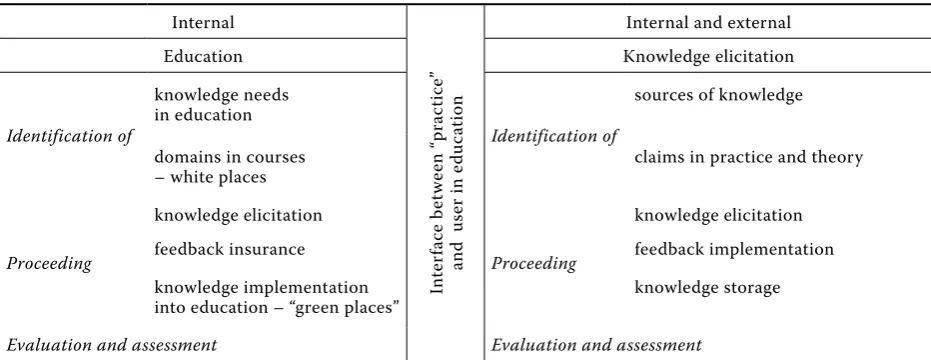
In education, the process of the knowledge life cycle is in Table 2.
1) Level of identification
a) Education, internal
The goal is to survey the knowledge items needed in the content of courses to support education process. They are “white places” in the content of courses.
b) Knowledge elicitation, internal and external Potential sources of knowledge are identified in practice, theory, text and multimedia sources. They become “knowledge claims” from which knowledge is exploited.
2) Level of proceeding
a) Education, internal
[image:8.595.64.530.583.763.2]The goal is to proceed knowledge into pedagogic and didactic tools and prepare it to use it in educa-tion process. The “white places” in the content of courses change into “green places”. The process of using of feedback is used during this procedure. b) Knowledge elicitation, internal and external Sources of knowledge are mined using a set of tech-niques and methods that attempt to elicit knowledge from a claim. Knowledge is postponed in education to be elaborated and implemented into courses.
Table 2. Knowledge life cycle in education
Internal
In
te
rf
ac
e
be
tw
ee
n
“p
ra
ct
ic
e”
an
d
u
se
r i
n
ed
uc
at
io
n
Internal and external
Education Knowledge elicitation
Identification of
knowledge needs in education
Identification of
sources of knowledge
domains in courses
– white places claims in practice and theory
Proceeding
knowledge elicitation
Proceeding
knowledge elicitation
feedback insurance feedback implementation
knowledge implementation
into education – “green places” knowledge storage
If required by evaluation by feedback, process of mining of knowledge continues. In the final state ,knowledge is stored.
3) Level of evaluation and assessment
Monitoring and evaluation and assessment are standard components of knowledge management – these processes become driver of further know-ledge life cycle.
In more detailed list of activities the knowledge life cycle can be described as follows:
1. Identification of knowledge domains (“white plac-es”) in study programmes
– identification of targets,
– domains familiarisation in dependence on time and place,
– knowledge specification, – knowledge refinement. 2. Knowledge acquisition – claims
– gathered through explicit search,
– received as a result of solicited or unsolicited communications,
– knowledge acquisition infrastructure building, – knowledge claims validation and evaluation. 3. Knowledge elicitation
– interviewing,
– information and text sources mining, – protocol analysis,
– special techniques like laddering, concept sort-ing, repertory grids.
4. Communication infrastructure – identification of agents,
– communication plan of transactions,
– infrastructure of knowledge exchange. 5. Teaching
– teaching infrastructure,
– elaboration of stories in texts and multimedia, – transposition of tacit to explicit knowledge, – knowledge sharing and sharing infrastructure. 6. Accelerated innovation
– evaluation and assessment, – implementation of feedback.
CONCLUSION
Curriculum is a “meta study plan”. It is a methodo-logical system of rules and approaches to create a good study plan. Knowledge based curriculum involves knowledge into study plans, and considers knowledge as a distinctive part of the study unit in a similar hierarchy as in the pyramid: knowledge becomes the engine which starts the cycle of new information acquisition, reproduction and integration.
Four aspects of the k-based curriculum need to be study:
– identification of knowledge claims (domains) in the content of study plans,
– technical support and infrastructure for k-based education,
– management and administration in k-based edu-cational environment,
– monitoring and evaluation of the process.
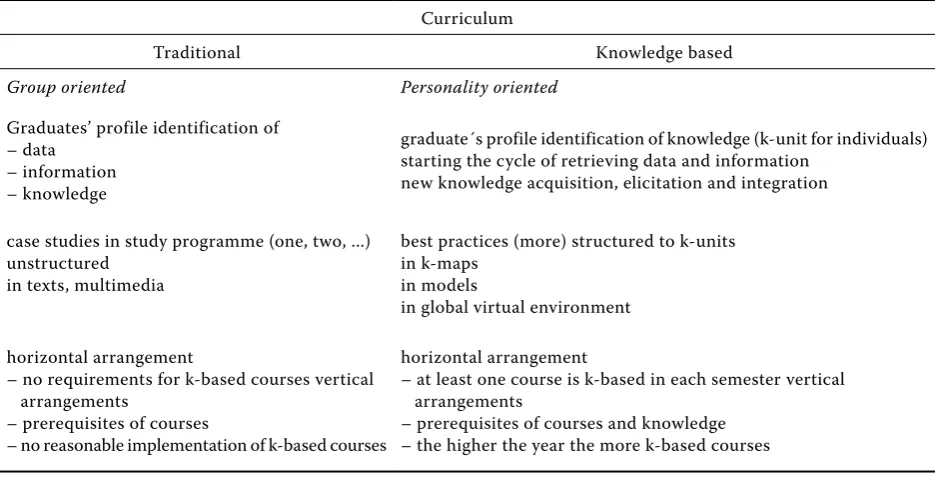
[image:9.595.64.535.527.767.2]Differences between the traditional and knowledge based curriculum are compared in the Table 3.
Table 3. Characteristics of standard and knowledge based education
Curriculum
Traditional Knowledge based
Group oriented Personality oriented
Graduates’ profile identification of – data
– information – knowledge
graduate´s profile identification of knowledge (k-unit for individuals) starting the cycle of retrieving data and information
new knowledge acquisition, elicitation and integration
case studies in study programme (one, two, ...) unstructured
in texts, multimedia
best practices (more) structured to k-units in k-maps
in models
in global virtual environment
horizontal arrangement
– no requirements for k-based courses vertical arrangements
– prerequisites of courses
– no reasonable implementation of k-based courses
horizontal arrangement
– at least one course is k-based in each semester vertical arrangements
REFERENCES
Argyris C. (1993): Knowledge for Action, Jossey-Bass, San Francisco.
Bennet A., Bennet D. (2000): Characterizing the next generation knowledge organisation. Knowledge and Innovation: Journal of the KMCI, 1 (1): 8–42. Bowerman B.L, O´Connell R.T. (1993): Forecasting
and Time Series: An Applied Approach. Duxbury Press, California.
Checkland P., Scholes J. (1990): Soft Systems in Ac-tion. Wiley, Chichester.
Jung C.G. (1968): Analytical Psychology: its Theory and Practice (Tavistock Lectures), Routledge and Kegan, London.
Davenport T., Prusak L. (1998):Working Knowledge. Harward Bussiness School Press, Cambridge. Durkin J. (1994): Expert System – Design and
De-velopment. Prentice Hall.
Firestone J.M. (2003): Enterprise Information Portals and Knowledge Management. Elsvier.
Gonzales A.J., Dankel D.D. (1993): The Engineering of Knowledge Based Systems. Prentice Hall. Havlicek J. (1999): Soft Decision Making in
Com-petitive Environment. In: Proceedings of Confer-ence Agrarní perspektivy VIII, PEF CZU, Prague: 616–619.
Havlicek J., Hron J., Ticha I. (2003): Tailor-made edu-cation for small entrepreneurs. MER Journal for Management and Development, 5 (5): 138-143.
Hron J., Ticha I. (1997): Strategic Management, PEF CZU, Prague (in Czech).
Hron J., Ticha I. (1999): The Virtual Organization and Its Implications for Agricultural Businesses, Wydz. E i OGZ. Szczecin: 105–120.
Mentzas G., Apostolou D., Abecker A., Young R. (2003): Knowledge Asset Management. Springer. Murray A.J. (2000): Knowledge systems research.
Knowledge and Innovation: Journal of the KMCI, 1 (1): 68–84.
Schreiber G., coll. (1999): Knowledge Engineering and Management (The CommonKADS Methodology). Bredford Book, London.
Nonaka I., Takeuchi H. (1995): The Knowledge Creat-ing Company. Oxford University Press.
Tiessen R., Andreiessen D., Deprez F. (1998): Value-Based Knowledge Management. Addison-Wesley, 1998.
Internet sources
Scenarios for Europe 2010 (http://europa.eu.int/ comm/cdp/scenario/resume/index_en.htm) Scenarios for ambient intelligence in 2010
(http://www.cordis.lu/ist/istag.htm). Providing Innovative Information Systems
(http://www.prisma.com) Best e-European Practices
(http://www.beep-eu.org/)
Arrived on 1st February 2006
Contact address:
Jaroslav Havlíček, Jan Hron, Ivana Tichá, Czech University of Agriculture Prague, Kamýcká 129, 165 21 Prague-Suchdol, Czech Republic