The logic of the business has been recently shifting from mass-production to knowledge-intensiveness (hussi 2004). The shift towards the knowledge-in-tensive economy is transforming the dynamic of the business environment and the emphasis of the post-industrial economy is on the value of intangible aspects of products and services (robertson 1999). According to Drucker (1993), in this new economy knowledge is not just another resource alongside with the traditional production factors, but the only meaningful resource.
general concerns about the traditional financial reporting system not meeting the information needs of the new economy relate to the omission of new economy assets and value drivers. The traditional accounting model is based on the principle of historic cost and for this reason, only a very narrow range of intangibles is included within financial statements.
in providing a record of what has happened in the past, historic cost accounts provide a useful starting point in assessing the performance of a business, however, without forward looking information, the picture that they provide is incomplete.
intellectual capital is a key element in an organisa-tion’s future earning potential. Theoretical and em-pirical studies show that it is the unique combination of the different elements of intellectual capital and tangible investments that determines an enterprise’s competitive advantage.
intellectual capital has been defined as the com-bination of an organization’s human, organizational and relational resources and activities. it includes the knowledge, skills, experiences and abilities of the employees, its r&D activities, organizational routines, procedures, systems, databases and its intellectual Property rights, as well as all of the resources linked
Intellectual capital reporting
Vykazování intelektuálního kapitálu
I. Tichá
Czech University of Life Sciences, Prague, Czech Republic
Abstract: The changing context within which businesses today compete requires deployment of intangible assets in order to achieve competitive position on the market. The growing importance of intellectual capital has been challenging the tra-ditional financial reporting system, which is not capable to meet the information needs any more. The article provides an overview of various intellectual capital reporting systems and highlights their key concerns. The selected list of intellectual capital reporting practices serves as an information basis for business leaders to raise the awareness, to consider pros and cons of intellectual capital reporting and to facilitate a broader acceptance of a new reporting practice.
Key words: intellectual capital, knowledge economy, reporting, intangible assets
Abstrakt: Měnící se kontext, v jehož rámci si v současné době podniky konkurují, vyžaduje v zájmu dosažení konkuren-ceschopné pozice na trhu zapojení nehmotných aktiv. rostoucí význam intelektuálního kapitálu zpochybňuje dosavadní způsoby finančního výkaznictví, které není schopno vyhovět požadavkům na informace. Článek poskytuje přehled různých konceptů pro vykazování intelektuálního kapitálu s uvedením klíčových poznatků. Vybraný seznam praktik používaných pro vykazování intelektuálního kapitálu slouží k rozšíření povědomí o intelektuálním kapitálu mezi podnikatelskou veřej-ností, umožňuje posoudit výhody a nevýhody vykazování intelektuálního kapitálu a přispívá k širšímu přijetí této moderní výkaznické praxe.
Klíčová slova: intelektuální kapitál, znalostní ekonomika, výkaznictví, nehmotná aktiva
to its external relationships; such as with its custom-ers, supplicustom-ers, r&D partncustom-ers, etc (MEriTUM 2002). intellectual capital can be both the product of r&D activities and the enabler for creating a greater value from r&D. This combination of intangible resources and activities allows an organisation to transform a bundle of material, financial and human resources into a system capable of creating stakeholder value. For intangibles to become part of the intellectual capital of an organisation, these have to be durably and effectively internalised and/or appropriated by it.
OBJECTIVES AND METHODS
The main idea behind intellectual capital report-ing is that financial information informs about the past performance of the enterprise but tells nothing about its future potential. The future potential of an enterprise does not lie within its financial capital, but in its intellectual capital. creating transparency about the enterprise’s intellectual capital will enable it to manage its intangible resources better, to increase its staff’s confidence and motivation as well as imparting greater certainty to investors and other stakeholders about its future earnings potential.
intellectual capital statements take a different and complementary stance by considering those things which are valuable in evaluating the future (rather than only the past) and this means that a much wider range of intangibles needs to be included. The meth-odology of considering historical financial statements and forward-looking intellectual capital statements together is aimed at improving the transparency of the way in which an organisation is seeking to cre-ate value.
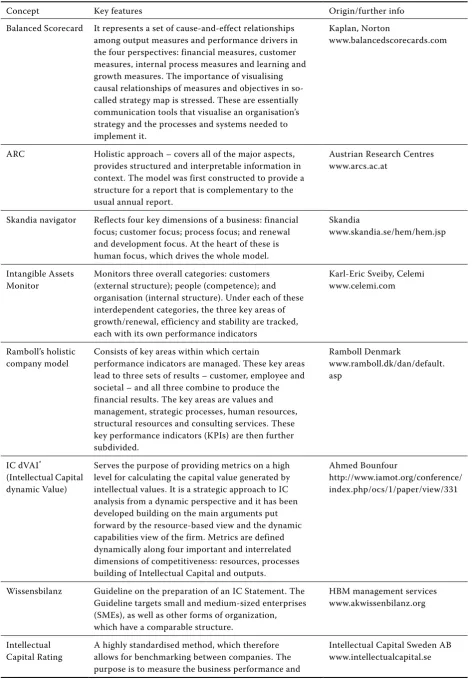
This article therefore takes a closer look at various concepts of intellectual capital reporting developed both by commercial bodies and government agencies (as national guidelines). By reviewing the selected concepts, the article provides useful insights and allows for recommendations to be derived in order to raise awareness about the benefits of intellectual capital reporting practice and thus facilitate its broader uptake by business and other organizations.
RESULTS AND DISCUSSION
Review of intellectual capital definitions
There is no consensual view about what intellectual capital is and this should be identified. A plethora of
intellectual capital terminologies is used in various disciplines, yet no broadly accepted definition of intellectual capital exists.
A well-known definition is the one proposed by Klein and Prusak (1994): ‘intellectual capital is intel-lectual material that has been formalised, captured and leveraged to produce a higher-valued asset’. hall (1992) makes a distinction between intellectual capital as assets and intellectual capital as skills, where assets are formalised and captured intellectual capital (e.g. patents, trademarks, copyright, contracts, and data-bases) and skills or competencies are tacit knowledge (e.g.expertise of employees, suppliers, and distribu-tors). According to Edvinsson and Malone (1997, p. 3), intellectual capital ‘is information, knowledge applied to work to create value’. in this definition, they stress the value creating capacity of intellectual capital. Mouritsen (1998, p. 462) argues that intel-lectual capital is a matter of ‘broad organisational knowledge, unique to a firm, which allows it con-stantly to adapt to changing conditions’. haanes and Lowendahl (1997) claim that the knowledge within an organisation exists at both the individual and the organisational level. on the individual level, intellectual capital includes knowledge, skills and aptitudes. on the organisational level, intellectual capital includes client specific databases, technology, routines, methods, procedures and organisational culture.
concept Key features origin/further info Balanced Scorecard it represents a set of cause-and-effect relationships
among output measures and performance drivers in the four perspectives: financial measures, customer measures, internal process measures and learning and growth measures. The importance of visualising causal relationships of measures and objectives in so- called strategy map is stressed. These are essentially communication tools that visualise an organisation’s strategy and the processes and systems needed to implement it.
Kaplan, norton
www.balancedscorecards.com
Arc holistic approach – covers all of the major aspects, provides structured and interpretable information in context. The model was first constructed to provide a structure for a report that is complementary to the usual annual report.
Austrian research centres www.arcs.ac.at
Skandia navigator reflects four key dimensions of a business: financial focus; customer focus; process focus; and renewal and development focus. At the heart of these is human focus, which drives the whole model.
Skandia
www.skandia.se/hem/hem.jsp
intangible Assets
Monitor Monitors three overall categories: customers (external structure); people (competence); and organisation (internal structure). Under each of these interdependent categories, the three key areas of growth/renewal, efficiency and stability are tracked, each with its own performance indicators
Karl-Eric Sveiby, celemi www.celemi.com
ramboll’s holistic
company model consists of key areas within which certain performance indicators are managed. These key areas lead to three sets of results – customer, employee and societal – and all three combine to produce the financial results. The key areas are values and management, strategic processes, human resources, structural resources and consulting services. These key performance indicators (KPis) are then further subdivided.
ramboll Denmark
www.ramboll.dk/dan/default. asp
ic dVAi*
(intellectual capital dynamic Value)
Serves the purpose of providing metrics on a high level for calculating the capital value generated by intellectual values. it is a strategic approach to ic analysis from a dynamic perspective and it has been developed building on the main arguments put forward by the resource-based view and the dynamic capabilities view of the firm. Metrics are defined dynamically along four important and interrelated dimensions of competitiveness: resources, processes building of intellectual capital and outputs.
Ahmed Bounfour
http://www.iamot.org/conference/ index.php/ocs/1/paper/view/331
Wissensbilanz guideline on the preparation of an ic Statement. The guideline targets small and medium-sized enterprises (SMEs), as well as other forms of organization, which have a comparable structure.
hBM management services www.akwissenbilanz.org
intellectual
capital rating A highly standardised method, which therefore allows for benchmarking between companies. The purpose is to measure the business performance and
[image:3.595.63.536.88.768.2]documentation service, the existence of a knowledge centre, the general use of information technologies and organisational learning capacity. Some of them may be legally protected and become intellectual property rights, legally owned by the firm under a separate title.
Review of Intellectual Capital Reporting concepts
The frameworks used for most of the intellectual capital reporting models have various similar char-acteristics, they are not fundamentally different, however, they do serve different purposes, or use different approaches.
First, the models take a managerial perspective by starting from the intellectual capital creating activi-ties and processes. The models try to relate these activities and processes to the companies’ strategy and give information about intellectual capital crea-tion compared with companies’ goals. Second, the reporting models are developed in accordance with
the balanced scorecard framework (Kaplan, norton 1996) in such a way that the models focus on the various aspects of intellectual capital management. The models give a broad picture of the various intel-lectual capital components which are related to each other, but which are not combined into a bottom line figure. The models do not try to incorporate the information on intellectual capital in the traditional accounting framework. Third, the intellectual capi-tal components are measured in different ways. All kinds of measures are used: non-financial, financial, qualitative and quantitative measures and descrip-tions of activities and processes.
CONCLUSIONS
intellectual capital is important to both society and organisations. it can be a source of competitive advantage for businesses and stimulate innovation that leads to wealth generation.
Technological revolutions, the rise to pre-eminence of the knowledge-based economy and the networked
concept Key features origin/further info
the potential of an enterprise by acquiring information on its business idea and, again, its human, structural and relational potential. in summary ic-rating™ is based on three focus areas: efficiency (present value of ic efficiency in creating future value), risk – (threat against present efficiency; probability of threat coming true) and renewal and development (efforts to renew and develop present efficiency.
MEriTUM classifies intellectual capital in human, structural and relational capital and emphasizes the distinction between the intangible (or ic) resources and activities of the firm. resources, as a static notion, are the stock or current value of a given intangible at a certain moment in time. Activities, as a dynamic notion, imply an allocation of resources aimed at: a) developing internally or acquiring new intangible resources; b) increasing the value of existing ones, or c) evaluating and monitoring the results of the other two activities.
MEriTUM project www.uam.es/meritum
DATi Formulation of self-reporting intellectual capital
guidelines. Danish Agency for Development of Trade and industry www.videnskabsministeriet.dk/ icaccounts
society have all led to the realisation that successful companies excel at fostering creativity and perpetually creating new knowledge. companies depend on being able to measure, manage and develop this knowledge. Management efforts therefore have to focus on the knowledge resources and their use. intangibles and the way how they contribute to value creation have to be appreciated so that the appropriate decisions can be made to protect and enhance them. There must also be a credible way of reporting those intangibles to the market to give the investment community a comprehensive information to assist in valuing the company more accurately.
it is clear that the following are pre-requisites to the intellectual capital reporting culture ever becoming popular and effective:
– organisation-wide understanding of the role and the value of intellectual capital and of each of its different components (basically human capital, relational capital and structural capital) and about the associated managerial issues;
– Effective discussion at a managerial level about the nature of tacit, as opposed to only explicit, knowledge and how it is created, expressed, shared and internalised;
– The ability to overcome the barrier of the effort (cost) and knowledge needed (capability) to develop and sustain the intellectual capital reporting proc-ess (ricardis 2006).
REFERENCES
Baldwin J.r., Johnson J. (1996): Business strategies in more- and less-innovative firms in canada. research Policy, 25 (5): 785–804.
Ballot g., Fakhfakh F., Taymaz E. (2001): Firms’ hu-man capital, r&D and Perforhu-mance: A study on French and Swedish firms. Labour Economics, 8: 443–462.
Bounfour A. (2003): The Management of intangi-bles. The organisation’s Most Valuable Assets. routledge, London and new York.
Bounfour A, Edvinsson L (2005): ic For communi-ties, nations, regions and cities. Butterworth-heinemann, Boston.
Drucker P.F. (1993): Post capitalist Society. Butter-worth heinemann, oxford.
Edvinsson L., Malone M. (1997): intellectual capital: realizing your company’s True Value by Finding its hidden Brainpower. harper Business, new York.
haanes K., Lowendahl B. (1997): The unit of activity: towards an alternative to the theories of the firm.
in: Thomas h. et al: Strategy, Structure and Style. John Wiley & Sons Ltd., new York.
hall r. (1992): The strategic analysis of intangible resources. Strategic Management Journal, 13 (2): 135–144.
hamel g., Prahalad c.K. (1994): competing for the Fu-ture.harvard Business School Press, Boston, MA. hussi T. (2004): reconfiguring knowledge manage-ment – combining intellectual capital, intangible assets and knowledge creation. Journal of Knowl-edge Management, 8 (2): 36–52.
Kaplan r.S, norton D.P. (1996): The Balanced Score-card: Translating Strategy into Action. harvard Business School Press, Boston, MA.
Klein D.A., Prusak L. (1994): characterizing intellec-tual capital. center for Business innovation, Ernst & Young LLP Working Paper, new York.
MEriTUM (2002). canibano L., garcia-Ayuso M., Sanchez P., chaminade c.: guidelines for managing and reporting on intangibles (intellectual capital report). Airtel-Vodafone Foundation, Madrid. Available at www.uam.es/meritum
METi (2004). Ministry of Economy, Trade and indus-try, reference guideline Property information Dis-closure: in: The pursuit of Mutual Understanding companies and capital Markets through Voluntary Disclosures of information and Technology. Avail-able at http://www.meti.go.jp/english/informa-tion/downloadfiles/ciPP0403e.pdf
METi (2005). Ministry of Economy, Trade and indus-try, guidelines for Disclosure intellectual Assets Based Management. Available at http://www.meti. go.jp/policy/intellectual_assets/guidelineforiAM. pdf
Mouritsen J. (1998): Driving growth: economic value added versus intellectual capital. Management Accounting research, 9 (4): 461–482.
oEcD (2002). Frascati Manual 2002; Proposed Standard Practice for Surveys on research and Experimental Development. 6th edition, oEcD
Publications, Paris, France.
oEcD/European commission – Eurostat (1997). Proposed guidelines for collecting and interpreting technological innovation data – oslo Manual, The Measurement of Scientific and Technical Activities. 2nd edition, oEcD Publications, Paris, France.
PiP Project – Putting ic into Practice (2004, version 2). The selected indicators, nordisk innovations centre.
Society for Knowledge Economics (2005). Australian guiding Principles on Extended Performance Man-agement – A guide to Better Managing, Measuring and reporting Knowledge intensive organisational resources. Draft, SKE, Sydney.
Sveiby K.E. (1997): The new organizational Wealth: Managing and Measuring Knowledge-Based Assets. Berrett-Koehler, San Francisco.
Arrived on 8th January 2008
Contact address: