The aim of soil tillage is to create favourable condi-tions for the plants growth and development. As a consequence of mechanical impacts on soil, soil ag-gregates and pore size changes occur, influencing the water regime and air motion in the soil (Titi 2002). It is necessary to evaluate the effects of the technolo-gies or machine types used for soil tillage and crop covers establishing the soil hydraulic properties.
The soil tillage procedures affect the soil resistance to the water or wind erosion. The water erosion en-dangers potentially more than one half of the arable land area while 10% of the arable land is endangered by the wind erosion in the Czech Republic (Janeček et al. 2002). The reduction of the soil permeability for water leads to the rainfall water surface runoff and soil erosion increasing. The soil wash away can affect the soil degradation particularly on inclined plots.
Knowledge of the rainfall water transport speed from the soil surface to the underground water level is significant for both agriculture and the environ-ment protection. The circulation of rainfall water retained in the soil profile is very slow when com-pared with the surface runoff. At a high infiltration of water into soil, a favourable retardation of the speed of water circulation occurs. On the contrary, the
hydrological cycle acceleration resulting at a poor infiltration is unfavourable (Kutílek 1978).
The cultivated layer depth, soil granularity, volume mass, porosity, clods, soil roughness and inclination, or the amount of crop residua in the soil surface layer are indicators of the soil properties investigated dur-ing the water soil infiltration evaluation.
In the years of 2004–2007, during the solution of the 6th RP EU SOWAP (soil and surface water pro-tection using conservation tillage in northern and central Europe), we used a rain simulator set up in accordance with the methodology recommendation of SOWAP project. Based on the experience gained with the utilisation of the rain simulator, installation modifications were suggested and the measuring method and measured data processing procedure were improved.
From the original rain simulator, the hydraulic cove nozzle Lechler 460 was used, the nozzle spray-ing with the circular area diameter R = 1.3 m even at the height of 0.5 m. The nozzle placed in the height of 1 m is able to spray the measurement area of 0.7 × 0.7 m and its surroundings to the distance of 0.5 m (there it is possible to take-off soil samples without influencing the soil properties in the mea-surement area). The meamea-surement area diminution
Supported by the Ministry of Agriculture of the Czech Republic, Projects No. MZE 0002703101 and No. 1G57042.
Measurement of water infiltration in soil using
the rain simulation method
P. Kovaříček
1, R. Šindelář
1,2, J. Hůla
1,2, I. Honzík
21
Research Institute of Agricultural Engineering, Prague-Ruzyně, Czech Republic
2
Faculty of Engineering, Czech University of Life Sciences in Prague, Prague, Czech Republic
Abstract: For the measurement of the infiltration speed under operational conditions, we were equipped by a rain simulator with the measuring surface of 0.5 m2. The infiltration speed is determined from the defined rain intensity
and water surface runoff from the measured surface. The retained water mass from the surface runoff is recorded at regular time intervals over the whole measuring period. The beginning of the water runoff from the measured surface indicates the beginning of elutriation. The measuring time is finished after the infiltration speed has been stabilised. The beginning of elutriation and infiltration speed stabilisation are typical and mutually comparable parameters for defined soil properties at the site followed.
reduces the water consumption during rainfalls and increases the operating procedure of the device dis-location. Both facts mentioned condition the com-parative measurements in the operational surfaces with a need of sufficient repetitions to eliminate the soil properties changes.
MAteRIAl And MetHods
The device developed in RIAEng is based on the principle of the measurement area rainfalls under constant intensity which is set up by the spraying pressure. The spraying pressure is maintained on the determined level by the regulation governor dur-ing the whole measurdur-ing time. The nozzle Lechler 460 788 with the scattering angle of 120° is used.
evaluation of spraying and the used nozzle scattering
Based on the evaluation of the technical documen-tation of agricultural and industrial nozzles manu-facturers, we chose the hydraulic conical nozzle of the firm Lechler, serial 460, scattering angle 120°, sprayed circle diameter R = 1.3 m to the height of 0.5 m and more. These nozzles comply with the drop size (Volume Middle Diameter – VDM) of 2 mm to 100 kPa and with the flow rate (Figure 1). The rain intensity for the adjustment of the spraying pressure was determined from the water mass at the nozzles calibration (by weighing with accuracy of ± 1 g) retained in a square tank (0.7 × 0.7 m) which cor-responds to the measurement surface chosen.
y1m(406788) = 0,408x + 46,94
y1,5m(460848) = 0,245x + 32,58 y1m(460788) = 0,251x + 122,7
y1,5m(460848) = 0,126x + 77,11
0 20 40 60 80 100 120 140 160 180
0 20 40 60 80 100 120 140 160
Spraying pressure (kPa)
R ai n in te ns ity (m m .h –1 )
[image:2.595.73.500.62.256.2]460 788; height 1 m 460 788; height 1.5 m 460 848; height 1 m 460 848; height 1.5 m
Figure 1. Calibration straight lines of simulated rain intensity per measuring surface of 0.7 × 0.7 m for nozzles Lechler 460 788 and 460 848 in dependence on adjustable spraying pressure and height
Sp ra yi ng p re ss ur e (k Pa )
Rain intensity (mm.h–1)
Ra in in te ns ity a ve ra ge (m m .h –1 ) (c oe ffi ci en t o f v ar ia tio n (% ))
Scheme of intake vessels layout 40 50 60 80 100 65.0 (5.1) 73.2 (5.1) 78.6 (4.3) 85.2 (5.1) 90.8 (4.8)
60 70 80 90 100 110
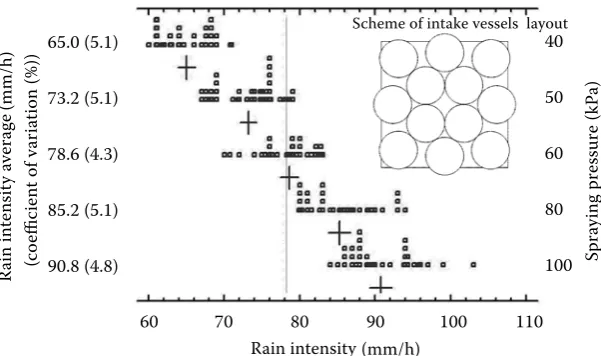
Figure 2. Rain intensity variability on measuring surface of 0.7 × 0.7 m beneath nozzle 460 788 at spraying from 40 to 100 kPa and height of 1 m
y1m(460788) = 0.25x + 122.7
Ra in in te ns ity (m m /h )
y1.5m(460848) = 0.126x + 77.11
y1m(406788) = 0.408x + 46.94
y1.5m(460848) = 0.245x + 32.58
(mm/h)
(m
m
/h
[image:2.595.65.366.578.756.2]The area uniformity of the simulated rain on the measured surface was evaluated for the spraying pressure range from 40 to 100 kPa for the nozzle Lechler 460 788. Round vessels of the diameter of 205 mm, arranged symmetrically around the nozzle vertical projection were used as collectors (Figure 2 – see ground plan of 12 collectors arrangement on the graph free area). The intake area of the round vessels overlapped slightly the square surface of the size of 0.7 × 0.7 m. The coefficient of the variation (CV) of the rain achieved the intensity on the mea-suring surface ranged from 4.3 to 5.1%.
For the nozzle Lechler 460 788 and the range of the spraying pressure utilised the manufacturer specified the drops diameter (VMD) as 2 mm. The spraying drops velocity was measured by means of their trace on a photograph using the exposure time of 0.02 s, and then their kinetic energy (Table 1) was determined.
description of rain simulator activity during field measurement
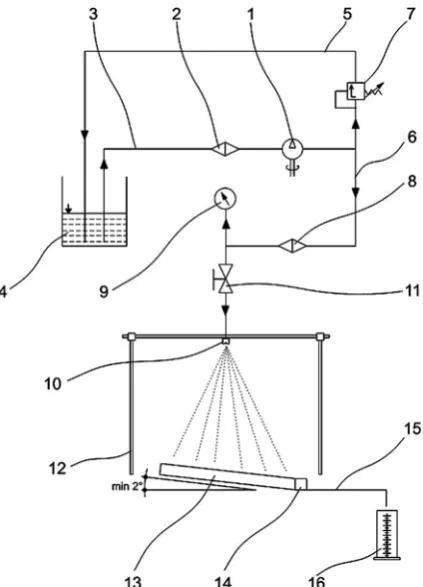
As the pressure water source, a pump aggregate (1) was used (Figure 3) with the flow rate of 2.4 m3/h at the delivery of 30 m. Over the whole measurement time, the spraying pressure was kept on the adjusted level through the manual pressure governor. That pressure governor is integrated in a distributor in the sprayer with outputs for three spraying sections. This composition allows to measure at three surfaces simultaneously. The sprinkler nozzle (10) is placed in the height of 1.0 m or 1.5 m above the measured surface centre limited by sheets (13) embedded into soil. The runoff water is concentrated in the pipe (15) by means of gravity sheet beneath the bottom edge of the measured surface. Water is led out of the spray-ing zone through the pipe to the removal vessel (14) or to the intake vessel placed on digital scales. The measured site is protected from wind by a canvas diaphragm and in the case of rain by a shed. The spraying pressure is continually controlled by using a manometer (9) in the accuracy class of ± 2%, which is placed in the stand in the height of the nozzle. The
simulated rain intensity range is set up by the spray-ing pressure regulation from 40 to 120 kPa.
Methods of measured area characterisation
The chosen site of measurement is characterised by the soil properties and soil surface parameters measured by standard procedures. Close to the measurement site, the soil samples from the top layer are taken off for the moisture and granular-Table 1. Specific kinetic energy of 1 mm rainfall in the device of RIAEng with nozzle Lechler 460 788 at spraying height of 1 m (evaluated from photograph record of drops trajectory at exposure of 0.02 s)
Nozzle spraying pressure (kPa)
Drop average trajectory within exposure time of 0.02 s
(mm)
Drop average speed
(m/s) Rainfall kinetic energy of 1 mm (J/m)
50 39.5 1.975 19.50
100 44.5 2.225 24.75
[image:3.595.67.535.84.165.2]150 47.0 2.350 27.61
Figure 3. Scheme of the device for water surface runoff with volume reading in calibrating cylinder
[image:3.595.306.518.348.642.2]ity determinations, Kopecky cylinders for the bulk density and porosity specifications. Just in the place of the measurement, inclinatic is determined us-ing a digital inclinometer in the gradient direction, soil surface roughness in the gradient direction is measured by the chain method (Klik et al. 2002), and the soil surface covering rate by crops and their remainders is evaluated by the method of picture analysis using digital photographs of the soil surface (Table 2). Besides the soil surface evaluation, we also utilise the supplementary characteristics of the soil structure - soil surface crust, crumbling structure, and surface dust layer.
Method of water surface run-off measuring
The described measuring procedure is considered as a method for the parallel evaluation of the moni-tored soil and the site factor effects on water soil infiltration. Different soil factors for the comparative measurement are prepared by intentional agro-tech-nical interventions in a part of one plot with a low
heterogeneity of the soil properties. To be able to observe the achieved change of the monitored factor also in a long-time period, the measured area coor-dinates are recorded by means of GPS receiver.
The simulated rain is defined by parameters – rain intensity and rainfall time. The amount of the water infiltrate in soil is calculated from the differences in the simulated rainfall (constantly adjusted rain intensity over the whole measuring time) and from the time course of the measured volume of water accumulative surface runoff from the measured surface.
Water from the surface runoff is scaled and filtered through filter paper. After drying, the weight of the washed away soil is determined and then converted to the surface unit for mutual comparison.
[image:4.595.68.531.84.214.2]Based on the evaluated results of the past years analyse a requirement resulted for monitoring the interval reduction in the initial phase of the water surface run-off. The manual reading in the measur-ing vessel was replaced by the investigation of the cumulative weight of water intake in the vessel by Table 2. Characteristic values of two compared surfaces before rain simulation at site with loosening depth 150 and 250 mm, loamy soil, Cox content in topsoil: 0.66%, emerged winter wheat 4–6 leaves
Site Inclination rate (°)
Soil surface roughness
(mm)
Depth (mm)
Soil moisture
(% wt)
Bulk density (g/cm3)
Total porosity
(% vol.)
Covering rate of measuring area with crop residua
(%)
Winter wheat
loosening 150 mm 3.2 36.21
0–50 11.2 1.44 45.5
0.1
50–100 8.3 1.44 45.3
100–150 6.8 1.52 42.3
Winter wheat
loosening 250 mm 2.6 24.57
0–50 9.8 1.36 48.6
0.2
50–100 9.6 1.40 46.9
100–150 7.9 1.51 42.7
[image:4.595.64.405.547.756.2]means of digital scales with communication output RS 232 into PC. In the PC, the measuring time and retained water weight are stored in memory in cho-sen intervals.
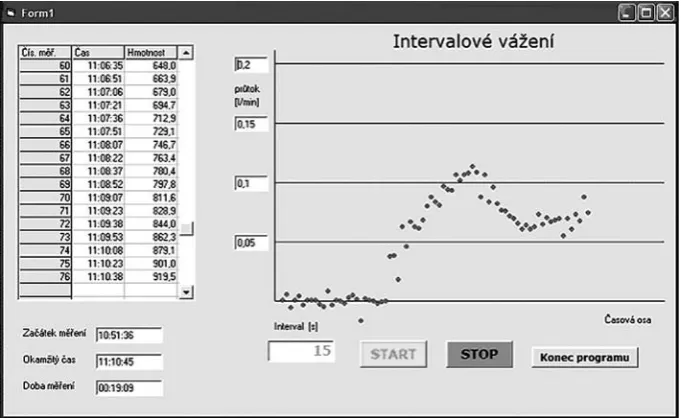
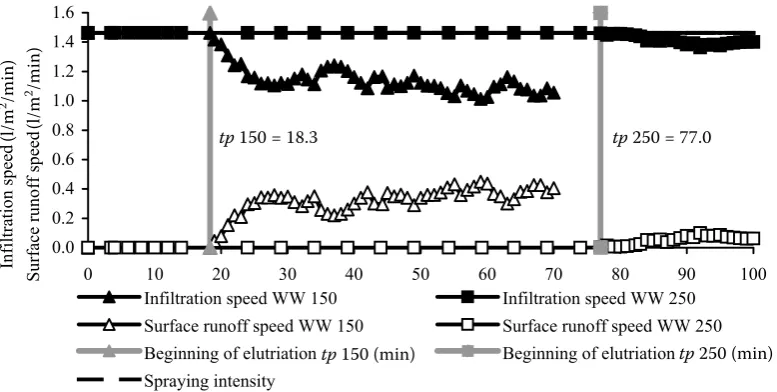
The program INVA was developed for the data transfer from the scales and their storing in PC memory. The program records the measuring date and time as well as the measured water weight. The advantage of the program advantage is the possibility to set-up the record interval from 1 to 999 s. It is nec-essary to display the weight values in some suitable graphical form for the control and visual evaluation of the water run-off measured. We chose the graphi-cal evaluation (Figure 4) where the water surface run-off is displayed. The water surface run-off speed is given by the volume running-off from 1 m2 during 1 min (1 m–2/min). The graphical illustration during measuring (Figure 4) enables to control the measur-ing course and monitormeasur-ing the water surface run-off beginning as well as to evaluate gradual stabilisation of the water surface run-off speed which is a signal for the measurement termination.
Results And dIscussIon
The method and examples of the evaluation processing realised are demonstrated with partial measurement results which serve only as a practi-cal illustration and cannot be used for any conclu-sions.
An example of the summarisation of winter wheat measured site characteristics with different technology for soil tillage before seeding is shown (Table 2).
In two parts of the plot with the granularity bound-ary of loamy-sandy soil, we monitored the effect of deep loosening on the water surface runoff and wa-ter erosion. In six previous years, the technology of
shallow tillage was applied on the plot. After the pre-crop harvest (winter rapeseed), a part of the plot was skimmed, with a disc tiller to the depth of 150 mm, and the other one was cultivated with a combined tiller Ecolo-Tiger to the depth of 250 mm. After the shedding of the pre-crop and weeds emerged, the second loosening followed to the depth of 120 mm performed by the disc tiller. There after the winter wheat seeding was carried-out with the drilling machine Pneusej equipped with drill counters, the seeding depth was of 40 mm. The infiltration meas-urement was conducted after the wheat emergence in the growth phase of 4–6 leaves.
An example of the results of water soil infiltration measurement in table
and graphical processing
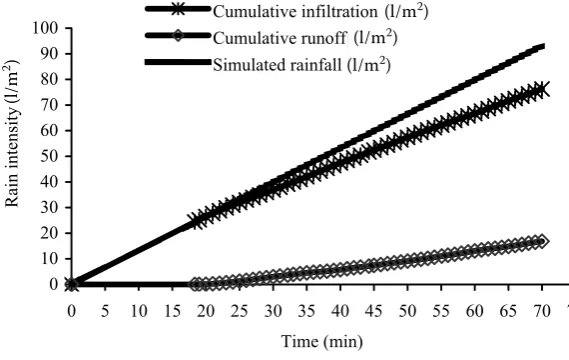
[image:5.595.66.351.578.758.2]Regarding the fact that the water surface run-off values are recorded in constant time intervals from the rainfall beginning, the cumulative surface runoff depending on time is the initial record type (Figure 5). The simulated rain intensity is constant during the whole measuring time and in graphical form it has a linear course starting at the beginning of the graph. The water surface runoff occurs after a certain time. That time is marked tp – the beginning of elutriation. Up to this moment, all water from the simulated rain infiltrates into the soil. From the beginning of elutriation, not all the water infiltrates into the soil but a part of it remains on the soil sur-face – i.e. elutriation begins and the water sursur-face runoff from the inclined plot occurs. All the values illustrated in the graph are converted into the surface unit to be mutually comparable between the vari-ants. No short-time changes are evident from their cumulative course (Figure 5) and there is no suitable way how to detect them. If the water cumulative
0 10 20 30 40 50 60 70 80 90 100
0 5 10 15 20 25 30 35 40 45 50 55 60 65 70 75
Time (min)
R
ai
n
in
te
ns
ity
(l
.m
–2 )
Cumulative infiltration[l.m-2] Cumulative runoff[l.m-2] Simulated rainfall [l.m-2]
Figure 5. An example of cumulative in-filtration and surface run-off courses in place with loosening depth of 150 mm, sandy-clay soil, content of Cox in top layer: 0.66%, emerged winter wheat 4 to 6 leaves
(l/
m
2)
(l/m2)
surface runoff values are low, they coincide with the x-coordinate and during the cumulative infiltration with the simulated rain course straight line. The be-ginning of elutriation, water cumulated infiltration in soil, and water cumulated surface runoff are the basic hydraulic properties of the site (Table 3).
For monitoring the changes regarding the de-scribed hydraulic properties of the soil, it is more suitable to express the volume of the infiltrated water and that flowing down from the surface in relation to the unit of surface and time (Figure 6). Such course gives clear speed changes of both functions from the beginning of elutriation tp and their gradual consoli-dation. If their values are not significantly changed over more than 10 minutes, the vertical motion of water in soil is considered stabilised and the meas-urement can be terminated. Under our conditions, such a situation occurs usually after 0.5–1.0 h of rainfalls. In the graphical display of the monitored phenomena speeds, the variants comparison is more telling with a higher conclusive ability.
conclusIons
To measure the infiltration speed under op-erational conditions we were equipped with a rain simulator with the measurement surface of 0.5 m2 and the rainfall intensity from 40 and 150 mm/h. The infiltration speed was determined from the defined rain intensity and the water surface runoff from the measured area. The water surface run-off from the measured surface is retained in the vessel on digital scales. Water weight is recorded automatically in regular time intervals during the whole measuring time into the connected PC. The time of the begin-ning of the water run-off from the measured area gives the starting time of elutriation (tp). The water soil infiltration speed stabilisation is the decisive criterion for the measurement termination.
[image:6.595.65.531.85.183.2]The defined characteristics of rainfalls, defined soil and description parameters of the site of the elutria-tion beginning, water surface run-off speed, and water soil infiltration are mutually comparable factors. Table 3. Measured values of water cumulative infiltration and surface runoff in points with different loosening depth 150 and 250 mm, loamy soil, emerged winter wheat 4–6 leaves
Site Measuring time (h)
Spraying pressure
(kPa)
Simulated rain (mm/h)
Beginning of elutriation tp
(min)
Cumulative infiltration
(l/m2)
Cumulative surface
runoff (l/m2)
Soil sediment
loss (g/m2/h) Winter wheat
loosening 150 mm 1.17 100 87.8 18.33 76.24 16.87 4.94
Winter wheat
loosening 250 mm 1.67 100 87.8 17.00 131.80 1.22 0.14
Figure 6. An example of infiltration and water surface run-off speed in two places with loosening depth of 150 and 250 mm, sandy-clay soil, emerged winter wheat 4–6 leaves
0.0 0.2 0.4 0.6 0.8 1.0 1.2 1.4 1.6
0 10 20 30 40 50 60 70 80 90 100
Time [min]
In
fil
tra
tio
n
sp
ee
d
(l.
m
-2
.m
in
–1 )
Su
rf
ac
e
ru
no
ff
sp
ee
d
(l.
m
-2
.m
in
–1 )
Infiltration speed WW 150 Infiltration speed WW 250 Surface runoff speed WW 150 Surface runoff speed WW 250 Beginning of elutriation tp150 [min] Beginning of elutriation tp250 [min] Spraying intensity
tp 150 = 18.3 tp 250 = 77.0
(l/
m
2/m
in
)
(l/
m
2/m
in
)
[image:6.595.91.480.527.723.2]References
Janeček M. et al. (2002): Protection of Agricultural Soil from Erosion. ISV, Praha. (in Czech)
Klik A., Kaitana R., Badraoui M. (2002): Desertifica-tion hazard in a mountainous ecosystem in the high Atlas region, Marocco. In: 12th ISCO Conference. Beijing, 636–644.
Kutílek M. (1978): Soil Science in Water Management. SNTL, Praha. (in Czech)
Titi E.A. (2002): Soil Tillage in Agroecosystems. CRC Press, Boca Raton.
Received for publication October 30, 2007 Accepted after corrections February 1, 2008
Corresponding author:
Ing. Pavel Kovaříček, CSc., Výzkumný ústav zemědělské techniky, v.v.i., Drnovská 507, 161 01 Praha 6-Ruzyně, Česká republika
tel.: + 420 233 022 236, e-mail: [email protected]
Abstrakt
Kovaříček P., Šindelář R., Hůla J., Honzík I. (2008): Měření infiltrace vody do půdy metodou simulace deště. Res. Agr. Eng., 54: 123–129.
Pro měření rychlosti infiltrace v provozních podmínkách byl sestrojen simulátor deště s měřicí plochou 0,5 m2.
Rych-lost infiltrace určujeme z definované intenzity deště a povrchového odtoku vody z měřicí plochy. Hmotnost zachy-cené vody z povrchového odtoku se zaznamenává v pravidelném časovém intervalu po celou dobu měření. Počátek odtoku vody z měřicí plochy udává čas počátku výtopy. Doba měření se ukončí po ustálení rychlosti infiltrace. Počá-tek výtopy a ustálená rychlost infiltrace jsou pro definované půdní vlastnosti na měřicím stanovišti charakteristický-mi a vzájemně porovnatelnýcharakteristický-mi parametry.