The concentrations of soluble forms of heavy metals in soil are mostly determined by their total content and soil processes. Soil organic matter and pH are the key factors affecting the content and mobility of heavy metals in soil (Soliman et al. 1992, Martinez and Motto 2000, Borůvka and Drábek 2004, Šichorová et al. 2004). Another important consideration is human activity which contributes to soil contamination in some regions of Poland, thus leading to changes in the natural heavy metals content. In the 1980’s SO2 emissions in Poland were at about Gg/year, which provided an average of 132.1 kg of SO2/ha during the year. In 2006, SO2 emissions were reduced to 1195 Gg/ year, i.e. 38.3 kg of SO2/ha CSO (2008).
According to many authors (Nederlof and Riemsolijk 1995, Temminghoff et al. 1997), the toxicity of heavy metals and their availability to plants increase due to soil acidification caused by sulfur deposition. In a study by Kayser et al. (2000), the application of elemental sulfur and a decrease in soil pH increased the solubility of heavy metals.
Some elements, including zinc and copper, pre-cipitate as sulfides and sulfates, to produce forms that are relatively immobile in the soil profile (Kabata-Pendias and Pendias 1992). Cadmium, on the other hand, can form inorganic ligands with S-SO42– (McLaughlin et al. 1996).
Direct and residual effect of sulfur fertilization on changes in the heavy metal content of soil has to be taken into account in environmental analy-ses in agricultural areas, including environmental impact assessments and predictions.
The purpose of the present study was to deter-mine the effect of fertilization with increasing rates of sulfur applied in the form of sulphates and as elemental sulfur on the natural content of heavy metals in soil at the depth 0–40 cm and 40–80 cm.
MATERIAL AND METHODS
A three-year field experiment was conducted from 2000 to 2002, in North-East Poland. The
The effect of different sulfur doses and forms on changes
of soil heavy metals
M. Skwierawska
1, L. Zawartka
1, A. Skwierawski
2, A. Nogalska
11
Departament of Agricultural Chemistry and Environmental Protection, University
of Warmia and Mazury in Olsztyn, Olsztyn, Poland
2
Chair of Land Reclamation and Management, University of Warmia and Mazury
in Olsztyn, Olsztyn, Poland
ABSTRACT
A three-year field experiment was conducted in North-East Poland. Each year three sulfur fertilization rates in the form of sulphate (S-SO42–) and pure (S–S0) sulfur were applied: 40, 80, and 120 kg/ha. After the third year of the study, the application of sulfate and elemental sulfur decreased the zinc content of 0–40 and 40–80 cm soil layers, as compared with soil sampled before the experiment. Over the entire experimental period, sulfur fertilization had no significant effect on changes in the natural copper content of soil at a depth of 0–40 and 40–80 cm. Manganese concentrations remained at a similar level at a soil depth of 0–40 cm. The manganese content of the 40–80 cm soil layer was substantially lower than in the 0–40 cm horizon. An insignificant increase in the lead content of soil was observed. The applied doses of sulfate and elemental sulfur led to an increase in the cadmium content of soil depth of 0–40 cm. Sulfur fertilization contributed to a decrease in the nickel content of soil. The applied doses of sulfate and elemental sulfur exerted a stronger effect in the 0–40 cm soil layer than in the 40–80 cm horizon.
village is distant from larger industrial plants which emit sulfur compounds and lies far from any big cities. The concentration of sulfur in the soil was not caused by human activity.
The trial was set up on Dystric Cambisols (FAO), of the granulometric composition of heavy loamy sand. The initial soil had the following properties: pHKCl = 5.30, mineral nitrogen 24.0, sulphate sulfur 4.10, available phosphorus 34.5 and potassium 110.0 mg/kg of soil. The annual rates of sulphate sulfur (S-SO42–-S) and elemental sulfur (S0-S) were: S1 – 40, S2 – 80 and S3 – 120 kg/ha. Air-dry soil was passed through a 1 mm mesh sieve. The soil samples were used to determine soil pH in 1 mol KCl (the ratio between soil and extraction 1:2.5); total sulfur (Butters and Chenery 1959) and S-SO42–
with the turbidimetric method (the ratio between soil and extraction 1:3); N-NO3– by colorimetry using phenyl disulphonic acid (the ratio between soil and extraction 1:5); N-NH4+ was determined using the Nessler’s reagent (the ratio between soil and extraction 1:5); available phosphorus and potassium was determined with the Enger Riehm’s method (DL) – (the ratio between soil and extraction 1:50) – (Panak 1997).
The permanent experiment was established in a random block design and consisted of eight fertilization treatments with four replications: (1) unfertilized control; (2) NPK; (3) NPK + S1-SO4; (4) NPK + S2-SO4; (5) NPK + S3-SO4; (6) NPK + S1-S0; (7) NPK + S
2-S0; (8) NPK + S3-S0.
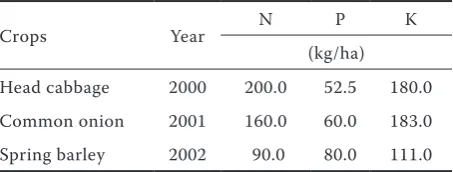
Nitrogenin the form ofammonium nitrateor am-monium sulphate, phosphorusin the form oftriple superphosphate, potassiumin the form ofpotassium saltof 60% orin the form of potassium sulphate, sulfurin the form ofpotassium sulphate and am-monium sulphatesupplementationaswell as inthe form ofelemental sulfur. The NPK rates (Table 1) depended on the crop species and soil fertility.
Soil samples were collected from each plot, at 0–40 and 40–80 cm depths, prior to the establish-ment of the trials, after each harvest and before sowing the consecutive crop. Air-dry soil was passed through a 1 mm mesh sieve. The soil samg-ples were used to determine the concentrations: Zn, Cu, Mn, Pb, Cd, and Ni in soil (extractions with 1 mol HCl/dm3, the ratio between soil and extraction – 1:10) was determined by AAS method using Schimadzu AA apparatus (model AA-6800, Kyoto, Japan).
The results of the yields and chemical analysis of soil were processed statistically with the analysis of variance for a two-factor experiment in a random block design, using the form of sulfur as factor a
and rate of sulfur as factor b. Additional statisti-cal analyses were performed with the software package Statistica 6.0 PL, to carry out analysis of regression with the Duncan’s tests with an aim of determining statistical differences between sets of data.
RESULTS AND DISCUSSION
Soil pH. Results ofsoil reaction changes after sulfur fertilizationare presentedin the publication by Skwierawska et al. (2008a).
During the three years of the experiment, sul-phate and elementary sulphur addition had a sig-nificant effect on changes in the soil pH at the depth of 0–40 cm. The rate of 120 kg S-SO42–/ha and S-S0 caused a significant decline in the soil pH versus the control object. At the deeper layer of soil (40–80 cm) the soil pH was in general more even and lower than in the top soil layer in the analogous objects.
Rate 120 kg S-SO42–/ha and S-S0 depressed soil pH in the 0–40 cm soil horizon. Acidification of soil caused by S-SO42– became evident already in the first year of the trials, while that produced by S-S0 did not occur until the third year. The influence of sulphur on soil pH at the depth of 40–80 cm was irregular.
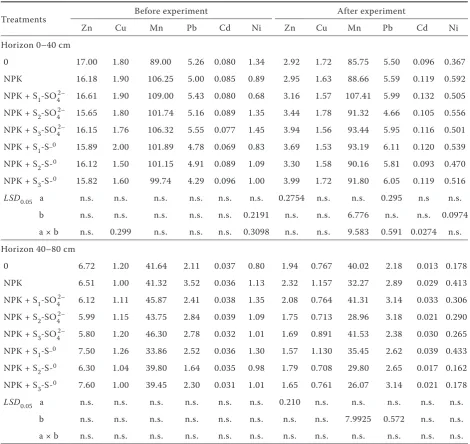
Zinc. Changes in the natural heavy metal content of soil fertilized with sulfate and elemental sulfur at a dose of 40, 80, and 120 kg/ha were studied over a three-year period (Table 2). Before the experi-ment, zinc concentrations ranged from 15.65 to 17.00 mg/kg in the 0–40 cm soil layer, and from 5.80 to 7.60 mg/kg in the 40–80 cm horizon.
[image:2.595.305.532.666.752.2]At the end of the experiment, zinc concentra-tions in the 0–40 cm soil layer ranged from 2.92 to 3.99 mg/kg, irrespective of sulfur doses, and they were generally considerably lower than in the corresponding treatments in the first and second year of the study. This could be due to in-creased bioavailability of zinc. Kayser et al. (2001) demonstrated that the application of elemental sulfur increased zinc solubility in the soil and
Table 1. NPK rates applied in the trials
Crops Year N P K
(kg/ha)
-utilization by plants. Kaya et al. (2009) reported that the application of sulfur and sulfur-containing waste resulted in decrease in soil pH, but it also increased the concentrations of nutrients available to plants, such as Zn, Cu and Mn. Different results were obtained by Abdou et al. (2011) who did not observe an increase in zinc availability to plants as a result of elemental sulfur fertilization. In the present study, zinc concentrations were lower in the 40–80 cm soil layer than in the 0–40 cm horizon, and they were significantly affected only by sulfur form. Elemental sulfur contributed to a higher decrease in zinc levels in the soil.
Copper. Before the experiment, the copper con-tent of the 0–40 cm soil layer remained at a stable
level in all treatments (Table 2). Copper concen-trations tended to increase in the treatment with a single dose of elemental sulfur. In the 40–80 cm horizon, copper content ranged from 1.00 to 1.26 mg/kg soil.
[image:3.595.63.534.85.529.2]In the first year of the study, sulfur fertiliza-tion had no significant effect on changes in the copper content of soil. In the second year, cop-per concentrations increased in the 0–40 cm soil layer, relative to the NPK treatment, in particular after sulfate application. This could result from changes in soil pH. Sulfur decreases soil pH and increases the solubility, availability and mobility of heavy metals (Tichý et al. 1997, Seidel et al. 1998, Kayser et al. 2000, Martinez et al. 2000, Cui
Table 2. Effect of different rates and forms of sulphur on heavy metals content in the soil layers at 0–40 and 40–80 cm depths, before and after experiment (mg/kg soil)
Treatments Before experiment After experiment
Zn Cu Mn Pb Cd Ni Zn Cu Mn Pb Cd Ni
Horizon 0–40 cm
0 17.00 1.80 89.00 5.26 0.080 1.34 2.92 1.72 85.75 5.50 0.096 0.367 NPK 16.18 1.90 106.25 5.00 0.085 0.89 2.95 1.63 88.66 5.59 0.119 0.592 NPK + S1-SO42– 16.61 1.90 109.00 5.43 0.080 0.68 3.16 1.57 107.41 5.99 0.132 0.505 NPK + S2-SO42– 15.65 1.80 101.74 5.16 0.089 1.35 3.44 1.78 91.32 4.66 0.105 0.556 NPK + S3-SO42– 16.15 1.76 106.32 5.55 0.077 1.45 3.94 1.56 93.44 5.95 0.116 0.501 NPK + S1-S_0 15.89 2.00 101.89 4.78 0.069 0.83 3.69 1.53 93.19 6.11 0.120 0.539 NPK + S2-S-0 16.12 1.50 101.15 4.91 0.089 1.09 3.30 1.58 90.16 5.81 0.093 0.470 NPK + S3-S-0 15.82 1.60 99.74 4.29 0.096 1.00 3.99 1.72 91.80 6.05 0.119 0.516 LSD0.05 a n.s. n.s. n.s. n.s. n.s. n.s. 0.2754 n.s. n.s. 0.295 n.s n.s. b n.s. n.s. n.s. n.s. n.s. 0.2191 n.s. n.s. 6.776 n.s. n.s. 0.0974 a × b n.s. 0.299 n.s. n.s. n.s. 0.3098 n.s. n.s. 9.583 0.591 0.0274 n.s. Horizon 40–80 cm
0 6.72 1.20 41.64 2.11 0.037 0.80 1.94 0.767 40.02 2.18 0.013 0.178 NPK 6.51 1.00 41.32 3.52 0.036 1.13 2.32 1.157 32.27 2.89 0.029 0.413 NPK + S1-SO42– 6.12 1.11 45.87 2.41 0.038 1.35 2.08 0.764 41.31 3.14 0.033 0.306 NPK + S2-SO42– 5.99 1.15 43.75 2.84 0.039 1.09 1.75 0.713 28.96 3.18 0.021 0.290 NPK + S3-SO42– 5.80 1.20 46.30 2.78 0.032 1.01 1.69 0.891 41.53 2.38 0.030 0.265 NPK + S1-S_0 7.50 1.26 33.86 2.52 0.036 1.30 1.57 1.130 35.45 2.62 0.039 0.433 NPK + S2-S-0 6.30 1.04 39.80 1.64 0.035 0.98 1.79 0.708 29.80 2.65 0.017 0.162 NPK + S3-S-0 7.60 1.00 39.45 2.30 0.031 1.01 1.65 0.761 26.07 3.14 0.021 0.178 LSD0.05 a n.s. n.s. n.s. n.s. n.s. n.s. 0.210 n.s. n.s. n.s. n.s. n.s. b n.s. n.s. n.s. n.s. n.s. n.s. n.s. n.s. 7.9925 0.572 n.s. n.s. a × b n.s. n.s. n.s. n.s. n.s. n.s. n.s. n.s. n.s. n.s. n.s. n.s.
et al. 2004). In a study by Takáč et al. (2009), the content of mobile copper forms in the soil was not significantly affected by soil pH.
In the third year of the study, at the end of the experiment, copper concentrations in the 0–40 cm soil layer were comparable, regardless of sulfur forms and doses. A decrease in copper content was noted, compared with soil samples collected before the experiment. A similar trend was ob-served in the 40–80 cm horizon, which could be due to copper uptake by plants (Skwierawska et al. 2008b). Kaya et al. (2009) reported that increased application of sulfur and sulfur-containing waste led to a significant increase in the average copper content of plants. In the present study, over the entire experimental period, sulfur fertilization had no significant effect on changes in the copper content of soil at a depth of 0–40 and 40–80 cm.
Manganese. One of the adverse effects of sulfur contamination is an increase in manganese solu-bility and the mobilization of heavy metals from both natural and anthropogenic sources (James and Riha 1984). Before the experiment, the man-ganese content of both soil horizons remained stable (Table 2). Manganese concentrations were substantially lower in the 40–80 cm horizon than in the top layer.
In the autumn, after the third year of the study, the manganese content of the 0–40 cm soil layer ranged from 85.75 to 107.41 mg/kg. Form of sulfur had no effect on changes in manganese concentra-tions in the soil. The application of 40 kg sulfur contributed to an increase in manganese content, compared with higher sulfur doses. Sulfate and elemental sulfur fertilization increased manganese concentrations in the soil, in comparison with the control treatments. The manganese content of the 40–80 cm horizon was considerably lower than in the surface layer, and it was not significantly affected by sulfur form. Manganese depletion was observed, relative to the corresponding treat-ments before the experiment. In a study by Erdal et al. (2004), the application of elemental sulfur in combination with nitrogen fertilizers substantially increased the bioavailability soil heavy metals, in particular manganese. Lošák et al. (2011) describe that individual nitrogen fertilization did not reduce the content of manganese in the plant or grain of maize. According to Abdou et al. (2011), sulfur fertilization has a minor effect on manganese availability.
Over a three-year period, manganese concentra-tions in the 0–40 cm soil layer remained stable, but were lower than in soil samples collected before the
experiment. The only exception was the treatment fertilized with 40 kg S-SO42–-S, where manganese content was higher than in the other treatments. This trend was maintained throughout the study. In the 40–80 cm layer, manganese concentrations were considerably lower than in the 0–40 cm hori-zon. The highest manganese content was observed in the treatment with a triple sulfate dose whose effect was noticeable over the entire experimental period. This could result from change in soil pH from acidic to highly acidic (Skwierawska et al. 2008a), which increased the content of readily available manganese.
Lead. Before the experiment, the lead content of soil samples collected at a depth of 0–40 cm and 40–80 cm was similar (Table 2).
In the second year of the study, sulfur fertilization had no significant effect on changes in the lead content of both sampled horizons (0–40 cm and 40–80 cm). The lead content of the 40–80 cm soil layer was considerably lower than in the 0–40 cm horizon, in the corresponding treatments. Similar results were obtained by Šichorová et al. (2004), in the cited study, lead concentrations decreased with increasing soil depth.
At the end of the experiment, the lead content of the 0–40 cm horizon ranged from 4.66 to 6.11 mg/ kg soil, and it was significantly affected by sulfur form. A minor increase in lead concentrations was observed. Terelak et al. (1996) found that sulfur-contaminated soils are characterized by increased bioavailability and accumulation of Mn, Cd, and Pb in crops. Similar findings were reported by Holoah et al. (2010) – increasing doses of elemental sulfur caused a significant increase in lead content and uptake by plants. In our study, lead concentrations were lower in the 40–80 cm layer than in the 0–40 cm horizon, and they were significantly affected only by sulfur dose.
natural cadmium content of soil, observed during a three-year period, were irregular. No distinct trends were noted in response to sulfate and el-emental sulfur fertilization. As demonstrated by McLaughlin et al. (1998), an increase in Na2SO4 doses is followed by an increase in the concentra-tions of active cadmium forms in the soil solution. Such an increase was also noted by Kayser et al. (2001) as a result of elemental sulfur application.
Nickel. Before the experiment, the nickel content of the 0–40 cm soil layer varied widely, from 0.68 to 1.45 mg/kg. In the first year of the study, the nickel content of the 0–40 cm horizon increased with increasing sulfate doses (Table 2). Sulfate sulfur exerted a stronger effect than elemental sulfur. The experimental factors had no significant influence on changes in nickel concentrations in the 40–80 cm soil layer.
At the end of the experiment, the nickel content of the 0–40 cm soil layer ranged from 0.367 to 0.592 mg/kg. Nickel depletion was observed, in comparison with the previous two years, probably due to increased nickel uptake by plants. Our results corroborate the findings of Holah et al. (2010). Sulfur fertilization had no significant influence on changes in nickel concentrations in the 40–80 cm horizon. However, a steady decrease in the nickel content of soil was noted, compared with the cor-responding treatments in the past two years.
REFERENCES
Abdou A.S., Al Darwish F.H., Saleh M.E., El-Tarabily K.A., Sofian-Azirun M., Monitor R.M. (2011): Effects of elemental sulfur, phosphorus, micronutrients and Paracoccus versutus on nutri-ent availability of calcareous soils. Australian Journal of Crop Science, 5: 554–561.
Basta N.T., Ryan J.A., Chaney R.L. (2005): Trace element chemistry in residual-treated soil: Key concepts and metal bioavailability. Journal of Environmental Quality, 34: 49–63.
Borůvka L., Drábek O. (2004): Heavy metal distribution between fractions of humic substances in heavily polluted soils. Plant, Soil, Environment, 50: 339–345.
Butters B., Chenery E. (1959): A rapid method for the determina-tion of the total sulfur in soils and plants. Analyst, 84: 239–286. CSO (2008): Environment 2008. Central Statistical Office of
Poland, Warszawa, 555. (In Polish)
Cui Y., Dong Y., Li Kaifeng, Wang Q. (2004): Effect of elemental sulfur on solubility of soil heavy metals and their uptake by maize. Environmental International, 30: 323–328.
Erdal I., Kepenek K., Kizilgoz I. (2004): Effect of foliar iron ap-plications at different growth stages on iron and some nutri-ent concnutri-entrations in strawberry cultivars. Turkish Journal of Agriculture and Forestry, 28: 421–427.
Holah Sh.Sh., Kamel M.M., Taalab A.S., Hanan S. Siam, Eman A. Abd El-Rahman (2010): Effect of elemental sulfur and peanut compost on the uptake of Ni and Pb in bazil and peppermint plants grown in polluted soil. International Journal of Academic Research, 2: 211–219.
James B.R., Riha S.J. (1984): Soluble aluminium in acidified or-ganic horizons of forest soils. Canadian Journal of Soil Science, 64: 637–646.
Kabata-Pendias A., Pendias H. (1992): Trace Elements in Soils and Plants. 2nd Edition. CRC Press Inc, Boca Raton, Florida.
Kaya M., Küçükyumuk Z., Erdal I. (2009): Effects of elemental sulfur and sulfur-containing waste on nutrient concentrations and growth of bean and corn plants grown on calcareous soil. African Journal of Biotechnology, 8: 448–449.
Kayser A., Schroder T.J., Grunwald A., Schulin R. (2001): Solu-bilization and plant uptake of zinc and cadmium from soils treated with elemental sulfur. International Journal of Phy-toremediation, 3: 381–400.
Kayser A., Wenger K., Veller A., Attinger W., Felix H.R., Gupta S.K. (2000): Enhancement of phytoextraction of Zn, Cd and Cu from calcareous soil: the use of NTA and sulfur amendments. Environmental Science and Technology, 34: 1778–1783. Lošák T., Hlušek J., Martinec J., Jandák J., Szostkova M., Filipčík
R., Maňásek J., Prokeš K., Peterka J., Varga L., Ducsay L., Orosz F., Martensson A. (2011): Nitrogen fertilization does not affect micronutrient uptake in grain maize (Zea mays L.). Acta Agricul-turae Scandinavica, Section B – Plant Soil Science, 61: 543–550. Martinez C.E., Motto H.L. (2000): Solubility of lead, zinc of copper
added to mineral soils. Environmental Pollution, 107: 153–158. McLaughlin M.J., Lambrechts R.M., Smolders E., Smart M.K. (1998): Effects of sulfate on cadmium uptake by Swiss chard: II. Effects due to sulfate addition to soil. Plant and Soil, 202: 217–222.
McLaughlin M.J., Tiller K.G., Neidu R., Stewens D.G. (1996): Re-view: The behavior and environmental impact of contaminants in fertilizers. Australian Journal of Soil Research, 34: 1–54. Nederlof M.M., van Riemsdijk W.H. (1995): Effect of natural
organic matter and pH on the bioavailability of metal ions in soils. In:Huang P.M., Berthelin J., Bollag J.M., McGill W.B., Page A.L.(eds): Environmental Impact of Soil Component Interactions. CRC, Boca Raton, USA, 73–84.
Panak H. (eds) (1997): Methodical Guide to Agricultural Chem-istry. University of Agriculture and Technology, Olsztyn. (In Polish)
Seidel H., Ondruschka J., Morgenstern P., Stottmeister U. (1998): Bioleaching of heavy metals from contaminated aquatic sedi-ments using a feasibility study. Water Science and Technology, 37: 387–394.
Šichorová K., Tlustoš P., Száková J., Kořínek K., Balík J. (2004): Horizontal and vertical variability of heavy metals in the soil of a polluted area. Plant, Soil, Environment, 50: 523–534. Skwierawska M., Zawartka L., Zawadzki B. (2008a): The effect
Skwierawska M., Zawartka L., Zawadzki B. (2008b): The effect of different rates and forms of applied sulfur on nutrient composi-tion of planted crops. Plant, Soil and Environment, 54: 179–189. Soliman M.F., Kostandi S.F., Beusichem van M.L. (1992): Influence
of sulfur and nitrogen fertilizer on the uptake of iron, manga-nese and zinc by corn plants grown in calcareous soil. Com-munications in Soil Science and Plant Analysis, 23: 1289–1300. StatSoft, INC (2001): Statistica (data analysis Software system),
version 6. Available at: www.statsoft.com
Takáč P., Szabová T., Kozáková Ľ., Benková M. (2009): Heavy metals and their bioavailability from soils in the long-term polluted Central Spiš region of SR. Plant, Soil and Environe-ment, 55: 167–172.
Temminghoff E.J.M., van der Zee S.E.A.T.M., de Hean F.A.M. (1997): Copper mobility in a copper contaminated sandry soil
as affected by pH and solid and dissolved organic matter. En-vironmental Science and Technology, 31: 1109–1115. Terelak H., Motowicka-Terelak T., Stuczyński T. (1996): Direct
and residual effects sulfur pollution on the acidity of a loamy soil. Applied Geochemistry, 11: 371–373.
Tichý R., Feitl J., Kuzel S., Kolar L. (1997): Use of elemental sulfur to enhance a cadmium solubilization and its vegetative removal from contaminated soil. Nutrient Cycling in Agroecosystems, 46: 249–255.
Zhao X.L., Masaihiko S. (2007): Fractionation and solubility of cadmium in paddy soils amended with porous hydrated cal-cium silicate. Journal of Environmental Sciences, 19: 343–347.
Received on November 2, 2011
Corresponding author:
Dr. Ing. Małgorzata Skwierawska, University of Warmia and Mazury in Olsztyn, Department of Agricultural Chemistry and Environmental Protection, ul. Oczapowskiego 8, 10-718 Olsztyn, Poland