© 2019, IRJET | Impact Factor value: 7.211 | ISO 9001:2008 Certified Journal
| Page 5005
Brain MRI Image Processing & Prediction of Cancer Stage
Including 3D Plotting & Segmentation
Gufran Baig
1, Krishna
2, Keshav Kishore
3, Madhura Sanap
41,2,3
Student, Department of Computer, Sinhgad Academy of Engineering, Pune, India
4Professor, Department of Computer, Sinhgad Academy of Engineering, Pune, India
---***---Abstract - Brain tumor segmentation is an important task
in medical image processing. Early diagnosis and detection of brain tumors plays an important role in improving treatment possibilities and increases the survival rate of the patients. Manual segmentation of the brain tumors for cancer diagnosis, from large amount of MRI images generated in clinical routine, is a difficult and time-consuming task.Automatic segmentation using deep learning methods proved popular because it can achieve results much faster and can address this problem better than other methods. Deep learning methods can also enable efficient processing and accurate evaluation of the large amounts of MRI-based image data
. We
are also representing the tumor in a 3D shape, which will
help doctors to analyze the type and size of the cancer.
Keywords: CNN, Magnetic Resonance Imaging,
Segmentation, Image Processing, 3D Plotting, Deep Learning, Brain Tumor
1.INTRODUCTION
Cancer can be defined as the uncontrolled, unnatural growth and division of the cells in the body. Occurrence, as a mass, of these unnatural cell growth and division in the brain tissue is called a brain tumor. Gliomas are type of brain tumors that originate from the cells. Gliomas are the main type of tumor on which most researchers focuses on. Glioma is a general term that is used to describe different types of gliomas ranging from low-grade gliomas like astrocytoma’s and oligodendroglia’s to the high grade (grade IV) glioblastoma multiform (GBM), which is the most aggressive and the most common primary malignant brain tumor.
There are various Imaging techniques which is used to provide the information about these Gliomas Brain tumor, such as Computed Tomography (CT), Magnetic Resonance
Spectroscopy (MRS) and Magnetic Resonance Imaging (MRI)
are all used to provide valuable information about shape, size, location and metabolism of brain tumors assisting in diagnosis. Among these Imaging techniques MRI are used due to its good soft tissue contrast and widely availability.
1.1 MRI Modalities
Images of different MRI sequences are generated by altering excitation and repetition times during image acquisition. These different MRI modalities produce different types of tissue contrast images, thus providing valuable structural information and enabling diagnosis and segmentation of tumors along with their sub regions.
Four standard MRI modalities used for glioma diagnosis include following:
T1-weighted MRI (T1)
T2-weighted MRI (T2)
T1-weighted MRI with gadolinium contrast
enhancement (T1-Gd)
Fluid Attenuated Inversion Recovery (FLAIR).
2. LITERATURE SURVEY
[1]R.DHANASEKARAN, Syed Ammal: MRI is useful in neurological(brain), musculoskeletal, and oncological (cancer) imaging because it offers much greater contrast between the diverse soft tissues of the body than the computer tomography (CT).
MRI is different from CT, it does not use ionizing radiation, but uses an effective magnetic field to line up the nuclear magnetization of hydrogen atoms in water in the body.
[2]
Anitha & S.Gowsalya PG Scholar: Convolutional
networks were inspired by biological processes and are
variations of multilayer perceptron is designed to use
minimal amounts of preprocessing & the memory
requirement is drastically reduced.
[3]Samer Hijazi: The lack of dependence on prior
knowledge and human effort in designing features is a
major advantage for CNNs.
© 2019, IRJET | Impact Factor value: 7.211 | ISO 9001:2008 Certified Journal
| Page 5006
[4]Sayali Lopes & Deepak Jayaswal: Implementation ofvarious steps of detecting and extracting the tumor from the 2D slices of MRI brain images by Seeded region growing technique along with automatic seed selection and designing software for reconstructing 3D image from a set of 2D tumor images.
The 3D visualization of the tumor data helps in better understanding of the topology and the shape of the tumor.
[5]Evangelia I. Zacharaki, Sumei Wang, Sanjeev, Chawla, Dong Soo Yoo, Ronald Wolf,a Elias R. Melhem, and Christos Davatzikos: The use of pattern classification methods for distinguishing different types of brain tumors, such as primary gliomas from metastases, and also for grading of gliomas.
3. OBJECTIVE
Automatic segmentation of the brain tumors for cancer diagnosis is a challenging task. Recently, availability of public datasets and the well-accepted BRATS benchmark provided a common medium for the researchers to develop and objectively evaluate their methods with the existing techniques.
In this paper, we provided a review of the state-of-the-art methods based on deep learning, and a brief overview of traditional techniques.
With the reported high performances, deep learning methods can be considered as the current state-of-the-art for glioma segmentation.
In traditional automatic glioma segmentation methods, translating prior knowledge into probabilistic maps or selecting highly representative features for classifiers is challenging task.
However, convolution neural networks (CNN) have the advantage of automatically learning representative complex features for both healthy brain tissues and tumor tissues directly from the multi-modal MRI images.
Future improvements and modifications in CNN architectures and addition of complementary information from other imaging modalities such as Positron Emission Tomography (PET), Magnetic Resonance Spectroscopy (MRS) and Diffusion Tensor Imaging (DTI) may improve the current methods, eventually leading to the development of clinically acceptable automatic glioma segmentation methods for better diagnosis.
4.
METHODOLOGY
4.
1 PROPOSED SYSTEM
The neural network is mainly used for vector quantization, approximation, data clustering, pattern matching, optimization functions and classification techniques. The neural network is divided into three types based on their interconnections.
Three type neural networks are feedback, feed forward and recurrent network. The Feed Forward Neural network is further divided into single layer network and multilayer network. In the single layer network, the hidden layer is not presented. But it contains only input and output layer. However, the multilayer consists of input layer, hidden layer and output layer.
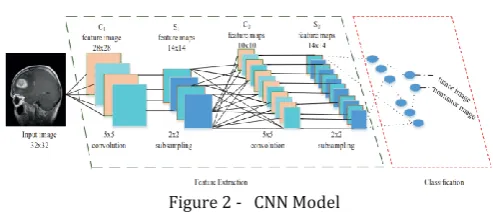
The Convolution Neural Network (CNN) consists of input layer, convolution layer, Rectified Linear Unit (ReLU) layer, pooling layer and fully connected layer. Pooling layer is optional. We can use or skip. However the pooling layer is mainly used for down sampling. In the final layer (i.e) fully connected layer is used to generate the class score or label score value based on the probability in-between 0 to 1. It has three
phases:-1. Pres-processing MRI Images
2. Training The Model (CNN)
3. classification via CNN (Prediction)
Figure 1 - System Architecture
4.1.1Pre-processing MRI Images
© 2019, IRJET | Impact Factor value: 7.211 | ISO 9001:2008 Certified Journal
| Page 5007
different reasons for the same MRI sequence. In order to
make the contrast and intensity range similar we use
intensity normalization method to remove the noise from
the image.
4.1.2Training the CNN
Figure 2 - CNN Model
For classification of the brain MRI images CNN Feed
forward Model in used. Once images are per-processed in
previous steps, images can be feed ed to the CNN model
for training the model. Training dataset has associated
image Pixel Data and its class label i.e. (Grade I,II,III,IV).
4.1.3Evaluation/Testing CNN
Model:-For evaluating the CNN model, trained model is used
which is generated and saved into the disk for usage. It
contains the Trained Model Graph. Before feeding an
image to the CNN model it is pre-processed and then feed
ed to CNN model for prediction. Test data only contains
the Pixel Data of image, it does not have labels associated
with them.
4.
2 IMAGE PROCESSING
4.2.1 Data Acquisition
According to the World Health Organization (WHO) classification system to identify brain tumors, there are more than 120 types of brain tumors which differ in origin, location, size, characteristics of the tumor tissues[6],[7]. In this paper we were concerning with three types of malignant tumors which are:
Glioblastoma: primary malignant brain tumors
that are classified as Grade IV and developed from star-shaped cells, called astrocytes that support nerve cells. It usually starts in the cerebrum.
Sarcoma: has different grades that vary from grade
I to grade IV and it arises in the connective tissues like blood vessels.
Metastatic bronchogenic carcinoma: secondary
malignant brain tumors that was spread to the brain from bronchogenic carcinoma lung tumor.
The dataset consists of 66 real human brain MRIs with 22 normal and 44 abnormal images which are glioblastoma, sarcoma and metastatic bronchogenic carcinoma tumors collected from Harvard Medical School website (http://med.harvard.edu/AANLIB/) [6].
All the brain MRIs was in axial plane, T2-weighted and 256 × 256 pixel. A sample of the dataset is illustrated in Fig. 3.
Figure 3. Brain MRI dataset sample.
4.2.2 Feature extraction and reduction
After segmenting the Brain MR images into 5 sections features of the segmented tumor is extracted using discrete wavelet transform (DWT). DWT has the advantage of extracting the most relevant features at different directions and scales as they provide localized time-frequency information of a signal using cascaded filter banks of high-pass and low-high-pass filters to extract features in a hierarchy manner[8].
Fig. 4 shows a 2-levels DWT decomposition of an image where the functions h(n) and g(n) represent the coefficients of the high-pass and low-pass filters, respectively. As a result, there are four sub-band (LL, LH, HH, HL) images at each level. The LL sub-band can be regarded as the approximation component of the image, while the LH, HL, HH sub-bands can be regarded as the detailed components of the image [8], [9].
[image:3.595.37.284.185.291.2] [image:3.595.307.569.254.355.2]© 2019, IRJET | Impact Factor value: 7.211 | ISO 9001:2008 Certified Journal
| Page 5008
Our methodology utilizes a 3-levels decomposition of Haar wavelet which was also used in our previous work [8] to extract 32 × 32 = 1024 features for each brain MRI.
Although this number is not so big compared to the number of feature maps resulted by the convolution filters of CNNs but we used the principal components analysis (PCA) [18] to approximate the original extracted features with lower dimensional feature vectors.
4.2.3 Classification
After the features are extracted and selected, the classification step using CNN is performed on the resulted feature vector. Classification is performed by using 7-fold cross validation technique for building and training the CNN of 7 hidden layers structure. Also for evaluating the performance of the selected classifier, we employed other machine learning classification algorithms from WEKA [9] using the same criteria.
5. RESULTS
5.1 Predicting the Grade of tumor
Figure 5. Interface for uploading images
We have designed a GUI from which you can upload
the MRI images and it will show the predicted state of
the tumor in grades (I,II,III,IV) respectively.
The common grading system uses a scale from grade I
to grade IV to classify benign and malignant tumor
types.
Benign tumors fall under grade I and II glioma and
malignant tumors fall under grade III and IV glioma.
The grade I and II glioma are also called low-grade
tumor type and possess a slow growth. The grade III
and IV are called high-grade tumor types and possess a
rapid growth of tumors.
Figure 6. Predicted values of grades
5.2Segmented brain MRI images
(a)
(b)
Figure 7. Brain MRI segmentation with an original MR image (a) and segmented image with three labels: WM, GM, and CSF (b).
We have segmented brain MRI images and classified them into these categories
● White Matter(WM) and Grey Matter(GM) segmentation
● Cerebrospinal Fluid (CSF) segmentation ● Tumor segmentation
5.3 3D Plotting of tumor
© 2019, IRJET | Impact Factor value: 7.211 | ISO 9001:2008 Certified Journal
| Page 5009
Figure 8. 3D plotting
6.CONCLUSION
Using convolutional neural network model for brain
cancer stage prediction, accuracy has been increased
as compared to conventional method. CNN is a time
saving method for MRI image processing. Segmentation
is performed on the MRI images to determine the
infected cells. An interactive 3D model is built using
the brain MRI images. It is useful in detecting the actual
size of the infected cells. Due to 3D plotting of the
tumor it will help the doctor to visualize the tumor,
which in turn will help in better diagnosis.
References
1. MRI BRAIN IMAGE SEGMENTATION TECHNIQUES -
A REVIEW D.SELVARAJ Research
Scholar.Department of ECE, Sathyabama University, Chennai, Tamilnadu, India. R.DHANASEKARAN Dean, Research, Syed Ammal Engineering College, Ramanathapuram,Tamil Nadu, India
2. BRAIN TUMOR SEGMENTATION USING
CONVOLUTIONAL NEURAL NETWORKS IN MRI IMAGES C. Anitha* & S. Gowsalya PG Scholar, Maharaja Prithvi Engineering College, Avinashi, Tamil Nadu ** Assistant Professor & Head, Maharaja Prithvi Engineering College, Avinashi, Tamil Nadu.
3. Using Convolutional Neural Networks for Image
Recognition By Samer Hijazi, Rishi Kumar, and Chris Rowen, IP Group, Cadence
4. A Methodical Approach for Detection and 3-D
Reconstruction of Brain Tumor in MRI Sayali Lopes M.E. Student, Dept. of Computer Engg., St. Francis Inst. of Technology, Mumbai, India Deepak Jayaswal,
PhD Prof., Dept. of Electronics and
Telecommunication Engg., St. Francis Inst. of Technology, Mumbai, India
5. Classification of brain tumor type and grade using
MRI texture and shape in a machine learning scheme Evangelia I. Zacharaki,a,b Sumei Wang,a Sanjeev Chawla,a Dong Soo Yoo,a,c Ronald Wolf,a Elias R. Melhem,a and Christos Davatzikos. 6. Sonu Suhag, Lalit Mohan Saini Automatic
brain tumor detection and classification using svm classifier Proceedings of ISER 2nd international conference, Singapore (July 2015), pp. 55-59 7. Mohsen, H., El-Dahshan, E.A., El-Horbaty, E.M.,
Salem, A.M. Brain tumor type classification based on support vector machine in magnetic resonance images, Annals Of “Dunarea De Jos” University Of Galati, Mathematics, Physics, Theoretical mechanics, Fascicle II, Year IX (XL), No. 1; 2017.
8. M.Ahmad, M.Hassan,I.Shafi,A.Osman