School of Computing and Communications
A Transfer Learning-aided Decision Support
System for Multi-Cloud Brokers
by
Faiza Samreen
MS in Computer Science, International Islamic University, 2007 Bachelor of Computer Science (Hons), International Islamic University, 2003
Thesis submitted for the degree of
Doctor of Philosophy
A Transfer Learning-aided Decision Support System for Multi-Cloud Brokers
by Faiza Samreen
MS in Computer Science, International Islamic University, 2007 Bachelor of Computer Science (Hons), International Islamic University, 2003
Thesis submitted for the degree of Doctor of Philosophy June 2017
School of Computing and Communications Lancaster University
Decision-making in a cloud environment is a formidable task due to the proliferation of service offerings, pricing models, and technology standards. A customer entering the diverse cloud market is likely to be overwhelmed with a host of difficult choices in terms of service selection. This applies to all levels of service, but Infrastructure as a Service (IaaS) level is particularly important for the end user given the fact that IaaS provides more choices and control for application developers. In the IaaS domain, however, there is no straightforward method to compare virtual machine performance and, more generally cost/performance trade-offs, within or across cloud providers. A wrong decision can result in a financial loss as well as a reduced application performance. A cloud broker can help in resolving such issues by acting as an intermediary between the cloud provider and the cloud consumer – hence, serving as a decision support system for assisting the customer in the decision process.
In this thesis, we exploit machine learning for building an intelligent decision support system which assists customers in making application-driven decisions in a multi-cloud environment. The thesis ex-amines a representative set of appropriate inference and prediction based learning techniques, that are essential for capturing application behaviour on different deployment setups, such as Polynomial Regression and Support Vector Regression (SVR). In addition, the thesis examines the efficiency of the learning techniques, recognising that machine learning can impose significant training overhead. The thesis also introduces a novel transfer learning aided technique, leading to substantial reduction in this overhead. By definition, transfer learning aims to solve the new problem faster or with a better solution by using the previously learned knowledge. Quantitatively, we observed a reduction
I declare that the work in this thesis is my own work and has not been submitted either in whole or in part for the award of a higher degree elsewhere. Any sections of the thesis which have been published are clearly identified.
... Faiza Samreen
When I first joined the Ph.D. program at the Lancaster University back in 2013. I could not fathom what it would feel like to successfully defend my thesis so many years later. I have been so lucky to be accepted into such a prestigious university as LU. It was such an adventure moving from Pakistan to the beautiful city of Lancaster, and I know that no matter where I am my heart will always have a special place for the Windy City. So it is with a sense of bittersweet accomplishment that I sit today to type up my Acknowledgements and add the final touches to my thesis just hours before my final submission.
I think all Ph.D. graduate students go through the same highs and lows when they are working on their research. But having a good supervisor is probably the only thing that can actually make you come out stronger when you feel you have hit a wall and you don’t know which direction to turn.
I have been extremely fortunate with my supervisors, Professor. Gordon Blair and Dr. Yehia Elkhatib. Professor. Gordon Blair is one of the nicest professors I know. Every time I would leave his office after a lengthy meeting I would think to myself, “I hope I can be as good a supervisor as he is one day.” His thoroughness and attention to detail always inspired me. From our talks and discussions, I learned many things other than about my research that I will remember for years to come. With him, I never felt that I was “just another student”. He is extremely kind and considerate, and he does what it takes to make his students come out shining on top no matter how far behind they were when they started. I would say to all students who are lucky enough to have him as their supervisor that they could not be in better hands.
I would like to thank Dr. Yehia Elkhatib, who was always there to keep me on my toes. If not for him keeping me on track I would probably be stuck in a dead-end idea. Nothing I write here can come close to expressing the gratitude I have for the time and effort he expended on me the last 4 years. He is professional, yet he is also very understanding and he knew how to keep me motivated by telling me exactly what I needed to hear to stay focused and to not lose sight of what my aims were. I acknowledge partial funding by COMSATS Institute of Information Technology, Amazon Web Services educational research grant, Graduate School travel grant, PEEL studentship and William Ritchie & Friends Program for the financial help to assist my study.
I am really very grateful to Dr. Vatsala Nandllol, Irni Khairuddin, Roberto Rodrigues and Izhar Ullah for always standing by my side whenever I had needed them.
I thank my dear friend Zunaira, who was always there to answer my frantic emails or phone calls about the challenges I was running into with my research. In her usual calm way, she would always give me good advice on how to pull through the difficulties and luckily things always worked out better than I expected.
I would like to thank Fatimah, Naheed, and Sana, my best friends with whom I probably shared the best times of my life before coming to LU. They were always there to make me laugh through whatever crisis I felt I was going through, be it personal or professional. I am very grateful to Aleena, Aneesa, Sadia and Maheen for their continuous support.
I would like to thank my dear brother Dr. Asif, and my dear sisters Dr. Humera, Dr. Sumera and Dr. Sadia, who always motivated and supported me during my time at LU. They have always been there to make me cheerful by sharing the loving memories of our childhood. They are very close to my heart and my life is incomplete without them. I thank Amna, Ayaan, Hamnah, Talha and Taaha for adding beautiful memories in our lives.
I would like to thank my dearest husband, Ahmad Waseem, who was always there to help me and to make me happy. He is the best partner anyone can wish for. His calmness, kindness, and tolerance helped me to finish my thesis in great spirits. Along with the many tiring hours, I spent in front of my computer typing up my thesis, I had many fun hours in front of T.V watching countless movies and Hasb-e-Hall with him. He has contributed as much to this thesis as I have just by being by my side. He is probably the only one who could truly understand my feelings of despair. Knowing that we both were in the same boat really helped get us through the tough times together!
My special gratitude for my parents, who have always been my great support. Their prayers, encouragement and spectacular advice were always with me. I can never forget what they have taught me nor can I stop loving them and thanking them for all that they have done for me. I am lucky enough to have parents like them who have not let a single second pass without loving me unconditionally. May Allah bless them always.
Lastly, I would like to say thanks to my lovely son Umar, who filled my life with happiness. My dear son Umar! when I tell you I Love You, I say it to remind you thatyou are the Best Thing that ever happened to me.
Without the inspiration, determination, and support that you have given me, I might not be the person I am today.
Contents
Abstract iii
Declaration v
Acknowledgement vii
Dedication ix
List of Figures xvii
List of Tables xix
1 Introduction 1
1.1 Overview . . . 1
1.2 Motivation . . . 2
1.3 Background . . . 3
1.3.1 Cloud Computing . . . 3
1.3.2 Cloud Brokers . . . 4
1.3.3 Decision Support Systems . . . 5
1.4 Limitations of Existing Approaches . . . 6
1.5 Statement of Research . . . 7
1.5.1 Goals & Research Questions . . . 7
1.5.2 Research Methodology . . . 8
1.5.3 Contributions . . . 10
1.5.4 Thesis Organization . . . 11
2 Background & Related Work 13 2.1 Background . . . 14
2.2 Cloud Broker . . . 16
2.2.1 Taxonomy of Brokerage Solution . . . 16
2.3 Decision Support Systems . . . 20
2.3.1 Service Measurement Index Approach . . . 22
2.3.2 Model Driven Engineering Approach . . . 24
2.3.3 Semantic Approach . . . 25
2.3.4 Benchmarking & Profiling Approach . . . 27
2.3.5 Application Specific Approach . . . 28
2.3.6 Summary & Discussion . . . 29
2.4 Machine Learning . . . 32
2.4.1 Machine Learning Classification . . . 33
2.4.2 Machine Learning for Decision Support System . . . 36
2.4.3 Machine Learning for Cloud and VM Selection . . . 39
2.4.4 Summary . . . 41
2.5 Discussion & Conclusion . . . 43
3 Daleel, A Decision Support System 45 3.1 Overview . . . 45
3.3 Proposed Solution . . . 46
3.3.1 Overview of Daleel . . . 46
3.3.2 Architecture of Daleel . . . 47
3.4 Daleel’s Decision Support . . . 48
3.4.1 Analysis Phase . . . 49
3.4.2 Learning Phase . . . 53
3.4.3 Planning Phase . . . 63
3.5 Machine Learning Methods for Model Generation . . . 64
3.5.1 Multiple Polynomial Regression . . . 65
3.5.2 Support Vector Regression (SVR) . . . 67
3.6 Revisiting the Related Research Goals . . . 69
3.7 Summary . . . 70
4 The Traditional Learning Setting 73 4.1 Overview . . . 73
4.2 Experimental Details . . . 73
4.2.1 Applications . . . 74
4.2.2 Cloud IaaS . . . 75
4.2.3 Experimental Setup . . . 76
4.3 Model Generation . . . 77
4.3.1 MPR Based Learning Models . . . 81
4.3.2 Generic Learning Model . . . 84
4.3.3 SVR Based Learning Models . . . 88
4.4 Experiential Analysis . . . 90
4.5 Summary . . . 94
4.5.1 Potential Benefits of Daleel . . . 95
4.5.2 Discussion . . . 95
5 The Transfer Learning Setting 97 5.1 Introduction . . . 97
5.2 Transfer Learning . . . 98
5.2.1 Transfer Learning Techniques . . . 99
5.2.2 Approaches to Transfer Learning . . . 100
5.3 Transfer Learning-aided Decision Support System . . . 102
5.3.1 Motivation . . . 102
5.3.2 Problem Formulation . . . 102
5.3.3 Overview of Proposed Solution . . . 103
5.4 Daleel in the Transfer Learning Setting . . . 104
5.4.1 Auxiliary Data . . . 107
5.4.2 Similarity Measure . . . 109
5.4.3 Base Learner . . . 113
5.4.4 Two-mode Transfer Learning Scheme . . . 114
5.4.5 Model Training & Assessment . . . 117
5.5 Evaluation of the Two-mode Transfer Learning Scheme . . . 117
5.5.1 Experimental Details . . . 119
5.5.2 Evaluation 1: Cross-application . . . 121
5.5.3 Evaluation 2: Cross-provider . . . 125
5.5.4 Evaluation 3: Corss-application & Cross-provider . . . 128
5.5.5 Limitation . . . 133
5.6 Summary and Discussion . . . 133
5.6.1 Learning Cost . . . 134
6 Conclusion 139
6.1 Introduction . . . 139
6.2 Thesis Summary . . . 140
6.3 Contributions . . . 141
6.3.1 Main Contributions . . . 141
6.3.2 Other Significant Contributions . . . 144
6.4 Future Work . . . 145
6.5 Revisiting the Research Goals . . . 145
Appendices 147 A Statistical Methods 147 A.1 F-Statistics . . . 147
A.2 Residual Sum of Squares (RSS) . . . 147
A.3 P-value . . . 148
A.4 R-squared . . . 148
A.5 Residual Standard Error (RSE) . . . 148
A.6 Cross Validation (CV) . . . 149
A.7 Variance Inflation Factor (VIF) . . . 149
B R Markdown 151
List of Figures
1.1 The number of Linux-based instance types offered by major IaaS providers, as of July
2017. . . 2
1.2 IBM Softlayer configurations, as of 2017 . . . 3
1.3 Area of study . . . 6
1.4 Research methodology approach . . . 9
2.1 Chapter structure . . . 14
2.2 Three level classification scheme for cloud broker . . . 17
2.3 Categorical distribution Of decision support system methodologies . . . 21
2.4 Classifications of machine learning with specified characteristics (purple box) of each category along with representative examples of algorithms. . . 33
2.5 Supervised learning work-flow . . . 34
2.6 Unsupervised learning workflow . . . 35
2.7 Semi-supervised learning workflow . . . 36
2.8 Reinforcement learning work-flow . . . 36
3.1 Daleel’s architecture. . . 47
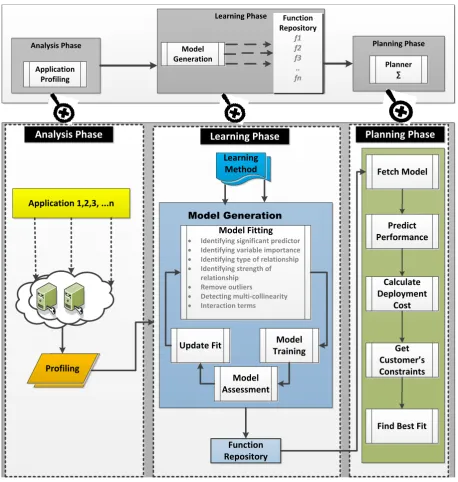
3.2 Overview of the three phase decision support system. . . 49
3.3 Collected data Traces details . . . 50
3.4 Transformed values in a CSV file. . . 53
3.5 Flow chart of the Learning phase. . . 54
4.1 Plot of actual vs predicted values of itemRecommender . . . 86
4.2 Plot of actual vs predicted values of smallpt . . . 86
4.3 Plot of actual vs predicted values of VARD . . . 87
4.4 VARD execution time over different cloud instance types. . . 90
4.5 Smallpt execution time over different cloud instance types. . . 91
4.6 Item Recommender execution time over different cloud instance types. . . 92
4.7 Dispersion of application execution time during all days of the week on different EC2 instance types. Notice that all graphs have the same y-axis range apart from m3.medium. 93 5.1 Fundamental approach of Transfer Learning. . . 99
5.2 Use of auxiliary data in the transfer learning technique. . . 103
5.3 Daleel’s decision support architecture in knowledge transfer setting. . . 105
5.4 Flow chart of theLearning Phase in transfer learning setting . . . 107
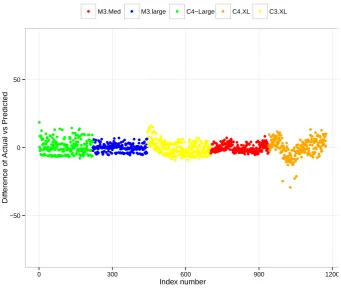
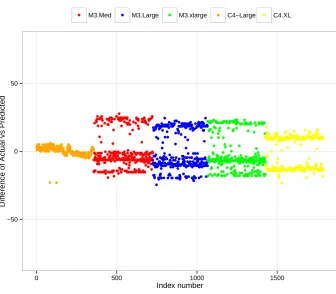
5.5 Plot of actual vs predicted values for three representative applications using two machine learning methods: SVR and polynomial regression. . . 108
5.6 A code snippet of transfer learning setting. . . 118
tion for the Item-Recommender-GCE (Target domain). Right: Effect of movie-GCE instance knowledge (source domain) on the model generation for the VARD-EC2
(Tar-get domain) . . . 131
5.10 The cost of running 1000 VARD jobs on EC2. . . 136
5.11 The cost of running 1000 VARD jobs on GCE. . . 137
5.12 The cost of running 1000 smallpt jobs on EC2. . . 137
5.13 The cost of running 1000 smallpt jobs on GCE. . . 138
6.1 The Daleel Architecture. . . 141
6.2 Model Fitting process . . . 142
List of Tables
2.1 Summary: Decision Support System Methodologies . . . 31
2.2 Summary: machine learning aided decision support systems . . . 42
4.1 Application specific properties (Application Vignette). . . 76
4.2 The computational specification of EC2 instances. . . 77
4.3 Significant predictors. . . 81
4.4 VARD’s model assessment. . . 83
4.5 Smallpt’s model assessment. . . 84
4.6 Item-Recommender’s model assessment. . . 84
4.7 List of all learning models to identify similar terms to extract a generic learning model. 85 4.8 MSE values for generic model on test data. . . 87
4.9 MSE values for SVR Model on test data. . . 89
4.10 MSE values for SVR and Polynomial model. . . 94
5.1 KS test results . . . 111
5.2 The computational specification of GCE instances. . . 120
5.3 Cross-application: Evaluation results of the two-mode transfer learning scheme . . . . 124
5.4 Cross-provider: Evaluation results of the two-mode transfer learning scheme. . . 126
ing scheme. . . 129 5.6 Cross-application & Cross-provider: Evaluation results of the transfer learning scheme
using polynomial regression method. . . 132 5.7 Failing Scenario. The two-mode transfer learning scheme could not help to generate
Chapter
1
Introduction
1.1
Overview
The cloud computing market is growing incredibly fast. In 2013, the global application market had a value of 30.35 billion U.S. dollars which kept on increasing every year and had reached to 62.5 billion U.S. dollar in 2017 [1]. According to Gartner’s lastest worldwide public cloud services revenue forecast, the market is projected to grow 18.5% in 2017 reaching$260.2 billion, up from$219.6 bilion in 2016 [2]. Consequently, decision-making in a cloud environment is a challenging task due to the proliferation of service offerings, pricing models, and technology standards [3]. This applies to all levels of service, but the Infrastructure as a Service (IaaS) level is particularly important for the end user given the fact that IaaS provides more choices and control for application developers. In the IaaS domain, there is no straightforward method to compare virtual machine performance and, more generally cost/performance trade-offs, within or across cloud providers. A wrong decision can result in financial loss as well as reduced application performance [4, 5, 6, 7]. A cloud broker can help in resolving such issues by acting as an intermediary between the cloud provider and the cloud customer – hence, serving as a decision support system for assisting the customer in the decision process [8].
The thesis investigates the problem of decision making to assist cloud customers in finding an optimal IaaS deployment strategy based on application-specific requirements and customer-related QoS constraints. The thesis argues for the use of machine learning methods for developing an intelligent decision support system. We believe that machine learning can provide behavioural and performance insights about the application and deployment setup necessary to make optimal decisions in terms of
performance and cost. Recognising that machine learning can impose significant training overhead, a key contribution of this thesis is a transfer learning aided methodology for efficient decision making, thus making this approach more cost-effective for cloud brokers.
The remainder of this chapter is organised as follows. The chapter starts with a discussion about the significance of decision support systems. Following that, the chapter outlines the key underline concepts of cloud brokers, decision support systems and machine learning and explains their rela-tionship in the context of cloud computing. Moreover, the chapter discusses the limitations of the current state of the art. Further to that, the chapter presents the research goals of the thesis, research methodology and contributions. Lastly, the chapter outlines the structure of the thesis.
1.2
Motivation
13 17 10 10 7
9
7 6 6 2
4 4 10 7
23 22 11 4 7
4 5 5 5
DigitalOcean RackSpace Google Compute Engine Joyent Compute Amazon EC2 Microsoft Azure
0 10 20 30 40 50 60 70
Number of Instance Types
IaaS Pro
vider
Instance Class
[image:23.595.99.490.320.620.2]General Purpose Memory Intensive CPU Intensive I/O Optimised Other Types
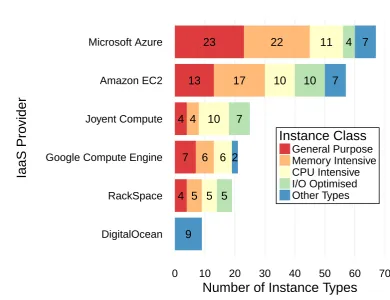
Figure 1.1: The number of Linux-based instance types offered by major IaaS providers, as of July 2017.
1.3. Background 3 the categories of Linux-based instance types (virtual machines) and the horizontal axis depicts the number of instance types in each category. This data is collected manually, based on market leading cloud service providers. It is evident that most IaaS vendors offer 20 or more instance types under different categories. Microsoft Azure is offering more than 60 different instance types, the maximum of all the listed IaaS providers.
IBM Softlayer is offering even more choices by providing an interface to the cloud customers where they can use a slider to build a virtual server that fits their needs, as shown in Figure 1.2. The customers can choose hourly or monthly billing. In addition, they can opt for additional services such as extra storage, firewall provision, monitoring, and various operating systems according to their choice. Such an interface offers hundreds of different types of virtual machine setup permutations. No one can imagine how challenging it would be to select from such a pool of offered instance types. There is a clear need for tools to simplify selection decision and potentially automate such decision making.
Figure 1.2: IBM Softlayer configurations, as of 2017
1.3
Background
1.3.1 Cloud Computing
cost, high scalability, zero upfront investment and reduction of maintenance expenses. Large companies such as Amazon, Google, Microsoft and others are striving to provide reliable and cost-efficient cloud platforms to users.
Cloud providers can be classified as public or private. Public cloud providers offer their resources as a service to the general public and charge them under a specified pricing model for utilised resources. Private clouds are mainly designed for the internal use of an organization to get full control of security, performance, and reliability.
Cloud providers offer their services at three main levels: infrastructure as a service (IaaS), plat-form as a service (PaaS) and software as a service (SaaS) [10]. IaaS refers to the provisioning of computer infrastructure (such as platform virtualisation), storage and networking. These offerings have heterogeneous configuration options (e.g. different choices of virtual machine configurations in terms of memory, CPU, I/O, etc), availability zones and so on. Examples of IaaS are Amazon EC2 and the Google Compute Engine. PaaS provides platform layer resources such as operating system support and software development frameworks. Google App Engine, Microsoft Windows Azure, and Force.com are some examples. SaaS refers to providing turn-key applications over the internet such as Salesforce.com.
Cloud providers use a variety of pricing models, including usage-based fixed pricing, usage-based dynamic pricing, subscription-based pricing, reserved services contracts with a combination of usage-based fixed pricing and up-front fees, auction-usage-based pricing and so on [11]. In addition to that, different cloud providers use different pricing schemes. For instance, Amazon charges for virtual machines on an hourly basis, Microsoft Azure bills on a per minute basis while Google charges a minimum of 10 minutes per virtual machine.
1.3.2 Cloud Brokers
A cloud broker is an important supporting actor in the cloud environment, acting as an intermediary between the provider and the consumer [12]. According to NIST, a cloud broker is defined as, “an entity that manages the use, performance, and delivery of cloud services and negotiates relationships between the cloud providers and the cloud consumers” [13]. Cloud brokers participate in a cloud computing environment with various roles such as intermediation, aggregation, arbitrage and integration [14].
1.3.3. Decision Support Systems 5 the management of multi-cloud environment. Here, the term ”multi-cloud” denotes the usage of multiple independent clouds by a client or service. Moreover, there has been a small amount of research looking at decision making to assist customers in the selection process by ranking cloud providers and their offered services.
Brokerage solutions can be classified as either hosted or deployable services. Hosted services are externally managed by a third party and customers have no insight as to how the application is provisioned. RightScale Cloud Portfolio Management [15], anStratus [16], xStream [17] and Cliqr [18] are some of the examples of a hosted service. In contrast, deployable services rely on open source software solutions that can be operated either internally by a corporation or externally as a grey-box service. Deployable approaches intend to be transparent for the application developer in order to feed the deployment and scalability policies. Examples include Apache Brooklyn [19], Scalr[20], Standing Cloud [21] and Aelous [22]. The mentioned solutions tackle interoperability and abstraction to reduce the deployment complexity of applications. However, except for RightScale, none of these solutions provide assistance for cloud selection.
1.3.3 Decision Support Systems
The cloud computing market is crowded with a large number of public IaaS providers [1, 2]. Therefore, a customer entering the cloud market has to face difficult comparisons and complex decisions. One way to address this challenge is to explore all the possible options exhaustively, which is quite an expensive and time-consuming task. Another way is to select a provider based on their reputation and then choose the resources from their suggested VM options. Such selections are not necessarily an effective choice for optimised performance or cost. The service offerings of cloud providers are somewhat of a black box for customers as they are not aware of the necessary details required for selection. Therefore, decision support is considered one of the fundamental objectives of cloud bro-kerage. However, current cloud broker frameworks tend to focus on abstraction, interoperability, and policy management. However, they are lacking support in automated decision-making and hence the selection of IaaS resources is mostly left to the customer.
typically based on the ranking of cloud providers or services taking into account the non-functional re-quirements and ignoring variability in application behaviour and cloud resource. Apart from ranking, some of the decisions are derived from a synthetic workload that cannot portray the real performance variation of the cloud [26, 28, 29]. Overall, decision making is challenging due to issues such as adaptability and also the need to satisfy multi-objective requirements from cloud customers [27].
Machine learning can help address such complicated decisions by observing application behaviour and modelling relationships amongst independent sources of knowledge such as cloud resource con-figuration and application behaviour. Therefore, machine learning has the potential to provide an intelligent and grounded decision support system. CloudProphet [28], Matrix [30] and [31] have taken first steps towards the use of machine learning in this context. These solutions are not considered a cost-effective option due to the requirement for a large amount of training data for the model genera-tion. Furthermore, the learning models are not generalised enough to be used for different application types or Quality of Service (QoS) attributes. Despite such considerable efforts, a decision support system in a multi-cloud environment is still an under-researched and demanding area that needs to be explored.
1.4
Limitations of Existing Approaches
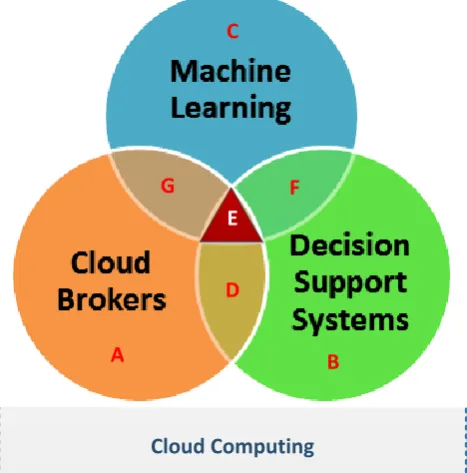
The research in this thesis sits at the intersection of the three areas studied above, namely cloud brokers, decision support systems and machine learning (see Figure 1.3). Area ’A’, indicates the area of work where cloud brokers mainly support interoperability, abstraction and unification of multi-cloud systems. Area ’B’ focuses on areas such as policy and SLA management regardless of multi-cloud broker concepts. Area ’C’ captures the research where machine learning is taking advantages of cloud computing to deal with big data analytic. Area ’F’ represents decision making in a cloud environment where machine learning is used to provide solutions to many problems such as scheduling, load balancing and energy consumption. There is barely any research effort (area ’G’) to exploit machine learning to assist the functionality of cloud brokers. A few solutions are available from the cloud broker community to assist the customer with deployment-related decisions and are indicated in area ’D’. Most notably, there is very little research at the intersection of all three areas (area ’E’) which is the focal point of this research.
1.5. Statement of Research 7
Cloud Computing
A B
C
E
D
[image:28.595.153.387.72.309.2]G F
Figure 1.3: Area of study
assist customers with optimal deployment choice. Moreover, the available methods are designed to deal with a specific application or single cloud infrastructure. In addition, there is a lack of solutions that consider support for a range of application types across multiple cloud providers.
1.5
Statement of Research
This thesis suggests that intelligent decision support systems integrated with cloud brokerage are still an under-researched area. Likewise, there is still a long way to go in terms of providing efficient decision making to help the customer in terms of optimised and application-driven deployment decisions in a multi-cloud environment.
1.5.1 Goals & Research Questions
deployment decisions by taking into account the application requirements and customer constraints. This overall goal can be further decomposed into three inter-dependent research goals.
1. The designing of a cloud broker architecture integrated with an implementation of an intelligent decision support system.
The key research questions associated with this goal are:
(a) What is the potential role of an intelligent decision support system in enhancing cloud brokerage?
(b) What does an intelligent decision support system architecture look like and which of its components is responsible for offering an understanding of application behaviour?
2. The investigation of machine learning methods that can be applied for optimal decision making in the decision support system of a cloud broker.
The key research questions associated with this goal are:
(a) What machine learning methods are most applicable to support decision making in the cloud?
(b) How can machine learning methods provide the insight necessary to help decision support systems? And to what extent can generalised learning models be used for learning across different application domains?
3. The development and evaluation of an efficient decision-making method integrated with the established decision support system (assuming that the research goal 2 is viable) to reduce the learning and decision-making cost and to making it more cost-effective for use in cloud brokers. The key research questions associated with this goal are:
(a) What are appropriate methods to make use of existing knowledge?
(b) How can learning be done efficiently to overcome the challenge of additional time and learning cost?
1.5.2 Research Methodology
1.5.3. Contributions 9
Experimental: In order to investigate the role and effectiveness of the machine learning for a
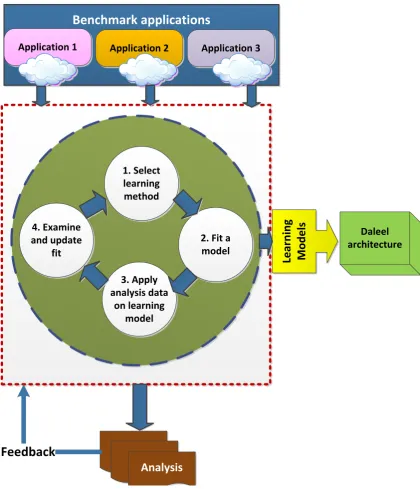
decision support system, a prototype named Daleel is developed to iteratively test different learning models. A large-scale analysis is used to incrementally enhance the learning model in order to make it more effective in a generalised manner. This is shown in Figure 1.4, where the analysis results are to fed iteratively into the design of learning models. Daleel requires generalised learning model(s) to be used for decision making.
Iterative: A learning method is selected by exploring different traditional machine learning
tech-niques. The exploration of different machine learning methods is used to build the learning models to be eventually used, keeping in mind the need for getting insight about the application behaviour with respect to the deployment setups. The intuition behind exploring different learning methods is the use of diverse baseline models that can be used for diagnostic and accuracy assessment as well. The learning models are built and refined following circular processes as shown in the middle green circle in Figure 1.4. The process of getting a final learning model starts with the selection of learning method followed by fitting a model. The fitted model is then evaluated on analysed data and further examined using statistical methods for update and re-fit. A human intervention is involved at this level in order to visually analyse the output of statistical results. By following this iterative process and further evaluating it with incremental data analysis a final model for decision making is derived. A detailed experimental study is done to check the feasibility of offering different learning models which are discussed in detail using different visualisations.
Quantitative: Furthermore, our research methodology follows a quantitative assessment of real
world scenarios in a real-time environment. A quantitative analysis is performed on a large scale experimental setup of two major IaaS providers; the first one is EC2 of Amazon Web Services and second is Google Compute Engine (GCE). For evaluation, three real-time applications of different categories are used as a representative subset of problems, as depicted in the blue rectangle at the top of Figure 1.4. The real-time data traces of the applications, running on different deployment setups (EC2 and GCE), are used for training and assessment of the prediction models. Therefore, the knowledge-base is comprised of real-time workload traces instead of synthetic workloads.
1.5.3 Contributions
Benchmark applications
Application 1 Application 2 Application 3
1. Select learning method
4. Examine and update
fit
2. Fit a model
3. Apply analysis data
on learning model
Le
ar
n
in
g
M
o
d
e
ls
Daleelarchitecture
Analysis
[image:31.595.91.512.62.552.2]Feedback
Figure 1.4: Research methodology approach
customer for making deployment decisions. The main contributions of this thesis are:
1. The architectural insight of a decision support system for inclusion of the machine learning methods and its integration with multi-cloud brokerage.
1.5.4. Thesis Organization 11 3. A two-mode transfer learning scheme for efficient decision making. This scheme is based on transferring knowledge from one domain to the other. The efficiency is achieved by reducing the learning overhead in terms of time and cost. Quantitatively, an overall reduction of 60% is observed.
Additional contributions of this thesis are:
1. A detailed study of machine learning techniques in general in different domains and more specif-ically in cloud brokerage.
2. A comprehensive study about cloud brokerage and decision support system methodologies.
3. Experiential insight about cloud providers and performance variations across different virtual machine instances
1.5.4 Thesis Organization
The remainder of the thesis is structured as follows:
Chapter 2 provides an understanding of the problem space as well as a background overview of
cloud brokerage and decision support systems. A detailed analysis of related decision support solutions is provided. In addition, the chapter gives an overview of using machine learning to achieve the goals mentioned in section 1.5, also exploring the state of art where machine learning methods are used in decision making. The chapter concludes by highlighting the potential of machine learning to be used for decision making integrated with cloud brokerage in a multi-cloud environment.
Chapter 3 describes the architecture of Daleel for cloud instance selection.Following this, the
chapter describes the key principles behind machine learning and also explores the core intelligence aspects of decision support systems. Finally, selected machine learning methods are explained along with their potential benefits.
Chapter 4 provides an experimental evaluation of different learning strategies leading to the adop-tion of a set of approaches. The chapter also highlights a possible performance issue over training overhead. The chapter concludes with the final architecture of a generic learning model along with as assessment feasibility across different applications.
Chapter 5 investigates a transfer learning technique to enhance the efficiency of an intelligent
reduction in this overhead. Following this, a detailed evaluation is carried out using two public cloud providers i.e, Amazon Web Services (AWS) and the Google cloud.
Chapter
2
Background & Related Work
Decision making in cloud environment is quite challenging due to the proliferation of service offerings, pricing models and technology standards. A customer entering the cloud market is overwhelmed with a host of difficult questions without much of a support for a decision support system. Moreover, there is no hard and fast rule for optimal selection of instance types that best suit the application needs and customer constraints.
The previous chapter has introduced key goals of this thesis, highlighting key limitations of existing decision support systems, along with the contributions and the adopted research methodology. The central tenet of this chapter is to investigate the current state of the art in decision support system, either offered as a service by cloud broker or just an independent effort in a multi-cloud environment. Moreover, the potential role of machine learning is also explored for developing an intelligent decision support system for a multi-cloud environment.
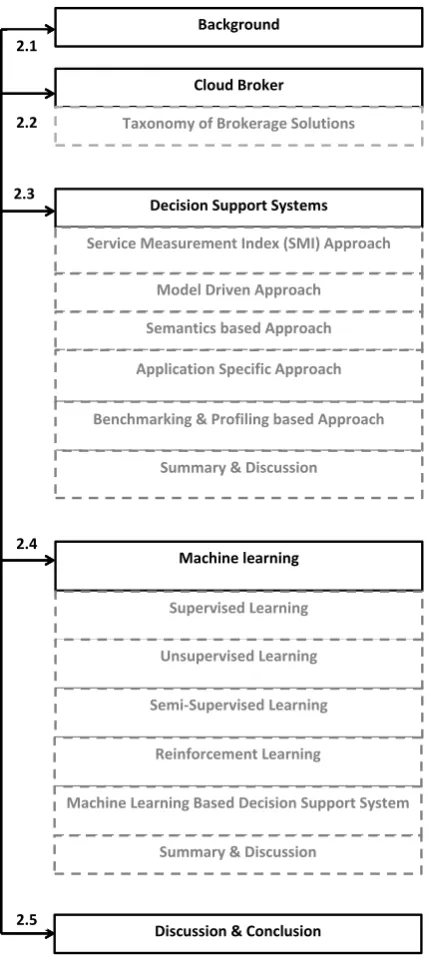
The upcoming sections cover the detail in the following manner, as shown in Figure 2.1. A quick recall of the problem domain is provided in Section 2.1. Section 2.2 defines cloud broker and classification of broker based offerings along with some of the brokerage examples. The role of decision support system and the current state of the arts are described in Section 2.3. This Section elaborates different methodologies involved in decision support system in the cloud or multi-cloud environment. The role of machine learning for developing decision support methodology is explored as well, and some supportive examples are stated in Section 2.4. The last section discusses the conclusion in view of limitations of existing approaches.
Decision Support Systems
Service Measurement Index (SMI) Approach
Model Driven Approach
Semantics based Approach
Application Specific Approach
Benchmarking & Profiling based Approach
Summary & Discussion
Background
Cloud Broker
Discussion & Conclusion Machine learning 2.1
2.2
2.3
2.4
2.5
Supervised Learning
Unsupervised Learning
Semi-Supervised Learning
Reinforcement Learning
Machine Learning Based Decision Support System
[image:35.595.133.349.67.553.2]Summary & Discussion Taxonomy of Brokerage Solutions
Figure 2.1: Chapter structure
2.1
Background
2.1. Background 15 service provisioning, security, green computing, SLA management, heterogeneity and many more [32, 33, 34, 35, 36, 37, 8, 38]. Thus, researchers are striving to find best possible solutions.
One of the biggest challenge of cloud computing is inherent complexity in terms of different tech-nologies, termitech-nologies, services and interfaces. Every cloud provider is opting for different approaches of service offerings, pricing models for services and interfacing with its services. This variety is reflect-ing series of issues startreflect-ing from vendor lock-in, portability to the performance comparison across the provider’s offerings. The interoperability and portability are important for end-user investors as many of them do not want to stick their applications to one cloud provider only [14]. The cloud customers want to avoid the risk of being tied to one cloud provider to avail the option of application migration due to pricing and availing similar service with additional offers from some other cloud provider. The goal of interoperability and portability is to allow cloud customer to make best use of diverse offerings from cloud providers.
and selection under diverse conditions.
A cloud broker can help in resolving such issues by acting as an intermediate between the cloud provider and cloud consumer and offer a decision support system to assist the customer through the decision process. Machine learning assisted methods can enhance the potential role of decision support system by adding intelligence for application-driven decisions. An intelligent decision support system as a brokerage service can reduce the customer’s efforts for optimal selection of infrastructure resources in a multi-cloud environment. This can lead to the satisfaction of application needs as well as user constraints in an optimal way. Here, the term ”multi-cloud” denotes the usage of multiple independent clouds by a client or service [33, 41].
2.2
Cloud Broker
A cloud broker is an entity in a cloud ecosystem to manage the use, performance, and delivery of services along with negotiation of the relationship between the cloud provider and cloud consumer [42]. A number of tasks can be done by cloud brokers on behalf of customers like arbitrage, aggregation and integration/intermediation. Generally, we can define cloud brokerage solutions as either hosted or deployable. Hosted services are mostly commercial ones and are externally managed by the third party stakeholders. Such services are not transparent to the users and do not provide information of how the application is being provisioned. In contrast, deployable services are most commonly open source solutions and can be managed internally by a corporation or externally as grey-box service.
2.2.1 Taxonomy of Brokerage Solution
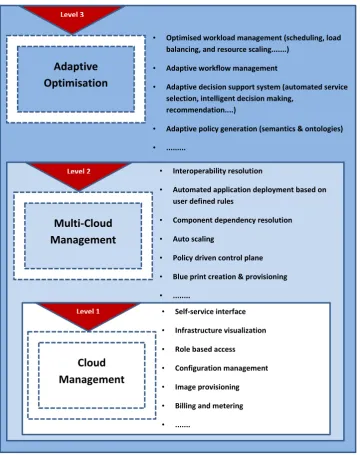
2.2.1. Taxonomy of Brokerage Solution 17 to clarify the scope of cloud and multi-cloud management in brokerage domain. The intention behind this effort is to give our reader a clear picture about cloud brokerage based research and development efforts with a glimpse of problem domain and potential research focus.
• Optimised workload management (scheduling, load balancing, and resource scaling...)
• Adaptive workflow management
• Adaptive decision support system (automated service selection, intelligent decision making,
recommendation....)
• Adaptive policy generation (semantics & ontologies) • ...
• Interoperability resolution
• Automated application deployment based on user defined rules
• Component dependency resolution • Auto scaling
• Policy driven control plane • Blue print creation & provisioning • ...
• Self-service interface • Infrastructure visualization • Role based access • Configuration management • Image provisioning • Billing and metering • ...
Level 1 Level 2 Level 3
Cloud Management Multi-Cloud Management
[image:38.595.158.519.122.578.2]Adaptive Optimisation
Figure 2.2: Three level classification scheme for cloud broker
Level 1 refers to the cloud management platform. The offerings and list of important tools at
management tools likechef [43],puppet [44],Ansible[45],CFEngine[46],SaltStack[47], etc are used as supporting tools in this layer and layers ahead for similar tasks. Level 2 refers to the provi-sioning of multi-cloud management solutions. This level contains services related to interoperability resolution, automated application deployment, dependency resolution and scaling management with the policy-driven control plane.
In the last couple of years, considerable developments have taken place in terms of solving the vendor lock-in and portability issues. The development of libraries/APIs is considered a principal effort to help reducing lock-in issue. Some useful libraries developed over time, to enhance interoperability, are discussed here. Apache jclouds [48] is an open source multi-cloud toolkit for Java to create an application that is portable across clouds. This library allows the full control of the cloud features to be used by the customer. Apache Libcloud [49] is a Python library and provides a unified API to interact with different cloud service providers. Apache Deltacloud[50] (moved to Apache Attic) is a REST-based API written in Ruby to interact with various cloud resources. Simple Cloud API[51] is a PHP library to access cloud application services offered by multiple vendors. It provides support for file and document storage and queue service of Amazon and Azure.
2.2.1. Taxonomy of Brokerage Solution 19 for secure application deployment, scheduling and automation. This product is offered as a SaaS management solution as well as on premise solution for enterprise customers. As cloud computing evolves, the integration of cloud services becomes hassle for cloud consumer. Brooklyn[19] is an open source application management solution to deploy your application across multi-cloud environment. It also provides features for application monitoring and some base level scaling based on user defined policies. Similar to Rightscale, Aeolus [22] Blender intends to provide a solution for the automatic deployment and configuration of complex service-based distributed application. Blender is a software product maintained by Mandriva, based on the approach taken by the Aeolus project to overcome the limitations of using pre-configured images. Blender is an integration of three tools, Zephyrus, Metis and Armonic. The provisioning features of Aeolus are similar to Rishtscale and Brooklyn, feasible for multi-cloud application management rather automated decision making to assist customer for virtualization selection. RightScale, Enstratusand Kavoo are some examples of the commercial broker services. In contrast, Brooklyn and Scalr [20] are considered deployable solutions for the cloud user.
The examples discussed so far from cloud brokerage solutions are focusing more on resolving inter-operability and providing solutions for cloud or multi-cloud application management solutions. These solutions are catering the need for automatic deployment, monitoring and defining the deployment and scaling requirements. These requirements are fed by the application-user in terms of specified configurations, targeted cloud provider along with basic scaling rules. In short, all decisions regarding application deployment are based on statically defined constraints. The most critical among these static constraints is the selection of suitable cloud provider. Further to that, the user has to be precise about mentioning the required configurations at virtual machine level.
the goals. Machine learning has proven its effectiveness in various aspects of distributed system ap-proaches like scheduling, load balancing, etc. Very few efforts are seen in the literature as decision support strategies for multi-cloud environments. PuLSaR, Matrix and [55, 56] are considered some of these efforts to help customers by recommending cloud and service selection.
The next sections will highlight some of the potential efforts regarding decision support system that are either offered as cloud brokerage service or independent efforts. The state of the art in decision support system is categorised based on different methodologies as shown in Figure 2.3. The contributions and limitations are also discussed keeping in view the objective of this research work.
2.3
Decision Support Systems
The rapid increase in cloud service offerings has increased the opportunity for users to have redundant and replaceable services from multiple providers. As a result, the quality of service may improve and the customer can get even better performance at a reduced cost.
Users of Infrastructure as a Service (IaaS) level are faced with a composite decision:
1. Which provider she should choose?
2. What instance types(s) would provide her with the cost: performance ratio that suits her needs?
3. Does the time of day at which she requests these resources affect how her application runs?
2.3. Decision Support Systems 21
Decision Support System Methodologies
Service Measurement Index (SMI) Approach
Model Driven Approach
Semantics based Approach
Application Specific Approach
Benchmarking & Profiling based Approach
Machine learning based Approach
Key performance indicators
Analytic Hierarchy Process (AHP)
Weighted Sum
PREDIQT analysis tool
CORAS analysis tool
DSL for defining requirements and rules
Linear Regression
Auto-Regression
Neural Network
Support Vector Machine
Fuzzy Analytic Hierarchic Process
[image:42.595.84.328.88.686.2] Response Surface
types from the range of infrastructure offerings is still a challenge for cloud users especially when user defined objectives has to be satisfied. So a cloud customer entering the market is overwhelmed by excessive hosting information without much knowledge of selection criteria.
An effective decision support system can help the customer by handling the bulk of information and ensuring the appropriate selection decision according to the mentioned requirements. This section discusses different approaches and methods for decision support systems. The offerings and limitations are critically evaluated keeping in view the research objective. These decision support solutions are explored with a viewpoint of brokerage in a multi-cloud environment.
2.3.1 Service Measurement Index Approach
TheService Measurement Index(SMI), developed by Cloud Service Measurement Initiative Con-sortium (CSMIC), is considered one of the approaches to compare different cloud offerings/services [57]. SMI is a set of Key Performance Indicators (KPI’s) to provide standardized methods for mea-suring and comparing the services. These KPI’s are categorized as accountability, agility, assurance, financial, performance, security and privacy, and usability. These seven characteristics are further divided into four or more attributes to capture all of its properties. These SMI indicators have been used by some of the commercial or open source broker based solutions for ranking different cloud providers and their offered services. Further, these ranking methods are used for decision making of cloud or service selection.
The work done by [58] for ranking of cloud computing services is considered one of the initial efforts for using SMI indicators. The proposed strategy measure all the KPIs of SMI and rank the cloud services based on the measuring results. An Analytical Hierarchical Process (AHP) based mechanism is proposed for the ranking mechanism. The proposed ranking is a three-phased process. Starting with the decomposition of a complex problem in a hierarchical structure to specify the interrelation among QoS attributes sub-attributes and alternative services. In the second phase, a relative property is calculated for each pair of QoS proceeding with pairwise comparison of cloud services for computing their local ranks as part of the third phase. The modeling of qualitative attributes is not in the scope of current work. Some other efforts are also done to define additional key performance indicators for SLAs and improved ranking methods [59, 60].
2.3.1. Service Measurement Index Approach 23 provisioning. This methodology requires the application owner to specify the application requirements in terms of KPI. The KPI based requirements are then compared to all the provider’s offerings to select the best acquisition. This selection acquisition is used at deployment time as well as at run time to fulfill the elasticity requirement. All the application specific details and objectives are defined in a Topology Descriptor File (TDF). SMI is used to measure cloud performance and the selection of resources is based on the defined details in TDF. Weighted sum method is used for objective optimization.
The main idea behind the OPTIMIS [36] project is to offer a toolkit for optimizing the whole service lifecycle, including service construction, deployment and operation on the basis of trust, risk, and eco-efficiency. In short, a suitable Infrastructure Provider (IP) is selected for Service Provider (SP). This project does not rely on the use of SMI, however, the measurement techniques for decision metrics are similar to the measurement of KPIs. The service life cycle starts with the service construction, where Service Provider (SP) prepares and configures the virtual machine images that constitute the service along with a specification of dependencies. As a next phase, most suitable Infrastructure Provider (IP) is selected for hosting the service. The selection process is based on the deployment cost along with other metrics including trust, risk, and energy impact. Reputation is considered a subjective measure of the perception of social network members regarding trust and risk analysis. One of the components of OPTIMIS is a deployment engine that is responsible for service packaging, discovery, and negotiation with a suitable cloud for hosting a particular service. The admission control component is responsible for analysing the current workload on infrastructure provider to carry on with the acceptance or rejection of service deployment request. After deployment, service and cloud optimizer components of OPTIMIS are responsible for monitoring the provisioning according to agreed SLAs.
Analysis: To measure the long list of SMI indicators along with KPI requires proper
virtual machines are selected by matching the user defined configuration requirements with the of-fered cloud infrastructure services. Such resource acquisition cannot be considered application-driven without knowing how the application will actually perform.
2.3.2 Model Driven Engineering Approach
Model driven engineering based solutions help application developers to model vendor-agnostic cloud services. A model-driven framework combined with different QoS based model-driven analysis can help in quantifying performance for the future. TheMODACloud[54] project developed is a model driven approach for design and execution of applications on multiple clouds. It aims to provide a deci-sion support system, an open source IDE, runtime environment for high-level design, semi-automatic code generation and automatic deployment on multi-cloud environments. A decision support method (DSM) [61] is presented to assist a cloud customer for selecting a cloud provider as well as service considering three QoS factors: risk, quality, and cost. This DSM is using the concepts of CORAS and PREDIQT to help to analyse these three QoS attributes. PREDIQT is a model-based quality assessment tool to predict the impacts of architectural design changes on system characteristics like performance, scalability, security, etc. CORAS is a model-based risk assessment tool and based on ISO 31000 risk management standards. It provides a customised language for threat and risk modeling and Unified Modelling Language (UML) is typically used to model the target of the analysis. The types of the proposed decision models are based on the modeling notations, languages and tools of CORAS and PREDIQT.
Similar to MODACloud,PaaSage[62] follows the principals of model-based software engineering. PaaSage is an open and integrated cloud management platform supporting design, development, opti-mization and deployment of existing and new applications. Cloud Modelling and Execution Language (CAMEL) is used by PaaSage to describe the application deployment model and scalability rules. The deployment starts with the translation of workflow description into a CAMEL model which is then consumed by another PaaSage component to generate a deployment plan. Finally, the deployment plan is passed to the execution component of PaaSage to perform the actual deployment. Application auto scaling is also managed by the execution component of PaaSage based on the rules mentioned against the workflow execution stage.
2.3.3. Semantic Approach 25 modernization of software and validation in post-migration phase. The decisions are mostly related to the business level, where a feasibility analysis is done to foresee the investment risk. However, both technical and business aspects of migration are covered to help the user in customizing according to application needs. The outcome of this project is a toolbox for the migration, modernization, and cloudification of the legacy application. The core of the offered software suite is the Methodology Process Tool for customisation and instantiation of the generic methodology on the pre-migration analysis results.
Analysis: Model-driven engineering based solutions are heavily dependent on the fine-grained information from domain experts, analysts and decision makers to get complete knowledge of business models and company strategies. A designer must be aware of the impact of decisions, alternative deci-sions, actor interactions, dependencies, and processes while designing the workflows and architectural models. Such processes require sufficient time to follow the model based design principals. In the case of DSM-MODACloud, there is no clear picture of how the cloud service measurements will be collected and which parameters to consider.
2.3.3 Semantic Approach
Semantic technology helps in representing resources, domain concepts and rules with the help of on-tologies. In this way, application requirements and service specifications can be defined in a vendor independent way raising the abstraction for the user. mOSAIC [37] is an open source PaaS pro-gramming interface for the development and deployment of multi-cloud based applications. mOSAIC has an assumption about the deployed application that it is component based and dependencies for both communication and data are defined explicitly among components. Furthermore, application architecture must be service oriented and only the mOSAIC API should be used for inter-component communication. Resource Brokering is one of the components of mOSAIC to act as a mediator between client and cloud provider. The mediation involves the responsibility of cost optimization and performance maximization. The mOSAIC platform assists the user for automatic provisioning without direct user involvement. However, the SLA based performance indicators at application and component level have to be defined by the user. mOSAIC assists the customer at PaaS level in order to combine services from different clouds and to provide a new service on top of existing ones (and provide transparency of multiple clouds).
domain concepts by means of Semantic Web Ontologies and inference rules. The proposed ontology is focusing on the IaaS layer for resource provisioning. This knowledgebase (support tool) is comprised of two components, Semantic Engine and Cloud Agency. Semantic Engine (a prototype tool) is responsible for helping the user to abstract the requirements in vendor independent way starting from application requirements or from specific vendor resources. A Cloud Agency compares the different offers of providers with the user proposal and retrieves the best offer. Cloud Agency is a Multi-Agent System conceived for provisioning by negotiation, monitoring, and reconfiguration of acquired resources. However, the proposed approach is taking advantage of inference rules and trying to overlap the gap between high-level requirements and technical requirements.
Cloud4SOA [25] is a multi-PaaS approach to semantically interconnect heterogeneous PaaS of-ferings across different cloud providers that share the same technology. This is a broker based solution for the PaaS layer so the developers can select, deploy and manage their applications on PaaS offerings and can switch between platforms without re-architecting the original application. The ontology-based semantic matchmaking capabilities provided by Cloud4SOA establishes a set of abstraction among dif-ferent PaaS offerings to support seamless deployment and management of application across difdif-ferent cloud platforms. Cloud4SOA is based on five layer architecture to support Service Oriented Architec-ture (SOA), user-centric focus, PaaS Semantic Interoperability Framework (PSIF) and management of the cloud-based application. The PaaS Recommendation module in SOA layer is responsible for suggesting for the best match of PaaS offering. The semantic profiles of application and PaaS offerings define the degree of their relation to helping in matchmaking.
Analysis: mOSAIC and Cloud4SOA are multi-PaaS semantic based management and governance
2.3.4. Benchmarking & Profiling Approach 27
2.3.4 Benchmarking & Profiling Approach
Due to the diversity in cloud computing infrastructure services, it is very difficult for the user to choose which virtual machine has the maximum performance capability to be selected for deploying the application. Sometimes, the wrong choice of selection ends up with under-performance of application or increase in resource cost. One of the methods to help categorize the virtual machines is to benchmark the performance. Mostly the benchmarking is performed independently of the application which is not an appropriate selection and categorization method as the heterogeneous virtual machine would have varying performance capability for various standards like CPU utilization or memory utilization etc which might not be a good choice for some other application.
A six step benchmarking methodology is proposed by [29]. In this strategy, different virtual machines are grouped (memory & process group, computation group, local communication group, and storage group) together based on the similarity of VM attributes. The attributes are normalized to rank the VM performance within each group. For each input application, weights are assigned to the respective groups by the experts. In this way, a relevancy of application is shown with the group using a value ranging from 0-5. Application experts indicate the relevance of application to the four groups (computation, memory, processor and storage) by assigning weights to each group. Scores are calculated by multiplying the weight and normalized value of the group and virtual machines are ranked accordingly. A high ranked virtual machine can be selected now to maximize the application performance.
Profiling-as-a-Service (PraaS)[64] approach is an adaptive instrumentation strategy to collect profiling information of running application on a cloud while achieving the defined QoS. This service intends to provide help to perform a trade-off between performance, cost, and accuracy of profiling data. In terms of accuracy, application architects can define expected QoS and constraints to achieve a certain level of accuracy. The policies are then uploaded to the PraaS service and instrumented application is deployed for resource usage monitoring.This service is tested for an open source web-based application. The current implementation supports profiling in three modes, no profiling, partial profiling and full profiling that can be applied to target VM instance of Windows Azure. The main focus for profiling is the resource utilization (CPU usage and data exchange) by different components of applications.
Analysis: The ranking method depends on the assigned weights by experts and so requires
fine-grained application specification and requirement knowledge. In contrast, the benchmarking based decision making is considered a useful solution. However, such decisions cannot be considered application-driven as the behavioral change of application and cloud resources are ignored. IaaS of-ferings are black-box for the user; the different software and hardware based policies at virtualization level can cause uncertainty about decision outcome. Profiling methods are considered effective cap-turing irregularities about application behavior. This is very evident that by increasing profiled data ratio, better results could be derived, though at a cost of time and budget. Such solutions show no relevance to broker based system though considered substantial efforts for decision making.
2.3.5 Application Specific Approach
Some research efforts regarding decision making for resource selection are based on application specific solutions. These solutions may not come with the assumption of being part of a brokerage system or multi-cloud environment. Such solutions are also considered domain specific decision support methods and may not be performing effectively in different domains.
2.3.6. Summary & Discussion 29 To find out the suitable hardware and software configuration for an application is non-trivial, especially with customer specific constraints regarding budget, performance and time. A common practice is to follow the past experience for such decisions. [55] has applied the concept of Response surface ( a statistical method) for selection of hardware and software resources for MapReduce applica-tion. Response Surfacemodel captures the performance change of application on different setups of hardware and software. In this methodology, a Response Surface is build using a range of exploratory variables including hardware platform, network, and software configuration. The parameter values can be collected from simulation to populate response service.
Analysis: Simulation-based data can be collected easily in a faster way in a controlled
envi-ronment; however it cannot represent the actual behavior of cloud environment on any application. Mathematical or statistical methods are considered a good choice to understand and explore the re-lationship among data attributes. This can lead to learning a system behavior. Such models can be easily used under enhanced machine learning methods.
2.3.6 Summary & Discussion
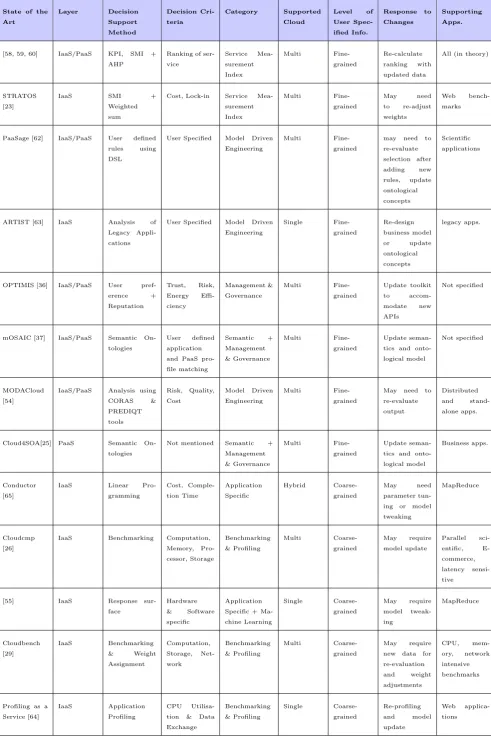
RightScale, Aelous, Kavoo, Brooklyn and Scalr are providing means of service offering for control and administration of distributed application deployed over different clouds, as stated in Section 2.2. These solutions help for automated deployment of cloud or multi-cloud application and the user is responsible for providing the choice for targeted cloud and virtual machine configurations. Optimis, mOSAIC, Cloud4SOA are offering platforms for management and governance of cloud services (de-ployable service for multi-cloud). Reputation is considered a subjective measure of trust and risk analysis in Optimis and STRATOS (Section 2.3.1). mOSAIC and Cloud4SOA also provide semantic-based solutions for matching of PaaS which requires a standard way of getting the requirements and matchmaking (Section 2.3.3). MODACloud, ARTIST, and PaaSage are considered Model-driven en-gineering solutions for multi-cloud and use analytical methods for decision making and requires a lot of information from domain experts, analysts and decision makers belong to business or organisation (Section 2.3.2). Ranking or matchmaking based methods cover fine grained requirements, however, do not consider how an application will perform on different cloud setups.
2.3.6. Summary & Discussion 31
Table 2.1: Summary: Decision Support System Methodologies
State of the Art Layer Decision Support Method Decision Cri-teria Category Supported Cloud Level of User Spec-ified Info. Response to Changes Supporting Apps.
[58, 59, 60] IaaS/PaaS KPI, SMI + AHP
Ranking of ser-vice Service Mea-surement Index Multi Fine-grained Re-calculate ranking with updated data
All (in theory)
STRATOS [23]
IaaS SMI +
Weighted sum
Cost, Lock-in Service Mea-surement Index Multi Fine-grained May need to re-adjust weights Web bench-marks
PaaSage [62] IaaS/PaaS User defined rules using DSL
User Specified Model Driven Engineering
Multi Fine-grained
may need to re-evaluate selection after adding new rules, update ontological concepts Scientific applications
ARTIST [63] IaaS Analysis of Legacy Appli-cations
User Specified Model Driven Engineering Single Fine-grained Re-design business model or update ontological concepts legacy apps.
OPTIMIS [36] IaaS/PaaS User pref-erence + Reputation Trust, Risk, Energy Effi-ciency Management & Governance Multi Fine-grained Update toolkit to accom-modate new APIs Not specified
mOSAIC [37] IaaS/PaaS Semantic On-tologies
User defined application and PaaS pro-file matching Semantic + Management & Governance Multi Fine-grained Update seman-tics and onto-logical model
Not specified
MODACloud [54]
IaaS/PaaS Analysis using CORAS & PREDIQT tools Risk, Quality, Cost Model Driven Engineering Multi Fine-grained
May need to re-evaluate output
Distributed and stand-alone apps.
Cloud4SOA[25] PaaS Semantic On-tologies
Not mentioned Semantic + Management & Governance
Multi Fine-grained
Update seman-tics and onto-logical model
Business apps.
Conductor [65]
IaaS Linear Pro-gramming Cost, Comple-tion Time Application Specific Hybrid Coarse-grained May need parameter tun-ing or model tweaking
MapReduce
Cloudcmp [26]
IaaS Benchmarking Computation, Memory, Pro-cessor, Storage Benchmarking & Profiling Multi Coarse-grained May require model update Parallel sci-entific, E-commerce, latency sensi-tive
[55] IaaS Response sur-face
Hardware & Software specific
Application Specific + Ma-chine Learning Single Coarse-grained May require model tweak-ing MapReduce Cloudbench [29] IaaS Benchmarking & Weight Assignment Computation, Storage, Net-work Benchmarking & Profiling Multi Coarse-grained May require new data for re-evaluation and weight adjustments CPU, mem-ory, network intensive benchmarks
Profiling as a Service [64]
IaaS Application Profiling
Statistical and mathematical methods are considered quite effective for defining the underlying relationships among data attributes. These methods are also linked with statistical machine learning, where the captured relationships are utilised in deriving adaptive and robust learning models for a given domain. This fortifies towards the argument of prospective use of machine learning for decision making. We will try to explore if machine learning can play a vital role to overcome many of the shortcomings in existing decision support methods. Limitations of existing state of the arts are summarised in different key questions in order to evaluate if machine learning can help answer these.
1. How can we use machine learning for application-driven acquisition decisions without much intervention of human choices? Particularly, the decisions related to virtual machine selection at IaaS layer.
2. Can we rely on machine learning methods to capture application behavior on different deploy-ment environdeploy-ments?
3. Are machine learning methods useful in deriving inference relations between the data instances where some uncertainties are generated due to the black-box nature of cloud provisioning?
4. Can we integrate learning based decision support system with brokerage architecture?
5. Can we design and develop learning based solutions that are viable across multi-cloud environ-ment?
The next section targets the evaluation of machine learning for decision support system keeping in view all the raised key questions.