co
and
people
COMPUTER
INSTRUCTION
BY
DOING
Good Management of Computer Operations Automation: Its Impact on the Delivery of
Health Care
"People-Mover" Automatic System at Seattle-Tacoma Airport
Computers and Democracy Is the Press Being Hobbled?
The New Orleans Portion of the Conspiracy to Assassinate President John F. Kennedy The People's Need To Know
?
7?1
- 1l...l
SCIE
NCE &
TECHNOlOGY
April, 1973
Vo
l.
22,
No
. 4
- ADL Systems
- Ray M. Antley, M.D
.
- J
.
N
.
Dravillas
- Anthony Ralston
-
Senator Sam J. Ervin, Jr.
- Edmund C. Berkeley
INVENTORY OF THE 36 ISSUES OF
- TITLES AND SUMMARIES
THE NOTEBOOK ON COMMON SENSE, FIRST YEAR
VOLUME 1
1. Right Answers - A Short Guide to Obtaining Them A collection of 82 principles and maxims. Example: "The moment you have worked out an answer, start checking it - it probably isn't right."
2. The Empty Column
A parable about a symbol for zero, and the failure to recognize the value of a good idea.
3. The Golden Trumpets of Yap Yap 4. Strategy in Chess
5. The Barrels and the Elephant
A discussion of truth vs. believability. 6. The Argument of the Beard
The accumulation of many small differences may make a huge difference.
7. The Elephant and the Grassy Hillside
The concepts of the ordinary everyday world vs. the pointer readings of exact science.
8. Ground Rules for Arguments
9. False Premises, Valid Reasoning, and True Conclusions The fallacy of asserting that the premises must first be correct in order that correct conclusions be derived.
10. The Investigation of Common Sense 11. Principles of General Science and Proverbs
8 principles and 42 proverbs.
12. Common Sense - Questions for Consideration 13. Falling 1800 Feet Down a Mountain
The story of a skimobiler who fell 1/3 of a mile down IVit. Washington, N.H., and was rescued the next day; and how he used his common sense and survived.
14. The Cult of the Expert
15. Preventing Mistakes from Failure to Understand Even though you do not understand the cause of some trouble, you may still be able to deal with it. The famous example of a cure for malaria. 16. The Stage of Maturity and Judgement
17. Doomsday in St. Pierre, Martinique - Common Sense vs. Catastrophe
How 30,000 people refusing to apply their common sense died from a volcanic eruption.
18. The History of the Doasyoulikes 19. Individuality in Human Beings
Their chemical natures are as widely varied as their external features.
20. How to be Silly
71 recipes for being silly. Example: "Use twenty words to say something when two will do." 21. The Three Earthworms
A parable about curiosity; and the importance of making observations for oneself.
22. The Cochrans vs. Catastrophe
The history of Samuel Cochran, Jr., who ate some vichyssoise soup.
23. Preventing Mistakes from Forgetting 24. What is Common Sense?
-An Operational Definition
A proposed definition of common sense not using synonyms but using behavior that is observable. 25. The Subject of What is Generally True and Important
-Common Sense, Elementary and Advanced 26. Natural History, Patterns, and Common Sense Some important techniques for observing. 27. Rationalizing and Common Sense
28. Opposition to New Ideas
Some of the common but foolish reasons for opposing new ideas.
29. A Classification and Review of the Issues of Vol. 30. Index to Volume 1
2
VOLUME 2
31. Adding Years to Your Life Through Common Sense 32. The Number of Answers to a Problem
33. "Stupidity has a Knack of Getting Its Way" 34 and 35. Time, Sense, and Wisdom
36. Wisdom - An Operational Definition
. . . . 24 issues promised, 36 issues delivered, for good measure
Some Comments from Subscribers I believe these to be the best, if not the most important, reading that I have had this year.
- Harold J. Coate, EDP Manager, St. Joseph, Mo. Your concept is brilliant, and a welcome antidote to much which is passed off as useful knowledge these days. Keep up the good work.
- Charles E. Abbe, Data Systems Analyst, Pasadena, Calif.
Very good articles; something all managers should read. - William Taylor, Vice President, Calgary, Alberta As I am involved with systems work, I can always use one of the issues to prove a point or teach a lesson.
- Edward K. Nellis, Director of Systems Development, Pittsford, N.Y.
Thoroughly enjoy each issue.
- David Lichard, Data Processing Manager, Chicago, III. All are good and thought-provoking - which in itself is worthwhile. Keep it up.
- Richard Marsh, Washington, D.C. Especially like "Right Answers".
- Ralph E. Taylor, Manager of Research and Develop-ment, West Chester, Ohio
Your tendency to deal with practical applications is very rewarding.
- Jeffrey L. Rosen, Programmer, Toronto, Canada
PAST ISSUES: As a new subscriber, you do not miss past is-sues. Every subscriber's subscription starts at Vol. 1, no. 1, and he eventually receives all issues. The past issues are sent to him usually four at a time, every week or two, until he has caught up, and thus he does not miss important and interesting issues that never go out of date. GUARANTEE: (1) You may return (in 7 days) the first batch
of issues we send you, for FULL REFUND, if not satis-factory. (2) Thereafter, you may cancel at any time, and you will receive a refund for the unmailed portion of your subscription.
-WE WANT ONLY HAPPY AND SATISFIED SUBSCRIBERS.
I - - - (may be copied on any piece of paper) - - - . To: Computers and Automation and People
815 Washington St., Rl, Newtonville, Mass. 02160 ) YES, I would like to try the "Notebook on Common
Sense, Elementary and Advanced". Please enter my subscription at $12 a year, 24 issues, newsletter style, and extras. Please send me issues 1 to 6 as FREE PREMI UMS for subscribing.
I enclose _ _ _ _ _ _ ) Please bill me. ) Please bill my organization.
Name Title _ _ _ _ _ _ _ _ _ _ Organization _ _ _ _ _ _ _ _ _ _ _ _ _ _ _ _ _ _ _ Address _ _ _ _ _ _ _ _ _ _ _ _ _ _ _ _ _ _ _ _ _
Signature _ _ _ _ _ _ _ _ _ Purch. Order No. _ _ _ _
COMPUTERS and AUTOMATION for April. 1973
ARE YOU INTERESTED IN
NATURAL LANGUAGE PROGRAMMING?
A
COMMON,ORDINARY, NATURAL
LANGUAGE I NSTR UCTI ONS
FRONTIERS' GENIE
-COMPUTER PROGRAMS
PRECISE, CORRECT, COMPUTER
PROGRAM
We believe we have discovered a set of automatic computer programs (we call them FRONTI ERS' GENI E) that will take in natural language in the form of common, ordinary instructions for making a calculation regarding an application for computers, and will auto-matically convert those natural language instructions into a precise, correct computer program. The resulting program will work correctly on several or many sample problems illustrating the application, and an indefinite number of similar problems implied by the samples.
The same methods, we believe, ought to be expandible into many varieties of automatic translation from any programming language, any machine language, and any natural language to any other language within certain broad conditions. We are aware that the current consensus is that such translation is not possible (and not economic even if it were possible). But we think we have found some significant paths around the obstacles.
liThe methods and principles of FRONTIERS' GENI E have been explained to us. We have seen the evidence offered and the demonstra-tions so far. Although the scheme is in its early stages, we believe that a significant breakthrough has been achieved, and we see no theoretical barriers to widespread applica-tion. "
- Edmund C. Berkeley
Editor,
Computers and Automation
- Jim Cryan and Ed Burnett Advisory Committee
COMPUTERS and AUTOMATION for April, 1973
This discovery, we believe, has considerable im-plications, to say the least.
We are interested in making a business arrange-ment with a large, energetic organization, under which we would receive appropriate royalties on resulting sales (estimated to be over $20 million a year), and suitable advances against royalties.
If your organization is interested in further de-tails and in a demonstration, and may be able to market programming in common, ordinary natural language, please write to us, making clear the nature of your interest.
F RONTI E RS GROUP Box 100
c/o "Computers and Automation" 815 Washington St.
Newtonville, MA 02160
Vol.
22, No.4
April, 1973
Editor Assistant
Editors Software
Editor Advertising
Director Art Director Contributing Editors
Advisory Committee
Editorial Offices
Advertising Contact
Edmund C. Berkeley
Barbara L. Chaffee Li nda Ladd Lovett Neil D. Macdonald
Stewart B. Nelson
Edmund C. Berkeley
Ray W. Hass
John Bennett Moses M. Berlin Andrew D. Booth John W. Carr III Ned Chapin Leslie Mezei
Bernhard W. Romberg Ted Schoeters Richard E. Sprague
Ed Burnett James J. Cryan Bernard Quint
Berkeley Enterprises, I nc~ 815 Washi ngton St. Newtonville, Mass. 02160 617-332-5453
The Publisher
Berkeley Enterprises, Inc. 815 Washington St.
Newtonville, Mass. 02160 617-332-5453
"Computers ·and Automation" is pub-lished monthly, 12 issues per year, at 815 Washington St., Newtonville, Mass. 02160, by Berkeley Enterprises, I nco Printed in U.S.A. Second Class Postage paid at Boston, Mass., and additional mailing points.
Subscription rates: United States, $9.50 for one year, $18.00 for two years. Canada: add 50 cents a year for postage; foreign, add $3.50 a year for postage.
NOTE: The above rates do not include our publication "The Computer Directory and Buyers' Gu ide". I f you elect to re-ceive "The Computer Directory and Buyers' Gu ide", please add $9.00 per year to your subscription rate.
Please address all mail to: Berkeley Enterprises, Inc., 815 Washington St., New-tonville, Mass. 02160.
Postmaster: Please send all forms 3579 to Berk eley Enterprises, Inc., 815 Wash ing-ton St .. Newing-tonville, Mass. 02160.
© Copyright 1973, by Berkeley Enter-prises, Inc.
Change of address: If your address changes, please send us both your new address and your old address (as it ap-pears on the magazine address imprint), and allow three weeks for the change to be made.
4
computers
and automation
and people
Computers and Applications
7 Good Management of Computer Operations: [T A] 1. Managing Software Work: It Can Be Done
2. Data Bases: There Really is a Better Way to Manage Your Files by AD L Systems, Acorn Park, Cambridge, Mass.
11 Automation: Its Impact on the Delivery of Health Care
by Ray M. and Mary Ann Antley, Indiana Univ. Medical Center, Indianapolis, Ind.
[T A]
How computers and automation will inevitably transform the function of the doctor, the scarcity of doctors, and the vast growth of medical knowledge.
15 "People-Mover" Automatic System at Seattle-Tacoma Airport
by J. N. Dravillas, Westinghouse Electric Corp., Pittsburgh, Pa.
[T A]
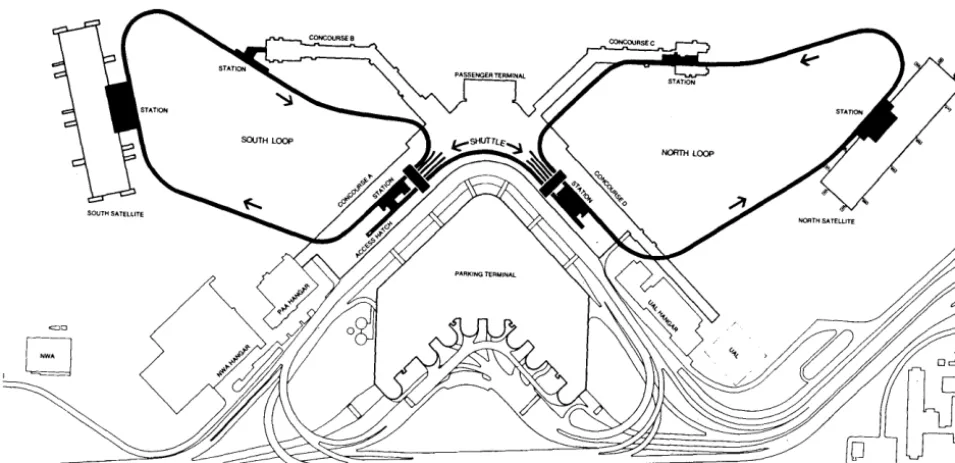
How an underground automatic rapid transit system will move people swiftly and comfortably to six stations in the airport complex - with automatic trains (like automatic elevators) available for boarding every two minutes.
Computers and Monopoly
32 The Monopoly by IBM of the Software Industry: [NT G] Position Paper
by J. L. Dreyer, ADAPSO and Software Industry Association, New York, N.Y.
How IBM is alleged to monopolize software for IBM machines and thereby produce poorer utilization of equipment and excessive requirements for equipment.
The Golden Trumpet
41 Our Subscriber List is Confidential [NT G] by James E. Carter, Shaw Elliott Inc., New York, and
the Editor
Computers and People
19 Computers and Democracy [NT A]
by Anthony Ralston, President, Association for Computing Machinery, New York, N.Y.
A thoughtful analysis of the relation of computers to a steadily more complex society in a steadily more limited spaceship Earth - and the effects of computers on freedom and on regulation.
The Profession of Information Engineer and the Pursuit of Truth
41 Unsettling, Disturbing, Critical [NT F]Statement of policy by
Computers and Automation
23 Is the Press Being Hobbled? [NT A] by Senator Sam J. Ervin, Jr., Senator from North Carolina,
U.S. Senate, Washington, D.C.
Many examples of recent efforts to discourage and prevent the press from reporting; and an analysis of the requirements of a law which will shield newsmen from the threat of prison for not revealing their confidential sources.
The magazine of the design, applications, and implications of
information processing systems - and the pursuit of truth in
input, output, and processing, for the benefit of people.
34 The New Orleans Portion of the Conspiracy to Assassinate President John F. Kennedy - I: Four Articles:
[NT A]
(1) by Edmund C. Berkeley in this issue; (2) by Jim Garrison in this issue; (3) by F. Irving Dymond in the May issue;
(4) by Jim Garrison in the May issue
On November 30, 1972, the Supreme Court of the United States refused to permit Jim Garrison, District Attorney, New Orleans, to prosecute Clay Shaw for perjury. On November
21, Jim Garrison issued a statement commenting on this re-fusal, which is Article 4 of this set; Article 1 is an introduc-tion; Articles 2 and 3 are opening statements to the trial jury, by Jim Garrison, prosecutor, and F. Irving Dymond, attorney for the defendant, in the February 1969 trial of Clay Shaw in New Orleans; Clay Shaw was charged by the grand jury with "having conspired with David W. Ferrie and Lee Harvey Oswald to murder President John F. Kennedy" - in regard to which the trial jury found Clay Shaw "not guilty".
26 The People's Need To Know - I [NT A] by Charles L. Whipple, Editor of the Editorial Page,
The Boston Globe, Boston, Mass.
How recent Supreme Court decisions and the jailing of re-porters for refusal to reveal confidential sources is
sabo-~ taging freedom of the press in the United States; and how an unqualified Federal "shield" law is needed.
6 The Problem of Truth [NT E]
by Edmund C. Berkeley, Editor, Computers and Automation and People
An argument by St. Peter, Lucifer, and Archangel Michael on distinguishing truth from lies.
41 Distrusting the Columbia Broadcasting System -Comments on the Romero Story
by Ivan Dryer, Sepulveda, Calif.
Computers and Puzzles
40 Numblesby Neil Macdonald
49 Problem Corner
by Walter Penney, COP
NOTICE
The official name of this magazine throughout· 1973 is:
Computers and Automation
[NT G]
[T C]
[T C]
We expect to change the name officially as of January 1, 1974, to: Computers and People
During 1973 from time to time, unofficially, and irregularly, we plan to use the name Computers and Automation and People as a way of informing our subscribers and readers of the intended change on January 1, 1974.
COMPUTERS and AUTOMATION for April. 1973
Front Cover Picture
The front cover shows a comput-er-controlled robot "turtle/" which has been programmed to traverse a maze. The movements of the turtle are controlled by simple programs which children write for themselves. This research is part of a long-range project at Bolt Beranek and New-man I nc., Cambridge, Mass., aimed at bringing computers into the class-rooms of elementary schools.
Departments
42 Across the Editor's Desk -Computing and Data Processing Newsletter
49 Advertising Index
50 Calendar of Coming Events 48 Monthly Computer Census
46
New Contracts47 New Installations
Key
[A] - Article
[C] - Monthly Column [E] - Editorial
[F] - Forum
[G] - The Golden Trumpet [NT] - Not Technical
[T] - Technical
NOTICE
*0 ON YOUR ADDRESS IMPRINT MEANS THAT YOUR SUBSCRIP-TION INCLUDES THE COMPUTER DIRECTORY. *N MEANS THAT YOUR PRESENT SUBSCRIPTION DOES NOT INCLUDE THE COM-PUTER DIRECTORY.
EDITORIAL
The Problem of Truth
St. Peter: (wearing a halo and sitting at the left hinge post of the Pearly Gates) Thou shalt not bear false witness. That's what I say.
Lucifer: (with his wings folded, sitting on a stone farther outside) I know, Pete, that's what's in the Good Book. But if you see a girl with a rip in the back of her dress - you don't tell her - you let her find it out when she gets home.
St. Peter: (dogmatically) There is only truth on the one hand and lies on the other, Lucifer, and I let truth through the Pearly Gates and I keep lies out.
Lucifer: Oh, Pete, Pete, wake up! That is so old-fashioned. What is true changes from generation to generation and from person to person. The Catholic Church tortured Galileo until he once more said that the sun went round the earth. And in these days the physicians have literal-ly proved that one man's meat is another man's poison: did you never hear of allergies?
St. Peter: (stiffly) I have heard of eulogies, Lucifer. In fact, I have listened to some of them.
Lucifer: No, St. Peter, allergies. One man sneezes and snif-fles from August to October from ragweed pollen in the air. The next man does not. That is an allergy. And individuals are different. What is bad, allergic for one man, makes n-o difference whatever to another one - he does not sneeze and sniffle.
St. Peter: (hesitating a bit) Well, Lucifer, even if there is some doubt about truth, I am against lies.
Lucifer: Pete, there are all sorts of lies. Of course, many lies go to hell, especially those that get found out. But how would a businessman sell a new product unless he made some glowing promises? How would revolution-ists make a new society unless they held forth some golden visions? How would people have an opportunity to elect a progressive liberal or a staunch conservative down there on Earth (Lucifer points) without making some deals which the candidates conceal or deny? How would a president stay in the White House of the United States if he told the truth about all the bribery, burg-lary, eavesdropping, wiretapping, etc., he had been in-volved in and the connection of so many important pol-iticians with it? Nowadays, truth is irrelevant. Beliefs, images, headlines, that's what counts.
St. Peter: Lucifer, lies is lies - even if that is ungrammat-ical.
Lucifer: I think you are almost hopeless, St. Peter. Archangel Michael: (wearing no halo, coming out through
the Pearly Gates, and observing the situation) What is all this discussion I hear? Peter, you look as if you had been losing an argument to Lucifer.
St. Peter: It is this way, Michael: Lucifer says truth is old-fashioned, not important, not relevant. Now I am for truth and I am against lies. But, to tell you the truth, Michael, that fallen angel Lucifer is confusing me. Arch. Michael: (gladly taking part in the discussion, and
sitting down at the right hinge post of the Pearly Gates)
6
Granted that it is hard to distinguish truth from false-hood, still that is no excuse for not trying. Granted that what is truth often changes from generation to genera-tion, still that is no excuse for not seeking the truth. Lucifer: You can't prove that, Michael. That is just an
as-sertion ab out the relation of truth to people - I should say, the relation of imaginary beliefs classified as truth to real existing persons trying to stay alive from day to day.
Michael: And how do people stay alive from day to day, Lucifer?
Lucifer: By solving problems, finding food, finding shelter, avoiding sickness, working with other people to make things they all need, and so on.
Michael: And if everybody were always telling lies to every-body else, would they be able to work together? Lucifer: (aside) Hell! I must not argue with that angel
-I can't win an argument if -I have to answer questions. I am getting into hot water . (aloud to Michael) I re-fuse to answer the question. I plead executive privilege and national security, like the president of the United States. The business of hell cannot be managed if the executive in charge has to answer questions.
Michael: So you refuse to answer? Lucifer: No comment.
Michael: (turning to Peter) Well, it is this way, Peter. No-body can solve problems without trying to get the truth. Lies, falsehoods, statements that are not completely hon-est and true, do harm. They interfere with the solving of problems. Of course most problems are hard to solve. Of course most people have a lot of hard work ahead of them trying to get good answers that are verified in the real world. To get the truth is a most important pro-cess, and everybody should and must cooperate. To re-fuse to answer questions on the ground of national se-curity or executive privilege is the earmark of the devil, Satan.
Lucifer: (his face black with rage) Don't you dare call me Satan that's "instant analysis" and you insult me -I'm leaving to go to hell. (Lucifer abruptly flies off downward; Michael and St. Peter look after him) Michael: (after a pause) To tell the truth, Peter, there are
some exceptions to answering any question truthfully. One of them is this: if you are an investigative newsre-porter, and your sources of information are confidential, then you have to refuse to reveal your sources.
St. Peter: (much relieved) Michael, thank you very much for helping me with that devilish argument. (They pass in together through the Pearly Gates)
Edmund
C
Berkeley
Editor
Good Management of Computer Operations:
1.
Managing Software Work:
It
Can Be Done
2. Data Bases: There Really is a Better Way to Manage Your Files
ADL Systems, Inc.
A Subsidiary of Arthur D. Little, Inc. Acorn Park
Cambridge, Mass. 02140
Part
I.
Managing Software Work: It Can Be Done
"1 don't think you can really manage software. It's like going off a diving board - you just have to hope."
Many senior executives share that feeling with the vice president of a steel company who used it to describe his view of software.
But the analogy is apt in two ways, and it indicates in fact that software management can be a highly devel-oped skill.
First, because we know there is a vast difference between the rank amateur whose venture off a high board is at best chancy, or the natural athlete whose innate capabilities enable him to dive relatively well, or the Olym-pic champion who supplements his basic skills with constant concern for improvement and application of tech-nique. Talents, attitudes and efforts might vary among these three - but they are in fact controllable and di-rectable towards specific goals. Second, our diving analogy points up the single most important factor in managing software: people. Unlike other forms of production which have a variety of elements to control, soft-ware production is exclusively rooted to the output of people.
In this issue of The Casebook, then, we will consider some of the struc-tures, styles and techniques by which senior managers can improve their performance off the software manage-ment high board.
It
Starts With
An Attitude:
Mature and Informed
Sufficient millions of lines of code have been written so that it no longer
COMPUTERS and AUTOMATION for Apri I, 1973
should seem remarkable when a pro-gram is written and works well. Soft-ware has matured as a discipline and as such is as manageable as any other production system. Yet our observa-tions indicate that many senior mana-gers, like the steel company execu-tive, are still ambivalent about that fact. Their ambivalence often con-veys a subtle but de facto standard to
the software staff - that miracles are still possible.
A preferred attitude is one in which performance to stated standards is ex-pected, and that deviation from those standards is a cause for concern and not an expectation.
A component of developing such an attitude is for senior executives to be well-informed. Software is a technical activity which requires management with the technical ability to establish appropriate initiatives and monitor activities in a knowledgeable fashion. Experienced management can quickly sense problems, lay down and adhere to "no surprises" guidelines, appreci-ate what is (or is not) being done, and lead the way in new directions. This level of being informed is not nearly as difficult to reach as it might seem. We have been amazed at the number of senior managers who have come from non-computer backgrounds into positions of responsibility for software management and within sev-eral months have been fully able to manage effectively a large and com-plex software activity.
These executives have brought two attitudes to their new responsibilities - a commitment to active participa-tion in their new role, despite the learning-curve problems implied by it, and a basic experience in applying
conventional management techniques to the software problem. Active par-ticipation is a self-generated attribute, but the application of management techniques does require some modifi-cation in terms of software manage-ment.
What are some of these modifica-tions, and how can a senior executive structure and apply them to his area of responsibility?
There are basically five stages in the execution of software projects, and in each there are many opportunities for management control. These five stages include:
• The systems plan
• Development of functional specifica-tions
• The systems design stage • The detailed design stage
• The implementation stage in which coding, testing and conversion to production is completed.
Let's look at each stage from the view-point of a senior manager, and iso-late those factors in each which en-able management to exercise its maxi-mum control.
The Systems Plan:
A Product Is
Developed
This is the first step in creating a pro-ductive software entity. It is neces-sarily broad - establishing overall targets, the major application to be developed, the stages of that develop-ment, and the allocation of personnel and equipment resources to get the job done.
This is the first opportunity for man-agement control, and demands maxi-mum participation to ullderstand, from the user departmellt's point of
view, what is needed. In this stage, management can match resources to need, set priorities and authorize re-sources. Too often, however, systems plans are developed as a "general un-derstanding" among various people, rather than as a specific document. If your systems plans exist in such a manner, you can be certain that dif-ferent people have difdif-ferent "under-standings," with predictable conse-quences.
Insure from the start that the product to be developed is clearly defined, with specific understanding by all concerned of the purpose and use of the system. In developing a written plan, be sure, too, that it is review-able. That is, insist that it has built into it sufficient clearly identifiable milestones that progress can be re-viewed objectively on a regular basis. Such milestones imply development in major phases, and within each phase, sufficient detail to allow management to make good decisions based on complete information. Without cost, time, staffing and progress details, the senior executive is stymied, for he cannot review and decide on the basis of facts.
The precept of creating reviewable work plans extends into every other stage as well:
o
Functional Specifications
This stage defines the system from
the user's point of view, and includes outlines of inputs, outputs, major processing steps, and files. It must al-so include definition of both the de-velopment and operating require-ments which the user will accept.
o
Systems Design
This is the stage at which the user's specifications ate converted to struc-tures which can operate within the computer's capabilities. Details of the input, output, file structure and proc-essing techniques are established, and the software techniques selected.
It also sets forth the detailed sched-ule, and the equipment needed for system operation. In a sense, the sys-tems design stage is the counterpart of an architect's design for a building after the basic structure has been approved. It sets forth the details and limitations within which the user and computer must work.
o
Detail Design and
Implementation
8
Just as the architect prepares engi-neering drawings and construction plannIng details, -tne systems design-ers must develop detail file designs, program flow charts, and perform coding, unit testing of finished pro-grams, and finally testing of com-pleted and integrated programs. These steps take place in the detail design and implementation phases. And it is usually at this point that
improper plarining starts to show up.
If you have to add an additional floor to a half-completed building, you are bound to have problems. So it is with software development. Only com-puter systems are not as tangible as brick and mortar, so the problems are often elusive.
The Management Key:
Minimize
Uncertainties
As work progresses, there are numer-ous opportunities to anticipate and manage problems. One such oppor-tunity is in the area of testing. There is a rule-of-thumb that states that 90
per cent of the processing requires 10
per cent of the code, and 10 per cent of the processing requires 90 per cent of the code. If your software testing seems to be progressing well, it may be that it is only "mainline" testing -of the broad ten per cent which is routine. Insure that unit and final test-ing covers the acute problem condi-tions of the system; if this is done, and tests out well, a major problem area will have been minimized. Another control element is continu-ous and careful documentation as work progresses. This not only mini-mizes personnel fluctuations, but in-sures development of the proper blue-prints before the bricks, boards and bulldozers arrive at the construction site.
Milestone Reporting:
Memos Make
ItEasy
At each stage of development, if a careful systems plan was developed, there will be numerous milestones in-dicated. To simplify management re-view, a system of regular reporting on accomplishment of these milestones should be established and adhered to. Often, a system of memo reports can cover most of the minor milestones. More elaborate reporting is suggested for major achievements in which complex integrations are involved.
The goal of documenting and report· ing on small-unit achievements is tG make systems development as people-independent as possible.
in establishing detailed project plans, then, it is vital to have schedules and budgets that are realizable, and meas-urable against reality. Bar charts, network charts, and numerous other methods are used for plotting progress.
By breaking tasks into identifiable segments - no one of which repre-sents more than 2-4 per cent of the total - you can avoid the trap of thinking that because 80 per cent of the budget has been expended, 80 per cent of the work has been done.
Anticipate the User's
Situation
This is the most critical step in sys-tems development. User expectations and needs will evolve, especially in projects which require lengthy devel-opment or involve numerous depart-ments. Thus it is crucial that the data processing department finds out ex-actly what the user wants, specifies it
to his satisfaction, and gives it to him. In this process, user involvement is mandatory. Have him review specifi· cations, look at sample outputs, and stay informed. Too many organiza-tions attempt to develop a system based upon preliminary user informa· tion which they then shape and pro-ject as they see it, only to find when the job is completed that it is not at all adequate or desirable for the user department.
In this process, it is important to remember that the user frequently does not know or is unable to specify exactly what he wants - just as an ar-chitect's client is often unable to define the elements of the building he de-sires.
The challenge for software manage-ment, then, is to help him translate his needs openly, to support him as he does so, and to establish from the very start a workable, manageable, reviewable program to which he and the systems developers can commit. Without such sensitivity and plan-ning, the process of software develop-ment becomes an expensive and sterile exercise. .
Data Management And
Data Communications
Challenge EDP Users
Our current activities indicate an in-creasing interest by computer users in two popular but challenging topics - data management systems and data communications.
In data management software, clients are encountering difficulty in deter-mining when and when not to use systems that facilitate the storage and retrieval of information from com-plex files. Numerous software pack-ages are available, but it is often dif-ficult to assess the potentials and limitations of such systems. The prin-cipal problems center around file structuring, devising updating and re-trieval modules and in throughput and recovery needs.
In data communications, a host of newly available software to provide message handling and support func-tions is also being marketed. Clients
have expressed concern that the use of suth systems, while reducing de-velopment costs, is extravagantly costly in terms of resource require-ments. Theyhave also been concerned with implementing front-end preproc-essing systems, built around mini-computers, because of their lack of knowledge of the problems inherent in such systems.
ADL Systems has had deep experi-ence in both of these areas, having developed some of the nation's most intricate data management and re-trieval systems, and elaborate data communications systems for over 20
clients. If you are investigating prob-lems such as these, we would be happy to discuss them with you. Sim-ply check off the appropriate box on the reply card if we can be of as-sistance.
Part 2.
Data Bases: 'There Really is a Better Way to Manage
Your Files
.. We became so bogged down with file changes that frustration led us to
look at data base systems. It meant some pain, but we were pleasantly surprised with the results."
More and more senior executives share the view, expressed by the fi-nan~e vi~e president of a Connecticut manufacturing firm, that data man-agement systems are finally paying their way.
Like the Wright brothers' pioneer-ing efforts, early data base systems were meticulously conceived and im-plemented but never developed much lift when applied to the practical re-alities of processing large files that had to be sorted, indexed and stored with live data.
Although memories of these earlier models still linger, today's data man-agement - or data base, or data base management, or information manage-ment, as you prefer - systems have passed the prototype stage, and are in use at hundreds of sites.
What do these systems do? What are their characteristics? And how do you determine if they might be
appro-COMPUTERS and AUTOMATION for April. 1973
priate for use in your installation? In this issue of The Casebook, we will address these questions to provide a framework for your planning.
Many Parts Form
A Whole
The data base system is relatively easy to understand. It consists princi-pally of three parts that emphasize a single function: the efficient manage-ment of files of information.
The term data base refers to just the information file. Data base
soft-ware is the set of programs whose function is to manage the da ta and the programs that operate on it. The data base system is the entire hierarchy of elements, files and applications pro-grams that result in efficient manage-ment of information.
In its most basic form, a data base consists of a number of data elements,
each of which is a unit of data that is complete in itself. A part number, for example, is a typical data element. These elements are organized into logically related groups called data
structures. A common data structure is a part number, its description, its supplier code, and its inventory status. Information files, or data files, are composed of a large number of data structures of the same type - for ex-ample, all of the parts data for a fam-ily of products.
The difference between data base systems and conventional files can be seen at this point. The data files in a data base system are organized in a fashion that permits their use in sev-eral applications, rather than a single application. Thus, in data base sys-tems, the focus shifts from a particu-lar application and its specific input and output needs to a more general requirement for the data files to serve a number of applications.
Take the case of the manufacturer of the product whose parts list is referred to above. Normally, the final products are made from many parts and subassemblies. In conventional systems, parts information would re-side in several physically separated files - one for inventory control, another for warehouse location, another with pricing schedules, a fourth with vendor codes, and still another describing subassembly us-age. A change in the data for any part would require modification of all five files. This is a common experience for thousands of computer users today.
With a data base system, all of this data is organized in a single file. Par-ticular applications - such as inven-tory, engIneering speciflcations,-order handling and pricing - all use the same file, each selecting from it the
infor-SOME EXAMPLES OF DATA
BASE SYSTEMS
o
An automobile manufacturer is us-ing data base systems for a dealer information system.o
An auto parts manufacturer uses a file management and reporting system for an order processing and inventory control system. The data base software has greatly fa-cilitated the preparation of many one-time reports.o
Another large machinery manufac-turer with extensive job-shop op-erations has developed an on-line system using data base concepts for the preparation of work orders and machine scheduling.o
A shipping firm is using data base systems to maintain information about ship movements, cargo, dock requirements, and space alloca-tion.o
A bank is using a data base sys-tems approach for a corporate cli-ent information system,o
Several insurance companies are using data base techniques for pol-icy holder information systems.o
ADL Systems has developed a ma-jor system for the detailed struc-tural design of naval ships, using a data base and program manage-ment system developed by us.Figure 1
mation needed, often through a com-plex cross-referencing scheme using indexes, keys, and sophisticated soft-ware routines. Other examples of data base systems are cited in Figure 1.
The logic of this central file con-cept seems indisputable, to the extent that one might wonder why every computer system isn't so organized. There are many positive and negative factors involved, however, and senior executives should be aware of them.
Let's Look At
The Pros and Cons
Advocates of data base systems point to five major advantages that these systems offer over conventional processing techniques:
o
Program development - Special filemanagement software Can simplify application program development by performing automatically many rou-tine liD and "housekeeping" soft-Ware functions.
o
File structures - Sophisticated file structures offer powerful cross-refer-encing capabilities that eliminate re-dundant data and make possible fewer files.o
System design - With data basesys-tems, far fewer "overhead" programs for use with specific applications are needed. This cuts down on sorts, merges, file extracts, duplicate updat· ing of files, and scanning of files.
o
Operations - Data base systems usu~ally require fewer files and programs, meaning less set-up time and less ex-ternal manual management of pro-grams and data, with potentially streamlined operations.
o
Flexibility - A major advantage cited by data base proponents is the ease with which changes in data elements can be implemented in such systems. There is a debit side, to be sure, and some of the cautionary factors to con-sider in data base evaluations are sig-nificant indeed:o
Equipment - Usually a significant amount of additional hardware -mostly memory and random access storage - is needed to support such systems.o
Software - Much more complicated software is required to manage data base files. Some of this can be pur-chased, but sophisticated skills are needed to use and maintain it.o
Design and Start-Up - Aside from be-ing new, data base concepts are in-herently complex, requiring a broad approach and very careful attention to planning, details and service goals.D
Processing efficiency - The nature of the file techniques implies that indi-vidual accesses to data elements must be made. These accesses, mo~e over, are often controlled by a hier-archy of indexes and keys, resulting in somewhat slower overall process-ing speed.To generalize, data base systems can be a major help to users with large file management and updating prob-lems, high demand for one-time ac-cesses and a large volume of changing retrieval needs. They probably are not a viable approach for the small-scale user, or for an initial implementation effort.
Data Base Software
Can Help
Specialized software can be a big help in implementing data base sys-tems. A number of software products are commercially available to take on the basic tasks of program manage-ment, data access and related file management functions. Such soft-ware generally has the following ca-pabilities:
• Data Definition Language. This fun-damental capability defines how rec-ords will be logically connected and how and where they will be stored, enabling the system to generate index tables that support the automatic re-trieval feature which is at the heart of data base software.
• Access Language. A user-oriented. easy-to-use method of retrieving arbi-trary combinations of data elements, enabling users to access just the data required for a particular processing task.
10
• Output Report Language. This is used to establish quickly and easily the for-mat of reports which list and summa-rize selected data retrieved from the data base.
• Program Management. A feature that coordinates the operation of particu-lar application modules written by the user to operate on the data base, such as making updates, specialized analy-ses, etc.
Besides these basic capabilities, data base software may possess checkpoint/restart capabilities, secu-rity features, the ability to operate in both an on-line or batch mode, and various facilities for performing housekeeping functions on complex cross referenced files.
Packages differ widely in the de-gree to which they possess these ca-pabilities and their relative efficiency. Indexing, for example, has tradition-ally been a huge consumer of machine time and software overhead. Yet the need to establish "pointers" which permit the cross-referencing of data from one file to another is fundamen-tal in a data management system. An analysis of pointer indexing tech-niques can help a user assess, in the selection process, the likely indexing overhead factor he will later contend withJn a processing mode.
It i's also important to assess the capabilities of data base software to manage applications programs and the processing of transactions. Multi-thread processing of different trans-actions and the re-entrant manage-ment of the applications modules can do much to improve the efficiency of the system, but they may create cer-tain internal interlocks.
Which Way
ToGo
Selection of the proper data base software depends to a large extent on your type of EDP operation and the priorities in terms of file organization and access dictated by your require-ments.
There are three major features to consider in the selectiop. process:
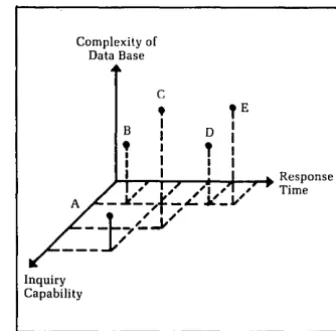
• Complexity Of The Data Base. This factor considers a system's logical capacity to handle complex cross-referenced file organizations. Some systems handle only a moderate num-ber of simple files; others can handle several full network files.
• Inquiry Capability. This defines the ease with which a user can search or retrieve from a file. Some data base software systems possess rigidly de-fined inquiry languages, while some allow free-access inquiry, using almost vernacular English.
• Throughput Or Response Time. The speed of acc~ss to' files and records, and the number of simultaneous
in-qUlfles possible, is a critical feature. Many packages allow only a single user inquiry at a time, while others permit several. Response times also vary widely. Some packages are for on-line use, while others operate pri-marily in a batch mode.
As Figure 2 suggests, every real data management system possesses these three dimensions. But there are trade-offs. The capabilities of anyone sys-Jem are often weighted towards peak
Complexity of Data Base
c
•
TE
I I
I I
I ,
I I
J-+---,...,'i--7-+-+--r+ Response " , , ' 1 ' , Time
A -
Jr_-,f -"-
Jt _J,'__
-_±.7~.J,/
Inquiry Capability
Figure 2. Data base software systems involve some trade-off within their three principal functions, as shown in this three-dimensional representa-tion. Package "E", for example, of-fers excellent response time to a com-plex data base, but has poor inquiry
capability. .
efficiency in just one or two of the di-mensions. In practical terms, then, a user must be willing to sacrifice ef-ficiency in one or more functional areas in order to maximize efficiency in others.
Users of data base software should recognize that they will have to bend their approach to the structure of the package used, rather than modifying it to meet their desires. This stark statement is based on economics. The cost of developing data base software ranges from ten to 50 man years of effort, and involves exceedingly com-plex logic and programming steps. To attempt modification of existing soft-ware to make it more responsive to specific user needs is a burden few are able to justify.
Users must generally accept and adapt their standards to what is com-mercially available. More are doing so every day - some by using data bases for only a single major applica-tion; others by committing the en-tire direction of future programming and systems work to a data base man-agement environment .
C
[image:10.617.383.551.182.348.2]Automation: Its Impact on the Delivery of Health Care
Ray M. Antley, M.D. and Mary Ann Antley, M.A.
Indiana University Medical Center 1100 West Michigan St.
Indianapolis, Ind. 46202
"Many factors have combined to create a condition that necessitates the general use of automation in medicine."
Developments in technology in concert with recog-nitionof the need for expanded medical care and compounded by the existent doctor shortage are pow-erful interacting forces that will structure the fu-ture application and development of automation in medicine. These forces will tend to channel techno-logical application toward assisting the primary phy-sician in the delivery of health care. Furthermore, the evolution of technology is such that the assist-ing phase will be transient and machines will be de-veloped which will do what the physician does now. These innovations seem remote tod~y, when only rep-resentative machines exist, but once these changes begin, they will develop quickly and the resulting readjustment in physicians' Job function will be cha-otic unless these changes are anticipated in medical education at this time.
Health Delivery
In the next two decades, health delivery will be approached by the application of automated processes which will perform tasks which are now carried out only by the primary physician:
1. The trend toward comprehensive third party payment medical service through either pre-paid group health such as Kaiser-Permanente, or Federal Health Service, encourages large group practice situations that would make it economically sound to use computer technology;
2. Automation offers a readily utilizable so-iution to the chronic need for medical man-power;
3. The rate of increase in the number of ef-ficient systems for aiding the physician in history taking~ physical diagnosis, and diag-nostic tests anticipates the widespread incor-poration of these machines into health deliv-ery structures.
4. The prospects of storing. and processing medical data for over 60 million people
COMPUTERS and AUTOMATION for April. 1973
causes politicians, administrators and physi-cians to look to automation a~ a solution for handling billions of bits of information.
It may be postulated that, as in other areas where technology has been extensively utilized, the adap-tation of various services to computer technology will result in radical changes in the appearance and presentation of these services. The use of automa-tion will also allow for second and third order changes in affected areas by the elimination of some jobs and the creation of others. It is necessary to anticipate the basi~ nature of these changes which the general use of computer technology in medicine will bring about so that the medical profession can realistically plan for medical education and health care delivery in the future.
Group Practice Encourages Medical Automation
Many factors have combined to create a condition that necessitates the general use of automation in medicine. Since World War II there has been a grow-ing trend toward group practice in the Uni ted States. There are at least three reasons for this trend: medical specialization; the physician's desire to create a more satisfactory working situation for himself through group practice; and the public's de-mand for help in obtaining comprehensive medical care through some form of group health.l This demand for help has resulted in the public's participation in various health insurance programs, in the suc~ cessful pre-paid medical care offered in the Kaiser-Permanente Plan, and i~ projected government finan-ced comprehensive health service (National Health Insurance). These group health plans which are de-signed to enable the delivery and maintenance of better health for more people economically, encour-age large clinic-type organizations. Since it is not unusual for a person to live as far as an hour away from his work, the idea of driving an equal distance to see a doctor makes the center-type prac-tice an acceptable reality for patients.
type medical practice is also in the ascendancy in the medical profession because it allows for more specialty care in fields of steadily increasing com-plexity. Large clinic practice situations make the introduction of computers economically realistic be-cause of the shared expense and the central availa-bility of the machines to many physicians. A major problem of the practicing medical doctor today is record keeping. Some physicians estimate that they spend one-half of their time filling out insurance forms and recording their findings. The record keeping for a group can be done more efficiently by machines, and the larger the number of clinics to be administrated, the less expensive and more necessary this service becomes. The burdensome problem of manually kept records, the adaptability to center practices, and the attractiveness of shared expenses will continue to encourage the introduction of auto-mation into the administrative aspects of medicine.
Physician Shortage Demands Innovative Solutions
Underlying the physician's reasons for the growth of group practice, i.e., the desire to provide ex-cellent specialty care and to plan his hours, one finds a very basic problem -- the shortage of physi-cians. An AMA survey conducted in 1966 showed that this overall shortage is accentuated by the two to one frequency of medical personnel in urban areas at the expense of rural communities. 2 The majority of group practices at this time are not even located in the inner city or in rural areas -- areas where the need for physicians continues to rise. This unequal distribution of manpower tends to negate any super-ficial gain in total number of physicians which can be shown from an increased enrollment in medical school. Even in prosperous suburbia, alternating night calls and weekend responsibilities are merely ways of insuring that the physician has some blocks of free time; they do not reduce the number of pa-tients to be seen. When an increased supply of doc-tors and a reorganization of their work situation fails to bring about a meaningful improvement in the basic problems of physician shortage and work load, an investigation of available innovative measures is in order.
Doctors' Assistants
The use of doctors' assistants to perform semi-skilled functions thnt the doctor does today has been initiated by some physicians, and there are several active training programs at this time. Training programs have been designed to insure the acquisition of specific skills in obstetrics,3 pe-diatrics,4 and surgery.S Acceptance of these trained doctor's assistants by patients and the medical profession has been positive.
While it is anticipated that paraprofessionals would help solve the problem of the physician short-age, it is doubtful that their use would signifi-cantly reduce the cost of medical care. Two trained aids could demand salaries comparable to one physi-cian. The word demand is especially appropriate here because whereas the physician, as a profes-sional, has hesitated to strike, it may be foreseen that paraprofessionals will organize themselves to acquire better working conditions.
Automated Medicine Today
As a second innovative approach, the medical pro-fession has looked to automation, which has been used so effectively in industry and business to in-crease production while reducing manpower. Automated histories, physical exams, and diagnostic tests have
12
been devised which are capable of helping the physi-cian deliver better medical care to more people. These systems, properly directed, can even replace the physician himself. Let us examine the machines available at the present time to help the physician give better medical care.
Medical History: Programming Insures Completeness and Retrievability
In the area of history taking, several low cost computers have already been successfully introduced. Slack et a1 6 have reported the use of an inexpensive computer (Linc) with a computer terminal and cathode ray display tube which takes a detailed allergy his-tory directly from the patient. The program con-tains 700 possible questions and statements. If a question is answered in the affirmative, a subset of questions follows. If the question is answered neg-atively, a question from the next major category ap-pears. When a question cannot be answered, an al-ternative set of explanatory questions is asked. Each question must be answered by the patient before the next question appears. Using this format, a de-tailed allergy history can be obtained in about twenty minutes. A second workable automated history system has been described by Grossman and associ-ates. 7 Once again, the history is obtained by means of a dialogue between the patient and the computer through a teletype terminal, and the patient's re-sponse to each question determines the next ques-tion. A third automated medical history system now in use at the Mayo Clinic has been reported by Mayne et al. 8 In all of these systems, the computerized history has been compared favorably with that taken by the individual physician. In fact, in certain areas, the peculiar abilities of the media make an automated history highly desirable. The breadth of the work-up and the objectivity of the data collec-tion found consistently in automated histories are not present in those of the physician.7~8 Grossman et a1 7 postulates that "history taking as used by most physicians is to corroborate an hypothesis and more importantly to develop management and disposi-tion plans for the patient".7 The automated history is also more readily interpretable by another physi-cian because of the uniformity and clarity wi th which its data is presented. The computers which have been developed to obtain these histories are capable of both data collecting and processing so that in thi s one area, i t is possible to install the computer and completely eliminate the physician from taking routine histories. This would give the doctor more time for other areas of work, would allow him to concentrate on patient adaptive processes, and would result in uniformly careful data collection that is easily retrievable.
Physical Examinations: Machines Offer New Structure
Automation of the physical examination thus far has been limited to programmed physical examination for entry of the results into the computer. Kanner9 has developed a branching questionnaire which the examining physician can expand from about 20 entries for a normal person to 17S3 potential answers. This approach permits efficient use of the physician's time, while insuring a systematized physical exami-nation that is recorded in a uniform pattern. This information in digital form is automatically avail-able for data processing leading directly to a dif-ferential diagnosis. Statistical analysis of the information in the uniform data bank permits criti-cal auditing for quality control of medicriti-cal care. The former, coupled with the automated history tak-ing, can assist the physician in the direct develop-ment of a treatdevelop-ment plan. The latter will permit
the delegation of the physical exam to paraprofes-sional individuals.
New, Scanning, Detection Devices
From these machines which help the physician re-cord a better physical examination within the tra-ditional system, we can go on to examine the possi-bility of machines that can eliminate the physical examination as it is presently conceived. For ex-ample, there are detection devices which could be harnessed to additional hardware for routine body scans. Sonar, with the power to discern a 1 mm ir-regularity in a smooth surface, is a number one pos-sibility. For physical diagnosis this scan could be mounted on a contraption which would systematically scan the chest and ~bdomen of a patient who posi-tions himself on the examining platform. The pro-gram would adjust the scanning procedure to the pa-tient's body size and contour. Erickson and Brill lO have already reported the digitalization of ultra-sonic images. Software development for the analysis of digitalized ultrasonic images might be developed to discern the size of the visceral organs like the liver, the kidney, the heart and the spleen. In ad-dition, there are other sensors such as a detector of thermal emission which would systematically traverse the body's surface, measuring difference in heat emission. From this data, inference could be made concerning normal and abnormal blood flows. A gastro-intestinal radiosensor has already been de-veloped which can measure pH and gut motility.ll Its signals can be monitored remotely and the signals directly transmitted from computer entry and analy-sis. An automated, expanded SMA can measure numer-ous serum electrolytes, proteins, and enzyme levels. The results from the SMA can be sent straight to the computer for evaluation as well as storage. Each of the diagnostic systems enumerated above are capable of producing electrical signals which can, in theory, be processed by the computer. With the development of analysis programs for each of these automated systems, the potential exists for detection of a more basic patho-physiology than any presently exe-cuted physical exam. These systems would be capable of automatically instructing the patient without medical personnel. They are not only able to re-place various aspects of the physician's traditional physical examination, but their approach is capable of detecting a more basic cause of the disease.
Differential Diagnosis: Computers Aid Decisions
Differential diagnosis is another area where ma-chines have been designed to help the doctor do a better job. As the body of information to be brought to any diagnoses has multiplied, the physi-cian has had to master an ever-widening setoffacts. The doctor's recognition of the increasing complex-ity of accurate diagnosis and treatment may be seen in the large percentage of physicians who choose to enter specialty practice where there is at least a potential for keeping up. For example, in 1900 when a patient was diagnosed as having dropsy, the physi-cian had only one decision to make: how much digi-talis leaf to prescribe. Today, the finding of pedal edema is only the beginning of a complex dicision-making process. The physician must determine if the fluid accumulation is due to congestive heart fail-ure, renal failfail-ure, venous obstruction, or lymph channel obstruction, Determining the abnormally functioning organ is not enough; further pursuit leads to a subset of diagnoses with their unique form of treatments. The plan of recommended therapy has frequently changed in the past five years or less. Obviously, the once simple skill required for diagnosing and treating dropsy has mushroomed into almost a subspecialty.
COMPUTERS and AUTOMATION for April, 1973
Storage of Information
The computer's skills are peculiarly adapted to aiding the physician in the practice of modern medi-CIne. It is able to store a large body of informa-tion in a manner that is easily retrievable and to quickly process new facts. Such a readily available source of information can be an invaluable aid to the physician in arriving at the causes and treat-ment of disease.
Baumeister 12 has graphically shown how this tech-nique can help establish a surgical diagnosis. He emphasizes that the use of the computer forces the surgeon to follow a logical procedure in gathering diagnostic information. He further suggests that the computer checklist can help prevent precipitous surgery which may occur when a patient presents an acute abdominal pain. The computer, with its total recall of the differential diagnosis and with its application of statistical methods, increases the rigorousness in the diagnosis and lessens the oppor-tunity for error.
This aid in decision making may be seen in the development of a program for electroencephalogram (EEG) analysis to diagnose brain injury. Here, an apparently healthy patient's complaint of difficulty in concentrating months after a head injury may be dismissed as neurotic by the conscientious physician but the computerized EEG analysis indicated that in the affected area there is a detectable contingent negative variation depression. The organic causes for the complaint will influence the doctor's deci-sion as to the recommended treatment. 13
Thus, it may be seen that the need for additional manpower and for aid in utilizing the burgeoning body of medical knowledge, coupled with today's tendency to "think technology" when problems of ef-ficient delivery of services arise, will naturally lead to the increasing utilization of mechanical aids which have already been developed and which will continue to be improved upon. Just how exten-sively they will be used is more difficult to pre-dict at this time.
Independent Diagnosis by Machine
It has also been shown that some of the machines which are now used as diagnostic aids can be readily adapted to make independent diagnosis in ways so different from the traditional approaches that what was done before becomes unrecognizable. These new approaches allow for second and third changes in health care as we now know it. Just as the greatest advance in radio technology was not achieved by mak-ing a better radio tube but by developmak-ing the tran-sistor, so the most effective uses of computer tech-nology in medicine will not come from computer~ . which are designed to imitate the work of the physi-cian as it is now carried out, but from machines which are designed to achieve basic medical goals in ways peculiar to their own abilities.
For example, if automated processes are developed which diagnose viral hepatitis directly from an SMA analysis with 99.7% confidence, then the necessity for the physician to determine the size of the liver by palpation may be superfluous. If treatment is prescribed without a physical exam (and often diag-nosis itself may be bypassed for treatment 14 ) then the structure of medical practice is in for major reorganization. The central focus on the impor-tance'ofthe physician's powers is removed when a technician or the patient himself can administer these machines.