© 2019, IRJET | Impact Factor value: 7.211 | ISO 9001:2008 Certified Journal
| Page 1581
MODIFIED SEPIC CONVERTER WITH SLIDING MODE CONTROLLER TO
IMPROVE THE EFFICIENCY
D. Shobana
1, R. Nivedha
2, G. Monica
3, D. Shalini
4, V. Sangeetha
51
Professor, Department of Electrical and Electronics Engineering, Panimalar Institute of Technology, Chennai
2,3,4,5
Ug Scholars, Department of Electrical and Electronics Engineering, Panimalar Institute of Technology, Chennai.
---***---
Abstract –
In this paper modified SEPIC converter with sliding mode approach is used to control the output from the solar panels. Modified SEPIC converter consist of an additional single inductor and capacitor which improves the efficiency. The sliding mode control is a non linear control method that alters the dynamics of a non linear system. Conventional PI controllers are not so efficient for different loads and disturbances. In order to overcome the drawbacks a proposed SMC based equivalent controller is implemented on the modified SEPIC converter. It provides a non inverting output which is an added advantage compared to conventional buck boost converters.Key Words
: Modified SEPIC converter, Sliding mode control (SMC), PI controller, on Linear Control, DC-DC
Converter
1. INTRODUCTION
Renewable energy sources have become popular in electrical grids due to environmental drawbacks of fossil fuels. DC-DC converter are vital devices for improving the efficiency and reliability of renewable solar PV panels. Moreover robust performance of the converter in a wide operating range is also crucial, since highly nonlinear variation in the generated PV voltage exist due to varying solar radiation and temperature. There are several methods to control dc-dc converters such as linear controllers, hysteresis control, Pulse Width Modulation voltage mode control, PWM current mode control, and Sliding Mode Control (SMC). The SMC is suitable for nonlinear systems such as switched converters to achieve the required dynamic response and steady state operating point. In addition, the SMC is not sensitive to changes in system parameters as it is a variable structure system. Moreover, The SMC is characterized by robustness, stability and fast dynamic response. SEPIC converter is a buck or boost DC-DC converter circuit that the output can be lower or higher than the input voltage. Diverse modifications are applied to the SEPIC circuit to improve the efficiency and performance. Conventional PI control techniques
in linear control methods are well known procedures. These methods are frail against external disturbances and cannot
guarantee a wide stability margin under different operating regions due to the nonlinear behaviour of DC-DC Converter.
In order to overcome the disadvantages of the conventional PI controllers modified SEPIC converter is used in this paper. It has an additional inductor and capacitor which improves the efficiency. Apart from this Sliding mode approach is implemented on the SEPIC converter so the nonlinearities in the output could be easily handled and hence this method provides more efficiency compared to other conventional techniques. Matlab/Simulink results of the SEPIC converter with SMC approach is also added in this paper.
The advantage of a SEPIC converter is its non-pulsating input current and can be used as an alternative to a boost converter, with a higher efficiency and a noninverting output. Traditional control of a SEPIC converter uses a Proportional Integral
Derivative(PID) algorithm. This control technique is a linear control technique. But since the converters are non-linear and
© 2019, IRJET | Impact Factor value: 7.211 | ISO 9001:2008 Certified Journal
| Page 1582
1.1 Analysis of Modified Sepic Converter
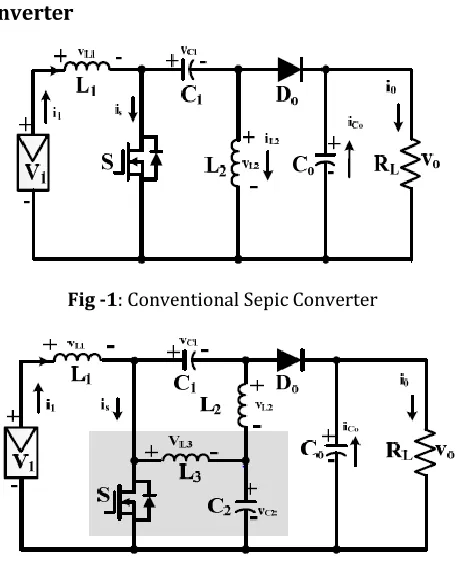
Fig -1: Conventional Sepic Converter
Fig -2: Modified Sepic Converter
The conventional SEPIC converter consist of static switch S diode (Do), and capacitor (C1-Co) .An addition of a single inductor L2 and Capacitor C2 reconfigures the SEPIC converter circuit.When the Switch(S) is turned on the diode Do is blocked inductors L1,L2 and L3 stores the energy and the capacitor Co discharges the stored energy.At the instant of S is turned off energy is transferred to the load through the diode Do and capacitors.
Fig-3: On state of modified Sepic converter
© 2019, IRJET | Impact Factor value: 7.211 | ISO 9001:2008 Certified Journal
| Page 1583
When the switch S is turned on, the inductance, voltge equations given below can be written to the circuit over one period insteady state
.
Similarly when the switch S is turned off, the inductance, voltage equations are varied over one period in steady state.
1.2 OPEN LOOP BLOCK DIAGRAM OF SYSTEM
Fig-5: Open loopdiagram of the system
The pv panel consist of array of cells which convert the solar energy in to electrical energy.The ouput of the panel is fed to the bloking diode.The blocking diode prevents the power flow in reverse direction to the panels during night time.The output of the pv panel is fed to the SEPIC converter.The SEPIC converter is a DC-DC converter that converts the signal from the panel in to a form suitable for the load.The trigger circuit is used to trigger the semiconductor switches that exist inside the sepic converter.The major disadvantage of the open loop system is that the output of the SEPIC converter could not be controlled based upon the changes in the load.This disadvantage could be avoided by using the closed loop model of the system.
1.3 CLOSED LOOP BLOCK DIAGRAM OF THE SYSTEM
Fig-6: Closed loop block diagram of the system
© 2019, IRJET | Impact Factor value: 7.211 | ISO 9001:2008 Certified Journal
| Page 1584
1.4 SIMULATION RESULTS
The simulation results shown below shows the various input signals, output signals and control signals.
[image:4.612.189.422.139.310.2]Time(s)
Fig-7: MPPT Output
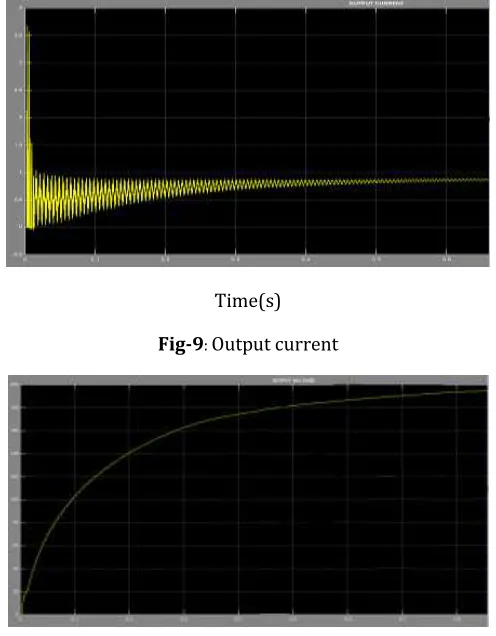
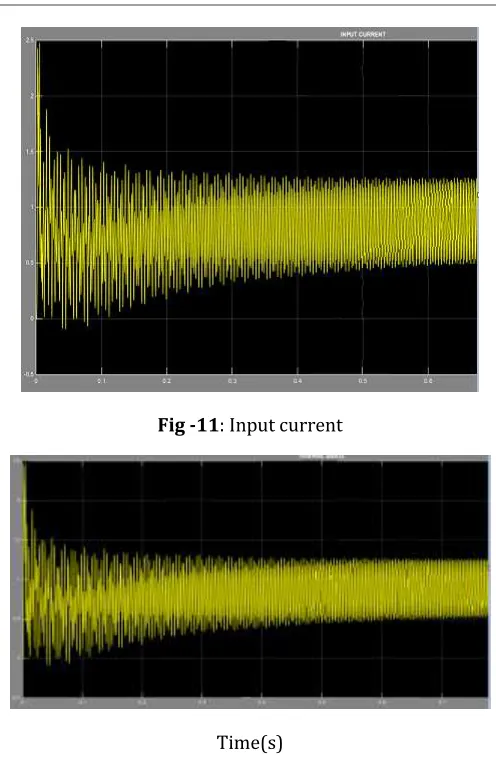
The simulation results are given which includes the input current signal, output voltage signal, output current signal, MPPT output and Control signal. From the simulation it is clear that the input current to the controller contains more oscillations.But the output current from the SEPIC has less oscillations and becomes constant after a particular time interval.
Time(s)
Fig-9: Output current
[image:4.612.182.430.374.692.2]© 2019, IRJET | Impact Factor value: 7.211 | ISO 9001:2008 Certified Journal
| Page 1585
Fig -11: Input currentTime(s)
Fig-12: Control signal
1.5 CONCLUSION:
The modified SEPIC converter with Sliding Mode Control approach is thus explained in this paper. Thus by including an inductor and capacitor to the conventional SEPIC converter the efficiency of the converter is improved to a great extent. The simulation results prove that modified SEPIC converter is efficient than conventional controller. Apart from this constant switching frequency could be achieved by making dynamic hysteresis control method on the existing system.
REFERENCES:
[1] F.Ahmad, A.Rasool, E.E.Ozoy, A.Sabanovic, M.Elitas, “Robust Cascaded Controller for DC-DC Boost and Cuk Converters” World Journal of Engineering, Emerald Insight, Vol. 14,No.5,2017(in press).
[2] S.B.Mahajan, P.Sanjeevikumar, F.Blaabjerg,”Multistage DC-DC Step up Self Balanced and Magnetic Component –Free Converter for photovoltaic Application: Hardware Implementation”, Vol.10 (5), 719,Energies Journal, MDPI publication Switzerland, May 2017.
© 2019, IRJET | Impact Factor value: 7.211 | ISO 9001:2008 Certified Journal
| Page 1586
[4] S .B. Mahajan,P. Sanjeevikumar, F. Blaaberg, R. Kulkarni, S. Seshagiri,A.Hajizadeh,”Novel LY Converter Topologies for High Gain Transfer Ratio-A New Breed of XY Family”,4th IET Intl.Conf. On Clean Energy and Technology(IET_CEAT16),2016.[5] S. B. Mahajan, R. Kulkarni, P. Sanjeevikumar, F. Blaabjerg, V. Fedak, M. Cernat,”Non Isolated and Non-Inverting Cockcroft
Walton Multiplier Based Hybrid 2Nx Interleaved Boost Converter For Renewable Energy Applicatins”,IEEE Conf. on 17th The
Power Electronics and Motion Control,2016.
[6] S. B. Mahajan, P. Sanjeeevikumar, F. Blaabjerg, O.Ojo,S. Seshagiri, R.Kulkarni,”Inverting Nx and 2Nx Non Isolated Multilevel
Boost Converter for Renewable Energy Application”,4th IET International Conf. On Clean Energy and Technology, 2016.
[7] P.Sanjeevikumar, G.Grandi, P.Wheeler, F.Blaabjerg, J.Loncaraki, “A Simple MPPT Algorithm for Novel PV Power Generation
system by High Output Voltage DC-DC Boost Converter”,Conf. Proc., 24th IEEE Intl. Symp, on Industrial Electronics,2015,Rio de
Janeiro(Brazil),pp.214-220.
[8] R.Gules, W.M.Santos, T.A.Reis, E.F.R.Romanelli,”A modified SEPIC converter with high static gain for renewable applications”,IEEE Trans. Power Electron., vol.29,no.11,pp.5860-5872,Nov.2014.
[9] C.Restrepo, J.Calvente, A. Cid, A.Aroudi, R.Giral, “A non-inverting buck-boost dc-dc switching converter with high efficiency and wide badwidth”,in IEEE Trans. Power Electron., vol. 26, no.9, Seo.2011 pp. 2490-2503.
[10] F.Blaabjerg, F.lov, T.Kerekes, R.Teodorescu, “Trends in power electronics and control of renewable energy systems,”14th
Int. Power Electro & Motion Control Conf., EPE-PEMC’10, Orid(Macedonia),pp.K-1,K-9<6-8 Sep. 2010.
[11] M.H.Rashid, “Power electronics; circuits, devices, and applications”,Pearson Education, India, 2009.