User Association and Resource Allocation in
Unified Non-Orthogonal Multiple Access
Enabled Heterogeneous Ultra Dense Networks
Zhijin Qin, Member, IEEE, Xinwei Yue, Student Member, IEEE, Yuanwei Liu, Member, IEEE,
Zhiguo Ding, Senior Member, IEEE, and Arumugam Nallanathan, Fellow, IEEE
Abstract
Heterogeneous ultra dense networks (HUDNs) and non-orthogonal multiple access (NOMA) have
been identified as two proposing techniques for the fifth generation (5G) mobile communication systems
due to their great capabilities to enhance spectrum efficiency. This article investigates the application
of NOMA techniques in HUDNs to support massive connectivity in 5G systems. Particularly, a unified
NOMA framework is proposed, including power-domain NOMA and code-domain NOMA, which can
be configured flexibly to serve different applications scenarios. As a further advance, the unified NOMA
framework enabled HUDNs is further investigated, with particular focuses on the user association and
resource allocation. Two case studies are provided for demonstrating the effectiveness of the unified
NOMA enabled HUDNs. Finally, some main challenges and promising research directions in NOMA
enabled HUDNs are identified.
Index Terms
Heterogeneous ultra dense networks, non-orthogonal multiple access, massive connectivity, user
association, and resource allocation.
I. INTRODUCTION
The last decade has witnessed the densification of wireless networks due to the various types of wireless
communication services. In order to support explosive data traffic, the concept of heterogeneous network
Z. Qin and Z. Ding are with Lancaster University, Lancaster, UK, LA1 4YW, email:{zhijin.qin, z.ding}@lancaster.ac.uk. X. Yue is with Beihang University, Beijing 100191, China, email: xinwei [email protected].
(HetNet) has been proposed by overlaying small cells with low transmit power to macro cells. Through
the dense deployment of small cells, throughput and spectrum efficiency of cellular networks can be
enhanced significantly [1–3]. Moreover, it is predicated that Internet of Things (IoT) will bring critical
challenges for the fifth generation (5G) communication systems as billions of devices are to be connected.
In order to support massive connectivity with heterogeneous quality of service (QoS), non-orthogonal
multiple access (NOMA) has attracted extensive attentions due to its potential capability to enhance
spectrum efficiency [4–7]. The key idea of NOMA is to enable multi-user transmission within the same
resource block (RB), i.e., frequency/time, by using various power levels and/or different codes. Driven by
the key characters of heterogeneous ultra dense networks (HUDNs) and NOMA, it is natural to invoke
NOMA technique in HUNDs to support heavy data traffic as well as provide massive connectivity.
Existing NOMA can be mainly categorized into power-domain NOMA (PD-NOMA) and code-domain
NOMA (CD-NOMA) including low-density spreading CDMA (LDS-CDMA), low-density spreading
OFDM (LDS-OFDM), and sparse code multiple access (SCMA), which distinguish users by different
power levels and codes, respectively. Despite of the growing attempts and extensive efforts on NOMA,
most of the studies have focused on the performance analysis of various NOMA techniques individually,
such as PD-NOMA and CD-NOMA. However, different scenarios have different preferred NOMA
tech-niques. For example, if users experience very bad channel conditions due to the near-far effect or in a
moving network, PD-NOMA can be a better candidate. If users experience poor channel conditions but
requiring high reliability, SCMA is preferred due to its shaping gain and near-optimal message passing
algorithm (MPA) detection. Therefore, it is desired to design a unified NOMA framework for 5G systems
to support various scenarios. The core idea of the proposed unified NOMA is to provide a multiple access
(MA) framework, which is capable of supporting massive connectivity with heterogeneous QoS by using
the same hardware infrastructure.
The goal of this article is to provide an unified NOMA framework and investigate its application in
HUNDs to support massive connectivity for 5G and IoT. As both the dense deployment of small cells
and the non-orthogonality in resource sharing bring severe interference, user association and resource
allocation are very challengeable to support massive connectivity. Particularly, the following two issues
should be addressed when designing the unified NOMA enabled HUNDs:
1) User association: user association process should consider both intra interference from the same
cell and inter interference introduced by the same cell as well as neighboring cells. Therefore,
controlling the number of users assigned to each cell can be an efficient approach to control
interference.
suitable cell and proper transmit power for NOMA users within the same cell becomes critical.
Thus, efficient resource allocation and interference control schemes are more than desired in NOMA
enabled HUNDs.
The rest of this article is organized as follows. We first introduce the concepts of HUNDs and NOMA
techniques. Then we explore how NOMA techniques can be applied in HUNDs to enhance spectrum
efficiency and support massive connectivity. Subsequently, we propose a unified NOMA framework and
investigate its application in HUNDs in section III. Specifically, we provide both the uplink and downlink
cases for the unified NOMA enabled HUNDs. We discuss user association and resource allocation in
NOMA enabled HUNDs. In section IV, we provide related case studies for the proof of concept. We
also identify some potential research challenges in unified NOMA enabled HUNDs in Section V before
giving the conclusion remarks in Section VI.
II. OVERVIEW OFNOMA-ENABLED HUDNS
In this section, we first introduce the basic principles of HUDNs and NOMA techniques, respectively.
Then we discuss the general architecture of NOMA enabled HUDNs to support massive connectivity.
A. HUDNs
The density of wireless networks is invoked by the large number of devices, such as tablets, smart
phones, and IoT devices. To provide higher throughput and spectrum efficiency, HUDN technique has
attracted extensive research interest [1]. Particularly, HUDNs refer to networks that involve many different
types of small cells to make the access points getting as close as possible to end users [2]. Besides macro
cells, HUDNs contain cells with various sizes, such as pico cells, femto cells, and relays, which normally
transmit at lower power than macro cells and can offload data traffic from the macro cells. With the
increasing density of small cells, the backhaul network capacity and spectrum efficiency can be enhanced
significantly. However, it is unrealistic to deploy small cells with infinite density in practical scenarios.
Therefore, extensive research efforts are required to capture the reality of densification networks.
B. NOMA
In order to satisfy the requirements of massive connectivity and higher spectrum efficiency, NOMA has
been identified as a proposing technique in 5G systems [4–7]. Compared with the orthogonal multiple
access (OMA) techniques, such as FDMA and TDMA, NOMA breaks the orthogonality by allowing
multiple users sharing the same physical resource. More particularly, the virtue of superposition coding
approaches, different multi-user detection (MUD) algorithms, such as successive interference cancellation
(SIC) and MPAs, can be implemented to remove co-channel interference. In general, MA techniques can
be classified into NOMA and CD-NOMA. Extensive research work has been carried out on
PD-NOMA [4, 6, 8–11] and CD-PD-NOMA [12–14], respectively.
C. Understanding NOMA in HUDNs
Driven by the above overview, both HUDNs and NOMA are considered as promising techniques in 5G
systems to enhance spectrum efficiency and to support massive connectivity. Therefore, NOMA enabled
HUDNs are capable of further improving the spectral efficiency by offering more access opportunities.
Fig. 1 illustrates the architecture of NOMA enabled HUDNs. It can be observed that small cells,
including femto cells, pico cells, and relays, are densely deployed through the whole network, which can
enhance the system capacity significantly. In NOMA enabled HUDNs, NOMA technique is adopted in
each small cell to enable multiple users sharing the same RB, while the massive input
multiple-output (MIMO) technique is employed by macro cells. More particularly, macro cells can be connected
to core networks by optical fiber or wireless backhaul networks, and it is assumed that the number of
antennas equipped at each macro BS is much larger than the number of users. For small cells, each user
is equipped with single antenna and NOMA techniques are adopted to support multi-user transmission
over the same RB.
More specifically, the pico cell in Fig. 1 gives an example of PD-NOMA, which has low-complexity
receivers and is preferred by applications with less restriction on reliability. It can be observed that pico
BS allocates different power levels for PD-NOMA users according to their channel conditions. At User
1, who has best channel condition and lowest transmit power, by applying SIC, signals for the other users
with higher transmit power levels will be detected first and abstracted from the received signal. Then the
desired signal for User 1 can be obtained. While for Usernassigned with highest transmit power, signals
for other users will be treated as noise when detecting its own signal. Moreover, femto cell shown in
Fig. 1 gives an illustration of multi-user transmission by invoking CD-NOMA, which is more suitable
for cases requiring higher reliability. We observe that users in femto cell carry out MUD-based MPA
individually to alleviate error propagation effects. After MPA detection, the soft information of users
is output to Turbo decoder, and the iterative process between MPA detector and Turbo decoder further
enhances the detection performance.
In HUDNs, users may experience very different channel conditions when connecting to BSs from
different tiers. It has been identified that different NOMA techniques have different performance in
reliabilities and/or transmission rates. The same user may need different NOMA techniques when it
experiences various channel conditions and has different transmission requirements. Therefore, different
hardware architectures are required to support such various scenarios, which brings bottleneck for the
real implementation of NOMA techniques. It is necessary to provide a unified NOMA framework for
HUNDs, which can be implemented on the same hardware architecture but with flexible capability to
support various scenarios.
III. A UNIFIEDNOMA FRAMEWORK FORHUDNS
In this section, we first propose a unified NOMA framework for HUDNs, in which both the uplink
and the downlink are investigated, respectively. Then we address user association and resource allocation
issues in the considered HUDNs with the proposed unified NOMA framework.
A. Overview of HUDNs with Unified NOMA
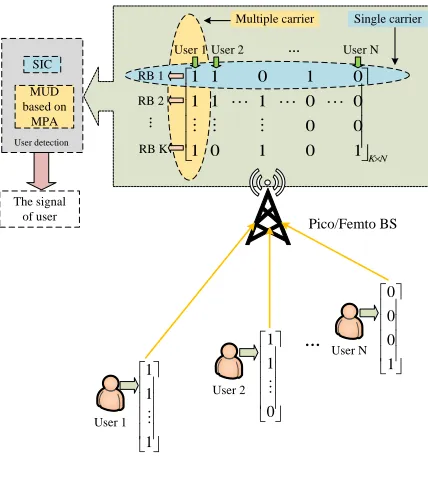
In this part, we propose a unified NOMA framework, which contains both PD-NOMA and CD-NOMA
techniques. As shown in Fig. 2, we first map the superposed signals of multiple users to single RB or
multi-RB over a sparse matrix, in which most of the elements are zero. Note that single RB and multi-RB
correspond to single carrier and multi-carrier, respectively. In other words, single carrier NOMA
(PD-NOMA) is the special case of multi-carrier NOMA (CD-(PD-NOMA). The rows and columns of the sparse
matrix represent different RB and different users, respectively. Here, “1” represents the user occupies
the corresponding RB and “0” otherwise. The use of such a sparse matrix is essential to capture the
features of SCMA [12] and pattern division multiple access (PDMA) [13], where the optimal design
of sparse matrix for CD-NOMA is capable of reducing detection complexity at receivers. In particular,
SCMA and PDMA are belong to CD-NOMA’s different types of forms, in which the equal and unequal
column weight sparse matrixes are employed, respectively. It is worth noting that in HUDNs, each cell
can choose PD-NOMA or CD-NOMA scheme based on the pre-configuration of the BS. We will present
the details of PD-NOMA and CD-NOMA, i.e., SCMA and PDMA, and use a two user case to illustrate
how the unified NOMA framework works in the following.
Regarding PD-NOMA, a transmitter is capable of multiplexing multiple users via different power levels
within the single subcarrier, i.e., the first row of sparse matrices illustrated in Fig. 2. At receivers,
PD-NOMA exploits SIC to remove the multi-user interference. Additionally, PD-PD-NOMA can be also realized
in multi-carriers, with the aid of appropriate user scheduling and power allocation approaches [8]. It is
worth noting that downlink multi-user superposition transmission (MUST), which is essentially a special
CD-NOMA can be regarded as a special extension that directly maps data streams of multiple users
into multiple carriers by using the sparse matrix or low density spreading code at transmitters, as shown
in the multi-carrier case in Fig. 2. At receivers, multiple users are distinguished by MPA to obtain
the multiplexing or coding gains. For example, SCMA utilizes a sparse matrix, in which each column
can be selected from the predefined codebooks. With the multidimensional constellations to optimize
codebooks, SCMA is able to achieve enhanced shaping and coding gains. While for PDMA, the core
concept is to jointly optimize transmitters with sparse pattern design and receivers with MPA-based
detection. The design of sparse pattern can provide disparate diversity for multiple users and further
reduce the complexity of detection. Additionally, phase shifting is an effective way to obtain constellation
shaping gain. It is worth noting that the pivotal difference between these two schemes is that the number
of RBs occupied by each user has to be the same in SCMA, while PDMA allows a variable number of
RBs to be occupied by the same user. For another CD-NOMA scheme, muti-user shared access (MUSA)
[14], each user’s data symbols are spread by a special spread sequence to facilitate SIC implementation.
This kind of spread sequence can be selected from the sparse matrix as illustrated in Fig. 2, which requires
special design to achieve low cross-correlation. Note that multiple spreading sequences constitute a pool,
where each user can select one sequence from it.
B. Uplink and Downlink Design for NOMA Enabled HUDNs
1) Uplink Design: To facilitate understanding the uplink design in the unified NOMA framework, we
present specific examples in the following. For uplink PD-NOMA, multiple users transmit messages to the
BS by the same RB. As shown in Fig. 2(a), when using the sparse matrix for PD-NOMA, multiple users’
signals are mapped into RBs in the first row of sparse matrix, while the rest rows of the sparse matrix
are set to zeros. Notice that power control strategy is a vital issue in the uplink NOMA transmission,
especially when powers received at users are significantly distinct. We employ SIC at BSs to decode and
subtract the information of the nearby user first, then decode the message of the distant user. By doing
so, the data rate of the distant user can be guaranteed. For CD-NOMA, each user selects one or several
columns from the sparse matrix and then maps its information to multiple RBs by using the spreading
code. For example, considering the case that each user selects only one column and spreads its message
to “1”, then the data streams ofN users are superposed through K RBs to construct the sparse matrix
with dimensions ofK×N at the BS. The sparse properties of matrix is conducive for implementing the
MPA detection. To guarantee the fairness among users, the nearby user selects one column with smaller
column weight, while the distant user selects column with larger column weight. Such operation can
2) Downlink Design: The key feature of the downlink design in the unified NOMA framework is that
multiple data streams of different users are superimposed at BSs. Then BSs transmit the superimposed
signals to multiple users simultaneously. More particularly, a BS maps multiple users’ signals into single
or multiple carriers over the sparse matrix. In the following, we use a two-user case to illustrate how the
downlink of the unified NOMA framework works.
For PD-NOMA shown in Fig. 2(b), the BS maps signals of multiple users into a single RB by utilizing
one row of the sparse matrix with dimension of 1× N
2 and then transmits superposed signals to two
users. It is observed that one row including multiple “1”s denotes that the data streams from one user can
be spread into multiple layers, which can provide more flexibility for resource mapping. While for
CD-NOMA, a user’s data streams are directly mapped into multi-RB by sharing multiple spread sequences. As
a further advance, the superposed signals of two users are formulated at the BS, which will be transmitted
to the destination. Similar to uplink design, optimal design of the sparse matrix can further enhance the
detection performance. At the receiver, MPA is implemented to recover the desirable user’s signals. From
a practical perspective, computational complexity at the reciter will grow exponentially with the number
of users increasing. Hence, how to reduce the detection complexity for CD-NOMA should be taken into
account in the 5G standardization process.
C. User Association in NOMA Enabled HUDNs
The distinct characteristics of the HUDNs with unified NOMA inevitably necessitate the redesign of
user association algorithms. In contrast to the conventional user association approaches, on the one hand,
the dense deployment of small cells introduce severe inter-interference as the neighbouring cells share
the same RB. On the other hand, NOMA brings extra intra-interference from the same BS, hence making
the user association design more challengeable.
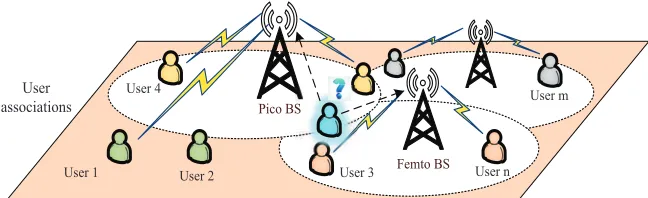
In order to address these two issues, we propose a flexible user association design for the unified NOMA
enabled HUDNs, in which a NOMA user is allowed to access the BS of any tier in order to achieve
the best coverage. As shown in Fig. 3, we take the PD-NOMA as a specific example. For simplicity, we
consider that all BSs of HUDNs operate over the same orthogonal RB. Assuming that each user connects
with one BS at most, while one BS can serve two users by adopting NOMA techniques. Particularly, we
propose to associate users to BSs based on the maximum average power received at each NOMA user.
In other words, each user not always access the nearest BS. It is allowed to access any tier BS. Such
a user association scheme is fundamentally different from the conventional approach, which associates
users with the nearest BS and may lead to the association of most users with small cells as their BSs
When a new user joints the network, its association should be determined by considering the effects of
both transmit power disparity of HUDNs and power sharing coefficients of NOMA users associated to
the same BS. Based on this flexible user association approach, network performance of NOMA enabled
HUDNs has been investigated in [9], which has analytically demonstrated that NOMA enabled HUNDs
outperform the conventional OMA enabled one.
D. Resource Allocation in NOMA Enabled HUDNs
Resource allocation is another significant aspect for designing NOMA enabled HUDNs. Note that
the implementation of NOMA brings more sophisticated co-channel interference to existing HUDNs,
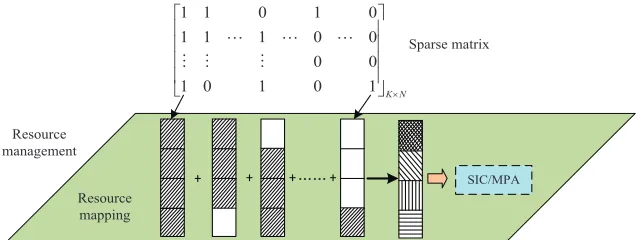
such distinct characteristics lead the resource allocation problems more challengeable. Fig. 4 provides
an illustration of resource allocation for our proposed unified NOMA enabled HUDNs framework. More
particularly, date streams of different users can be spread over multiple RBs, where “1” and “0” denote
whether there exists a resource mapping between the corresponding user and RB. More specifically,
the shaded blocks refer to the RB occupied by users’ data, which indicates a mapping. Technically,
each user can select one column from the sparse matrix randomly. However, to improve the detection
performance, distant user prefers to select one column with larger column weight for resource allocation.
While nearby user tends to select one column with smaller column weight. Furthermore, by multiplying
a power sharing coefficient with each column, network performance can be further enhanced. Finally, we
employ MUD-based SIC/MPA to detect and output the information for the desired user.
For resource allocation in NOMA enabled HUDNs, several problems should be jointly considered for
intelligently tackling the intra-BS and inter-BS interferences: i) the number of users to be allocated in
the same RB; ii) which users should be allocated into which RB; and iii) the power sharing coefficient
for each RB as well as for users sharing the same RB. For example, for single carrier system, the
superposed signal of multiple users can be mapped into a single carrier over different power levels. The
power allocation between NOMA users should be considered carefully. For multi-carrier system, the
superposed signal can be mapped into multiple sub-carriers, where the NOMA users can select which
sub-carrier to employ based on their requirements and then consider power allocation. All these problems
can be addressed by properly designing the sparse matrix and its corresponding power sharing coefficients.
Actually, due to the unique character of intra-BS interference brought by NOMA, resource allocation
in NOMA enabled HUNDs becomes mix integer non-convex optimization problems, which usually tend
to be NP-hard. Hence, efficient resource allocation algorithms are more than desired. Matching theory
can be invoked as an effective approach for achieving good tradeoff between system performance and
resource allocation approach to show that NOMA enabled HUNDs scheme is capable of achieving a
higher sum rate compared to the OMA-enabled one.
IV. CASE STUDY FORNOMA ENABLEDHUDNS
In this section, we evaluate the unified NOMA enabled HUDNs by simulations. For simplicity, we
con-sider the uplink transmission of PD-NOMA. In the following, we provide two case studies to demonstrate
user association and resource allocation in the unified NOMA enabled HUDNs, respectively.
A. User Association in NOMA Enabled HUDNs
In this study, we illustrate how the density of small cells influences the user association in NOMA
enabled HUDNs. Here, we consider user association in the case where the proposed unified NOMA
framework is applied in HUDNs based on a stochastic geometry model. More particularly, the locations
of BSs and users follow homogeneous Poisson point processes. In the consider network, macro cells
employ massive MIMO and small cells adopt NOMA to support massive connectivity, and the maximum
average received power approach is adopted to determine user association as aforementioned in section
III. More details of the considered network configurations can be found in [9].
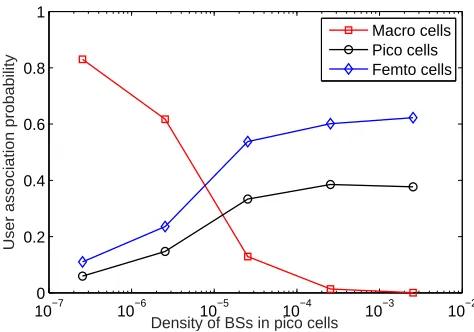
Fig. 5 plots the user association probability of the unified NOMA enabled HUDNs with three layers,
i.e., K = 3. In this case, the density of macro BSs is fixed, while the densities of pico BSs and femto
BSs vary correspondingly. It can be observed that NOMA users prefer macro cells when the density of
small cells is relatively low. With the densification of small cells, which is the case of HUDNs, NOMA
users show a higher intention to be associated with BSs in pico and femto cells. It is also worth noting
that NOMA users have a higher probability to be associated with BSs in femto cells even though BSs
in pico cells transmit at a higher power level. This is caused by the dense deployment of femto cells,
which also revels the effectiveness and benefits of the NOMA enabled HUDNs.
B. Resource Allocation in NOMA Enabled HUDNs
In this study, we compare the performance of our unified NOMA enabled HUDNs with the conventional
OMA enabled scheme in terms of both fairness and sum rates. We consider a HetNet with two tiers,
in which the macro cell and small cells reuse the same set of RBs. In other words, we can refer to the
small cells as the underlay tier. We allow each small cell BS to serve two users via NOMA by using the
same RB. Our goal is to maximize the sum rate of NOMA enabled small cell BSs via proper RB and
power sharing coefficients schemes. More particularly, we adopt the matching theory for user allocation
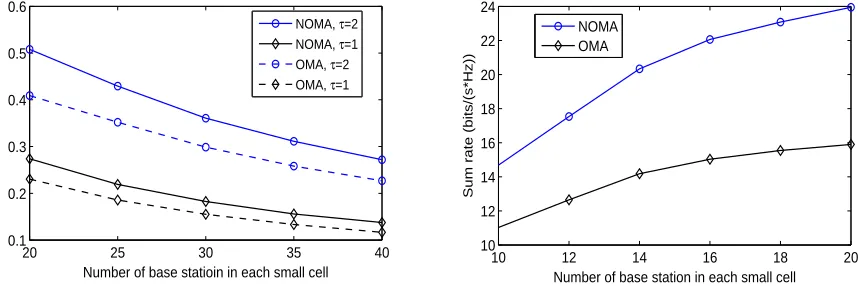
Fig. 6 plots the fairness and sum rate of resource allocation versus the total number of small cell BSs,
respectively. Here,τ is the maximum number of small cell BSs occupying the same RB for restricting the
co-channel interference. Jains fairness [15] index is adopted to evaluate the performance of the considered
networks. We can observe that the fairness performance decreases with the number of small cell BSs
in Fig. 6(a). This is because that large number of small cell BSs leads to more severe competition for
limited spectrum resources. Consequently, more small cell BSs with poor channel conditions can not be
accessed. We can also note that asτ increases, a higher fairness rate can be achieved. This is attributed to
the fact that more small cell BSs can be multiplexed on each RB, which increases the multi-user diversity
gain. It is also worth noting that the unfied NOMA enabled HUDNs have superior performance than the
conventional OMA scheme both in terms of fairness and sum rate, which demonstrates the effectiveness
the proposed structure.
V. RESEARCHCHALLENGES IN NOMA ENABLEDHUDNS
To support massive connectivity and enhance spectrum efficiency in 5G systems, the following research
problems should be addressed in the NOMA enabled HUNDs:
• Energy efficiency in NOMA enabled HUNDs: one of the potential applications of NOMA enabled
HUNDs is IoT for smart cities, in which massive number of devices need to be connected. The unified
NOMA enabled HUNDs provide a practical infrastructure to offer massive access opportunities for
such large number of devices, especially for the cases that each device only needs to send a small
amount of data periodically. However, these devices are normally restricted to power consumption
as they are powered by battery. In order to extend the battery lifetime of these IoT devices,
i.e., devices are expected to keep live for ten years, the energy efficiency is under investigated.
Particularly, higher data transmission rate results in shorter airtime, however, the power consumption
for data transmission becomes higher. With lower power consumption, the achieved transmission
rate becomes lower, which extends the airtime. Therefore, the tradeoff between data rate and airtime
should be considered to maximize battery lifetime of devices.
• Big Data aided Adaptive NOMA in HUNDs: IoT devices normally have limited processing
capability, while some devices, i.e., mobile phones, are capable of performing more complex tasks.
Meanwhile, it is noted that different NOMA schemes requires different complexity levels at the user
side. For instance, SIC receiver is relatively simple, which makes PD-NOMA more suitable for IoT
devices. Therefore, a software-defined NOMA network architecture is desired to achieve adaptive
NOMA with awareness on complexity to support different user scenarios. Machine learning can
categorized into two types, including pre-settings and real-time settings. Pre-settings refer to assign
the MA technique according to historical social media information, such as the number of users
within a given area in several months or one year. The real-time settings adjust the MA technique
based on the real-time feedback from social media.
• Testbed for NOMA enabled HUNDs: even though extensive research has been carried out on the
performance analyses and algorithm designs for NOMA enabled HUNDs, there is still a large gap
to the real implementation of NOMA in HUNDs. For the proof of concept, a testbed is more than
desired to demonstrate the effectiveness of the proposed unified NOMA enabled HUNDs. More
particularly, the idea of software defined radio (SDR) can be adopted to enable BSs to select the
proper NOMA technique smartly according to different application scenarios.
VI. CONCLUSIONS
This article has envisioned NOMA enabled HUDNs as a promising solution to support massive
connectivity in 5G systems. Instead of focusing on specific NOMA techniques individually, we have
proposed a unified NOMA framework. Moreover, we have investigated the application of the proposed
unified NOMA framework in HUDNs. We have further explored the critical challenges on user association
and resource allocation in NOMA enabled HUDNs, as both the dense deployment of small cells and the
non-orthogonality in resource sharing bring severe interference. Additionally, we have carried out related
case studies, which have provided important insights for the future design of NOMA enabled HUDNs
to support massive connectivity in 5G systems.
REFERENCES
[1] H. Zhang, Y. Dong, J. Cheng, M. J. Hossain, and V. C. M. Leung, “Fronthauling for 5G LTE-U ultra dense cloud small
cell networks,” IEEE Wireless Commun., vol. 23, no. 6, pp. 48-53, Dec. 2016.
[2] X. Ge, S. Tu, G. Mao, and C. X. Wang, “5G ultra-dense cellular networks,” IEEE Wireless Commun., vol. 23, no. 1, pp.
72-79, Feb. 2016.
[3] H. Zhang, S. Huang, C. Jiang, K. Long, V. C. M. Leung and H. V. Poor, “Energy efficient user association and power
allocation in millimeter-wave-based ultra dense networks with energy harvesting base stations,” IEEE J. Sel. Areas Commun.,
vol. 35, no. 9, pp. 1936-1947, Sep. 2017.
[4] Y. Saito, Y. Kishiyama, A. Benjebbour, T. Nakamura, A. Li and K. Higuchi, “Non-orthogonal multiple access (NOMA) for
cellular future radio access,” IEEE Veh. Technol. Conf. (VTC Spring’13), Dresden, Germany, Jun. 2013, pp. 1-5.
[5] L. Dai, B. Wang, Y. Yuan, S. Han, C. l. I and Z. Wang, “Non-orthogonal multiple access for 5G: solutions, challenges,
opportunities, and future research trends,” IEEE Commun. Mag., vol. 53, no. 9, pp. 74-81, Sep. 2015.
[6] Z. Ding, Y. Liu, J. Choi, Q. Sun, M. Elkashlan, I. Chih-Lin, and H. V. Poor, “Application of non-orthogonal multiple access
[7] Y. Cai, Z. Qin, F. Cui, G. Y. Li, J. A. McCann, “Modulation and multiple access for 5G networks,” CoRR, abs/1702.07673,
Feb. 2017. http://arxiv.org/abs/1702.07673
[8] Y. Sun, D. W. K. Ng, Z. Ding, and R. Schober, “Optimal joint power and subcarrier allocation for full-duplex multicarrier
non-orthogonal multiple access systems,” IEEE Trans. Commun., vol. 65, no. 3, pp. 1077-1091, Mar. 2017.
[9] Y. Liu, Z. Qin, M. Elkashlan, A. Nallanathan, and J. A. McCann, “Non-orthogonal multiple access in large-scale
heterogeneous networks,” IEEE J. Sel. Areas Commun., Jul. 2017.
[10] F. Fang, H. Zhang, J. Cheng and V. C. M. Leung, “Energy-efficient resource allocation for downlink non-orthogonal
multiple access network”, IEEE Trans. Commun., vol. 64, no. 9, pp. 3722-3732, Sep. 2016.
[11] J. Zhao, Y. Liu, K. Chai, A. Nallanathan, Y. Chen, and Z. Han, “Resource allocation for non-orthogonal multiple access
in heterogeneous networks”, in Proc. IEEE Int. Conf. Commun. (ICC’17), Paris, France, May 2017.
[12] H. Nikopour and H. Baligh, “Sparse code multiple access,” in Proc. IEEE Annual Int. Symp. Personal Indoor Mobile Radio
Commun. (PIMRC’13), London, UK, Sep. 2013, pp. 332–336.
[13] S. Chen, B. Ren, Q. Gao, S. Kang, S. Sun, and K. Niu, “Pattern division multiple access PDMA - A novel non-orthogonal
multiple access for 5G radio networks,” IEEE Trans. Veh. Technol., vol. 66, no. 4, pp. 3185-3196, Apr. 2017.
[14] Z. Yuan, G. Yu, W. Li, Y. Yuan, X. Wang, and J. Xu, “Multi-user shared access for Internet of Things,” in Proc. IEEE
Veh. Technol. Conf. (VTC Spring’16), Nanjing, China, May 2016, pp. 1–5.
[15] R. Jain, D.-M. Chiu, and W. R. Hawe, “A quantitative measure of fairness and discrimination for resource allocation in
shared computer system,” Eastern Research Laboratory, Digital Equipment Corporation Hudson, MA, USA, Sep. 1984, vol.
38.
Zhijin Qin received her Ph.D degree from Queen Mary University of London in 2016. She is currently a Lecturer (assistant
professor) at Lancaster University since August 2017. Before that, she was with Imperial College London as a Research Associate.
Her research interests include compressive sensing, Internet of Things, and non-orthogonal multiple access. She won the best
paper award at Wireless Technology Symposium 2012.
Xinwei Yue received his master degree from Henan Normal University, P. R. China, in 2013, and is currently working toward
the Ph.D. degree in the School of Electronic and Information Engineering at Beihang University (BUAA). His research interests
include wireless communications theory, non-orthogonal multiple access and cooperative networks.
Yuanwei Liu is a Lecturer (assistant professor) with Queen Mary University of London, where he received his Ph.D. degree
in 2016. His research interests include 5G wireless networks, Internet of Things, and stochastic geometry. He received the
Exemplary Reviewer Certificate of the IEEE Wireless Communication Letters and the IEEE Transactions on Communication.
He serves as an Editor of the IEEE Communications Letters and the IEEE Access.
Zhiguo Ding received his Ph.D. degree from Imperial College London in 2005, and is currently a chair professor at Lancaster
University, United Kingdom. His research interests include 5G communications, MIMO and relaying networks, and energy
harvesting. He serves as an Editor for several journals including IEEE Transactions on Communications, IEEE Transactions on
Vehicular Technology, and Wireless Communications and Mobile Computing.
Arumugam Nallanathan is Professor of Wireless Communications at Queen Mary University of London since September 2017.
He was with King’s College London from 2007 to 2017, and National University of Singapore from 2000 to 2007. His research
Macro BS Core networks
Femto BS Pico BS
User 1
User n
Macro BS
User 1
Relay
User 1
ĂĂ
User k
ĂĂ
ĂĂ
User n signal detection Subtract the signal
of user 1 SIC
User n signal detection User 1 signal
detection
Detector
Detector User m
MPA
MPA
User’s signal
User’s signal
Turbo Decoder
[image:14.595.73.539.310.530.2]Turbo Decoder
User 1
1 1 0 1 0
1 1 1 0 0
0 0
1 0 1 0 1K N×
L L L
M M M
User 2
User N
…
User 1 User 2 … User N
RB 1
RB 2
RB K
…
Multiple carrier Single carrier
SIC MUD based on MPA User detection Pico/Femto BS The signal of user 1 1 1 M 1 1 0 M 0 0 0 1
(a) Uplink NOMA
1 1 0 1 0
1 1 1 0 0
0 0
1 0 1 0 1K N×
6447448 6447448
L L L
M M M
User 1 User 2
RB 1
RB 2
RB K
…
Multiple carrier Single carrier
Pico/Femto BS Detector Decoder MPA Signal of superposition The signal of user SIC User 2 User 1
[image:15.595.80.294.307.546.2](b) Downlink NOMA
User associations
Femto BS
User 4
User 1 User 3 User n
User m
User 2
[image:16.595.147.471.372.471.2]Pico BS
Resource management
ĂĂ SIC/MPA
1 1 0 1 0
1 1 1 0 0
0 0
1 0 1 0 1 KN
! "
# $
# $
# $
# $
% &
! ! !
Resource mapping
[image:17.595.150.468.363.483.2]Sparse matrix
10−7 10−6 10−5 10−4 10−3 10−2 0
0.2 0.4 0.6 0.8 1
Density of BSs in pico cells
User association probability
[image:18.595.183.420.319.485.2]Macro cells Pico cells Femto cells
Fig. 5. User association probability versus density of BSs in pico cells,K = 3tiers, number of antennas equipped in macro
cell BS M = 200, data streams N = 15, macro BS transmit power is P1 = 40dBm, pico BS transmit power is P2 = 30
dBm, and femto BS transmit power isP3= 20dBm, power sharing coefficients for NOMA users aream= 0.6andan= 0.4,
respectively, density of macro BS 1
20 25 30 35 40 0.1
0.2 0.3 0.4 0.5 0.6
Number of base statioin in each small cell
Jain‘s fairness index
NOMA, τ=2 NOMA, τ=1 OMA, τ=2 OMA, τ=1
(a) Fairness comparison, transmit power at macro BSs is 43
dBm, the transmit power at small cell BSs is23dBm.
10 12 14 16 18 20
10 12 14 16 18 20 22 24
Number of base station in each small cell
Sum rate (bits/(s*Hz))
NOMA OMA
(b) Sum rate comparison, maximum number of small cells
[image:19.595.92.521.346.489.2]occupying the same RBτ= 2.