Towards A Welsh Semantic Annotation System
Scott Piao
1, Paul Rayson
1, Dawn Knight
2and Gareth Watkins
21School of Computing and Communications, Lancaster University, UK 2School of English, Communication and Philosophy, Cardiff University, UK
{s.piao;p.rayson}@lancaster.ac.uk, [email protected], [email protected]
Abstract
Automatic semantic annotation of natural language data is an important task in Natural Language Processing, and a variety of semantic taggers have been developed for this task, particularly for English. However, for many languages, particularly for low-resource languages, such tools are yet to be developed. In this paper, we report on the development of an automatic Welsh semantic annotation tool (named CySemTagger) in the CorCenCC Project, which will facilitate semantic-level analysis of Welsh language data on a large scale. Based on Lancaster’s USAS semantic tagger framework, this tool tags words in Welsh texts with semantic tags from a semantic classification scheme, and is designed to be compatible with multiple Welsh POS taggers and POS tagsets by mapping different tagsets into a core shared POS tagset that is used internally by CySemTagger. Our initial evaluation shows that the tagger can cover up to 91.78% of words in Welsh text. This tagger is under continuous development, and will provide a critical tool for Welsh language corpus and information processing at semantic level.
Keywords:Welsh semantic tagger, corpus annotation, Welsh language, Welsh corpus, CorCenCC
1.
Introduction
Automatic semantic annotation and analysis is an impor-tant task for Natural Language Processing (NLP), and se-mantic taggers have been developed and used for carrying out semantic analysis of language data on a large scale. A major tool built for such a purpose is USAS (UCREL Se-mantic Analysis System)1(Rayson et al., 2004; Piao et al., 2017), which is designed to annotate each word or phrase in text with lexical semantic categories derived from Tom McArthur’s Longman Lexicon of Contemporary English (McArthur, 1981), such as “Food” or “Time”. The USAS semantic scheme contains 21 major semantic fields that are further divided into 232 sub-categories. Initially developed for processing English text, it has been extended to tag texts of a number of languages, including Italian, Chinese, Span-ish etc. (Piao et al., 2015).
In the CorCenCC Project2, we have been developing a Welsh semantic tagger, named CySemTagger, modelled on the USAS framework, which employs a translated USAS semantic classification scheme and tagset for Welsh lan-guage. During the course of development, we have first constructed large Welsh semantic lexicons containing ap-proximately 136,468 Welsh word entries, which provide a lexical knowledge base for the semantic tagging system3.
Based on the lexicons, we have developed an initial version of the tagger software system that is designed to accommo-date different Welsh POS taggers and tagsets that exist or will be developed. In the CorCenCC project, CySemTagger will be mainly based on a new Welsh POS tagger, named CyTag, which has been developed in this Project (Neale et al., 2018). In this paper, we describe the CySemTagger sys-tem and report on its initial evaluation.
1
For further details of USAS, see website http://ucrel.lancs.ac.uk/usas/
2
For information about this project, see website http://www.corcencc.org/
3These lexicons are made available at
https://github.com/UCREL/Multilingual-USAS
The remaining part of this paper is organised as follows. Section 2 will discuss related work, Section 3 will describe the architecture of the CySemTagger, Section 4 will discuss the construction of Welsh semantic lexicon, Section 5 will explain about detailed working mechanism of CySemTag-ger’s main components, Section 6 will discuss an evaluation of the current version of CySemTagger, and Section 7 will conclude our work and discuss future work.
2.
Related Work
Over recent years, various semantic annotation tools have been developed in the NLP community. These tools are used to automatically recognise and annotate various se-mantic categories and concepts at different syntactic levels, such as word level, phrase level, sentence level etc. Among the major existing semantic taggers developed in NLP communities is USAS (Rayson et al., 2004; Piao et al., 2017), GATE4 (Cunningham et al., 2011), Freeling (Padro and Stanilovsky, 2012), NLTK5 (Bird et al., 2009) etc.,
which provide functionalities of semantic annotation of var-ious types, such as WordNet’s Word sense IDs or Named Entity types etc. For example, GATE and KIM (Popov et al., 2003), combined together, provide multilingual seman-tic tagging function based on ontologies. Freeling is capa-ble of detecting and tagging multilingual texts with named entity types and WordNet senses. Zhang and Rettinger (2014) developed a toolkit that carries out Wikipedia-based annotation. NLTK (Bird et al., 2009) provides a function for analysing the meaning of sentences.
What is directly related to our work is the past develop-ment of multilingual functionality of the USAS framework. As mentioned earlier, initially developed for English, it has been extended and modified to cover an increasing num-ber of languages. Currently USAS is capable of carrying out semantic annotation on 12 languages, including Italian, Finish, Russian, Chinese, Spanish, Portuguese, Swedish,
4
See website https://gate.ac.uk/
5
Dutch etc. (Lofberg et al., 2005; Mudraya et al., 2006; Piao et al., 2015).
Our research draws upon the experiences of the previous work, while extending the capability of automatic seman-tic annotation of existing tools to the Welsh language, for which no existing NLP tools can provide such a compre-hensive semantic annotation as CySemTagger aims to per-form. Our new tagger will facilitate new semantic based research on Welsh language data, and via the CorCenCC framework will assist with improving the understanding of real-life communication for Welsh speakers, teachers and learners.
3.
Outline of CySemTagger’s Architecture
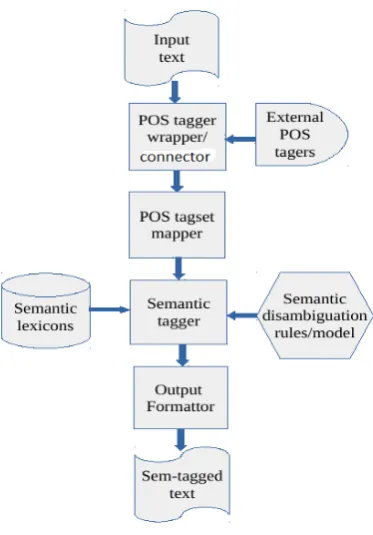
[image:2.595.75.262.333.601.2]The CySemTagger is a software system which has an archi-tecture consisting of a set of lexical knowledge resources and disambiguation rules and models wrapped in software components that interact with each other. Figure 1 illus-trates the outline of the architecture and main workflows of the system.
Figure 1: CySemTagger Software Architecture
As shown in the figure, a set of software modules provide main functionalities, such as receiving input data stream, calling external part-of-speech taggers to carry out morpho-syntactic analysis, produce tagged output in required for-mats etc. Together, they form a pipeline to interact with each other to complete the whole task of semantic tagging. The main challenge for building such a system for a new language, Welsh in our case, is the development of semantic lexicons and word sense disambiguation rules and models for the new language. Because there are very few Welsh semantic lexical resources available, we were faced with a tough challenge for building the Welsh semantic tagger.
4.
Semantic Lexicon Construction
As a system based on linguistic knowledge, a core part of the semantic tagger system is a set of semantic lexicons which provide candidate semantic categories for each word, hence Welsh semantic lexicon construction is the first main step for the development of Welsh semantic tagger. For this purpose, we exploited various lexical and corpus resources. The main lexical resource used for this work is the Eu-rfa Welsh/English bilingual lexicon developed by Donnelly (2017). This bilingual lexicon contains a large number of Welsh words and their English translations along with use-ful information such as lemma forms and part-of-speech (POS) labels. It also contains many Welsh multi-word ex-pressions (MWEs), which is a valuable resource for cre-ating semantic MWE lexicons for the semantic tagger in later stages. Because it is time-consuming work to manu-ally compile new semantic lexicons from scratch, we ap-plied automatic methods by mapping and porting seman-tic categories and tags for Welsh words via their English translations through the existing English semantic lexicons. This method has been proven effective in our previous re-search on other languages (Piao et al., 2016). The high quality of the Eurfa bilingual lexicon helped us to achieve a good initial result for the automatically generated Welsh semantic lexicon. Obviously, the automatically generated lexicon will need be pruned manually or by other meth-ods to guarantee the accuracy of the semantic annotation. Through the automatic process, we extracted a lexicon con-taining 136,468 Welsh words (including many inflected forms) mapped to semantic category/ies. It provides a solid basis for developing a system of Welsh semantic tagger. In addition to the automatic lexicon generation, we also col-lected 264 Welsh closed class words and integrated them into the lexicon, mainly including function words such as prepositions, conjunctions etc. Although there are a limited number of such words, they are critical for correctly un-derstanding the meaning of the text, and typically are high frequency items. Another important lexical source is the Welsh names. Our initial observation showed that a signif-icant proportion of corpus data consists of various names. Therefore, we searched and collected Welsh names, includ-ing person names and place names, from various sources6, including the Language Technologies Unit of Bangor Uni-versity7, UK and the websites of “Behind The Name”8, “Think Baby Names”9, and “Wales UK”10. As a result, we collected 6,553 Welsh names to expand the semantic lexi-con. Combining automatic and manual processes, currently we have constructed a Welsh single word semantic lexicon of 143,287 entries. Table 1 shows a sample of the single word semantic lexicon, where the semantic tags are from the USAS semantic tagset11.6The creators/owners of these name sources gave us
permis-sions to use their Welsh name resources for the purpose of devel-oping the Welsh semantic tagger
7
https://www.bangor.ac.uk/canolfanbedwyr/technolegau_iaith.php.en
8http://www.behindthename.com/names/usage/welsh 9
http://www.thinkbabynames.com/names/1/welsh
10
http://www.walesuk.info/wales.html
11
Table 1: Sample of Single Word Semantic Lexicon Word POS-tag Sem-tag
abacws noun N3.1
corfforaethol adj I2.1/S5
galluogai verb S8+
gambled verb A15- I1/A1.4 K5.2/I1
sobr adv A13.3
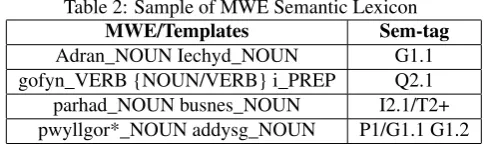
[image:3.595.352.489.148.199.2]Our semantic tagger also needs a Welsh MWE seman-tic lexicon, which provides semanseman-tic categories for MWE terms and non-compositional idiomatic expressions, e.g. “take care of” and “kick the bucket” (for English) etc. Cur-rently we use a sample MWE semantic lexicon for testing software, but work is under way to construct a large MWE semantic lexicon as the project progresses. Table 2 shows samples of MWE semantic lexicon entries, including tem-plate codes.
Table 2: Sample of MWE Semantic Lexicon MWE/Templates Sem-tag Adran_NOUN Iechyd_NOUN G1.1 gofyn_VERB {NOUN/VERB} i_PREP Q2.1
parhad_NOUN busnes_NOUN I2.1/T2+ pwyllgor*_NOUN addysg_NOUN P1/G1.1 G1.2
Besides the existing English/Welsh bilingual lexical re-sources, we are also considering Welsh corpus rere-sources, particularly Welsh/English parallel corpora, for further ex-panding and improving the Welsh semantic lexicons. We carried out an initial experiment by collecting words from the existing Welsh corpora, including CEG Cronfa Elec-troneg o Gymraeg (Ellis et al., 2001), Kwici (Corpus of Welsh Wikipedia)12and Corpus of Children’s Literature in Welsh13, and estimated the proportion of text that can be covered by the word list, together with the formal seman-tic lexicon. Our experiment shows that, if all the newly collected words can be integrated into the Welsh semantic lexicons, our semantic tagger could achieve over 97% of text coverage. Therefore we aim to semantically classify as many words in the word collection as possible and inte-grate them into the semantic lexicon in order to achieve a high lexical/text coverage.
Some unique features of Welsh language present a tough challenge for the Welsh semantic lexicon building. As a Celtic language, the Welsh language’s linguistic features are widely different to those of the English language (a Germanic language). For instance, while the English al-phabet consists of 26 letters, the Welsh alal-phabet consists of 29 letters, including some letters which are made up of two characters (namely “Ch”, “Dd”, “Ff” “Ng”, “Ll”, “Ph”, “Rh” and “Th”). The Welsh language is different from En-glish in terms of grammar, there is no indefinite article in the Welsh language, for instance. Furthermore, the Welsh language is unique in that it employs a system of mutation, that is, under certain circumstances the first letter of a word
12
http://cy.wikipedia.org
13
http://www.egni.org
is substituted for another. For example, Welsh feminine nouns which follow the Welsh definite article “y” mutate as shown in 3 (see the highlighted letters).
Table 3: Example of mutation following the definite article in Welsh
Welsh English Mutation Pioden Magpie YBioden Craith Scar YGraith Teml Temple YDeml
In respect of English equivalents to Welsh words, a one-to-one relationship does not always exist, as shown in 4. For instance, the English word “together” would normally be translated as the MWE “gyda’i gilydd” in Welsh. Con-versely, the Welsh word “haprif” would be equivalent to “random number” in English. These factors present a tough challenge for the automatic or semi-automatic creation of Welsh semantic lexicons based on existing English ones, and requires more manual efforts in this process, particu-larly for MWE lexicon construction.
Table 4: Examples of Equivalence Between English and Welsh Single Words and MWEs
English Welsh
beyond repair anadferadwy random number haprif
take pride in ymfalchïo lifeboat bad achub yorker (a cricket term) pelen lawn Iceland Gwlad yr Iâ reserve (in sport) chwaraewr wrth gefn
desktop bwrdd gwaith toadstool caws llyffant
5.
Main Components of CySemTagger
The current version of the CySemTagger is based on the Welsh semantic lexicons constructed so far. With regards to major functionality, the system mainly consists of four modules:
1) Lexicon look-up (both for single words and MWEs), 2) Part-of-speech tagging,
3) Semantic category disambiguation, 4) Output formatting.
The first main module is for loading the lexicons into the system and looking up candidate categories for each word. For single words this is a straightforward process, whereas a complex algorithm is needed for the MWE lookup. In the USAS framework, the MWE entries can contain specified template codes and format which are used to represent sim-ilar MWEs with a single lexicon entry. For example, the entry below:
spe*d_* {R*} off_RP
[image:3.595.49.292.312.384.2]semantic tagger to identify and annotate a large amount of MWE variants using a moderate-sized MWE lexicon. Next, the part-of-speech module is a software wrapper for external POS taggers. It is a program component that links and wraps external Welsh POS taggers built independently into the CySemTagger system. We started with an exist-ing Welsh POS tagger, WNLT (Welsh Natural Language Toolkit)14, which was publicly available when our project began. With the development of the new Welsh POS tag-ger, CyTag, in the CorCenCC Project (Neale et al., 2018), it has also been integrated into the semantic tagger. Con-sidering the existence of multiple POS taggers, and in or-der to make CySemTagger compatible with different POS tagsets, we designed a core POS tagset that provides suffi-cient information for the semantic annotation purpose and to which other Welsh POS tagsets can easily be mapped. Such a design makes CySemTagger flexible to potentially accommodate existing and future POS taggers and provides a wider choice for users. Table 5 lists the core POS tagset.
Table 5: Core POS Tags POS Tag Definition
noun Noun verb Verb
adj Adjective adv Adverb num Numerals pnoun Proper noun
intj Interjection art Article part Particle prep Preposition conj Conjunction pron Pronoun
code Special code, e.g. Maths symbol punc Punctuation
fw Foreign word abbrev Abbreviation
lett Letter
xx Unregnized token
Table 6 lists the detailed mapping from the CyTag POS tagset15 and WNLT POS tagset16 to the core tagset. As
shown in the table, different POS tagsets can have widely different levels of granularity. For instance, the CyTag POS tagset has 59 fine-grained sub-categories for Welsh verbs. As a result, the mapping of the tagsets is not straightforward for some POS categories such asabbreviationandforeign wordsetc. The core POS tagset is designed to accommo-date all of the POS sub-categories included in the Cytag and WNLT tagsets, with four categories (fw,abbrev, lett and
XX) only mapping with CyTag tags without corresponding WNLT tags. This may cause slight loss of POS
informa-14See https://sourceforge.net/projects/wnlt/ 15
For details of the CyTag POS tagset, see website: http://cytag.corcencc.org/tagset
16For details of the WNLT POS tagset, see website:
https://sourceforge.net/projects/wnlt/files/user-guide.pdf
tion if the WNLT is used, but we expect that such a design provides the optimal practical solution for our system. The disambiguation module for CySemTagger is in early stages of development, and will be reported in future pa-pers. Various context aware algorithms will be tested and integrated to improve the accuracy of the tagger. The tagged output can be presented to users in various formats as necessary, such as CTV and XML.
The current version of CySemTagger has been built as a Web service for the convenience of integrating software written in different programming languages, including Java and python programs and the VISL’s Constraint Grammar v3 (CG-3) package, and it can be accessed via a demo web site17and a desktop client GUI application18.
6.
Evaluation
In order to assess the performance of the current ver-sion of CySemTagger, we carried out a test based on a Welsh test corpus, a gold corpus, which is specifically com-piled for the tool evaluation task in the CorCoeCC Project. The test corpus consists of text segments selected from four existing corpora, Kwici (Welsh Wikipedia)19, Kynul-liad20 (Welsh Assembly Proceedings), Meddalwedd (soft-ware translations)21, and LER-BIML (a small corpus of 10 multi-domain texts)22, and contains around 15,000 words. In this experiment, we focused on examining the average text coverage of the tool, i.e. what percentage of the words in the test corpus can be identified by CySemTagger. In detail, we examined the text coverage of the CySem-Tagger when it is linked to the two POS taggers CyTag (internal prototype version) and WNLT respectively. Be-cause CyTag and WNLT use different tokenisation rules and algorithms, they produced different number of tokens. CyTag produced 13,220 words (excluding punctuations) of which 3,716 (28.11%) are function words; WNLT pro-duced 14,435 words (excluding punctuations) of which 5,314 words (36.81%) are function words. Therefore, the text coverages are based on different word numbers, but they are comparable in terms of tool performance. Table 7 shows the text coverage statistics in terms of content words, function words and whole text respectively.
As shown by our experiment, CySemTagger is capable of covering about 91.78% of Welsh running text when it uses CyTag POS tagger, which is under continuous develop-ment in the CorCenCC Project. It still covers 72.92% of text when using the WNLT. Our initial analysis reveals that an important factor for the difference of the text coverages is the performance of lemmatisation of Welsh words, for which CyTag has a superior accuracy compared to WNLT. Due to the lack of manually annotated Welsh test data, it was not possible to carry out an evaluation on the qual-ity of the semantic annotation. Currently a test corpus for
17
See demo web site http://phlox.lancs.ac.uk/ucrel/semtagger/welsh
18A Java desktop application downloadable at
http://ucrel.lancs.ac.uk/usas/gui/
19http://cymraeg.org.uk/kwici 20http://cymraeg.org.uk/kynulliad3 21
http://techiaith.cymru/corpws/Moses/Meddalwedd
22
Table 6: Map of Welsh POS Tagsets
Core Tags CyTag Tags WNLT Tags
noun Egu Ebu Egll Ebll Egbu Egbll NN NNS NNM
NNF verb Be Bpres1u Bpres2u Bpres3u Bpres1ll Bpres2ll Bpres3ll Bpresamhers Bpres3perth
Bpres3amhen Bdyf1u Bdyf2u Bdyf3u Bdyf1ll Bdyf2ll Bdyf3ll Bdyfamhers Bgorb1u Bgorb2u Bgorb3u Bgorb1ll Bgorb2ll Bgorb3ll Bgorbamhers Bamherff1u Bamherff2u Bamherff3u Bamherff1ll Bamherff2ll Bamherff3ll Bamherffamhers Bgorff1u Bgorff2u Bgorff3u Bgorff1ll Bgorff2ll Bgorff3ll Bgorffamhers Bgorff-sef Bgorch2u Bgorch3u Bgorch1ll Bgorch2ll Bgorch3ll Bgorchamhers Bdibdyf1u Bdibdyf2u Bdibdyf3u Bdibdyf1ll Bdibdyf2ll Bdibdyf3ll Bdibdyfamhers Bamod1u Bamod2u Bamod3u Bamod1ll Bamod2ll Bamod3ll Bamodamhers
VB VBD VBDP VBDI VBI VBF
adj Anscadu Anscadbu Anscadll Anscyf Anscym Anseith JJ JJR JJS PDT
adv Adf RB
num Rhifol Rhifold Rhifolt Rhitref Rhitrefd Rhitreft Gwdig Gwrhuf CD
pnoun Epg Epb NNP NNPS
intj Ebych UH
art YFB DT
part Uneg Ucad Ugof Utra Uberf RP
prep Arsym Ar1u Ar2u Ar3gu Ar3bu Ar1ll Ar2ll Ar3ll IN
conj Cyscyd Cysis CC
pron Rhapers1u Rhapers2u Rhapers3gu Rhapers3bu Rhapers1ll Rhapers2ll Rhapers3ll Rhadib1u Rhadib2u Rhadib3gu Rhadib3bu Rhadib1ll Rhadib2ll Rhadib3ll Rhamedd1u Rhamedd2u Rhamedd3gu Rhamedd3bu Rhamedd1ll Rhamedd2ll Rhamedd3ll Rhacys1u Rhacys2u Rhacys3gu Rhacys3bu Rhacys1ll Rhacys2ll Rhacys3ll Rhagof Rhadangg Rhadangb Rhadangd Rhaperth Rhaatb Rhacil
PP INT
code Gwfform Gwsym SC
punc Atdt Atdcan Atdchw Atdde Atdcys Atddyf PN
fw Gwest abbrev Gwacr Gwtalf
lett Gwllyth xx Gwann
Table 7: Text Coverage of CySemTagger Word-type CyTag WNLT content words 88.69% 65.42% function words 99.70% 85.79% total 91.78% 72.92%
the semantic tagger is under compilation by manually an-notating the gold corpus by language experts in the Cor-CenCC project. When this test data becomes available, we will carry out a full scale evaluation of the semantic tag-ger, including evaluation of the contextual disambiguation accuracy.
7.
Conclusion
In this paper, we have reported on our development of a Welsh Semantic tagger carried out in the CorCenCC Project. We applied various approaches for rapidly con-structing Welsh semantic lexicons and extended and mod-ified existing USAS software framework to develop the CySemTagger system, aiming to provide a tool for auto-matic annotation of Welsh language corpus data in large scales. In our evaluation, the prototype Welsh semantic tagger demonstrated an encouraging performance and, as
it stands, already provides a useful tool for the semantic analysis of Welsh language data. This system is under con-tinuous development, and we will investigate using cross-lingual word embeddings and other techniques, and inte-grate more efficient algorithms into the system to develop a wide-coverage and accurate Welsh semantic tagger, which will support a range of new research on Welsh Language data in a large scale.
8.
Acknowledgement
This research work is funded by the UK Economic and Social Research Council (ESRC) and Arts and Humani-ties Research Council (AHRC) as part of the CorCenCC (Corpws Cenedlaethol Cymraeg Cyfoes; The National Corpus of Contemporary Welsh) Project (Grant Number ES/M011348/1).
References
Bird, S., Klein, E., and Loper, E. (2009). Natural Lan-guage Processing with Python - Analyzing Text with the Natural Language Toolkit. O’Reilly Media.
Cunningham, H., Maynard, D., and Bontcheva, K. (2011).
Text Processing with GATE. Gateway Press CA. Donnelly, K. (2017). Eurfa, a gpled dictionary of welsh.
[image:5.595.90.252.507.558.2]Ellis, N. C., O’Dochartaigh, C., Hicks, W., Morgan, M., and Laporte, N. (2001). Cronfa electroneg o gymraeg (ceg): A 1 million word lexical database and frequency count for welsh. https://www.bangor.ac.uk/ canolfanbedwyr/ceg.php.en. Online publica-tion.
Lofberg, L., Piao, S., Nykanen, A., Varantola, K., Rayson, P., and Juntunen, J.-P. (2005). A semantic tagger for the finnish language. InProceedings of the Corpus Linguis-tics Conference 2005.
McArthur, T. (1981). Longman Lexicon of Contemporary English. Longman London.
Mudraya, O., Babych, B., Piao, S., Rayson, P., and Wil-son, A. (2006). Developing a russian semantic tagger for automatic semantic annotation. InProceedings of In-ternational Corpus Linguistics Conference 2006, pages 290–297.
Neale, S., Donnelly, K., Watkins, G., and Knight, D. (2018). Leveraging lexical resources and constraint grammar for rule-based part-of-speech tagging in welsh. InProceedings of the LREC 2018 Conference.
Padro, L. and Stanilovsky, E. (2012). Towards wider mul-tilinguality. InProceedings of the Language Resources and Evaluation Conference (LREC 2012).
Piao, S., Bianchi, F., Dayrell, C., D’Egidio, A., and Rayson, P. (2015). Development of the multilingual semantic an-notation system. InProceedings of the 2015 Conference of the North American Chapter of the Association for Computational Linguistics - Human Language Technolo-gies (NAACL HLT 2015). Association for Computational Linguistics.
Piao, S., Rayson, P., Archer, D., Bianchi, F., Dayrell, C., El-Haj, M., Jimenez, R.-M., Knight, D., Kren, M., Lof-berg, L., Nawab, R., Shafi, J., Teh, P., and Mudraya, O., (2016). Lexical coverage evaluation of large-scale mul-tilingual semantic lexicons for twelve languages, pages 2614–2619. European Language Resources Association (ELRA), 5. The LREC 2016 Proceedings are licensed under a Creative Commons Attribution-NonCommercial 4.0 International License.
Piao, S., Dallachy, F., Baron, A., Demmen, J., Wattam, S., Durkin, P., McCracken, J., Rayson, P., and Alexander, M. (2017). Time-sensitive historical thesaurus-based se-mantic tagger for deep sese-mantic annotation. Computer Speech and Language, 46:113–135.
Popov, B., Kiryakov, A., Kirilov, A., Manov, D., Ognyanoff, D., and Goranov, M. (2003). Kim - seman-tic annotation platform. In Proceedings of 2nd Inter-national Semantic Web Conference (ISWC2003), pages 834–849.
Rayson, P., Archer, D., Piao, S., and McEnery, A. (2004). The ucrel semantic analysis system. In Proceedings of the beyond named entity recognition semantic labelling for NLP tasks workshop, pages 7–12.