warwick.ac.uk/lib-publications
Manuscript version: Author’s Accepted Manuscript
The version presented in WRAP is the author’s accepted manuscript and may differ from the
published version or Version of Record.
Persistent WRAP URL:
http://wrap.warwick.ac.uk/119812
How to cite:
Please refer to published version for the most recent bibliographic citation information.
If a published version is known of, the repository item page linked to above, will contain
details on accessing it.
Copyright and reuse:
The Warwick Research Archive Portal (WRAP) makes this work by researchers of the
University of Warwick available open access under the following conditions.
Copyright © and all moral rights to the version of the paper presented here belong to the
individual author(s) and/or other copyright owners. To the extent reasonable and
practicable the material made available in WRAP has been checked for eligibility before
being made available.
Copies of full items can be used for personal research or study, educational, or not-for-profit
purposes without prior permission or charge. Provided that the authors, title and full
bibliographic details are credited, a hyperlink and/or URL is given for the original metadata
page and the content is not changed in any way.
Publisher’s statement:
Please refer to the repository item page, publisher’s statement section, for further
information.
Kenton M. Barnes
University of WarwickCoventry, UK [email protected]
Michael B. Gale
University of WarwickCoventry, UK [email protected]
ABSTRACT
Quantum programs are difficult for humans to develop due to their complex semantics that are rooted in quantum physics. It is there-fore preferable to write specifications and then use techniques such as genetic programming (GP) to generate quantum programs in-stead. We present a new genetic programming system for quantum circuits which can evolve solutions to the full-adder and quantum Fourier transform problems in fewer generations than previous work, despite using a general set of gates. This means that it is no longer required to have any previous knowledge of the solution and choose a specialised gate set based on it.
CCS CONCEPTS
•Software and its engineering→Genetic programming; • Computer systems organization→Quantum computing;
KEYWORDS
genetic programming, quantum computing
ACM Reference Format:
Kenton M. Barnes and Michael B. Gale. 2019. Meta-Genetic Programming For Static Quantum Circuits. InGenetic and Evolutionary Computation Con-ference Companion (GECCO ’19 Companion), July 13–17, 2019, Prague, Czech Republic.ACM, New York, NY, USA, 4 pages.
https://doi.org/10.1145/3319619.3326907
1
INTRODUCTION
Quantum programs are programs that, to our best knowledge, can only be run in linear time complexity on a quantum computer. They take advantage of quantum mechanics to achieve exponential speed-ups compared to classical computers in some areas.
The semantics of quantum programs can be defined in terms of quantum mechanical principles such as superposition and entan-glement. However, these principles are alien to us because they are unparalleled in our everyday lives. While this makes the program-ming of quantum computers a hard task for humans, the syntax of quantum programs remains surprisingly simple. For example, in the circuit model for quantum computation, programs are expressed as an arrangement of unitary transformations acting on quantum bits (qubits), called quantum circuits. A quantum program could,
Permission to make digital or hard copies of all or part of this work for personal or classroom use is granted without fee provided that copies are not made or distributed for profit or commercial advantage and that copies bear this notice and the full citation on the first page. Copyrights for components of this work owned by others than ACM must be honored. Abstracting with credit is permitted. To copy otherwise, or republish, to post on servers or to redistribute to lists, requires prior specific permission and/or a fee. Request permissions from [email protected].
GECCO ’19 Companion, July 13–17, 2019, Prague, Czech Republic © 2019 Association for Computing Machinery.
ACM ISBN 978-1-4503-6748-6/19/07. . . $15.00 https://doi.org/10.1145/3319619.3326907
therefore, exist as a list of small data structures defining a unitary transformation, the qubits to act on, and any other parameters required for the transformation’s construction. We refer to these small data structuresgates. Such a representation is shown below:
H (Qubit 0)
UP (Qubit 0) (Angle pi/4) CNOT (Qubit 0) (Qubit 1)
The unitary transformations for each of the gates used can be found in Appendix A. The qubits the gates act on are provided by an argument, and other parameters like the angleϕneeded for the UPgate are also given. This syntactic simplicity suggests that some methods previously used to automatically generate programs for classical computers could be just as applicable in the domain of generating quantum circuits.
One such method isgenetic programming(GP), which is the use of genetic algorithms to manipulate and create programs. Systems that use GP are largely unaware of the semantic meaning of the program elements they manipulate. Instead, for a given input, they calculate a fitness value by comparing a candidate program’s output with the desired output.
These GP systems can be augmented usingmeta-genetic program-ming, which is where some parts of the genetic algorithm itself are able to evolve and change alongside the candidate solutions. The aim of this is to remove the need for a human to optimise the genetic algorithm for each problem they want to solve, and instead have the genetic algorithm optimise its own methods. The way this is achieved varies from having the whole genetic algorithm written in a language that can be genetically manipulated, or just having a few parameters that are optimised during the running of the genetic algorithm.
In this paper, we continue efforts to use GP for producing quan-tum programs. Concretely, our contribution is a meta-genetic pro-gramming system which combines the following techniques to allow us to evolve quantum circuits without prior knowledge about a particular problem’s solution:
• To determine how likely it is that a particular type of quan-tum gate is added to a candidate solution during mutation, we assign probabilities to each type of gate. Our system allows for these probabilities to also be mutated on the meta-level when evolving a problem solution.
• We present a general gate set comprised of quantum gates andhigher-order gatesthat can be used to evolve quantum programs successfully, without the need for the manual op-timisation of this gate set.
GECCO ’19 Companion, July 13–17, 2019, Prague, Czech Republic Barnes and Gale
2
BACKGROUND AND PREVIOUS WORK
Koza [1] pioneered the use of genetic algorithms for automatic program generation for classical computers. Spector et al. [7] then applied this method to quantum programs and set out several tech-niques for representing populations of quantum programs for use in GP systems. The technique that this paper focuses on is referred to as thestaticmethod, which generates abstract representations of quantum circuits. The qubits that the circuits act on are first set to an input state, the circuit is then run, and then the resultant states of the qubits are measured. As these quantum circuits have a fixed number of qubits, the number of qubits required to represent the input could be larger than the number of qubits available. Thus, this method is not scalable, and there will always be some size of input that a static circuit cannot deal with.A common weakness of previous work using this representation is that the collection of gates (thegate set) that the quantum circuits are to be made up of is manually selected. GP system designers often use information about an optimal solution for the problem they wish to solve in order to inform the selection of their gate set. For example Massey et al. consistently improve the gate set used by their system by hand in order to achieve better results [2–4]. In particular they choose to add gates they know helps them evolve a circuit that implements the quantum Fourier transform (QFT).
While a chosen gate set may represent some circuits very suc-cinctly, it may also make others very complicated. It is likely to not be very useful for evolving solutions to problems other than the ones it is optimised for. A natural solution to trying to create a more “generic” gate set that can be used to solve many problems is to make it larger, which is more likely to be able to succinctly represent more circuits. However, this has the cost of slowing evo-lution down as there are more gates that can be added to a circuit during mutation, and therefore it is less likely that the optimal gate would be placed. In this paper, we are addressing this issue through the use of meta-genetic programming.
3
METHOD
In our system, we focus on improving the static approach of evolv-ing abstract representations of quantum programs. The resultevolv-ing programs can then be scaled up by hand, which we believe is signif-icantly less difficult than developing a solution without assistance from an automatic programming system in the first place. Specifi-cally, we usestackless linear genetic programming[7], which creates circuits of the form seen in the Introduction. The complete list of gates, along with their unitary transformations, defined for use in our language can be found in Appendix A. We usetournament selec-tionto pick candidate solutions (individuals) to form the parents of the next generation: to select a single individual using this method we select, at random, a specific number of individuals, called the tournament. We then select the fittest circuit in this tournament to be included in the pool of parents for the next generation with a given probability. If the fittest was not selected then we select the next fittest with the same probability, until an individual is chosen. The system also haselitism: the automatic preservation of a given percentage of the fittest individuals. Our system uses the fitness function, genetic mutation, and genetic crossover meth-ods described by Spector [6]. Genetic mutation was influenced by
Potoček et al. [5]: it can use 3 of their proposed 12 genetic opera-tors. Initialisation of circuits isramped: a maximum size is defined and then the size of the randomly produced circuits is distributed uniformly between 1 and the maximum size.
3.1
Probabilities of adding gates
When mutating candidate solutions, new genetic material is often added. In our case, this comes in the form of new gates that are added to the circuit. The gate that is chosen comes from the gate set which is specified as an input to the genetic algorithm. While in previous work this gate set is an optimised collection of gates for solving the problem at hand, our work removes the requirement to optimise this gate set. Instead, we give the system a comparatively large gate set and expect it to optimise this down to the gates that are found to be useful during evolution.
Each individual has, in addition to its quantum circuit representa-tion, a probability distribution of gates. When a candidate solution is undergoing a mutation that requires new genetic material, the gate is chosen probabilistically according to that individual’s gate distribution. At the start of evolution the distributions are uniform: each gate has an equal chance of being produced during a mutation. During evolution, the distributions can undergo genetic crossover or mutation. These operations are applied with a given probability and are independent of the mutation and crossover of the quantum circuits. The crossover operation will produce a distribution that is the average of the two given distributions. The mutation operation can decrease or increase the probability of a specific gate being produced. There are two possible methods for the selection of the gate to change the probability of, which we explore: it could be uniformly at random or the chance of increasing the probability a given gate occurs could be proportional to the amount of times the gate appears in the circuit of the individual. In either case, mutation works such that all gates are never completely removed from the distribution, but instead can just have an arbitrarily small probability of occurrence. This feature is in place to allow gates to “come back” and occur more commonly again if they become more relevant in future generations, though the ability of the genetic algorithm to do this is limited as it takes many generations for this to occur. However, the minimum probability that all gates can be assigned is configurable: setting a larger value for this minimum makes it easier for gates to come back later in the process, but also reduces the effectiveness of the distribution as it reduces the ability for it to remove useless gates from the system.
3.2
Higher-order gates
Table 1: Results of evolving full-adder and quantum Fourier transform solutions.
Population Gate set Probability Manipulation Successful1 Mean Gens.
Full-adder
100 General None 0% N/A
100 General+Higher None 98.2% 179±8.7 100 General+Higher Random 97.8% 170±7.3 100 General+Higher Frequency Proportionate 93.0% 210±17.4 200 Massey Frequency Proportionate 99.2% 93±6.5
200 Massey N/A N/A 9432
Quantum Fourier
1000 General+Higher None 99.8% 231±13.9 1000 General+Higher Random 99.6% 208±12.3
1000 Potoček None 91 108±7.4
1000 Potoček N/A 98% 10533
the best gates available to do so, this process requires knowledge about the solution to the problem. This may not be possible if we want to apply GP to previously unsolved problems or want to use the same system for a range of problems. Another disadvantage of specialised gate sets is that it is often the case, and often the aim, that GP produces solutions that solve problems in ways that humans have not thought of. By limiting the system to the specialist gates that the designer feels should be used to solve the problem we reduce the ability of the system to solve the problem in new ways. A compromise between these two approaches is through the use ofhigher-order gates. These are functions that take other gates as arguments, to produce more “complicated” gates. The intention is to have a gate set consisting of several higher-order gates as well as some “generic” gates, such that the genetic algorithm can now produce, via the higher-order gates, a large array of more compli-cated gates. This gives the genetic algorithm access to complicompli-cated gates that may be the best to solve the problem in a way that does not require knowledge about the problem at hand. This approach works well with the meta-genetic approach of changing the proba-bilities that different gates are added. This is because, if a specific higher-order gate and generic gate pair produce a useful output, then both these gates will become more likely to be added to a circuit during a mutation. It is important to optimise the gate set in this way to make sure mutations are using the more relevant and useful gates. Otherwise many mutations would be wasted, as the gate set for this approach is quite large and likely to contain many gates that are redundant for the current problem.
4
RESULTS
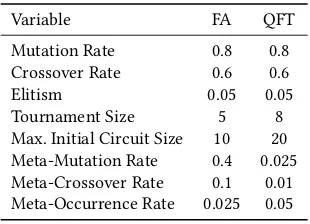
To evaluate our system, we used it to evolve solutions for the full-adder (FA) and quantum Fourier transform (QFT) problems using different combinations of gate sets. Each experiment was repeated 500 times. We recorded the mean number of generations that was required to arrive at a solution. The results of our experiments are shown in Table 1 while the values used for the system’s parameters
1The process was stopped after 500 generations for the fuller-adder problem and 3000
for the quantum Fourier problem. If the fitness value was not within 0.1% of the optimal fitness by that point, the attempt was deemed unsuccessful.
[image:4.612.361.516.278.390.2]2This value is quoted from the work of Massey et al. [4]. 3This value is quoted from the work of Potoček et al. [5].
Table 2: Hyper-parameters
Variable FA QFT
Mutation Rate 0.8 0.8 Crossover Rate 0.6 0.6
Elitism 0.05 0.05
Tournament Size 5 8 Max. Initial Circuit Size 10 20 Meta-Mutation Rate 0.4 0.025 Meta-Crossover Rate 0.1 0.01 Meta-Occurrence Rate 0.025 0.05
are shown in Table 2. The gate sets that we use are defined as:
General = {CNOT,PX,PY,PZ,UP,H,SWAP}
Higher = {Conditional,Anti-conditional,All,Inverse}
Massey = {PX,RX,RZ,RY,V,W,CNOT,CCNOT}
Potoček = {H,UP,CUP,CCUP,SWAP}
TheMasseyandPotočeksets are inspired by the works of Massey et al. [4] and Potoček et al. [5] respectively, and are included to compare our system to their work.
TheGeneralset contains common gates seen in a large variety of quantum circuits. It is not specialised and we intend to use this gate set for solving arbitrary problems. The higher-order gates introduced in Section 3.2 are grouped intoHigher. We use them to enhance theGeneralset as described in that section.
5
DISCUSSION
GECCO ’19 Companion, July 13–17, 2019, Prague, Czech Republic Barnes and Gale
to surpass previous results with ourGeneral + Highergate set, and hence without prior knowledge of the problem solutions.
The full-addition problem can be solved quickly if an optimal gate set is used. Usinge.g.{CCNOT,CNOT}, the optimal solution requires only four gates. However, without knowledge of the solu-tion we might not have the more obscureCCNOT(Toffoli) gate in our gate set. Instead, we might use a more standard gate set such as theGeneralset, which does not include the Toffoli gate. In this case, the optimal solution consists of around 30 gates which is larger and therefore harder for a genetic algorithm to evolve. This can be seen in the first result in Table 1, where the experiment that used the Genericgate set failed to solve the problem in 500 generations.
Adding higher-order gates to the general gate set allows us to successfully evolve the adder in 179 generations, only 1.9x slower than using the optimised gate set. This can be attributed to the Conditionalhigher-order gate, as it can create the equivalent of theCCNOTgate while being more general. No manual gate set optimisation or knowledge about a problem’s solution is required. We improve on this further with the meta-genetic method (Sec-tion 3.1) by an average of 9 genera(Sec-tions using the random method. When using the frequency proportionate method, the number of generations increased, and thus the random method was used for the remaining experiments.
The results for evolving QFT are similar. Using theGeneral + Highergate set, we evolved solutions in roughly14as many gener-ations as Potoček et al. [5] and only 2.1x slower than using their optimised gate set in our system. When using the right hyper-parameters for probability mutation and crossover rates, enabling the meta-genetic feature slightly decreased the mean generations to 208. This is only a factor of 1.9x off the same system being used with a manually optimised gate set.
6
CONCLUSIONS AND FURTHER WORK
We presented a quantum programming system which can evolve solutions to the FA and QFT problems in fewer generations than previous work, but without needing prior knowledge about a solu-tion. If given prior knowledge in the form of a manually optimised gate set, our system is even more efficient.Our main improvement is the addition of higher-order gates which increase the effectiveness of a general gate set. Enhancing this approach by dynamically evolving the probabilities that certain types of gates are chosen in the mutation stage led to further, but small, improvements. The combination of these two techniques allows our system to reach solutions with this generalised approach only about 2x slower than using a manually optimised gate set.
Our system also performs better than previous work when using exactly the same gate sets that they used. For example, to solve the QFT problem our system required 9.8x fewer generations than the work of Potoček et al. [5]. We theorise that this improvement is because of our more effective genetic mutation operation and the use of well optimised hyper-parameters.
Our work paves the way to more general, genetic algorithms that can evolve solutions to quantum programming problems which do not depend on human guidance or previous knowledge of the solu-tion. However, there is more room for improvement. Throughout this work the system user has had to optimise hyper-parameters
such as the population size and mutation rate manually. More work can be done on methods to tune these automatically. Also, as shown in the results, our system is still more efficient with an optimal gate set. Ideally, there would be no difference in the use of an optimal gate set versus a general gate set. We envisage that further improve-ments in this area could be achieved by exploring the addition of new higher-order gates.
A
GATE DEFINITIONS
CNOT =
1 0 0 0 0 1 0 0 0 0 0 1 0 0 1 0
SWAP =
1 0 0 0 0 0 1 0 0 1 0 0 0 0 0 1
CUP =
1 0 0 0 0 1 0 0 0 0 1 0 0 0 0eiϕ
H = √1
2
h1 1
1 −1
i
UP =
1 0 0 eiϕ
V = h1 00 ii W = h1 00 −ii
PX = h0 11 0i PY = h1 00 −1i PZ = h0i −0ii RZ =
e−iθ 0
0 eiθ
RX = h−cos θi sin θ −cos θi sin θi RY = hcos θsin θ cos θ−sin θi
CCUP =
1 0 0 0 0 0 0 0 0 1 0 0 0 0 0 0 0 0 1 0 0 0 0 0 0 0 0 1 0 0 0 0 0 0 0 0 1 0 0 0 0 0 0 0 0 1 0 0 0 0 0 0 0 0 1 0 0 0 0 0 0 0 0eiϕ
CCN OT =
1 0 0 0 0 0 0 0 0 1 0 0 0 0 0 0 0 0 1 0 0 0 0 0 0 0 0 1 0 0 0 0 0 0 0 0 1 0 0 0 0 0 0 0 0 1 0 0 0 0 0 0 0 0 0 1 0 0 0 0 0 0 1 0
B
HIGHER-ORDER GATES
• Conditional: a given operation is performed if a specified qubit is 1.
• Anti-Conditional: a given operation is performed if a specified qubit is 0.
• Inverse: the inverse of a given operation is performed. • All: a given operation is applied to all possible qubits.
ACKNOWLEDGMENTS
We would like to thank the referees for their constructive feedback and useful suggestions about the paper.
REFERENCES
[1] John R Koza. 1990. Genetic programming: A paradigm for genetically breeding populations of computer programs to solve problems. Vol. 34. Stanford University, Department of Computer Science Stanford, CA.
[2] Paul Massey, John A Clark, and Susan Stepney. [n. d.]. Evolution of a human-competitive quantum fourier transform algorithm using genetic programming. In Proceedings of the Genetic and Evolutionary Computation Conferece 2005 (GECCO ’05).
[3] Paul Massey, John A Clark, and Susan Stepney. 2004. Evolving quantum circuits and programs through genetic programming. InProceedings of the Genetic and Evolutionary Computation Conferece 2004 (GECCO ’04). Springer, 569–580. [4] Paul Massey, John A Clark, and Susan Stepney. 2006. Human-competitive
evo-lution of quantum computing artefacts by genetic programming.Evolutionary Computation14, 1 (2006), 21–40.
[5] Václav Potoček, Alan P Reynolds, Alessandro Fedrizzi, and David W Corne. 2018. Multi-objective evolutionary algorithms for quantum circuit discovery. arXiv preprint arXiv:1812.04458(2018).
[6] Lee Spector. 2004.Automatic Quantum Computer Programming: a genetic program-ming approach. Vol. 7. Springer Science & Business Media.