Original citation:
Bray, Caroline, Peltier, Raoul, Kim, Hyungsoo, Mastrangelo, Antonio and Perrier, Sébastien.
(2017) Anionic multiblock core cross-linked star copolymers via RAFT polymerization.
Polymer Chemistry, 8 (36). pp. 5513-5524.
Permanent WRAP URL:
http://wrap.warwick.ac.uk/93573
Copyright and reuse:
The Warwick Research Archive Portal (WRAP) makes this work of researchers of the
University of Warwick available open access under the following conditions. Copyright ©
and all moral rights to the version of the paper presented here belong to the individual
author(s) and/or other copyright owners. To the extent reasonable and practicable the
material made available in WRAP has been checked for eligibility before being made
available.
Copies of full items can be used for personal research or study, educational, or not-for-profit
purposes without prior permission or charge. Provided that the authors, title and full
bibliographic details are credited, a hyperlink and/or URL is given for the original metadata
page and the content is not changed in any way.
Publisher statement:
First published by Royal Society of Chemistry 2017
http://dx.doi.org/10.1039/C7PY01062A
A note on versions:
The version presented here may differ from the published version or, version of record, if
you wish to cite this item you are advised to consult the publisher’s version. Please see the
‘permanent WRAP url’ above for details on accessing the published version and note that
access may require a subscription.
Journal Name
ARTICLE
Received 00th January 20xx, Accepted 00th January 20xx
DOI: 10.1039/x0xx00000x
www.rsc.org/
Anionic Multiblock Core Cross-Linked Star Copolymers via RAFT
Polymerization
Caroline Bray, a Raoul Peltier,a Hyungsoo Kimb, Antonio Mastrangeloc, Sébastien Perriera,d,e *
Poly(2-acrylamido-2-methylpropane sulfonic acid) is a polyelectrolyte currently used in numerous industrial applications. Herein, we report the use of reversible addition fragmentation chain transfer (RAFT) polymerization to prepare a range of well-defined homopolymers and block copolymers of 2-acrylamido-2-methylpropane sulfonic acid (AMPS®) and either N
-hydroxyethyl acrylamide (HEAm) or 4-acryloylmorpholine (NAM) as a comonomer. We also describe the one-pot synthesis of multiblock core cross-linked star copolymers of AMPS® and HEAm with low dispersities (< 1.3). The influence of several
parameters such as the cross-linker type, cross-linker to chain transfer agent (CTA) ratio, arm length and composition on the polymerization efficiency are investigated.
Introduction
Polyelectrolytes, and sulfonated polymers in particular, have gradually become key components in important industrial processes such as water purification, oil recovery or fuel cells preparation.1–3 Amongst them, polymers of 2-acrylamido-2-methylpropane sulfonic acid (AMPS®) are of a particular interest as they combine high thermal stability, resistance to hydrolysis and a high solubility in water over a wide range of pH. Poly(2-acrylamido-2-methylpropane sulfonic acid ) (PAMPS) is used as a rheology modifier, a dispersant for oil spills, or as biocompatible hydrogels for various biomedical purposes.1,2,4,5 In all these applications, the molecular weight, architecture and chain-end functionality of the polyelectrolyte plays an essential role in controlling the physico-chemical properties of the resulting material.
PAMPS is commonly prepared via conventional radical polymerization in aqueous solution at low temperature, a process that has been widely used for about three decades, albeit with a lack of control over the resulting polymer’s molecular weight and chain-end functionality, typically resulting in dispersities above 1.5.6,7 Today, the emergence of controlled/living radical polymerization such as
nitroxide-mediated radical polymerization (NMP)8, atom transfer radical polymerization (ATRP),9 or reversible addition-fragmentation chain transfer polymerization (RAFT)10 allows for the easy preparation of well-defined polymers, both in term of molecular weight and architecture.11 Mincheva et al. optimized the polymerization of AMPS® using copper-mediated ATRP in a mixture of methanol and water and reported the influence of pH and ligand type on the resulting materials.12 In another example, Nikolaou et al. achieved full monomer conversion in less than 30 minutes by polymerizing AMPS® using copper-mediated living radical polymerization in aqueous solution at 0 °C.13 While facilitating the preparation of short polymers with narrow molecular weight dispersity, these methods yielded poor control over the polymers with a degree of polymerization (DP) higher than 80. The use of a metal-catalyst also requires a further step of product purification, which might be an issue for associated applications. A more convenient approach to preparing PAMPS consists of using RAFT polymerization. RAFT polymerization has been successfully used to polymerize AMPS® in water and yielded materials with low dispersity (Ð < 1.3) and a linear increase of the molecular weight over time.14 In order to diversify its functionality and optimise its physical properties, AMPS® is often polymerized with other comonomers such as acrylic acid,1 acrylamide, N,N-dimethylacrylamide,15 sodium 3-acrylamido-3-methylbutanoate,16 or poly(ethylene glycol).17 For example, diblock copolymers of PAMPS-b-PAMBA with low dispersity values were successfully obtained in water within 12 hours by Sumerlin et al.16
Highly ordered multiblock copolymers can be obtained by RAFT polymerization in aqueous solution,18 especially when using monomers with a high rate of polymerization (kp), such
as acrylamide. Such systems lead to the preparation of multiblock copolymers (up to 20 blocks, Ð < 1.5) in a one-pot process where full monomer conversion was reached for each chain extension step.18–21 RAFT polymerization was shown to be particularly advantageous in that the final materials did not require extensive purification steps. In addition, the presence of the CTA in the polymers, which can easily be converted into a thiol, offers a convenient functionalization handle at the end of the polymer chain. Alternately, the CTA can be subsequently removed by post-polymerization modifications.22
RAFT polymerization also provides a suitable method for the preparation of more complex architectures such as star-shaped polymers, hyperbranched polymers and nanoparticles.23–25 The physical properties of star polymers are known to vary greatly in comparison to their linear counterparts, making them attractive materials for numerous applications ranging from oil recovery to drug delivery.26 Polymerization techniques used to prepare star polymers can be divided into two general strategies; core-first or arm-first.27 The core-first approach relies on the use of multifunctional CTAs and typically results in star-shaped polymers with a well-defined number of arms.28,29 The arm-first approach is a convergent method that consists of chain extending a previously-synthesized arm in the presence of a multifunctional monomer that behaves as a cross-linker. The latter typically allows less control over the number of arms incorporated, but provides better control over the length of the arms incoporated.30,31 Using the arm-first approach, RAFT emulsion polymerization has been previously utilized to synthesize stars with excellent dispersity (Ð < 1.3) with high incorporation of polymeric arms (~ 90 %).32 A couple of examples in the literature compares the two approaches for the preparation of multiblock star copolymers using acrylate monomers. Using ATRP, the arm-first approach proved better suited than the core-first approach, which required the synthesis of complex multiarm initiators. In both cases, however, low conversions (typically < 70 %) were obtained, demonstrating that RAFT is possibly better suited for the preparation of star-shaped polymers.33,34
Despite the existence of readily available methods, the preparation of linear and star shaped multiblock polymers of PAMPS has not been reported so far. Here, we describe the optimization of RAFT polymerization in aqueous solution for the preparation of complex architectures of PAMPS. This includes homopolymers with a wide range of DP (from 10 to 400) and well-defined multiblock and random copolymers of AMPS with either HEAm or NAM comonomers. We also describe the synthesis of core crossed-linked star polymers using the arm-first approach and either a homopolymer of AMPS or an octablock copolymer of AMPS and HEAm.
Experimental Section:
Materials. Sodium hydroxide (NaOH; Fischer Scientific, 97 %, pellets), 1-butanethiol (Sigma-Aldrich, 99 %), carbon disulfide (CS2; Sigma-Aldrich, 99 %), 2-bromo-2-methylpropionic acid (Sigma-Aldrich, 98 %), hydrochloric acid solution (HCl, VWR chemical, 35 %), acetone (Sigma-Aldrich, 99 %), n-hexane (VWR chemical, 99 %), chloroform (Sigma-Aldrich, 99 %), distilled water, sodium 2-acrylamido-2-methylpropane sulfonate (AMPS®2405, Lubrizol, 50 % in water), 2-(((butylthio)-carbonothioyl)thio)-2-methylpropanoic acid (BDMAT, synthesized using method35), 4,4ʹ-azobis(4-cyanopentanoic acid), 2,2ʹ-azobis[2-methyl-N-((2-hydroxyethyl)propionamide] (VA-086, WAKO, 98 %), N,Nʹ-Methylenediacrylamide (BIS, Sigma-Aldrich), di(ethylene glycol) diacrylate (Sigma-Aldrich, 75 %, technical grade), deuterium oxide (D2O, Sigma-Aldrich, 99.9 % D atom), methanol-d4 (MeOD; Sigma-Aldrich, 99.8 % D atom). The chemicals were used as received with no further purification.
Instrumentations. 1H NMR spectra were recorded on either a Bruker AV300 or a Bruker HD300 spectrometer using either deuterium oxide (D2O) or deuterated methanol (MeOD).
Chemical shift values (δ) are reported in ppm. Size Exclusion Chromatography (SEC) was carried out on an Agilent Technologies PL-GPC Integrated GPC System, the instrument was equipped with a differential refractive index (DRI). Agilent PL aquagel OH Mixed M 8 µm, two set of columns in series was used alongside with an 8 μm aquagel guard column. The mobile phase used was 80 % NaNO3 in water at 0.1 M and 20 %
methanol. Column oven and detector temperatures were set at 40 °C. Flow rate was set at 1 mL·min-1. Poly(ethyleneoxide) standards (Agilent EasyVials) were used for calibration. Analyte samples were filtered through a hydrophilic membrane with 0.22 μm pore size before injection. Respectively, experimental molar mass (Mn,SEC) and dispersity (Đ) values of synthesized
polymers were determined by conventional calibration using Agilent GPC/SEC software. Static light scattering measurements were done using an ALV-CGS3 system (ALV-Langen) operating with a vertically polarized laser at a wavelength of 632.8 nm. Measurements were done at 45 °C in water containing 0.1 M NaNO3, over a range of scattering wave vectors q varying from 4.8x10⁶ to 2.8x10⁷ m-1 (q = 4πn/ .sin( /2)), with Ɵ being the angle of observation and n
the refractive index of the solvent).
Methods
Determination of Monomer Conversions. Monomer conversion (p) was calculated from 1H NMR data using
Equation 1:
𝑝
=
[!]!!!![!]!
=
1
−
!!
!!
=
1
−
!!.!!!.!" !!"
!!
!"!"#$%!%&
(1)
Where [M]0 and [M]tare the monomer concentrations at time 0 and time t, respectively; ( 𝐼!.!!!.!" !!" 𝐼!) is the corrected
Journal Name ARTICLE
targeted; I!is the integration of the signal for the three methyl protons belonging to the Z group of the RAFT agent (-CH2-CH3) used as an internal reference.
Calculation of the Theoretical Number-Average Molar Mass (Mn,th). The theoretical number-average molar mass (Mn,th) was calculated using Equation 1:
𝑀
!,!!=
[!][!"#!!!]!!
+
𝑀
!"#(2)
Where [M]0 and [CTA]0 are the initial concentrations of monomer and chain transfer agent, respectively; p is the monomer conversion as determined using equation 1; MM and MCTA are the molecular mass (g mol-1) of the monomer and
chain transfer agent, respectively.
Calculation of the Theoretical Number Fraction of Living Chains (L).36 The number of living chains (L) was calculated
using Equation 2:
𝐿
=
[!"#]![!"#]!!!!!!(!!!!!!!)
(3)
Where [I]0 and [CTA]0are the initial concentrations of initiator and chain transfer agent, respectively; kd is the decomposition rate constant (in s-1) of the azoinitiator at a given temperature; t is the polymerization time (in s); f is the efficiency of the initiator and is equal to 0.5.
Determination of the Chain Transfer Constant (Ctr). The
apparent chain transfer constant (Ctr) of AMPS monomer (salt
form) in phosphate buffer tablet solution at 90 °C was then determined experimentally by plotting Ln([CTA]consumed) in
function of Ln([AMPS]consumed) using Equation 4:
C
!"!""=
!"#[!"#!"#][!](4)
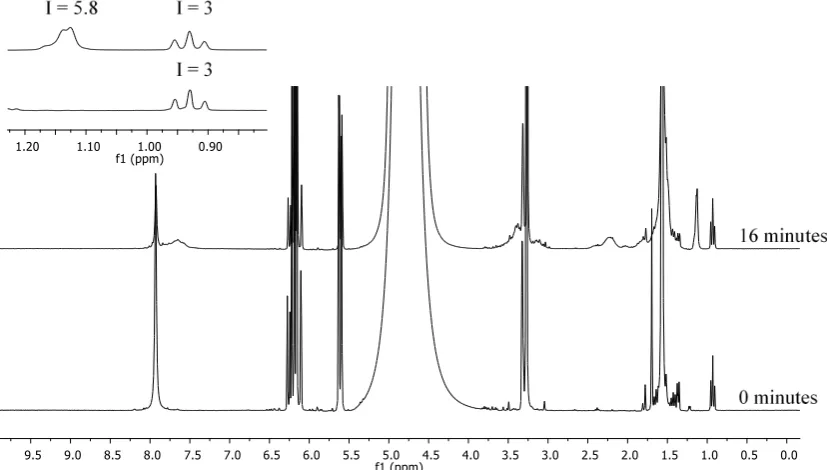
Consumption of the chain transfer agent and monomerwere followed by 1H NMR (Figure SI 1 and 2). CTA consumption was followed by the appareance of a peak at approximatelly 1.10 ppm corresponding to the C(CH3)2 of the R group of the CTA as
the polymer chains form. Monomer consumption was followed by the disappearance of the vinylic proton between 5.50 and 6.50 ppm. The CH2-CH3 (C4H9 alkyl chain) of the Z
group (~ 0.90 ppm, triplet) was taken as the internal reference due to the chemical shift remained unchanged for incorporated and non-incorporated monomer units.
Determination of the Molecular Weight by Static Light Scattering (SLS). The molecular weight was determined using a Zimm plot which follows Equation 5:
!" !Ɵ
=
! !!
1
+
!!! !!
!
(5)
Where K is a constant; c is the polymer concentration in g.L-1; RƟ is the Rayleigh ratio; Mw is the average molecular weight; q is the wave vector; Rg is the apparent radius of gyration. For each polymer, four solutions of 7.0, 5.0, 2.5 and 1.0 mg.mL-1 were made up, filtered and the ratio Kc/R measured at different angle (20, 30, 50, 70, 90, 110, 130 and 150°). Mw was then determined by extrapolating the equation at the intercept with the y-axis at concentration equal to 0 mg.mL-1.
Calculation of the Percentage of Arm Incorporated into the Star.37 The percentage of arm incorporated into each star was determined by deconvolution of multimodal SEC traces using
Equation 6:
𝐶𝑜𝑛𝑣𝑒𝑟𝑠𝑖𝑜𝑛 𝑡𝑜 𝑆𝑡𝑎𝑟 = !"#!"#$
!"#!"#$! !"#!"#
(6)
Where 𝐴𝑖𝑟!"#$ is the integration of the SEC signal
corresponding to the star polymer and 𝐴𝑖𝑟!"# is the integration of the SEC signal corresponding to the arm only.
Synthesis.
Chain Transfer Agent Synthesis: BDMAT. BDMAT was synthesized by adapting a procedure from Lai et al.35 Briefly, a solution of a 17 % NaOH aqueous solution (44.0 mL, 222 mmol) was added to a mixture of butanethiol (24.0 mL, 222 mmol) and acetone (12 mL), and the colourless miscible solution was stirred for 30 minutes at room temperature. Carbon disulfide (15 mL, 244 mmol) was then added and stirred for another 30 minutes at room temperature to give an orange solution. The solution was cooled in an ice bath (~ 5 °C) and 2-methyl-2-bromopropanoic acid (38.00 g, 227 mmol) was added slowly, keeping the internal temperature below 30 °C, forming a yellow precipitate. Another 17 % NaOH aqueous solution (44.0 mL) was added (internal temperature again kept below 30 °C) to dissolve the orange precipitate. The solution was left to stir overnight at room temperature. After 17 hours, the reaction mixture was diluted with 200 ml of water before being washed twice with hexane. The aqueous phase was then cooled to 0 °C and hydrochloric acid (200 mL, 1 M) was added dropwise (pHfinal ~ 2-3) until a yellow precipitate was observed.
The solid was collected by suction filtration and washed twice with cold water. Subsequently, the solid was dissolved in chloroform (200 mL) and dried over MgSO4. After filtration and
removal of the dichloromethane in vacuo, the solid was recrystallized from hexane. The yellow solid was finally dried on vacuum (42.00 g, 76 % yield). δH(300 MHz, CDCl3) 3.29 (2H,
t, J = 7.4, SCH2), 1.72 (6H, s, C(CH3)2), 1.69 – 1.61 ( 2H, m,
SCH2CH2), 1.52 – 1.35 (2H, m, CH2CH3), 0.93 (3H, t, J = 7.3, CH2CH3); δC (300 MHz, D2O) 178.95 (COOH), 55.57 (C(CH3)2),
36.75 (SCH2), 29.85 (SCH2CH2), 25.21 (C(CH3)2), 22.13 (CH2CH3),
13.64 (CH2CH3); m.p.: 57-58 °C (Lit. 52 °C)38; M/Z (M-H+
C9H15S3O2- requires 251.0) found 251.0; νmax/cm-1 3000-2500
Homopolymer Synthesis. BDMAT (26 mg, 0.1 mmol), AMPS (2.00 g, 5.1 mmol), phosphate buffer tablet solution (1.5 mL), sodium hydroxide (5.1x10⁻² mmol, 2 mg) and VA-086 (8.4x10⁻³ mmol, 2.4 mg) (from stock solution at 20.0 mg.mL-1) were introduced into a flask equipped with a magnetic stirrer bar and sealed with a rubber septum. The solution was deoxygenated by bubbling through with nitrogen for 10 minutes, and the vial was then placed in a temperature controlled oil bath at the desired temperature (90 °C), for the duration of time required to reach nearly full conversion (~ 2 hours). At the end of the reaction, the mixture was allowed to cool down at room temperature and then opened to the atmosphere. Final materials were characterized using 1H NMR and SEC (Mn,SEC and Ð were determined).
Random Copolymer Synthesis. BDMAT (26 mg, 0.1 mmol), HEAm (0.47 g, 4.1 mmol), AMPS (1.60 g, 4.1 mmol), phosphate buffer tablet solution (3.4 mL), sodium hydroxide (5.1x10⁻² mmol, 2 mg) and VA-086 (1.4x10⁻² mmol, 4 mg) (both taken from a stock aqueous solution at 20.0 mg.mL-1) were introduced into a flask equipped with a magnetic stirrer bar, and sealed with a rubber septum. The solution was deoxygenated by bubbling through with nitrogen for 10 minutes, and the vial was placed in a temperature controlled oil bath at the desired temperature (90 °C) for the time required to reach nearly full conversion (~ 1 hour). After the reaction, the mixture was cooled down to room temperature and opened to the atmosphere. The monomer conversion was then determined using 1H NMR and the material was analysed by SEC (Mn,SEC and Ð were determined).
Block Copolymer Synthesis. For the synthesis of the first block, refer to Homopolymer synthesis above. Iterative chain extension with various comonomers were carried out using a similar protocol. An example of synthesis is given here for a diblock copolymer of AMPS and HEAm (PAMPS50-b-PHEAm50).
Briefly, a solution containing HEAm (0.58 g, 5.1 mmol) and further VA-086 (0.9 mg, 3.0x10⁻³ mmol) was degassed and added via a syringe to the polymerization medium. The polymerization mixture was allowed to polymerize at the same temperature (90 °C) for the time required to reach full monomer conversion (1 h for AMPS, and 1.5 h for NAM and HEAm). Before each new block, a sample was taken with a degassed syringe for analysis (1H NMR and SEC). The quantity of each compound used for the multiblock copolymer synthesis with HEAm and NAM is reported in table SI 3 and SI 5.
Star Polymer synthesis. For the synthesis of the initial arm, refer to Homopolymer Synthesis or Random Copolymer Synthesis or Block Copolymer Synthesis above. Star polymer synthesis were carried out using the same protocol. An example of the synthesis is given here for a star comprised of homopolymer PAMPS50. A solution of additional initiator (0.6
mg, 2.2x10⁻³ mmol) and cross-linker (0.17g, 8.1x10⁻¹ mmol) was degassed and added via a syringe to the polymerization medium. The polymerization mixture was allowed to polymerize at the same temperature (90 °C) for the time required to reach full cross-linker conversion and maximum conversion of the arm into the star (0.5 h). Before the star polymer synthesis, a sample was taken with a degassed syringe for analysis (1H NMR and SEC).
Results and Discussion
PAMPS Homopolymer
RAFT polymerization combines good control of the molecular weight and dispersity of syntheized polymers, catalyst-free protocols, easy purification steps and a high livingness that is essential for the preparation of complex architectures. At first, a range of homopolymers of AMPS with degrees of polymerization varying from 10 to 400 were prepared (Scheme 1). The polymerization reactions were invariably carried out in phosphate buffer tablet solution at pH = 7 to ensure that pH changes will not affect the kinetics of the reactions and the solubility of the reactants (monomer, CTA and initiator).39,40 BDMAT was chosen as the CTA because its melting point (63 °C) is lower than the reaction temperature (90 °C), allowing full CTA solubilisation within the first few minutes of the reaction.41 Sodium hydroxide (0.5 equivalents per CTA) was also added to the polymerization mixture to further ensure the CTA solubility in aqueous solution. The CTA concentration was decreased from 0.15 M to 3.7×10⁻³ M with increasing DPs (Table 1) to keep the monomer concentration constant across all reactions (1.5 M).
[image:5.595.41.552.652.747.2]Scheme 1: RAFT polymerization of AMPS (DP 10 to 400)
Table 1: RAFT polymerization of AMPS homopolymers using BDMAT as chain transfer agent in phosphate buffer tablet solution (pH ~ 7) at 90 °C.
Polymer DP [AMPS]0:[CTA]0:[I]0
(mol.L-1) Livingness (%) Conv. a
(%)
Mn,thb
(g.mol-1) Mn,SEC c
(g.mol-1) Ð c
1 10 10:1:0.017 99.7 98 2,500 5,500 1.09
2 20 20:1:0.033 99.3 > 99 4,800 8,100 1.10
3 50 50:1:0.083 98.4 > 99 11,600 13,000 1.11
4 100 100:1:0.167 96.8 > 99 23,000 17,600 1.16
5 200 200:1:0.333 93.4 > 99 45,600 29,900 1.25
Journal Name ARTICLE
a Determined by 1H NMR using equation (1) (see experimental section); b Determined using equation (2) (see experimental section); c Determined by Aqueous-SEC with
PEG standard.
The polymerization conditions were optimized to retain a high “livingness” of the system. RAFT polymerization typically leads to two types of polymer chains, thiocarbonyl-thio ended chains (living chains) and initiator-ended chains (dead chains). In order to subsequently prepare block copolymers with good precision, it is important to have both a low percentage of dead chains and a good retention of the end group, which is typically referred to as the “livingness” of the system.21 High livingness is typically obtained by either keeping the concentration of initiator low or by using a slowly decomposing initiator. In this study, an optimum concentration of initiator (VA-086) was determined to be of 2.5x10⁻³ M. Using this parameter, 20 % of the initiator is expected to be decomposed after 2 hours. When targeting DP = 10, this represented an initial ratio [CTA]0/[VA-086]0 = 60, a
final ratio of [CTA]0/[VA-086]consumed = 300 and a livingness of
[image:6.595.69.260.379.533.2]approximately 99.7 % for the polymerization. The initiator concentration was kept constant with varying DPs in order to have similar kinetic profiles for each reaction. Using these conditions, livingness higher than 90 % was obtained for polymerization targeting DP lower than 200 (Table 1). Only the reaction at DP = 400 was found to be slightly below this threshold (L = 87.6 %).
Figure 1: Aqueous SEC chromatograms (Refractive Index) of PAMPS homopolymers with DPs varying from 10 to 400.
Aqueous SEC (Figure 1) was used to characterize the polymer’s molecular weight, showing narrow dispersities (≤ 1.25) for polymers with a DP below 200. For the higher DP (Table 1,
Entry 6) a broader chromatogram (i.e. Ð = 1.51) was obtained containing a tail at lower molecular weights. This phenomenon is commonly observed for high molecular weight polymers and is usually referred to as “gel effect”. The viscosity of polymers is known to increase with molecular weight. For high DPs, this leads to a decrease in the diffusion of polymer chains and an accumulation of radical species that can affect the kinetics of termination and propagation of the reaction, thus leading to an increased percentage of smaller polymer chains.42 To determinate the CTA efficiency, we determined the chain transfer constant (Ctr = ktr/kp) a value that characterizes the
efficiency of a RAFT agent for a given monomer, solvent and temperature system. Ctr was determined using the Walling method plot using 1H NMR to follow consumption of CTA and monomer.43,44 Using this method, the Ctrapp was estimated to
be around 25 (Figure SI 1 and 2). A Ctrapp higher than 1 means
that the rate of transfer is higher than the rate of monomer propagation (ktr>kp).44 The high value obtained here indicates
that the number of monomer units incorporated into the CTA is controlled, and that the CTA was efficient under the conditions studied (i.e. control of molecular weight and low dispersity).
Multiblock Copolymer of NAM / HEAm and AMPS
Scheme 2: Synthesis of multiblock copolymers of AMPS, AMPS with HEAm and NAM.
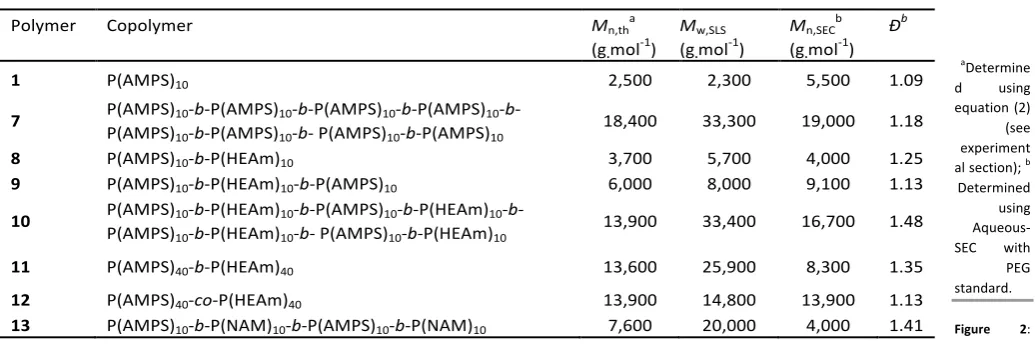
The preparation of multiblock polymers was first investigated using blocks strictly made of AMPS. An octablock homopolymer (Scheme 2, Polymer 7) was successfully synthesized by a one-pot sequential monomer addition method. Full monomer conversion was obtained between each chain extension (Table SI 1 and 2, Figure SI 4) despite the monomer concentrations decreasing from 1.5 to 0.32 M during the polymerization. It is noteworthy that the first block needed a longer reaction time (2 hours) to reach full monomer conversion, with subsequent blocks only taking approximately 1 hour, which can be attributed to the slower consumption of the initial CTA, upon comparison to the macroCTA formed later. SEC analysis shows monomodal chromatograms and a shift towards higher molecular weight after each monomer addition (Figure 2a, right). The monodisperse nature of the final octablock homopolymer (i.e. 1.18) confirms the high livingness of the system throughout the whole process (~ 98.5 %) (Table 2). This is further supported by the relatively linear increase of the number-average molecular weight observed with increasing number of blocks (Figure 2a, left). The number-average molecular weight measured by SEC was found to be slightly higher than the theoretical values, which can be attributed to dissimilarity in the hydrodynamic volume of PAMPS (polyelectrolyte) and the PEG-standard used for calibrating the aqueous SEC.20,45 Overlay of the
earlier (Figure SI 5) shows a slightly higher molecular weight for the octablock ((P(AMPS)10)8: Mn,SEC = 19,000 g.mol-1 , Ð =
1.18; PAMPS80: Mn,SEC = 15,000 g.mol-1, Ð = 1.14). This can be
attributed to the longer reaction times used to prepare the
[image:7.595.37.555.143.315.2]octablock (9 hours verses 1.5 hours) and the higher solution viscosity of the octablock reaction mixture compared to the homopolymer. A similar observation was
Table 2: Copolymers prepared in this study.
aDetermine
d using equation (2) (see experiment al section); b
Determined using Aqueous-SEC with PEG standard. Figure 2:
Stepwise characterisation of the block extension of multiblock copolymers of a) (P(AMPS)10)8; b) (P(AMPS)10-b-P(HEAm)10)4; c) (P(AMPS)10-b-P(NAM)10)2; (left) molar mass and dispersity;
(right) aqueous-SEC chromatograms.
made by Gody et al., for a decablock of poly(N,N-dimethylacrylamide) (PDMA) versus its homopolymer
counterpart.46
Copolymerization of PAMPS with other monomers was studied
Polymer Copolymer Mn,tha
(g.mol-1)
Mw,SLS
(g.mol-1)
Mn,SECb
(g.mol-1)
Ðb
1 P(AMPS)10 2,500 2,300 5,500 1.09
7 P(AMPS)10-b-P(AMPS)10-b-P(AMPS)10-b-P(AMPS)10
-b-P(AMPS)10-b-P(AMPS)10-b- P(AMPS)10-b-P(AMPS)10 18,400 33,300 19,000 1.18
8 P(AMPS)10-b-P(HEAm)10 3,700 5,700 4,000 1.25
9 P(AMPS)10-b-P(HEAm)10-b-P(AMPS)10 6,000 8,000 9,100 1.13
10 P(AMPS)10-b-P(HEAm)10-b-P(AMPS)10-b-P(HEAm)10
-b-P(AMPS)10-b-P(HEAm)10-b- P(AMPS)10-b-P(HEAm)10 13,900 33,400 16,700 1.48
11 P(AMPS)40-b-P(HEAm)40 13,600 25,900 8,300 1.35
12 P(AMPS)40-co-P(HEAm)40 13,900 14,800 13,900 1.13
[image:7.595.47.501.349.777.2]Journal Name ARTICLE
next, using two different water soluble comonomers as a model: N-hydroxyethyl acrylamide (HEAm) and 4-acryloylmorpholine (NAM). These monomers were chosen as representative of acrylamide monomers because of their hydrophilicity and good reactivity. Octablock copolymer PAMPS-b-PHEAm and tetrablock copolymer PAMPS-b-PNAM were synthesized with an average DP of 10 for each block (Scheme 2, Polymer 10 and 13). Chain extension of PAMPS macroCTA with HEAm or NAM required a longer reaction time to reach full monomer conversion than chain extension with AMPS itself (1.5 hours versus 1 hour), which can be attributed to differences in the kp value of each monomer.211H NMR was
used to confirm full monomer conversion between each monomer addition (Table SI 3 and 4, Figure SI 6). Monomodal distributions were obtained after each block addition, with dispersities ranging from 1.09 for the first block, to 1.48 for the last block of the octablock copolymer of PAMPS and HEAm. While the general trend shows a linear evolution of the experimental molecular weight with increasing number of blocks (Figure 2b), a shift at lower molecular weight when PAMPS10 was chain extended with HEAm, followed by a shift at
higher molecular weight when macroCTA (PAMPS10
-b-PHEAm10) was further chain extended with AMPS, can be
observed. This “step effect” can be attributed to differences in the nature of the two monomers (electrolyte versus neutral).47 PAMPS being a negatively charged polyelectrolyte, electrostatic interactions are expected to expand the polymer more than in the case of the neutral polymer segments (i.e, NAM and HEAm), accounting for the irregular variation of hydrodynamic volumes, and therefore molecular weights observed. The difference of molecular weights of the two monomers (MAMPS = 229.2 g.mol-1 and MHEAm = 115.1 g.mol-1) is
expected to further enhance this phenomenon. This is in accordance with an observation made by McKenzie et al. for the synthesis of a hexablock copolymer of ethyl acrylate (EA) and methyl acrylate (MA).33 To verify this hypothesis, static light scattering (SLS) measurements were used to determine the absolute molecular weight of our copolymer (Equation 5). As expected, a linear increase of the molecular weight was observed for 1 (2,300 g mol-1), 8 (5,700 g mol-1) and 9 (8,000 g mol-1) (Table 2).
NAM, which has been widely used in the literature to synthesize well-defined multiblock homo- and copolymers due to its high reactivity, was used here as an alternative comonomer to demonstrate the robustness of the method. Using similar conditions to those for HEAm, full monomer conversions (Table SI 5 and 6, Figure SI 8) and monomodal chromatograms (Figure 2c) were obtained after each sequential monomer addition. As expected, a similar trend was seen to that of HEAm, with steps observed in the plot of the experimental molecular weight versus the number of blocks. Similarly, we attributed this artefact to differences in the hydrodynamic volume of AMPS and NAM segments, as illustrate by SLS measurement that the absolute molecular weight of 13 is higher than the value measured using SEC. Next, a diblock (11) and a random copolymer (12) of similar composition and molecular weight than octablock copolymer
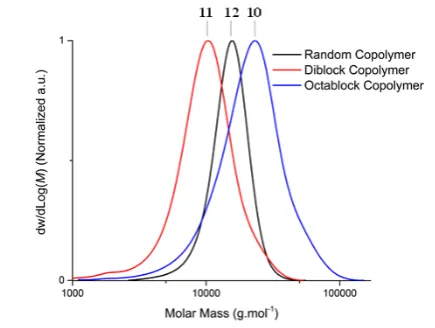
[image:8.595.321.539.328.492.2]10 was prepared for comparison. An induction period of 8 minutes was observed for the random copolymer synthesis, compared to approximately 25 minutes for AMPS homopolymer synthesis. This is likely due to the slow consumption of the CTA, following full monomer conversion which was obtained in 45 minutes (Figure SI 3). Error! Reference source not found. shows an overlay of the SEC chromatograms for 10-12. All three chromatograms showed monomodal distribution with dispersities varying from 1.13 to 1.35. The narrower chromatogram observed for the random copolymer when compared to the block copolymers is likely due to a better distribution of both monomers along the polymer chains lowering the repulsion between the negatively charged AMPS. Using SEC, the experimental molecular weights of polymers 10, 11 and 12 were found to be 16.7, 8.3 and 13.9 kg.mol-1, respectively. These differences can be attributed to differences in the conformation of the three architectures. Indeed, spreading of the negative charge over the backbone is expected to result in a more elongated polymer, which explains why the hydrodynamic volume measured for the diblock 11 is smaller than for its mixed counterparts 10 and 12.
Figure 3: Aqueous-SEC chromatogram of random, diblock and octablock copolymer of AMPS and HEAm.
Complementary analysis using SLS gave molecular weight values of 33.4, 25.9 and 14.8 kg.mol-1 for polymers 10, 11 and
the weight average molecular weight than they would have on number average molecular weight.
Star-Shaped (Co-)Polymer of AMPS and AMPS/HEAm
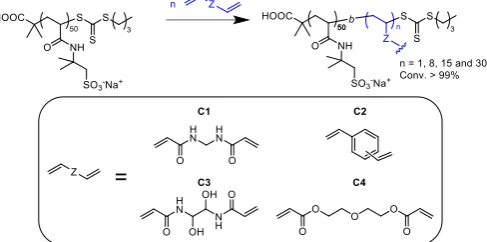
Next, we explored the use of RAFT polymerization to prepare a range of star-shaped polymers of both homopolymers and copolymers of AMPS. These polymers were synthesized using an “arm-first approach” in which a linear polymer is used as the initial arm, with subsequent addition of a cross-linker in a one-pot fashion, without any purification step in between (Scheme 3). At first, the influence of the ratio of cross-linker to CTA was investigated using simple N,Nʹ-methylenebisacrylamide (C1) as the cross-linker, and homopolymer PAMPS50 (3) as the model arm. C1 was chosen
as the model because its acrylamide functions ensure similar reactivity between the newly incorporated monomer and the newly reinitiated group (AMPS monomer). Due to the low solubility of C1 in water (20 g.L-1 at 20 °C), the cross-linker was first dissolved in DMSO (150 mg.mL-1) before being added to the polymerization mixture alongside additional initiator.
Scheme 3: Synthesis of star polymers using the arm-first approach. Bottom insert shows the different cross-linkers used in this study.
Effect of cross-linker to CTA ratio
The ratio of cross-linker to CTA was varied from 1 to 30 (Figure 4, left, Table 3, Entries 14 to 17) using C1 as the cross-linker. The molecular weight of the resulting material increased from 32 to 125 kg.mol-1 with increasing ratio of cross-linker to CTA from 1 to 15. When using a ratio C1/CTA of 30, a gel-like polymer was formed in less than 30 minutes, likely due to the formation of a highly branched polymer that could not be analysed by SEC. For C1/CTA = 1, the percentage of arm incorporated was found to be relatively low (37 %) when
compared with the percentage of arm incorporated (92 %) obtained with a C1/CTA ratio of 8. Higher ratios (i.e. 15) led to the observation of a tail by SEC chromatography with the peaks at retention times of 16, 13 and 12 minutes corresponding to unreacted arm, star polymer and star-star coupling respectively. In view of these results, a cross-linker to CTA ratio of 8 appears optimal as it allows low dispersity (1.24), high molar mass (64 kg.mol-1), high arm incorporation (90 %) and no visible star-star coupling. It was noteworthy that the percentage of arm incorporated never reached 100 % in all cases. This could either be due to high electrostatic repulsions between the negatively charged arms, or to the presence of dead chains remaining from the synthesis of the initial arm. This is in agreement with previous reports of star-shaped polymers synthesized in the literature.49
Effect of cross-linker group
Having determined the optimal cross-linker to CTA ratio, we turned to study the influence of the cross-linker structures. A range of cross-linkers with different solubility values in aqueous solution were tested, using functionalities such as an aromatic cross-linker (C2), a hydrophilic acrylamide (C3) and an acrylate (C4),(Table 3, Entry 15, 18, 19 and 20). C2 and C4 are liquid at room temperature and were injected alongside the initiator without additional solvent. C3 is a solid and was pre-dissolved in a sodium hydroxide solution (20 mg.mL-1), at a
concentration of 150 mg.mL-1, prior to introduction to the
polymerization mixture. The chromatograms obtained using the four different cross-linkers are shown in Figure 4 (right). Acrylate cross-linker (C4) was found to give the narrowest chromatogram, which can be attributed to the lower reactivity (lower kp) of acrylates when compared to acrylamides.20 C2
[image:9.595.47.291.315.436.2]resulted in a shift towards a lower molecular weight peak corresponding to the star polymer, when compared to star polymers prepared using either C1 or C4. . This can be explained by the poor solubility of C2 in water (0.005 %) which limits the incorporation of the arm into the star (estimated to be 70 % after 24 hours).32
Table 3: Star polymers as prepared by RAFT polymerization using various cross-linker type, and cross-linker to CTA ratio
Polymer Cross-linker Solvent [Cross-linker]/[CTA]0 Arm Incorporationa
(%)
Star Mn,SECb
(kgmol-1) Ð b
14 C1 DMSO 1 37 32 -
15 C1 DMSO 8 92 64 1.24
16 C1 DMSO 15 94 125 1.90
17 C1 DMSO 30 - - -
18 C2 - 8 70 42 1.11
19 C3 NaOH (aq.) 8 0 12 1.27
20 C4 - 8 89 67 1.15
Journal Name ARTICLE
Figure 4: Aqueous SEC chromatograms of star polymer prepared by RAFT polymerization, (left) using C1 with an increasing ratio from 1 to 15, (right) using cross-linker (C1, C2, C3 and C4) with an optimum ratio of [cross-linker]/[CTA]0 = 8.
Interestingly, no star polymer was formed using C3. In the literature, C3 was used to synthesize a core cross-linked star polymer of poly(oligoethylene glycol-acrylate) (POEG) via emulsion polymerization, yielding a material with low dispersity (< 1.20) and a high percentage of arm incorporation (> 90 %).32 In our case, absence of star formation can be attributed either to the difference in reactivity of the polymers, with acrylamide being typically more reactive than acrylate, or to the influence of solvent (water rather than toluene).
Effect of arm length
Using C4 as cross-linker, we then investigated the influence of arm length on the synthesis of star-shaped PAMPS. Arm length was increased while keeping the ratio of cross-linker to CTA at 8, and varying the molecular weight of the initial AMPS homopolymer arm from 11 to 38 kg.mol-1 (Table 4, Entries 20, 21, 23 and 26). Figure 5 (top left) shows the chromatograms obtained with increasing the arm. In each case, two peaks were observed which corresponds to the star polymers and the unreacted arms. With increasing length of the initial arm, the molecular weight of the resulting stars increased from 67 to 385 kg.mol-1, while the dispersities remained between 1.1 and 1.2. The efficiency of the reaction decreased however with
increasing arm length, and the percentage of arm incorporated calculated was reduced from 89 to 48 %, using the ratio of the two peaks by SEC. This can be attributed to either an increased viscosity of the reaction mixture or to the increase of steric hindrance.
Using the molecular weight of the SEC peak corresponding to the star and the linear, the number of arms per star was approximated to around 6 arms of small molecular weight, but increased up to 10 for the larger molecular weight arms. This result contradicts the decrease in quantity of arms incorporated as calculated previously using the ratio of the two peaks, suggesting that the use of linear PEG to calibrate the aqueous GPC is again responsible for the artefact observed. The hydrodynamic volume of a linear system is different from a branched system of equivalent molecular mass, and the discrepancy is expected to increase with increase of the molecular mass. In the above experiments, cross-linker concentration was decreased from 0.23 M to 0.03 M with a DP 400 to keep the ratio of cross-linker to CTA equal to 8 (Table 4, Entries 20 and 26). In a separate experiment, the cross-linker to CTA ratio was gradually increased from 8 to 15 and then 30 (Table 4, Entries 23 to 25) for a DP 200 instead.
Table 4: Star polymers prepared by RAFT polymerization using C4 and increasing degrees of arm polymerization from 50 to 400
aDetermined using Aqueous-SEC with PEG standard; b .Determined using equation (6) (see experimental section)
Figure 5: Aqueous SEC chromatograms of star polymers obtained by RAFT polymerization using C4 as cross-linker and increasing the arm length (DP50 to 400 and C4/CTA = 8) (left), increasing C4/CTA ratio from 8 to 15 (DP 100) (middle) and increasing the ratio from 8 to 15 and then 30 for a DP 200 (right)
While no improvement in the percentage of arm incorporated was observed, an increase in molecular weight of the resulting star was observed, corresponding to a higher quantity of cross-linker incorporated in the star (higher hydrodynamic volume of the core)
Effect of the arm composition:
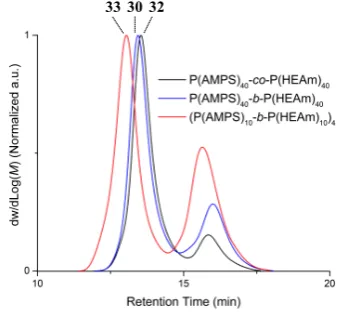
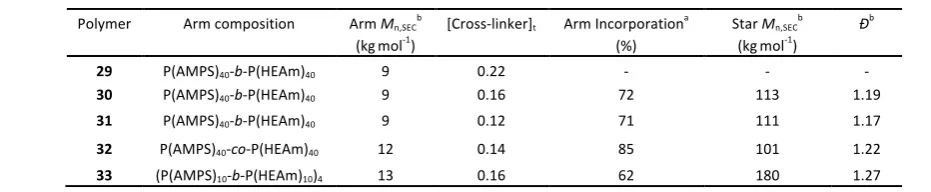
The effect of arm composition was investigated by preparing star copolymers from copolymers of AMPS and HEAm namely octablock 10, diblock 11 and random 12 (Table 2). Synthesis of star polymers using an arm made of diblock 11 and the conditions previously described (0.22 M of C4, C4/CTA = 8) resulted in the formation of a gel-like polymer which could not be analysed by SEC (Table 5, Entry 29). We attributed this behaviour to the high concentration of cross-linker used. Upon decreasing the concentration of cross-linker to 0.16 and 0.12 M (Table 5, Entries 30 and 31), star polymer were formed in solution, with a molecular weight of about 110 kg.mol-1, a
dispersity below 1.2 and about 70 % of arm incorporated. Using random polymer 12 and a concentration of C4 equal to 0.14 M, a star copolymer with a molecular weight of about 100 kg.mol-1 and high arm incorporation (85 %) was obtained (Table 5, Entry 32, Error! Reference source not found.). Finally, a star copolymer derived from octablock 10 was synthesized which resulted in a product with a high molecular weight (180
[image:11.595.325.495.506.664.2]kg.mol-1) but lower arm incorporation (Table 5, Entry 33). Again, this can be attributed to differences in the hydrodynamic volume of diblock, octablock and random polymers, resulting in artificially shifted SEC measurements.
Figure 6: Aqueous SEC chromatograms of star polymers obtained by RAFT polymerization using C4 as cross-linker and diblock, octablock and random copolymer as arm.
23 26 21 20
23
26 21 20
22 21
23 24 25
Polymer DP Arm Mn,SECa
(kgmol-1) [Cross-linker]/[CTA]0 [Cross-linker] Arm Incorporation b
(%)
Star Mn,SECa
(kgmol-1) Ð a
20 50 11 8 0.23 89 67 1.15
21 100 16 8 0.12 80 126 1.17
22 100 16 15 0.21 85 129 1.21
23 200 23 8 0.06 68 199 1.16
24 200 23 15 0.11 75 177 1.18
25 200 23 30 0.21 74 271 1.30
26 400 38 8 0.03 48 385 1.19
27 400 38 15 0.06 51 423 1.19
28 400 38 30 0.11 47 501 1.19
Journal Name ARTICLE
Table 5: Star polymers as prepared by RAFT polymerization using C4 as cross-linker and various copolymer as arms. Theoretical molecular weight was kept constant.
Polymer Arm composition Arm Mn,SECb
(kgmol-1) [Cross-linker]t Arm Incorporation a
(%)
Star Mn,SECb
(kgmol-1) Ð b
29 P(AMPS)40-b-P(HEAm)40 9 0.22 - - -
30 P(AMPS)40-b-P(HEAm)40 9 0.16 72 113 1.19 31 P(AMPS)40-b-P(HEAm)40 9 0.12 71 111 1.17 32 P(AMPS)40-co-P(HEAm)40 12 0.14 85 101 1.22 33 (P(AMPS)10-b-P(HEAm)10)4 13 0.16 62 180 1.27 a Determined using equation (6) (see experimental section); b Determined using Aqueous-SEC with PEG standard.
Conclusion:
We have reported the synthesis of a range of complex architectures of PAMPS using RAFT polymerization. High ordered multiblock polymers and copolymers of AMPS were obtained with full monomer consumption in between each block chain extension. An octablock copolymer (P(AMPS)10
-b-P(HEAm)10)4 was successfully synthesized within 9 hours with a
final dispersity of 1.48. The influence of monomer distribution on the polymerization was studied by comparing the octablock polymer with a diblock and random copolymer of analogous composition. Finally, we reported the first synthesis of AMPS-derived star-shaped polymers with narrow dispersity (Ð < 1.30). This is, to the best of our knowledge, the first example of multiblock core cross-linked star (CCS) copolymerization via RAFT polymerization. The ratio of cross-linker to CTA and the nature of the cross-linker turned out to be a crucial parameter where optimization resulted in high arm-incorporation and narrow molecular weight distribution. Additionally, random and diblock-based CCS copolymers of similar structures were prepared. Our group is currently investigating the influence of such complex architectures for both physical properties and biological applications of the resulting polyelectrolytes.
Acknowledgements
The Royal Society Wolfson Merit Award (WM130055; SP), the Monash-Warwick Alliance (SP), the European Research Council (TUSUPO 647106; SP, RP) and Lubrizol (CB) are acknowledged for funding.
References
(1) Dietzsch, M.; Barz, M.; Schüler, T.; Klassen, S.; Schreiber, M.; Susewind, M.; Loges, N.; Lang, M.; Hellmann, N.; Fritz, M.; Fischer, K.; Theato, P.; Kühnle, A.; Schmidt, M.; Zentel, R.; Tremel, W. Langmuir 2013, 29 (9), 3080–3088.
(2) Sabhapondit, A.; Borthakur, A.; Haque, I. Energy {&} Fuels
2003, 17 (3), 683–688.
(3) Smitha, B.; Sridhar, S.; Khan, A. A. Macromolecules 2004, 37 (6), 2233–2239.
(4) Koromilas, N. D.; Lainioti, G. C.; Vasilopoulos, G.; Vantarakis, A.; Kallitsis, J. K. Polym. Chem. 2016.
(5) Bartlett, R. L.; Panitch, A. Biomacromolecules 2012, 13 (8), 2578–2584.
(6) McCormick, C. L.; Elliott, D. L. Macromolecules 1986, 19 (3), 542–547.
(7) McCormick, C. L.; Johnson, C. B. Macromolecules 1988, 21 (3), 686–693.
(8) Guillaneuf, Y.; Gigmes, D.; Marque, S. R. A.; Astolfi, P.; Greci, L.; Tordo, P.; Bertin, D. Macromolecules 2007, 40 (9), 3108–3114.
(9) Anastasaki, A.; Nikolaou, V.; Nurumbetov, G.; Wilson, P.; Kempe, K.; Quinn, J. F.; Davis, T. P.; Whittaker, M. R.; Haddleton, D. M. Chem. Rev. 2015, 150730144649001. (10) Semsarilar, M.; Perrier, S. Nat Chem 2010, 2 (10), 811– 820.
(11) Moad, G.; Rizzardo, E.; Thang, S. H. Acc. Chem. Res. 2008, 41 (9), 1133–1142.
(12) Mincheva, R.; Paneva, D.; Mespouille, L.; Manolova, N.; Rashkov, I.; Dubois, P. J. Polym. Sci. Part A Polym. Chem. 2009, 47 (4), 1108–1119.
(13) Nikolaou, V.; Simula, A.; Droesbeke, M.; Risangud, N.; Anastasaki, A.; Kempe, K.; Wilson, P.; Haddleton, D. M. Polym. Chem. 2016, 7 (14), 2452–2456.
(14) Sumerlin, B. S.; Donovan, M. S.; Mitsukami, Y.; Lowe, A. B.; McCormick, C. L. Macromolecules 2001, 34 (19), 6561–6564. (15) Read, E.; Guinaudeau, A.; James Wilson, D.; Cadix, A.; Violleau, F.; Destarac, M. Polym. Chem. 2014, 5 (7), 2202– 2207.
(16) Sumerlin, B. S.; Lowe, A. B.; Thomas, D. B.; McCormick, C. L. Macromolecules 2003, 36 (16), 5982–5987.
(17) Yusa, S.; Yokoyama, Y.; Morishima, Y. Macromolecules
2009, 42 (1), 376–383.
(18) Gody, G.; Barbey, R.; Danial, M.; Perrier, S. Polym. Chem.
2015, 6 (9), 1502–1511.
(19) Zetterlund, P. B.; Gody, G. Macromol. Theory Simulations
2014, 23 (5), 331–339.
(20) Martin, L.; Gody, G.; Perrier, S. Polym. Chem. 2015, 6 (27), 4875–4886.
(21) Gody, G.; Maschmeyer, T.; Zetterlund, P. B.; Perrier, S. Macromolecules 2014, 47 (10), 3451–3460.
(23) Gregory, A.; Stenzel, M. H. Prog. Polym. Sci. 2012, 37 (1), 38–105.
(24) Gurnani, P.; Lunn, A. M.; Perrier, S. Polymer. 2016. (25) Wang, D.; Li, X.; Wang, W.-J.; Zhu, S.; Gong, X.; Li, B.-G.; Zhu, S. Macromolecules 2012, 45 (1), 28–38.
(26) N. H. Aloorkar, A. S. Kulkarni, R. A. Patil, D. J. I. Int. J. Pharm. Sci. Nanotechnol. 2012, 5 (2), 1675–1684.
(27) Ren, J. M.; McKenzie, T. G.; Fu, Q.; Wong, E. H. H.; Xu, J.; An, Z.; Shanmugam, S.; Davis, T. P.; Boyer, C.; Qiao, G. G. Chem. Rev. 2016, 116 (12), 6743–6836.
(28) Rosselgong, J.; Williams, E. G. L.; Le, T. P.; Grusche, F.; Hinton, T. M.; Tizard, M.; Gunatillake, P.; Thang, S. H. Macromolecules 2013, 46 (23), 9181–9188.
(29) Bekhradnia, S.; Diget, J. S.; Zinn, T.; Zhu, K.; Sande, S. A.; Nyström, B.; Lund, R. Macromolecules 2015, 48 (8), 2637– 2646.
(30) Gao, H.; Ohno, S.; Matyjaszewski, K. J. Am. Chem. Soc.
2006, 128 (47), 15111–15113.
(31) Wiltshire, J. T.; Qiao, G. G. Macromolecules 2006, 39 (26), 9018–9027.
(32) Ferreira, J.; Syrett, J.; Whittaker, M.; Haddleton, D.; Davis, T. P.; Boyer, C. Polym. Chem. 2011, 2 (8), 1671–1677.
(33) McKenzie, T. G.; Ren, J. M.; Dunstan, D. E.; Wong, E. H. H.; Qiao, G. G. J. Polym. Sci. Part A Polym. Chem. 2016, 54 (1), 135–143.
(34) Wenn, B.; Martens, A. C.; Chuang, Y.-M.; Gruber, J.; Junkers, T. Polym. Chem. 2016, 7 (15), 2720–2727.
(35) Lai, J. T.; Filla, D.; Shea, R. Macromolecules 2002, 35 (18), 6754–6756.
(36) Gody, G.; Maschmeyer, T.; Zetterlund, P. B.; Perrier, S. Nat. Commun. 2013, 4.
(37) Cao, X.; Zhang, C.; Wu, S.; An, Z. Polym. Chem. 2014, 5 (14), 4277–4284.
(38) Skrabania, K.; Miasnikova, A.; Bivigou-Koumba, A. M.; Zehm, D.; Laschewsky, A. Polym. Chem. 2011, 2 (9), 2074– 2083.
(39) Chaduc, I.; D'Agosto, F.; Lansalot, M.; Crepet, A.; Boyron, O. Macromolecules 2013, 46 (15), 6013–6023.
(40) Convertine, A. J.; Lokitz, B. S.; Lowe, A. B.; Scales, C. W.; Myrick, L. J.; McCormick, C. L. Macromol. Rapid Commun.
2005, 26 (10), 791–795.
(41) Chaduc, I.; Lansalot, M.; D'Agosto, F.; Charleux, B. Macromolecules 2012, 45 (3), 1241–1247.
(42) Wang, A. R.; Zhu, S. Macromol. Theory Simulations 2003, 12 (2–3), 196–208.
(43) Walling, C. J. Am. Chem. Soc. 1948, 70 (7), 2561–2564.
(44) Keddie, D. J.; Thang, S. H.; Moad, G.; Rizzardo, E.; Thang, S. H. Macromolecules 2012, 45 (13), 5321–5342.
(45) Mühlebach, A.; Gaynor, S. G.; Matyjaszewski, K. Macromolecules 1998, 31 (18), 6046–6052.
(46) Gody, G.; Maschmeyer, T.; Zetterlund, P. B.; Perrier, S. Macromolecules 2014, 47 (2), 639–649.
(47) Rinaudo, M.; Desbrieres, J. Eur. Polym. J. 1980, 16 (9), 849–854.
(48) Moraes, J.; Peltier, R.; Gody, G.; Blum, M.; Recalcati, S.; Klok, H.-A.; Perrier, S. ACS Macro Lett. 2016, 5 (12), 1416– 1420.
(49) Blencowe, A.; Tan, J. F.; Goh, T. K.; Qiao, G. G. Polymer.
Journal Name ARTICLE
Supporting Information
Figure SI1: Walling plot for the polymerization of AMPS monomer targeting a DP of 20 with the chain transfer agent BDMAT (in water at 90 °C)
Figure SI2: 1H NMR spectra (D2O, 300 MHz) showing the chain transfer agent and monomer consumption after 16 minutes of the
[image:15.595.79.493.382.617.2]Journal Name ARTICLE
Figure SI3: Conversion (Blue) and pseudo-first order plot (Black) versus the time for the synthesis of the random copolymer P(AMPS)40-co-P(HEAm)40 synthesized in water at 90 °C with VA-086.
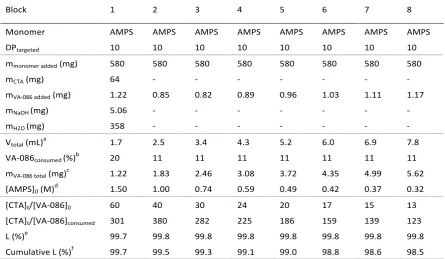
Table SI1: Conditions used for the preparation of (P(AMPS10))8 via RAFT polymerization in phosphate buffer solution at 90 °C.
Block 1 2 3 4 5 6 7 8
Monomer AMPS AMPS AMPS AMPS AMPS AMPS AMPS AMPS
DPtargeted 10 10 10 10 10 10 10 10
mmonomer added (mg) 580 580 580 580 580 580 580 580
mCTA (mg) 64 - - - -
mVA-086 added (mg) 1.22 0.85 0.82 0.89 0.96 1.03 1.11 1.17
mNaOH (mg) 5.06 - - - -
mH2O (mg) 358 - - - -
Vtotal (mL)a 1.7 2.5 3.4 4.3 5.2 6.0 6.9 7.8
VA-086consumed (%)b 20 11 11 11 11 11 11 11
mVA-086 total (mg)c 1.22 1.83 2.46 3.08 3.72 4.35 4.99 5.62
[AMPS]0 (M)d 1.50 1.00 0.74 0.59 0.49 0.42 0.37 0.32
[CTA]t/[VA-086]0 60 40 30 24 20 17 15 13
[CTA]t/[VA-086]consumed 301 380 282 225 186 159 139 123
L (%)e 99.7 99.8 99.8 99.8 99.8 99.8 99.8 99.8
Cumulative L (%)f 99.7 99.5 99.3 99.1 99.0 98.8 98.6 98.5
a Represents the sum of the volume of the monomer added + V
total from the previous block. b Determined using the following
equation VA-086consumed = [VA-086]consumed/[VA-086]0 *100 = 2f(1-exp(-kdt))(1-fc/2)*100 with f = 0.5, fc = 0, kd = 3.1x10⁻⁵ s-1. c
Represents the total weight of VA-086 at the start of each chain extension characterised by the sum of the weight of VA-086 added plus the weight of VA-086 remaining from the previous block. d Represents the concentration of the monomer at the
beginning of each block extension. e Theoretical estimation of the fraction of living chains per block. f Theoretical estimation of
[image:16.595.75.521.383.642.2]Table SI2: 1H NMR and SEC data analysis for the multiblock homopolymer (P(AMPS)10)8 after chain extension
Block Multiblock composition Monomer conversiona
(%)
Mn,thb
(g mol-1) Mn,SEC c
(g mol-1) Ð c
1 P(AMPS)10 99 2,500 5,700 1.09
2 P(AMPS)10-b-P(AMPS)10 99 4,800 8,300 1.09
3 P(AMPS)10-b-P(AMPS)10-b-P(AMPS)10= > 99 7,100 9,600 1.09
4 P(AMPS)10-b-P(AMPS)10-b-P(AMPS)10
-b-P(AMPS)10 > 99 9,300 12,300 1.10
5 P(AMPS)10-b-P(AMPS)10-b-P(AMPS)10
-b-P(AMPS)10-b-P(AMPS)10 > 99 11,600 14,800 1.12
6 P(AMPS)10-b-P(AMPS)10-b-P(AMPS)10
-b-P(AMPS)10-b-P(AMPS)10-b-P(AMPS)10 > 99 13,900 17,000 1.13
7
P(AMPS)10-b-P(AMPS)10-b-P(AMPS)10
-b-P(AMPS)10-b-P(AMPS)10-b-P(AMPS)10
-b-P(AMPS)10
> 99 16,200 17,700 1.16
8
P(AMPS)10-b-P(AMPS)10-b-P(AMPS)10
-b-P(AMPS)10-b-P(AMPS)10-b-P(AMPS)10
-b-P(AMPS)10-b-P(AMPS)10
> 99 18,400 18,900 1.18
a Determined by 1H NMR in MeOD. b Determined using equation 2. c Determined using aqueous SEC with a RI detector using PEG
as a standard.
[image:17.595.77.510.372.657.2]Journal Name ARTICLE
Figure SI5: Comparison of the final SEC chromatograms (aqueous SEC using PEG standard) obtained for the homopolymer P(AMPS)80 and the 8th blocks of the octablock (P(AMPS)10)8 synthesized by RAFT polymerization.
Table SI3: Conditions used for the preparation of (P(AMPS)10-b-P(HEAm)10)4 via RAFT polymerization in phosphate buffer solution
at 90 °C.
Block 1 2 3 4 5 6 7 8
Monomer AMPS HEAm AMPS HEAm AMPS HEAm AMPS HEAm
DPtargeted 10 10 10 10 10 10 10 10
mmonomer added (mg) 580 292 580 292 580 292 580 292
mCTA (mg) 64 - - - -
mVA-086 added (mg) 1.22 0.47 0.91 0.43 1.08 0.53 1.25 0.64
MNaOH added (mg) 5.06 - - - -
VH2O 358 - - - -
Vtotal (mL)a 1.69 1.99 2.85 3.15 4.01 4.33 5.19 5.51
VA-086consumed (%)b 1.22 1.42 2.06 2.26 2.89 3.11 3.73 3.98
mVA-086 total (mg)c 20 20 11 20 11 20 11 20
[AMPS]0 (M)d 1.50 1.27 0.89 0.80 0.63 0.59 0.49 0.46
[CTA]t/[VA-086]0 60 51 36 32 25 23 20 18
[CTA]t/[VA-086]consumed 301 255 338 161 240 117 186 92
L (%)e 99.7 99.7 99.8 99.7 99.8 99.7 99.8 99.7
Cumulative L (%)f 99.7 99.3 99.2 98.8 98.7 98.3 98.2 97.8
a Represents the sum of the volume of the monomer added + V
total from the previous block. b Determined using the following
equation VA-086consumed = [VA-086]consumed/[VA-086]0 *100 = 2f(1-exp(-kdt))(1-fc/2)*100 with f = 0.5, fc = 0, kd = 3.1x10⁻⁵ s-1. c
Represents the total weight of VA-086 at the start of each chain extension characterised by the sum of the weight of VA-086 added plus the weight of VA-086 remaining from the previous block. d Represents the concentration of the monomer at the beginning of each block extension. e Theoretical estimation of the fraction of living chains per block. f Theoretical estimation of the cumulated fraction of living chains
[image:18.595.75.520.334.597.2]Table SI4: 1H NMR and SEC data analysis for the multiblock copolymer (P(AMPS)10-b-P(HEAm)10)4 after chain extension
Block Multiblock composition Monomer conversiona
(%)
Mn,thb
(g mol-1) Mn,SEC c
(g mol-1) Ð c
1 P(AMPS)10 99 2,600 5,500 1.09
2 P(AMPS)10-b-P(HEAm)10 99 3,700 4,000 1.25
3 P(AMPS)10-b-P(HEAm)10-b-P(AMPS)10 > 99 6,000 9,100 1.13
4 P(AMPS)10-b-P(HEAm)10-b-P(AMPS)10
-b-P(HEAm)10 > 99 7,100 8,400 1.18
5 P(AMPS)10-b-P(HEAm)10-b-P(AMPS)10
-b-P(HEAm)10-b-P(AMPS)10 > 99 9,400 13,100 1.18
6 P(AMPS)10-b-P(HEAm)10-b-P(AMPS)10
-b-P(HEAm)10-b-P(AMPS)10-b-P(HEAm)10 > 99 10,500 11,800 1.25
7
P(AMPS)10-b-P(HEAm)10-b-P(AMPS)10
-b-P(HEAm)10-b-P(AMPS)10-b-P(HEAm)10
-b-P(AMPS)10
> 99 12,800 17,700 1.30
8
P(AMPS)10-b-P(HEAm)10-b-P(AMPS)10
-b-P(HEAm)10-b-P(AMPS)10-b-P(HEAm)10
-b-P(AMPS)10-b-P(HEAm)10
> 99 13,900 16,700 1.48
a Determined by 1H NMR in MeOD. b Determined using equation 2. c Determined using aqueous SEC with a RI detector using PEG
as a standard.
[image:19.595.74.515.348.631.2]Journal Name ARTICLE
Figure SI7: SEC chromatogram (aqueous SEC with PEG standard) of the macro CTA-PAMPS10 (Black) then chain extended with PHEAm200.
Table SI5: Conditions used for the preparation of (P(AMPS)10-b-P(NAM)10)2 via RAFT polymerization in phosphate buffer solution
at 90 °C.
Block 1 2 3 4
Monomer AMPS NAM AMPS NAM
DPtargeted 10 10 10 10
mmonomer added (mg) 1160 715 1160 715
mCTA (mg) 128 - - -
mVA-086 added (mg) 2.43 0.74 1.61 0.97
MNaOH added (mg) 10.13 - - -
VH2O 1080 - - -
Vtotal (mL)a 3.38 4.07 5.79 5.63
VA-086consumed (%)b 1.22 1.45 1.98 2.25
mVA-086 total (mg)c 20 20 11 20
[AMPS]0 (M)d 1.50 1.24 0.88 0.90
[CTA]t/[VA-086]0 60 50 35 31
[CTA]t/[VA-086]consumed 301 325 334 203
L (%)e 99.6 99.6 99.8 99.7
Cumulative L (%)f 99.6 99.3 99.1 98.8
a Represents the sum of the volume of the monomer added + V
total from the previous block. b Determined using the following
equation VA-086consumed = [VA-086]consumed/[VA-086]0 *100 = 2f(1-exp(-kdt))(1-fc/2)*100 with f = 0.5, fc = 0, kd = 3.1x10⁻⁵ s-1. c
Represents the total weight of VA-086 at the start of each chain extension characterised by the sum of the weight of VA-086 added plus the weight of VA-086 remaining from the previous block. d Represents the concentration of the monomer at the
beginning of each block extension. e Theoretical estimation of the fraction of living chains per block. f Theoretical estimation of
[image:20.595.38.319.395.659.2]Table SI66: 1H NMR and SEC data analysis for the multiblock copolymer (P(AMPS)10- b-P(NAM)10)2 after chain extension
Block Multiblock composition Monomer conversiona
(%)
Mn,thb
(g mol-1) Mn,SEC c
(g mol-1) Ð c
1 P(AMPS)10 99 2,500 5,400 1.09
2 P(AMPS)10-b-P(NAM)10 99 4,000 1,800 1.50
3 P(AMPS)10-b-P(NAM)10-b-P(AMPS)10 > 99 6,200 9,100 1.10
4 P(AMPS)10-b-P(NAM)10-b-P(AMPS)10
-b-P(NAM)10 > 99 7,600 4,000 1.41
a Determined by 1H NMR in MeOD. b Determined using equation 2. c Determined using aqueous SEC with a RI detector using PEG
as a standard.
[image:21.595.73.515.226.516.2]Journal Name ARTICLE
Figure SI9: 1H NMR spectra (MeOD, 300 MHz) showing the monomer conversion for the arm (bottom) after 2 hours and the
[image:22.595.74.476.66.266.2]

![Figure 4: Aqueous SEC chromatograms of star polymer prepared by RAFT polymerization, (left) using C1 with an increasing ratio from 1 to 15, (right) using cross-linker (C1, C2, C3 and C4) with an optimum ratio of [cross-linker]/[CTA]0 = 8](https://thumb-us.123doks.com/thumbv2/123dok_us/9434412.450336/10.595.89.491.57.225/figure-aqueous-chromatograms-polymer-prepared-polymerization-increasing-optimum.webp)