© 2019, IRJET | Impact Factor value: 7.211 | ISO 9001:2008 Certified Journal | Page 4153
Internal Curing of Concrete by using SAP and Vermiculite
Mahesh Sawant
1, Pradip Shelke
2, Kapil Chounashtte
3, Anshul Mishra
4, Shreedhar Patil
5,
Ashish Hakke
61,2,3,4
B.E. Student, Department of Civil Engineering Dr. D Y Patil School of Engineering and Technology,
Charholi (BK), Pune-412 105, Maharashtra, India
5,6
Professor, Dept. of Civil Engineering, Dr. D Y Patil School of Engineering and Technology, Charholi (BK),
Pune-412 105 Pune, Maharashtra, India
---***---Abstract -
Concrete expands and contracts because ofchange in temperature, freezing and thawing cycle and environmental conditions. During early age hardening of concrete exhibits few crack due to its chemical nature. The main reason for crack development in paste fraction is the loss of water due to chemical reaction and environment. The crack development due to aggregate was mainly on its chemical composition and physical properties. There are many reasons for the crack development in concrete like cracks due to plastic shrinkage, drying shrinkage and settlement cracks. Shrinkage is a loss of excess water from the concrete leads to reduction in its volume and gets hardening. The most common crack formation in concrete was mainly due to plastic shrinkage. The crack due to plastic shrinkage could be reduced by adopting internal curing method. This internal curing agent supply absorbed water to concrete to minimize the crack effect due to plastic shrinkage. Internal curing does not replace conventional surface curing, but works with it to make concrete more robust. Internal curing can also help compensate for less than ideal weather conditions and poor conventional curing that is often seen in the real world. ACI defines internal curing (IC) as a process by which the hydration of cement continues because of the availability of internal water that is not part of the mixing water. The introduction of SAP as a new additive for the production of concrete materials presents a number of new possibilities in respect of water control, i.e., the purposeful water absorption and/or water release in either fresh or hardened concrete. Proper curing of concrete structures is important to ensure they meet their intended performance and durability requirements. In conventional construction, this is achieved through external curing, applied after mixing, placing and finishing. Internal curing (IC) is a very promising technique that can provide additional moisture in concrete for a more effective hydration of the cement and reduced self-desiccation. Internal curing implies the introduction of a curing agent into concrete that will provide this additional moisture.
Keywords- SAP, Vermiculite, Internal curing, compressive strength, concrete.
1. INTRODUCTION
Concrete expands and contracts because of change in temperature, freezing and thawing cycle and environmental conditions. During early age hardening of concrete exhibits few crack due to its chemical nature. The main reason for crack development in paste fraction is the loss of water due to chemical reaction and environment. The crack development due to aggregate was mainly on its chemical composition and physical properties. There are many reasons for the crack development in concrete like cracks due to plastic shrinkage, drying shrinkage and settlement cracks. Shrinkage is a loss of excess water from the concrete leads to reduction in its volume and gets hardening. The most common crack formation in concrete was mainly due to plastic shrinkage. The crack due to plastic shrinkage could be reduced by adopting internal curing method. This internal curing agent supply absorbed water to concrete to minimize the crack effect due to plastic shrinkage. Internal curing does not replace conventional surface curing, but works with it to make concrete more robust. Internal curing can also help compensate for less than ideal weather conditions and poor conventional curing that is often seen in the real world. ACI defines internal curing (IC) as a process by which the hydration of cement continues because of the availability of internal water that is not part of the mixing water. The even distribution of additional water sources within the concrete will lead to greater uniformity of moisture throughout the thickness of the section, and thus reduced internal stresses due to differential drying. While drying shrinkage may not be completely prevented in the long term, delaying it will allow the mixture to gain strength and be better able to resist the associated stresses. Once concrete sets, hydration creates partially-filled pores in the cement paste which causes stress that result in shrinkage. IC provides readily available additional water throughout the concrete, so hydration can continue while more of the pores in the cement paste remain saturated. This reduces shrinkage, cracking, early age curling/warping, increases strength and lowers the permeability of the concrete.
© 2019, IRJET | Impact Factor value: 7.211 | ISO 9001:2008 Certified Journal | Page 4154
material and minimize the cracking problems due to drying shrinkage. When the mixing water is contact with the cementitious materials, the hydration starts. During hydration some part of the mixing water becomes chemically bonded to the hydration products, some other adsorbed at the surface of the hydration products, and the rest remains in solution at the capillary pores formed during hydration. Cementitious materials get the water from the capillary pores to promote hydration, which generates surface tensions that result in volumetric reductions known as autogenous shrinkage. In case the free autogenous shrinkage of a concrete structure is not prevented, internal tensile stresses can be introduced at early ages, which can exceed the tensile strength of the concrete. As a result, premature cracks can be created, making the concrete more vulnerable to the ingress of potentially aggressive species and thus severely reducingthe durability of the concrete .So that the autogenous shrinkage of hardening concrete becomes the core area of various research projects. One of the most conventional and well known applied curing methods is external water curing to mitigate the autogenous shrinkage of small size concrete elements. However, once the capillary pores de-percolate, it will be more difficult to provide adequate external water curing. Therefore, internal water curing by means of pre-soaked or saturated light weight aggregate and Super Absorbent Polymer (SAP) is considered as the most effective method for reducing autogenous shrinkage. An internal water reservoir is created into the fresh concrete through inclusion of internal curing agent in to the concrete. Once the initial free water has been consumed, the water absorbed by the light weight aggregate/SAP will be gradually released to maximize the heat of hydration.
1.1 Introduction of Internal Curing of Concrete
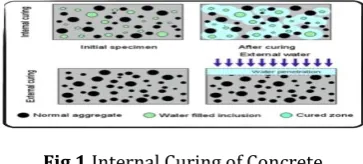
The American Concrete Institute in 2010 defined internal curing as “supplying water throughout a freshly placed cementitious mixture using reservoirs, via pre-wetted lightweight aggregates, that readily release water as needed for hydration or to replace moisture lost through evaporation or self-desiccation”. Within the first decade of the 21st century this technology has been intentionally incorporated into concrete mixtures at the proportioning stage, using a variety of materials including pre-wetted lightweight aggregates, pre-wetted crushed returned concrete fines, superabsorbent polymers, and pre-wetted wood fibers. The ongoing exploration of extensions of the internal curing concept that employ the internal reservoirs to contain materials other than water are reviewed. Finally, the critical issue of sustainability is addressed. To reduce shrinkage cracking, a method named as internal curing is developed. In this method internal curing agents by means of LWA added to balance the reduction of water content. Hence LWA plays a major role in internal curing. And at the same time fabrication of heavy structure needs high strength concrete to hold the structure without failure. ACI defines internal curing (IC) as a process by which the hydration of cement continues because of the availability of internal
water that is not part of the mixing water. The even distribution of additional water sources within the concrete will lead to greater uniformity of moisture throughout the thickness of the section, and thus reduced internal stresses due to differential drying. While drying shrinkage may not be completely prevented in the long term, delaying it will allow the mixture to gain strength and be better able to resist the associated stresses. Once concrete sets, hydration creates partially-filled pores in the cement paste which causes stress that result in shrinkage. IC provides readily available additional water throughout the concrete, so hydration can continue while more of the pores in the cement paste remain saturated. This reduces shrinkage, cracking, early age curling/warping, increases strength and lowers the permeability of the concrete.
Fig 1.Internal Curing of Concrete
The process of curing involves maintaining satisfactory moisture content and temperature after concrete is placed in order to hydrate the cement particles and produce the desired hardened concrete properties. Proper curing can improve strength, durability, abrasion resistance etc. Curing either supplies additional moisture from the original mixing water or minimizes moisture loss from the concrete. Water may be bonded directly on the concrete to prevent evaporation of water from the fresh concrete.
Conventional concrete is typically cured using external methods. External curing prevents drying of the surface, allows the mixture to stay warm and moist, and results in continued cement hydration. Internal curing is relatively recent technique that has been developed to prolong cement hydration by providing internal water reservoirs in a concrete mixture that does not adversely affect the physical properties of fresh or hardened concrete. Internal curing grew out of the need for more durable structural concrete that are resistant to shrinkage cracking. Internal curing decreases the risk of cracking by providing additional water to a concrete mixture for the purpose of prolonged cement hydration without affecting the w/c ratio. Internal curing can be provided by highly absorptive materials that will readily desorb water for cement hydration. Materials that may be used for internal curing include LWA, super absorbent polymer (SAP), perlite, and wood pulp.
[image:2.595.342.524.279.361.2]© 2019, IRJET | Impact Factor value: 7.211 | ISO 9001:2008 Certified Journal | Page 4155
Field knowledge revealed the truth of high strength concrete which needs not to be high performance concrete and vice versa. Improvement in compressive strength, bond strength and abrasion resistance can be achieved on adding silica fume with Portland cement concrete. The main idea of using light weight aggregate was to build the structure with less weight and high insulation. On applying heat to vermiculite leads to the expansion and such expanded vermiculate was refer as expanded vermiculite. This expanded vermiculite was used as spray in building plasters to provide advance coverage, fire conflict, adhesion and opposition to chipping, cracking and shrinkage.
2. INTRODUCTION OF VERMICULITE AND SAP
2.1 Vermiculite
Fig 2.Vermiculite
Vermicular is an Italian word for worm from which it has consequent its name as vermiculite. Some establishment quotes the Latin word vermicular from which the name vermiculite might be implemented. Vermiculite is a hydrous phyllosilicate mineral group and is micaceous in environment. Vermiculite is formed by weathering or hydrothermal alteration of biotite or phlogopite. Exfoliated vermiculite is obtainable in five different grades, which are based upon weight rather than particle size. It undergoes significant expansion when heated. Vermiculite is chosen to replace fine aggregates in concrete because of its specific properties such as it is lighter in weight, improved workability, improved fire resistance, improved resistance to cracking and shrinkage and mainly inert chemical nature. Vermiculites take for concrete preparation which passes through 2.36mm sieve size.
2.2 Super Absorbed Polymer
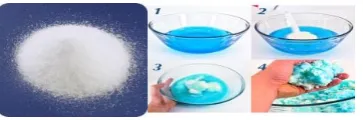
Fig 3.Super Absorbed Polymer
The introduction of SAP as a new additive for the production of concrete materials presents a number of new possibilities in respect of water control, i.e., the purposeful water absorption and/or water release in either fresh or hardened concrete. Proper curing of concrete structures is important to ensure they meet their intended performance and durability requirements. In conventional construction, this is achieved through external curing, applied after mixing,
placing and finishing. Internal curing (IC) is a very promising technique that can provide additional moisture in concrete for a more effective hydration of the cement and reduced self-desiccation. Internal curing implies the introduction of a curing agent into concrete that will provide this additional moisture. Superabsorbent polymer (also called slush powder) can absorb and retain extremely large amounts of a liquid relative to their own mass. Water-absorbing polymers, which are classified as hydrogels when cross-linked absorb aqueous solutions through hydrogen bonding with water molecules. A SAP's ability to absorb water depends on the ionic concentration of the aqueous solution. In deionized and distilled water, a SAP may absorb 300 times its weight (from 30 to 60 times its own volume) and can become up to 99.9% liquid, but when put into a 0.9% saline solution, the absorbency drops to approximately 50 times its weigh The presence of valence cations in the solution impedes the polymer's ability to bond with the water molecule. The total absorbency and swelling capacity are controlled by the type and degree of cross-linkers used to make the gel. Low-density cross-linked SAPs generally have a higher absorbent capacity and swell to a larger degree. These types of SAPs also have a softer and stickier gel formation. High cross-link density polymers exhibit lower absorbent capacity and swell, but the gel strength is firmer and can maintain particle shape even under modest pressure. The largest use of SAPs is found in personal disposable hygiene products, such as baby diapers,
Adult diapers and sanitary napkins SAP was discontinued from use in tampons due to 1980s concern over a link with toxic shock syndrome SAP is also used for blocking water penetration in underground power or communications cable, horticultural water retention agents, control of spill and waste aqueous fluid, and artificial snow for motion picture and stage production. The first commercial use was in 1978 for use in feminine napkins in Japan and disposable bed liners for nursing home patients in the USA.
3. METHOLOGY
[image:3.595.312.560.553.714.2] [image:3.595.91.273.588.648.2]© 2019, IRJET | Impact Factor value: 7.211 | ISO 9001:2008 Certified Journal | Page 4156
3.1 Tests to Be Conducted
3.1.1 Compression Test
A compression test is any test in which a material experiences opposing forces that push inward upon the specimen from opposite sides or is otherwise compressed, “squashed”, crushed, or flattened. The test sample is generally placed in between two plates that distribute the applied load across the entire surface area of two opposite faces of the test sample and then the plates are pushed together by a universal test machine causing the sample to flatten. A compressed sample is usually shortened in the direction of the applied forces and expands in the direction perpendicular to the force.
Specimen Size: 150 X 150 X 150 mm
Fig 5.Compression Test
3.1.2 Flexural Test
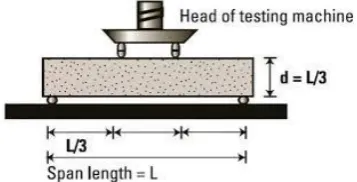
Flexure tests are used to determine the flexural strength of a material. A flexure test is more affordable than a tensile test and test results are slightly different. The material is laid horizontally over two points of contact (lower support span) and then a force is applied to the top of the material through either one or two points of contact (upper loading span) until the sample fails. The maximum recorded force is the flexural strength of that particular sample. Specimen Size: 150 X 150 X 750 mm
Fig 6.Flexural Test
3.1.3 Split Tensile Test
Tensile strength is one of the basic and important properties of concrete. Knowledge of its value is required for the design of concrete structural elements direct tensile
strength of concrete is difficult to determination of flexural strength or the splitting tensile strength and computing the direct tensile test. This method is to determine the tensile strength of concrete for across the vermiculite. It is an indirect method of testing tensile strength of concrete.
Specimen Size will be 150 X 500 mm.
Fig 7.Split Tensile Test
[image:4.595.367.501.179.293.2]4. RESULT
Table No.1 Compressive Strength Results (N/mm2)
Graph No.1 Compressive Strength Results (N/mm2) Compressive test
taken after days
Conventional
M25 0.2% SAP
0.35% SAP
0.5% SAP
7 16.87 20.96 22.29 19.63
14 23.15 27.91 30.52 26.87
[image:4.595.85.239.296.421.2] [image:4.595.311.561.365.640.2] [image:4.595.72.251.592.683.2]© 2019, IRJET | Impact Factor value: 7.211 | ISO 9001:2008 Certified Journal | Page 4157
Table No.2 Flexural Strength Results (N/mm2)Flexural Strength test
taken after days
Conventional
M25 0.2% SAP 0.35% SAP 0.5% SAP
7 3.53 3.87 4.45 4.03
14 4.84 5.30 6.09 5.51
28 5.44 6.85 5.96 6.20
[image:5.595.39.293.113.381.2]Graph No.2 Flexural Strength Results (N/mm2)
Table No.3 Split Tensile Strength Results(N/mm2)
Split Tensile Strength test taken after
days
Conventional
M25 0.2% SAP 0.35% SAP 0.5% SAP
7 1.83 2.04 2.30 1.89
14 2.51 2.80 3.15 2.59
28 2.83 3.15 3.54 2.92
Graph No.3 Split Tensile Strength Results (N/mm2)
Table No.4 Compressive Strength Results(N/mm2)
Compressive test taken after days
Conventional M25
5% Presoaked Vermiculite
10% Presoaked Vermiculite
15% Presoaked Vermiculite
7 16.87 22.46 20.96 18.58
14 23.26 29.82 24.26 21.82
28 27.21 32.12 28.27 26.29
[image:5.595.39.285.424.713.2]Graph No.4 Compressive Strength Results (N/mm2)
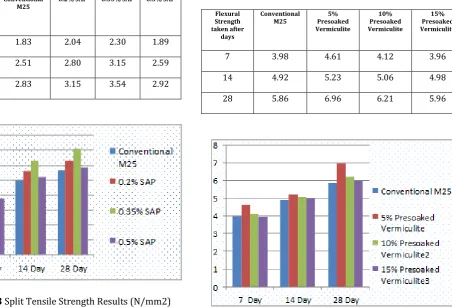
Table No.5 Flexural Strength Results(N/mm2)
Graph No.5 Flexural Strength Results (N/mm2) Flexural
Strength taken after
days
Conventional
M25 Presoaked 5% Vermiculite
10% Presoaked Vermiculite
15% Presoaked Vermiculite
7 3.98 4.61 4.12 3.96
14 4.92 5.23 5.06 4.98
28 5.86 6.96 6.21 5.96
0 5 10 15 20 25 30 35
7 Day 14 Day 28 Day
Conventional M25
0.2% SAP
0.35% SAP
[image:5.595.100.553.432.740.2]© 2019, IRJET | Impact Factor value: 7.211 | ISO 9001:2008 Certified Journal | Page 4158
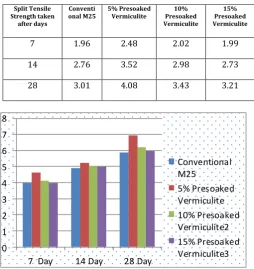
Table No.6
Split Tensile Strength Results(N/mm2)
Split Tensile Strength taken
after days
Conventi
onal M25 5% Presoaked Vermiculite Presoaked 10% Vermiculite
15% Presoaked Vermiculite
7 1.96 2.48 2.02 1.99
14 2.76 3.52 2.98 2.73
28 3.01 4.08 3.43 3.21
Graph No.6 Split Tensile Strength Results (N/mm2)
5. CONCLUSIONS
From experimental work and testing of specimen following conclusions have been concluded:
i. After 28 day concrete attaining highest compressive strength when 0.35% of super absorbed polymer is added and increase compressive strength upto 29% and also using 5% of vermiculite added the compressive strength of concrete increase up to 18% as compare to conventional concrete.
ii. After 28 day concrete attaining highest Split Tensile strength when 0.35% of super absorbed polymer is added and increase Split Tensile strength upto 25% and also using 5% of vermiculite added the Split Tensile strength of concrete increase up to 35% as compare to conventional concrete.
iii. After 28 day concrete attaining highest Flexural strength when 0.35% of super absorbed polymer is added and increase Flexural strength upto 9% and also using 5% of vermiculite added the Flexural strength of concrete increase up to 18% as compared to conventional concrete.
iv. For the given interval of SAP the compressive strength of concrete increase upto 29% as compared to conventional concrete.
v. For given interval of vermiculite the compressive strength of concrete increase upto 18% as compared to conventional concrete.
6.
ACKNOWLEDGEMENT
This paper was supported by civil engineering department and our colleagues from Dr. D Y Patil School of Engineering and Technology, Pune. who provide insight and expertise that greatly assisted the research. I also like to show our gratitude to the college for sharing their pearls of wisdom with me during the course of this research.
7. REFERENCES
[1] Mechtcherine, Viktor, and Dudziak, Lukasz, and Schulze,
Joachim “Internal curing by super absorbent polymers (SAP) – effects on material properties of selfcompacting fibre-reinforced high performance concrete” RILEM Publications SARL, ISBN : 2-35158-004-4, Year 2006, pages 87-96.Author Information
[2] Al-Nasra, Moayyad, and Daoud, Mohammad,
“Investigating the use of Super Absorbent Polymer in plain concrete”, IJETAE, Vol 3, Issue No. 8, August 2013, pages 598-603.
[3] Jensen, M, “Use of superabsorbent Polymer in concrete”,
Concrete International, Vol 35, No. 1, January 1, 2013, pages 48-52.
[4] IS 10262:2009 Recommended guidelines for concrete
mix design.
[5] A.V.V Sairam and K Sailaja (2017) “ An Experimental
Study on Strength Properties of Vermiculite Concrete Using Flyash as Partially Replacement of Cement and Silica Fume as Mineral Admixture” , International Research Journal of Engineering and Technology, Volume 4, Issue 5, pages 659-664.
[6] Experimental study of vermiculite insulated samples
with conventional samples in construction industry, Praveen Kumar.
0 1 2 3 4 5 6 7 8
7 Day 14 Day 28 Day
Conventional M25