warwick.ac.uk/lib-publications
Original citation:
Wilson, P. M., Mathie, E., Poland, F., Keenan, J., Howe, A., Munday, D., Kendall, S., Cowe, M., Staniszewska, Sophieand Goodman, C. (2018) How embedded is public involvement in
mainstream health research in England a decade after policy implementation? A realist evaluation. Journal of Health Services Research and Policy, 23 (2). pp.
98-106.doi:10.1177/1355819617750688
Permanent WRAP URL:
http://wrap.warwick.ac.uk/96879
Copyright and reuse:
The Warwick Research Archive Portal (WRAP) makes this work of researchers of the University of Warwick available open access under the following conditions.
This article is made available under the Creative Commons Attribution 4.0 International license (CC BY 4.0) and may be reused according to the conditions of the license. For more details see: http://creativecommons.org/licenses/by/4.0/
A note on versions:
The version presented in WRAP is the published version, or, version of record, and may be cited as it appears here.
How embedded is public involvement in
mainstream health research in England a
decade after policy implementation?
A realist evaluation
Patricia Wilson
1, Elspeth Mathie
2, Fiona Poland
3, Julia Keenan
4,
Amanda Howe
5, Diane Munday
6, Sally Kendall
7, Marion Cowe
6,
Sophie Staniszewska
8and Claire Goodman
9Abstract
Objectives:To explore how embedded patient and public involvement is within mainstream health research following two decades of policy-driven work to underpin health research with patient and public involvement in England. Methods:Realist evaluation using Normalization Process Theory as a programme theory to understand what enabled patient and public involvement to be embedded as normal practice. Data were collected through a national scoping and survey, and qualitative methods to track patient and public involvement processes and impact over time within 22 nationally funded research projects.
Results:In research studies that were able to create reciprocal working relationships and to embed patient and public involvement this was contingent on: the purpose of patient and public involvement being clear; public contributors reflecting research end-beneficiaries; researchers understanding the value of patient and public involvement; patient and public involvement opportunities being provided throughout the research and ongoing evaluation of patient and public involvement. Key contested areas included: whether to measure patient and public involvement impact; seeking public contributors to maintain a balance between being research-aware and an outsider standpoint seen as ‘authentically’ lay; scaling-up patient and public involvement embedded within a research infrastructure rather than risk token presence and whether patient and public involvement can have a place within basic science.
Conclusions:While patient and public involvement can be well-integrated within all types of research, policy makers should take account of tensions that must be navigated in balancing moral and methodological imperatives.
Keywords
health research, patient and public involvement and engagement, realist evaluation
1
Professor of Primary and Community Care, Centre for Health Services Studies, University of Kent, UK
2
Research Fellow, Centre for Research in Primary and Community Care, University of Hertfordshire, UK
3
Professor of Social Research Methodology, School of Health Sciences, University of East Anglia, UK
4
Research Fellow, School of Health Sciences, University of East Anglia, UK
5
Professor of Primary Care, Norwich Medical School, University of East Anglia, UK
6
Lay Member, Public Involvement in Research Group, University of Hertfordshire, UK
7
Professor of Community Nursing and Public Health, Centre for Health Services Studies, University of Kent, UK
8
Professor of Patient and Public Involvement and Experiences of Care, RCN Research Institute, University of Warwick, UK
9
Professor of Health Care Research, Centre for Research in Primary and Community Care, University of Hertfordshire, UK
Corresponding author:
Patricia Wilson, Centre for Health Services Studies, University of Kent, Canterbury CT2 7NF, UK.
Email: [email protected]
Introduction
While patient and public involvement (PPI) in research is increasing in many parts of the world,1 the United Kingdom (UK) health research arena is recognised as having led the way through its significant policy drive to embed PPI within the national health research infra-structure.2PPI became a statutory part of the national research governance framework in 2005 and is now integral to the main UK health research funding streams. Researchers are routinely required to show how PPI has shaped their research proposal and its delivery.
To establish PPI within a national research infra-structure requires significant investment. Such resour-ces are commonly justified by two main arguments. First, alongside the democratic imperative, the moral argument asserts that research conducted on people without their input is unethical. The second argument for PPI is methodological, that having PPI within a research study will improve recruitment, impact and outcomes.
Despite claims for impact, there is less evidence of the actual processes or mechanisms that enable PPI to fulfil its promises. Ten years after a PPI research infrastruc-ture was created in the UK, it is also unclear whether and how PPI has become embedded within the health research environment. This paper presents findings from a realist evaluation of PPI in health research in England3 to explore how PPI becomes integrated within clinical research and what actions enable this.
The terms ‘participation’, ‘engagement’ and ‘involvement’ are often used interchangeably to capture what PPI entails. For the purposes of this paper, we use the following definitions: ‘involvement’ being active involvement of public members in advising on scope, direction and conduct of research and research organ-izations; ‘engagement’ involving the provision and dis-semination of information and knowledge about
research and ‘participation’ denoting when people take part in a research study to provide its data.2
Methods
The Research into Patient and Public Involvement: A Realist Evaluation (RAPPORT) study3was conducted in England from 2011 to 2013 and was approved by the National Research Ethics Service Committee East Midlands – Nottingham 1 Research Ethics Committee (reference 11/EM/0332).
Previous evaluations of PPI have been criticised for using designs incapable of exploring contextual factors and mechanisms that enable or inhibit PPI process and impact.4 We adopted a realist evaluative design5 to develop a theory-driven account of what enables PPI to be integrated as normal practice, and under what circumstances, in terms of research type and setting.
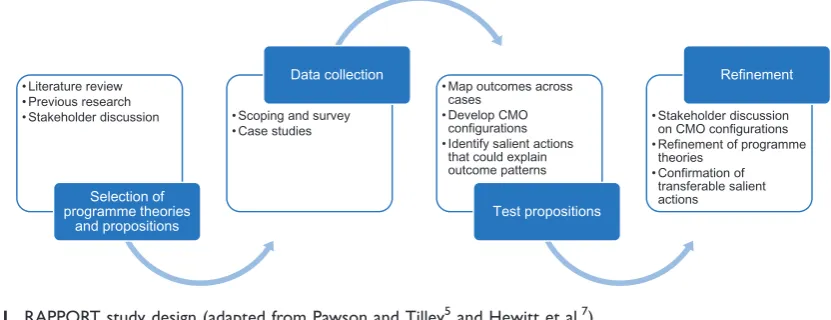
The RAPPORT study design is illustrated in Figure 1. Data were collected through two main meth-ods. First, a national scoping exercise and survey was conducted with investigators of studies adopted by the UK Clinical Research Network, detailed elsewhere.6 The results were used to select 22 nationally funded research projects as case studies in which to explore PPI processes and impact. Case studies were followed up over 18 months, through semi-structured interviews (initial and regular follow-up) and documentary anal-ysis (for example, notes from team meetings).
As we were interested in how PPI becomes embed-ded within clinical research, Normalization Process Theory8 provided an explanatory theory to inform the development of a PPI specific programme theory about how PPI has become embedded (or not) as normal practice within health research.9
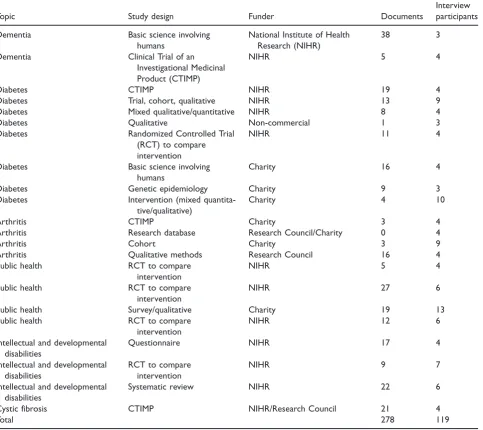
To capture a broad range of study designs, popula-tions and topic areas, we purposively focused our data collection on six diverse topic areas: arthritis; cystic fibrosis; dementia; diabetes; intellectual and
• Literature review • Previous research • Stakeholder discussion
Selection of programme theories
and propositions
• Scoping and survey • Case studies
Data collection
• Map outcomes across cases
• Develop CMO configurations • Identify salient actions
that could explain outcome patterns
Test propositions
• Stakeholder discussion on CMO configurations • Refinement of programme
theories • Confirmation of
transferable salient actions
[image:3.595.92.508.557.717.2]Refinement
Figure 1. RAPPORT study design (adapted from Pawson and Tilley5and Hewitt et al.7).
RAPPORT: Research into Patient and Public Involvement: A Realist Evaluation. CMO: context, mechanism and outcome.
developmental disabilities and public health (Table 1). This ensured that we included studies with different population ages, accessibility challenges and history of PPI. Cystic fibrosis studies were more likely to be laboratory-based or have a biomedical focus, whereas the other topic areas tended to involve a range of designs and sample size.
Within the case studies, we interviewed 64 research-ers, 48 public contributors, 7 PPI coordinators and 10 representatives from funding organizations and UK Clinical Research topic networks (n¼129). We also analysed 278 documents. We were more successful in recruiting interviewees from some topic areas than others, and case studies differed in providing us access to their documents.
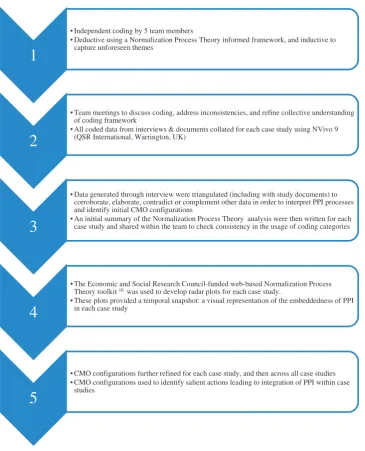
[image:4.595.54.538.289.719.2]We used Normalization Process Theory to provide an initial coding frame for the analysis of the interview data and documents.10 We followed a stepped approach to data analysis11 (Figure 2) and the study itself was underpinned by PPI as reported elsewhere.12 The use of Normalization Process Theory radar plots10 and realist evaluation summaries helped us understand changes in PPI processes over time within case studies. Regular research team meetings were held to compare data across the case studies and discuss emerging context, mechanism and outcome (CMO) configurations. These CMO configurations were tested across the data set and rejected, accepted, or refined. Candidate CMO configurations were further refined through discussion with case study participants,
Table 1. RAPPORT case studies.
Topic Study design Funder Documents
Interview participants
Dementia Basic science involving
humans
National Institute of Health Research (NIHR)
38 3
Dementia Clinical Trial of an
Investigational Medicinal Product (CTIMP)
NIHR 5 4
Diabetes CTIMP NIHR 19 4
Diabetes Trial, cohort, qualitative NIHR 13 9
Diabetes Mixed qualitative/quantitative NIHR 8 4
Diabetes Qualitative Non-commercial 1 3
Diabetes Randomized Controlled Trial
(RCT) to compare intervention
NIHR 11 4
Diabetes Basic science involving
humans
Charity 16 4
Diabetes Genetic epidemiology Charity 9 3
Diabetes Intervention (mixed
quantita-tive/qualitative)
Charity 4 10
Arthritis CTIMP Charity 3 4
Arthritis Research database Research Council/Charity 0 4
Arthritis Cohort Charity 3 9
Arthritis Qualitative methods Research Council 16 4
Public health RCT to compare
intervention
NIHR 5 4
Public health RCT to compare
intervention
NIHR 27 6
Public health Survey/qualitative Charity 19 13
Public health RCT to compare
intervention
NIHR 12 6
Intellectual and developmental disabilities
Questionnaire NIHR 17 4
Intellectual and developmental disabilities
RCT to compare intervention
NIHR 9 7
Intellectual and developmental disabilities
Systematic review NIHR 22 6
Cystic fibrosis CTIMP NIHR/Research Council 21 4
Total 278 119
stakeholder reference groups made up of public contrib-utors, and the RAPPORT independent advisory group. Finally, the configurations were presented at four regional events in England for refinement.
Results
We identified six CMO configurations and salient actions13that could explain what enabled PPI integra-tion within the case studies.
Salient action 1: a clear purpose, role and
structure for PPI are ensured
A clear structure and understanding of the different roles was required if PPI was to be seen as a different
way of working with patients and the public. Requirements included an identified person to coordi-nate PPI, but also the whole team being supportive of PPI, with the work required for PPI being appropriate-ly allocated. Providing skills, continued support and trust in each other’s input were also key mechanisms.
This salient action was heavily influenced by the non-negotiable requirement of UK research funders that grant applications detail how PPI had contributed to the proposal and would be operationalised within the project. Many researchers had engaged with PPI because they ‘had to’ to obtain funding. There were differences between the main funding bodies on how they prioritised and understood PPI. The funding pro-grammes and management organizations of the English National Institute for Health Research
1
• Independent coding by 5 team members
• Deductive using a Normalization Process Theory informed framework, and inductive to capture unforeseen themes
2
• Team meetings to discuss coding, address inconsistencies, and refine collective understanding of coding framework
• All coded data from interviews & documents collated for each case study using NVivo 9 (QSR International, Warrington, UK)
3
• Data generated through interview were triangulated (including with study documents) to corroborate, elaborate, contradict or complement other data in order to interpret PPI processes and identify initial CMO configurations
• An initial summary of the Normalization Process Theory analysis were then written for each case study and shared within the team to check consistency in the usage of coding categories
4
• The Economic and Social Research Council-funded web-based Normalization Process Theory toolkit 10 was used to develop radar plots for each case study.
• These plots provided a temporal snapshot: a visual representation of the embeddedness of PPI in each case study
5
• CMO configurations further refined for each case study, and then across all case studies • CMO configurations used to identify salient actions leading to integration of PPI within case
[image:5.595.124.490.67.519.2]studies
Figure 2. Approach to analysis.
(NIHR) suggested that PPI impact should mainly be seen from the methodological perspective, with PPI as a way of improving research quality.
It [PPI], you know, is likely to improve recruitment. It makes sure that it meets patient needs so that when it gets out the other end into the implementation phase it can actually have a possibility of having impact. (Funder, NIHR)
In contrast, the large charitable funders often priori-tised the moral imperative for PPI.
. . .we get our money from the public, from people with the condition, so it’s really important that we include viewpoints of people with the condition in our decision. (Funder, Charity)
This initial funder-led coercion could be gradually transformed into research team enthusiasm with the positive impact of PPI. Funders spoke of a ‘sea-change’ and some attributed a perceived improvement of the quality of funding applications to growing PPI contributions over the past 10 years.
The growth of PPI-related activity within funding organizations had also brought about what one respon-dent described as ‘industrial scale PPI’, seeming per-haps at odds with the person-centred ethos of the moral perspective of PPI. One consequence of this formal PPI activity was the need to have people respon-sible for coordination and continuity of PPI within research. This had created a new role with a focused responsibility for coordinating PPI. This role was often challenging and demanded much effort, particularly if dealing with large numbers of public contributors through email or social media.
For research teams without dedicated PPI support, access to an external pre-existing PPI group was an enabler. With the drive towards PPI within the NIHR infrastructure, topic-specific PPI panels had devel-oped. Some researchers stated a preference for this outsourced approach, suggesting it provided access to a wider, more representative group, than the ‘usual suspects’ who were part of more local groups. In contrast to working with an ‘in house’ group, the interaction between the outsourced PPI panel and research team tended to be for a single task; for exam-ple, reviewing patient recruitment literature. While the purpose and role for PPI was very clear in these cir-cumstances, it also limited PPI impact to discrete stages of the research process. In contrast, studies with embedded PPI extended impact to, for example, dissemination and identification of further research priorities.
Salient action 2: active recruitment of public
contributors who reflect the diversity of a study
population
Researchers and funders acknowledged that to ensure public involvement that reflected the defined research study population posed a significant challenge. While training in community engagement was helpful, study teams located within the study population (for exam-ple, clinical study teams) found it easier to recruit public contributors. However, we found unintended consequences of this approach to PPI recruitment, with evidence of some merging of roles between being study participant and also of being asked to advise the study team. This dual role provided helpful consumer feedback (for example, how the process of data collec-tion was experienced) and could work well, but was potentially problematic if participant and advisor roles were blurred. Patients undertaking this dual role were further confused when the investigator was also their clinician; reporting it was difficult to remember whether they were talking to the investigator as a par-ticipant, patient or advisor.
You have to switch your hat and say ‘Look I’m not a patient expert today, I’m a patient of yours and I want you just to look at my illness and not discuss any other research’. (Public contributor)
We also found examples of a single public contributor acting as a link to the broader community. Frequently, these people were recruited from charities that served the study population. This worked well when the single representative had strong links with the relevant com-munity and acted as a two-way conduit between the research team and community. However, recompense for their time was sometimes an issue, particularly when the PPI work impinged on other roles they had within the charity.
Salient action 3: whole team engagement with PPI
For this action to be achieved, and despite new roles being created, all researchers in the team needed none-theless to engage with PPI. While having someone in the research team responsible for PPI was important, not having senior researchers engaged could lead to tokenistic PPI. We found that the need to explain tech-nical aspects of the research to public contributors had also increased engagement with PPI throughout the research team.
working with public contributors had helped, again supporting a visible positive impact of PPI. Having the ability to write a publicly accessible explanation of a research study was identified by senior researchers as a transferable skill useful across their range of work. When there was whole team engagement, recognizing the full impact of PPI within projects was also more likely through a shared narrative.
Salient action 4: mutual understanding and trust
Strong relationships were found to be fundamental to PPI and these are predicated on a shared understand-ing of what PPI is. There was some evidence that researchers, and in particular, newer researchers, did not fully understand the difference between patients participating in research as a ‘subject’, and being involved as advisors. The more junior researchers had often joined a study only once it was funded and received minimal training on PPI as part of their gen-eral research education. In contrast, more senior researchers understood the concept of PPI because of the discipline of meeting funding requirements and having been involved in applying for funding.
Trust also underpinned relationships in PPI and was seen by researchers as essential for the smooth running of the study. For public contributors, trust was created when they felt valued. This sense of value was enhanced if there was explicit appreciation by the research team of their input, but especially if the relationship was ongoing, ensuring that even at the end of the study there was feedback given on how their input had influ-enced the study. To this end, the PPI arena (its physical setting, social context, and formality) where their input was aired, needed careful facilitation. In more formal settings, such as trial steering committees, public con-tributors needed a skilled chairperson who ensured that their contributions were made within an equitable envi-ronment where all perspectives and needs were recog-nized and valued.
Trust was also engendered by a sense that there was fair reimbursement of PPI time. All case studies reim-bursed for ‘out of pocket’ expenses; however, reimburs-ing for time varied. Complexities around payment to people while they were in receipt of social welfare was raised as one significant issue, but some public contrib-utors expressed unhappiness with the level of payment:
. . .people just make an assumption, oh they’re patients, we won’t need to pay them. And you know our time in
our life is just as . . . important as a researcher’s.. . .
(Public contributor)
While shared understanding and feeling valued were the foundations of relationships in PPI, the process of
building and sustaining relationships needed nurturing over time. Only 19% (n¼9) of public contributors we interviewed were working with researchers they had not met or worked with before. Public contributors who were known to the team were actively recruited to new studies, bypassing the initial time required to establish the working relationship. Sustained engage-ment was also enabled by PPI groups being attached to research centres.
Salient action 5: opportunities for PPI throughout
the research process
It was common for public contributors to be involved throughout the research process within applied health research. However, some researchers did question whether this broad involvement was possible in basic science studies and had the potential to ‘jeopardize the research’ through a lack of technical understanding. There were examples where PPI had worked well in basic science research, including involvement in fund-ing panels, and prioritizfund-ing studies for access to a tissue bank database. However, this type of involvement in basic science research required a dedicated facilitator and the resources to support this. For studies of any type without this level of support, public contributor involvement was most marked during project set-up but tailed off during recruitment phases when research teams had intense periods of work and hence less capacity to work with public contributors. Some public contributors described ‘losing contact’ with the project after extensive involvement during proposal development and study set-up.
To ensure involvement at all stages of the research cycle and as a way of addressing power differentials, it is increasingly common for a member of the public to be a co-applicant on a research grant application. For example, the NIHR application process allows for a ‘lay’ co-applicant’s CV to be submitted alongside those of the professional members of the research team. However, there were some concerns from laboratory-based scientists that having a lay co-applicant was now seen as the ‘gold standard’, and grants without one were seen to be less likely to suc-ceed. These researchers felt that it would be very diffi-cult to have a ‘non-scientist’ who would be able to be fully engaged in the project.
Salient action 6: reflection, appraisal and
evaluation of PPI
We found that ongoing evaluation was necessary for PPI integration as processes were modified to address any issues. However, only two of the case studies were systematically appraising PPI in their studies.
There were two reasons why studies did not evaluate their PPI. Some questioned why focus only on PPI and not the research process as a whole, and others identi-fied the lack of readily available heuristic tools to sup-port evaluation. However, many case studies did routinely record PPI activities.
The need for robust PPI evaluation to know whether it had an impact or not was seen as the ‘holy grail’ by some researchers. There was also some debate on what outcomes were being evaluated: PPI impact on the research study outcome (for example, recruitment of participants), or outcomes for researchers and PPI con-tributors themselves? A number of researchers com-mented on the impact of PPI in making them reappraise the way they viewed an issue, and how they related to the public. Public contributors frequent-ly reported improved self-worth, increased health knowledge and respite from caring roles, as the person-al impact of undertaking a PPI role.
Barriers to normalizing PPI
While there was a direct relationship between the six salient actions and how integrated PPI was within a study, we also found a number of barriers to normal-izing PPI. In global comparisons, PPI in UK health research can be seen as the most heavily shaped by the mainstream funders’ requiring PPI. Within RAPPORT and other studies,14 the influence of fun-ders was seen to be clearly shaped by values which reflected a dichotomy between primarily methodologi-cal and primarily moral imperatives for PPI. This presents us with two discrete lenses through which to view barriers to PPI integration and the ongoing debate influencing how PPI may be embedded in health research.
First, there are disagreements between those who see developing tools to measure the impact of PPI as vital within a resource-constrained system, and those who see attempts to measure PPI impact as being at odds with understanding PPI as a moral right and process.15 While the scientific community expects robust evidence of the effectiveness of PPI, its complexity as a phenom-enon makes it difficult to develop validated tools that can provide broadly meaningful evidence.4,16One chal-lenge is to accommodate the multiple perspectives involved, while acknowledging that these will influence what may be identified as important to evaluate.17 Some call for the impact of PPI not just to be seen as confined to the research outcomes but also to ways in which it has changed the perspectives of researchers4 and public contributors.18 Rose19 critiques current attempts at evaluating PPI for limiting evidence pre-sented to descriptive case studies, which largely exclude information on impact more relevant for assessing how
PPI changed the knowledge produced and its conse-quent impact on the ultimate research beneficiaries. Nevertheless, we found studies, which had embedded PPI, were matching their evaluation approach with the aims and purpose of PPI within that particular study, as endorsed by Edelman and Barron.15Understanding how values shape the PPI purpose within a study, and so affect how PPI should be measured or evaluated, appears to be a prerequisite of transparency in any adequate evaluative approach.20
A second contested area in PPI is how to find ‘the right people’ to be public contributors. Public contrib-utors have mainly been drawn from the well-educated, retired and affluent,21and are so less likely to represent under-served populations. Some social anthropological perspectives would define the challenge as to find public contributors whose views authentically reflect their insider knowledge of the study population.22 However, this insider status can pose problems, not least because insiders from any community are still unlikely to be a homogenous group, and they will have their own diverse agendas not necessarily reflect-ing the range of views of the broader study popula-tion.22 Whether any public contributor can speak for an entire study population must therefore be debat-able.23However, others argue from a consumerist per-spective that even without complete representativeness, at least some alternative perspectives will be voiced.24 Thus, recognizing the problem of representativeness informs a current emphasis on recruiting more diverse public contributors.15 The RAPPORT findings found that pre-existing relationships, which take time to develop, will encourage trust between researchers and public contributors. Timescales are often short for car-rying out funded research, so it is unsurprising that most research teams within RAPPORT recruited patient and public contributors already known to them. However, there was evidence that this called for some teams to carry out a delicate balancing act in ensuring that the public involved had enough (research) knowledge to be able to contribute in a way researchers felt was useful, but not so much (research) knowledge that they lost their distinct per-spective and became research team insiders. Maintaining this fine line is reported elsewhere25,26 and represents a fundamental conundrum of PPI: maintaining a perspective as an insider (to study pop-ulation) and also as an outsider (to research team) over a study’s lifetime.
characterised by commodification and standardization. A commodity can have both use and exchange values in transactions and PPI can be described as being ‘pur-chased’ through some exchanges of values which can improve the quality of research directly experienced and in its wider applications.15,26Commodification in health care has been extensively critiqued as character-izing depersonalization and bureaucratic control.27 However, Timmermans and Almeling27 argue that commodification in the health care arena, rather than informal ad hoc arrangements, can be more effective in advancing important goals. Thus, it is not commodifi-cation as such that is the problem, but rather, the way it happens. Commodification may, equally, be interre-lated with altruism and so engender new ideas and awareness. In those case studies exemplifying embed-ded PPI, a transaction was maintained between researchers and public contributors through experien-tial knowledge being treated as having value, and so facilitating reciprocity in terms of increasing public contributors’ self-worth alongside any monetary exchange.
Some suggest that requiring PPI at every research stage irrespective of whether the research focus is basic science or applied, or its stage of development, is a tyranny.26We found in RAPPORT that basic science studies were finding unexpected benefits from PPI, and our interviews with funders revealed that after hesitant implementation, public involvement in ‘blue skies’ research funding committees had been less challenging than anticipated, bringing benefits such as more critical appraisal of the likely usefulness of the end product of translational research. This contradicts findings in the van Bekkum and Hilton14study of UK research fund-ing bodies’ views on PPI where some funders view PPI as unnecessary in ‘high-level science’. Those less critical of PPI in all health research still caution that PPI may at least be more challenging in basic science,28and that levels of PPI needed will vary between topics and sit-uations.29Nevertheless, Callard et al.30call for PPI to be reconceptualised within all stages of translational research. They warn that restricting involvement to latter stages, concerned only with improving recruit-ment to trials and to disseminating findings risks the research community producing interventions and prod-ucts not fit for purpose, so that ethical concerns around new research areas, such as biomarkers, will not be interrogated, and omit patient and public potentially valuable contributions to early stages of the research process. As in considering commodification, we argue that the problem is not about involving public contrib-utors at all stages and types of research, but that it is the less robust processes of involvement that more often cause issues.
Discussion
Alongside a growing body of evidence is 20 years’ expe-rience of attempts to embed PPI in UK health research, which in the past decade has been underpinned by a well-resourced infrastructure and dedicated organiza-tion (INVOLVE) (http://www.invo.org.uk/) to support PPI within the NIHR.
The NIHR commissioned a review of the state of PPI in research,15which informed the INVOLVE deci-sion to focus on three priorities. The first priority is to encourage more diversity, equity and inclusion. The second is to develop support, capacity building and learning and development for both public contributors and the research community. The third is community, network and partnership building. These priorities can be informed by the RAPPORT findings which also shed light on key areas of debate for policy makers to consider. These include maintaining a balance between the moral and methodological imperatives in evaluat-ing PPI; seekevaluat-ing the most appropriate public contrib-utors and how best to harness PPI skills and relationships developed over time; ensuring adequate resources and scale in PPI to support research whilst avoiding impersonally ‘industrializing’ PPI activities and finally, enabling optimal PPI contributions at all stages of research without adversely affecting research outcomes. Tensions are to be expected in PPI, but working through them in partnership can fuel novel research synergies.
Declaration of conflicting interests
The author(s) declared no potential conflicts of interest with respect to the research, authorship, and/or publication of this article.
Funding
The author(s) disclosed receipt of the following financial sup-port for the research, authorship, and/or publication of this article: This report presents independent research funded by the National Institute for Health Research (NIHR), under the Health Services and Delivery Research Programme.
References
1. McKenzie A, Alpers K, Heyworth J, et al. Consumer and community involvement in health and medical research: evaluation by online survey of Australian training
work-shops for researchers.Res Involv Engagem2016; 2: 1–15.
2. Denegri S, Coldham T, Eglin S, et al. Going the extra mile: improving the nation’s health and wellbeing through public involvement in research, www.nihr.ac. uk/documents/about-NIHR/NIHR-Publications/Extra %20Mile2.pdf (2015, accessed August 2016).
3. Wilson P, Mathie E, Keenan J, et al. ReseArch with Patient and Public invOlvement: a RealisT evaluation –
the RAPPORT study.Health Serv Deliv Res2015; 3(38).
4. Staley K. ‘Is it worth doing?’ Measuring the impact of
patient and public involvement in research. Res Involv
Engagem2015; 1: 6.
5. Pawson R and Tilley N. Realist evaluation, British
Cabinet Office, www.communitymatters.com.au/RE_
chapter.pdf (2004, accessed 13 December 2017). 6. Mathie E, Wilson P, Poland F, et al. Consumer
Involvement in health research: a UK scoping and
survey.Int J Consum Stud2014; 38: 35–44.
7. Hewitt G, Sims S and Harris R. The realist approach to
evaluation research: an introduction. Int J Therapy
Rehab2012; 19: 250–259.
8. May C and Finch T. Implementing, embedding, and inte-grating practices: an outline of normalization process
theory.Sociology2009; 43: 535–554.
9. Howe A, Delaney S, Romero J, et al. Public involvement in health research: a case study of one NHS project over 5
years. Primary Health Care Research & Development
2010; 11: 17–28.
10. May C, Murray E, Finch T, et al. Normalization process theory on-line users’ manual and toolkit, www.normaliza tionprocess.org (2010, accessed March 2014).
11. Rycroft-Malone J, Wilkinson J, Burton CR, et al.
Collaborative action around implementation in
Collaborations for Leadership in Applied Health
Research and Care: towards a programme theory.
J Health Serv Res Policy2013; 18: 13–26.
12. Howe A, Mathie E, Munday D, et al. Learning to work together – lessons from a reflective analysis of a
research project on public involvement. Res Involv
Engagem 2017; 3: 1. Available at: https://doi.org/10.
1186/s40900-016-0051-x (accessed 4 January 2018). 13. Schierhout G, Hains J, Si D, et al. Evaluating the
effec-tiveness of a multifaceted, multilevel continuous
quality improvement program in primary health care:
developing a realist theory of change. Implementation
Sci2013; 8: 119.
14. van Bekkum JE and Hilton S. UK research funding bodies’ views towards public participation in
health-related research decisions: an exploratory study. BMC
Health Serv Res2014; 14: 318.
15. Edelman N and Barron D. Evaluation of public
involve-ment in research: time for a major re-think?J Health Serv
Res Policy2016; 21: 209–211.
16. Evans D. Patient and public involvement in research in the English NHS: a documentary analysis of the complex
interplay of evidence and policy. Evid Policy 2014; 10:
361–377.
17. Slade M, Bird V, Chandler R, et al. The contribution of advisory committees and public involvement to large
studies: case study.BMC Health Serv Res2010; 10: 323.
18. Brett J, Staniszewska S, Mockford C, et al. A systematic review of the impact of patient and public involvement
on service users, researchers and communities. Patient
2014; 7: 387–395.
19. Rose D. Patient and public involvement in health research: ethical imperative and/or radical challenge?.
J Health Psychol2014; 19: 149–158.
20. Popay J and Collins M (eds.). PiiAF. The public involve-ment impact assessinvolve-ment framework guidance, http://
piiaf.org.uk/documents/piiaf-guidance-jan14.pdf (2014,
accessed 3 January 2017).
21. Martin GP. ‘Ordinary people only’: Knowledge, repre-sentativeness and the publics of public participation in
healthcare.Sociol Health Illn2008; 30: 35–54.
22. McKevitt C. Experience, knowledge and evidence: a com-parison of research relations in health and anthropology.
Evid Policy2013; 9: 113–130.
23. Gibson A, Britten N and Lynch J. Theoretical directions for an emancipatory concept of patient and public
involvement.Health (London)2012; 16: 531–547.
24. Stewart E. What is the point of citizen participation in
health care?J Health Serv Res Policy2013; 18: 124–126.
25. Thompson J, Bissell P, Cooper C, et al. Credibility and the ‘professionalized’ lay expert: Reflections on the dilem-mas and opportunities of public involvement in health
research.Health (London)2012; 16: 602–618.
26. Ives J, Damery S and Redwod S. PPI, paradoxes and
Plato: who’s sailing the ship?J Med Ethics2013; 181–185.
27. Timmermans S and Almeling R. Objectification, stan-dardization, and commodification in health care: A
con-ceptual readjustment.Soc Sci Med2009; 69: 21–27.
28. Snape D, Kirkham J, Preston J, et al. Exploring areas of consensus and conflict around values underpinning public involvement in health and social care research: a
modified Delphi study.BMJ Open2014; 4: e004943.
29. Harris J, Croot L, Thompson J, et al. How stakeholder participation can contribute to systematic reviews of
complex interventions. J Epidemiol Community Health
2016; 70: 207–214.
30. Callard F, Rose D and Wykes T. Close to the bench as well as at the bedside: involving service users in all phases
of translational research. Health Expect 2012; 15: