warwick.ac.uk/lib-publications
Original citation:Uotila, Juha. (2017) Exploratory and exploitative adaptation in turbulent and complex landscapes. European Management Review.
Permanent WRAP URL:
http://wrap.warwick.ac.uk/90206 Copyright and reuse:
The Warwick Research Archive Portal (WRAP) makes this work by researchers of the University of Warwick available open access under the following conditions. Copyright © and all moral rights to the version of the paper presented here belong to the individual author(s) and/or other copyright owners. To the extent reasonable and practicable the material made available in WRAP has been checked for eligibility before being made available.
Copies of full items can be used for personal research or study, educational, or not-for profit purposes without prior permission or charge. Provided that the authors, title and full bibliographic details are credited, a hyperlink and/or URL is given for the original metadata page and the content is not changed in any way.
Publisher’s statement:
"This is the peer reviewed version of the following Uotila, Juha. (2017) Exploratory and exploitative adaptation in turbulent and complex landscapes. European Management Review which has been published in final form at http://doi.org/10.1111/emre.12140 This article may be used for non-commercial purposes in accordance with Wiley Terms and Conditions for Self-Archiving."
A note on versions:
The version presented here may differ from the published version or, version of record, if you wish to cite this item you are advised to consult the publisher’s version. Please see the ‘permanent WRAP URL’ above for details on accessing the published version and note that access may require a subscription.
Exploratory and Exploitative Adaptation in Turbulent and Complex Landscapes
Juha Uotila
Warwick Business School
The University of Warwick
Coventry CV4 7AL, United Kingdom
Phone: +44 75115 08022
Email: [email protected]
Forthcoming in European Management Review
Acknowledgements
I thank Markku Maula, Thomas Keil, Julian Birkinshaw, Riitta Katila, Pasi Kuusela, Hart
Posen, and the participants in the 2012 Academy of Management meeting in Boston, MA, for
Exploratory and Exploitative Adaptation in Turbulent and Complex Landscapes
Using a simulation of organizational adaptation in turbulent and complex landscapes, I examine
how the optimal balance between exploration and exploitation is influenced by the organization’s
task environment. I find that, contrary to conventional wisdom, increasing exploration relative to
exploitation is not always the optimal response to increased environmental turbulence or
complexity. Turbulence is found to have a curvilinear effect on the optimal share of exploratory
versus exploitative adaptation, with the relative importance of exploitation greatest at moderate
degrees of turbulence. While environmental complexity is found to have a generally positive
effect on the optimal share of exploration, the effects of complexity and turbulence are found to
interact and, jointly, to increase the relative importance of exploitative adaptation over
exploratory adaptation. These findings suggest that the proper exploration–exploitation balance
depends, in complex ways, on the pressures for global versus local adaptability posed by the
interaction of turbulence and complexity.
Keywords: exploration and exploitation, NK model, organizational learning, turbulence,
Exploratory and Exploitative Adaptation in Turbulent and Complex Landscapes
Introduction
Exploration and exploitation are generally considered the two key modes of organizational
adaptation (March, 1991; O'Reilly and Tushman, 2013; Raisch et al., 2009). However, despite
the relative conceptual consensus in recent literature that both exploration and exploitation
should be seen as forms of search and adaptation, albeit of different types (Gupta et al., 2006;
Lavie et al., 2010), the literature has frequently equated the tension between exploration and
exploitation with the tension between adaptability and efficiency (e.g., Adler et al., 2009; Benner
and Tushman, 2003; Posen and Levinthal, 2012). The emphasis of research on organizational
ambidexterity has typically been on ensuring sufficient exploration in dynamic environments
(e.g., Benner and Tushman, 2003; Levinthal and March, 1993; Siggelkow and Levinthal, 2003;
Siggelkow and Rivkin, 2006; Walrave et al., 2011), and the conditions in which organizations
need to conduct exploitative adaptation have received relatively little attention.
In this study, I investigate the relative merits of exploratory and exploitative adaptation in
different types of dynamic task environments. I utilize a widely used simulation model of
adaptive search in the complexity literature – the NK landscapes framework (Kauffman, 1993;
Levinthal, 1997) – and extend this model by modeling the exploration–exploitation balance as a
resource allocation decision between the two processes of distant and local search. I examine two
key environmental characteristics, complexity and turbulence, and look at how the optimal
balance between exploratory and exploitative adaptation is influenced by the complexity and
While the simulation results offer some support for the widely held view that exploration
becomes relatively more important than exploitation when environmental turbulence and
complexity increase (see e.g., Fang et al., 2010; Lavie et al., 2010; Levinthal, 1997; March,
1991; Rivkin and Siggelkow, 2007; Sidhu et al., 2004), the results also point out two situations in
which this conventional wisdom does not hold. First, with low to moderate levels of turbulence,
increasing turbulence increases the need for exploitative adaptation faster than the need for
exploratory adaptation, and only high levels of turbulence are found to necessitate exploration
over exploitation. Second, the effects of turbulence and complexity are found to interact and
jointly increase the importance of exploitation over exploration in environments with high
degrees of both turbulence and complexity.
This study contributes to our understanding of organizational adaptation by highlighting
the increased need for not only exploration but also exploitation in dynamic environments and
showing how the proper balance between exploratory and exploitative adaptation is dependent
on the complexity and turbulence of the organization’s task environment. Specifically, it is found
that increasing exploratory adaptation at the expense of exploitative adaptation may not be the
proper managerial response to increased environmental turbulence or complexity, and
environmental turbulence and complexity are found to influence the optimal exploration–
exploitation balance in complex and interlinked ways. Some of these findings seem
counterintuitive in light of the view that equates adaptability with exploration, but they follow
logically from the notion of exploitation as representing not rigidity but rather local adaptability
(e.g., Andriopoulos and Lewis, 2010; Levinthal, 1997; Tay and Lusch, 2007). These findings call
for a more integrated examination of the exploration–exploitation tradeoff in organizational
Balancing exploratory and exploitative adaptation
Exploration, exploitation, and adaptability
The exploration–exploitation tradeoff is one of the central issues in the literature on
organizational search and adaptation. It is widely argued that, in order to succeed and survive in
the long term, organizations need to both explore new opportunities and exploit existing
competencies (Gupta et al., 2006; Lavie et al., 2010; March, 1991; Raisch et al., 2009; Stettner
and Lavie, 2014; Volberda et al., 2001). Exploitation is necessary for short-term efficiency,
whereas exploration is needed to ensure that the organization’s competencies do not become
obsolete in the long run (Levinthal and March, 1993; March, 1991).
In the organizational adaptation literature, adaptability is often, implicitly or explicitly,
considered mainly as a problem of ensuring sufficient exploration (e.g., Adler et al., 2009;
Benner and Tushman, 2003; Levinthal and March, 1993; Siggelkow and Levinthal, 2003;
Walrave et al., 2011). This is exemplified in the review by Lavie et al. (2010, p. 116), who
consider it a given that “flexibility and change are associated with exploration, stability and
inertia are associated with exploitation”. Consequently, exploration is considered especially
important in environmental contexts that are complex and turbulent and thus pose substantial
adaptive demands on the organization, whereas exploitation is seen as more appropriate in stable
and simple environments with less intense adaptive demands (Fang et al., 2010; Levinthal, 1997;
March, 1991; Rivkin and Siggelkow, 2007).
At the same time, the organizational ambidexterity literature has increasingly
conceptualized exploration and exploitation as competing modes of organizational search and
Lusch, 2007). In this view, exploration is associated with distant search, radical change, and
developing completely new competencies, whereas exploitation is associated with local search,
incremental adaptation, and refining the organization’s existing competencies (Gupta et al.,
2006; Levinthal, 1997; March, 1991). This line of thinking follows March’s mutual learning
model (March, 1991), in which both exploration and exploitation are conceptualized as adaptive
processes.
The literature is therefore somewhat divided with regard to the relationship between
exploration, exploitation, and adaptation. Owing to the multiple different definitions of the two
concepts, some scholars have considered exploration and exploitation as two different forms of
adaptation (e.g., Andriopoulos and Lewis, 2010; Tay and Lusch, 2007), whereas others have
considered all forms of search and adaptation to be exploration, limiting exploitation to issues of
choice or implementation (e.g., Posen and Levinthal, 2012; Vermeulen and Barkema, 2001).
Even though, as suggested by Gupta et al. (2006) and Lavie et al. (2010), recently exploration
and exploitation have more consistently been defined as two different forms of search and
adaptation (Baum et al., 2000; Benner and Tushman, 2002, 2003; He and Wong, 2004; Katila
and Ahuja, 2002; Tay and Lusch, 2007), the role of exploitation as an adaptive process is still
relatively understudied, and there is little in the form of a substantive theoretical examination of
the comparative importance of exploitation versus exploration to organizational adaptability.
In addition to the conflicting definitions, another reason for the relative neglect of
exploitation as a component of adaptability may be the implicit assumption held by many, and
explicitly stated by Lavie et al. (2010, p. 118): “Given our conceptualization of exploration and
exploitation as resting at the opposite ends of a continuum, we assume that antecedents of
complexity and turbulence make exploration more important, they should, according to this
assumption, make exploitation correspondingly less important. However, the tradeoff between
exploration and exploitation does not, as such, imply that their environmental antecedents are
contradictory. When both exploration and exploitation are seen as components of organizational
adaptability, it may well be that the same forces that act as antecedents of exploration also act as
antecedents of exploitation, and the effects on the exploration–exploitation tradeoff may be far
from straightforward. Thus, a joint examination of the effects of exploratory and exploitative
adaptation is needed to understand their role in organizational adaptability to dynamic
environments.
To improve understanding of how the two types of adaptation contribute to an
organization’s efforts to adapt to its environment, I conduct a formal examination of exploration
and exploitation as two components of organizational adaptability and look at their relative
merits by conceptualizing the exploration–exploitation tradeoff as a resource allocation decision
between the two adaptation modes. Although some scholars have argued that exploration and
exploitation draw on different resources and antecedents and thus may not pose a direct tradeoff
(Baum et al., 2000; He and Wong, 2004; Katila and Ahuja, 2002), conceptualizing the
exploration–exploitation balance as a resource allocation decision has two advantages. First, it is
consistent with the generally accepted conceptualization of exploration and exploitation as two
distinct organizational processes competing for scarce resources (Lavie et al., 2010; March,
1991; Uotila et al., 2009; Walrave et al., 2011). Second, even to the extent that exploration and
exploitation may draw on different resources, organizations still make implicit or explicit choices
between the two (March, 1991, p. 71), and in formal modeling, conceptualizing the tradeoff as a
versus exploitative adaptation in different environmental contexts, abstracting away from
potentially confounding factors such as resource specificity or conflicting organizational
routines.
Environmental pressures for adaptation
Because environmental demands provide the need for organizations to adapt, the optimal balance
between exploration and exploitation can be expected to depend on the organization’s task
environment. Complexity and turbulence are two of the most central and widely studied
characteristics of organizational task environments in terms of their influence on organizational
adaptation (Anderson and Tushman, 2001; Damanpour, 1996; Dess and Beard, 1984; Duncan,
1972; Siggelkow and Rivkin, 2005). I will therefore focus on examining the influence of these
two environmental factors on the organization’s exploration and exploitation needs.
Complexity refers to the extent that the organization needs to take a large number of
interrelated factors into account in its adaptation decisions (Anderson, 1999; Duncan, 1972;
Levinthal and Warglien, 1999; Siggelkow and Rivkin, 2005). Complex task environments
involve a large number of interdependencies between the different decision elements of the
organization. Such interdependencies limit the organization’s ability for local, incremental
improvement and may cause the organization to be stuck in a suboptimal choice configuration
(Levinthal, 1997). Escaping such suboptimal equilibria requires exploratory adaptation, and there
is wide agreement in the established literature that increased environmental complexity increases
the need for exploration (Levinthal, 1997; Rivkin and Siggelkow, 2007). Thus, it could be
expected that increased complexity would move the optimal exploration–exploitation balance
Turbulence refers to the rate of unpredictable change in the organization’s task
environment (Jansen et al., 2006; March, 1991). In a turbulent environment, the factors that
affect an organization’s decision making change frequently (Duncan, 1972). The organization’s
current competencies are in constant danger of becoming obsolete (Sørensen and Stuart, 2000),
and increased turbulence in the task environment increases the need for organizational flexibility
and adaptability (Burns and Stalker, 1961; Thompson, 1967). Although ongoing turbulence may
in some cases be argued to decrease the benefits from exploration by reducing the “lifespan of
returns” to the newly found knowledge (Posen and Levinthal, 2012, p. 594), generally
environmental turbulence is considered to increase the importance of exploration over
exploitation (Fang et al., 2010; Lavie et al., 2010; March, 1991; Sidhu et al., 2004).
The arguments for the relative importance of exploratory adaptation in complex and
turbulent environments typically focus on the antecedents of the need for exploration, and the
effects of increased complexity and turbulence on the importance of exploitative adaptation have
received comparatively little attention. However, there are reasons to believe that the importance
of not only exploration but also exploitation may depend on the complexity and turbulence of the
task environment. While the benefits of exploration in turbulent environments, such as helping
the organization to find novel responses to changing conditions, are well established (e.g., Lavie
et al., 2010; March, 1991; Tay and Lusch, 2007), research also suggests that exploitative learning
tends to yield results faster than exploratory learning (e.g., Lazer and Friedman, 2007; March,
1991), and such a rapid response may also be valuable in turbulent contexts. In a turbulent
environment, the tradeoff between exploratory and exploitative learning can therefore also be
that between novelty and speed of response, and the overall effects on organizational
exploitative adaptation in a complex and turbulent environment highlights the important role of
both exploratory and exploitative learning in such contexts.
It is therefore possible that environmental factors that increase the need for exploratory
adaptation, such as turbulence and complexity, may also increase the need for exploitative
adaptation. Consequently, when examining the proper balance between exploration and
exploitation, it is necessary to consider the importance of the two types of adaptation together
when considering the optimal search strategy of an organization. In this study, I conceptualize an
organization’s search strategy as the relative share of search resources it devotes to exploratory
search versus exploitative search, and look at how the optimal search strategy of an organization,
i.e. the optimal exploration–exploitation balance, is influenced by the complexity and turbulence
of the task environment.
The NK model of organizational adaptation
Modeling organizations as self-organizing systems can be a useful tool in examining and
elaborating organizational change theories (Sundarasaradula et al., 2005). Formal modeling of
organizational adaptation processes requires one to lay out the assumptions explicitly and
provides a means for the generation and examination of the outcomes and predictions that follow
from these assumptions. Thus, simulation modeling can be used to elaborate and extend simple
theories by rigorously examining their underlying theoretical logic and the resulting theoretical
implications (Davis et al., 2007). Simulation modeling can therefore be particularly useful in
extending the theory on the exploration–exploitation balance because, even though the theory
has proven to be particularly evocative in the management literature, its underlying assumptions,
basics of the exploration–exploitation tradeoff are contested or unclear (Gupta et al., 2006; Lavie
et al., 2010; O'Reilly and Tushman, 2013). A rigorous, formal examination of the underlying
processes can therefore be helpful in illuminating the underlying dynamics of exploratory and
exploitative organizational adaptation.
The most widely-used model of self-organizing systems in organization studies is the NK
model, originally developed in the natural sciences (Kauffman, 1993) and subsequently adopted
by management scholars for studying a wide range of questions on organizational adaptation
(Caldart and Ricart, 2007; Gavetti and Levinthal, 2000; Knudsen and Levinthal, 2007; Levinthal,
1997; Levinthal and Posen, 2007; Rivkin, 2000, 2001; Rivkin and Siggelkow, 2003, 2006;
Siggelkow and Levinthal, 2003; Siggelkow and Rivkin, 2005, 2006). The NK framework has
become popular in organizational adaptation studies due to its versatility for analyzing a wide
range of adaptive systems, and the naturally emerging tension between distant and local search
behavior in the framework makes it a particularly useful tool for examining the tension between
exploration and exploitation. For the purposes of the present study, the NK framework has the
advantage over alternative exploration–exploitation models, such as the mutual learning model
(e.g., Fang et al., 2010; March, 1991) or the multiarmed bandit model (e.g., Posen and Levinthal,
2012), in that in the NK framework both exploration and exploitation are explicitly modeled as
distinct processes of adaptive search, consistent with the conceptualization of exploration and
exploitation as two forms of adaptation.
In the NK framework, the system is modeled as consisting of N discrete decision
elements. In organizational systems, these elements can represent the choices that the
organization makes regarding, for example, its markets, products, strategies and technologies.
performance or fitness for the element. Because limiting the number of possible values per
element does not limit the generalizability of the NK model, it is customary to limit these values
to 0 and 1. I follow this convention and model the organization as an N-dimensional vector of
binary elements, e.g. “0110011010000110” for N = 16.
The fitness value of each element is dependent on not only the value of the element itself
but also on the value of K other, interconnected elements. This represents the fact that in
organizational task environments, individual organizational choices may be more or less
dependent on the other choices made by the organization. For example, an organization’s chosen
marketing strategy may depend on its product characteristics, which in turn may depend on the
choices that the organization has made regarding its technological base and organization
structure, and so on. In the NK framework, K therefore denotes the complexity of the task
environment. In simple, low-K environments, organizations can make all their choices relatively
independently, with little interaction between the choice elements. Conversely, in complex,
high-K environments, the fitness value of any choice the organization makes is dependent on a variety
of other choice elements. An improvement in one element may reduce the performance of a
number of other elements, which makes organization-wide optimization difficult. Because there
are N elements in the organizational system, K can range from 0 to N – 1.
In each time period t, for each combination of the binary values of element n ∈ {1, …, N}
and the binary values of its K interconnected elements n1, …, nK, a distinct fitness contribution
Pnt is drawn from the unit interval [0, 1]. Formally, Pnt = fn (ent; en1t, …, enKt), where ent is the
binary value of choice element n in time period t, enkt is the binary value of the k:th
interconnected choice element in time period t, and fn is a function that gives a different,
the entire system Pt is the average of the fitness values Pnt of its N elements. In this way, the NK
framework specifies a fitness landscape with 2N unique positions, i.e. combinations of choice
elements, that the organization can assume in a given time period, each with its unique fitness
value. This N-dimensional landscape can be interpreted as representing the organization’s task
environment to which the organization attempts to adapt.
The parameter K denotes the number of interactions per system element and controls the
ruggedness of the fitness landscape. If K = 0, the landscape is smooth, and the fitness
contribution of every element is independent of every other element. The organization could
therefore find the globally optimal position, called the global peak, simply by adjusting each of
its elements one by one, and the fitness of neighboring landscape positions differs from each
other only by the relative contribution of one element. Conversely, when K = N – 1, the fitness
contribution of each element depends on every other element, neighboring positions can have
wildly different fitness values, and the landscape is maximally rugged. In such a rugged
landscape, there are a large number of local peaks, i.e. positions that are better than all the
neighboring positions but may not be globally optimal.
Organizational adaptation is modeled in the NK framework by allowing the
organizational system to attempt to search for element combinations that provide maximum
fitness. The most typical way for this is local search, i.e. incremental adaptation or hill-climbing
search, which means experimenting with changing a single randomly chosen element from 0 to 1
or vice versa, and adopting the new landscape position if and only if it offers improved fitness
compared to the previous position (Levinthal, 1997). Consistent with recent research (e.g.,
that incrementally builds on the existing choices of the organizational system to represent
exploitative adaptation.
The organization can also occasionally be capable of a long jump in which several
elements of the organizational system are changed at once. Long jumps can occur when the
organization conducts distant search, sampling landscape positions further away in the fitness
landscape and changing to the new position if it offers increased performance (Levinthal, 1997).
Because distant search entails the exploration of completely new choice combinations and
provides the possibility to radically break away from existing solutions, it represents exploratory
adaptation in the NK framework (Caldart and Ricart, 2004; Rivkin and Siggelkow, 2007).
Although in the NK framework the organization can, in principle, search more or less locally by
varying the search radius (Rivkin and Siggelkow, 2007), in this study I separate exploration and
exploitation into two distinct constructs, and model exploration as search that occurs randomly
over the entire landscape and exploitation as search that occurs in the immediate vicinity of the
organization’s current landscape position. This clear distinction between exploratory and
exploitative search actions is done both for analytical simplicity and to be consistent with the
established notion of exploration and exploitation as distinct organizational processes that
compete for scarce resources (e.g., Levinthal and March, 1993; March, 1991; Uotila et al., 2009).
Although many simulation studies of exploration and exploitation focus on equilibrium
performance (e.g., Fang et al., 2010; Siggelkow and Levinthal, 2003), in constantly changing
environments the organizational system is never truly in equilibrium. I therefore model
environmental turbulence as a continuous stream of unpredictable environmental changes to
which the organization needs to adapt (March, 1991; Siggelkow and Rivkin, 2005). I use the
the landscape. T denotes the probability of change per each dimension per time period. Thus, for
example, the value of T = 0.05 means that, in each time period, for each choice element n ∈ {1,
…, N} there is a five percent probability that the function fn is reinitialized, i.e. the fitness values
for element n are redrawn randomly from the unit interval.
As noted above, and consistent with recent literature on organizational adaptation
(Caldart and Ricart, 2004; Gupta et al., 2006; Lavie et al., 2010; Rivkin and Siggelkow, 2007;
Sidhu et al., 2007), exploitation is modeled as local search and exploration as distant search in
the NK model of organizational adaptation. Sampling local landscape positions and sampling
distant landscape positions are independent processes, and therefore the organization’s
exploitation and exploration activities are independent of each other. Thus, in the NK model,
exploration and exploitation are, in principle, modeled as orthogonal processes rather than as
ends of a continuum (Gupta et al., 2006). These processes are therefore not mutually exclusive,
and the organization can engage in both exploratory and exploitative search at the same time.
However, a key assumption underlying the NK model of adaptation – and the theory of
organizational search in general – is that organizations are not able to sample all landscape
positions at once. Organizations therefore need to make tradeoffs between resources invested in
local search and resources invested in distant search. This division of scarce resources between
exploration and exploitation efforts is a key driver of the need to find a proper balance between
the two types of organizational search (Gupta et al., 2006; Lavie et al., 2010). Thus, as suggested
by Lavie et al. (2010), I use a single variable, the relative share of resources devoted to
exploration, to operationalize the exploration–exploitation tradeoff.
To analyze how the characteristics of the task environment affect the proper balance
resource allocation decision. Specifically, the organization is modeled as having R search
resources that can be allocated to either exploratory, distant search, or to exploitative, local
search. Thus, in each time period the organization can sample a total of R different landscape
positions. Each resource allocated to a search type corresponds to the organization sampling one
landscape position of the corresponding type. If an organization allocates RD resources to
exploratory search, it is left with RL = R – RD resources for exploitative search. Such an
organization samples, in each time period, RL local landscape positions and RD distant landscape
positions, and if it finds a position with higher fitness than its current position, it moves to this
new, higher-performing position in the landscape.1 In each time period, the organization first
conducts its exploitative adaptation efforts and then its attempts at exploratory adaptation.2 The
organization is limited to conducting one local change and one long jump per time period, and if
the organization finds, for example, a potential local improvement, it ceases its local search for
the period and implements this improvement, and continues with its distant search efforts for the
1 In the baseline model setup, the organization’s search efforts might identify the same landscape position
twice. Thus, complete coverage of the organization’s local neighborhood does not necessarily occur when RL = N,
but is rather an asymptotic property of the search process as RL tends to infinity. Robustness tests using the
alternative specification in which the organization cannot sample the same landscape position twice yielded results
qualitatively similar to the baseline model.
2 The organization conducts its allocated exploratory search efforts regardless of whether or not its local
adaptation efforts were successful earlier in the time period. Consistent results were obtained with the alternative
specification in which the organization conducted exploratory adaptation before exploitative adaptation in each time
period.3 In the analyses below, I look at how the organization should divide its available search
resources between exploration and exploration in different search contexts. The organization’s
search strategy in terms of the exploration–exploitation balance is represented by the relative
exploration variable, defined as RD/(RD + RL), which denotes the share of resources RD that the
organization devotes to exploration, out of the R = RD + RL total resources.
Because in a turbulent environment there is no stable equilibrium, it is not possible to
calculate an equilibrium performance for the organization. The organization’s long-term
performance P is therefore calculated as the average fitness Pt it can maintain over an interval of
1,000 time periods. Furthermore, the organization starts the simulation from a random position in
the landscape and spends the first few time periods to locate a relatively good landscape region,
not unlike the real-world equivalent of a newly founded organization setting up its operations. To
ensure that these initial adaptation efforts are not confounded with the organization’s adaptive
responses to the ongoing environmental turbulence and complexity, I ignore the first 100 time
periods and calculate the performance variable as the organization’s average fitness over time
periods 101–1,100.4
3 Qualitatively similar simulation results were obtained using an alternative specification in which the
organization used a “greedy” search process (Kauffman, 1993, p. 71) and continued searching even after finding a
superior position, conducting all R = RD + RL searches and eventually choosing the highest-performing landscape
position it found in the time period.
4
Robustness tests using all time periods from the start of the simulation yielded results consistent with the
All the adjustable parameters used in the simulations are summarized in Table 1. To
recap, in this study there are two key environmental parameters in the NK model: the number of
interactions per decision element K, representing the complexity of the task environment, and the
rate of change in the performance contributions of the decision elements T, representing the
turbulence of the task environment. In the following section, I vary K and T and examine how
they influence the optimal division of resources between exploration and exploitation. I present a
representative selection of simulation experiments with varying values of complexity and
turbulence, and formulate the results of these formal simulations into empirically testable
propositions. In the baseline model presented below, the size of the decision landscape is kept
constant at N = 16 choice dimensions,5 and the total number of local or distant search attempts R,
representing the available resources that the organization can divide between exploration and
exploitation, is kept constant at 20.6
5 The size of the decision landscape N was chosen to be as large as computationally feasible. Additional
tests with lower values of N produced patterns that were qualitatively similar to those reported below, as long as the
landscape was large enough (N > 6) such that there was a clear distinction between the potential outcomes from
exploratory and exploitative adaptation. Landscapes with very low N represent decision environments with a very
low number of decision variables, and in such environments organizations are likely to find optimal solutions
quickly regardless of their search strategy.
6 I tested for the robustness of these results by using varying numbers of available resources R (from 1 to
100), and by relaxing the assumption that distant search requires the same amount of resources as local search
(requiring the organization to spend RS resources for each distant search attempt, where RS > 1). These robustness
tests yielded results consistent with all three propositions described in the results section. Furthermore, these tests
confirmed that increasing the amount of resources used for exploration RD while keeping the resources used for
--- Insert Table 1 about here ---
Simulation results and propositions
To examine the face validity of the simulation model, Figures 1 and 2 below show how the
long-term fitness of the organization depends on the division of resources between exploration and
exploitation with different values of environmental turbulence T and environmental complexity
K. The long-term fitness P represented in the vertical axis is calculated as the average fitness of
the organization over 1,000 time periods, with each data point averaged over 10,000 trials in
different landscapes. The horizontal axis represents the relative share of search resources that the
organization uses for exploration. Relative exploration of zero therefore represents a search
strategy in which the organization uses all of its resources to exploitative adaptation and none for
exploration, and a value of one for relative exploration represents a strategy with all search
resources devoted to exploratory adaptation and no resources allocated to exploitation. The
figures illustrate the effect of the relative share of exploration versus exploitation on the
organization’s long-term adaptive performance, with two different values of environmental
turbulence, low (T = 0.025) and high (T = 0.5), and two different values of landscape
complexity, simple (K = 1) and complex (K = 15).
--- Insert Figure 1 about here ---
exploration–exploitation tradeoff in the NK model as stemming from the limited amount of search resources
--- Insert Figure 2 about here ---
Consistent with the argument that exploration and exploitation need to be properly
balanced for optimal fitness (March, 1991; Uotila et al., 2009), the figures show a general
inverted U-shaped relationship between relative exploration and long-term performance. Apart
from the extreme cases in which the apex of the inverted U is at full exploration or full
exploitation, completely omitting either exploration or exploitation has a negative performance
effect. Without exploratory search, the organization cannot find optimal regions in the landscape,
and without exploitative search, it cannot optimize its position in the region it has found. Thus,
devoting all resources to either exploration or exploitation is typically not optimal, as can be seen
in the curvilinear relationships shown in the figures. These baseline results are therefore
consistent with the existing literature, thus supporting the face validity of the simulation model.
A comparison of Figures 1 and 2 also suggests that the optimum point of exploratory
versus exploitative adaptation is dependent on both the complexity and the turbulence of the task
environment. In the following main analysis of this study, I examine how this optimal balance
between exploratory and exploitative adaptation depends on environmental pressures. I take the
optimum exploration–exploitation balance – i.e., the position of the peak of the inverted
U-shaped exploration–fitness curve – as the dependent variable and have a closer look into how it is
influenced by the turbulence and complexity of the organization’s task environment.
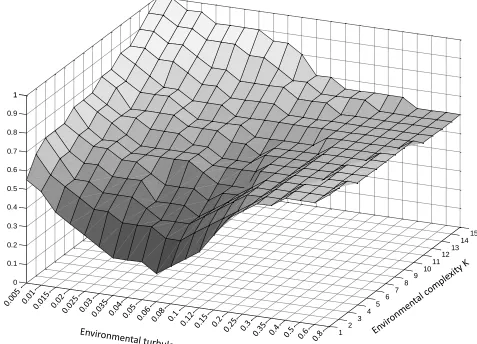
The optimal share of exploration as a function of environmental turbulence and
environmental complexity is shown in Figure 3. All data points in the figure are the result of at
least 100 simulation runs with each potential exploration–exploitation combination. As shown in
highly dependent on the turbulence and complexity of the task environment. To analyze the
effects of turbulence and complexity in more detail, I will next examine cross-sections of Figure
3 to examine first the effects of turbulence with both low and high levels of complexity, and then
the effects of complexity with both low and high levels of turbulence. I will end the results
section with a discussion of the joint effects of turbulence and complexity on the optimal
exploration–exploitation balance.
--- Insert Figure 3 about here ---
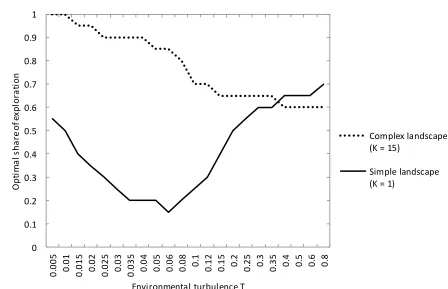
The results regarding the influence of environmental turbulence on the optimal share of
exploration relative to exploitation are shown in Figure 4, for both simple (K = 1) and complex
(K = 15) environments. As shown in Figure 4, and contrary to the conventional wisdom, the
simulation results suggest that in moderately fast-moving environments the optimal share of
exploration is typically clearly lower than in slow-moving environments, and exploitative
adaptation is relatively more important. This occurs because, in moderately turbulent
environments, the overall shape of the landscape remains relatively stable whereas the exact
position of the highest-performing peak in the landscape changes rapidly. For example in a
simple (K = 1) landscape, when turbulence increases from 0.005 to 0.05, the probability that the
exact position of the globally optimal choice configuration changes in a given time period was
found to increase from 4 to 36 percent. In such moderately turbulent conditions, exploitation is
the preferred mode of adaptation because of its higher success rate: for example, on a landscape
with K = 1 and T = 0.05, an organization conducting RD = 10 exploratory search attempts and RL
= 10 exploitative search attempts was found to improve its position 44 percent of the time
therefore needs to conduct a large amount of exploitative adaptation in order to be able to
respond to the demands for rapid and frequent incremental adjustments with sufficient certainty.
Moderate environmental turbulence therefore necessitates exploitative adaptation over
exploratory adaptation, compared with a relatively stable environment.
--- Insert Figure 4 about here ---
However, when environmental turbulence increases even further while complexity stays
low to moderate, the optimal balance again starts to shift towards increased exploration, and in
highly turbulent environments the optimal share of resources used for exploration is typically
higher than in moderately turbulent environments. This occurs because, under highly turbulent
environmental conditions, local incremental adaptation is not enough to keep pace with the
rapidly changing environment. Exploitative adaptation, building on prior competencies, is only
able to change the organization one element at a time. When the task environment changes very
rapidly it is not enough for the organization to be able to change frequently; it also needs to be
able to change a lot, often crossing large regions of the landscape in search of the rapidly moving
peaks. For example in a simple (K = 1) landscape with moderate (T = 0.05) turbulence, an
organization that is at a peak in a given time period was found to be, on average, 0.5 steps (i.e.
one choice dimension adjustments) away from the peak in the following period, making it
possible to stay at or close to the peak through incremental, exploitative adaptation. However,
when turbulence is high (T = 0.5), this distance increases to 4.4 steps, making sufficient
adjustment through only local improvements impossible. The ability to conduct exploratory
radical adaptation becomes necessary in order that the organization is not left too far behind the
As suggested by these results, environmental turbulence increases the importance of both
exploratory and exploitative adaptation, but at different rates. Increasing turbulence in the
organization’s task environment creates, at lower levels of turbulence, increasing pressures for
local adaptability and thus exploitative search but also, at high levels of turbulence, substantial
pressures for global adaptability and therefore exploratory search. These conflicting demands
imply a curvilinear relationship between environmental turbulence and the optimal exploration–
exploitation balance, formalized as Proposition 1.
Proposition 1. At low to moderate levels of environmental complexity, there is a
curvilinear (U-shaped) relationship between environmental turbulence and the optimal
share of exploratory adaptation relative to exploitative adaptation so that, ceteris paribus,
increasing environmental turbulence first decreases then increases the optimal share of
exploratory adaptation.
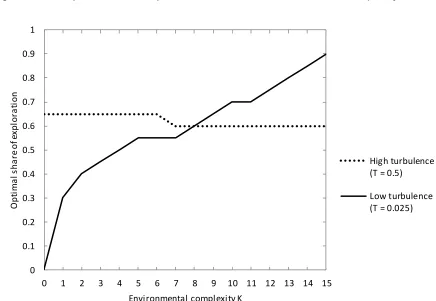
The effects of environmental complexity on the optimal exploration–exploitation balance
are shown in Figure 5, for both a relatively stable environment (T = 0.025), and a highly
turbulent environment (T = 0.5). When environmental turbulence is low to moderate, the optimal
share of resources devoted to exploration is generally higher when the landscape is complex than
when the landscape is simple. In complex landscapes, exploration is necessary to escape
potentially low-performing local peaks and find better regions in the landscape (Levinthal,
1997). In simpler landscapes, exploration may not be necessary, and the optimal amount of
exploration may, in extreme cases, even tend to zero. Thus, environmental complexity typically
Proposition 2. At low to moderate levels of turbulence, increasing environmental
complexity increases the optimal share of exploratory adaptation relative to exploitative
adaptation.
--- Insert Figure 5 about here ---
Proposition 2 is consistent with the existing literature (Levinthal, 1997; Rivkin and
Siggelkow, 2007), but adds the condition that the suggested complexity–exploration relationship
applies when environmental turbulence is low to moderate. However, Figures 3, 4, and 5 also
suggest that environmental turbulence and environmental complexity interact in their effects on
the relative importance of exploration and exploitation. Figure 4 suggests that increased
complexity can turn the U-shaped relationship between turbulence and the optimal share of
exploration into one that is monotonically negative, and Figure 5 suggests that when
environmental turbulence increases, the positive association between complexity and the optimal
share of exploration relative to exploitation gets weaker and, at very high levels of turbulence, is
even reversed. The interaction of complexity and turbulence, thus, seems to increase the relative
importance of exploitation over the need for exploration.
This can be explained by looking at how complexity and turbulence influence the shape
of the landscape and the need both to find good landscape regions and to locally optimize in the
landscape region found. While increased complexity makes the local peaks in the decision
landscape more numerous, thus increasing the need for exploratory adaptation in order to find as
good a peak as possible, it simultaneously makes these peaks narrower and thus increases the
performance loss from straying from the peak, therefore also increasing the need for exploitative
landscape is simple (K = 1), the average drop in performance when straying from a random local
peak by one choice dimension was found to be 0.034, whereas in a complex landscape (K = 15)
the loss in performance by such a small misstep was found to be much greater at 0.144. When
environmental turbulence is also high, staying sufficiently close to the increasingly narrow peaks
becomes increasingly difficult and, furthermore, the peaks are shorter-lived and thus require
quick and accurate local optimization for the organization. Consequently, the need for large
amounts of exploitative adaptation starts to dominate the need for exploratory adaptation. This
suggests that the joint effect of turbulence and complexity increases the relative importance of
exploitation over the relative importance of exploration.
Proposition 3. There is a negative interaction effect of environmental turbulence and
environmental complexity on the optimal share of exploratory adaptation relative to
exploitative adaptation.
Discussion
The results presented above suggest that exploratory and exploitative adaptation have different
functions in responding to the demands posed by turbulent and complex environments, and the
specific characteristics of the organization’s task environment can significantly influence the
optimal balance between exploratory and exploitative adaptation. Environmental turbulence was
found to have a generally U-shaped effect on the importance of exploration relative to
exploitation, whereas environmental complexity was found to generally increase the relative
importance of exploration. Furthermore, the joint effect of turbulence and complexity was found
section, I discuss the implications of these results to the research and management of
organizational adaptation.
Turbulence, complexity, and exploratory versus exploitative adaptation
The curvilinear effect of turbulence on the optimal exploration–exploitation balance suggests
that environmental turbulence poses distinct challenges to exploratory and exploitative
adaptation at different degrees of turbulence, and the key to adaptive success lies in properly
identifying and tackling these challenges. In a relatively stable task environment, the key to
success is consistency in finding the globally optimal landscape region, which the organization
then has ample time to exploit. This makes sufficient exploration vital to allow the organization
to find the region of the landscape – the so called “basin of attraction” (Kauffman, 1993) –
wherein the global peak resides. Because the environment changes relatively slowly, little local,
exploitative adjustment is needed to stay at the global peak once it is found. However, even in
relatively stable environments, changes in the task environment occasionally accumulate to
create a new global optimum at a different region in the landscape. Maintaining a sufficient
amount of exploration activity is therefore important to quickly respond to the occasional
emergence of new, better-performing peaks far away in the landscape. In a relatively
slow-moving landscape, the key adaptive challenge is to avoid getting stuck in a competency trap
(Levinthal and March, 1993; Levitt and March, 1988) in a landscape region that environmental
change has made obsolete, and through sufficient exploratory search to maintain the ability to
quickly jump to a distant region in the landscape when such a radical transformation becomes
necessary (Romanelli and Tushman, 1994; Tushman and O'Reilly, 1996).
When the turbulence of the task environment increases from low to moderate, local
factor. The exact position of the peak is in constant flux even within the same basin of attraction,
and continuous local adjustment is vital to keep the organization as close to the peak as possible.
Thus, in contrast to the established wisdom, when turbulence increases from low to moderate,
the need for exploitative adaptation increases more than the need for exploratory adaptation.
Consequently, the importance of exploitative adaptation dominates the importance of exploratory
adaptation in moderately turbulent environments. The key to success in such environments is
local responsiveness to frequent environmental changes (Burns and Stalker, 1961; Slater and
Narver, 1995), and operational flexibility becomes vital (Volberda, 1996).
In highly turbulent task environments, yet another dynamic sets in. When environmental
change is too fast for the organization to keep pace using only incremental adaptation, the ability
to quickly catch up with environmental demands through distant search becomes important.
Sufficient exploration activity becomes vital for the long-term success of the organization, and
the optimal exploration–exploitation balance shifts again towards increased exploration.
Organizations operating under high environmental turbulence therefore need large amounts of
structural and strategic flexibility (Volberda, 1996) to facilitate the frequent radical changes
necessitated by such environmental conditions.
With regard to the first-order effects of environmental complexity on the exploration–
exploitation balance, the simulation results are largely in line with the existing organizational
adaptation literature (Levinthal, 1997; Rivkin and Siggelkow, 2007). Environmental complexity
increases the relative importance of exploration when the environment is at least relatively
stable. In complex task environments, the interdependencies between the choice elements limit
escape competency traps, represented by the local peaks in the decision landscape (Levinthal and
March, 1993; Levitt and March, 1988).
However, the joint effect of environmental complexity and environmental turbulence was
found to decrease the relative importance of exploration by making exploitative adaptation a
more vital consideration. In environments with a high degree of both turbulence and complexity,
the peaks in the landscape are narrow and short-lived, and the organization not only needs to be
able to find them quickly, but also – and sometimes even more importantly – needs the ability to
exploit them quickly and accurately (Brown and Eisenhardt, 1997; Rindova and Kotha, 2001).
For example, Brown and Eisenhardt (1997) found that the “short product cycles and rapidly
shifting competitive landscapes” (p. 1) in the complex and fast-changing computer hardware and
software industry made it necessary for successful firms to “direct attention simultaneously to
different time frames” (p. 3), not only continuously exploring and probing for future
opportunities but also rapidly exploiting existing opportunities before these opportunities became
obsolete. A dedicated focus on exploration does not suffice in the organization’s adaptation
efforts when the task environment exhibits both high turbulence and high complexity because, in
order to reap any rewards from its exploration efforts in such an environment, the organization
also needs a large amount of exploitative, local adaptability. In complex environments, the
locally optimal choice configurations are highly fragile, and a combination of high complexity
and high turbulence therefore necessitates high levels of exploitative adaptation for the
organization to achieve and maintain this fragile alignment with its environment.
It is interesting to compare these results with those obtained by Posen and Levinthal
(2012) using a multiarmed bandit model. They found that environmental turbulence may
knowledge found by the search efforts.7 The present study examines the value of not only search
in general but of different types of search, exploratory and exploitative, and finds that the higher
success rate of exploitative search can make it preferable to exploratory search in turbulent
environments where ongoing environmental change can quickly devalue the superior landscape
regions found by exploration. Thus, in the contexts discussed by Posen and Levinthal (2012),
environmental turbulence may not only shift the optimal balance from searching new knowledge
to rapidly utilizing the knowledge found, but also shift the balance in the search process towards
exploitative search that yields more certain and immediate returns than exploratory search. The
exception to this is when turbulence is so high so as to make exploitative search insufficient to
keep up with the environment, thus necessitating exploratory search.
These results also provide further insight into the relatively small literature that has
explicitly studied the organizational benefits of exploitative adaptation. For example, Tay and
Lusch (2007) found that while turbulence increases the need for exploration, exploitative
learning is needed in both stable and turbulent environments. The results of the present paper
support their finding and suggest that increasing exploitative learning may be vital in response to
environmental turbulence even when it entails the tradeoff of simultaneously reducing
exploration. Whether increasing turbulence increases the relative need for exploitation or
7 The model used by Posen and Levinthal (2012) only involves one type of search, labeled “exploration”,
and what they label “exploitation” is concerned with the utilization of the knowledge obtained through the search
efforts. Thus, the exploration–exploitation balance that they talk about is conceptually different from the balance
between exploratory and exploitative search and adaptation that is the focus of the present paper. For more
discussion about the different conceptualizations of exploration and exploitation, see Gupta et al. (2006) and Lavie
exploration depends on whether it increases the need for rapid incremental adaptation more than
it increases the need for searching for distant alternatives.
These results point out that in changing and complex environments, organizations need
not only global adaptability provided by exploration, but also local adaptability achieved through
exploitative adaptation. Thus, in the context of organizational adaptation, the interpretation of the
exploration–exploitation tradeoff as a tradeoff between flexibility and efficiency (e.g., Adler et
al., 2009; Lavie et al., 2010) needs to be qualified with the understanding that the efficiency
provided by exploitation is not rigidity but rather a local form of flexibility and adaptiveness
(Farjoun, 2010). Thus, exploitation and flexibility are not antithetical, and exploitative adaptation
should be seen as an essential component of organizational adaptability, by both researchers and
managers.
Managerial implications
The findings of the present study highlight that the management of organizational adaptation in
turbulent and complex environments requires proper attention to both exploratory and
exploitative learning. When environmental turbulence or complexity increases, it is important for
managers to recognize that this may increase the relative importance of either exploration or
exploitation. Increasing turbulence may increase the importance of exploitative learning when it
makes it increasingly difficult to stay at the peak but is not so intense as to shift the peak to a
completely new landscape region. Similarly, increasing complexity may pose pressures for both
types of learning by, on the one hand, increasing the number of local peaks and thereby
increasing the need to explore distant choice configurations while, on the other hand, making the
peaks narrower and thereby increasing the need to stay at or close to a peak through exploitative
evaluate whether the changing environment poses more demands on the search for completely
new practices through exploration or on incremental adjustments of the existing practices
through exploitative learning.
The transformation of the media industry due to the rise of the Internet from the late
1990s onward can be seen as an example of a change in the task environment that posed
increasing demands for exploration by radically increasing the environmental turbulence faced
by newspaper publishers. The Internet brought about new modes of content acquisition and
delivery, with associated changes to business models and the roles of journalists and editors
(Smith et al., 2010). Such rapid changes in several decision elements shifted the new global peak
far from the newspaper firms’ established positions in the decision landscape, and incremental,
exploitative adaptation was insufficient for successfully tackling the new challenges. Instead, the
firms needed to invest in exploratory learning to develop “competencies, practices and structures
that challenged many of the existing newspaper industry’s fundamental assumptions” (Smith et
al., 2010, p. 448) – for example, by establishing separate online units like USA Today did.
Similar challenges have been met by many industries facing competence-destroying
technological discontinuities (Tushman and Anderson, 1986).
Conversely, the Toyota Production System (Adler et al., 2009; Adler et al., 1999; Spear
and Bowen, 1999) provides an illustrative case example of the importance of exploitation and
local adaptability as a response to more moderate environmental turbulence. The success of the
Toyota Production System is often touted as a model example of how an organization can sustain
exploration in the face of pressures for exploitation and thereby maintain its adaptability while
staying efficient. However, while the Toyota case does provide various examples of the
be seen in the different accounts of the Toyota Production System is that much of the
adaptability described is local in nature and therefore associated with exploitative rather than
exploratory learning. For example, giving production workers the responsibility for continuous
improvement and encouraging them to constantly monitor the system for problems and propose
solutions helps the organization to adapt to frequent but not overly radical changes in the task
environment (Adler et al., 1999). While Toyota's task environment involves “complex
dependencies that drive Toyota to a state of disequilibrium” (Adler et al., 2009, p. 106), its
production system facilitates rapid local, exploitative improvements made “at the lowest possible
level in the organization” leading to a “continual response to problems that makes this seemingly
rigid system so flexible and adaptable to changing circumstances” (Spear and Bowen, 1999, p.
98).
Similar cases of the interplay of both global and local adaptability can be found in Burns
and Stalker’s (1961) discussion of organic organizational systems. The advantage of the organic
system is frequently interpreted as its ability to facilitate exploration over exploitation (e.g.,
Crossan and Hurst, 2006; He and Wong, 2004; Lavie et al., 2010). However, when exploitation
is understood as a component of local adaptability, the joint importance of both exploratory and
exploitative learning in such systems becomes apparent. It is important for managers to
distinguish environmental pressures that necessitate exploratory learning and those that require
exploitative learning, and respond appropriately in terms of strategy and organizational design.
Limitations and future research
A key caveat to these results is that they only apply to the exploration–exploitation tradeoff when
exploration and exploitation are truly conceptualized as two modes of organizational search and
exploration and exploitation in recent literature (Gupta et al., 2006; Lavie et al., 2010), the
concepts of exploration and exploitation have been studied in a variety of disparate domains with
various conceptualizations of the exploration–exploitation tradeoff, and it is important to be
careful not to make unwarranted generalizations to the entire exploration–exploitation literature
(Lavie et al., 2010). Thus, reconciling the results of the present paper with the existing
exploration–exploitation literature requires careful consideration of the various theoretical and
operational definitions of the two concepts in different studies.
The analytical model used in this study is also highly simplified. For example, I assume
that the organization can conduct off-line evaluation of all the choice configurations it identifies
through exploratory or exploitative search, i.e., it does not need to implement those changes to
know whether they will improve its performance or not (Gavetti and Levinthal, 2000). However,
especially with distant alternatives, organizations may not be able to accurately evaluate their
value without experimenting with them on-line, which may make exploratory search more costly
than exploitative search in the real world. I also only look at the average long-term performance
of different exploration–exploitation allocations, and ignore the temporal dynamics of the
adaptive processes as well as the possibility that organizations may change their levels of
exploration and exploitation over time, for example as a reaction to environmental changes
(Boumgarden et al., 2012). In the model used in the present paper, the organization can also draw
on the same pool of resources for both exploration and exploitation; while this assumption is
useful for studying the exploration–exploitation balance (Lavie et al., 2010), a more dynamic
analysis of exploration and exploitation over time might require relaxing this assumption. How
changes in such simplifying assumptions may change the dynamics of the exploration–
This study has highlighted the intricate interplay between exploration and exploitation in
complex and turbulent environments, and the consequent interplay between local and global
adaptability to changing environmental demands. However, because the results of the study are
based on a high-level abstract examination of exploration versus exploitation using a formal
simulation model of organizational adaptation, their applicability to and implications for the
variety of real-world contexts in which these processes occur require further study. Therefore,
empirical research is needed that explicitly examines the interrelated roles of exploratory and
exploitative adaptation and the corresponding interplay between global and local adaptability.
For example, testing the propositions presented in the results section using large-scale empirical
data could be helpful in increasing our understanding of the interplay of exploratory and
exploitative adaptation in various organizational settings.
Conclusion
The existing literature on organizational adaptation has widely argued that environmental
turbulence and environmental complexity increase the importance of exploration. However,
turbulence and complexity influence not only the importance of exploratory adaptation but also
the importance of exploitative adaptation. Using a formal simulation model of exploratory versus
exploitative search processes, I have shown that the turbulence and complexity of the
organization’s task environment affect the exploration–exploitation balance in nonlinear and
interdependent ways. Contrary to conventional wisdom, moderate turbulence was found to
increase the importance of exploitation relative to exploration and, further, the joint effect of
turbulence and complexity was found to make local adaptability and consequently exploitative
and exploitation is an especially important consideration in highly turbulent and complex
environments and call for the need to take not only exploration but also exploitation explicitly