Use of the Curriculum Research Framework (CRF) for Developing a Reading-Comprehension Curricular Supplement for the Primary Grades
Language and Reading Research Consortium
Abstract
This article describes nine phases of curriculum-development activities conducted by the
Language and Reading Research Consortium (LARRC), the end result of which was to arrive at a research-based supplemental curriculum that could be used by teachers of English-speaking or bilingual Spanish-English speaking children in pre-kindergarten and English-speaking children in kindergarten to third grade to bring about significant changes in students’ language skills as a route to improved reading comprehension. LARRC followed the Curriculum Research
Framework (CRF) proposed by Clements (2007) as a means for developing curricula that can be called research-based; CRF phases include establishing the foundations of the curriculum
Use of the Curriculum Research Framework (CRF) for Developing a Reading-Comprehension Curricular Supplement for the Primary Grades
In the summer of 2010, the Institute of Education Sciences (IES) of the U.S. Department of Education committed more than $100,000,000 to the Reading for Understanding (RFU) initiative, which provides support to five research teams to develop and test multiple
instantiations of interventions targeting reading comprehension as the primary outcome. Each team was charged with designing interventions that would span at least five grades and would lead to significant improvements in students’ reading comprehension. The Language and Reading Research Consortium (LARRC), a multidisciplinary team of researchers from five universities, was one of two teams whose work was focused specifically on designing interventions for students in the early primary grades (pre-kindergarten to grade three). The specific focus of LARRC was to design and test interventions that would improve students’ oral language skills as a mechanism for improving reading comprehension among pre-kindergarten (pre-K) through third-grade students, and Spanish-English bilinguals in Pre-K.
integrated into curriculum development (Ornstein & Hunkins, 2009). The CRF involves ten phases of activities that fall into three categories, as presented in Table 1. The initial phases (1-3) generally involve establishing the general content of the curriculum, identifying learner goals, and considering various pedagogical options and activities. The next phase (4) involves developing specific learning activities and laying these out in sequence or trajectory. The final phases (5-10) involve systematic evaluation of various aspects of the curriculum, to include conducting market research, formative assessments and design studies, and summative evaluations. Development of a curriculum may utilize none, some, or all of these phases, although Clements points out that curricula that were developed using more rather than fewer CRF phases tend to have more positive impacts on students’ learning.
To date, LARRC activities have progressed through each of the CRF’s first nine phases to arrive at two instantiations per each of five grades of a language-focused
explication of key constructs. Finally, a point is warranted regarding organization of this work, such that it follows the sequence of the ten phases (and three categories) of the CRF (Table 1).
Category 1: Establishing A Priori Foundations
Phases 1, 2, and 3 of the CRF involved establishing the educational goals, subject matter content, and proposed outcomes of the curriculum under development, largely based on broad and deep survey of the extant literature. Examples of materials studied, in addition to hundreds of peer-reviewed research articles, included research compendia (e.g., Handbook of Language and Literacy; Stone, Silliman, Ehren, & Apel, 2004), quantitative reviews (e.g. National Reading Panel Report, 2000), practice guides (Shanahan et al., 2010), textbooks, state and Common Core standards documents, and existing curricula. These resources were used to address Phase 1 (Subject Matter Foundations), which focuses on establishing curriculum content and educational goals that are relevant to students’ development and achievement; Phase 2 (General Foundations), which focuses on examining general concepts related to curricula implementation and theory, including various philosophies of how to teach the given content; and Phase 3 (Pedagogical Foundations), which focuses on identifying specific activities and pedagogies to be used within the curriculum.
Phase 1 Activities and Outcomes
reading comprehension are intricately related in most if not all models of skilled reading (e.g., Gough & Tunmer, 1986; Kintsch & Kintsch, 2005; Perfetti, 1999), the consortium determined that its curricular focus would emphasize improvements in children’s language comprehension rather than reading comprehension, theorizing that improvements in children’s language comprehension would result in improvements in reading comprehension (Bowyer-Crane et al., 2008; Williams et al., 2005). This is an innovative focus with respect to designing a reading-comprehension curriculum, in that LARRC was seeking to leverage the relations between language and reading comprehension as a means to improve both the former and the latter.
Upon deciding to emphasize language comprehension as the overall focus of the curriculum (rather than reading comprehension, per se), the next undertaking was to determine the scope of the curriculum in terms of which language-comprehension skills to target. Skilled reading comprehension draws upon many component language skills, as well as their interplay (Cain, Oakhill, & Bryant, 2004; Catts, Fey, Tomblin, & Zhang, 1999). Of particular importance to being able to eventually read for meaning is the child’s lexicon: the lexicon contains
cognitive skills (Cain et al., 2004) to engage in higher-level comprehension of text; higher-level comprehension involves creating a mental model of the text that integrates the text with one’s prior knowledge and organizes its multiple propositions into an integrated whole (Kintsch & Kintsch, 2005). Higher-level cognitive skills particularly influential to skilled comprehension include inferencing, comprehension monitoring, and use of text-structure knowledge, which are referred to as “higher level meaning construction skills” and “higher-level factors in
comprehension” (respectively, Cain et al., 2004; Perfetti et al., 2005). LARRC refers to these three component skills as higher-level language skills (Hogan, Bridges, Justice, & Cain, 2011).
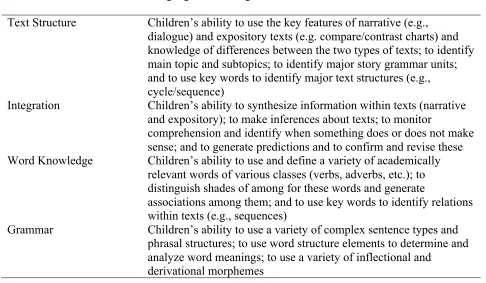
Given the theoretical importance of both lower- and higher-level language skills to reading comprehension, and the fact that these skills develop in early childhood through the primary grades (the span of the LARRC activities), the LARRC curriculum established a fourfold scope of instruction that transcended both higher- and lower-level language skills, organized into four domains (see Table 2). The term “domain” was used to represent a general set of language skills. The scope included two domains reflecting higher-level skills, text-structure knowledge and integration (which included both inferencing and comprehension monitoring), and two reflecting lower-level language skills, word knowledge and grammar.
reading instruction in kindergarten (Cummins, 1979). Our approach was informed by findings showing that transitional Spanish-English bilingual instruction is effective for promoting oral language and emergent literacy skills in English and Spanish in dual-language preschoolers (Farver, Lonigan, & Eppe, 2009), and positive cross-linguistic correlations for higher-level oral language and reading comprehension skills (Proctor, August, Carlo, & Snow, 2006).
Once the initial scope of instruction was established, it was necessary to generate grade-level objectives for each domain, given that the curriculum would span five grades. A thorough search of the literature, to include examination of textbooks, scholarly articles, and numerous standards documents (including the Common Core), was conducted to generate
grade-appropriate indicators for each objective for each of five grades. When this task was completed, we saw considerable redundancy in indicators across various grades, particularly for pre-K and kindergarten and for grades 2 and 3. With input from our advisory board, the five grade levels were collapsed into three “levels”: Level 1 indicators mapped to pre-kindergarten and
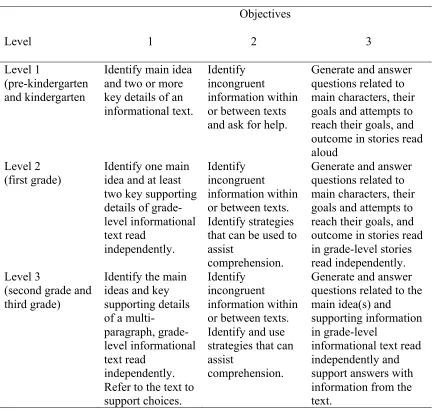
kindergarten classrooms, Level 2 for first grade classrooms, and Level 3 for second and third grade classrooms. Table 3 shows objectives for the Integration domain, as an example, across the three levels. (Consistent with the iterative nature of this work, we would revert in the future to having specific objectives for each of the five grades, as pilot testing would help to differentiate instructional objectives for Pre-K and kindergarten, and grades 2 and 3. Thus, Table 3 represents a relic of our development activities.)
advisory group included Spanish-English bilingual teachers and administrators. In Phase 1, the group largely provided feedback on the scope, objectives, and indicators by grade. Advisory-group members comprised eight principals, 24 teachers (eight pre-K, five kindergarten, four first grade, four second grade, three third grade), six reading coaches/language-arts coordinators, one speech-language pathologist, and one special education director. The advisors would be
particularly useful in Phase 5 with respect to market research, and we discuss the group more thoroughly in description of Phase 5 activities. In general, curriculum-related products and decisions resulted from a dialectic process that involved all subcommittee members and took into advisory group feedback into consideration, and subsequently were reviewed and approved by the consortium members as a whole.
Phase 2 Activities and Outcomes
Phase 2 (General Foundations) activities followed initial establishment of the domains, scope, objectives, and grade-level indicators to address two general issues prior to beginning to develop an initial draft of the curriculum. The first concerned establishing the theoretical
framework governing how children would learn (and teachers would teach) the curricular content (i.e., language skills). Given that the LARRC researchers consisted of individuals from a variety of backgrounds (speech-language pathology, developmental psychology, general education, special education, evaluation), there was active discussion and occasional disagreement
regarding what would be the “active ingredients” of language-based comprehension instruction. Many discussions focused on whether instruction would emphasize explicit and/or direct
reading instruction, and language ability levels covered (i.e., preschool to third grade children) necessitated a discussion on how to bridge the curriculum across grades.
Ultimately, the research team adopted many tenets of scaffolded instruction, such that instruction would emphasize children’s engagement in complex activities while being supported through differentiation by the teacher via scaffolding and supportive discussions. Active learning and gradual release of responsibility are important facets of scaffolded instruction (Rodgers & Rodgers, 2004). However, we also adopted key tenets of explicit instruction, particularly the importance of explicitly teaching students specific strategies to employ to monitor their comprehension. To this end, the consortium members agreed that no single pedagogy (explicit instruction or scaffolded instruction) would underlie the curriculum so as to ensure its
effectiveness for spanning multiple grades and a potentially large array of language-skill objectives. Rather, they approached planning lessons through Pearson and Gallagher’s (1983) framework for instruction, which includes both the elements of explicit instruction (modeling, guided practice, independent practice) and acknowledges that the “proportion of responsibility for task completion” (p. 337), essentially the amount of “explicitness” necessary and level of scaffolding, will vary depending on what is being taught and at what age level.
comprehension-related abilities. They indicated that the LARRC curriculum would be more marketable to districts (particularly during the evaluation work to be conducted in Phases 6-10) if it could be embedded into their existing language-arts structure but be “value-added” in terms of enhancing comprehension-related instruction and students’ language skills.
Recent studies have shown that curriculum supplements embedded into the general classroom curriculum can improve children’s comprehension skills (see Williams et al., 2005, 2009). For instance, researchers tested a supplemental classroom intervention targeting lower- and higher-level language skills (e.g., vocabulary, text-structure knowledge) for second graders in ten classrooms (n = 128), who participated in 15, 45-minute semi-scripted sessions embedded within the classroom curriculum twice weekly. Exposure to the curriculum supplement had positive impacts on the language skills targeted as well as text comprehension (Williams et al., 2005). Thus, a primary outcome of Phase 2 activities was agreement that the LARRC
curriculum would be designed as a supplement to augment the comprehension component of any language-arts program. Importantly, because it would be a supplement, consortium members established the parameter in Phase 2 that curriculum implementation could not require more than about 30-minutes of instruction per day, corresponding to about 2.5 hours per week.
Phase 3 Activities and Outcomes
Phase 3 (Pedagogical Foundation) activities generally focused on establishing the “look and feel” of the curriculum with respect to (a) the techniques to be used in individual lessons to target instructional objectives, and (b) the overall schedule and organization of instruction over time. Phase 3 involved establishing initial prototypes for both the English and bilingual versions, which we discuss here, although it is important to note that each aspect was subsequently
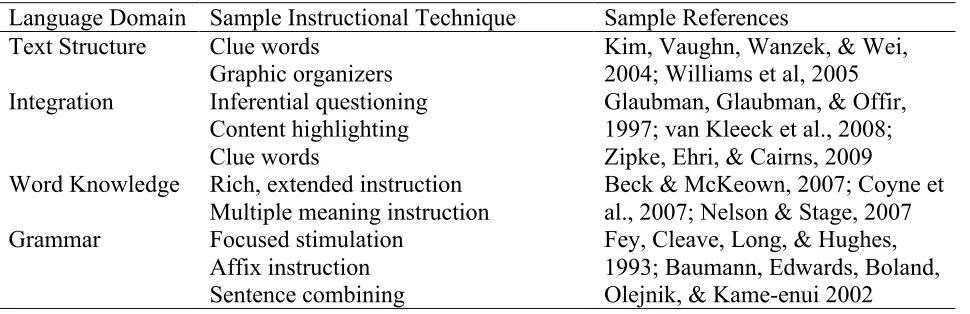
Subcommittee members conducted a thorough review of the literature in order to identify instructional techniques to be used to address the LARRC objectives. The review focused on identifying, for each objective, experimental research studies linking a specific instructional technique to that objective. For instance, to improve children’s vocabulary skills, the team identified “rich instruction” as an empirically validated approach. Rich instruction (also called robust instruction) involves targeting a small set of high-utility words via highly informative and repeated exposures to these words (e.g., see Beck & McKeown, 2007). These techniques (e.g., rich instruction) would be used to populate the lessons themselves, developed in Phase 4. For the Pre-K bilingual curriculum, this phase also considered examining recent literature on techniques used to facilitate language growth in English-Spanish bilinguals (e.g., Farver et al., 2009). At times, a research-based teaching technique for a language domain could not be found for a particular grade level, such as teaching inferencing to pre-kindergarteners. On these occasions, researchers identified a technique utilized in a similar grade level and discussed ways to adjust the technique. Table 4 provides an overview of techniques identified in an initial literature review for the Integration domain, many retained through to the final curriculum draft.
consortium considered, for instance, whether one objective should be targeted extensively within a given lesson, or whether multiple objectives should be targeted within a lesson. Literature regarding the benefits of distributed practice was carefully studied by the consortium, which refers to interspersing periods of learning opportunities with periods of rest or focus on alternative skills (Burdick, 1977). Some research studies find that distributing learning
opportunities across time, rather than concentrating all learning of a skill in a single session, is useful for maximizing learning of new skills (Cepeda, Pashler, Vul, Wixted, & Rohrer, 2006). Thus, the consortium determined that objectives pursuant to a specific language domain would be distributed over an entire academic year, consistent with distributed practice. For instance, a text-structure domain objective “Identifies similarities and differences across expository text structures” in the third-grade supplement occurs in lessons over the entire academic year, with periods of instructional focus interspersed with periods of focus on alternative objectives.
An additional activity conducted as part of Phase 3 was determining the overall organizational scheme to be used for instruction. This initially concerned how to parse an academic year into periods of instruction; initial decisions made in Phase 3 involved parsing the curriculum supplement into five seven-week units so as to span 35 weeks of instruction. Multiple district calendars were consulted to establish the practicality of this decision.
Decisions that flowed subsequently included an interest in using scientific topics as the focus of each of the five units. A content-area specialist in the area of science was therefore hired to consult with the project in this phase. The decision to use science as a focus was drawn from several studies showing the utility of embedding language- and reading-comprehension
narrative and expository texts aligned to a given topic; an initial unit prototype focused on animals and their habitats, and included a variety of narrative and expository texts on the topic.
In addition to determining in Phase 3 that the curriculum would be organized into units, it was also determined that units would consist of individual structured lessons, which are
supported in the literature as a means for improving students’ language and reading
comprehension (e.g., Nelson & Stage, 2007; Beck & McKeown, 2007; Justice et al., 2009; Williams et al., 2005, 2009). Not all language-focused curricula employ structured lessons; some interventions, for instance, involve reading texts in certain ways to students to accentuate
vocabulary development. In developing initial prototypes of lessons, we elected to create and rely upon “soft-scripted” lessons that teachers would follow. Soft-scripted lessons include
suggested rather than prescribed wording to guide teachers as they implemented a lesson. At this time, there was debate as to whether the lessons should be implemented in small- versus whole-class formats. Initial instantiations of lessons involved both: some lessons were written for small-group instruction whereas others involved only whole-class instruction. Eventually, the
curriculum supplement would involve only whole-class instruction, as a result of pilot research showing that use of small-group lessons was making the lessons last much longer than practical.
curriculum’s organization would eventually be modified to comprise four rather than five units, consisting of three 7-week units and one shorter 5-week unit, to provide 26 weeks of instruction. [This would occur in Phase 7 following consistent evidence showing that teachers were taking about seven weeks to complete what we viewed as five weeks of instruction.]
Phase 4: Establishing the Learning Model
Phase 4 of the CRF involves establishing the model by which the curriculum would be enacted; this may include a variety of activities, to include organizing the sequence or trajectory of instruction over time into a set of lessons and considering how objectives should be organized over time. As Clements (2007) points out, curriculum-development activities in this phase are explicitly drawn from subject matter content, to include research and theory on how children learn the content being targeted. For our purposes, given that improving children’s language skills was the targeted content, we relied on extant research and theoretical positions concerning how children acquire language, encompassing both lower-level and higher-level skills.
instructional lessons. We also generated multiple drafts of our own rendering. Lesson drafts were reviewed and revised repeatedly by LARRC investigators and staff and project advisors. Drafts generated in Phase 4 would be revised in all of the following phases (within Phases 5-8), but three basic design considerations that emerged during Phase 4 were retained throughout.
First, each lesson emphasized repeated readings and explorations of authentic
commercial texts, comprising either narrative or expository books. Initially, some units involved up to five different texts, with the texts explicitly selected to support the objectives of the units (e.g., teaching a cause-effect sequence) as well as individual lessons. The selection process involved a number of activities, to include working with librarians to identify candidate texts, vetting selections with the Advisory Board, and conducting pilot work in classrooms. Expository texts selected were reviewed for accuracy of information, inclusion of features that supported different types of text structure (e.g., sequences, cycles), general appeal to children via special features and illustrations, and the potential for extension activities to build upon the text’s content. Narrative texts (fiction and folktales) selected were reviewed for inclusion of story-grammar components (characters, setting, theme, and a plot comprising an initiating event, goal conflict, and outcome or resolution), character development through their thoughts, actions, and words, settings developed through description and/or illustration, and plots developed through the actions of the characters as they seek resolution to conflict. For the bilingual curricula, researchers translated one English book for which a Spanish version was not available.
knowledge, grammar). Targeting objectives across multiple domains within a single lesson was initially considered given an interest in interleaving; interleaving involves weaving different skills (in this case, different domains of language) into a single learning opportunity, and some evidence suggests that this approach to ordering instruction boosts learning (Birnbaum, Kornell, Bjork, & Bjork, 2013). The lesson structure thus involved a series of different activities, such as a large-group reading of a text followed by hands-on writing activities, with different objectives targeted in different activities (e.g., targeting of inferencing during whole-group reading, and targeting of grammar during writing activities).
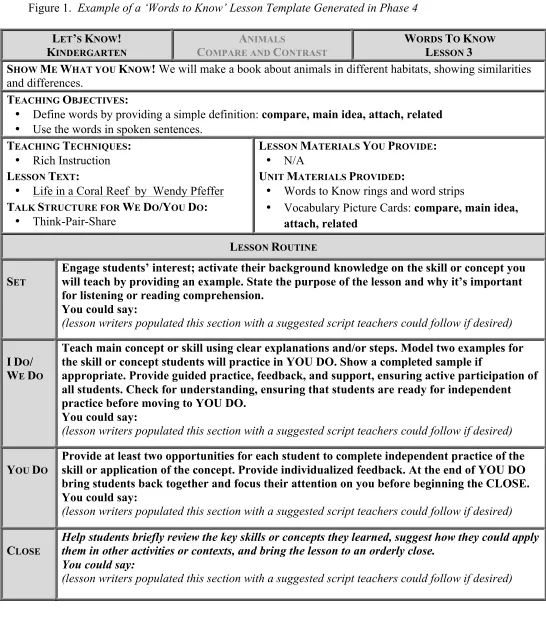
Advisory-group input indicated that the lessons seemed overly complex, and pilot work indicated that the lessons took much longer than desired for completion. In Phase 4, the decision was thus made for each lesson to target only one or two domains of language. This resulted in development and design of three different lesson templates that were aligned with specific objectives: Words to Know lessons targeted word knowledge/vocabulary (see Figure 1 for the template for this lesson type), Integration lessons targeted integration (comprising inferencing and comprehension monitoring), and Text Mapping lessons targeted text-structure knowledge and grammar. These three lesson types (Words to Know, Integration, Text Mapping) were then nested into a larger unit structure, which would start with a Hook and end with a Close. In generating these lesson templates, and organizing them across a unit, concerns were raised about the limited opportunities for children to participate in read-aloud experiences that would
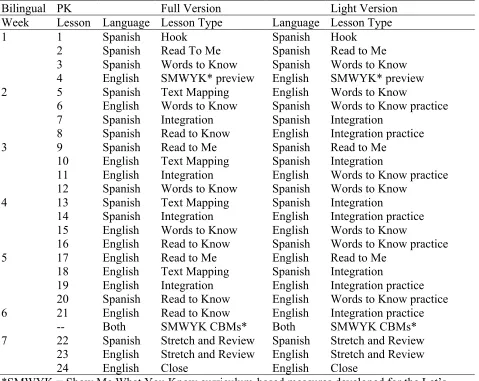
Note that the bilingual version of Let’s Know!,¡Vamos a Aprender!,was developed in tandem with the English-only version using the same iterative processes. It has the same instructional context, scope and sequence of instruction, overall organization, lesson types, lesson layout, and instructional techniques as Let’s Know!, but about half of the lessons are taught in Spanish. In all units, the Hook is presented in Spanish, the intervention books are read first in Spanish then English in subsequent lessons, and each type of lesson is taught in Spanish and in English. The Spanish lessons are not translations of previously taught English lessons; rather, they provide foundational knowledge in Spanish upon which English lessons build.
Third, in this phase an interest in monitoring children’s learning as they progressed through the curriculum emerged, particularly as a means to support children who may struggle with curriculum content and for whom differentiation would be necessary. The development of curriculum-based measures (CBMs) tailored to LARRC content began in this phase, although the CBMs would undergo as much revision as the curriculum itself over subsequent phases. As a starting point, the extant literature was reviewed concerning how teachers use progress-monitoring data to inform instruction (e.g., Hosp, Hosp, & Howell, 2006; Roehrig, Duggar, Moats, Glover, & Mincey, 2008; Stecker, Fuchs, & Fuchs, 2005) and the role of testing in improving children’s learning (Meyer & Logan, 2013). Initial drafts of the Let’s Know!
curriculum-based measure (CBM), eventually named Show Me What You Know (SMWYK), were generated and embedded within each unit during the fifth week of instruction. The initial CBMs (one per each grade per unit) comprised a brief set of items designed to span development across all targeted domains, to include vocabulary, grammar, integration, and text mapping. Since there were no models to follow for creating such CBMs, the team examined prior research for
tasks for progress-monitoring. For instance, a simple experimental task used with first graders to assess their comprehension monitoring (Markman, 1979) was adapted for use across all grades as a measure of skill in this higher-level skill. In Phase 4, initial CBM drafts were pilot-tested on a small number of children. For the bilingual version, CBMs are administered in both Spanish and English using different items for each language, but assessing the same skills as in the English version. The intention was for teachers to be able to complete the CBM on each child in the classroom in about 10 minutes, such that the administration of all CBMs within a classroom could be completed within about two hours distributed over the week. Future pilot work would contribute to numerous revisions of the SMWYK, in response to data collected on the length of time it took teachers to use the CBM, how teachers used the data, and psychometric findings regarding reliability of the tool and its apparent sensitivity to children’s gains in language skill.
Phases 5-10: Evaluation
interventions that cannot be reliably implemented and that have limited perceived benefits are unlikely to be taken to scale (O’Donnell, 2008), and thus have limited utility to the field. Phase 5 Activities and Outcomes
Phase 5 (Market Research) activities are consumer-oriented research activities designed to learn about what the customer wants (Clements, 2007). A 36-member advisory board, representing a number of school-based personnel working in four different states, was involved in numerous development activities over the first two years of curriculum development. These advisors also helped us to engage in market research designed to learn about potential adopters of a curriculum with respect to their goals and needs, as well as the probability that they would adopt the tool if developed.
Our advisors (34 females, 2 males), referenced earlier, included administrators, general educators, special educators, and specialized personnel (e.g., reading specialists). They had, on average, 19 years of experience within the field of education (range 5 to 40 years) and ranged from 29 to 60 years. Each advisor was affiliated with one of the four LARRC project sites, and was compensated by their site with stipends for their participation either on a per-meeting basis or an annual stipend (based on site-specific practices).
PowerPoint presentation was also used to start each session that provided an overview of LARRC activities to date and outlined the role of the advisors in these activities. The first set of sessions (four panels convened in four states) discussed general design considerations relevant to Phases 1 to 4, such as the use of whole- versus small-group lessons, the relevance of curricular objectives to the Common Core, and the extent to which terms appearing in curricular materials were clear and relevant. The second set of sessions (four panels convened in three states, with two conducted at one site) corresponded to Phase 5 of the CFR, and was conducted immediately prior to an initial pilot study (Phase 6). Prior to the session, advisors were provided with a set of guiding principles governing the curriculum as a whole, a proposed scope and sequence of instruction, and a sample two-week unit, and were asked to review this prior to the meeting and mark suggested revisions directly on the materials. Advisors provided their marked-upon units to the moderator and these were compiled and used for future unit revisions. These sessions
generally assessed advisors’ reactions to the guiding principles of the curriculum, the proposed scope and sequence, and the unit/lessons provided.
Revisions requested included the use of different lesson types (instead of interweaving objectives in a single lesson), the need to enhance student engagement in lessons (many were seen as too academic or dry), the need to help teachers to differentiate instruction to students of different skill levels, and a need to reduce the length and complexity of lessons. Cross-site trends were used to revise the initial unit prior to the Phase 6 pilot study.
Phase 6 Activities and Outcomes
Phase 6 (Formative Research: Small Group) activities involve pilot testing of specific components of the curriculum or sections of the curriculum. For our purposes, we conducted an initial design experiment to test a prototype of the curriculum which involved two weeks of lessons. This was conducted in winter of 2011, approximately seven months after the development activities commenced. Teachers at selected grades implemented a 2-week (6-lesson) unit, after which the unit was revised. The primary goal of this formative research was to assess teachers’ preparation and planning for the lessons, the length of time required for lesson implementation (and teachers’ perceptions about lesson length), and their fidelity of
implementation when delivering the lesson prototypes. Noted earlier, the lessons were soft-scripted such that lesson objectives were identified, specific activities were delineated, and suggested language was provided; we wanted to determine the extent to which teachers adhered to the script provided and if they were generally satisfied with the level of scripting. Also, we sought to assess students’ engagement within the lessons, particularly given that lessons had a scripted feel to them.
teachers participate at that time; rather, we anticipated that we could generalize findings from our second grade teachers.) The teachers averaged 11 years of teaching experience (range 3 to 23). Teachers recruited into the study worked in schools that had established a formal relationship with LARRC and were involved in a variety of Consortium-related activities; some served on the advisory board. All teachers volunteered to participate in this study and provided informed consent prior to engaging in any research activities.
General procedures. Teachers implemented one of two prototype units based on grade (pre-kindergarten and kindergarten teachers implemented one prototype, first and second grade teachers the other). Each unit comprised a total of six lessons, and teachers were asked to implement three lessons per week on a schedule provided by the research staff. Prior to implementation, each teacher met with a member of the research staff for an overview of the implementation plan; this 90-min session was conducted in teachers’ classrooms and involved providing teachers within information about the units’ teaching objectives, activities, and materials. During this meeting, teachers received all materials that they would need to complete the 2-week unit, including a binder containing all lessons in the unit as well as any
supplementary materials needed. For instance, pre-kindergarten and kindergarten teachers
received two trade books, whereas first and second grade teachers received three trade books and three leveled readers.
three open-ended questions with an unlimited amount of electronic space to respond. The classroom observations, which lasted approximately 45 minutes, were conducted by research staff; during the observation they completed an observational tool developed for the purpose of this study. Using a scale of 1 (low) to 5 (high), staff provided ratings for (a) general delivery of the lesson (preparation, staying within allotted time, following script, enthusiasm), (b) materials (preparedness, visibility to children), (c) specifics of lesson delivery (effectiveness of covering learning objectives, differentiating instruction, students ability to complete tasks within lessons, progress monitoring, modeling vocabulary words, evaluated and expanded on students’ phrases and engaged students), and (d) students’ responses to the books/texts in the lessons. Field notes were also maintained to capture salient impressions during lesson implementation.
Results and revisions. Data collected in Phase 6 included 33 surveys completed by the 16 teachers following lesson implementation and 34 classroom observations conducted by LARRC staff. In this and all future phases, the LARRC team had to identify a means for aggregating data from a variety of different types (e.g., survey responses, observation data) and locations (four study sites) so as to effectively guide substantive curricular revisions in a very rapid manner. Often, we sought to begin curricular revisions within one month after fieldwork was completed, so as to have revised curricula available at the time of the next planned field study. In general, our approach was to have a team (typically two or three investigators) be responsible for a given measure: they would be responsible for (a) developing and cleaning the relevant data, (b)
to consensus regarding the need for or against suggested revisions. Oftentimes, these discussions would seek to balance revision recommendations with time constraints.
Examination of Phase 6 data resulted in the following consequential recommendations for revision, prior to future field tests: (a) lessons would be modified to only involve whole-class instruction, (b) lessons would be modified so that could be implemented in a much shorter duration, (b) the scope and sequence of instruction would be revised so that fewer objectives would be covered over an academic year (necessary given the overhaul of lessons), and (c) some unit supplements would be eliminated (e.g., certain types of vocabulary stimuli, student readers).
An important outcome of Phase 6 was the obvious need to simplify the curriculum so that it could readily “fit” within language-arts instruction. Lesson plans were overhauled so that each lesson would follow the same instructional routine featuring five ordered components adhering to a scaffolded instructional approach (Fisher & Frey, 2008): Set, I Do, We Do, You Do, and Close. The purpose of the Set was to identify the goal of the lesson (typically the lesson’s objective), and to grab the children’s attention and help them to relate their experiences to the goal of the lesson. The purpose of I Do was for the teacher to model for students what it is they are to do or learn in the lesson, which is followed by the We Do, in which the teacher and children co-participate in doing or learning something. In the You Do, children practice on their own whatever it is they are doing or learning, often with a peer. Finally, in the Close, the teacher summarizes again the goal of the lesson (what was learned). With this new framework for individual lessons, we theorized that the curriculum could more readily be embedded into
generate new units and new lesson prototypes, based on the Phase 6 outcomes, which were tested in Phase 7.
Phase 7 Activities and Outcomes
Phase 7 (Formative Research: Single Classroom/Curricular Enactment) activities involve extensive observation of the implementation of the curriculum so as to “examine learning in the context of the curriculum with teachers who can enact it in concert with the developers’ visions” (Clements, 2007, p. 49). Clements refers to this as “super-realization,” or assessing impacts of the curriculum when implemented at its best; it thus involves close collaboration between teachers and developers at this phase. For LARRC, our Phase 7 formative research activities involved eight teachers (two teaching the bilingual pre-kindergarten curriculum supplement) who implemented a six-week unit comprising 17 separate lessons. This was conducted in fall of 2011. In this presumed “super-realization” of the curriculum, we elected to observe all lessons
implemented in order to arrive at deep understanding of how each lesson, and each lesson’s components, were or were not being effectively enacted within the six classrooms. Three primary research aims guided the Phase 7 pilot study were to determine the extent to which the lessons were implemented as intended; the extent to which teachers were able to implement the curriculum in their classrooms; and the extent to which teachers expressed satisfaction with the curriculum. Our interest at this phase largely concerned teachers’ enactment of the curriculum, rather than students’ learning outcomes. Given that the targets of instruction (e.g., word
knowledge, text structure knowledge) and techniques used (e.g., rich discussion) were
Participants. Eight teachers in four states participated in the Phase 7 feasibility study (two in each of kindergarten, kindergarten, and grade two English versions and two in pre-kindergarten bilingual versions). Although not all targeted grades were represented in this phase of formative research, we anticipated that we could generalize findings to the omitted grades (first and third). Teachers self-selected into the study and provided informed consent for participation. Important to note is that over the course of the feasibility study, two teachers (kindergarten and grade two) dropped from the study without completing the entire unit of implementation. Although attrition of teachers was not originally intended to serve as a Phase 7 data point, the loss of two of six teachers during this formative work was influential to the revisions that resulted from Phase 7 research. Subsequent interviews with the teachers held us better understand the contexts in which teachers were worked, particularly their concerns about fitting the LARRC curriculum into their extant curriculum and adoption of Common Core.
General procedures. The six teachers implemented a 17-lesson unit (each lesson to last approximately 30 minutes) that included six different lesson types (Hook, Word Detectives, Integration, Text Structure, Read to Know, Close) comprising five lesson components (Set, I Do, We Do, You Do, and Close). In addition, teachers implemented the unit’s SMWYK CBM in the fifth week of instruction to all of the students in their classrooms. This was the first formal trial of the CBMs, and a principle interest was to determine how long it took teachers to administer these, as they were designed to require less than 10 minutes per student, ideally.
staff sat in an unobtrusive location and used a notation system on each lesson plan to monitor implementation of specific lesson components (Set, I Do, We Do, You Do, and Close); the observer also completed a summary section at the end of each lesson to provide qualitative impressions of lesson implementation. No feedback was provided to teachers. The teacher logs were completed by teachers to provide information for each lesson specific to the ease of
implementation, length of lessons, student engagement and motivation, effectiveness of lessons, lessons alignment with teaching objectives, and satisfaction and future use of curriculum.
Results and revisions. The primary data used for formative purposes during Phase 7 were derived from the 117 classroom observations. As in the prior phase, a team was responsible for examining these observational data so as to generate a summary report of the data collected and provide explicit recommendations for future revisions. That team report noted that 74% of the lessons were implemented with high fidelity and 26% with mid-level fidelity, indicating overall fidelity to be generally acceptable. However, some lesson types, such as Word Detectives, were implemented with lower levels of fidelity than others, and some lesson components, namely the We Do complement near the end of each lesson, were often omitted from lesson implementation. The report also noted that some lesson components were not seen very favorably (only 50% of the You Do components were viewed favorably). Additional reports were generated to examine the data provided from 102 teacher lesson logs, five end-of-unit surveys, and six guided
interviews, all of which was aggregated to further revise the curriculum. A report on the teachers’ feedback specific to the use of CBMs was also generated.
Specific changes that resulted from the e Phase 7 post-research recommendations
decreased from five to four, and the total duration of instruction was shortened from 35 weeks to 26 weeks, thus giving teachers time to make-up missed lessons and slow the pace as needed. Third, the use of hands-on activities was increased in an effort to promote student engagement, as well as the number of trade books featured in each unit (to promote refreshing of content over a seven-week period of implementation). Fourth, lessons providing the opportunity for students to practice previously addressed objectives were created. Fifth, professional development
modules were drafted to promote teachers’ use of certain techniques with higher levels of fidelity and to emphasize the importance of certain lesson components (e.g., the We Do component). Sixth, the lessons were also redesigned to promote more opportunities for children to engage in discussion with others, including peers. Seventh, feasibility data on teachers’ implementation of the CBMs showed that they took the desired length of time to administer (less than five minutes, on average), but there were numerous needs for refinement. For instance, teachers were unclear as to what to do with the CBM data once it was administered. An important revision to the curriculum subsequently was to incorporate a week of “stretch and review” post
CBM-administration, in which teachers could work individually with students who appeared to have difficulties acquiring specific targeted language skills (e.g., unit vocabulary).
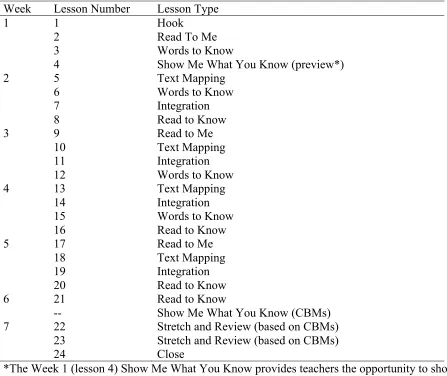
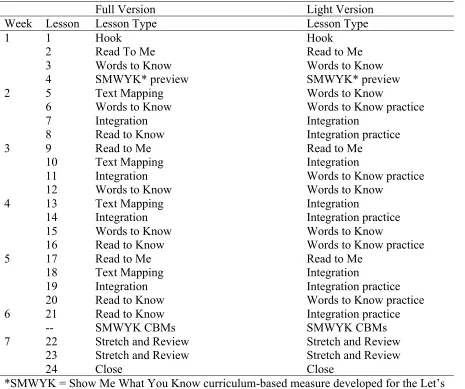
and extensions of the Words to Know and Integration lesson types (see Table 6 and 7 for the English and bilingual lesson sequence), in which students received opportunities for further practice of newly taught skills. Retention of the Read to Me lesson types across both
instantiations ensured that children in the Light version would have experiences with the curriculum texts. Given that two teachers had attritioned from the Phase 7 research reportedly due to perceived burdens of integrating the curriculum with district standards, we sought to test whether a more “simplified version of the curriculum, featuring fewer lesson types and more opportunities to participate targeted language skills, may promote retention and implementation. Approximately three months were used for revision prior to moving into Phase 8 activities. Phase 8 Activities and Outcomes
Phase 8 (Formative Research: Multiple Classrooms) activities involve examination of implementation of the two Let’s Know! curricular instantiations in multiple classrooms, with the purpose of assessing the effectiveness and usability of the curriculum in more varied
circumstances and to compare the Light and Full versions. Specifically, the goal of the Phase 8 study was to determine whether the revised lesson prototypes (representing two instantiations) could be delivered in prekindergarten to grade three classrooms with acceptable levels of
consistency, fidelity, and satisfaction. LARRC’s Phase 8 activities involved testing a new unit of the curriculum, now requiring an estimated seven weeks of instruction, across all five targeted grades and with a larger number of teachers; teachers were randomly assigned to implement either the Full or the Light version. This was conducted in spring of 2012.
Participants. Participants were 50 teachers working in schools in four different states; the teachers were equally distributed across the five grades (10 pre-kindergarten, 10
participated at the ASU site. Teachers self-selected into the study at the invitation of their school districts. The teachers agreed to random assignment of one of the two curricular instantiations, although specific information about differences between instantiations was withheld.
General procedures. All teachers implemented a 7-week unit comprising 24 lessons during the spring of the academic year. Teachers received one-on-one orientation to research activities and also completed an online self-paced professional development module designed to enhance understanding of the instructional techniques used in lessons. Data-collection activities included an online survey following completion of the professional development module, three observations of lessons by LARRC staff to assess implementation fidelity, a lesson log
completed by teachers following every lesson, and an end-of-unit teacher survey and guided interview. Many of the data-collection tools made use of tools from prior phases of work. Data considered most closely by the research team were threefold: (a) the lesson logs completed by teachers after each lesson, (b) the end-of-unit teacher survey and face-to-face interview, and (c) the classroom observations (three per teacher).
Results and revisions. The 50 teachers participating in Phase 8 completed 1,015 logs; logs captured teachers’ satisfaction on a 5-point scale (0=not at all satisfied, 4=very satisfied) for each of five lesson components (i.e., Set, I Do, We Do, You Do, Close) and across all lesson types (e.g., Word Detectives, Read to Me). A mean satisfaction score per lesson was created by averaging the teacher ratings across the five components. Overall, teachers were generally satisfied with the lessons (M = 3.2, SD = .7), with little differences observed between the two instantiations (M = 3.2 and 3.1 for the Full vs. Light Instantiations, respectively).
Phase 7 explicitly sought to simplify and shorten lessons. Two dichotomous (1 = yes / 0 = no) items on the lesson logs captured teacher satisfaction with the overall timing of lesson
implementation. These items asked if the teachers were able to implement all lesson components within the 30 minute timeframe and if they were satisfied with the pace of the lesson. For all logs for which these data were available (n = 992), 631 (64%) were scored as 1 (yes) for the former and 768 (83%) were scored as 1 (yes) for the latter. Thus, the majority of lessons were
appropriate in length and pacing, although not all were.
Additionally, logs were useful for examining teacher impressions regarding students’ engagement during lessons. For each lesson, teachers rated students’ engagement on a five-point scale (0 = not at all satisfied, 4 = very satisfied); the mean rating for all lessons was 3.3, and 87% of lessons were scored as >3 (satisfied or very satisfied). Thus, lessons were generally seen as engaging for students, with no differences observed between instantiations.
An important contribution of the teachers’ logs is that they were able to provide additional input in an open-ended response option. Teachers provided an enormous volume of very specific input for a majority of the 992 logs completed; for instance, they would make suggestions for wording changes when lessons were unclear, or discuss how children did with respect to a given objective. These open-ended responses were aggregated into a single document and all suggestions were considered for revision.
average) and that neither instantiation was better than the other. We did not find that teachers using a simplified version of the curriculum had heightened satisfaction ratings.
The classroom observations were useful for examining the overall length of time needed for lesson implementation and for examining teachers’ fidelity to various components of the lessons as well as student engagement; the observational data could be triangulated with teacher reports, which were favorably disposed to these aspects of implementation. Classroom
observations showed that, on average, all lesson types for all grades and both instantiations were above 30 minutes. Integration lessons were lasting particularly long, averaging more than 40 minutes. Second, fidelity of implementation was relatively high, ranging from 68 to 94% on fidelity checklists. These data did show, however, that fidelity ranged somewhat across teachers. Third, the majority of lessons were rated as ‘engaging’ across grades, lesson types, and
instantiations, although variability was noted across some lesson types and across grades (pre-kindergarteners were generally less engaged than older pupils
consortium then moved to summative research testing implementation of the curriculum over much of the academic year. The prototype units provided the basis to generate two additional units per grade for testing at Phase 9.
Phase 9 Activities and Outcomes
Phase 9 (Summative Research: Small Scale) activities provide initial tests of the potential impacts of the curriculum subsequent to its development over the 9 prior phases. At Phase 9, LARRC conducted a quasi-experimental three-group pilot study to examine impacts of curriculum implementation on general and specific features of language-arts instruction (not discussed here due to space limitations) and researcher-designed measures of student learning of targeted language skills. As a quasi-experimental study, findings are interpreted cautiously but are important for assuring the appropriateness of moving to a larger-scale field study at Phase 10.
In the LARRC pilot study, three units of the curriculum (two revised units as well as one new unit, all based on the prototype tested at Phase 8) were implemented across five grades (pre-K to grade three) with a larger number of teachers than in previous phases and thus representing greater diversity in instructional conditions. In this phase, teachers were assigned to one of three groups: business-as-usual instruction (control group) or the Full or Light versions of Let’s Know!. At the time of this manuscript, we can present results specific to student learning based on Let’s Know! CBMs (SMWYK) collected following seven weeks of exposure to the
curriculum, at the close of Unit 1.
formative studies. Because of this, any teacher involved in prior research activities was randomly assigned to implement either the full or light version of the curriculum. Any new teachers to the study were randomly assigned to one of the three conditions, although in some sites business-as-usual teachers could not be randomly assigned due to various school-specific complexities (e.g., a teacher had been exposed to Let’s Know! previously). Five students were sampled from each classroom to take part in data collection activities, with a total of 300 students represented from the 60 English classrooms and a total of 35 students from the pre-kindergarten bilingual
classrooms. The students were randomly selected from among all students in a classroom for whom informed caregiver consent was provided.
SMWYK examines students’ learning at the close of each unit in three of the four language domains targeted in Let’s Know: Word Knowledge, Text Structure, and Integration. Grammar would also eventually be coded through analysis of stories children produced during administration of the CBM (e.g., analysis of complex sentence structures), although this coding is not yet scheduled for completion. All SMWYKs were implemented by teachers following training in implementation; these audio-recorded in order to allow for double-coding to check for reliability of teachers’ scoring, calculated on a randomly selected 10% of the assessments per site. These results showed high overall inter-rater agreement in scoring (91%).
SMWYK includes three different sets of items, all implemented in an oral context. Word Knowledge items (e.g., “Tell me what solution means”) asked students to provide definitions of vocabulary words that occurred in Let’s Know! instruction (e.g., compare, admire, relieve, similar); responses were scored for partial credit (1 point) or full credit. Text Structure items included three categories of items (story grammar, cohesion, episode structure) that were scored in a task that required students to listen to a story, retell it, and answer questions about it; up to 43 points were possible. Integration items focused specifically on comprehension monitoring; students listened to a storybook that contained inconsistent information and were prompted to identify when this occurred; up to 4 points were possible. For the present purposes, we summed all CBM items to arrive at a raw score for each student, and compared these for students
receiving Let’s Know! instruction versus those receiving business-as-usual instruction.
Table 9 provides a comparison of scores for students in four of the five targeted grades (first grade data for the control condition and data for bilingual classrooms were not yet
instruction (all ps <.001) compared to those receiving business-as-usual instruction, based on t-tests of mean differences. Effect-size indices show that for two of the three grades (pre-K, kindergarten) impacts were quite large. It is unclear whether these preliminary results will translate to impacts on more distal measures of reading comprehension, which would obviously be less closely aligned to the intervention. However, we speculate that these short-term
improvements in students’ skills in word knowledge, text structure, and integration, even if they are closely aligned to the intervention, should theoretically lead to improvements in reading comprehension, a premise that we will assess directly in Phase 10 of this multi-phase project.
Conclusions
In recent years, public interest and investments in reading comprehension have increased substantially, to include considerable federal sponsorship of research designed to develop effective interventions via the RFU initiative. Five federally supported RFU research teams, of which LARRC is one, are designing, developing, and testing reading-comprehension
identifying targets and techniques of instruction; incorporating a high level of involvement of stake-holders, including school administrators and teachers, in the development activities; and following a principled approach to pilot testing and formative evaluation in the design process.
A possible limitation to generalizing the work presented here is that it is very resource intensive (see Table 1). Many research teams may not have the time and financial resources that were available to LARRC, and thus may perceive that they cannot engage in the breadth and depth of activities relevant to each phase as recommended in the CRF and used by LARRC. However, an important feature of CRF is that its systematicity creates a “coherent structure” for curriculum development (Clements, 2007, p. 40). There are many less-intensive ways to
References
Baker, L., & Zimlin, L. (1989). Instructional effects on children's use of two levels of standards for evaluating their comprehension. Journal of Educational Psychology, 81(3), 340. Beck, I., & McKeown, M. (2007). Increasing young low-income children’s oral vocabulary
repertoires through rich and focused instruction. The Elementary School Journal, 107, 251-271.
Birnbaum, M., Kornell, N., Bjork, E. L., & Bjork, R. A. (2013). Why interleaving enhances inductive learning: The role of discrimination and retrieval. Memory & Cognition, 41 (3), 392-402.
Bowyer-Crane C, Snowling MJ, Duff F, Carroll JM, Fieldsend E, Miles J, et al. Improving early language and literacy skills: differential effects of an oral language versus a phonology with reading intervention. Journal of Child Psychology and Psychiatry. 2008;49:422–432. Bradley, B. A., & Reinking, D. (2011). Revisiting the connection between research and practice
using formative and design experiments. In N. Duke & M. Mallette (Eds.), Literacy research methodologies (2nd edition) (pp. 188-212). New York: Guilford.
Brown, A. L. (1992). Design experiments: Theoretical and methodological challenges in creating complex interventions in classroom settings. Journal of Learning Sciences, 2 (2), 141-178.
Burdick, K. J. (1977). Effects of massed and distributed practice on the learning and retention of a novel gross motor skill. Master’s Thesis, Western Illinois University.
Cain, K., Oakhill, J., & Bryant, P.E. (2004). Children's reading comprehension ability: Concurrent prediction by working memory, verbal ability, and component skills. Journal of Educational Psychology, 96, 31-42.
Cain, K., & Oakhill, J. (1996). The nature of the relationship between comprehension skill and the ability to tell a story. British Journal of Developmental Psychology, 14(2), 187-201.
Catts, H.W., Fey, M.E., Zhang, X.,& Tomblin, J.B. (1999). Language basis of reading and reading disabilities: Evidence from a longitudinal investigation. Scientific Studies of Reading, 3, 331-361.
Cepeda, N. J., Pashler, H., Vul, E., Wixted, J. T., & Rohrer, D. (2006). Distributed practice in verbal recall tasks: A review and quantitative synthesis. Psychological Bulletin, 132, 354-380
Clements, D. H. (2007). Curriculum research: Toward a framework for "research-based curricula." Journal for Research in Mathematics Education, 38(1), 35-70.
Cobb, P., Confrey, J., diSessa, A., Lehrer, R., & Schauble, L. (2003). Design experiments in educational research. Educational Researcher, 32(1), 9-13.
Cummins, J. (1979). Linguistic interdependence and the educational development of bilingual
children. Review of educational research, 49(2), 222-251.
Collins, A., Joseph, D., & Bielaczyc, K. (2004). Design research: Theoretical and methodological issues. The Journal of the Learning Sciences, 13(1), 15-42.
Davies, P., Shanks, B., & Davies, K. (2004). Improving narrative skills in young children with delayed language development. Educational Review, 56(3), 271-286.
Easton, J. Q. (2010). New Research Initiatives for IES. IES Research Conference Keynote Address. National Harbor, MD. Retrieved July 19, 2011, from
http://ies.ed.gov/director/speeches2010/2010_06_29.asp.
Farver, J. A. M., Lonigan, C. J., & Eppe, S. (2009). Effective Early Literacy Skill Development for Young Spanish-‐Speaking English Language Learners: An Experimental Study of Two
Methods. Child Development, 80(3), 703-719.
Fitzgerald, J., & Teasley, A. B. (1986). Effects of instruction in narrative structure on children's writing. Journal of educational psychology, 78(6), 424-32.
Hayward, D., & Schneider, P. (2000). Effectiveness of teaching story grammar knowledge to pre-school children with language impairment. An exploratory study. Child Language Teaching and Therapy, 16(3), 255-284.
Hogan, T. P., Bridges, M. S., Justice, L. M., & Cain, K. (2011). Increasing higher level language skills to improve reading comprehension. Focus on Exceptional Children, 44, 2-19. Hosp, M.K., Hosp, J.L., & Howell, K.W. (2006). The ABCs of CBM: A Practical Guide to
Curriculum-Based Measurement. New York, NY: The Guilford Press.
Idol, L. (1987). Group Story Mapping A Comprehension Strategy for Both Skilled and Unskilled Readers. Journal of Learning Disabilities, 20(4), 196-205.
Ivey, G. & Broaddus, K. (2007). A formative experiment investigating literacy engagement among adolescent Latina/o students just beginning to read, write, and speak English. Reading Research Quarterly, 42(4), 512 – 545.
Jenkins, J. R., Heliotis, J. D., Stein, M. L., & Haynes, M. C. (1987). Improving reading comprehension by using paragraph restatements. Exceptional children.
Current issues in reading comprehension and assessment (pp. 71-92). Mahwah, NJ: Lawrence Erlbaum Associates.
Lidz CS. Practitioner’s guide to dynamic assessment. Guilford Press; New York: 1991. Lidz CS. Dynamic assessment and the legacy of L.S. Vygotsky. School Psychology
International. 1996;16:143–154.
Markman, E. M. (1979). Realizing that you don't understand: Elementary school children's awareness of inconsistencies. Child development, 643-655.
Morrow, L. M. (1985). Retelling stories: A strategy for improving young children's comprehension, concept of story structure, and oral language complexity. The Elementary School Journal, 85(5), 647-661.
National Center for Education Statistics. (2009). The Nation's Report Card: Reading
2009 (NCES 2010–458). Institute of Education Sciences, U.S. Department of Education, Washington, D.C. Retrieved July 19, 2011, from
http://nces.ed.gov/nationsreportcard/pubs/main2009/2010458.asp#section1.
National Institute of Child Health and Human Development. (2000). Report of the National Reading Panel: Teaching children to read: An evidence-based assessment of the scientific research literature in reading and its implications for reading instruction: Reports of the subgroups. (NIH Publication No 00-4754). Washington, DC: U.S. Government Printing Office.
Nielsen, D.C. (1993). The effects of four models of group interaction with storybooks on the literacy growth of low achieving kindergarten children. In D. J. Leu, & C.K. Kinzer (Eds.) Examining Central Issues in Literacy Research, Theory, and Practice pp. 279-287. Forty-Second Yearbook of the National Reading Conference. Chicago: National Reading Conference.
Neuman, S.B., & Dwyer, J. (2011). Developing vocabulary and conceptual knowledge for low-income preschoolers: A design experiment. Journal of Literacy Research, 43(2), 103-129.
Ornstein. A. C., & Hunkins, F. P. (2009). Curriculum: Foundations, principles, and issues (5th edition). Boston: Pearson.
Paris, A. H., & Paris, S. G. (2007). Teaching narrative comprehension strategies to first graders. Cognition and Instruction, 25, 1-14.
Pearson, P. D., & Gallagher, M. C. (1983). The instruction of reading comprehension. Contemporary Educational Psychology, 8, 317-344.
Perfetti, C. A. (1999). Comprehending written language: A blueprint of the reader. In C. Brown & P. Hagoort (Eds.), The neurocognition of language (pp. 167-208). Oxford University Press.
Perfetti, C. A. (2007). Reading ability: Lexical quality to comprehension. Scientific Studies of Reading, 11, 357–383.
Proctor, C. P., August, D., Carlo, M. S., & Snow, C. (2006). The intriguing role of spanish
Roehrig, A.D., Duggar, S.W., Moats, L., Glover, M., and Mincey, B. (2008). When Teachers Work to Use Progress Monitoring Data to Inform Literacy Instruction: Identifying Potential Supports and Challenges. Remedial and Special Education, 29: 364–382. Scarborough, H. S. (1998). Predicting the future achievement of second graders with reading
disabilities: Contributions of phonemic awareness, verbal memory, rapid serial naming, and IQ. Annals of Dyslexia, 48, 115-136.
Shanahan, T., Callison, K., Carriere, C., Duke, N. K., Pearson, P. D., Schatschneider, C., & Torgesen, J.
(2010). Improving reading comprehension in kindergarten through 3rd grade: A practice
guide (NCEE 2010-‐4038). Washington, DC: National Center for Education Evaluation and
Regional Assistance, Institute of Education Sciences, U.S. Department of Education.
Retrieved from whatworks.ed.gov/publications/practiceguides.
Shavelson, R. J., Phillips, D.C., Towne, L., & Feuer, M.J. (2003). Educational Researcher, 32(1), 25-28.
Stecker, P. M., Fuchs, L. S., & Fuchs, D. (2005). Using curriculum-based measurement to improve student achievement: Review of research. Psychology in the Schools, 42, 795– 819.
Sternberg, R. J., & Grigorenko, E. L. (2002). Dynamic testing. New York: Cambridge University Press
Stetter, M. E., & Hughes, M. T. (2010). Using story grammar to assist students with learning disabilities and reading difficulties improve their comprehension. Education and Treatment of Children, 33(1), 115-151.
Verhoeven L, Leeuwe J. (2008). Predictors of text comprehension development. Applied Cognitive Psychology, 22,407–423.
Williams, J., Hall, K., Lauer, K., Stafford, K., DeSisto, L., & deCani, J. (2005). Expository text comprehension in the primary grade classroom. Journal of Educational Psychology, 97(4), 538-550.
Williams, J.P., Stafford, K.B., Lauer, K.D., Hall, K.M., & Pollini, S. (2009). Embedding reading comprehension training in content-area instruction. Journal of Educational Psychology, 101 (1), 1–20.
Table 1
Categories and Phases of the Curriculum Research Framework (Clements, 2007) and LARRC-Specific Research Activities
Phase LARRC-Specific Activities
Category 1: Establishing A Priori Foundations
1. Subject-Matter Foundations Extensive survey of extant literature (textbooks, research reports, standards) to establish focus of intervention (lower- and higher-level language skills), scope of
instruction (four domains), objectives within each domain, and indicators of skills per grade level; review of all products by advisory board at each of four sites
2. General Foundations Consortium-level discussions and advisory-board feedback to determine the general pedagogical framework and nature of instruction (complete curriculum vs. supplement) 3. Pedagogical Foundations Consortium-level discussions and research review to
identify instructional techniques, organization of objectives into lessons (e.g., massed vs. distributed learning), and the organization of lessons into units Category 2: Establishing the Learning Model
4. Activity Design Extensive survey of extant curricula and research, generation of prototypes, and review by consortium and advisory board to establish lesson plan prototypes Category 3: Evaluating the Curriculum and Its Components 5. Market Research Seven advisory-board meetings with focus groups and
discussions to vet numerous aspects of early curricular development (e.g, scope and sequence, lesson prototypes) 6. Formative Research: Small
Groups Design study involving 16 teachers (spanning three grades) in a 2-week implementation period (six lessons total) to test initial lesson prototypes; teacher-level outcomes only 7. Formative Research: Single
Classroom
Feasibility study involving 6 teachers (spanning in three grades) in a 6-week period (17 lessons) to test one complete unit; teacher-level outcomes only
8. Formative Research: Multiple Classrooms
Quasi-experimental two-group pilot study involving 50 teachers (spanning five grades) in a 7-week period (24 lessons) to test revised unit; teacher-level outcomes only 9. Summative Research: Small
Scale Quasi-experimental three-group pilot study involving 60 teachers (spanning all five grades) in a 21-week implementation period to test three complete revised units; teacher- and student-level outcomes collected
10. Summative Research:
Table 2
Scope of Instruction: Four Language Domains Targeted in Let’s Know! Instruction Domain Language Skills Targeted within Domain
Text Structure Children’s ability to use the key features of narrative (e.g., dialogue) and expository texts (e.g. compare/contrast charts) and knowledge of differences between the two types of texts; to identify main topic and subtopics; to identify major story grammar units; and to use key words to identify major text structures (e.g., cycle/sequence)
Integration Children’s ability to synthesize information within texts (narrative and expository); to make inferences about texts; to monitor
comprehension and identify when something does or does not make sense; and to generate predictions and to confirm and revise these Word Knowledge Children’s ability to use and define a variety of academically
relevant words of various classes (verbs, adverbs, etc.); to distinguish shades of among for these words and generate
associations among them; and to use key words to identify relations within texts (e.g., sequences)
Grammar Children’s ability to use a variety of complex sentence types and phrasal structures; to use word structure elements to determine and analyze word meanings; to use a variety of inflectional and
Table 3
Example Objectives for Three Levels for the Integration Domain Objectives
Level 1 2 3
Level 1
(pre-kindergarten and kindergarten
Identify main idea and two or more key details of an informational text.
Identify incongruent information within or between texts and ask for help.
Generate and answer questions related to main characters, their goals and attempts to reach their goals, and outcome in stories read aloud
Level 2 (first grade)
Identify one main idea and at least two key supporting details of grade-level informational text read independently. Identify incongruent information within or between texts. Identify strategies that can be used to assist
comprehension.
Generate and answer questions related to main characters, their goals and attempts to reach their goals, and outcome in stories read in grade-level stories read independently. Level 3
(second grade and third grade)
Identify the main ideas and key supporting details of a
multi-paragraph, grade-level informational text read
independently. Refer to the text to support choices.
Identify incongruent information within or between texts. Identify and use strategies that can assist
comprehension.
Generate and answer questions related to the main idea(s) and supporting information in grade-level
Table 4
Examples of Empirically Validated Techniques used in Curriculum Design Language Domain Sample Instructional Technique Sample References Text Structure Clue words
Graphic organizers
Kim, Vaughn, Wanzek, & Wei, 2004; Williams et al, 2005 Integration Inferential questioning
Content highlighting Clue words
Glaubman, Glaubman, & Offir, 1997; van Kleeck et al., 2008; Zipke, Ehri, & Cairns, 2009 Word Knowledge Rich, extended instruction
Multiple meaning instruction
Beck & McKeown, 2007; Coyne et al., 2007; Nelson & Stage, 2007 Grammar Focused stimulation
Affix instruction Sentence combining