i
A thesis submitted to Lancaster University for the degree of Doctor of Philosophy in the Faculty of Science and Engineering
June 2016
Liam Blything, M.Sc.
ii Declaration
This thesis is my own work and no portion of the work referred to in this thesis has been submitted in support of an application for another degree or qualification at this or any other
institute of learning.
iii
The goals of the thesis were to identify the development of 3- to 7-year-old children’s comprehension and production of two contrasting temporal connectives - before and after
-that signal the order of events in two-clause sentences, and to establish the reasons for difficulties with these linguistic devices. Chapter 1 reviews the literature that is considered relevant to the experimental work.
In the experimental work (Chapters 2 to 4), children’s comprehension and production of two-clause sentences containing before and after wasexamined in separate groups of children aged 3 to 7 years. The sentence structures differed in their memory and also language demands. Independent measures of memory and language were related to performance. The design enabled a contrast of traditional memory capacity accounts (e.g., Just & Carpenter, 1992) versus more recent language-based accounts (e.g., Van Dyke, Johns, & Kukona, 2014) of why working memory explains variance in the processing of complex sentences. A capacity account predicts a direct relation between memory and sentence processing: specifically, that some sentence structures are more difficult to process than others because they require more information to be held in working memory than others. Alternatively, a language-based account proposes an indirect relation between memory and sentence processing, such that good language skills modulate the influence of memory on sentence processing, by influencing the accurate representation of information in verbal working memory.
iv
limited children’s comprehension of sentences containing temporal connectives, supporting a memory capacity account.
Experiment 2 (Chapter 3) further investigated comprehension of these sentences focusing on how memory and language influence the ease of processing. Children were trained to make speeded responses to the sentence structures investigated in Experiment 1. The findings support Experiment 1: memory capacity best predicted comprehension of these sentence structures.
Experiments 3 and 4 (Chapter 4) examined production of the same sentence types. In two experiments (elicited production with blocked conditions, and sentence repetition), separate groups of children viewed an animated sequence of two actions, and were asked to describe the order of events. Instructions and practice trials were used to model the target sentence structures. In contrast to the comprehension experiments (Experiments 1 and 2), this work showed that children’s individual differences in the production of two-clause sentences linked by before or after were related to variability in language skills, rather than poor memory capacity.
v
First and foremost, I feel privileged to have been supervised by Professor Kate Cain, who has been extremely generous with her expertise and time in providing me with every opportunity to develop the skills needed to pursue a successful future in academia. I also thank my second supervisor Dr Rob Davies for his valuable contributions to the Ph.D. work. Both Kate and Rob inspire me by their academic achievements, enthusiastic attitudes, and personability, to make the most out of life!
My thanks must also go to fellow colleagues and students. Dr Nicola Currie and Gill Francey have always made themselves available for advice, and have helped make our lab group meetings productive and enjoyable. Further, I have shared great research chats and humour with Matt Hilton and Ryan Blything, who both began their respective Ph.D.s at the same time as me in October 2012.
I also extend my gratitude to the Economic and Social Research Council for funding my Masters and Ph.D. work.
vi Contents
Abstract iii
1. LITERATURE REVIEW 1
1.1. Introduction and outline 1
1.2. Children’s understanding and production of connectives 2
1.2.1. Why focus on temporal connectives? 4
1.3. Mental representations of temporal information 8 1.4. Accounts of developmental gains in connective comprehension and
production of two-clause sentences containing before and after 10
1.4.1. A non-linguistic strategy 10
1.4.2. Factors that influence sentence processing in the immediate years that follow the emergence of an initial understanding of the meaning of before and
after 12
1.5. Memory capacity vs. language-based accounts of sentence processing 16
1.6. Methodological limitations with previous research 23
1.6.1. Definitions of competence 23
1.6.2. Comprehension tasks 24
1.6.3. Production tasks 27
1.7. Overview of the research 29
1.7.1. Summary of literature review 29
vii
PERFORMANCE. 36
2.1. Introduction 37
2.2. Method 46
2.3. Results 51
2.4. Discussion 58
3. EXPERIMENT 2. CHILDREN’S PROCESSING AND COMPREHENSION OF COMPLEX SENTENCES CONTAINING TEMPORAL CONNECTIVES: THE
INFLUENCE OF MEMORY ON THE TIME COURSE OF ACCURATE RESPONSES. 66
3.1. Introduction 68
3.2. Method 76
3.3. Results 79
3.4. Discussion 91
4. EXPERIMENTS 3 AND 4. THE ROLE OF MEMORY AND LANGUAGE ABILITY IN CHILDREN’S KNOWLEDGE AND PRODUCTION OF TWO-CLAUSE
SENTENCES CONTAINING BEFORE AND AFTER. 98
4.1 Introduction 100
4.2 Experiment 3 106
4.2.1. Method 106
4.2.2. Results 111
4.2.3. Discussion 119
4.3. Experiment 4 120
4.3.1. Method 120
4.3.2. Results 122
4.3.3. Discussion 127
viii
5. GENERAL DISCUSSION 137
5.1. Aim 1: When do children display an early appreciation for the meaning of
before and after? 139
5.2. Aim 2: The influence of memory capacity vs. language knowledge on
sentence processing 141
5.2.1. Evidence in support of memory capacity accounts 142
5.2.2. Evidence in support of language-based accounts 144 5.2.3. Does position of connective provide an adequate explanation for the difficulty in producing after-reverse sentences? 145
5.3. Aim 3: Comprehension versus Production 146
5.3.1. An integrated framework for comprehension and production 149
5.4. Methodological implications 151
5.4.1. Comprehension 151
5.4.2. Production 155
5.4.3. Methodological improvements for future studies 158
5.4.4. Corpus studies of spoken language 160
5.5. Educational implications 161
5.6. Final conclusions 162
ix Supplementary Tables from Experimental work
Table A.3.1. Summary of GLMM: Justification for pruning the non-significant main effect and interactions of age, order and connective on the proportion of correct answers by 3- to
7-year-olds. 179
Table A.3.2. Summary of GLMM: Main effect of age and order on the proportion of correct
answers by 3- to 7-year-olds. 180
Table A.3.3. Summary of GLMM: Main effect and interactions of age, order and connective on response times (without square root transformation) to correct answers by 4- to
7-year-olds. 181
Table A.3.4. Summary of GLMM: Main effect and interactions of age, order and connective on response times (with square root transformation) to correct answers by 4- to 7-year-olds.
182
Table A.4.1. Frequency counts of each individual error types made by 3- to 5-year-olds in the
sentence repetition and blocked elicited production task. 183
Table A.4.2. Summary of GLMM: Main effect and interactions of age, connective, and order on the percentage of connective substitution errors in relation to the total errors by 3- to 4-
and 4- to 5- year-olds in the sentence repetition task 184
Table A.4.3. Summary of GLMM: Main effect and interactions of age, memory, order and connective on 3- to 6-year-old’s accuracy responses in the elicited production task. 185
Table A.5. Summary of GLMMs (medial position sentences only, by age group) for the
x
Table A.6.1. Mean (SD) proportion correct for each sentence type by 3- to 7-year-olds in
Experiment 1. 187
Table A.6.2. Mean (SD) proportion correct for each sentence type by 3- to 7-year-olds in
Experiment 2. 188
Table A.6.3. Mean (SD) response times for each sentence type by 4- to 7-year-olds in
Experiment 2. 189
Table A.6.4. Mean (SD) proportion correct for each sentence type by 3- to 6-year-olds in
Experiment 3. 190
Table A.6.5. Mean (SD) onset times for each sentence type by 5- to 6-year-olds in Experiment
3. 191
Table A.6.6. Mean (SD) proportion correct for each sentence type by 3- to 6-year-olds in
Experiment 4. 192
Table A.7.1. Zero-order correlations between the main effects and interactions of age, order,
and connective in Experiment 1 (a follow up for Table 2.2). 193
Table A.7.2. Zero-order correlations between the main effects and interactions of age,
memory, order, and connective in Experiment 1 (a follow up for Table 2.4). 194
Table A.7.3. Zero-order correlations between the main effects and interactions of age, order,
memory and vocabulary on accuracy in Experiment 2 (a follow up for Table 3.2). 195
xi
and connective on accuracy in Experiment 3 (a follow up for Table 4.2). 197
Table A.7.6. Zero-order correlations between the main effects and interactions of age,
memory, vocabulary, age, order, and connective on accuracy in Experiment 3 (a follow up for
Table 4.3). 198
Table A.7.7. Zero-order correlations between the main effects and interactions of age, order,
and connective on accuracy in Experiment 4 (a follow up for Table 4.4). 199
Table A.7.8. Zero-order correlations between the main effects and interactions of age, memory, vocabulary, order, and connective on accuracy in Experiment 4 (a follow up for
xii List of Tables
Table 1.1. Chronological and reverse order sentence structures containing before and after,
with world knowledge either present or absent. 7
Table 1.2. Sentence structures and their additional working memory load as influenced by a reverse order of mention of events, a later acquired connective, and an initial position of the
connective. 19
Table 2.1. Sentence conditions. 48
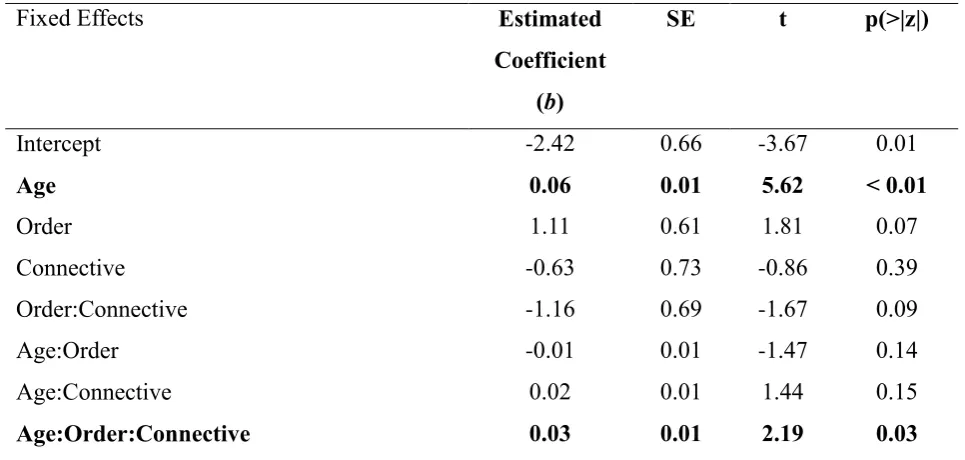
Table 2.2. Summary of GLMM for the log-odds of accuracy responses: Effects and
interactions of age, order and connective. 55
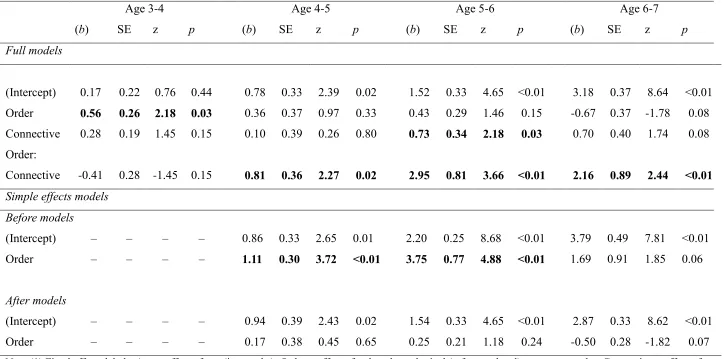
Table 2.3. Summary of GLMMs (per age group) for the log-odds of accuracy responses:
Effects and interactions of order and connective. 56
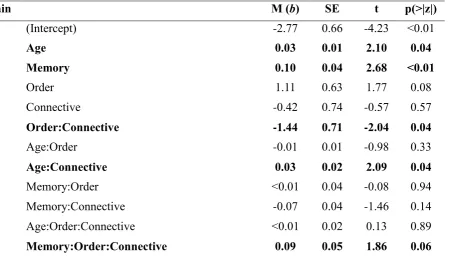
Table 2.4. Summary of GLMM for the log-odds of accuracy responses: Effects and
interactions of memory, age, order and connective. 58
Table 3.1. Sentence conditions 78
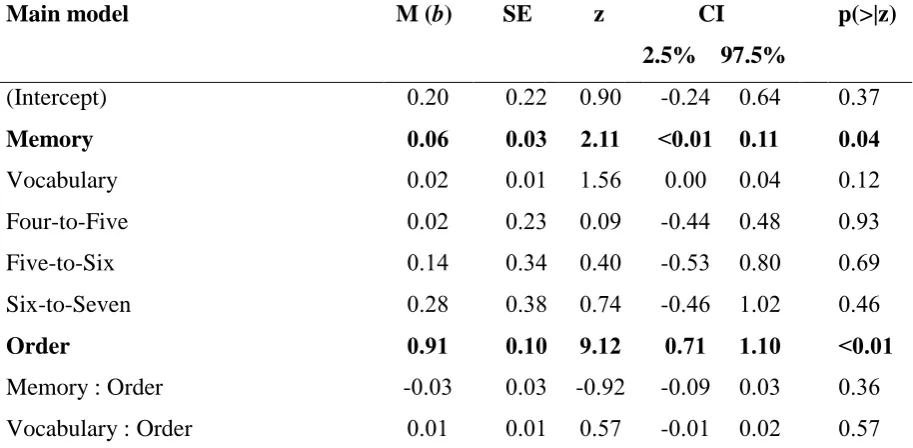
Table 3.2. Summary of GLMM: Main effect and interactions of memory, vocabulary, age, and
order on the proportion of correct answers by 3- to 7-year-olds. 84
Table 3.3. Summary of GLMM: Main effect and interactions of memory, age, order and connective on response times (with square root transformation) to correct answers by 4- to
7-year-olds. 89
Table 3.4. Summary of GLMMs: Simple effects age group models of the effect of order by
xiii
Table 4.2. Summary of GLMM: Main effect and interactions of age, order and connective on
accuracy responses by 3- to 4- and 4- to 5- year-olds in the sentence repetition task. 115
Table 4.3. Summary of GLMM: Main effect and interactions of age, memory, vocabulary,
order and connective on 3- to 4- and 4- to 5- year old’s accuracy responses in the sentence
repetition task. 117
Table 4.4. Summary of GLMM: Main effect and interactions of age, order and connective on
accuracy responses by 3- to 6- year-olds in the elicited production task. 125
Table 4.5. Summary of GLMM: Main effect and interactions of age, memory, vocabulary, order and connective on 3- to 6- year old’s accuracy responses in the elicited production
task.
xiv List of Figures
Figure 2.1. Example presentation of an animation freeze-frame (cream, jelly). 49
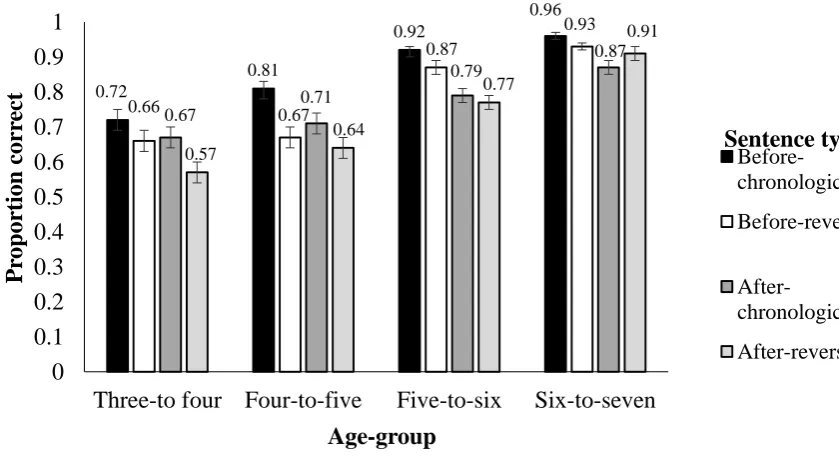
Figure 2.2.Mean proportion correct (with standard error bars) for each experimental
condition by age group. 54
Figure 3.1. Mean proportion correct (with standard error bars) for each experimental
condition by 3- to 7-year-olds. 84
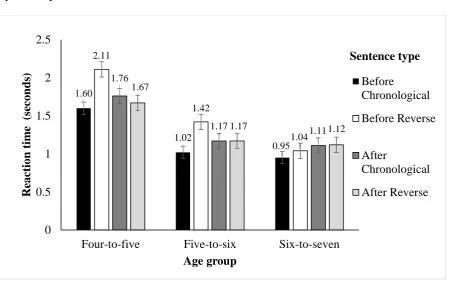
Figure 3.2. Mean response times (with standard error bars) for each experimental condition
by 4- to 7-year-olds. 87
Figure 4.1. Mean percentage correct (with standard error bars) for each experimental
condition in a sentence repetition paradigm by age group. 114
Figure 4.2. Mean percentage correct (with standard error bars) for each experimental
xv
CHAPTER 1: LITERATURE REVIEW.
1
1. Literature Review 1.1. Introduction and outline
We experience events in our everyday lives in the order in which they occur. In spoken or written discourse, however, temporal connectives such as before and after can be used to report the events in either their chronological order of occurrence, for example, ‘He finished his homework, before he played in the garden’ or in reverse order, for example, ‘Before he played in the garden, he finished his homework’. Therefore, temporal connectives signal the actual order of occurrence.
It is well known that adults recognise the difference between before and after, using them accurately in both comprehension (Münte, Habets, & Jansma, 1998; Ye et al., 2012) and production (Habets, Jansma, & Münte, 2008; Ye, Habets, Jansma, & Münte, 2011). However, although before and after appear in spontaneous speech from around 3 years of age (Diessel, 2004), children display difficulties understanding and producing sentences containing these connectives up to at least early adolescence (e.g., Peterson & McCabe, 1987; Pyykkönen & Järvikivi, 2012). Therefore, it is not yet clear to what extent children can accurately use
before and after to understand and signal the temporal relations between events (Cain & Nash, 2011; Pyykkönen & Järvikivi, 2012).
2
outline the relevant literature that motivates the experimental work presented in Chapters 2, 3, and 4.
1.2. Children’s understanding and production of connectives
Connectives are cohesive devices such as before, because, and although, that help language users to establish coherence, because they signal the nature of the relation between events (Gernsbacher, 1997). Connectives are grouped into semantic classes that each signal a similar type of coherence relation. For example, temporal connectives (before, after) signal that the sequence of events relate in time; causal connectives (so, because) signal the causal relations between events, and adversative connectives (but, although) indicate information that is contrary to expectation.
Skilled comprehenders access word meanings and assemble these into meaningful clauses. They go beyond single clauses and integrate these to form coherent sentences, and to link the meanings of sentences to build a coherent mental representation of the combined meaning of those various propositions (Gernsbacher, 1990; Johnson-Laird, 1983; Van Dijk & Kintsch, 1983; Zwaan & Radvansky, 1998). This mental representation is typically referred to as a mental model or situation model. In the same way, speakers produce discourse in which the individual clauses and sentences are interrelated in meaning to refer to a coherent overall topic or theme.
CHAPTER 1: LITERATURE REVIEW.
3
comprehenders in the integrative and inferential skills that are necessary for linking clauses and establishing coherence (Zwaan, Langston, & Graesser, 1995).
In contrast to the facilitative effects seen for adults, research with children suggests that connectives might hamper, rather than help, children’s text comprehension. Evidence for this comes from studies of 7- to 10-year-olds who have had difficulties with selecting an appropriate connective to join two clauses in cloze tasks (Cain & Nash, 2011; Cain, Patson, & Andrews, 2005). However, those studies found that children typically perform at above chance levels, which indicates some understanding about the function of connectives in a sentence and their specific meanings. Online processing paradigms have also indicated that children in this age range display knowledge of the function and meaning of connectives. In a self-paced reading paradigm, Cain and Nash (2011; Experiments 3 and 4) reported that 8-year-olds performed like adults: they read a clause more quickly when it was linked to a preceding clause by an appropriate connective (e.g., Amy wanted a dog but she was not allowed one) than when no connective was present (e.g., Amy wanted a dog. She was not allowed one) or when and was used to link the clauses. This and other studies also suggest developmental improvements: between 8 and 10 years, children demonstrate a more refined understanding for the function of connectives in both offline and online tasks (Cain et al., 2005; Cain & Nash, 2011).
Turning to production, corpus and experimental studies indicate that children can produce a range of connectives from around 3 years of age (e.g., Spooren & Sanders, 2008; Winskel, 2003). However, studies by Peterson and McCabe (1983; 1987; 1991) indicate that young children who appear to be using connectives in their speech, are not yet fully
4
connectives as general linking words between sentences rather than intending the same target meaning used by adults. Further, children frequently used connectives for pragmatic purposes such as narrative initiation or termination, rather than for semantic purposes, as demonstrated by examples i and ii below.
i. Experimenter: ‘I bet you saw the sun come up this morning.’ Child: ‘But I saw the zoo…’
ii. Child (following description of a car crash incident: ‘…So they dead right now.’ Peterson and McCabe explained this pattern of usage from a developmental perspective: young children start out using a connective to signal a range of relations between events and, through experience, develop a more refined understanding for the function of specific
connectives. Therefore, this work in production also suggests that children do not fully understand how to use semantically restricted connectives in the same way as adults. 1.2.1. Why focus on temporal connectives?
Within each of the semantic classes already outlined (e.g., temporal, causal, adversative), the characteristics of the connectives themselves (e.g., Evers-Vermeul & Sanders, 2009; Spooren & Sanders, 2008), as well as their frequency of occurrence from environmental input (Crosson & Le Saux, 2008), may influence ease, and therefore age, of acquisition. Therefore there is a need to investigate the comprehension and production of specific connectives within a given semantic class, particularly from a developmental perspective whereby some connectives may be more easily acquired than others (Cain & Nash, 2011).
CHAPTER 1: LITERATURE REVIEW.
5
(while, whilst and as) signal that events happen at the same time. Sequential connectives are typically acquired earlier than simultaneous connectives (Atanassova, 2001; Keller-Cohen, 1981, 1987; Silva, 1991; Vion & Colas, 2004; Winskel, 2003, 2004, 2007). Therefore, an investigation into children’s understanding of temporal connectives, particularly sequential ones, can indicate how early on in development children are able to use connectives to aid their comprehension and production of two-clause sentences.
The experimental work in this thesis examined children’s understanding of before and
after in two-clause sentences. It is unclear when children display the ability to comprehend and produce these sentences. As described earlier for comprehension, Cain and Nash (2011) reported that 8-year-olds performed above chance in offline comprehension tasks that required knowledge of before and after, and were faster in online tasks at integrating the relation between events when these connectives were used instead of a full stop (albeit the latter analysis did not examine specific connectives separately, but treated them as single class). Therefore, by 8 years, children display some level of competence in comprehending these connectives. However, those children were significantly less accurate compared to adults, and additional research has reported that children up to 12 years of age have difficulties in accurately comprehending two-clause sentences containing before and after
(Pyykkönen & Järvikivi, 2012). Research on children’s ability to produce these connectives tells a similar story to comprehension: both corpus and experimental work shows that children regularly produce sentences containing before and after from as young as 3-years-old (Diessel, 2004; Winskel, 2003), however, children display difficulties with correct production of these connectives up to at least 9 years (Peterson & McCabe, 1987; Winskel, 2003).
6
structures, and that children find some of these more difficult than others (e.g., Clark, 1971; Pyykkönen & Järvikivi, 2012). Specifically, when these connectives are used to signal the order of events, the events can be written in either their chronological order of occurrence, for example, ‘He finished his homework, before he played in the garden’, or in reverse order, for example, ‘Before he played in the garden, he finished his homework.’ As a result of this language flexibility, the same underlying temporal information can be expressed in four different sentence structures: before-chronological, after-chronological, before-reverse, and after-reverse(see Table 1.1). This means that studies of children’s competence for two-clause sentences containing before and after that do not consider the full range of possible sentence structures, may belie children’s full competence. The remainder of this chapter will review the factors within these sentence structures that may influence sentence comprehension and production, focusing on accounts that can inform our understanding of development. First, I outline the processes and mechanisms involved in constructing a coherent mental
CHAPTER 1: LITERATURE REVIEW.
7 Table 1.1.
Chronological and reverse order sentence structures containing before and after.
Before After
Chronological
He put on the sandals,
before he ate the burger
After he put on the sandals, he ate the burger
Reverse
Before he ate the burger, he put on the sandals
He ate the burger,
8
1.3. Mental representations of temporal information
As noted, comprehenders construct a mental representation of the situation described by the text or discourse (Gernsbacher, 1990; Johnson-Laird, 1983; Van Dijk & Kintsch, 1983; Zwaan & Radvansky, 1998). The construction of the mental representation requires the simultaneous processing and storage of information in working memory, and is ultimately stored in long term memory. The majority of theoretical models (and empirical evidence) for how we mentally represent text and discourse focus on comprehension rather than production and, consequently, this section will describe the relevant processes with greater reference to comprehension. Of these theoretical models, the event-indexing model (Zwaan, Langston, & Graesser, 1995; Zwaan & Radvansky, 1998) speaks most to the present thesis because it separately indexes different dimensions, including time, which is the information provided by temporal connectives.
With relevance to temporal information, the event-indexing model explains that the comprehender foregrounds a mental substructure for initial temporal information (e.g., the first clause), and will more easily incorporate incoming information (e.g., the second clause) into an updated version of the foregrounded substructure if it is coherent, for example within the same timeframe.1 Conversely, if incoming temporal information indicates a time shift from the foregrounded substructure, the comprehender will have difficulty integrating such information to their current representation. This would necessitate the encoding of a new foregrounded substructure, making the previous substructure less accessible in memory. The resulting mental representation is likely to consist of several branching substructures, each of which will differ by their levels of activation in memory. The strength of activation (or
1 Note that the processes described here overlap in essence with Gernsbacher’s (1990) structure building framework: foregrounding is similar to the concept of ‘laying a
foundation’; the updating of incoming information is similar to ‘mapping’; and the building
of new substructures when information is incoherent is similar to ‘shifting.’ The
CHAPTER 1: LITERATURE REVIEW
9
activation) for new or previous substructures is determined by the continuity of incoming information with those substructures.
It is important to note that the construction of coherent mental representations of discourse meaning is also necessary for successful production. For example, studies of schizophrenic adults, who display disordered discourse, have reported that in comparison to controls, they take longer pauses between clause boundaries when describing a story (e.g., Ditman & Kuperberg, 2010; Rochester & Martin, 1978; Traxler & Gernsbacher, 1995). The longer pauses between clause boundaries are interpreted as difficulties in foregrounding and updating mental structures of the discourse meaning. This indicates that, as in
10
1.4. Accounts of developmental gains in connective comprehension and production of two-clause sentences containing before and after
1.4.1. A non-linguistic strategy
A critical factor that influences children’s understanding of two-clause sentences containing before and after is the degree to which they have an appreciation for the temporal information signalled by the different connectives. When young children have a fragile understanding of the relation signalled by a temporal connective, they can use different strategies to understand and represent the relation between two events, rather than using the precise linguistic information provided by the connective itself (Clark, 1971). Depending on the sentence structure, these strategies will sometimes result in accurate comprehension. There are two non-linguistic strategies that children may use to interpret temporal order: an order of mention strategy or a world knowledge strategy. Each strategy can assist children’s comprehension accuracy for before and after in specific sentence structures, so can belie their understanding for the connective itself. No previous study has identified a
preference for one strategy over the other.
CHAPTER 1: LITERATURE REVIEW
11
A study by Clark (1971) confirms that an order of mention strategy is used by
children when they do not appreciate the temporal information signalled by before and after. Clark mapped out three developmental stages in 3- to 5-year-olds’ comprehension of
chronological and reverse order sentences containing before and after, measuring performance using an act-out task. A 75% accuracy criterion was chosen to indicate
competence for each sentence type, whereas 25% or below reflected inaccuracy. Children in the first developmental stage were accurate on chronological sentences but not on reverse order sentences. The mean age for children at this stage was 3 years and 7 months. Clark concluded that these children did not have a sufficient understanding of either connective. Children in stage two performed accurately on before-reverse sentences as well as
chronological sentences, but were inaccurate on after-reverse sentences (M = 4 years and 3 months). This result suggests that these children were using an order of mention strategy only for after sentences, but had sufficient understanding of before. She attributed earlier
competence for before relative to after to the semantic features of each term: before indicates the prior event, whereas after does not, making the latter more semantically complex. In the final stage, children (M = 4 years and 7 months) reached the accuracy criterion for all four sentences (before-chronological, after-chronological, before-reverse, and after-reverse), indicating an understanding of both before and after earlier than 5 years of age.
12
sentences relate typical sequences of events the order can be inferred by world knowledge alone. When sentences relate events that share an arbitrary relation, the order cannot be inferred by world knowledge as the events can occur in either temporal order. Instead, the child must use the connective to identify the temporal order for accurate performance on all sentence types.
1.4.2. Factors that influence sentence processing in the immediate years that follow the emergence of an initial understanding of these connectives.
From around 5 years of age, children no longer rely on non-linguistic strategies to understand and represent order (Clark, 1971). There are several factors that might influence older children’s comprehension and production of two-clause sentences containing before
and after. These factors include the relation between the order of mention of the events and the order of events being described by the connective; the depth of understanding and ease of accessibility for the meaning of the connective; the position of the connective in a sentence, and the availability of world knowledge in a sentence. These may explain reasons for children’s inaccurate comprehension and production of these sentences in the immediate years that follow the emergence of an initial understanding of these connectives. Each will be discussed in turn.
Order of mention. As noted, several studies have reported that 3- to 5-year-olds are more likely to be accurate in comprehension tasks for sentences in which the order of mention of events corresponds with the actual order of occurrence signalled by the
connective. This has been used as evidence of an incomplete understanding of the meaning of
CHAPTER 1: LITERATURE REVIEW
13
It is established that the mental representation of event order maps onto the chronological order in which the events occur in real world situations: the first occurring event is followed by the second, and so forth (Coll-Florit & Gennari, 2011; Givón, 1991; Zwaan & Radvansky, 1998). As a result, the comprehender has a default expectation that new information (i.e., the event described in the second clause) will be temporally later than the most recent event in the current foregrounded substructure (i.e., the event described in the first clause) (Zwaan & Radvansky, 1998). Similarly, speakers also construct a mental
representation of the events in the actual order that they occur (Bereiter & Scardamalia, 1987; Bos, Bjorn, de Koning, van Wesel, Boonstra, & van der Schoot, 2015). Therefore, reverse order sentences require more cognitive effort to comprehend and produce because the order of mention of events does not correspond with the linear mental representation of the events. This does not fully afford incremental word-by-word or clause-by-clause processing.
The extra processing effort required for comprehending and producing reverse order sentences in comparison to chronological sentences has been demonstrated in ERP and fMRI studies with adults (Münte and colleagues, 1998, 2008, 2011, 2012). Most recently, Ye et al. (2012) asked adults to read chronological sentences (After the scientist submitted the paper, the journal changed its policy) and reverse order sentences (Before the journal changed its policy, the scientist submitted the paper). Reverse order sentences were associated with stronger activation of the caudate network as a whole, which has been strongly associated with mental imagery processes such as visual rotation of pictures (Kucian et al., 2007). Moreover, the left middle frontal/precentral gyrus, which is associated with maintaining temporal order information in working memory (see Wager & Smith, 2003), was activated most for reverse order sentences. Together, these findings indicate that reverse order
14
Connective meaning. A second factor that is likely to influence the processing
demands of the sentence structures is the differences between the meaning and function of the connectives. Previous theoretical work has argued that before should be more difficult to acquire than after. According to Clark’s (1971) semantic features theory, words share a componential hierarchy and the positive value of a component is learned earlier than the negative value. Clark explained that before and after share three hierarchical components (+/-Time, +/-Simultaneous, +/-Prior). At the top of the hierarchy, both before and after represent time and so are classified as ‘+Time.’ Second, both before and after represent a serial time relation, and so are classified as ‘-Simultaneous.’ The third function classifies the direction for the serial sequence described by before and after: before indicates the ‘Prior’ event (+Prior) whereas after does not. Thus, according to Clark, before should be easier to
understand than after because they differ in the direction of the serial relation that they signal. That is, before is semantically simpler than after because it carries more positive values.
In addition after may be more difficult than before because it functions more broadly as a grammatical device. Word frequency counts by Leech et al. (2001) from The British National Corpus (BNC)indicate that after functions more often (927 out of 1160 counts) than before (577 out of 882 counts) as a non-connective such as a preposition or adverb (e.g.,
The dog chased after). For that reason, it might be harder to learn the use of after as a connective.
Words that are typically more difficult to learn are processed by adults more slowly and less accurately than their less difficult to learn counterparts. For example, these
difficulties have been demonstrated for words with a late age-of-acquisition (Carroll & White, 1973; Juhasz, 2005), a low frequency of occurrence (Coltheart, Rastle, Perry,
CHAPTER 1: LITERATURE REVIEW
15
pronounced in comprehenders with low working memory span compared to comprehenders with high working memory span, which suggests that more difficult words place additional demands on working memory resources (Gunter et al., 2003). Together, this literature indicates that even once the child acquires an appreciation for the difference in meaning between before versus after, their processing of sentences containing these connectives may still be affected by the connective because they are likely to find it more taxing on their working memory resources when activating their knowledge of after as a temporal connective compared to before.
Sentence position of the connective. Manipulating the order of mention for clauses that start with before and after also varies the position of the connective in the sentence. For example, when events are spoken in a chronological order, the connective appears in an initial position when after is used to establish the link (e.g., After she combed her hair, she put on her gloves), but appears in a medial position when before is used (e.g., She combed her hair, before she put on her gloves). The opposite applies to reverse order sentences. Children and adults display a preference for using temporal connectives in a medial position rather than an initial position (Diessel, 2004; 2008). A medial position is between the successive clauses, so the connective provides the linking information at a point close to when the events can be integrated during incremental processing (Cain & Nash, 2011; Traxler et al., 1997). Conversely, an initial position is associated with higher memory demands because it requires the individual to hold the connective information in working memory from the beginning of the sentence until the point at which the events can be integrated (Diessel, 2004; also see Hawkins, 2004).
World knowledge. World knowledge may also influence the ease with which these sentences are processed in the immediate years that follow the emergence of an initial
16
2011) and children (e.g., Barnes, Ahmed, Barth, & Francis, 2015) make use of their world knowledge of the typical order of events to support sentence comprehension. For example, Barnes et al. reported that 11- to 18-year-olds were faster at reading sentences in which the events were typically related by a causal sequence (e.g., Jane took the aspirin. Her headache went away) than sentences in which the events were not typically associated (e.g., Jane looked for an aspirin. Her headache went away).
The reason why world knowledge supports sentence processing can be explained by theoretical models of mental representations of text and discourse (e.g., Zwaan & Radvansky, 1998). When incoming information is coherent with previous information it is highly
activated in memory so is incorporated more easily into a foregrounded mental substructure. Therefore, when events follow a typical sequence, world knowledge can be used to infer order, for example that ketchup is typically poured on prior to eating a burger. For such an example, the order of events that is signalled by a temporal connective can be checked against world knowledge. In that way, world knowledge can support accurate sentence
processing (Graesser et al., 1994; Metusalem, Kutas, Urbach, Hare, McRae, & Elman, 2012). 1.5. Memory capacity vs. language-based accounts of sentence processing
As noted, the construction of a mental representation of a sentence (or longer
CHAPTER 1: LITERATURE REVIEW
17
The classic theory concerning the role of working memory in sentence processing is the memory capacity account (e.g., Just & Carpenter, 1992). This posits that the structural demands of some sentences require a greater amount of information to be held in working memory, making it harder for the comprehender to retain a full and accurate representation. It follows that individuals with high working memory span should be more capable of
maintaining relevant information to arrive at an accurate mental representation when comprehending text.
The majority of research on whether the memory demands of different sentence structures influence sentence processing has been related to comprehension rather than production. Consequently, the present section gives greater reference to comprehension, but is nevertheless considered equally applicable to production, as noted by Carpenter, Miyake, and Just (1994):
‘Although we have focussed on the role of working memory in language
comprehension, clearly the demands for concurrent computation and storage are
equally crucial in language production (p. 1112).’
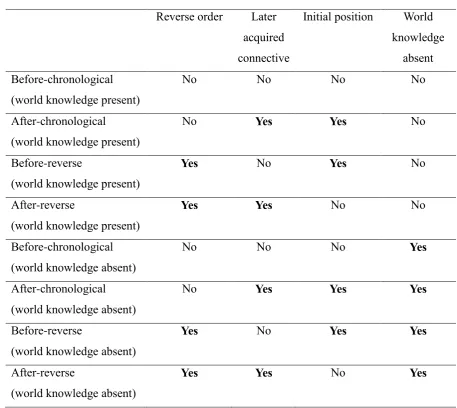
18
working memory: before-reverse (reverse order, initial position), after-chronological (initial position, later acquired connective), and after-reverse (reverse order, later acquired
CHAPTER 1: LITERATURE REVIEW
[image:34.595.61.519.169.577.2]19 Table 1.2.
Sentence structures and their additional working memory load as influenced by a reverse order of mention of events, a later acquired connective, and an initial position of the connective.
Additional working memory load Reverse order Later
acquired connective
Initial position World knowledge
absent Before-chronological
(world knowledge present)
No No No No
After-chronological
(world knowledge present)
No Yes Yes No
Before-reverse
(world knowledge present)
Yes No Yes No
After-reverse
(world knowledge present)
Yes Yes No No
Before-chronological (world knowledge absent)
No No No Yes
After-chronological (world knowledge absent)
No Yes Yes Yes
Before-reverse
(world knowledge absent)
Yes No Yes Yes
After-reverse
(world knowledge absent)
Yes Yes No Yes
20
2013; Klem, Melby-Lervåg, Hagtvet, Lyster, Gustafsson, & Hulme, 2015; Van Dyke et al., 2014). That is, memory limitations are driven by the quality of the knowledge that must be retrieved from long term memory (e.g. Van Dyke et al., 2014), rather than by the quantity of retrieved information that can be maintained within working memory (e.g., Just & Carpenter, 1992). This argument draws on the framework that, rather than being separate systems, working memory and long term memory are part of a unitary architecture in which working memory is a temporarily active portion of long term memory (Ericsson & Kintsch, 1995; McElree, 2006). Therefore, rich language knowledge should support the role of memory in building a robust mental representation because the comprehender (or speaker) quickly accesses and accurately retrieves the target concepts, freeing up resources for maintaining an accurate representation of information in memory. Conversely, poor knowledge of language is likely to result in a more fragile mental representation because the comprehender (or speaker) is less able to suppress competing concepts which share some similarity to the target concept, using up processing resources.
CHAPTER 1: LITERATURE REVIEW
21
connectives, and how well other words in the sentence are activated in relation to competing words with similar meanings), rather than the quantity of individual text elements that must be held active in memory, can account for why some sentences are more difficult to process than others (Van Dyke & Johns, 2012; Van Dyke et al., 2014; Van Dyke & McElree, 2006). In these experiments, adult readers display greater processing difficulties for complex sentences (e.g., object relative clause sentences; It was the boat that the guy who lived by the sea fixed after 2 days) when they are preceded by a list of recall words that have similar meanings to the target cues in the sentence. For the given example, the recall words table, sink, and truck
would make it more difficult to retrieve the target meaning of the object (boat) of the verb
fixed because each could semantically serve as objects of the verb. Critically, processing difficulties are not displayed when the recall words do not share similar features to the target cue, nor do they vary by the quantity of recall words. Also, independent measures of working memory capacity do not predict performance once measures of language knowledge are additionally incorporated (e.g., vocabulary, see Van Dyke et al., 2014).
Together, these findings indicate that performance is not driven merely by whether an additional load of information can be maintained within working memory. Instead, these experiments demonstrate that processing difficulties are determined by how well
comprehenders use their language knowledge in the retrieval of the target information of the retrieval cues in the sentence. Thus according to this account, the influence of memory on processing difficulties is moderated by language knowledge.
If language-based accounts (e.g., Van Dyke et al., 2014) can explain developmental differences in children’s comprehension and production of sentences containing before and
22
sentences (before versus after). A vocabulary test was used to assess language and served as a proxy measure for knowledge of the words within the sentence. Therefore, sentences with greater cognitive demands (i.e., reverse order sentences) would be expected to be more difficult when linked by after, which has greater semantic complexity and is later acquired, and this pattern of performance should also be driven by vocabulary knowledge.
Critically, the influence of these measures of language knowledge would be expected to override the effects of working memory that would be proposed by the memory capacity account (Just & Carpenter. 1992; as demonstrated by Van Dyke et al., 2014). For example, the memory capacity account predicts that since after is more complex than before, the presence of after in any sentence will increase the quantity of information that has to be actively maintained within an independent system of working memory. Therefore, the effect or interacting effect of the connective should be driven by working memory capacity alone. Conversely, the language-based account takes the perspective of a unitary storage system for long term memory and working memory (McElree, 2006), to argue that more processing resources are likely to be allocated to retrieval operations in long term memory for
discriminating the meaning of after compared to before, so are less likely to be allocated to accurately representing complex sentences in memory (i.e., reverse order). Therefore, due to the association between language knowledge and working memory, the effects of working memory that are proposed by a memory capacity account (Just & Carpenter, 1992) would be expected to serve as a proxy for the processing difficulties that are moderated by language knowledge (e.g., Van Dyke et al., 2014).
CHAPTER 1: LITERATURE REVIEW
23
thought was first to temporally occur. Most notably, 8- to 12-year-olds displayed a difficulty with reverse order sentences but only when linked by the connective after. The authors argued that children had difficulty with after-reverse sentences because the connective did not signal a reverse order until half-way through processing the sentence, thus disrupting
construction of the mental representation. In contrast, interpreting a reverse order sentence linked by before may not require revision of the mental representation, as reverse order of mention is signalled from the beginning of the sentence. Therefore, the authors argued that after-reverse sentences require additional working memory computations to hold the concepts for later reconstruction of the mental representation. It must be noted however, that the
difficulty with after-reverse sentences may also align to the prediction of language-based accounts that were outlined earlier, especially considering that a significant disadvantage for
after over before was reported. As noted, to help dissociate memory accounts, the present experimental work used independent measures of memory and language, in addition to manipulating these as factors within the experimental sentences.
1.6. Methodological limitations with previous research 1.6.1. Definitions of competence
Definitions of competence with temporal connectives can vary enormously. For example, overall competence could be explicated as (i) whether children are performing above chance overall (i.e., collapsed across conditions); (ii) whether children no longer display use of a non-linguistic strategy (i.e., they are performing above chance in each specific sentence structure); or (iii) whether children are performing near ceiling and
24
begin to improve upon their fragile understanding for the meaning of the connective.
Competence cannot be concluded by this alone, as children continue to have difficulties up to early adolescence (Cain & Nash, 2011; Peterson & McCabe, 1987; Pyykkönen & Järvikivi, 2012). This motivated my experimental work to determine the reasons for why children continue to have difficulties with these sentences in the immediate years that follow the emergence of an initial understanding for the meaning of the connective. To do this, I
contrasted the roles of memory and language skills to investigate how the structural demands of specific sentence structures influence processing.
One way to examine the role of memory versus language demands on sentence processing is to consider how they are manipulated within the structural demands of the sentences (i.e., order of mention and connective). This consideration is absent in studies of the production of sentences with temporal connectives: no previous study has used a paradigm that examined all possible sentence structures. In addition, no previous
comprehension or production study has used independent measures of memory or language to gain insight into whether these skills can predict variation in performance for sentences that carry different structural demands on processing (e.g., Just & Carpenter, 1992; Van Dyke et al., 2014). I now outline other limitations in previous studies of children’s comprehension and production of temporal connectives, which motivate the experimental work of the present thesis.
1.6.2. Comprehension tasks
CHAPTER 1: LITERATURE REVIEW
25
Studies are typically recommended to have a minimum of eight items per condition (Field, 2009), so these previous studies were short of reliable statistical power. This is important in the light of recommendations for more psychological studies to provide adequate power so that false positive and false negatives is minimised (see Cohen, 1992).
Additional task demands. A major limitation of previous comprehension studies is that the paradigms used may have underestimated performance because of additional demands. Of the 11 previous studies on children’s comprehension of temporal connectives, 10 have used an act-out task (the exception being Pyykkönen & Järvikivi, 2012). However, the requirement to act-out a sentence with toys creates additional memory demands because children must store both clauses in memory whilst planning and acting out the sequence (Ambridge & Lieven, 2011). Indeed, Amidon and Carey (1972) and French and Brown (1977) cited this as a likely reason for why 3- to 5-year-olds often only acted-out one of two clauses that were linked by before or after, in their studies.
In addition, the concept of the act-out task may be difficult for children to understand. For example, to satisfy the presupposition in the instruction ‘Beforeyou move the red plane, move the blue plane’, the intention for the action in the subordinate clause should be
established. To do this, Hamburger and Crain (1982) established a playing context prior to each item by asking the child to choose which toy they would like to use. That toy would then feature in the subordinate clause of the instruction (e.g., Before you move the red plane). Results indicated that the satisfaction of presuppositions vastly improved performance and children no longer appeared to fall back on a non-linguistic strategy. Further confusion over the purpose of act-out tasks may be caused by the materials used. For example, Keller-Cohen (1987) included materials that required children to suggestively act-out events such as
26
children to give a default response where they ignored the wording of the sentence and instead played with the toys in the order they considered to be most sensible (i.e., their natural tendency). For these reasons, previous research may have underestimated competence.
One comprehension study that did not use an acting-out task, was Pyykkönen and Järvikivi’s (2012) written judgement paradigm, which was described in section 1.5. However, their study was of older children (aged 8 to 12) so does not examine the immediate years that follow the emergence of an initial understanding of the meaning of the connective. In
addition, their study measured reading comprehension rather than listening comprehension. Therefore, word reading ability may have influenced performance, as it is a crucial
requirement in reading comprehension (Cain et al., 2004; Gough & Tunmer, 1986; Juel, Griffith, & Gough, 1986). Further, in their task, children read the sentence, and then had to read a choice of answers (i.e., the first versus the second verb) and circle the one that they considered to have happened first. Similar to in act-out tasks, this may have increased processing demands because the child had to process additional information whilst
maintaining their representation of the sentence in working memory. Together, these factors may provide an inaccurate picture of children’s early competence.
One means to reduce the memory demands, is to use forced-choice paradigms such as picture-sequencing or touch-screen technology. Previous studies have examined children’s basic understanding of temporal order by asking them to organise pictures into a temporal sequence (Brown & French, 1976; Brown & Murphy, 1975; Trosborg, 1982). An even simpler requirement for children would be to use a touch-screen to indicate their
CHAPTER 1: LITERATURE REVIEW
27
performance in young infants was significantly better when using touch-screen technology compared to an analogous conventional picture identification task, indicating that the touch-screen task had fewer additional demands.
Furthermore, no previous developmental research has examined processing strategy for sentences containing before and after. Online research with children and adults has provided insights into the benefit of connectives in two-clause sentences and the processes involved in accurate reading comprehension (Cain & Nash, 2011; Cozijn, Noordman, & Vonk, 2011; Traxler et al., 1997). Only two previous studies have used online measures of children’s comprehension of two-clause sentences containing connectives, both choosing a self-paced reading task (Cain & Nash, 2011; Mouchon, Fayol, & Gaonac’h, 1995). Both of those studies reported that 8-year-olds read the second clause faster when it was linked by an appropriate connective to the previous clause compared to when it was linked by no
connective or by an inappropriate connective. However, both studies examined the presence versus the absence of appropriate connectives in general, so do not speak directly to the focus of the thesis on temporal connectives. Self-paced reading cannot be used with the age group of interest in this thesis because it involves non- and beginner-readers (3- to 7-year-olds). Instead, a listening comprehension task with a two-option picture choice on a touch-screen was used to record accuracy and response times, which have been previously used with children as young as three as a reflection of their mental representations (Möhring, Newcombe, & Frick, 2014).
1.6.3. Production tasks
28
2001; Clark, 1971; Weist, Lyytinen, Wysocka & Atanassova, 1997). Other more naturalistic work has examined the use of connectives in corpora of children’s language (e.g., Diessel, 2004). The problem with elicited production and corpus studies is that they cannot
experimentally manipulate whether the speaker uses the connectives in a specific sentence structure (Ambridge & Lieven, 2011). As noted, in order to display true competence, children must be able to produce before and after in each sentence structure (Ferreira, 1996).
A sentence repetition task is one way to provide experimental control over target sentence structures, so that the design can be analogous to that used in comprehension studies (Ambridge & Lieven, 2011). This has been used by Winskel (2003; also see Keller-Cohen, 1981) to elicit target sentence structures containing temporal connectives. Children aged 3 to 7 years were asked to repeat sentences containing one of eight temporal connectives. The main analysis by Winskel focused on a research question that is not directly relevant to this thesis (acquisition of connectives marking sequential versus simultaneous order) and it did not include reverse order sentences. However, one finding is of direct interest. Children made frequent substitution errors for both before-chronological (45% by 4-year-olds; 38% by 5-year-olds; 15% by 6-5-year-olds; 20% by 7-year-olds) and after-chronological (27% by 4-year-olds; 27% by 5-year-4-year-olds; 43% by 6-year-4-year-olds; 10% by 7-year-olds) sentences. This finding reinforces the view that children have difficulties producing two-clause sentences containing
before and after well beyond the period that they first occur regularly in their speech. Further, it motivated my experimental work to use sentence repetition as a measure of children’s ability to produce before and after in chronological and reverse order sentences.
CHAPTER 1: LITERATURE REVIEW
29
sentence in memory prior to production. These extra requirements may reduce the sensitivity of this task as a measure of production. The only other paradigm for examining the
production of specific sentence structures containing temporal connectives reported in
published work, was used by Ye et al. (2011). Adults were presented with red and yellow cues that denoted which sentence structure was required. Whilst this method would be too
demanding for young children, my experimental work drew on this concept to design blocked training conditions for each sentence structure (e.g., Huttenlocher, Vasilyeva, & Shimpi, 2004). Blocked conditions can be used to examine spontaneous production, whilst removing the additional comprehension and memory demands associated with sentence repetition. The major limitation with a blocked design is that the child may remember the rules from one training phase better than for others, creating a bias for a specific block condition (see Müller, Heller, & Ziegler, 1995; Reali, Spivey-Tyler, & Terranova, 2006). Therefore, the
experimental work in the present thesis uses both sentence repetition and a blocked design to examine children’s production of two-clause sentences containing before and after (see Chapter 4).
1.7. Overview of the research 1.7.1. Summary of literature review
Previous research shows that connectives appear in children’s speech from a young age (Diessel, 2004), but that even in early adolescence, they are not fully understood (Cain & Nash, 2011; Pyykkönen & Järvikivi, 2012) or produced accurately (Peterson & McCabe, 1987). Further, work with adults indicates that sentences with temporal connectives are more difficult to process in some sentence structures than others (e.g., Ye et al., 2012). For
30
the necessary sentence processing skills to make full use of the function of the connective in relation to the surrounding discourse (Cozijn et al., 2011; Traxler et al., 1997). This means that there is more than one reason for why performance may be inaccurate. First, young children are likely to make errors because they have a fragile understanding of the meaning of the connective. This is shown in comprehension tasks when children engage in the use of a non-linguistic strategy, rather than using the information provided by the connective (e.g., Clark, 1971). Second, when children no longer display a non-linguistic strategy, they may still have difficulties with sentences that carry additional structural demands on processing effort (Pyykkönen & Järvikivi, 2012).
Note that the influence of connective knowledge that is proposed by a non-linguistic strategy hypothesis (Clark, 1971) differs to that proposed by accounts of sentence processing (Just & Carpenter, 1992; Van Dyke et al., 2014). A non-linguistic strategy hypothesis focuses on whether young children display below-chance accuracy for reverse order sentences: this would be a result of using a non-linguistic strategy, which is in turn a result of having a fragile understanding for the meaning of the connective. Conversely, an account of sentence processing (Just & Carpenter, 1992; Van Dyke et al., 2014) relates to when children perform
above-chance at all sentence structures. Therefore, it focuses on the period that follows children’s initial understanding for the meaning of the connective, which is a later period of interest to the non-linguistic strategy hypothesis (Clark, 1971) and relates to a more fine-grained understanding of the connective that can be used to contrast only the predictions of a memory capacity-constrained account (Just & Carpenter, 1992) and a language-based account (Van Dyke et al., 2014).
CHAPTER 1: LITERATURE REVIEW
31
processes (Pickering & Garrod, 2013), we do not know how the additional planning demands of language production influence accurate use of sentences expressing different temporal orders of events. The problem with corpus and elicited production studies cited here is that they cannot experimentally manipulate whether the speaker uses the connectives in a specific sentence structure. The flexibility to produce these connectives in any given sentence
structure without measuring competence in other sentence structures, may belie children’s true competence (Ferreira, 1996). There are two paradigms used in the present thesis to elicit specific sentence structures: sentence repetition (e.g., Winskel, 2003) and blocked conditions in elicited production (e.g., Huttenlocher et al., 2004).
Taking comprehension and production together, the essential research question that my experimental work examines is why children continue to have difficulties processing two-clause sentences containing before and after in the immediate years that follow the
emergence of their use in speech. There are a number of limitations in previous research. One standout issue is that, whilst some research attributes variation in performance to the
32
In addition, there are a number of paradigms that can now be used to gain a clearer insight into early competence without the additional demands imposed by the act-out tasks (e.g., Friend & Kelpinger, 2008). An insight into when children use connectives to guide their understanding of multi-clause sentences and the factors that limit this is fundamental to the development of theoretical models of listening comprehension, critical skills for educational success.
1.7.2. Objectives of the thesis
The first aim of the present research was to determine the age that children can use
before and after to understand and produce two-clause sentences with a sequential temporal order of events (Clark, 1971). The second aim was to elucidate the reasons for why children continue to have difficulties processing two-clause sentences containing connectives in the immediate years that follow the emergence of an initial understanding of the function of the connective. The third aim was to identify whether the pattern of difficulty for different sentence structures was the same or different for comprehension versus production. In the light of theoretical advances and experimental methods, these aims were investigated using accuracy and timing measurements of comprehension and production.
CHAPTER 1: LITERATURE REVIEW
33
connective), whereas the other structures each have two factors that increase the amount of information that must be held active in working memory: before-reverse (reverse order, initial position), after-chronological (initial position, later acquired connective), and after-reverse (reverse order, later acquired connective). Critically, the independent measure of working memory would be expected to explain unique variance in performance across sentence structures.
The role of language knowledge was also investigated in two ways: by manipulating connective difficulty (before, after), and also by including an independent measure of
vocabulary to examine whether it drives performance effects. A language-based account (e.g., Van Dyke et al., 2014) would predict that language knowledge (i.e., connective, vocabulary) modulates how well children perform with sentence structures that require more cognitive effort. More specifically, children would be expected to have most difficulty for reverse order sentences linked by after, and the pattern of performance should be driven by vocabulary knowledge.
34
difficulties that emerge in the immediate years that follow an initial understanding for the connective.
In relation to the first point above, previous evidence suggests that young children who do not understand the meaning of the connective use a non-linguistic strategy to comprehend sentences containing connectives. However, no previous study has identified if there is preference for the two possible non-linguistic strategies that were investigated in the present thesis (order of mention, world knowledge). In relation to the second point above, the experiment built on recent research on adults’ processing of sentences containing
connectives, which suggests that the structural demands of some sentences require greater cognitive effort to process (Münte et al., 1998; Ye et al., 2012). On that basis, this experiment examined whether a memory-capacity constrained (Just & Carpenter, 1992) or a language-based (Van Dyke et al., 2014) account best predicted comprehension accuracy.
Experiment 2 (Chapter 3) used the same paradigm and materials as Experiment 1 (Chapter 2), but additionally assessed speed of response. Children were trained to make speeded responses to touch the thing that happened last. The use of a timed response measure, in addition to response accuracy, provided a sensitive means to assess whether different sentence structures differ in processing ease, as has been previously found for adults. It also provided an opportunity to replicate the findings of Experiment 1 (Chapter 2). Therefore this experiment provided an insight into how young children construct temporal representations of the meaning conveyed in spoken and written discourse.
CHAPTER 1: LITERATURE REVIEW
35
production of two-clause sentences linked by before or after, specifically whether any difficulties are best attributed to low working memory capacity or to weak language skills.
36
2. Young children’s comprehension of temporal relations in complex sentences: the influence of memory on performance
Text as it appears in: Blything, L. P., Davies, R., & Cain, K. (2015). Young children’s comprehension of temporal relations in complex sentences: the influence of memory on
CHAPTER 2: TEMPORAL RELATIONS IN CHILDREN’S COMPREHENSION.
37 Abstract
We investigated 3- to 7-year-olds’ (N=91) comprehension of two-clause sentences containing the temporal connectives before or after. The youngest children used an order of mention strategy to interpret the relation between clauses: they were more accurate when the presentation order matched the chronological order of events: ‘He ate his lunch, before he played in the garden’ (chronological) versus ‘Before he played in the garden, he ate his lunch’ (reverse). Between 4 to 6 years, performance was influenced by a combination of factors that influenced memory processing load: connective type and presentation order. An independent measure of working memory was predictive of performance. We conclude that the memory demands of some sentence structures limits young children’s comprehension of sentences containing temporal connectives.