Caroline A. Handley
A Thesis Submitted for the Degree of PhD at the
University of St. Andrews
2011
Full metadata for this item is available in Research@StAndrews:FullText
at:
https://research-repository.st-andrews.ac.uk/
Please use this identifier to cite or link to this item: http://hdl.handle.net/10023/1709
HMX-based plastic-bonded explosives
at the mesoscale
Caroline A. Handley
Thesis submitted for the degree of Doctor of Philosophy
of the University of St Andrews
Mesoscale models are needed to predict the effect of changes to the microstructure of plastic-bonded explosives on their shock initiation and detonation behaviour. This thesis describes the considerable progress that has been made towards a mesoscale model for two HMX-based explosives PBX9501 and EDC37. In common with previous work in the literature, the model is implemented in hydrocodes that have been designed for shock physics and detonation modelling. Two relevant physics effects, heat conduction and Arrhenius chemistry, are added to a one-dimensional Lagrangian hydrocode and correction factors are identified to improve total energy conservation. Material models are constructed for the HMX crystals and polymer binders in the explosives, and are validated by comparison to Hugoniot data, Pop-plot data and detonation wave profiles. One and two-dimensional simulations of PBX9501 and EDC37 microstructures are used to investigate the response of the bulk explosive to shock loading. The sensitivity of calculated temperature distributions to uncertainties in the material properties data is determined, and a thermodynamic explanation is given for time-independent features in temperature profiles. Hotspots are widely accepted as being responsible for shock initiation in plastic-bonded explosives. It is demonstrated that, although shock heating of crystals and binder is responsible for temperature localisation, it is not a feasible hotspot mechanism in PBX9501 and EDC37 because the temperatures generated are too low to cause significant chemical reaction in the required timescales. Critical hotspot criteria derived for HMX and the binders compare favourably to earlier studies. The speed of reaction propagation from hotspots into the surrounding explosive is validated by comparison to flame propagation data, and the temperature of the gaseous reaction products is identified as being responsible for negative pressure dependence. Hotspot size, separation and temperature requirements are identified which can be used to eliminate candidate mechanisms in future.
1. Candidate’s declarations:
I, Caroline Angela Handley, hereby certify that this thesis, which is approximately 54,000 words in length, has been written by me, that it is the record of work carried out by me and that it has not been submitted in any previous application for a higher degree.
I was admitted as a research student in September 2004 and as a candidate for the degree of PhD in October 2005; the higher study for which this is a record was carried out in the University of St Andrews between 2004 and 2010.
date . . . signature of candidate . . . .
2. Supervisor’s declaration:
I hereby certify that the candidate has fulfilled the conditions of the Resolution and Regulations appropriate for the degree of PhD in the University of St Andrews and that the candidate is qualified to submit this thesis in application for that degree. date . . . signature of supervisor . . . .
3. Permission for electronic publication:
In submitting this thesis to the University of St Andrews I understand that I am giving permission for it to be made available for use in accordance with the regula-tions of the University Library for the time being in force, subject to any copyright vested in the work not being affected thereby. I also understand that the title and the abstract will be published, and that a copy of the work may be made and supplied to any bona fide library or research worker, that the thesis will be electronically accessible for personal or research use unless exempt by award of an embargo as requested below, and that the library has the right to migrate the thesis into new electronic forms as required to ensure continued access to the thesis. I have ob-tained any third-party copyright permissions that may be required in order to allow such access and migration, or have requested the appropriate embargo below. The following is an agreed request by candidate and supervisor regarding the elec-tronic publication of this thesis. Access to printed copy and elecelec-tronic publication of thesis through the University of St Andrews.
I would like to thank my supervisors Dr Alec Milne (Fluid Gravity Engineering Ltd, St Andrews) and Prof. Alan Hood (School of Mathematics and Statistics, University of St Andrews) for their help and guidance throughout the course of this work. I am grateful to Dr Aaron Longbottom (Fluid Gravity), Dr Nicholas Whitworth and Dr Peter Langridge (both at AWE, Aldermaston), who provided me with source code and documentation for ReactDiff, Peruse and Petra respectively. I also thank members of the Material Modelling Group at AWE for many useful discussions, especially Hugh James, Brian Lambourn and Dr Graham Ball. Jack Reaugh (Lawrence Livermore National Laboratory) and Dr Greg Pearce have been a great help in proof-reading this thesis. Thanks are also due to my husband Nicholas Handley, my parents Nigel and Angela Charlwood and my parents-in-law Stephen and Vivienne Handley for their patience during my PhD studies. I also gratefully acknowledge the financial support of AWE. This thesis has been approved for release by the Ministry of Defence and is copyright:
Notation and units v
1 Introduction 1
1.1 Motivation . . . 1
1.2 Shocks and detonations in condensed explosives . . . 2
1.3 Hydrocode modelling of explosives . . . 7
1.4 Mesoscale modelling of plastic-bonded explosives . . . 13
1.5 Research plan . . . 17
1.5.1 Thesis outline . . . 18
1.6 Summary . . . 19
2 Computational techniques 20 2.1 Relevant physics . . . 20
2.1.1 Hydrodynamics . . . 24
2.1.2 Chemistry . . . 25
2.1.3 Heat conduction . . . 26
2.1.4 Species diffusion . . . 27
2.2 Hydrocodes . . . 28
2.2.1 Chec: a 1D Eulerian hydrocode . . . 30
2.3 Heat conduction and Arrhenius chemistry . . . 36
2.3.1 ReactDiff . . . 36
2.3.2 Peruse implementation . . . 37
2.4 Generating computational microstructures . . . 45
2.5 Summary . . . 51
3.1.1 Strength . . . 53
3.1.2 Equations of state for intermediate species . . . 54
3.1.3 Equation of state mixing rules . . . 55
3.1.4 Temperature calculation . . . 56
3.1.5 Thermal conductivity . . . 57
3.1.6 Latent heat . . . 58
3.1.7 Porosity . . . 58
3.1.8 Sound speed . . . 60
3.1.9 Turbulence . . . 61
3.1.10 Anisotropy . . . 61
3.2 Equation of state for unreacted explosive . . . 62
3.2.1 Unreacted equation of state parameters . . . 63
3.3 Equation of state for reaction products . . . 67
3.3.1 Reaction products equation of state parameters . . . 69
3.4 Reaction rate . . . 70
3.4.1 Arrhenius reaction-rate parameters . . . 73
3.5 Mixing rule . . . 78
3.6 Summary . . . 79
4 Model validation 80 4.1 Hugoniot data . . . 80
4.2 Pop-plot data . . . 84
4.3 Detonation wave profiles . . . 86
4.4 Summary . . . 90
5 Shock heating of crystals and binder 91 5.1 Initial investigation using ReactDiff . . . 92
5.2 Results obtained using Peruse . . . 94
5.2.1 Planar calculations with simplified geometry . . . 94
5.2.2 Effect of meshing . . . 103
5.2.3 Effect of geometry . . . 105
5.3.1 Initial temperature . . . 109
5.3.2 Solid heat capacity . . . 109
5.3.3 Thermal conductivity . . . 111
5.3.4 Unreacted equation of state . . . 111
5.3.5 Reaction products equation of state . . . 114
5.3.6 Reaction products thermal properties . . . 114
5.3.7 Arrhenius chemistry parameters . . . 115
5.4 Summary . . . 119
6 Critical hotspots and flame propagation 120 6.1 Critical hotspot calculations . . . 120
6.1.1 Effect of hotspot temperature . . . 126
6.1.2 Effect of background temperature . . . 128
6.1.3 Effect of hotspot size . . . 128
6.1.4 Effect of background size . . . 131
6.1.5 Effect of initial conditions . . . 131
6.1.6 Effect of geometry . . . 135
6.1.7 Effect of mesh density . . . 135
6.1.8 Propagation through binder layers . . . 138
6.2 Critical hotspot results . . . 139
6.2.1 HMX . . . 142
6.2.2 Binders . . . 142
6.2.3 Comparison with the literature for HMX . . . 143
6.3 Flame propagation . . . 146
6.3.1 Computational method . . . 148
6.3.2 Flame propagation simulations . . . 149
6.4 Flame propagation results . . . 153
6.5 Discussion . . . 157
6.6 Summary . . . 159
7 Bulk temperature distributions 160
7.1.2 Hydrocode comparisons . . . 164
7.1.3 Effect of computational settings . . . 165
7.1.4 Effect of geometry and meshing . . . 168
7.2 Material modelling . . . 171
7.2.1 Temperature calculation . . . 171
7.2.2 Heat capacity . . . 173
7.2.3 Hugoniot parameters . . . 175
7.2.4 Gr¨uneisenΓ . . . 176
7.2.5 Heat conduction and the wall heating effect . . . 176
7.2.6 Effect of chemical reaction . . . 182
7.2.7 Effect of strength . . . 183
7.3 Results . . . 184
7.3.1 Visual results . . . 184
7.3.2 Temperature distributions . . . 188
7.3.3 Bulk properties . . . 194
7.3.4 Shear velocities . . . 195
7.3.5 Pressure versus specific volume data . . . 198
7.3.6 Pressure and temperature traces . . . 199
7.4 Summary . . . 203
8 Conclusions 204 8.1 Future research . . . 206
8.2 Model improvements . . . 208
8.3 Summary . . . 211
A Reaction rate equations 212
B Energy conservation 216
C Temperature calculation 219
Bibliography 230
Symbol Meaning Unit 3α volume coefficient of thermal expansion K−1 βL linear artificial viscosity coefficient -βQ quadratic artificial viscosity coefficient -γ ratio of specific heat capacities for an ideal gas
-Γ Gr¨uneisen gamma
-λ burn fraction
-ρ density g/cm3
ρ0 initial density g/cm3
φ(S) function of entropy kJ/g
χ correction factor J/g K
a Hugoniot parameter km/s
b Hugoniot parameter
-A JWL parameter GPa
B JWL parameter GPa
C JWL parameter GPa
c sound speed km/s
cs sound speed of the solid km/s
cg sound speed of the gas km/s
cp specific heat capacity at constant pressure J/g K
cv specific heat capacity at constant volume J/g K
cv,s specific heat capacity of the solid J/g K
cv,CJ specific heat capacity at the CJ state J/g K
D diffusion coefficient m2/s
e specific internal energy kJ/g
es specific internal energy of the solid kJ/g
eg specific internal energy of the gas kJ/g
Ei activation energy for reactioni kJ/mol
fi mass fraction of speciesi(dynamic) -˙
fi chemical reaction rate for speciesi µs−1
k thermal conductivity W/m K
K detonation wave curvature cm−1
KS bulk modulus GPa
Mi molar mass of speciesi g/mol
ni molar density of speciesi mol/cm3
nt total number of chemical species
-Ni mass fraction of speciesi(static)
-p pressure GPa
ps pressure of the solid GPa
pg pressure of the gas GPa
qi specific energy released by reactioni kJ/g ˙
q rate of chemical energy release kJ/gµs
Q artificial viscous pressure GPa
ri thickness of regioni cm
R molar gas constant J/mol K
R1 JWL parameter
-R2 JWL parameter
-S specific entropy J/g K
t time µs
T temperature K
T0 initial temperature K
TCJ temperature at the CJ state K
u,up particle velocity km/s
Us shock velocity km/s
v0 initial specific volume cm3/g
vs specific volume of the solid cm3/g
vg specific volume of the gas cm3/g
vCJ specific volume at the CJ state cm3/g
V volume cm3
w JWL parameter
-x distance cm
zi frequency factor for reactioni µs−1
Zi frequency factor for reactioni(static) µs−1
Zi frequency factor for reactioni(dynamic) µs−1
A combination of CGS and SI units have been used in this thesis. These are chosen for their convenience in modelling explosives and their prevalence in the literature. However, material model parameters will occasionally be quoted in a different set of units based on g, cm,µs and Mbar for ease of use in future hydrocode simulations. The conversion factor is 1 Mbar = 100 GPa = 100 kJ/cm3. In some figures, cubic centimetres (cm3) will be abbreviated as “cc”.
Introduction
1.1
Motivation
Explosives are substances that can decompose exceedingly rapidly to produce hot, high pressure gases. They need not have a particularly high energy density; for instance, there is more energy per unit mass in chocolate than in many explosives, but in explosives this energy can be released very quickly, in nanoseconds. Two common explosives are cyclotetramethylene-tetranitramine (HMX) and triamino-trinitrobenzene (TATB), with molecular formulae C4H8N8O8 and C6H6N6O6 respectively [1]. The fuel and oxidiser are both located within a single explosive molecule, enabling extremely fast chemical reactions under certain circumstances. Explosives are used for mining and engineering purposes, but most research is directed towards military applications. Usually, it is the expansion of the hot, high pressure gases produced by the explosive that is used to gen-erate useful work, for example breaking rock or accelerating metal. However, explosives can only be used if they are safe to handle. They need to react predictably when required (this is known as performance), but remain intact and inert at all other times (known as safety) [2].
Explosives can react when they are heated or mechanically insulted. Understanding at precisely what temperature an explosive will begin to decompose, or at what strength of mechanical insult, is vital to ensure their safety. The propensity of an explosive to initiate (start reacting) is known as its sensitivity. A sensitive explosive will initiate following a weaker mechanical insult than an insensitive explosive, and so is less safe to handle.
The sensitivity of explosives is controlled by a number of factors including composition (whether it is made mainly from HMX or TATB, for example), initial temperature, poros-ity and microstructure [3]. Current models for predicting the sensitivity of explosives use continuum representations that ignore many details of the microstructure. This means that they are unable to predict the effect of changes to the microstructure caused by a new manufacturing technique or as the explosive ages in storage. Such changes may affect the sensitivity and therefore the safety of the explosive. The aim of this work is to begin con-structing a mesoscale model for explosives that accurately represents their microstructure and will eventually be able to predict its effect on sensitivity.
Like many materials, the behaviour of explosives is strongly rate-dependent. Re-sponses vary from creep and chemical degradation which take place over timescales of months or years, to detonation chemistry that completes in nanoseconds. No single model can be expected to account for this diversity. This work focuses on understanding the re-sponse of condensed phase (solid or liquid) explosives to shock and detonation waves, which cause chemical reactions over microsecond to nanosecond timescales. Although this has been an active area of research for more than a century, the complexity of the in-teraction between shock waves, chemical reactions and the microstructure of explosives means that much is still not understood.
1.2
Shocks and detonations in condensed explosives
There are two classes of explosives: low and high explosives [4]. Low explosives are often used as propellants in rocket motors and fireworks, for example. In low explosives, the chemical reactions can build up to a fast but sub-sonic deflagration wave. This is in contrast to high explosives, the subject of this thesis, in which the chemical reactions can generate a super-sonic wave known as a detonation wave that travels at speeds between 1 and 10 km/s. A detonation wave is a self-supporting shock wave.
Shock
Wave speed is faster at high Front of pulse steepens Back of pulse spreads into a rarefaction
shock and weakens it
fan that eventually catches up with the into a shock wave
Pressure pulse
pressures than at low pressures
Rarefaction fan
Pressure
Distance
Figure 1.1: Sketch illustrating how a strong pressure pulse forms into a shock wave and rarefaction fan as it propagates through a material.
into a rarefaction fan. Eventually, if the pressure pulse is unsupported, the rarefaction will catch up with the shock front and weaken it. In a detonation [6], the shock wave is supported by chemical reactions triggered by the jump in temperature associated with the shock front. Since these reactions take a finite time to complete, the chemical energy of the explosive is released over a short distance known as the reaction zone. For a steady planar detonation wave, the end of the reaction zone coincides with the sonic point. This is the point at which the flow switches from super-sonic to sub-sonic. Rarefactions and other waves can affect the flow behind the sonic point, but they cannot affect what is hap-pening ahead of the sonic point. Therefore, a steady planar detonation wave propagates at a constant detonation velocity determined by the response of the explosive ahead of the sonic point, irrespective of how it was created. In divergent curved geometries, the reaction zone extends past the sonic point, reducing the energy available to support the detonation wave and lowering its velocity.
In designed applications of explosives, detonations are initiated using purpose-built detonators [1]. However, detonations may also occur as a result of high speed impacts in accident scenarios or experimental configurations. The simplest case is a one-dimensional projectile impact which drives a sustained shock wave into the explosive, raising its tem-perature, pressure and density. The response depends on whether the explosive is homo-geneous or heterohomo-geneous, as shown in figure1.2.
Homogeneous initiation Heterogeneous initiation 4 5 3 2 1 Shock
Interface Steadydetonation
detonation Steady Chemical reaction strengthens shock Run−to− detonation point
1 2 3 4 5
4 5
3 2 1
1 2 3 4 5
detonation Super detonation Overdriven Shock Steady detonation
Interface Steadydetonation
Overdriven detonation detonation Super Shock Shock Time Time Time Time Distance
Distance Particle velocity
Particle velocity
Figure 1.2: Illustration of the differences between homogeneous and heterogeneous shock initiation. The time versus distance plots (left) show how waves propagate through the explosive [7, 8]. The particle velocity histories (right) demonstrate the features that are observed in the results of embedded-gauge experiments [9].
log (run−to−detonation distance)
More sensitive HMX−based Less sensitive explosive explosive TATB−based
[image:17.595.75.470.111.408.2]log (incident shock pressure)
is over-driven, the wave settles down to a steady detonation. Homogeneous explosives are relatively insensitive because the incident shock must be strong enough to heat the bulk explosive to above its chemical activation energy. Owing to their initially-uniform composition, homogeneous explosives are not often modelled at the mesoscale.
Heterogeneous explosives [8] have a non-uniform microstructure and are often porous, e.g., plastic-bonded explosives. These explosives are more sensitive than would be expected from their bulk temperature. It is widely accepted that reaction begins (i.e. ig-nition occurs) at localised hot regions, known as hotspots, that are created by shock inter-actions with the heterogeneous microstructure. Reaction then spreads from the hotspots into the surrounding cooler explosive (the growth phase). Growing chemical reactions behind the shock front raise the pressure and temperature, strengthening and accelerating the shock front. In turn, this produces higher temperatures and faster reactions until even-tually the shock transits to a detonation wave. The point at which this occurs is known as the run-to-detonation distance (or time).
A logarithmic plot of the run-to-detonation distance or time versus incident shock pressure is known as a Pop-plot after Ramsay and Popolato, who noticed that shock initia-tion data are approximately linear when presented in this way [10]. Pop-plots for different explosives (e.g., HMX and TATB) can be quite different from each other, as sketched in figure1.3. HMX-based explosives are more sensitive than TATB compositions: they re-quire a significantly lower incident shock pressure to generate the same run-to-detonation distance. This is due to their different chemical reactivities which result in longer reaction zones in TATB-based explosives than in HMX. While the eventual aim is that mesoscale models will be formulated for a variety of different types of explosives, it is sensible to focus on a single type initially.
appropri-ate for mesoscale modelling in 1D and 2D. It is for this reason that this work will focus on two well-characterised HMX-based explosives. PBX9501 comprises 95% by weight HMX and 5% binder, with 1.6% porosity [11]. EDC37 comprises 91% HMX and 9% binder, with<0.2% porosity [12]. These two explosives make an interesting comparison because they exhibit similar shock sensitivity despite significant differences in porosity.
Pores are often thought to be responsible for shock initiation in plastic-bonded explo-sives, since porosity is known to have a significant effect on the Pop-plot. For example, the run-to-detonation distance of an HMX-based explosive PBX9404 at 3 GPa input pressure falls from 9 mm at 1.4% porosity to 5 mm at 7.8% porosity [11], representing a significant increase in sensitivity. Pores can trigger reaction in shocked heterogeneous explosives by creating hotspots on their collapse. Pore collapse has been the subject of much research owing to its amenability to analytic and computational modelling, and reviews are given by several authors, e.g., Bourne [13] and Fried [14]. Some continuum models treat pore collapse as the only active hotspot mechanism in plastic-bonded explosives, but a variety of other hotspot mechanisms can also be responsible for ignition. For example, shear bands may occur in a shocked explosive when thermal softening exceeds work harden-ing, leading to localised deformation and heating due to viscoplastic work [15]. The similar response of PBX9501 and EDC37 under shock initiation suggests that a hotspot mechanism other than pore collapse may be dominant in these explosives.
In two landmark papers [16,17], Field presented evidence for the ten hotspot mecha-nisms that may cause ignition in explosives and propellants, using the concept of critical hotspots. A super-critical hotspot is sufficiently large and hot that it can itself react, and go on to spread reaction into the cooler surrounding explosive, before it is cooled by heat conduction. A sub-critical hotspot is too small or too cool, so that it dies away before it can react significantly. A critical hotspot lies on the boundary between these two regimes; it is just large and hot enough to react and initiate the surrounding explosive. Field used experimentally-determined criteria [18] that critical hotspots in explosives have dimen-sions of typically 0.1 to 10µm, durations of 10−5 to 10−3s and temperatures greater than
∼700 K to evaluate candidate hotspot mechanisms. However, he did not consider the sim-plest mechanism responsible for temperature localisation in plastic-bonded explosives: the shock heating of crystals and binder. One of the aims of this work is to determine whether this is a feasible hotspot mechanism in PBX9501 and EDC37.
explo-sives [21, 22]. Previous studies have investigated the size, duration and temperature of critical hotspots in explosives. The governing heat conduction and chemistry equations need to be solved numerically even if simple material models are used [23]. Critical hotspot criteria for realistic models of HMX were first determined using heat transfer codes [e.g.,24]. These studies have since been extended to include the effects of hydro-dynamics, after thermal solvers were embedded in hydrocodes [25,26]. In this work, crit-ical hotspot criteria will be determined for the HMX and binder components of PBX9501 and EDC37 for comparison to results in the literature.
1.3
Hydrocode modelling of explosives
Models describing the response of explosives to shock and detonation waves are usually implemented in multi-material hydrodynamics computer codes or “hydrocodes” [27,28]. Like computational fluid dynamics codes, hydrocodes solve the Euler equations for the conservation of mass, momentum and energy. An additional relation known as the equa-tion of state for each material is required to close the system of equaequa-tions. Hydrocodes differ from computational fluid dynamics codes in their use of advanced equations of state to model solids in addition to liquids and gases. Coupled with a method for dealing with shock discontinuities, hydrocodes allow the shock compression of realistic materials to be simulated in complex engineering geometries and are a valuable tool for under-standing the results from experiments. Hydrocode models for detonating explosives date back over sixty years and have steadily gained in complexity as computing power has increased. There are three types of model in common use: programmed burn, detona-tion shock dynamics and reactive burn. These are related to two fundamental models of detonation: the CJ and ZND theories.
Initial state
Partially−reacted equation of state
CJ state
detonation products Neumann
von
spike
unreacted explosive state of
Equation of Equation of state of Pressure
volume Specific
Figure 1.4: Sketch illustrating Chapman-Jouguet theory (in red) and the additions made by Zeldovich, von Neumann and Doering (in black). CJ theory assumes that the explosive transforms instantaneously into gaseous detonation products. ZND theory accounts for a finite reaction zone between the von Neumann spike and the CJ state.
Zeldovich [31], von Neumann [32] and Doering [33] independently made additions to CJ theory to account for finite chemical reaction rates. ZND theory assumes that the detonation wave shocks the unreacted explosive to a high-temperature state, initiating chemical reactions which transform the explosive into gaseous detonation products over a finite reaction zone. As sketched in figure1.4, the equations of state for the unreacted explosive and the detonation products are both required. In ZND theory, a straight line through the initial and CJ states is extended until it intercepts the equation of state of the unreacted explosive, at a point known as the “von Neumann spike”. In a 1D steady detonation, the explosive is shocked to this high-pressure spike state. As chemical reac-tions proceed, the pressure falls as the explosive passes (along the straight black line in figure 1.4) through partially-reacted equations of state on its way down to the CJ state (the sonic point), which is reached at the end of the reaction zone.
CJ theory is a good approximation – these are known as “ideal” explosives. However, all real explosives show some degree of non-ideal behaviour.
Detonation shock dynamics [34,35] includes a key property of non-ideal explosives: the observed variation in detonation velocity with charge size or, equivalently, with wave curvature. As with programmed burn, the cell pressure is increased from zero towards
pCJat a pre-determined burn time. However, the burn time calculation does not assume a constant detonation velocity but requires a relationship to be supplied for the variation in detonation velocityDwith wave curvatureK. TheD(K) curve is determined empirically for each explosive from a series of detonation propagation experiments at different charge sizes. The model requires as input the initial state of the explosive, the equation of state of the detonation products and theD(K) relation. In some implementations, the equation of state of the detonation products is modified withK, to ensure that it is consistent with the local value ofD. Detonation shock dynamics can be used for modelling detonation propagation in non-ideal explosives, but it does not account for shock initiation behaviour.
Reactive burn models represent shock initiation and detonation propagation behaviour in explosives, and are run as an integral part of the hydrocode simulation. Examples include the Ignition and Growth model [36], the Wescott, Stewart and Davis model [37] and the CREST model [38]. A finite reaction rate converts the unreacted explosive to detonation products and is often assumed to be pressure-dependent, but temperature or entropy-dependent rates are also used. Reactive burn models require as input the initial state of the explosive, the equations of state of the unreacted explosive and the gaseous detonation products, and the reaction rate. The number and variety of models in current use reflects the fact that the behaviour of heterogeneous explosives in the shock regime is not fully understood, so empirical reaction rates are used. The ability of a model to predict shock initiation and detonation propagation phenomena is highly dependent on the quality of its reaction rate, which is tuned to a suite of experimental data on each explosive composition. Continuum reactive burn models do not account for the microstructure of the explosive, and so are unable to predict the effect of microstructural changes on shock initiation and detonation behaviour.
graphic orientations, is pressed during the manufacturing process. The different shapes and sizes of the crystals in PBX9501 and EDC37 produce different microstructure char-acteristics; for example, some of the large grains in pressed PBX9501 are cracked [40] while EDC37 crystals are believed to be relatively undamaged [41]. The crystal size dis-tribution changes during the manufacturing process [42, 43], but accurate distributions can be obtained by analysing micrographs [44]. Crystal size effects are known to have an influence on the sensitivity of explosives. For example, experimental data for a cast explosive indicate that large grains are more sensitive than small grains at low pressures, while small grains are more sensitive at high pressures [45]. Although explanations for such effects have been suggested, microscale and mesoscale models are needed to verify the mechanisms responsible and to make predictions for other compositions.
Microscale studies use atomistic and molecular dynamics modelling to investigate both the inert and reactive response of explosive crystals under shock compression. For example, molecular dynamics simulations have been used to investigate the thermal con-ductivity of liquid HMX [46] and the decomposition of HMX at 3500 K [47], both quan-tities that would be very difficult to measure experimentally. However, the quality of molecular dynamics simulations depends on the representation of the force field, the computational method, the importance of quantum effects that are not accounted for in a classical simulation, and the convergence that is achieved [48]. In addition, the length and time-scales that can be accessed by molecular dynamics simulations are highly con-strained (to micrometres and nanoseconds) by the available computing power and data analysis techniques. While investigations of hotspot mechanisms might be possible with molecular dynamics in the near future, modelling the entire run-to-detonation process in a plastic-bonded explosive is not feasible. Since the aim of this work is to produce a model that can predict the effect of microstructure on shock initiation and detonation propagation over centimetres and microseconds, microscale modelling is not a suitable approach.
for the plastic-bonded explosive as a whole. The material properties data required to parametrise these models is drawn from experiments and from the results of microscale simulations. In this way, mesoscale models can build on microscale studies and it is envisaged that improvements to continuum reactive-burn models will, in turn, be based on the results of mesoscale simulations. This approach is known as multiscale modelling and is often employed for complex materials like explosives. The mesoscale modelling work presented in this thesis will contribute to the construction of multiscale models for PBX9501 and EDC37.
1.4
Mesoscale modelling of plastic-bonded explosives
There are two main approaches to mesoscale modelling. The first is to construct a reactive-burn model that is aware of the microstructure of the explosive. It includes pa-rameters for the grain size, porosity, etc., and is able to account for their effect on shock initiation and detonation propagation. Examples include the statistical hotspot models by Nichols [49] and Hamate [50], the grain burning model by Milne [51], the mixture model by Swift [52] and the hotspot population dynamics model proposed by Lambourn [53]. Such models are based on mesoscale concepts but they contain empirical parameters that must be tuned to macroscopic experiments or to more fundamental models, potentially limiting their predictive capability. Therefore, this approach is not developed further here.
Microstructure simulations of HMX-based explosives have been conducted in four different regimes and with a variety of computational methods. The low-rate stress-strain response of PBX9501 has been studied by Mas [54, 55]. The compaction of granu-lar HMX was investigated by Menikoff[56, 57] in an Eulerian hydrocode, and by Pan-chadhar [58] using a Lagrangian code with an inter-granular friction model. The weak-shock response of PBX9501 microstructures has been simulated using a particle-in-cell approach [59,60,61] and with the discrete element method [62], although this technique is not widely used owing to the problems identified by Tang [63]. These problems in-clude the lack of a mathematical proof for the method and numerical anisotropy caused by the orderly arrangement of elements. The shock initiation and detonation regime that is the focus of this work has previously been studied in Eulerian hydrocodes by Baer [64, 65, 66], Brundage [67], Conley [68, 69, 70, 71] and Reaugh [26]. Since they are well established for shock and detonation modelling, Lagrangian and Eulerian hy-drocodes will be used in this work.
Explosive microstructures have been represented both in 2D and 3D; for example, two dimensions were favoured by Conley and Panchadhar, while Baer and Brundage used three dimensions. Mesoscale simulations on inert materials have demonstrated the importance of 3D modelling; for example, Benson [72] concluded that a better represen-tation of the shock compaction of copper powder would be achieved in 3D. In addition, Flinn [73] stated that 3D simulations would be needed to account for the effect of inter-granular gases in the dynamic consolidation of stainless-steel powders, because the open path between particles cannot be represented in 2D. However, 3D simulations are sig-nificantly more computationally expensive than 2D simulations, which in turn are more expensive than 1D simulations. This limits the mesh resolution that can be achieved and therefore the accuracy of the simulation. In this work, both 1D and 2D simulations will be used to investigate the response of PBX9501 and EDC37 at the mesoscale. Direct com-parison will be made between 2D and 1D calculations in plane, cylindrical and spherical geometries to assess the effect of reducing the 3D microstructure to fewer dimensions.
pres-sure, and pressure fluctuations persist long after the shock front has passed. In this work, pressure and temperature fluctuations in PBX9501 microstructures will be compared to results in the literature. None of these papers simulates EDC37 despite its being a well characterised explosive [74, 75, 76]. An aim of this work is to address this gap in the literature by performing direct comparisons between mesoscale simulations of PBX9501 and EDC37.
Methods of creating geometries for microstructure simulations fall into two cate-gories: constructing an artificial geometry and using tomography data. In the first cat-egory, the simplest method is to use ordered particle arrays to create an artificial ge-ometry [e.g., 66] using a simple particle size distribution [e.g., 26]. The drop-and-fill approach was found to be inadequate for creating low-porosity geometries representative of plastic-bonded explosives [64]. Monte Carlo methods have been used successfully by Bardenhagen [60] and by Baer with realistic particle size distributions. Artificial geome-try methods often treat HMX crystals as spherical (or circular in 2D), which is not realistic for modelling inter-granular interactions like friction. Although Monte Carlo methods are available here [77], a simple technique that could analyse tomography data is preferred to ensure that computational microstructures are as realistic as possible. Either 2D micro-graphs [e.g.,69and78] or 3D tomography data [e.g.,67and79] can be used to construct microstructure geometries. These methods are capable of producing representative parti-cle size distributions, depending on the resolution of the data, and there is no restriction on the shape of the explosive crystals. Simple artificial geometries and realistic geometries constructed from micrographs of PBX9501 and EDC37 will both be used in this work.
model of the compaction of granular HMX, but did not seem to account for the reduction in frictional heating due to melting, despite the HMX exceeding its melting temperature in his simulations [58]. Friction is difficult to represent in Eulerian hydrocodes so, in com-mon with many of the mesoscale studies in the literature, it is not modelled in this work. Artificial viscous pressure will be used to treat shocks but a physical viscosity model is not included. Although a few studies have investigated heat conduction [26, 65], it is not often included in microstructure simulations because of the additional computational effort required and the small distances over which it operates. However, thermal conduc-tivity will be included in this work owing to its importance in controlling the behaviour of hotspots. The material models used in mesoscale modelling are often empirical and require calibration to experimental data. Menikoffpublished an excellent compilation of experimental data for HMX in reference80, which provides many of the material model parameters used in this work.
Although explosives are by their very nature highly reactive materials, they are often treated as inert in mesoscale modelling studies [e.g., 57, 64 and 69] because of uncer-tainties in the underlying chemical reaction mechanisms and the computational expense of reactive simulations. Neglecting chemical reaction may be an appropriate assumption in situations where little reaction is expected over timescales of interest, e.g., for low strain-rate simulations. In the shock initiation regime, inert simulations have been used to investigate the shock response of plastic-bonded explosive microstructures without the complicating influence of chemical reaction. Reactive simulations of shock initiation require very fine meshing to resolve hotspots accurately, and centimetre-long computa-tional domains to capture the entire shock-to-detonation transition. To the best of our knowledge, such simulations have not yet been undertaken, and addressing this gap in the literature is a long-term aim of this work. To reduce the computational expense, some mesoscale studies have used Arrhenius reaction rates to represent the reaction in hotspots, followed by an empirical pressure-dependent burning law describing the propagation of the reactive wave into the surrounding explosive [70, 71]. Other models use entirely pressure-based rates [64,66] for reaction in hotspots and the bulk explosive.
McGuire-Tarver multi-step kinetics [86] to represent HMX in the shock initiation regime. Despite this, Reaugh found it necessary to modify one of the McGuire-Tarver parame-ters to significantly increase the reaction rate at high temperatures [26, 87] and Menikoff uses a single-step rate for modelling HMX detonation [83]. In this work, single-step and multi-step Arrhenius schemes have both been tested but a single-step reaction is used for the majority of the simulations.
1.5
Research plan
The long-term aim of this study is to construct a mesoscale model for shock initiation and detonation propagation in two plastic-bonded explosives, PBX9501 and EDC37, that is able to predict the effect of changes to their microstructure. It was decided at the outset that the model will directly represent the heterogeneous microstructure of the explosives in a hydrocode, following the approach of Baer [64, 65, 66], Conley [68, 69] and oth-ers. Since PBX9501 and EDC37 are heterogeneous explosives, the model must represent not only the bulk response of the microstructure but also the hotspots where chemical reaction begins and the propagation of reaction from hotspots into the bulk. Developing such a model is a long-term research project owing to its complexity and because the un-derlying physics and chemistry is not thoroughly understood. It is envisaged that model development will take place in three phases:
Phase 1. Model the bulk response:
Incorporate appropriate physics for modelling bulk response in a hydrocode. Construct material models for the crystal and binder components and validate by comparison to suitable experimental data.
Investigate the bulk response of shocked explosive.
Phase 2a. Model hotspot mechanisms:
Incorporate appropriate physics for modelling hotspots in a hydrocode. Model hotspot mechanisms and rank them in order of importance.
Develop approximate models for key hotspot mechanisms if mesh resolution is insufficient to represent them explicitly.
Phase 2b. Model the reaction propagation from hotspots into the bulk:
Develop an approximate model for reaction propagation if mesh resolution is in-sufficient to represent it explicitly, and implement in a hydrocode.
Investigate the interaction of reactive waves from multiple hotspots.
Phase 3. Full microstructure simulations:
Establish location of potential hotspot sites from experimental data. Incorporate hotspots in a hydrocode with appropriate statistics.
Investigate the combined bulk and hotspot response of shocked explosive.
Validate the model by comparison to reactive-burn models and shock initiation data.
This work addresses phase 1 and some aspects of phase 2. The main focus is on mod-elling the bulk response of PBX9501 and EDC37. This allows the “background” effect of the shock heating of HMX crystals and binder to be established without the complicat-ing influence of hotspots. The available hydrocodes did not include heat conduction or Arrhenius chemistry, two physical effects that are important for mesoscale modelling, so these are implemented in a one-dimensional Lagrangian hydrocode. Appropriate material models are constructed for the HMX and binder components from available data. These are used to investigate the bulk response of PBX9501 and EDC37 microstructures and the predicted shock temperature distributions are compared to results from the literature. The capability to model the experimental data relevant to the bulk response of these ex-plosives will also be assessed. Critical hotspot criteria will be determined for comparison to results in the literature, and the propagation of reaction from hotspots into the bulk ex-plosive will be investigated using flame propagation simulations. The feasibility of shock heating of crystals and binder as a hotspot mechanism in PBX9501 and EDC37 will be determined. Assessing the remaining hotspot and reaction propagation mechanisms (e.g., pore collapse and shear banding) will require additional physics to be incorporated into the available hydrocodes, and so the remainder of phases 2 and 3 is left for the future.
1.5.1
Thesis outline
of PBX9501 and EDC37. The models are validated by comparison to Hugoniot data, Pop-plot data and detonation wave profiles in chapter 4. In chapter 5, shock heating of crystals and binder is investigated and it is confirmed that the results are not sensi-tive to geometry, meshing or reasonable changes to the material properties data. Crit-ical hotspots are determined for HMX and the binders in chapter 6, and the effects of initial temperature, geometry and mesh density are established. The observed reaction propagation speed is validated using diamond anvil cell data, and implications are drawn that can be used to rank hotspot mechanisms in the future. In chapter7, one and two-dimensional hydrocode calculations are used to determine bulk temperature distributions in inert PBX9501 and EDC37. The sensitivity to computational settings, geometry and uncertainties in the material properties is investigated. Pressure versus specific volume data and pressure/temperature profiles are also obtained. The thesis is concluded in chap-ter8, where key points of interest from the earlier chapters and areas that represent novel work are highlighted. Suggestions will be made for future research on the development of a mesoscale model for PBX9501 and EDC37.
1.6
Summary
Computational techniques
This chapter presents the computational techniques that will be used for mesoscale mod-elling of explosives in the shock to detonation regime. Section 2.1 will discuss which physical processes are relevant and which can be neglected, resulting in a complete set of reactive-flow equations that include the effects of hydrodynamics, chemistry and heat conduction. An introduction to the well-established hydrocodes used to solve these equa-tions, and details of a one-dimensional Eulerian hydrocode that was written during the early stages of this work, will be given in section2.2. Since heat conduction and Arrhe-nius chemistry were not previously available in the codes, section2.3will describe how they were implemented in a one-dimensional Lagrangian hydrocode. The method de-veloped to analyse micrographs of PBX9501 and EDC37 and to generate computational microstructure geometries will be discussed in section 2.4. Finally, a summary of the chapter will be given in section2.5.
2.1
Relevant physics
Plastic-bonded explosives are initially-solid materials with a complex microstructure. In the shock to detonation regime, they may be subjected to a variety of hydrodynamic phe-nomena including shocks, compressions and release waves, all of which will modify the explosive’s thermodynamic state depending on its material properties. Any significant increase in temperature will cause chemical reactions to proceed, converting the solid unreacted explosive into gaseous reaction products. The resulting energy release and
equation of state change will cause additional pressure waves to propagate through the microstructure. Although the laws of hydrodynamics require that pressure be continuous across material interfaces, temperature and density discontinuities can occur. Any tem-perature and composition variations may be reduced by the effects of heat conduction and species diffusion.
In general, modelling problems similar to this are known as “reactive flow”. The equations used to model reactive flow can be found in many textbooks, e.g., reference88. They include five types of physical processes: motion and compression, chemical reac-tions, diffusion effects, radiation transport, and waves. Not all of these effects are relevant to shock initiation of plastic-bonded explosives owing to the scales over which they op-erate. The length-scales of interest for mesoscale modelling are between 0.1µm and 1 m, representing the smallest crystal size and the maximum extent of typical explosive charges respectively. Relevant timescales are between nanoseconds and microseconds, which are typical of wave reverberation times in hotspots and run-to-detonation times respectively. The physical processes that will be neglected in this work are discussed below.
• Viscosity affects the behaviour of a fluid under shear motion. For many fluids (known as Newtonian fluids), the shear stress is proportional to the spatial derivative of velocity [89]. The proportionality factor is known as the viscosity coefficientµ and is typically in the range 0.001 to 0.1 Pa s for liquids [80]. Viscosity is significant over length-scales∆x.µ/ρu. For typical densitiesρof 2 g/cm3in plastic-bonded explosives and particle velocitiesuof 0.3 km/s in the shock initiation regime,∆x
lies between 2 nm and 0.2µm. This is only just within the length-scales of interest for mesoscale modelling, so it is reasonable to neglect fluid viscosity. In contrast to liquids where viscosity results from molecular diffusion, viscosity in solids is an approximation to rate-dependent plasticity and µ ∼ 100 Pa s [80]. Therefore, viscosity may be significant over length-scales ∆x ∼ 0.2 mm which are directly relevant to mesoscale modelling, if strength effects are significant. Since strength is in this work (see section3.1), solid viscosity will also be neglected for consistency.
ex-plosives like PBX9501 and EDC37 because experimental evidence shows that con-vection is not significant near theoretical maximum density [91, 92]. In addition, the fast chemical reactions and the isolation of individual reaction centres (hotspots) mean that there is limited potential for motion within the partially-reacted explosive during shock initiation. For these reasons, multi-phase flow will be neglected.
• Radiation transport is widely neglected in explosives modelling, although some experimentalists have suggested that radiative heating may play a role in shock initiation [93]. An order of magnitude estimate of its significance can be made using the Stefan-Boltzmann law [94] that the power per unit area radiated by a black body isσT4whereσ= 5.67×10⁻⁸W/m2K4andT is the temperature. For detonation products at 3000 K and unreacted explosive at 300 K, the power radiated is 4.6 × 10⁶J/m2s. In comparison, the energy released by detonating HMX is approximately 1010J/m3. For a detonation velocity of ∼10 km/s, the power per unit area released by chemical reactions within the explosive is∼1014J/m2s. This is eight orders of magnitude greater than the radiated power and demonstrates that radiation transport can be neglected.
• Electromagnetic forces are usually ignored in explosives modelling, although the possibility of applied electromagnetic fields being able to enhance detonation ba-haviour has been studied [95]. In the absence of an applied field, any electro-magnetic forces must be internally generated due to charge separation and motion. Temperatures in detonating explosives (3000 K) are much lower than the temper-atures required to ionise the C, H, N and O atoms they contain (approximately 105K). Therefore, the electromagnetic forces will act over distances comparable to the molecular separation. For explosives with a density of∼2 g/cm3and molecular mass∼300 g/mol, the number of molecules in a volume of 1µm3can be calculated from the Avogadro constant 6×10²³mol−1. The number of molecules across the length of a 1µm cubic computational cell is∼1600. Since the molecular separation is three orders of magnitude less than the computational mesh size, electromagnetic forces are expected to be insignificant at the mesoscale and can be neglected.
can safely be neglected.
The four physical processes that remain after neglecting the above effects are hy-drodynamics, chemical reaction, heat conduction and species diffusion, as described by equations 2.1 to 2.5 for fluids. Strength in solid materials introduces extra terms into these equations. The behaviour of a solid can be split into isotropic and deviatoric compo-nents [96], represented by independent equation of state and strength models respectively. Since strength will be neglected in this work (see section3.1), the additional terms are omitted from the following equations. Equations2.1to2.5are the reactive-flow equations as they apply to mesoscale modelling of explosives.
∂ρ
∂t +∇ ·(ρu)=0 (2.1)
∂(ρui)
∂t +∇ ·(ρuiu)+∇i(p+Q)=0 fori=1,2,3 (2.2)
∂(ρe)
∂t +∇ ·(ρeu)+(p+Q)∇ ·u= ρq˙+∇ ·(k∇T) (2.3)
∂nj
∂t +∇ ·(nju)=n˙j+∇ ·(D∇nj) for j=1. . .nt (2.4)
p= p(ρ,e) and T = T(ρ,e) (2.5)
The mass conservation equation2.1relates the rate of change of densityρwith timetto spatial derivatives of the particle velocity vectoru, with componentsui. The momentum conservation equations2.2in the three dimensionsirelate the rate of change of momen-tum to the spatial derivatives of pressure pand artificial viscous pressure Q. The energy conservation equation2.3describes the effect on the specific internal energyeof the hy-drodynamic work, the chemical energy release rate ˙q and thermal conduction, through the thermal conductivityk and the spatial gradient of temperature T. The species con-servation equations2.4 for the rate of change of the molar density (number of moles per unit volume) of each chemical speciesnj depend on the chemical reaction rates ˙nj and the diffusion coefficientD. There arent species conservation equations in total, wherent is the total number of species involved in the chemical reaction scheme. The equation of state (equations2.5) describes the isotropic response of the material to changes in density ρand specific internal energy e. For future reference, a list of the notation used in this thesis is given on pagev.
be related to the Eulerian time derivative∂/∂tvia Dφ
Dt ≡
∂φ
∂t +u· ∇φ, (2.6)
where φ is any physical quantity [89]. Manipulating equations 2.1 to 2.4 using equa-tion2.6, the reactive-flow modelling equations become in the Lagrangian frame
D(ρδV) Dt =0
ρDui
Dt +∇i(p+Q)= 0 fori=1,2,3
ρDe
Dt +(p+Q)∇ ·u=ρq˙+∇ ·(k∇T) (2.7)
1 δV
D(njδV)
Dt = n˙j+∇ ·(D∇nj) for j= 1. . .nt p= p(ρ,e) and T = T(ρ,e),
whereδV is the volume of a small element of the material. Use of the Lagrangian frame allows the advection terms, which have the form ∇ ·(φu) in the Eulerian equations 2.1 to2.4, to be removed. These terms describe how material flows from one computational cell to another and can lead to numerical diffusion in Eulerian hydrocodes [28]. (Advec-tion will be discussed in sec(Advec-tion2.2.) Equations2.7are the complete set of equations that will be considered in this work. The four physical processes they describe will be dis-cussed separately in sections2.1.1 to2.1.4, and computational techniques used to solve them will be presented in section2.2. The equations of state p(ρ,e) andT(ρ,e) represent the behaviour of the material and will be the subject of chapter3.
2.1.1
Hydrodynamics
In this thesis, the term “hydrodynamics” is used to describe unsteady, compressible, invis-cid flow of any material. The hydrodynamic equations are known as the Euler equations and can be found in many textbooks, e.g., reference89. In the Lagrangian frame they are
D(ρδV) Dt =0
ρDui
Dt =−∇i(p+Q) fori=1,2,3 (2.8)
ρDe
They can be derived by considering the conservation of mass, momentum and energy for a small element of material. The hydrodynamics equations 2.8 are written in terms of specific internal energy e rather than total energy for two reasons [28]. Firstly, if they were written in terms of total energy, thenewould need to be calculated as the difference between the total energy and the kinetic energy for use in the equation of state. Since the total and kinetic energies are large and similar in magnitude in the shock regime, the calculation ofewould be prone to numerical errors. Secondly, in Eulerian hydrocodes, unrealistic heating errors can be reduced if specific internal energy is advected rather than total energy.
The artificial viscous pressure Q is included in the hydrodynamics equations 2.8 in order to model shock discontinuities by spreading the shock front over several computa-tional cells [97]. Care must be taken to choose an appropriate form of artificial viscosity that has good directional properties and introduces sufficient shock smearing to prevent oscillations, while minimising its diffusive effect [98]. Riemann solvers and flux lim-iters [28] are alternative techniques for dealing with shocks which have their own advan-tages and disadvanadvan-tages, but they will not be used in this work.
Analytic solutions to the hydrodynamics equations can provide a useful test of the accuracy of numerical schemes. For example, solutions to the Riemann problem [99] include equations for shocks and rarefactions generated at the interface between two uni-form regions. These provide an analytic solution to the Sod shock tube [100] which is regularly used as a hydrocode test problem. Another example is the Rankine-Hugoniot equations which relate the thermodynamic states before and after a shock, and can be found in any textbook on shock physics, e.g., reference1. These equations are used to generate the analytic solution to the plate-impact test problem in section2.2. Although analytic solutions to various idealised hydrodynamics problems are available, the multiple wave interactions that occur at the mesoscale make an analytic approach not feasible for modelling the shock-to-detonation transition in plastic-bonded explosives. This is why a numerical approach is followed in this work.
2.1.2
Chemistry
still considerable uncertainty regarding the detailed reaction kinetics in explosives, de-spite many decades of research. Many continuum reactive-burn models use pressure-based reaction rates pressure-based on empirical observations [e.g.,36]. However, chemists favour the Arrhenius temperature-dependent reaction rates that will be used in this work [6]. In the Lagrangian frame and for a single-step reaction A →1 B, the governing energy conservation equation is
De
Dt =q˙ = q1nAz1e
−E1/RT (2.9)
and the species conservation equations are 1
δV
D(nAδV)
Dt =n˙A =−nAz1e
−E1/RT (2.10)
1 δV
D(nBδV)
Dt = n˙B= nAz1e
−E1/RT,
where q1 is the heat released by reaction 1, z1 is the frequency factor for the reaction,
E1 is the activation energy and R is the molar gas constant. For a single-step reaction, the unreacted explosive is species A and the reaction products are species B, with molar densitiesnAandnB respectively. The Arrhenius reaction rate can be derived from kinetic theory [101] by assuming that molecules must acquire activation energy E1 before they can react. Arrhenius reactions present a challenge to computational schemes because the rate of reaction can be slow for a long time, before the temperature rises sufficiently for rapid reaction to proceed [88]. A stiffordinary differential equation solver may need to be used, as will be discussed in section2.3.2.
2.1.3
Heat conduction
Heat conduction is neglected in many hydrocodes because it is a relatively slow effect on the centimetre length-scales of interest in engineering applications. However, it is recog-nised that heat conduction plays an important role in determining whether hotspots are sub-critical or super-critical (see chapter6) and so heat conduction needs to be included in mesoscale models. In the Lagrangian frame, the governing equation is
ρDe
wherek is the thermal conductivity and T is the temperature. This is Fourier’s law of thermal conduction [102] that the heat flux is proportional to the local temperature gra-dient ∇T. Section 2.3 will describe how heat conduction was implemented in a one-dimensional hydrocode. The dependence on the spatial gradient of the temperature means that heat conduction cannot be implemented on a cell-by-cell basis like equation of state or strength models, but must be integrated into the energy conservation equation.
2.1.4
Species di
ff
usion
In many computational fluid dynamics codes for reactive flow, species diffusion is in-cluded in addition to thermal conduction [88]. However, hydrocode models of plastic-bonded explosives usually do not include species diffusion, and Reaugh [103] has demon-strated that species diffusion can be neglected at the high pressures of relevance to shock initiation. In the Lagrangian frame, the species diffusion equations are
1 δV
D(njδV)
Dt = ∇ ·(D∇nj) for j= 1. . .nt,
wherenjis the molar density of species j,Dis the diffusion coefficient andnt is the total number of species. This is Fick’s law of diffusion [102] that the flux is proportional to the local concentration gradient, and is analogous to the heat conduction equation. To determine whether it is appropriate to neglect species diffusion in this work, compare the magnitudes of the two effects. Using the material properties data for HMX and the binders in PBX9501 and EDC37 from section3.2, an estimate for the timescale of thermal conduction is
∆t∼ ρcv(∆x)
2
k ∼(5×10
6s/m2)(∆
x)2,
wherecvis the specific heat capacity and∆xis a relevant length-scale. Bedrov [104] de-rived the self-diffusion coefficient for liquid HMX from molecular dynamics simulations. His values ranged from 0.06×10⁻⁹m2/s at 550 K to 0.325×10⁻⁹m2/s at 800 K, leading to the following estimates for the timescale of species diffusion in liquid HMX:
∆t∼ (∆x)
2 D ∼
In solid HMX, the diffusion times will be higher because the crystal lattice inhibits molec-ular motion. These estimates show that species diffusion in HMX is much slower than thermal conduction. In addition, these timescales can be compared to the reaction du-ration in detonating PBX9501 and EDC37. From the particle-velocity gauge traces for an EDC37 experiment which detonates, the reaction time is approximately 0.028µs [75]. For a steady-state detonation speed of 8.8 mm/µs, the reaction zone length is therefore 0.25 mm. For diffusion or heat conduction to have an effect over even a tenth of this length would take 1 ms, four orders of magnitude slower than the reaction time. This suggests that both heat conduction and diffusion are of little interest in the detonation regime. In the shock initiation regime, the longer reaction time∼1µs means that heat conduction could have an effect over short distances (e.g., for hotspots), but species diffusion is sev-eral orders of magnitude slower. Therefore, it is reasonable to neglect species diffusion in both the shock initiation and detonation regimes, so species diffusion is omitted from this work.
2.2
Hydrocodes
The two major classes of hydrocodes, Lagrangian and Eulerian, are illustrated in fig-ure2.1. A Lagrangian hydrocode solves the conservation equations on a grid that moves with the material. This has the advantages of automatically providing increased resolu-tion where the material is compressed and allowing accurate modelling of material in-terfaces, but the disadvantages that the mesh may be difficult to construct in complex geometries (such as a granular explosive microstructure) and may tangle as the calcula-tion proceeds [105]. An Eulerian code uses a fixed grid, through which material can flow.
Eulerian hydrocode Lagrangian hydrocode
on moving grid Lagrangian step
plus re−map to fixed grid Lagrangian step or steps
This is often achieved by initially advancing the conservation equations with a few (typi-cally 1, 2 or 4) Lagrangian steps, before an advection step is used to re-map the solution back to the original fixed grid [106]. Eulerian codes have the advantage of being robust because mesh-tangling is avoided, and unimportant material can be allowed to move off the computational domain through the use of transmissive boundaries. Disadvantages are that the advection step reduces accuracy and mixed cells at interfaces do not easily allow physical effects like slide and friction to be modelled. Some codes make a compromise between these two extremes: Arbitrary Lagrangian Eulerian codes use a Lagrangian grid that can move in a semi-Eulerian way to avoid mesh tangling [105]. Adaptive Mesh Re-finement codes use an Eulerian grid with sub-divided cells to increase mesh resolution in areas of interest. All of these types of hydrocode are available but four codes will be used in this work. They are all multi-material hydrocodes that use predictor-corrector schemes to advance the hydrodynamic equations2.8in time on a staggered grid.
• Peruse [107] is a one-dimensional Lagrangian hydrocode, whose source code and documentation were provided by Whitworth [108]. Section2.3.2will describe the modifications that have been made to Peruse in order to incorporate the effects of heat conduction and Arrhenius chemistry. The updated Peruse code will be used for one-dimensional simulations throughout this work.
• As will be discussed below, Chec is a one-dimensional Eulerian hydrocode. It was written during the initial stages of this work to demonstrate that an understanding of hydrocode numerics had been achieved. However, an Eulerian code provides no advantage over a Lagrangian code in one dimension where mesh tangling cannot occur, so Chec will not be used in subsequent chapters.
• Corvus [105] is a two-dimensional Arbitrary Lagrangian Eulerian hydrocode. It has been used for only a few simulations in this work, although its potential for use in future work to investigate hotspot mechanisms (where interface effects might be important) is recognised.
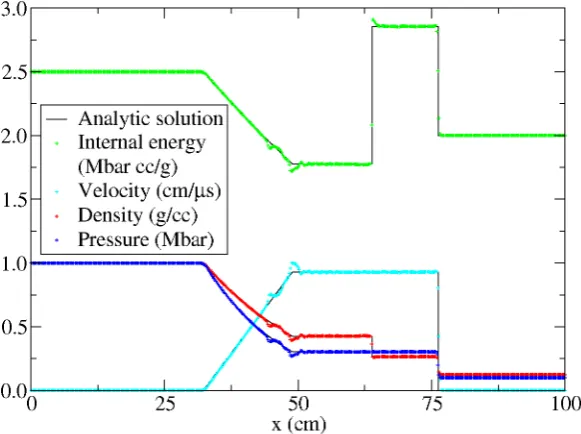
Peruse, Corvus and Petra are well-established codes that have all passed a suite of test problems and so they will be used without detailed examination in this work. In contrast, Chec is a new code and its performance against two test problems will be presented below.
2.2.1
Chec: a 1D Eulerian hydrocode
Chec is a one-dimensional Eulerian hydrocode that was written (in Fortran 90) during the initial stages of this work. Chec solves the Eulerian reactive-flow modelling equa-tions2.1to2.5in one-dimensional plane geometry neglecting chemistry, heat conduction and diffusion. A polytropic gas is used for the equation of state:
p=(γ−1)ρe, (2.12)
whereγis the ratio of specific heat at constant pressure to that at constant volume. This can be derived from the more familiar ideal gas equations p = ρRT and e = cvT, for constant cv, which were originally determined experimentally but can also be derived from kinetic theory [101]. The temperatureT is eliminated in equation2.12to create an equation of state (EOS) of the formp(ρ,e) which is sufficient to solve the hydrodynamic equations. A temperature relation T(ρ,e) is only required when additional physics like heat conduction is modelled. The polytropic gas equation of state is used here because it is convenient for hydrocode testing purposes owing to its simple analytic form, but it begins to break down even for gases under atmospheric conditions [88], and is inadequate for modelling both solid unreacted explosives and hot, high-pressure gaseous reaction products. For these reasons, more advanced equations of state will be used elsewhere in this work (see chapter3).
A simple quadratic artificial viscous pressure [97] is used:
Q=
0 for ∂u∂x ≥ 0
βQρ∆x2
∂u
∂x
2
for ∂u∂x ≤ 0, (2.13)
artificial viscosity coefficient andcis the sound speed. More advanced artificial viscosity forms, for example monotonic viscosity [27] and Wilkins viscosity [98], are implemented in Peruse and Petra and will be used in subsequent chapters to produce better results.
Chec is an explicit finite-difference code. This means that the flow variables are ad-vanced to time tn+1 using the known values at the previous time tn, in contrast to an implicit or semi-implicit scheme where a combination of values at tn+1 and tn is used. Explicit schemes are favoured for unsteady flow since they are more accurate and compu-tationally efficient [89]. However, the timestep∆t = tn+1−tn used in an explicit scheme needs to be controlled to ensure stability. The Courant-Friedrichs-Lewy (CFL) condition for hyperbolic equations is used:
∆t= C∆x
c , (2.14)
whereCis the Courant factor. It is necessary thatC ≤1 for stability but it is desirable that
Cshould be as close to 1 as possible to enable an accurate solution to be obtained [89]. A predictor-corrector scheme is used in Chec to provide second-order accuracy in time. In the predictor step, the numerical solution is advanced to time tn+1/2 with first-order accuracy to calculate a half-timestep pressure and artificial viscosity. These are then used in the corrector step to advance the solution fromtn totn+1with second-order accuracy.
A staggered grid is used: the velocityuis stored at cell edges whileρ,e, pandQare stored at cell centres. Staggered grids allow strength models to be implemented relatively easily and are generally favoured by the hydrocode community [105]. Two different boundary conditions, reflective and transmissive, are implemented in Chec using a ghost cell at each end of the computational domain. The final boundary condition needed to run a hydrocode simulation is the initial condition att0. The initial geometry is defined in the hydrocode input and the thermodynamic state within each computation cell is calculated during initialisation.
and artificial viscosity
Calculate timestep
Advection step
Print out data
Calculate total energy to check energy conservation
Check for end time
End
Call EOS to update pressures
Mass advection
Energy advection
Momentum advection
Update values, including call EOS to update pressures Interface construction Lagrangian
predictor step
[image:45.595.110.438.115.471.2]Lagrangian corrector step to update u and e Set up problem
Figure 2.2: A flow-chart for the computational scheme in Chec. To achieve second-order accuracy, a predictor step calculates the pressure and artificial viscosity at the half-timestep, before the full-timestep Lagrangian corrector step. The advection step is used to remap the full-timestep solution back to the fixed computational grid.
half-timestep values for pressure and artificial viscosity. The velocity and specific inter-nal energy updates are repeated using the half-timestep values for p and Q during the corrector step. During the advection step, the mass, energy and momentum conservation equations are used to calculate the density, specific internal energy and particle veloci-ties at tn+1, before the equation of state is called to determine the pressure and artificial viscosity.

![Figure 1.5: Micrograph of EDC37 [] showing a mixture of coarse and fine HMX crys-The scratches and dark holes (known as “pull-outs”) are thought to be artefacts of thesample preparation, but it is clear that many of the larger striped crystals are twinned.T](https://thumb-us.123doks.com/thumbv2/123dok_us/8703194.381827/23.595.89.458.125.668/figure-micrograph-scratches-thought-artefacts-thesample-preparation-crystals.webp)
![Figure 1.6: Micrograph of PBX9501 [39] showing a mixture of coarse and fine HMXcrystals with diameters between 1 and 1000 µm, for comparison with figure 1.5](https://thumb-us.123doks.com/thumbv2/123dok_us/8703194.381827/24.595.142.509.123.665/figure-micrograph-showing-mixture-hmxcrystals-diameters-comparison-gure.webp)

![Figure 2.6: A flow-chart of the computational scheme in Peruse. The chemical kineticsand heat conduction terms are implemented within the existing predictor-corrector algo-rithm [107], to give second-order accuracy](https://thumb-us.123doks.com/thumbv2/123dok_us/8703194.381827/54.595.119.534.408.675/computational-kineticsand-conduction-implemented-existing-predictor-corrector-accuracy.webp)
![Figure 3.2: Sketch of the effHugoniot using the snow-plough model [ect of porosity on the shock velocity versus particle velocity146]](https://thumb-us.123doks.com/thumbv2/123dok_us/8703194.381827/72.595.181.466.123.459/figure-sketch-ehugoniot-plough-porosity-velocity-particle-velocity.webp)