Aaron J. Cotnoir | [email protected]| January 28, 2010
1 N ¯ag ¯arjuna and the Catuskoti
The traditional dominant view in Western philosophy is thattruthand falsityare
seman-tic categories that exhaust, without overlap, all (meaningful, declarative) sentences. A
traditional Buddhist view is that, in addition to the Western categories, there may be
(meaningful, declarative) sentences that areneithertruenorfalse, and even some that are
both true and false. So, the Buddhist might recognize four distinct truth values: t,f,b,n.
These four truth values make up the ‘four corners of truth’, or thecatuskoti.
N¯ag¯arjuna, in M ¯ulamadhyamak¯akarik¯a [7], uses the catuskotipositivelyandnegatively.
In the positive use, he argues that for a given proposition all four truth-values hold. In the
negative use, he argues that for a given proposition none of the four truth values hold.
Jay Garfield and Graham Priest [4] attempt to make sense of these apparently
paradox-ical uses of the catuskoti by presenting a series of lattices – orderings on truth-values. The
series of lattices are intended to model the process ofawakening. Garfield and Priest are
silent as to whether these lattices will suffice as forming the basis for models of valid
in-ference. But the question is interesting nonetheless. In what follows, I argue that these
lat-tices cannot ground the logic at play in M ¯ulamadhyamak¯akarik¯a (MMK). In §2, I present
Garfield and Priest’s view. In §3, I argue that validity in the given logic is too weak to
rep-resent the arguments made by N¯ag¯arjuna inMMK. In §4, I argue for a new interpretation
that places greater emphasis on a suggestion made by Deguchi, Garfield, and Priest in
an earlier paper [3]. The suggestion is that thepositivecatuskoti requires disambiguation
between the conventional and ultimate perspectives, whereas the negative catuskoti does
not. The result is, I think, a clean interpretation of N¯ag¯arjuna’s logic.
2 The Garfield/Priest Interpretation
N¯ag¯arjuna’s positive uses of the catuskoti are primarily intended to undermine the
ap-pearances of ‘conventional reality’ orsam
˙ vr˙ti-satya. Conventional reality is the world re-plete with properties, universals, causation, self, and the like – in other words, the world
as it is usually seen. N¯ag¯arjuna undermines this picture of reality by arguing that
propo-sitions about this conventional reality have all four truth values.
Everything is real and is not real, both real and not real, neither unreal nor
real. This is the Lord Buddha’s teaching. (MMK, XVIII, 8)
According to Garfield and Priest, the positive catuskoti is best represented by a
four-valued lattice, identical to the one proposed by Dunn for the four-four-valued semantics for
the logic of First Degree Entailment (FDE): We then use the lattice to generate a semantics
t
b n
f
Table 1: Dunn’s 4-valuedFDE
for the logic. We give truth values to all the sentences of our language via an interpretation
function ν such thatν(A)∈ {t,f,b,n}. We define the behavior of the standard connectives
• The value of a conjunction,ν(A∧B), is thegreatest lower boundofν(A)andν(B).
• The value of a disjunction,ν(A∨B), is theleast upper boundofν(A)andν(B).
• The value of a negationν(¬A) = ν(A) wheneverν(A)∈ {b,n}, otherwise it toggles t andf.
Importantly, the material conditional (A⊃B) is defined in the standard way as¬A∨B.1
This semantics, Garfield and Priest contend, is the correct depiction of the state of the
‘conventional situation’.
A common view is that N¯ag¯arjuna uses the negative catuskoti in order to underscore
the view that ultimate reality, or param¯artha-satya, is fundamentally ineffable. Consider
the application of the negative catuskoti to the proposition that Buddha exists:
We do not assert ‘empty’. We do not assert ‘non-empty’. We neither assert both
nor neither. They are asserted only for the purpose of designation. (MMK,
XXII, 11)
The proposition has none of the four truth values present in the positive catuskoti. So,
Garfield and Priest, following Sylvan, suggest a fifth truth value,e, to represent the
tran-sition to the ultimate perspective – called ‘the great death’ by J ¯oshu. This ordering on
values is not, strictly speaking, a lattice since eis meant to be incomparable to the other
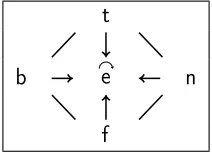
values. How then do sentences receive this value? We introduce a new valuation
func-tion,µ(indicated by the arrows) which maps all values in the set{t,f,b,n}toe. Moreover,
ifµ(ν(A)) =e, thenµ(ν(¬A)) =µ(ν(A∧B)) =µ(ν(A∨B)) =e. The negative catuskoti utilizes
µon the positive values to yield the denial of the entire conventional picture.
1Given the truth functions defined by Garfield and Priest, the material conditional is the only candidate
t
↓
b → e ← n
↑
[image:4.612.252.360.111.193.2]f
Table 2: the great death
Since truth and falsity are themselves merely part of the conventional picture, the
negative catuskoti is meant to explicitly say the unsayable, to truly say what cannot truly
be said. So, there is a self-undermining paradoxical nature to the negative catuskoti as
well. The next stage of awakening for N¯ag¯arjuna is the realization that the distinction
between conventional and ultimate reality is itself a convention. This has sometimes been
referred to as ‘the emptiness of emptiness’. But in the above table,µ(e)is undefined, and
so a new ordering must be defined. In the final stage, when one has appreciated the fact
t
↓
b → xe ← n
↑
f
Table 3: the emptiness of emptiness
that distinction between the conventional and the ultimate is itself ‘empty’, the usefulness
of negative catuskoti, and soµ, becomes null. Garfield and Priest represent this as a lattice
with theµ-arrows removed, but with the ‘empty’ value still present. Such is the extent of
[image:4.612.253.359.400.476.2]t
b e n
f
Table 4: the awakening
3 Reductio, Modus Ponens, and Validity
If we grant that Garfield and Priest’s view is an accurate model of the stages ofawakening,
there is the additional question as to whether their view will serve as a model for valid
inference. It is difficult to get a grasp on just what kind of logical arguments we should
expect from theMMK. One must assume that, given the conventional perspective at least,
the semantics are to be used in the same way as Dunn’sFDE. That is, validity is defined
as designation preservation, where the valuestandbare designated. But the movement
from lattice to lattice seems to alter the logic entirely. We must decide whether e is a
designated value or not. One would expect not, since if it were designated, tables 2 and 3
would represent a kind oftrivialism– the thesis that every sentence is designated – a view
argued against by Priest [5].2 Moreover, it appears that N¯ag¯arjuna viewed the negative
catuskoti as a kind ofdenial, and Priest and Garfield seeµas a kind of ‘external’ negation.3
Hence, one would assume thateis undesignated.
Under these assumptions, it will be useful to consider what argument forms are valid
and invalid in such a logic. In doing so, we will see that the lattices as presented cannot
be extended to a charitable interpretation of the logic in MMK. In what follows, I shall
assume that we should attribute N¯ag¯arjuna as endorsing valid arguments whenever
sible.4 In determining valid inferences for this logic, I will restrict my attention to tables
1 and 2. These tables represent the uses of the positive and negative catuskoti, and hence
are central to the argument inMMK. Moreover, tables 3 and 4 aretransitional; Priest and
Garfield claim they are best viewed asdynamic. Hence I focus attention on two
perspec-tives: the conventional, and the ultimate as seen in the ‘great death’.
Let us start with the four-valued lattice and corresponding semantics for FDE. I use
X FDE Ato abbreviate the claim that the argument from a set of premises X to a
con-clusion Ais valid inFDE. It is well known that in many paraconsistent logics, likeFDE,
disjunctive syllogismfails.
(1) A∨B,¬A2FDEB
Proof. Let ν(A) =band ν(B) =f. The least upper boundofband f isb; so, we have it that
ν(A∨B) =b. Hence, the first premise is designated. Ifν(A) =bthenν(¬A) =b, so the second
premise is designated. Butν(B) =f, and hence the conclusion is undesignated.
Since the material conditional is just a disguised disjunction, modus ponenswill fail as
well. Given the semantics forFDE, modus ponens isnotvalid in the framework.
(2) A,A⊃B2FDEB
Proof. ν(A) =band ν(B) =f yields a counterexample. Sinceν(A) =b, the first premise is
designated. Whenν(A) =b,ν(¬A) =b. Since theleast upper boundofbandfisb, we have it
thatν(¬A∨B) =b. By definition, ν(A⊃B) =ν(¬A∨B), so the second premise –ν(A⊃B)–
is designated. Butν(B) =f, and hence the conclusion is undesignated.
The failure of modus ponens is a serious handicap. In fact, modus ponens makes a
frequent appearance inMMK. Consider the following example:
When there is change, there is motion. Since there is change in the moving
[. . . ] motion is in that which is moving. (MMK, II, 2)
Such instances of modus ponens inM M K should give us pause.5 N¯ag¯arjuna’s preferred
logic ought to make such argumentsvalid.
We also have a failure of modus tollens in the framework.
(3) A⊃B,¬B2FDE¬A
Proof. Letν(A) =nandν(B) =b. So,ν(¬A) =n. Theleast upper boundofnandbist. Hence,
ν(¬A∨B) =t; and thus ν(A⊃B) = t. So the first premise is designated. Since ν(B) =b, ν(¬B) =bas well. Hence the second premise is designated. But notice that ν(A) =n, and
soν(¬A) =n. This means that the conclusion is undesignated.
The failure of modus tollens from the conventional perspective is problematic because,
again, N¯ag¯arjuna explicitly reasons in accordance with it.
If apart from the cause of form, there were form, form would be without cause.
But nowhere is there an effect without a cause. If apart from form there were
a cause of form, it would be a cause without an effect. But there are no causes
without effects. [. . . ] Form itself without a cause is not possible or tenable.
(MMKIV, 2–5)
This passage is clearly made up of two instances of modus tollens, which again N¯ag¯arjuna
appears to take as valid.
Further, we also have the failure of hypothetical syllogism:
(4) A⊃B,B⊃C2FDEA⊃C
Proof. Letting ν(A) = t, ν(B) = band ν(C) = f yields a counterexample. Since ν(¬A) =f,
the least upper bound of f and b is b. Hence, ν(¬A∨B) = b; and thusν(A⊃ B) = b. So
the first premise is designated. Since ν(B) = b, ν(¬B) = bas well. Since the least upper
boundofbandf isb,ν(¬B∨C) =b. Hence the second premise is designated as well. But
notice thatν(¬A) =f andν(C) =f, and soν(¬A∨C) =c. This means that the conclusion is
undesignated.
MMK is rife with hypothetical syllogism. Indeed, Robinson [6] claims that “the
hy-pothetical syllogism is N¯ag¯arjuna’s principal form of inference” (196). For example, the
following passage is an instance of hypothetical syllogism:6
Since this action is not arisen from a condition, nor arisen causelessly, it follows
that there is no agent. If there is no action and agent, where could the fruit of
action be? Without a fruit, where is there an experiencer? (MMKXVII, 29–30)
It should be noted that the failure of modus ponens, modus tollens, and
hypotheti-cal syllogism are primarily due to the failures of the materialconditional in this context.
Given the truth functions defined by Garfield and Priest, the material conditional is the
only candidate available. We could, however, use the F D E-lattice (with additional
re-sources) as a basis for a relevant conditional. While none of this is explored in Garfield
and Priest, the relevant conditional would solve some of the issues mentioned above.7 For
6The conclusion is implied in what follows.
example, a relevant conditional could be constructed to validate modus ponens, modus
tollens, and hypothetical syllogism. A more detailed exploration of this option could
prove productive. One particularly interesting problem with this approach is that it is
difficult to correctly model restricted quantification in relevant logics due to the strength
of the conditional.8 But N¯ag¯arjuna makes frequent use of restricted quantification of the
problematic sort. For example:
[. . . ] Whatever is deceptive is false. Compounded phenomena are all
decep-tive. Therefore they are all false. (MMKXIII, 1)
In any case, moving to a relevant logic is unnecessary; in §4, I present a simple
reinter-pretation of Garfield and Priest’s lattices which validates all these inferences using the
materialconditional.
Even on the relevant conditional semantics forF D E, some conditional-free inferences
(primarily disjunctive syllogism) would still be problematic. Moreover, we still have the
failure ofreductio ad absurdum:
(5) A⊃(B∧ ¬B)2FDE¬A
Proof. Letν(A) =tandν(B) =b. Thenν(¬B) =b, and since thegreatest lower boundofband
bisb, we have it thatν(B∧¬B) =b. Further, it follows from our supposition thatν(¬A) =f.
Since theleast upper boundofband f isb, we have it thatν(¬A∨(B∧ ¬B)) =b. But that’s
equivalent to (A⊃(B ∧ ¬B), and so our premise is designated. But ν(¬A) = f, which is
undesignated. So we have a counterexample.
As Deguchi, Garfield, and Priest [3] note, reductio arguments (in Sanskrit, prasa ˙nga)
are used throughout MMK. For example, the entirety of MMKV is intended as a
reduc-tio.9 But if, according to the conventional perspective, contradictions are to be tolerated,
in what sense is a reductio ad contradictionem a reductio ad absurdum? Deguchi, Garfield,
and Priest [3] address this question directly. Their response is that while the given
argu-ment form is, strictly speaking, invalid, one can still force one’s opponents to concede a
consequence which by their lights is unacceptable, whether it is contradictory or not. This
may well be so, but it does not appear to save reductio as N¯ag¯arjuna uses it, unless there
is some independent reason the contradiction’s conclusions are not to be accepted.
It may also be objected that the reductio arguments are not intended to establish the
negation of a proposition, but merely to provide reasons for rejecting that proposition.10
This response, however, would only be successful if one, in the conventional perspective,
could distinguish between rejection and accepting a negation. I tentatively suggest that
this distinction is not present in the conventional perspective, but only arises out of the
transition to the ultimate perspective.11 This seems to be the whole point of the positive
catuskoti.
Are these arguments part of up¯aya– teachings which are, from the ultimate
perspec-tive, false but useful for a better understanding than the one currently had? If so, one may
wish to endorse a part of the conventional perspective in order to allow it to lead one to
a deeper understanding. Could this be the case with the invalidity of such argument
forms?
Unfortunately, no. This interpretation of N¯ag¯arjuna would make sense if these
argu-ment forms were valid from the conventional perspective, but invalid from the ultimate
9See in particular [3], p. 4. For another example of reductio, seeMMK, VII, 3. 10Thanks to an anonymous referee for suggesting this response.
perspective. In that case, these argument forms could be considered up¯aya; acceptable
for teaching but ultimately to be rejected. But as we have seen, according to Garfield and
Priest’s interpretation, the positive catuskoti makes these argument forms invalid from
the conventional perspective. What’s more, it turns out these forms of argument are valid
from the ultimate perspective. So let us turn to that now.
We have seen that the negative catuskoti amounts to a rejection of all sentences using
µ, our external negation, and a new value e. Let us abbreviate the claim that an
argu-ment from a set of premises X to a conclusion Ais valid according to these semantics
thus: X e A. Remember that µ(ν(A)) =e for every atomic A, and whenever µ(ν(A)) =e,
µ(ν(¬A)) =µ(ν(A∧B)) =µ(ν(A∨B)) =e. Thus, any nonempty set of premisesX can never
be designated. It follows that every valuation according to whichX is designated (there
are none) will be one where a conclusion Ais designated. Thus, it turns out that every
argument from nonemptyX toAis valid.
(6) XeAfor allAand nonemptyX.
Notice that this result does not turn on our earlier assumption thateis undesignated. For
ifewere designated, then every sentence would be designated, and hence every argument
fromX (whether empty or not) toAwould benon-vacuously valid.
4 A Proposal
In light of these problems, I want to suggest a gloss on the important work that Garfield
and Priest have done. Indeed, the following proposal is really just a natural extension of
that led me to the proposed gloss.
The first comes from some textual evidence that the positive catuskoti is
fundamen-tally a tool used by N¯ag¯arjuna to undermine the conventional perspective; it is not the
conventional perspective itself. If this is right, then the FDElattice is not the correct
ac-count of conventional truth values.
The second thought comes from suggestions made in Deguchi, Garfield, and Priest [3]
and in Garfield and Priest [4, 8] to the effect that contradictions as applied to conventional
reality are merelyprima facie. It is suggested that these contradictions need to be
disam-biguated between the conventional and ultimate perspectives and their distinct notions
of truth.
Thus, something may be true (conventionally), false (ultimately), true and
false (conventionally and ultimately, respectively), and neither true nor false
(ultimately and conventionally, respectively. ([4], 2)
This suggests that the positive catuskoti is really an intermixing of perspectives, and not
constitutive of the conventional perspective itself. There is more evidence that this
in-terpretation ofMMK is correct. Garfield and Priest [8] suggest such an interpretation is
supported by the fact that N¯ag¯arjuna never explicitly endorses a contradiction at the level
of conventional reality. Second, as we have already noted, N¯ag¯arjuna takes reductio
ar-guments to be decisive against his opponents. As such, it seems he cannot be committed
to the possible truth of contradictions in the conventional picture.
Following these two lines of thought, I propose we revise the Garfield/Priest
inter-pretation by starting with an alternative lattice. In this lattice, truth values reflect both
perspectives; they are ordered pairs of the values 1, 0, where 1 represents ‘yes’ and 0
conventionally true?”; the second member of the pair reflects the answer to the question
“Is it ultimately false”?. There are four possibilities: 〈1, 1〉,〈1, 0〉,〈0, 1〉,〈0, 0〉. Intuitively,
ν(A) =〈1, 1〉 when Ais both conventionally true and ultimately false; ν(A) = 〈1, 0〉 when
Ais conventionally true and ultimately not false; ν(A) =〈0, 1〉when Ais conventionally
not true and ultimately false, andν(A) =〈0, 0〉whenAis neither conventionally true nor
ultimately false.
So, we can represent the order on these values by the following lattice.
〈1, 0〉
〈1, 1〉 〈0, 0〉
〈0, 1〉
Table 5: B4
We include semantics for the connectives as follows.
• The value of a conjunction,ν(A∧B), is thegreatest lower boundofν(A)andν(B).
• The value of a disjunction,ν(A∨B), is theleast upper boundofν(A)andν(B).
• Whereν(A) =〈x,y〉, the value of the negationν(¬A) =〈1−x, 1−y〉.
The only significant change from the Dunn semantics above is the treatment of
nega-tion. Here, negation toggles〈1, 0〉and 〈0, 1〉similar to the Dunn semantics, but also
tog-gles〈1, 1〉,〈0, 0〉. This reflects the suggestion emphasized by Garfield and Priest [4, 8] that
N¯ag¯arjuna never explicitly endorses contradictions from the conventional perspectives.
According to our semantics for negation, a proposition and its negation may never both
To fully explicate the logic, we need to specify designated values and consequence.
Since the primary purpose of the positive catuskoti is to adopt the conventional
perspec-tive (if only to undermine it) we take conventional truth as designated. That means that
any truth value which has1as its first member should be designated, otherwise not. So,
〈1, 1〉and 〈1, 0〉are designated values. On this semantics, we defineconventionalvalidity
(B4) in the usual designation-preserving way: an argument fromX toAisconventionally
valid(X B4A) iff wheneverν(x)is designated for allx inX, so too isν(A)designated.
It is important to notice that theB4semantics for the connectives on this lattice
gener-ates a fully classical propositional logic, according to which disjunctive syllogism, modus
ponens, modus tollens, hypothetical syllogism, and reductio are all valid. More
specif-ically, these semantics are a four-valued Boolean algebra, and hence validate all the same
inferences as is two-valued counterpart – the standard classical semantics.12 Thus, from
the conventional perspective, N¯ag¯arjuna has all the classical inference principles at his
disposal, because they are indeed valid. The positive catuskoti, the four corners of truth,
arise when we move between perspectives. The clash of perspectives generates the
four-values necessary for the positive catuskoti.
It is worth noting that we have not yet discussed the relation between ‘true’ and ‘not
false’, nor the relation between ‘false’ and ‘not true’. It is plausible to assume that from the
conventional perspective, being false is equivalent to being not true. The distinction
be-tween ‘false’ and ‘not true’ is, in part, what is supposed to result from attending carefully
to the positive uses of the catuskoti. So, in short, a1in the first argument place of a truth
value denotes conventional truth and a0in the first argument place denotes conventional
falsity (which is just to say conventional untruth). Of course, from the conventional
per-12For proof of this fact, see Beall and Van Fraassen’s [2] discussion of the liberalB4 matrix, §11.4, pp.
spective, the above semantics dictates that a proposition and its negation are never both
conventionally not true. But this is to be expected, if falsity is conventionally identical to
untruth. The result is that a proposition and its negation may never be both
convention-ally untrue because they may never both be conventionconvention-ally false. This is simply because
conventionally (i.e.classically) the falsity ofAimplies the truth of¬A, and the falsity of¬A
implies the truth ofA. In other words, if we allowed conventionally false contradictions,
we would be forced to accept conventionally true ones.
On the other hand, from the ultimate perspective, the negative catuskoti teaches us
that beingnot falseis not the same as beingtrue. What the positive catuskoti adds to the
conventional perspective is the possibility of rejecting or denying propositions and their
negations. So, in an important way, our truth values build an external negation into the
ultimate perspective. Since a1in the second place denotes ‘not ultimately false’ this need
not imply that anything is ultimatelytrue. Taking this external negation seriously moves
us from positive catuskoti to negative catuskoti, as understood by Garfield and Priest,
since the attitude there is rejectionall the way down. It may be objected, that the above
semantics appears to imply that no proposition and its negation may both be ultimately
not false.13 Here, I think, it is important to see that the above semantics is useful only for
positiveuses of the catuskoti. Negativeuses are best understood via Garfield and Priest’s
µvaluation function and the valuee.
In summary, Garfield and Priest’s series of lattices are best understood as models of
the stages of awakening, but do not give adequate models for valid inference. In order to
extend their account to valid inference, one must see that pure conventional reality only
includes two truth values,tandf, and that N¯ag¯arjuna’s logic is entirely classical. The
itive catuskoti utilizes ambiguity between the conventional and ultimate perspectives, as
outlined using theB4semantics. The logic here is still fully classical. Once the transition is
made to negative uses of the catuskoti, we employ a new valuation functionµand a new
semantic valueecorresponding to ‘emptiness’. This leads us directly to the full ultimate
perspective.14
14Thanks to Joel Kupperman, Graham Priest, Jay Garfield, and two anonymous referees for suggestions
References
[1] Jc Beall, R. T. Brady, A. P. Hazen, G. Priest, and G. Restall. Relevant restricted
quan-tification. Journal of Philosophical Logic, 35(6):587–598, 2006.
[2] Jc Beall and B. Van Fraassen.Possibilities and Paradox. Oxford University Press, Oxford,
2003.
[3] Y. Deguchi, J. Garfield, and G. Priest. The way of the dialetheist: contradictions in
Buddhism. Philosophy East and West, 58(3):395–402, 2008.
[4] J. Garfield and G. Priest. Mountains are just mountains. In T. Tillemans M. D’Amato,
J. Garfield, editor, Pointing at the Moon: Buddhism, Logic, Analysis. Oxford University
Press, Oxford, 2009.
[5] G. Priest. In Contradiction. Oxford University Press, 2nd edition, 2006.
[6] R. Robinson. Some aspects of N¯ag¯arjuna’s system. Philosophy East and West, 6(4):291–
308, 1957.
[7] J. Garfield (trans.), editor. The Fundamental Wisdom of the Middle Way: N¯ag¯arjuna’s
M ¯ulamadhyamakak¯arik¯a. Oxford University Press, Oxford, 1995.
[8] G. Priest (with J. Garfield). Beyond the Limits of Thought, chapter 16, “N¯ag¯arjuna and