doi:10.4236/jsea.2010.31008 Published Online January 2010 (http://www.SciRP.org/journal/jsea)
Element Retrieval Using Namespace Based on Keyword
Search over XML Documents
Yang WANG1, Zhikui CHEN1, Xiaodi HUANG2
1School of Software, Dalian University of Technology, Dalian, China; 2School of Computing and Mathematics, Charles Sturt
Uni-versity, Australia.
Email: [email protected], [email protected], [email protected]
Received July 31st, 2009; revised September 12th, 2009; accepted September 22nd, 2009.
ABSTRACT
Querying over XML elements using keyword search is steadily gaining popularity. The traditional similarity measure is widely employed in order to effectively retrieve various XML documents. A number of authors have already proposed different similarity-measure methods that take advantage of the structure and content of XML documents. However, they do not consider the similarity between latent semantic information of element texts and that of keywords in a query. Although many algorithms on XML element search are available, some of them have the high computational complexity due to searching for a huge number of elements. In this paper, we propose a new algorithm that makes use of the se-mantic similarity between elements instead of between entire XML documents, considering not only the structure and content of an XML document, but also semantic information of namespaces in elements. We compare our algorithm with the three other algorithms by testing on real datasets. The experiments have demonstrated that our proposed method is able to improve the query accuracy, as well as to reduce the running time.
Keywords: Semantics, Namespace, SVD, Text Matching
1. Introduction
Keyword search querying over XML elements has emer- ged as one of the most effective paradigms in information retrieval. To identify relevant results for an XML key-word query, different approaches lead to various search results in general. Some authors calculated the similarity between the content of XML documents and query, only analyzing the content and structure of XML (e.g., [1–3]). Many algorithms calculate the degree of text of elements matching with the keywords to produce the ranked re-sult-list (e.g., DIL Query processing algorithm [4] and Top-k algorithm [5]). The classical methods focus on TF-IEF formula to calculate the cosine similarity between elements and query (e.g., Tae-Soon Kim et al. [6]; Maria Izabel M et al. [7]; Yun-tao Zhang et al. [8]).
In particular, overlaps of elements in XML documents must be considered. For several overlapping relevant ele- ments, we have to choose which one should be avoided to ensure that users do not see the same information for several times. Su Cheng Haw et al. [9] presented the TwigINLAB algorithm to improve XML Query process-ing. In this paper, we modify it to deal with the elements overlap occurring in keyword search results.
On the basis of previous work, we make the following
contributions in this paper. Firstly, we utilize the seman-tic information of namespaces in elements to filter the relevant components since the text of elements are com-monly related with semantic information of namespace. Secondly, the precision and recall of our algorithm show that the non-text matching but semantic relevant ele-ments with respect to the keyword can be effectively retrieved. Compared with traditional work, our algorithm also shows the better performance on time execution over a large collection of elements.
The rest of this paper is organized as follows: Section 2 introduces the element-rank schema by keyword search. Section 3 presents the Namespace Filter Algorithm (NFA). The experiments on the comparison of NFA and related methods are reported in Section 4. Related work is presented in Section 5, followed by the conclusion.
2. Element-Rank Schema
In this section, we utilize the namespace of elements to describe our element rank schema. Another goal of util-izing namespace is to filter relevant elements with the keyword in a query to reduce time execution compared with traditional algorithms.
ments containing the same markup that refers to different semantic meanings. As an illustration, we consider two
elements with the same markup of <table>: <table>
<td>apple</td>
<td>banana<td> </table>
<table>
<name>coffee table</name>
<width>80</width> </table>
This will lead to the confliction when they are in the same XML document. Thus, we utilize different name-spaces of 'h' and 'f' to distinguish them as below.
<h:table xmlns:h = "http://.../fruit"> <h:td>apple</h:td>
<h:td>banana</h:td> </h:table>
<f:table xmlns:f = "http://.../furniture"> <f:name>coffee table</f:name>
<f:width>80</f:width> <f:length>120</f:length>
</f:table> As discussed above, the text of elements is commonly related with the semantic information of their namespaces. Given the semantic information of namespace that is ir-relevant to the keyword, it is not desirable to access all the elements containing this namespace. In order to calculate the semantic similarity between namespaces and key-words, we map semantic information of namespaces and keywords into different vectors in a concept vector space created by Singular Value Decomposition (SVD) [10] over a collection of elements. In order to do this, Defini-tions 1 and 2 are provided as follows.
Definition 1: : a function that maps the namespace of element v into a vector and represents a special meaning in the concept vector space created by SVD.
) (v prefix
Definition 2: : the
degree of relevance calculated by the cosine similarity between the namespace vector of element v and the key-word vector in concept vector space created by SVD.
) ),
(
(prefix v keyword n
correlatio
The value of the correlation is commonly normalized between the range [-1,1]. If the semantic meaning of namespaces is very close to that of the keywords, the value of ‘correlation’ will be around 1. Nobert Govert et al. [2] proposed the concept of degree of relevance be-tween elements. We extend it to include several intervals in [-1,1] to describe the degree of the semantic similarity of namespaces and keywords. Without loss of generality, some definitions are provided to describe the degree of relevance between namespaces and keywords.
Definition 3: High relevance: the high correlation between namespaces and keywords which satisfies
1 ) ),
( (
1correlation prefix v keyword
(1)
Definition 4: Common relevance: the median corre-lation between namespaces and keywords which satisfies
1
2 ( ( ), )
correlation prefixv keyword (2)
Definition 5: Irrelevance: the lower correlation be-tween namespaces and keywords which satisfies
2
) ),
( (
1
correlation prefix v keyword (3)
In the above equations, we have 02 11, our
ranking algorithm accesses the elements containing the namespaces that satisfy either Equation (1) or Equation (2) rather than Equation (3).
3. Espace Filter Algorithm
In this section, we introduce some preliminary knowl-edge, followed by presenting our algorithm called the Namespace Filter Algorithm (NFA).
3.1 Preliminaries
The tf idf weight is commonly used to calculate the term weight in documents in the field of traditional in-formation retrieval. The purpose of our work is to re-trieve the appropriate nested elements that contain the relevant text to keywords instead of entire XML docu-ments. So we extend tf idf to for ele-ments in XML docuele-ments.
ief tft,e
Notations:
e t
tf, the number of times that keyword t occurs in the text of element e.
q t
tf, the number of times that keyword t occurs
in the query q.
ef N
ief log10 where is the total number of elements over a collection of XML documents, and is the number of elements that contain the keyword. We then give Definition 6 as below.
N
ef
Definition 6: keyword weights in elements and query
otherwise tf if ief
tf
Wte te te
0
0 )
log 1
( 10 , ,
, (4)
ief tf
Wt,q (1log10 t,q) (5) where is keyword weight in the text of element , and keyword weight in a query . We calculate the cosine similarity between query vector
e t
W,
q t,
e
W q
q and ele-ment vector e in Equation (6) on text matching factor.
n
i i
n
i i
n
i i i
e q
e q e
q e q e q score
1 2 1
2 1
) ,
Figure 1. Example of elements with the label ID in the XML document tree
where ei is the ith keyword weight in e, and is the ith keyword weight in
i
q q. Their weight values are calcu-lated using Equation (4) and Equation (5), respectively.
In XML documents, elements are of varying size and nested. Since relevant elements can be at any level of granularity, either an element or its children can be rele-vant to a given query. These facts commonly lead to a problem that the same resulting elements of a query based on keyword search will be presented to users for several times. As an illustration, Consider the structure of an XML document that is shown as the labeled tree in Figure 1.
Besides, let us suppose the relevantelement list after key-word search are listed in Table 1.
Elements with ID 0.2.1 and 0.2 are overlapping, so are with 0.1, 0.1.1, and 0.12. If one element's parent is the component of another element, the two relevant compo-nents can be merged into one. An element will be merged into its parent only if the number of the keyword occur-ring in this particular element is less than that of its par-ent elempar-ent. In this way, there will be no overlap in the resulting list shown in Table 2.
Furthermore, we denote value[v] calculated by NFA in Section 3.2 as element v. Combining with Definition 2. The final comprehensive evaluation formula about rele-
Table 1. Example of ranked list
Rank Self Parent
1 0.2.1 0.2
2 0.2 Root 3 0.1 Root
4 0.1.1 0.1
5 0.1.2 0.1
Table 2. Result list without overlap
Rank Self Parent
1 0.2.1 0.2
2 0.1 Root
vant elements ranking is given as Equation (7).
] [ )
), ( ( )
(v a1 correlation prefixv keyword a2 valuev
rank
(7) where a1a21. In order to highlight the factor of
namespace's semantic, we have 0a2a11.
3.2 NFA Description
In the following discussion, we will focus on presenting the Namespace Filter Algorithm (NFA) and how it per-forms based on the keyword search over a collection of elements.
Let A be a set consisting of different elements to be accessed by NFA, and the namespaces of elements in set A satisfy either Equation (1) or Equation (2). Other ele-ments not included in A will be neglected by NFA. The length[e] in Equation (6) is defined as
n
i 1ei 2 .
Value[e] in Figure 2 gives the degree of text matching between the text of element and keywords.
3.3 An Example
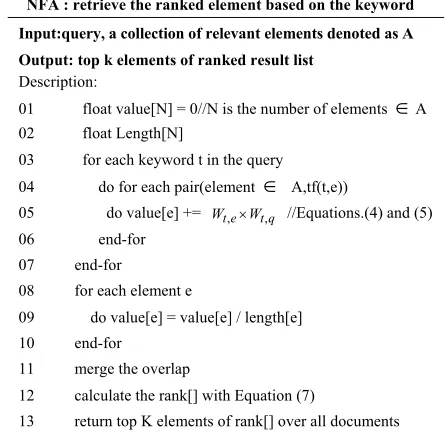
To evaluate the effectiveness of NFA, using an example, we perform it with different pair values of 1and2in Equations (1) and (2). We empirically provide an XML document named as record.xml in Figure 3 which con-sists of many elements with namespace 'c' describing semantic "computer" and 'n' describing "joy". Let the query be "data and space in algorithm". Meanwhile, we set 1 in Equation (1) and 2 in Equation (2) to 0.8 and 0.6, respectively. SVD is commonly applied to docu- ments in traditional information retrieval. We extend it to
NFA : retrieve the ranked element based on the keyword Input:query, a collection of relevant elements denoted as A Output: top k elements of ranked result list
Description:
01 float value[N] = 0//N is the number of elements
A 02 float Length[N]03 for each keyword t in the query
04 do for each pair(element
A,tf(t,e))05 do value[e] += Wt,eWt,q //Equations.(4) and (5) 06 end-for
07 end-for
08 for each element e
09 do value[e] = value[e] / length[e] 10 end-for
11 merge the overlap
12 calculate the rank[] with Equation (7)
[image:3.595.310.533.490.707.2]13 return top K elements of rank[] over all documents
Table 3. Term-element matrix M
<root1>
<c:cs xmlns:c = "http://.../computer"> <c:DBMS>
<c:DB>attribute</c:DB> <c:DB>Management</c:DB> </c:DBMS>
<c:programming>
<c:complexity>data and space</c:complexity> <c:time>data in computer's Algorithm</c:time> </c:programming>
<c:java>data of Algorithm in computer science</c:java> </c:cs>
<n:joy xmlns:n = "http://.../happiness"> <n:entertainment>
<n:in>no space with audience's joy</n:in> <n:out>jackson dance in large space</n:out> </n:entertainment>
</n:joy> </root1>
0.1.1.1 0.1.1.2 0.1.2 0.1.3.1 0.1.3.2 0.1.4 0.2.1.1 0.2.1.2
Computer 0 0 1 0 1 1 0 0 Data 0 0 1 1 1 1 0 0 Space 0 0 1 1 1 0 1 1 AAlgorithm 0 0 0 0 1 1 0 0
Joy 0 0 0 0 0 0 1 0
elements in this example.
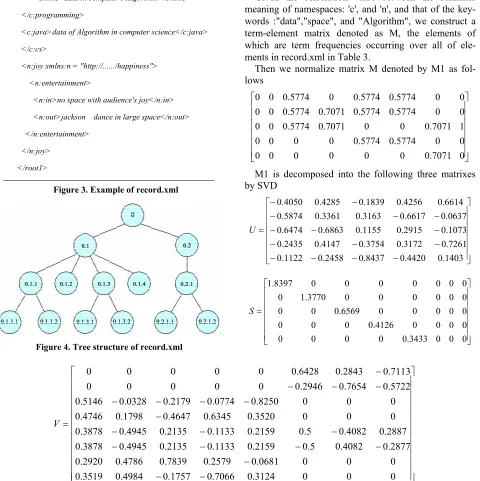
Each element in record.xml corresponds to a node in the tree with labeled IDs in Figure 4.
Given the correlation value between the semantic meaning of namespaces: 'c', and 'n', and that of the key-words :"data","space", and "Algorithm", we construct a term-element matrix denoted as M, the elements of which are term frequencies occurring over all of ele-ments in record.xml in Table 3.
Then we normalize matrix M denoted by M1 as fol-lows 0 7071 . 0 0 0 0 0 0 0 0 0 5774 . 0 5774 . 0 0 0 0 0 1 7071 . 0 0 0 7071 . 0 5774 . 0 0 0 0 0 5774 . 0 5774 . 0 7071 . 0 5774 . 0 0 0 0 0 5774 . 0 5774 . 0 0 5774 . 0 0 0
[image:4.595.63.543.228.709.2]M1 is decomposed into the following three matrixes by SVD
Figure 3. Example of record.xml
1403 . 0 4420 . 0 8437 . 0 2458 . 0 1122 . 0 7261 . 0 3172 . 0 3754 . 0 4147 . 0 2435 . 0 1073 . 0 2915 . 0 1155 . 0 6863 . 0 6474 . 0 0637 . 0 6617 . 0 3163 . 0 3361 . 0 5874 . 0 6614 . 0 4256 . 0 1839 . 0 4285 . 0 4050 . 0 U 0 0 0 3433 . 0 0 0 0 0 0 0 0 0 4126 . 0 0 0 0 0 0 0 0 0 6569 . 0 0 0 0 0 0 0 0 0 3770 . 1 0 0 0 0 0 0 0 0 8397 . 1 S
Figure 4. Tree structure of record.xml
In the following, we consider the reduced semantic space with two most informative dimensions. Let U1 be first two columns of U, S1 be the diagonal square matrix that contains the first two biggest eigenvalues 1.8397, and 13770 of S as diagonal elements, and other elements in S1 are 0.V1 be the transpose of first two columns of V. We then build up a new term-element matrix M2 by us-ing U1* S1*V1 as below.
2413 . 0 2222 . 0 0874 . 0 0874 . 0 1587 . 0 0950 . 0 0 0 1271 . 0 1426 . 0 4559 . 0 4559 . 0 1097 . 0 2490 . 0 0 0 8897 . 0 7997 . 0 0059 . 0 0059 . 0 7346 . 0 5813 . 0 0 0 1492 . 0 0937 . 0 6475 . 0 6475 . 0 4292 . 0 5707 . 0 0 0 0321 . 0 0650 . 0 5804 . 0 5804 . 0 2472 . 0 4024 . 0 0 0
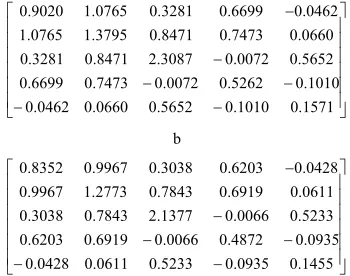
The correlation values between terms are shown in Ta-ble 4a by using M2M2T. We then normalize these
values in table 4a to the range of [-1,1] as given in Table 4b. According to Table 4b, the correlation values between the semantic meanings of namespaces 'c','n' and those of the keywords in the query are given in Table 5.
Consider the keyword search for "data" or "Algorith- m" in a query. As shown in Table 5, both the values of correlation of Namespace 'c' vector with "data" and "Al-gorithm" vector satisfies Equation (1) and Equation (2). In contrast, the correlation value of Namespace 'n' vector and keyword vectors does not satisfy Equations (1) and (2). So we have {0.2,0.2.1,0.2.1.1,0.2.1.2}
A. The pa-rameter values (in Section 3.1) of elements in set A are listed in Table 6.From line 05 to 11 of NFA in Figure 2, combining with Table 6, the value[e] s of elements in set A are shown in Table 7.
As shown in Table 7, there exists the overlap between element 0.1 and other elements. After merging the over-lap, the result is 0.1 including its descendent elements 0.1.2,0.1.3,0.1.4 as a whole components. The other re-sulting element is 0.1.1 including all its descendent ele-ments. Let , and in Equation (7) be 0.9 and 0.1, respectively, and the correlation value between name-space and keywords be 0.8085, which is the average cor-relation value between “data" and "Algorithm". Then we can get the final ranked result by using Equation (7) in Table 8.
1
a a2
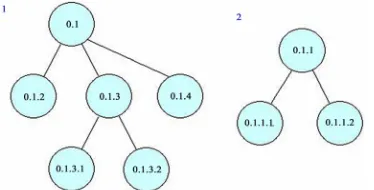
In order to exploit the relation between in Equation (1), and in Equation (2) and search result, we assign different pair values to and such as 0.6 and 0.3. We still give the same query to perform NFA over re-cord.xml. This time we focus on "space" in the query rather than "Algorithm" and "data". Table 5 shows that the correlation value between namespace 'c' vector and "space" vector is 0.3038, which satisfies Equation (2) and namespace 'n' vector and "space" vector is 0.5233, which satisfies Equation (2). Consequently, the search result performed by NFA is given in Figure 6.
1
2
1
2
As shown in Figures 5 and 6, the different degrees of semantic information relevance between the name-spaces and keywords will lead to various search results by using NFA.
In summary, the degree of semantic relevance between the namespace and keywords depends not only on their semantic information similarity, but also on user-speci-fied weights on other factors.
4. Experiments
[image:5.595.334.509.259.397.2]In our experiments, we compare NFA with other related
Table 4. Correlation value between different pair of terms in record.xml a 1571 . 0 1010 . 0 5652 . 0 0660 . 0 0462 . 0 1010 . 0 5262 . 0 0072 . 0 7473 . 0 6699 . 0 5652 . 0 0072 . 0 3087 . 2 8471 . 0 3281 . 0 0660 . 0 7473 . 0 8471 . 0 3795 . 1 0765 . 1 0462 . 0 6699 . 0 3281 . 0 0765 . 1 9020 . 0 b 1455 . 0 0935 . 0 5233 . 0 0611 . 0 0428 . 0 0935 . 0 4872 . 0 0066 . 0 6919 . 0 6203 . 0 5233 . 0 0066 . 0 1377 . 2 7843 . 0 3038 . 0 0611 . 0 6919 . 0 7843 . 0 2773 . 1 9967 . 0 0428 . 0 6203 . 0 3038 . 0 9967 . 0 8352 . 0
Table 5. Correlation value between semantic of namespace 'c', 'n' vectors and other three keyword vectors over ele-ments in record.xml
Correlation data space Algorithm computer 0.9967 0.3038 0.6203 joy 0.0611 0.5233 -0.0935
Table 6. Times of "data","space","algorithm" occurring in query and revelant elements of record.xml
Dewey ID tft,e(data) tft,e(space) tft,e(algorithm) 0.1 3 3 2 0.1.2 1 1 0 0.1.3 1 1 1
0.1.3.1 1 1 0
0.1.3.2 0 0 1
0.1.4 1 1 1
Table 7. The ranked result-list with element overlap
Rank Self Parent Value[e]
1 0.1 Root 1.6160
2 0.1.4 0.1 1.5779
3 0.1.3 0.1 1.5779
4 0.1.2 0.1 1.4145
5 0.1.3.1 0.1.3 1.4145
6 0.1.3.2 0.1.3 1
Table 8. Comprehensive ranking using Equation (7)
Rank Dewey ID Score
1 0.1 0.8893
algorithms and methods on two metrics: precision and recall. The result of comparing NFA with the methods that have the similar Precision and Recall on aspect of time execution of algorithm is also presented. We set 0.9 to 1, 0.6 to 2, 0.9 to , and 0.1 to in Equation (7) to perform NFA.
1
a a2
4.1 Experimental Setup and Results
Equipment: Our experiments are performed on a PC with a 2.33GHz Intel(R) Core(TM) 2 Duo CPU, 3.25 GB memory, and Microsoft Windows XP. The TermJoin algorithm [11], semantic tree creation algorithm [12], and NFA are all implemented in C++.
Data set: We have tested NFA on two data sets called Dataset1 [13] and Dataset2 [14], respectively. In order to show its performance, we add some namespaces to ele-ments [13]. Each namespace represents the general idea of text embedded in elements [13].
Query set: the query set consists of two parts with 13 queries that represent all kinds of queries over Dataset1 and Dataset2 in Table 9.
4.1.1 Precision and Recall
Precision is defined as the number of relevant elements retrieved by keyword search divided by the total number of elements, while recall refers to as the number of rele-vant elements retrieved by keyword search divided by the total number of existing relevant elements. We compare the precision and recall of NFA with the Termjoin algo-rithm [11], semantic tree creation algoalgo-rithm [12] on Dataset1 and CAS Query [7] on Dataset2. We then cal-culate the precision and recall of top 20 components re-trieved by each algorithm as reported in Figure 7.
As shown in Figure 7, the Term-join algorithm re-trieves the relevant elements. However, it also rere-trieves some non-relevant elements. The basic idea of the Term- join algorithm is to calculate the degree of text matching of elements with keywords rather than the latent semantic information of text of elements. Furthermore, both NFA and semantic tree creation algorithm efficiently solve the semantic information similarity between text of elements and keyword. However, they do not have the equal run-ning time as given in Section 4.1.2. In [6, 7], authors pro-vide the methods that utilize the semantic
Figure 5. Experimental result elements in record.xml re-trieved by NFA with in Equation (1) be 0.8 and in Equa-tion (2) be 0.6 1
[image:6.595.309.538.86.178.2] 2
[image:6.595.306.539.230.617.2]Figure 6. Experimental result elements in record.xml retrieved by NFA with1 in Equation (1) be 0.6 and2in Equation (2) be 0.3
Table 9. Query set on Dataset 1 and Dataset 2
Dataset1
Q11: pitch step B and octave 2 Q12: natural type
Q13: voice 1 and type eighth Q14: music with voice 1 staff 1 Q15: music with beam begin and down Q16: 16th type in music
Q17: 16th type and type of beam
Q18: 16th type and duration 2
Dataset2
[image:6.595.81.268.587.682.2]Q21: best table in furniture Q22: best fruit table in furniture Q23: eat apple at the table Q24: have coffee at the table Q25: the list of table
Figure 7. Precision and recall on Dataset1
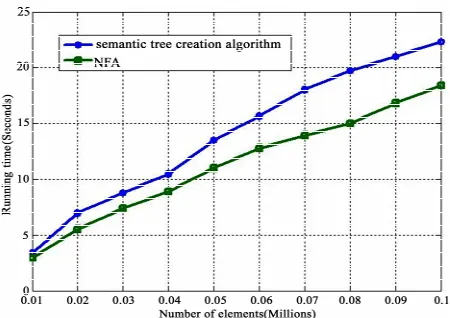
Figure 9. The average running time of NFA and semantic
formation of markups in elements to calculate the
se-ussed in Section 2.1, namespace can distinguish di
In term e in practice, we compare NFA to
ts with re
knowledge, no existing work has
earches have been done on the area of ta
er related area in elements retrieval is ranking sc
the tree creation algorithm over 100 thousand elements from
Dataset1 based on the queries from Q11 to Q18 in Table 9
in
mantic information similarity between the elements and query. However, sometimes it can only get the relevant components with various markups. In order to present the difference of search results of CAS Query [7] and NFA, we test both of them on Dataset2 consisting of elements with namespace 'h' and 'f' nested in the same markup <ta-ble>. Both of them are tested by queries from Q21 to Q25 in Table 9 and the precision and recall is shown in Figure 8.
As disc
fferent elements even with the same markup which leads to different precision of NFA and CAS in Figure 8.
4.1.2. Running Time of NFA and Semantic Tree Crea-tion Algorithm
s of running tim
the semantic tree creation algorithm. We test both of them on Dataset1, and plot the average running time based on the queries from Q11 to Q18 in Table 9 over 100 thousand elements from Dataset1 in Figure 9.
The idea of NFA is to filter the relevant elemen spect to keywords in order to reduce the running time of the semantic tree creation algorithm [12], which ac-cesses all elements in a collection to get the semantic information similarity between the text of elements and keywords. Figure 9 shows that the semantic information of namespace in elements significantly reduces running time compared with the semantic tree creation algorithm over a large collection of elements.
5. Related Work
To be the best of ourformally studied on the namespaces [14] for elements retrieval. There has been a large body of work on con-tent-oriented of XML documents and corresponding ranking schema.
Substantial res
king relevant matches between the content and the query as the criteria. e.g., DIL Query processing algo-rithm [4], Termjoin Algoalgo-rithm [11] and Top-k algoalgo-rithm [5]. Jovan Pehcevski et al. [15] content that the purpose of XML retrieval task is to find elements that contain as much relevant information. However, some elements that are not keyword matches may be also relevant to the query but not return in those algorithms. The classical method is to calculate the value of consine similarity be-tween the content and keyword utilizing the formula of TF-IEF, the related work have been reported in [6–8,11,16,18,19]. Unfortunately, most of them still can-not accurately calculate the similarity on semantic prob-lem only by this formula. Li Deng et al. [12] present the semantic tree creation algorithm. Other proposals are given on semantic problem from the inner structure of XML document (e.g., Hongzhi Wang et al. [1]; Norbert Govert et al. [20]; Felix Weigel et al. [3]; Sihem Amer-Yahia et al. [5]; M.S.Ali et al. [21]). However, they have to do a large time execution. Benny Kimelfeld et al. [5] have observed this shortcoming. They presented the method which filters the relevant documents before processing the algorithm. Due to the notion of methods [22], we interestingly find that the namespace in elements not only solve the latent semantic problems between elements and keyword, but also filter the relevant ele-ments based on the keyword to reduce time execution in the traditional algorithm. The most related work to this paper is [6,11], both of which have proposed the content of markup or frequency of markup as a factor contributed to semantic similarity between the content and query. However, It cannot effectively distinguish the elements with same markup representing different semantic infor-mation.
Anoth
hema based on keyword search. The classical scoring function is tf-ief (e.g., [5,23]) in information retrieval. However, many approaches simply calculate tft,e with respect to all elements of the collection [9] or p con-sider it by estimating tft,e across elements of the same type [25]. tft,e is also calculated based on the concen-tration of th xt of the element and that of its descen-dants [25,26]. A different approach is to compute tft,e for leaf-elements only, which are then used to score leaf-elements themselves. All non-leaf elements are scored based on combination of the score of their de-scendants elements. The propagation of score starts from the leaf elements and can consider the distance between the element being considered and its descendent leaf-elements [27]. Similar notion is adopted by the DIL algorithm [4]. V. Mihajlovi et al. [28] rank elements us-ing a utility function that is based not only on the rele-vance score of an element, but also on its size.
artly
s the keyword search over elem
nymous reviewers for their
REFERENCES
[1] H. Z. Wang, J X. M. Lin, “Cod
uhr, and M. Lalmas, “Evalua
gasundaram,
A. Marian, D. Srivastava, and D
Lee, J. W. Song, and D. H. Kim,
“Similar-g, and Y. C. Wan“Similar-g, “An improved
aw and C. S. Lee, “TwigINLAB: A
Schutze,”
Introduc-C. Yu, and H. V. Jagadish, “Querying
oral
cxml.org/xml/elite.xml.
www.w3schools.
[15] “HixEval: Highlighting
ring similarity of
, G. Lin, C. Botev, and J. Shanmugasundaram,
“XML
“A novel method for
onsens, and M. Lalmas, “Structural
, Y. Sagiv, and D. Yahav, “Using
anmugasundaram, “Context-sensitive
ct
XXL
. Callan, “Parameter estimation for a
sim-t XML,” IR asim-t INEX 2005.
6. Conclusions
This paper addresse ents tion to information retrieval,” Cambridge Press, April, 2008. [11]S. Al-Khalifa,
in XML documents. Using the namespaces of elements, we have presented the Namespace Filter Algorithm (NFA) that retrieves the relevant components of XML docu-ments with respect to keyword queries. In addition, we provide a new approach that can remove effectively the element overlaps occurring in query results. Using an evaluation formula, our approach is able to produce a ranking result-list without element overlaps. Compared with previous algorithms, NFA has demonstrated a better performance not only on time execution but also on the precision and recall of query results. Our future work will study the relation of the previous factors on the back-ground of graph structures in XML documents.
7. Acknowledgments
We are grateful to the anostru
helpful comments.
. Z. Li, W. Wang, and
-sem
ing-based join algorithm for structure queries on graph-structured XML document,” WorldWide Web, Vol. 11, pp. 485–510, 2008.
[2] N. Govert, G. Kazai, N. F ting retrieval: What about using contextualrelevance?” SAC,
pp. 1114–1115, April 23–27, 2006. [20]B. Jeong, D. Lee, H. Cho, and J. Lee, the effectiveness of content-oriented XML retrieval,”
In-formation Retrieval, Vol. 9, No. 6, pp. 699–722, 2006.
[3] F. Weigel, H. Meuss, and K. U. Schulz, “Francois bry me content and structure in indexing and ranking XML,”
WebDB, Vol. 17–18, pp. 68–72, June 2004. [4] G. Lin, S. Feng, C. Botev, and J. Shanmu
“XRank: Ranked keyword search over XML documents,” ACM International Conference Proceeding, SIGMOD, pp. 7–11, June 9–12, 2003.
[5] S. A. Yahia, N. Koudas, .
rel
Toman, “Structure and content scoring for XML,” Pro-ceedings of the 31st VLDB Conference, pp. 362–372,
2005.
[6] T. S. Kim, J. H.
ity measurement of XML documents based on structure and contents,” International Conference on Computational Science (ICCS), Part 3, LNCS 4489, pp. 902–905, 2007. [7] M. Izabel, M. Azevedo, L. P. Amorim, and N. Ziviani, “A
of st
universal model for XML information retrieval,” LNCS pp. 312–318, 2005.
[8] Y. T. Zhang, L. Gon
TF-IDF approach for text classification,” Journal of Zhejiang University Science, Vol. 6A, No. 1, pp. 49–55, 2005.
[9] S. C. H
tion-matching-merging approach to improving XML query processing,” American Journal of Applied Sciences, Vol. 5, No. 9, pp. 1199–1205, 2008.
[10]C. D. Manning, P. Raghavan, and H.
structured text in an XML database,” ACM International Conference Proceeding, SIGMOD, June 9–12, 2003. [12]D. Li, X. J. Wang, and L. H. Wang, “Indexing temp
XML using semantic tree index,” IEEE Xplore, pp. 448– 451, 2008.
[13]http://www.musi
[14]Namespaces in XML Available: http:// com/XML/xml_namespaces.asp/. J. Pehcevski and J. A. Thom,
XML retrieval evaluation,” LNCS 3977, pp. 43–57, 2006. [16]T. S. Kim, J. H. Lee, J. W. Song, and S. L. Lee, “Semantic
ctural similarity for clustering XML documents,” Inha University Technical Report, 2006. http://webbase.inha. ac.kr/TechnicalReport/tech_04.pdf.
[17]C. Yang and N. Liu, “Measu
i-structured documents with context weights,” ACM International Conference Proceeding, pp. 719–720, Au-gust 6–11, 2006.
[18]S. Feng
“Efficient keyword search over virtual XML views,” VLDB,pp. 1057–1065, September 23–28, 2007.
[19] K. Sauvagnat, L. Hlaoua, and M. Boughanem,
asuring semantic similarity for XML schema match-ing,” Expert Systems with Applications, Vol. 24, pp. 1651–1658, 2008.
[21]M. S. Ali, M. P. C
evance in XML retrieval evaluation,” Proceedings of the SIGIR Workshop on XML and Information Retrieval, pp. 2–8, July 27, 2007.
[22]B. Kimelfeld, E. Kovacs
language models and the HITS algorithm for XML re-trieval,” LNCS 4518,Springer-Verlag Berlin Heidelberg, pp. 253–260, 2007.
[23]C. Botev and J. Sh
keyword search and ranking for XML,” WebDB, 2005. [24]B. Sigurbjornsson, J. Kamps, and M. de Rijke, “The effe
ructured Queries and selective Indexing on XML re-trieval,” INEX’05, LNCS 3977, pp. 104–118, 2006. [25]M. Theobald, R. Schenkel, and G. Weikum, TopX &
at INEX 2005. [26]P. Ogilvie and J
ple hierarchical generative model for XML component re-trieval,” INEX, 2004.
[27]S. Geva, “GPX-gardens poin