Automatic Extraction of Linguistic Metaphor with LDA Topic Modeling
Ilana Heintz*, Ryan Gabbard*, Mahesh Srinivasan+, *, David Barner+, Donald S. Black*, Marjorie Freedman*, Ralph Weischedel*
* Raytheon BBN Technologies 10 Moulton St,
Cambridge MA 02139
{iheintz, rgabbard, mfreedman, dblack, rweischedel}@bbn.com
+University of California, San Diego 5336 McGill Hall,
9500 Gilman Drive
La Jolla, CA 92093-0109
Abstract
We aim to investigate cross-cultural patterns of thought through cross-linguistic investiga-tion of the use of metaphor. As a first step, we produce a system for locating instances of metaphor in English and Spanish text. In con-trast to previous work which relies on re-sources like syntactic parsing and WordNet, our system is based on LDA topic modeling, enabling its application even to low-resource languages, and requires no labeled data. We achieve an F-score of 59% for English.
1 Introduction
Patterns in the use of metaphors can provide a great deal of insight into a culture. Cultural differ-ences expressed linguistically as metaphor can play a role in matters as complex and important as dip-lomatic relations. For instance, Thornborrow (1993) discusses the different metaphors that are used in the context of security in French and Brit-ish coverage of two major post-cold-war summit meetings. Example metaphors such as “the corner-stone of the new security structure,” “structures for defence and security cooperation,” and “the emerg-ing shape of Europe,” exemplify the English use of the sourceconcept structure in describing the tar-get concept of security. In contrast, the metaphors “des règles de sécurité nouvelles (new rules of se-curity)”, “une révision fondamentale des disposi-tions de sécurité (a fundamental revision of security provisions)”, and “un système de sécurité européen (a system of European security)”
exem-plify the French use of the more abstract source concept system to describe the same target concept. As Thornborrow notes, the implied British concep-tion of security as “concrete, fixed, and immobile” contrasts deeply with the French conception of se-curity as “a system as a series of processes.”
Our ultimate goal is to use metaphor to further our knowledge of how different cultures under-stand complex topics. Our immediate goal in this paper is to create an automated system to find in-stances of metaphor in English and Spanish text.
Most existing work on metaphor identification (Fass, 1991; Martin, 1994; Peters and Peters, 2000; Mason, 2004; Birke and Sarkar, 2006; Gegigan et al., 2006; Krishnakumaran and Zhu, 2007; Shutova et al., 2010; Shutova et al., 2012)1 has relied on some or all of handwritten rules, syntactic pars-ing, and semantic databases like WordNet (Fell-baum, 1998) and FrameNet (Baker et al., 1998). This limits the approaches to languages with rich linguistic resources. As our ultimate goal is broad, cross-linguistic application of our system, we can-not rely on resources which would be unavailable in resource-poor languages. Instead, we apply LDA topic modeling (Blei et al., 2003b) which requires only an adequate amount of raw text in the target language. This work is similar to Bethard et al. (2009), in which an SVM model is trained with LDA-based features to recognize metaphorical text. There the work is framed as a classification task, and supervised methods are used to label metaphorical and literal text. Here, the task is one of recognition, and we use heuristic-based,
1
See Shutova (2010) for a survey of existing approaches
pervised methods to identify the presence of meta-phor in unlabeled text. We hope to eliminate the need for labeled data which, as discussed in Bethard et al. (2009) and elsewhere, is very diffi-cult to produce for metaphor recognition.
2 Terminology
We will refer to a particular instance of metaphori-cal language in text as a linguistic metaphor. Each such metaphor talks about a target concept in terms of a source concept. For example, in “Dems, like rats, will attack when cornered” the source concept is animals and the target concept is politicians2, or at a higher level, governance. The abstract mapping between a source concept and a target concept will be referred to as a conceptual metaphor which is grounded by a collection of linguistic metaphors.
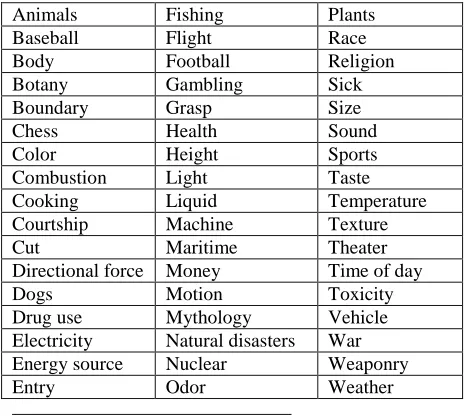
In this work, we restrict our attention to a single target concept, governance. Our definition of gov-ernance is broad, including views of the governed and those who govern, institutions of government, laws, and political discourse. We used a large col-lection (see Table 1) of potential source concepts. Beginning with the source concepts of primary metaphors, which are hypothesized to be univer-sal (Grady, 1998), we expanded our set to include source concepts commonly found in the scientific literature about metaphor, as well as those found by human annotators manually collecting instances of governance-related metaphors.
Animals Fishing Plants Baseball Flight Race Body Football Religion Botany Gambling Sick
Boundary Grasp Size
Chess Health Sound
Color Height Sports
Combustion Light Taste Cooking Liquid Temperature Courtship Machine Texture
Cut Maritime Theater
Directional force Money Time of day
Dogs Motion Toxicity
Drug use Mythology Vehicle Electricity Natural disasters War Energy source Nuclear Weaponry
Entry Odor Weather
2
“Dems”' refers to the Democratic Party, an American politi-cal party
Family Pathways Weight Farming Physical structure Wild west Fight Planning
Table 1: English Source Concepts
[image:2.612.73.307.470.678.2]3 High-level system overview
Figure 1: System Overview
Our main hypothesis is that metaphors are likely to be found in sentences that exhibit evidence of both a source and a target concept. The core idea of our system is to use LDA topics as proxies for seman-tic concepts which may serve as the source or tar-get for a metaphor. For a given language, we build an LDA model from Wikipedia and then align its topics to potential source and target concepts, which are defined by small human-created lists of seed words.
At runtime, the system first does LDA infer-ence on our input corpus to get topic probabilities for each document and sentence. The system then selects those sentences linked by LDA to both a source-aligned topic and a target-aligned topic.3 For example, a sentence containing “…virtud
3
cial para construir la democracia…”4 will be se-lected because LDA strongly associates it with both the topic [elecciones, ministro, sucesor, …]5, aligned to the target concept governance, and the topic [edificio, arquitectura, torre,…] 6
, aligned to the source concept physical structure.
Next, the system identifies the words in each selected sentence that are strongly associated with each concept. In the sentence above, it marks vir-tud and democracia as target-associated and con-struir as source-associated.
Next it applies two filters. First, we exclude any sentence with too few words that are not LDA stopwords, because the model's predictions may be very inaccurate in these cases. Second, if the topic associated with the source model for a sentence is also a top-ranked topic for the document as a whole, the sentence is excluded. The reason for this is that if the source concept is present through-out the document, it is probably being used literal-ly (see Figure 2).
Finally, it uses previously-computed infor-mation to determine a final score. All linguistic metaphors scoring above a certain threshold are returned. By varying this threshold, the user can vary the precision-recall tradeoff as needed. A dia-gram of the system can be found in Figure 1.
Figure 2: Even though the last sentence is relevant to the source concept pathways and the target concept govern-ance, it will be correctly rejected because
pathways-aligned topics are present throughout the document.
4 Implementation Details: Training
Our runtime system requires as input an LDA model, a list of seed words for each concept, and an alignment between concepts and LDA topics.
4.1 LDA Topic Model
The topics defined by LDA topic modeling serve as stand-ins for the more abstractly-defined source and target concepts underlying the metaphors. The input to training our LDA model is the full text of
4
social virtue to build democracy
5
elections, minister, successor
6
building, architecture, tower
Wikipedia articles in the target language. Wikipe-dia is available in numerous languages and serves as a corpus of general knowledge, providing us with topics corresponding to a broad range of con-cepts. Our LDA model is trained using MALLET (McCallum, 2002) for 1000 iterations with 100 topics, optimizing hyperparameters every 10 itera-tions after a 100 iteration burn-in period. The 500 most common tokens in the training corpus were used as stopwords. The result of LDA is 100 top-ics, where each topic is a probability distribution over the training corpus vocabulary. Representa-tive words for example English topics are shown in Figure 3.
Figure 3: Sample LDA topics with representative terms
4.2 Concept Seed Word Lists
For each concept , we have a label and a small set of seed words representing that concept, referred to as . These lists were created by hand in Eng-lish and then translated into Spanish by native speakers. The translation was not intended to be exact; we instructed the annotators to create the lists in a way that was appropriate for their lan-guage and culture. For instance, the football topic for English describes American football, but in Spanish, the same topic describes soccer.
4.3 Concept-Topic Alignment
The final input to our system is an alignment be-tween concepts and topics, with every topic being mapped to at most one concept. In addition to the seed lists and LDA model, this alignment process takes a score threshold and a maximum number of alignments per source and target con-cept and .
The alignment algorithm is as follows. We align each topic to the concept with the maxi-mum score , which measures the concept terms’ summed probability in the LDA topic:
. We remove all align-ments where . Finally, for each concept, only the highest scoring alignments are kept, where may be different for source and Our county has many roads in bad shape.
Thousands of our bridges are structurally deficient. Congress needs to pass a new highway bill.
theater stage musical miss actreess
theory philosophy pp study scientific knowledge
target. We refer to the aligned topics for a concept as .
Label Seed List Words
Aligned Topics
Vehicle vehicle,
wheels, gas, bus
0.035: engine, car, model
0.29: railway,
trains, train
0.022: energy,
gas, linear
Animals animal, beast, cattle
0.066: animals, animal, species Courtship courtship,
ro-mance, court
None
Governance aristocrat, bi-partisan, citi-zen, duke
0.25: Election, elected, parliament 0.22: Governor, republican, Senate 0.14: sir, lord, henry
[image:4.612.73.302.96.382.2]0.13: kingdom, emperor, empire 0.12: rights, legal, laws
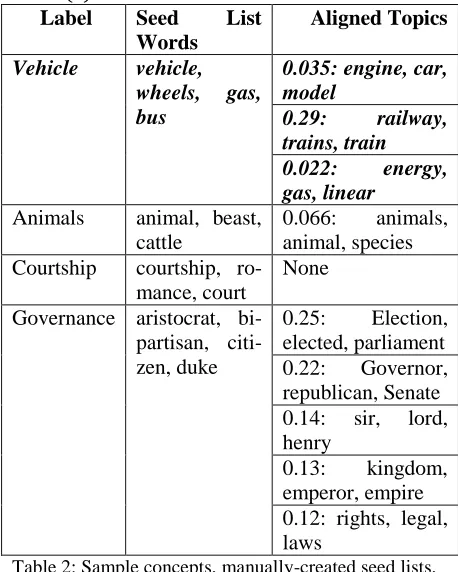
Table 2: Sample concepts, manually-created seed lists, and aligned topics
A last condition on the topic-concept alignment is the assignment of topics to trump concepts. Our only trump concept in this study is war. If an LDA topic is aligned with both the war concept and the governance concept, it is removed from alignment with the governance concept. We do this because war is so tightly associated with governments that the alignment algorithm invariably aligns it to the governance topic. However, war is also a very important source concept for governance meta-phors; our choice is to suffer on recall by missing some governance-relevant sentences, but increase recall on metaphors for which the source concept is war. Sample topic-concept alignments are shown inTable 2. By inspecting the resulting alignments by hand, we chose the following parameter values for both languages: =0.01, =3, =5.
The process of defining concepts is simple and fast and the alignment method is inexpensive. Therefore, while we have not captured all possible source concepts in our initial list, expanding this list is not difficult. We can define new source con-cepts iteratively as we analyze metaphors that our
extraction system misses, and we can add target concepts as our interests broaden.
5 Implementation Details: Runtime
The system receives as input a corpus of docu-ments, their LDA decodings, the LDA decodings of each sentence treated as a separate document, and the topic-concept alignments. Each four-tuple
is processed independently, where is the language, is the source concept, is the tar-get concept, and is the sentence.
Determining Concept Relevance: Recall our basic intuition that a sentence relevant both to an LDA topic in (termed source-relevant) and one in (termed target-relevant) is potentially metaphorical. The system judges a sentence to be -relevant if the probability of -aligned topics in that sentence is above a threshold:
, where is an ad-justable parameter tuned by hand. is 0.06 in English and 0.05 in Spanish. is 0.1 in both languages. On the source side, the system removes all topics in from and renormalizes before determining relevance in order to avoid pe-nalizing sentences for having very strong evidence of relevance to governance in addition to providing evidence of relevance to a source concept. For reference below, let (a measure of how strongly the sentence is associated
with its topics) and let
(the most proba-ble -aligned topic in the sentence).
If is not both source- and target-relevant, the system stops and the sentence is not selected.
Finding Concept-Associated Words: The system next creates sets of the words in associated with the concept . Let . Then let { , where
is a hand tuned parameter set to 0.1 for both languages. That is, any word whose probability in the topic is higher than a theshold is included as a concept-associated word in that sentence. Let
and (the combined strength of those associations).
If lacks words strongly associated with the source and target concepts (that is, or is empty), the system stops and the sentence is not selected.
Filters: The system applies two filters. First, must have at least four words which are not LDA stopwords; otherwise, the LDA predictions which drive the system's concept-relevance judgements tend to be unreliable. Second, the most likely source topic must not be one of the top 10 topics for the document as a whole, for reasons described above. If either of these requirements fail, the system stops and the sentence is not se-lected.
Final Scoring: Finally, the system determines if
( ( ) ( ) ) where is a hand-tuned threshold set to -10.0 for English and -13.0 for Spanish. This takes into account the strength of association between topics and the sentence, between the annotated words and the topics, and between the topics and their aligned concepts. Any sentence passing this threshold is selected as a linguistic metaphor.
6 Example Output
We provide examples of both true and false posi-tives extracted by our system. The annotations of source and target-associated words in each sen-tence are those defined as and above. The source concept animals is used for all examples. 1. ModeratesT we all hear are an endangeredS
speciesS, Sen. Richard
2. DemsT like ratsS sometimes attack when cor-nered
3. ObamaT 's world historical political ambitions crossbredS with his
4. At least DemocraticT representativesT are snakeheadS fish
5. Another whopperS from Cleveland, GOPT lawyer backs him up
6. Previous post: Illinois GOPT lawmakerT ar-rested in animalS feed bag related incident 7. Next post: National Enquirer catfighting
MichelleObamaT has clawsS out for that nice
Ann Romney
8. Sen. Lisa MurkowskiT R AK independent from Alaska - thank you silly Repubs, teaS party her out ha
Examples 1 through 4 are correct metaphors ex-tracted by our system. In each, some words related to the target concept governance are described us-ing terms related to the source concept animals. Example 1 best represents the desired output of our system, such that it contains a governance- and animals-relevant metaphor and the terms associat-ed with the metaphor are properly annotatassociat-ed. Some issues do arise in these true positive examples. Ex-ample 2, while often termed a simile, is counted as a metaphor for our purposes. In example 3, the source term is correctly annotated, but the target terms should be political ambitions rather than Obama. It is unclear why the term snakehead but not the term fish in example 4 is associated with the source concept.
Examples 5 through 8 represent system errors. In example 5, the fact that the word whopper oc-curs frequently to describe a large animal (espe-cially a fish) causes the sentence to be mistakenly identified as relevant to the source concept animal. The source term animal in example 6 is clearly relevant to the source concept, but it is being used literally. The document-level source concept fil-tering does not entirely eliminate this error class. While example 7 contains a metaphor and has some relationship to American politics, it would be counted as an error in our evaluations because the metaphor itself is not related to governance. In ex-ample 8, we have two errors. First, tea is strongly present in the topic aligned to the animal concept, causing the sentence to be incorrectly marked as source-relevant. Second, because our topic model operates at the level of individual words, it was unable to recognize that tea here is part of the fixed, governance-related phrase tea party. 7
7 Evaluation
7.1 Collecting Evaluation Data
We collected a domain-specific corpus in each language. We curated a set of news websites and governance-relevant blogs in English and Spanish and then collected data from these websites over the course of several months. For each language, we ran our system over this corpus (all steps in
7
Section 5), produced a set of linguistic metaphors for each topic-aligned source concept (the target concept was always governance), and ranked them by the final score (Section 4.4). Below, we will refer to the set of all linguistic metaphors sharing the same source and target concept as a conceptual metaphor.
7.2 Simple Evaluation
For this evaluation, we selected the top five exam-ples for each conceptual metaphor. If the same sentence was selected by multiple conceptual met-aphors, it was kept for only the highest scoring one. We then added enough of the highest-ranked unselected metaphors to create a full set of 300. We then added random sentences from the corpus that were not selected as metaphorical by the sys-tem to bring the total to 600. Our Spanish annota-tors were unavailable at the time this evaluation took place, so we are only able to report results for English in this case.
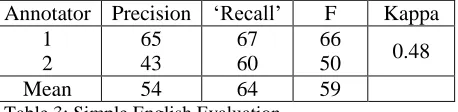
For each of these instances, two annotators were asked the question, “Is there a metaphor about governance in this example?” These annota-tors had previous experience in identifying meta-phors for this study, both by searching manually in online texts and evaluating previous versions of our system. Over time we have given them feed-back on what does and does not constitute a meta-phor. In this case, the annotators were given neither the system's concept-word association an-notations nor the source concept associated with the instance. In one way, the evaluation was gen-erous, because any metaphor in the extracted sen-tence would benefit precision even if it was not the metaphor found by our system. On the other hand, the same is true for the random sentences; while the system will only extract metaphors with source concepts in our list, the annotators had no such restriction. This causes the recall score to suffer. The annotation task was difficult, with a -score of 0.48. The resulting scores are given in Table 3. The examples given in Section 5 illustrate the error classes found among the false positives identified
by the human annotators. There are many cases where the source-concept associated terms are used literally rather than metaphorically, and many cas-es where the system-found metaphor is not about governance. Some text processing issues, such as a bug in our sentence breaking script, as well as the noisy nature of blog and blog comment input, caused some of the examples to be difficult to in-terpret or evaluate.
Annotator Precision ‘Recall’ F Kappa 1
2
65 43
67 60
66
50 0.48
[image:6.612.311.540.196.252.2]Mean 54 64 59
Table 3: Simple English Evaluation
7.3 Stricter Evaluation
Common Experimental Setup
We did a second evaluation of both English and Spanish using a different paradigm. For each lan-guage, we selected the 250 highest-ranked linguis-tic metaphor instances in the corpus. Subjects on Amazon Mechanical Turk were shown instances with the system-predicted concept-associated words highlighted and asked if the highlighted words were being used metaphorically (options were yes and no). Each subject was randomly asked about roughly a quarter of the data.
We paid the subjects $10 per hour. We added catch trial sentences which asked the subject to simply answer yes or no as a way of excluding those not actually reading the sentences. Subjects answering these questions incorrectly were exclud-ed (17 in English, 25 in Spanish).
English Results
We restricted our subjects to those claiming to be native English speakers who had IP addresses within the U.S. and had 115 participants. The ex-amples were grouped into 66 conceptual meta-phors. The mean metaphoricity of instances was 0.41 (standard deviation=0.33). The mean meta-phoricity of the conceptual metaphors (Figure 4), was 0.39 (SD=0.26). Although there was wide variance in metaphoricity across conceptual meta-phors, it appears likely that most of the conceptual metaphors discovered by the system are correct: 65% of the conceptual metaphors had metaphorici-ty greater than 0.25, and 73% greater than 0.2. Given that many metaphors are conventional and difficult to detect in natural language (Lakoff and Johnson, 1980), it is possible that even in cases in which only a minority of subjects detected a meta-phor, a metaphor nonetheless exists
Spanish Results
We restricted our subjects to those claiming to be native speakers of Mexican Spanish with IP ad-dresses in the US (57) or Mexico (29). The
in-stances were grouped into 52 conceptual meta-phors. The mean metaphoricity of instances was 0.33 (SD=0.23) and for conceptual metaphors (Figure 4), 0.31 (SD=0.16). 60% of conceptual metaphors had metaphoricity greater than 0.25, and 73% greater than 0.2. That performance was only slightly lower than English is a positive indication of our method’s cross-linguistic potential.
8 Discussion and Future Work
We observed a number of problems with our ap-proach which provide avenues for future research.
8.1 Topics as Proxies of Primary Metaphor Concepts
[image:7.612.98.512.96.369.2]approach to primary metaphor would boost its per-formance significantly.
8.2 Topics as Proxies of Non-Primary Meta-phor Concepts
We found that most of our potential source con-cepts did not correspond to any LDA topic. How-ever, many of these, such as wild west, have fairly strong word co-occurrence patterns, so they plau-sibly could be found by a different topic modeling algorithm. There are two promising approaches here which could potentially be combined. The first is to use a hierarchical LDA algorithm (Blei et al, 2003b) to allow concepts to align to topics with varying degrees of granularity, from the very gen-eral (e.g. war) to the very specific (e.g. wild west). The second is to use constrained LDA approaches (Andrzejewski and Zhu, 2009; Hu et al., 2010) to attempt to force at least one topic to correspond to each of our seed concept lists.
A different approach would leave behind seed lists entirely. In our current approach, only about one third of the topics modeled by LDA are suc-cessfully aligned with a source concept from our hand-made list. However, some non-aligned LDA topics have properties similar to those that were chosen to represent source concepts. For instance, the topic whose highest ranked terms are [institute, professor, engineering, degree] is comprised of a set of semantically coherent and concrete terms, and could be assigned a reasonably accurate label such as higher education. If we were to choose LDA topics based on the terms’ coherence and concreteness (and perhaps other relevant, measura-ble properties), then assign a label using a method such as that in Mei et al. (2007), we would be able to leverage more of the concepts in the LDA mod-el. This would increase the recall of our system, and also reduce some of the confusion associated with incorrect labeling of concepts in linguistic and conceptual metaphors. Applying Labeled LDA, as in Ramage et al. (2009), would be a similar ap-proach.
8.3 Confusion of Literal and Metaphorical Usage of Source Concepts
Another major problem was the confusion between literal and metaphorical usage of source terms. This is partly addressed by our document topics filter, but more sophisticated use of document con-text for this purpose would be helpful. A similar
filter based on contexts across the test corpus might be useful.
8.4 Fixed Expressions
Some of our errors were due to frequent fixed phrases which included a word strongly associated with a source topic, like Tea Party. Minimum de-scription length (MDL) phrase-finding or similar techniques could be used to filter these out. Initial experiments performed after the evaluations dis-cussed above show promise in this regard. Using the MDL algorithm (Rissanen, 1978), we devel-oped a list of likely multi-word expressions in the Wikipedia corpus. We then concatenated these phrases in the Wikipedia corpus before LDA mod-eling and in the test corpus before metaphor pre-diction. Though we did not have time to formally evaluate the results, a subjective analysis showed fewer of these fixed phrases appearing as indica-tors of metaphor (as words in or ).
8.5 Difficulty of Annotation
A different method of presentation of metaphors to the subjects, for instance with annotations marking where in the sentence we believed metaphor to exist or with a suggestion of the source concept, may have improved agreement and perhaps the system’s evaluation score.
8.6 Summary
Acknowledgements
Supported by the Intelligence Advanced Research Pro-jects Activity (IARPA) via Department of Defense US Army Research Laboratory contract number W911NF-12-C0-0023. The U.S. Government is authorized to reproduce and distribute reprints for Governmental pur-poses notwithstanding any copyright annotation there-on. Disclaimer: The views and conclusions contained herein are those of the authors and should not be inter-preted as necessarily representing the official policies or endorsements, either expressed or implied, of IARPA, DoD/ARL, or the U.S. Government.”
References
David Andrzejewski and Xiaojin Zhu. 2009. Latent Di-richlet Allocation with Topic-in-Set Knowledge. In
Proceedings of NAACL Workshop on Semi-Supervised Learning for NLP.
Collin Baker, Charles Fillmore, and John Lowe. 1998. The Berkeley FrameNet project. In Proceedings of COLING-ACL.
Stephen Bethard, Vicky Tzuyin Lai and James H. Mar-tin. 2009. Topic Model Analysis of Metaphor Fre-quency for Psycholinguistic Stimuli. . In Proc. Of NAACL-HLT Workshop on Computational Ap-proaches to Linguistic Creativity.
Julia Birke and Anoop Sarkar. 2006. A Clustering Ap-proach for the Nearly Unsupervised Recognition of Nonliteral Language. In Proceedings of EACL.
David Blei, Thomas Griffiths, Michael Jordan, and Joshua Tenenbaum. 2003a. Hierarchical topic models and the nested Chinese restaurant process. In Pro-ceedings of NIPS.
David Blei, Andrew Ng, and Michael Jordan. 2003b. Latent Dirichlet Allocation. Journal of Machine Learning Research, 2003(3):993–1022.
Dan Fass. 1991. met*: A Method for Discriminating Metonymy and Metaphor by Computer. Computa-tional Linguistics, 17(1):49–90.
Christine Fellbaum. 1998. WordNet: An Electronic Lex-ical Database. MIT Press, Cambridge, MA.
Matt Gegigan, John Bryant, Srini Narayanan, and Branimir Ciric. 2006. Catching Metaphors. In Pro-ceedings of the 3rd Workshop on Scalable Natural Language Understanding.
Joseph E. Grady. 1998. Foundations of meaning: Prima-ry metaphors and primaPrima-ry scenes. UMI.
Yuenin Hu, Jordan Boyd-Graber, and Brianna Satinoff. 2010. Interactive Topic Modeling. In Proceedings of ACL.
Saisuresh Krishnakumaran and Xiaojin Zhu. 2007. Hunting Elusive Metaphors Using Lexical Re-sources. In Proceedings of the Workshop on Compu-tational Approaches to Figurative Language.
George Lakoff and Mark Johnson. 1980. Metaphors We Live By. University of Chicago.
James H. Martin. 1994. MetaBank: A knowledge-base of metaphoric language convention. Computational Intelligence, 10(2):134–149.
Zachary Mason. 2004. CorMet: A Computational, Cor-pus-Based Conventional Metaphor Extraction Sys-tem. Computational Linguistics, 30(1):23–44. Andrew Kachites McCallum. 2002. MALLET: A
Ma-chine Learning for Language Toolkit.
http://mallet.cs.umass.edu.
Qiaozhu Mei, Xuehua Shen, and Chengxiang Zhai. Automatic Labeling of Multinomial Topic Models. In Proceedings of KDD ’07. 2007.
Wim Peters and Ivonne Peters. 2000. Lexicalised Sys-tematic Polysemy in WordNet. In Proceedings of LREC.
Daniel Ramage, David Hall, Ramesh Nallapati and Christopher D. Manning. 2009. Labeled LDA: A su-pervised topic model for credit attribution in multi-labeled corpora. In Proceedings of EMNLP.
Jorma Rissanen. Modeling by shortest data description.
Automatica 14:465-471.
Ekaterina Shutova, Lin Sun, and Anna Korhonen. 2010. Metaphor Identification Using Noun and Verb Clus-tering. In Proceedings of COLING.
Ekaterina Shutova, Simone Teufel, and Anna Korhonen. 2012. Statistical Metaphor Processing. Computation-al Linguistics. Uncorrected proof.
Ekaterina Shutova. 2010. Models of metaphor in NLP. In Proceedings of ACL.