D S Sharma, R Sangal and J D Pawar. Proc. of the 11th Intl. Conference on Natural Language Processing, pages 321–327,
Evaluating Two Annotated Corpora of Hindi Using a Verb Class
Identifier
Neha Dixit
Centre for Technology Studies, MGAHV, Wardha [email protected]
Narayan Choudhary ezDI, LLC.
Abstract
[In the past few years, Indian languages have seen a welcome arrival of large parts of speech annotated corpora, thanks to the DIT funded projects across the country. A major corpus of 50,000 sen-tences in each of the 12 of major Indian languages is available for research pur-poses. This corpus has been annotated for parts of speech using the BIS annotation guideline. However, it remains to be seen how good these corpora are with respect to annotation itself. Given that annotated corpora are also prone to human errors which later affect the accuracies achieved by the statistical NLP tools based on these corpora, there is a need to open evaluation of such a corpus. This paper focuses on finding annotation and other types of errors in two major parts of speech annotated corpora of Hindi and correcting them using a tool developed for the identification of verb classes in Hindi.]
1 Introduction
This paper emerges from a task meant to auto-matically identify the syntactico-semantic class of Hindi verbs occurring in a sentence. A verb class identifier was developed that took the parts of speech annotated text as input and identified the class of the verbs marked as main verbs in the text. Section 1 and 2 details the development of this automated identifier. This tool was run against two corpora, first the Hindi corpus devel-oped by Microsoft Research India (MSRI) (Bali et al., 2010) and distributed by the Linguistic
Data Consortium (LDC)1 and second, the Hindi
corpus developed under the consortia project called Indian Language Corpora Initiative (ILCI) (Choudhary et al., 2011) and distributed by the TDIL2. While the MSRI corpus is annotated in
the IL-PoST framework (Baskaran et al., 2008) of parts of speech annotation, the ILCI corpus is annotated using a tagset now commonly known as the BIS (Bureau of Indian Standards) tagset. Both of these tagsets are conceptually hierarchi-cal and therefore have top level categories for each of the classes of words. For verbs, both of these tagsets categorize them as either main verb or auxiliary verb. While the IL-POST also in-cludes the morphological information for each of the verbs annotated, the BIS tagset requires only the top level categorization of main or auxiliary verb. We show that both of these corpora have a high number of errors of both omission and commission which should be taken care of be-fore these corpora are used as gold data for fur-ther NLP tasks such as statistical parts of speech tagging and so on.
The second section gives an overview of the verb classification used to develop the verb class identifier followed by the third section detailing the development of the knowledge base. The fourth and fifth sections detail the ambiguities arising out of the use of a knowledge base for verb classification and provide a solution for the most frequent cause of the ambiguities. The last sections present the results achieved after evalu-ating the verb class identifier against the LDC and the ILCI corpora followed by an error analy-sis.
1 https://catalog.ldc.upenn.edu/LDC2010T24 2 http://tdil-dc.in
2 Verb Classification
While we base the classification of verbs on the traditional classification into transitive and in-transitives, we extend the category into multiple sub-classifications. Verbs are classified into a total of 13 categories. The classification we use emanates from the practical use envisaged for such a knowledge base. While the major catego-ries are traditionally four in number (namely, intransitive, transitive, causative and double causative), we further classify the intransitives into 7 sub-classes based on some diagnostic tests which govern their syntactic function and affect or validate what constructions they allow in a sentence.
2.1 Classification of Intransitive Verbs
There are three diagnostic tests applied to clas-sify the intransitive verbs. These diagnostic tests are as follows.
2.1.1 Allows ergative –ne
We know that some verbs require the marking of ergative case marker –ne in the simple past sen-tences in Hindi while with the others the same is not allowed. While this is always required with the transitive, causative and double causative verbs, the same does not always happen with the intransitive verbs.
For example, in the following two sentences where the main verb is intransitive, the use of – ne makes the sentence ungrammatical:
*Hindi मोहन ने बहुत सोया IPA: mohən ne bahut soja:
Gloss: Mohan ERG very sleep-PST-MSG Meaning: Mohan slept a lot
*Hindi सुमन के िसर ने बहुत चकरा
या
IPA: sumə n
ke sir ne ba-hut
cəkra:j a: Gloss:
Su-man POS head ER G
a lot reel
Mean-ing:
Suman’s head reeled a lot.
But in the sentences below where again the main verb is intransitive, the use of –ne marking is perfectly fine:
Hindi शेर ने जोर से दहाड़ा IPA: sher ne ʤor se dəha:ɖa: Gloss: lion ERG strong ASSOC roar-PST-MSG
Meaning: The lion roared strongly.
Hindi राम ने जोर से छींका IPA: ra:m ne ʤor se cʰi:̃ka: Gloss:
Ram ERG strong ASSOC
sneeze-PST
-MSG
Meaning: Ram sneezed heavily.
2.1.2 Allows Adjectival Use of the Perfective Form
All the intransitive verbs in their perfective forms cannot be used as an adjective. While some verbs allow this, others do not. For exam-ple, in the following sentences, the perfective forms of the verbs are being used as adjectives to modify nouns or noun phrases following it:
*Hindi ती
थर्
यात्रा पर गए हुए लोग की.. .
IPA: ti:rt̪ ʰ
ja:tr a:
pə r
gəe hu e
logon ki: … Gloss: pilgrimage on
go-PFT be -PF T peopl e of
Mean-ing:
People who have gone on a pilgrimage…
Hindi संत िगरे हुए लोग को उठा
ते ह
IPA: ənt̪ gire hue logo
n ko uʈʰat̪e hɛ̃ Gloss: sai
nt fall-PFT be-PFT peo-ple AC C pick -IMP F be -PL Mean-ing:
Saints help the fallen people.
Hindi झाड़ी म अटका गद खो गया IPA: ʤʰaɖi
: mẽ əʈka: gẽd̪ kʰo gəja: Gloss: bush LO
C stick-PST bal l lose -PST go-PST Mean-ing:
The ball stuck in the bush got lost.
But if we use the same form of some other verbs as adjectives, the sentence becomes un-grammatical or sounds awkard:
*Hindi कांपा हुआ लड़का िगर गया IPA: kã:pa: hua: ləɖka: gir gəja: Gloss: shiver-PST be-PST boy fall go-PST
Meaning: The boy, who had shivered, fell.
*Hindi घाटी म चीखा लड़
का
मर ग
या
i: a: r Gloss:
val-ley LO C
shriek-PST
boy die go-PST
Mean-ing: The boy, who had shrieked in the valley, died.
*Hindi दौड़ा
हुआ लड़का जीता
IPA: dəuɖa: hua: ləɖka: ʤi:t̪a: Gloss: run-PFT be-PFT boy win-PFT Meaning: The boy, who had run, won.
2.1.3 Passivization Selection
Similar to other constraints, some intransitive verbs does not allow passivization while other intransitives do. For example, in the following sentences the passive use of the main verb is al-right:
Hindi अब उठा जाए IPA: əb uʈʰa ʤae Gloss: now stand-PFT go-OPT Meaning: Let’s stand up now.
Hindi शेर से गुरार्या नहीं गया IPA: ʃer se gurraja: nəhĩ: gəja: Gloss: lion ASSOC roar-PFT NEG go-PFT
Meaning: The lion could not roar.
But the same does not hold true for the intran-sitive verbs as used in the following sentences:
Hindi अब उजड़ा जाए IPA: əb uʤɖa: ʤa:e Gloss: now wreck-PFT go-OPT
Meaning: Let’s get wrecked now.
Hindi उससे घबड़ाया नहीं गया IPA: usəse gʰəbɖa:ja:-PFT nəhĩ: gəja:
Gloss: he-DAT bewilder-PFT NEG go-PFT
Meaning: He could not get bewildered.
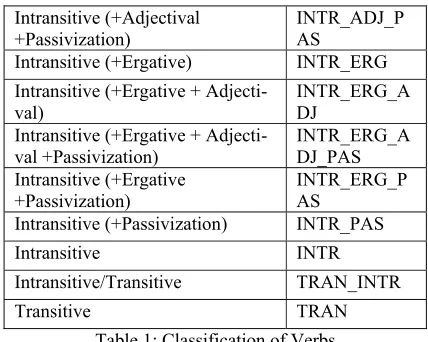
Taking these three diagnostics test as the base of the sub-classification within intransitive verbs, we come with a total of 13 classes of verbs as noted in the table below:
Verb Class Verb Class
Label
Causative CAUS
Copular Verb COP
Second Causative DB_CAUS Intransitive (+Adjectival) INTR_ADJ
Intransitive (+Adjectival
+Passivization) INTR_ADJ_PAS Intransitive (+Ergative) INTR_ERG Intransitive (+Ergative +
Adjecti-val) INTR_ERG_ADJ
Intransitive (+Ergative + Adjecti-val +Passivization)
INTR_ERG_A DJ_PAS Intransitive (+Ergative
+Passivization)
INTR_ERG_P AS
Intransitive (+Passivization) INTR_PAS
Intransitive INTR
Intransitive/Transitive TRAN_INTR
[image:3.612.309.523.64.235.2]Transitive TRAN
Table 1: Classification of Verbs
3 Developing a Verb Class Knowledge Base
Identification of verbs and their classes bases itself mainly on what we consider the largest ever knowledge base of Hindi verbs collected from various sources such as dictionaries, corpus and others. The knowledge base contains a total of 3240 verbs and all of their morphological forms, including spelling variations and common mistakes. The morphological forms and the spelling variations are further given their own labels in the knowledge base itself along with the class for each of the verbs and their forms. The structure of knowledge base has been illustrated in the following table:
ID Word morph_type verb_class
[image:3.612.101.293.296.416.2]86727 पीना inf_msg Transitive 86728 पीनी inf_fsg Transitive 86729 पीने inf_pl Transitive 86730 पीता impf_msg Transitive 86731 पीती impf_fsg Transitive 86732 पीतीं impf_fsgh Transitive 86733 पीते impf_pl Transitive 86734 िपया pft_msg Transitive 86735 िपयी pft_fsg_var1 Transitive
Table 2: Structure of Knowledge Base With inclusion of 3240 verbs, we get a total of 149,518 words present in the knowledge base.
4 Types of Ambiguities in Verb Classi-fication
which they appear. An analysis of the verbs pre-sent in the knowledge shows that it has 1260 words that occur twice in the corpus. These words are possible causes of ambiguity resulting into incorrect assignment of class to the verbs. Our analysis shows that these ambiguities could be of 5 different types as mentioned below.
4.1 Ambiguity: Verb Root vs. Perfective Verb
This occurs mainly because of a derivational process used in Hindi and several other Indian languages where a valency is added by vowel lengthening. For example while the verb
जग/ʤəg, an intransitive verb, means “to wake up” the verb root जगा/ʤəga, a transitive verb, means “to awaken”. While जगा/ʤəga is a verb root, it is also the perfective inflectional form of the verb root जग/ʤəg and this way जगा/ʤəga gets two verb classes which need to be resolved.
While a solution to disambiguate this type of ambiguity has been implemented as described in by analysing the verb group patterns (as men-tioned in the section below), the other types of ambiguities (described below) have to be taken care of at the word level.
4.2 Ambiguity: Conjunctive Participle vs. Perfective Verb
Another type of ambiguity which has a chance of becoming frequent if the genre of the corpus un-der test is of non-formal kind is that conjunctive participles can get confused with the perfective of the verbs ending on consonant -क/-k. Conjunc-tive participles are usually formed by adding the auxiliary verb –कर/-kər to any verb root and give a sense of perfective aspect to the verb. While the formal way of creating the conjunctive parti-ciple is to either attach -कर-/kər to the verb root itself or juxtaposing it afterwards, informally the variant -के/-ke is used. Thus we can have
खाकर/kʰa:kər and खाके/kʰa:ke having the same sense and used interchangeably. Except for a few frequent use of this variant such as खाके//kʰa:ke,
रोके/roke, कसके/kəske, etc. most of the time this variant is not used. And this is why we have ig-nored finding out a rule-based solution to disam-biguate this.
4.3 Ambiguity: Perfective Verb vs. Infini-tive Verb
Some verbs that end with consonant –न/-n as in
छान/cʰa:n, मान/ma:n, जान/ʤa:n etc. may be shar-ing the same grapheme and may be homopho-nous with some other verb’s infinitive form. Thus a verb like छाना/cʰa:na: may have two meanings, the first being the perfective of the verb root छान/cʰa:n (to filter) and another as the infinitive form of the verb root छा/cʰa: (which means “to cover the roof”). However, this type of ambiguity is also limited and count only 3 in Hindi. For this very reason, we have also ignored disambiguating this for the time being.
4.4 Ambiguity: Perfective Verb vs. Imper-fective Verb
There are also a couple of verbs which can be interpreted as imperfective of a verb root and perfective of another. There are two verb root pairs that create this problem. The first pair is
जीतना/ʤi:tna: and जीना/ʤina:, meaning respec-tively “to win” and “to live”. The second pair is
बरतना/bərətna बरना/bərna, meaning respectively “to follow” and “to choose”.
4.5 Ambiguity: Verbs in multiple classes
While it is very common in other languages such as English that the same verb is used both as transitive and intransitive, the same is very rare in Indo-Aryan languages like Hindi. Out of all the verbs that we have analysed, we found only one verb that can be used both as transitive and intransitive. This verb is ऐंठना/ɛ̃ʈʰna: (meaning “to writhe” or “to snatch by deceit”).
An analysis of the 675 verb group templates shows that there are only 30 such templates where both verb root (VR) and perfective verb (VR_pft) can stay. This means we basically have to find out the disambiguation rules for only these verb groups. The rest are taken care of automatically as proper, grammatical structure of Hindi would not allow them. These verb group templates are noted in the table below:
Template with First word as
either VR or VR_pft Ambiguity
VR_pft+ja+rah_pft+ho_fut Yes VR_pft+ja_pft+ho_impf+prs_aux Yes VR_pft+ja+rah_pft+prs_aux Yes VR_pft+ja_inf+cahiye+pst_aux Yes VR_pft+ja+rah_pft+pst_aux Yes VR_pft+ja_inf+cahiye Yes VR_pft+ja_impf+prs_aux Yes VR_pft+ja_pft+prs_aux Yes VR_pft+par_pft+prs_aux Yes VR_pft+ja_pft+pst_aux Yes VR_pft+par_pft+pst_aux Yes VR_pft+ja+rah_pft Yes
VR_pft+ja_fut Yes
VR_pft+ja_impf Yes
VR_pft+ja_opt Yes
VR_pft+ja_pft Yes
VR_pft+rah_pft Yes
VR_pft+VINF Yes
VR_pft+VINF_imp Yes
VR_pft+ho_fut No
VR_pft+ho_impf No
VR_pft+ho_opt No
VR_pft+ho_pft No
[image:5.612.91.287.181.643.2]VR_pft+kar_fut No VR_pft+kar_imp No VR_pft+kar_impf No VR_pft+rah_fut No VR_pft+rah_imp No VR_pft+rah_opt No VR_pft+rakh_pft No
Table 3: Possible Ambiguous Verb Group Templates Now, if we closely analyse these auxiliary verbs in the given templates, we find that these auxiliaries actually do not allow perfective verbs to occur as their main verbs. This conclusion is based on a corpus study done on the EMILLE (McEnery et al., 2000) corpus and the
Gyan-Nidhi corpus as well as some exact searches done on a prominent search engine. For example, in the phrase जगाजाएगी/ʤəga: ʤa:egi:, the main verb जगा/ʤəga: or for that matter any other verb can never be inflected for the perfective aspect. Similar is the case with the place of other main verbs in the templates having ambiguity (noted with “yes” in table V above).
6 Evaluating against Corpora
The tool was given two corpora as input– the LDC and the ILCI. A summary of the error analysis on the results achieved has been pro-vided here.
6.1 The LDC Corpus
LDC corpus contains a total of 4839 sentences annotated in the IL-PoST framework. When run against the verb class identifier, we get the fol-lowing results:
Total Main Verbs Found 8,386 Total Main Verbs Classified 8,048 Unclassified Main Verbs 338 Error Percentage 4.030527 The 4% of error in identifying a verb class for a verb marked as VM emerges due to four differ-ent reasons as noted below:
Error Types Frequency Spelling Error 258 Annotation Error 39 Tokenization Error 18
Echo-Words 23
Total Errors 338
6.2 The ILCI Corpus
The Hindi corpus of ILCI contains 50,000 sen-tences from two domains of health and tourism. Summary of the error analysis done on the output of this corpus is given below:
Total Main Verbs in ILCI 87,801 No. of Main Verbs Classified in ILCI 82,232 No. of Main Verbs Unclassified in ILCI 5,569 Accuracy on the ILCI Corpus 93.66
Error Percentage 6.34
Further analysis breaks down the types of er-rors found in this evaluation. This has been shown in the table below:
Error Type
Error
Echo word 104 144 248 0.044397 Spelling Error 31 96 127 0.022735 KB Error 74 8 82 0.01468 Pre-Processing
Error 3 9 12 0.002148 Table 4: Error Types in the ILCI Corpus
7 Error Types
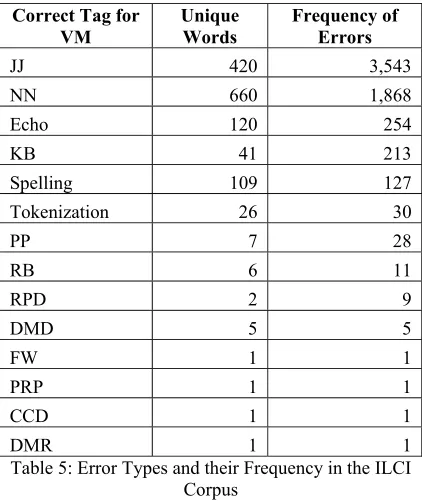
Evaluating against the ILCI corpus and following the error analysis, we find that there are four types of errors in the annotated text. “KB errors” are errors of knowledge base used in the verb classification tool itself. A summary of the errors for each of the tokens at the annotation level are shown below:
Correct Tag for
VM Unique Words Frequency of Errors
JJ 420 3,543
NN 660 1,868
Echo 120 254
KB 41 213
Spelling 109 127
Tokenization 26 30
PP 7 28
RB 6 11
RPD 2 9
DMD 5 5
FW 1 1
PRP 1 1
CCD 1 1
[image:6.612.116.521.62.273.2]DMR 1 1
Table 5: Error Types and their Frequency in the ILCI Corpus
The four major types of errors are mentioned below.
7.1 Annotation Error
Annotation errors are the errors in the assign-ment of the parts of speech tags to the text. As seen in the table above, the highest number of words marked incorrectly as main verb adjec-tives which should have been marked as JJ. This is followed by words that should have been marked as NN but are marked as VM. Some pre-positions, adverbs, particles and demonstratives are also marked as VM. Some examples such errors are noted below:
Actual Tag
Example Words
JJ ि थत, पैदा, उपल ध, पता, थािपत,
प्राप्त, खड़े, प्रदान, िघरा, शु , तैयार,
सेवन, िनिमर्त
NN सेवन, प्रयोग, आराम, नजर, यान, लाभ,
काम, िनमार्ण, मािलश, याद, इ तेमाल,
बढ़ावा, बढ़ावा
PP पर, बाहर, सामने, पास, अंदर, आर-पार,
का, पारकर
RB खासकर, नहीं, ब , ऐसे, खड़े-खड़े, िसफर् RPD वाला, ही
DMD इससे, यह, यहाँ, वहाँ, वहीं
Table 6: Examples of Annotation Errors
7.2 Echo word
Echo-words are a type of reduplication used as a method of word formation for emphasis and other semantic purposes. Using the echo-formation as the word echo-formation process, a non-word is used together with the actual non-word to add a meaning to it. This phenomenon is seen all the content class words of Indian languages.
However, when it comes to be captured at the level of language computation, this has not been covered yet in most of the cases. The current knowledge base used in the verb class identifier also does not cover the echo-words. Therefore, the main verbs when used in their echo-formation forms do not get detected. Some ex-amples of such words as shown in the exex-amples below:
खाने-पीने, चलने-िफरने, कूट-पीसकर, आने-जाने,
घूमने-िफरने, आना-जाना, चलते-चलते, पहुँचते-पहुँचते,
उठने-बैठने, िमलता-जुलता
7.3 Spelling Error
The ILCI corpus contains text that is usually cor-rected for any spelling errors. But some errors have still been found in our analysis. Some of these spelling errors are as follows:
होग, ध, बढने, िभग, रखन, करेग, कर, चढ़़कर, पे
7.4 Pre-Processing Error
[image:6.612.90.301.282.533.2]"(बोलना, ", "बहना’", "``देखने``", "``देखो", "``सुनने``", "``सूँघने``", "आना’", "आने’", "कर-", "काँट", "िकया।", "खाय/िखलाय", "जाँचे,"
8 Conclusion
NLP community in India must be elated to have received a big annotated corpus in many Indian languages, including Hindi. These corpora really help a lot in developing next generation of NLP tools for various purposes. However, these cor-pora are labor intensive tasks and prone to hu-man errors. Errors have been noted in almost all of the human annotation tasks including the Penn Treebank (Manning, C., 2011), the same is true also for other corpora. We have shown here a method to check the accuracy of the tags as-signed to main verbs, done the error analysis and pointed out the errors that should be taken care of in the next release of the ILCI corpus and the LDC corpus so that users of the corpora do not need to do the same task again. The verb class identifier tool we used to mark the possible er-rors can also be used to check the accuracy of any other Hindi corpus annotated for parts of speech tags, thereby alleviating the time taken for error analysis.
Reference
Bali, Kalika, Monojit Choudhury, Priyanka Biswas, Girish Nath Jha, Narayan Kumar Choudhary and Maansi Sharma. 2010. Indian Language Part-of-Speech Tagset: Hindi. Linguistic Data Consortium, Philadelphia.
Baskaran, Sankaran, Kalika Bali, Monojit Choudhury, Tanmoy Bhattacharya, Pushpak Bhattacharyya, Gi-rish Nath Jha, S. Rajendran, K. Saravanan, L. Sob-ha and K.V. Subbarao. 2008. A Common Parts-of-Speech Tagset Framework for Indian Languages. In: Nicoletta Calzolari (Conference Chair), Khalid Choukri, Bente Maegaard, Joseph Mariani, Jan Od-jik, Stelios Piperidis, Daniel Tapias (Eds.) Proceed-ings of the Sixth Inter-national Language Re-sources and Evaluation (LREC'08), Marrakech, Morocco.
Choudhary, Narayan and Girish Nath Jha. 2011. Creating Multilingual Parallel Corpora in Indian Languages. In: Proceedings of 5th Language Technology Conference, Poznan.
Choudhary, Narayan, Girish Nath Jha, Pramod Pan-dey. 2011a. A Rule based Method for the Identifi-cation of TAM features in a PoS Tagged Corpus. In: Proceedings of 5th Language Technology Con-ference, Fundacja Uniwersytety im. A. Mickiewic-za, Poznan.