Letter N-Gram-based Input Encoding for Continuous Space Language
Models
Henning Sperr†, Jan Niehues? and Alexander Waibel?
Institute of Anthropomatics KIT - Karlsruhe Institute of Technology
Karlsruhe, Germany
?
†
Abstract
We present a letter-based encoding for words in continuous space language mod-els. We represent the words completely by letter n-grams instead of using the word index. This way, similar words will au-tomatically have a similar representation. With this we hope to better generalize to unknown or rare words and to also capture morphological information. We show their influence in the task of machine translation using continuous space lan-guage models based on restricted Boltz-mann machines. We evaluate the trans-lation quality as well as the training time on a German-to-English translation task of TED and university lectures as well as on the news translation task translating from English to German. Using our new ap-proach a gain in BLEU score by up to 0.4 points can be achieved.
1 Introduction
Language models play an important role in natural language processing. The most commonly used approach is n-gram-based language models (Chen and Goodman, 1999).
In recent years Continuous Space Language Models (CSLMs) have gained a lot of atten-tion. Compared to standard n-gram-based lan-guage models they promise better generalization to unknown histories or n-grams with only few occurrences. Since the words are projected into a continuous space, true interpolation can be per-formed when an unseen sample appears. The stan-dard input layer for CSLMs is a so called 1-of-n codi1-of-ng where a word is represe1-of-nted as a vector with a single neuron turned on and the rest turned off. In the standard approach it is problematic to infer probabilities for words that are not inside the
vocabulary. Sometimes an extra unknown neu-ron is used in the input layer to represent these words (Niehues and Waibel, 2012). Since all un-seen words get mapped to the same neuron, no real discrimination between those words can be done. Furthermore, rare words are also hard to model, since there is too few training data available to es-timate their associated parameters.
We try to overcome these shortcomings by using subword features to cluster similar words closer together and generalize better over unseen words. We hope that words containing similar let-ter n-grams will yield a good indicator for words that have the same function inside the sentence. Introducing a method for subword units also has the advantage that the input layer can be smaller, while still representing nearly the same vocabulary with unique feature vectors. By using a smaller in-put layer, less weights need to be trained and the training is faster. In this work we present the letter n-gram approach to represent words in an CSLM, and compare it to the word-based CSLM presented in Niehues and Waibel (2012).
The rest of this paper is structured as follows: First we will give an overview of related work. After that we give a brief overview of restricted Boltzmann machines which are the basis of the letter-based CSLM presented in Section 4. Then we will present the results of the experiments and conclude our work.
2 Related Work
First research on neural networks to predict word categories has been done in Nakamura et al. (1990) where neural networks were used to pre-dict word categories. Xu and Rudnicky (2000) proposed a language model that has an input con-sisting of one word and no hidden units. This network was limited to infer unigram and bigram statistics. There has been research on feed for-ward neural network language models where they
achieved a decrease in perplexity compared to standard n-gram language models (Bengio et al., 2003). In Schwenk and Gauvain (2005) and later in Schwenk (2007) research was performed on training large scale neural network language mod-els on millions of words resulting in a decrease of the word error rate for continuous speech recog-nition. In Schwenk et al. (2006) they use the CSLM framework to rescore n-best lists of a ma-chine translation system during tuning and testing steps. Usually these networks use short lists to reduce the size of the output layer and to make calculation feasible. There have been approaches to optimize the output layer of such a network, so that vocabularies of arbitrary size can be used and there is no need to back off to a smaller n-gram model (Le et al., 2011). In this Structured Output Layer (SOUL) neural network language model a hierarchical output layer was chosen. Re-current Neural Networks have also been used to try and improve language model perplexities in Mikolov et al. (2010), concluding that Recurrent Neural Networks potentially improve over classi-cal n-gram language models with increasing data and a big enough hidden unit size of the model. In the work of Mnih and Hinton (2007) and Mnih (2010) training factored restricted Boltzmann ma-chines yielded no gain compared to Kneser-Ney smoothed n-gram models. But it has been shown in Niehues and Waibel (2012), that using a re-stricted Boltzmann machine with a different layout during decoding can yield an increase in BLEU score. There has also been a lot of research in the field of using subword units for language mod-eling. In Shaik et al. (2011) linguistically moti-vated sub-lexical units were proposed to improve open vocabulary speech recognition for German. Research on morphology-based and subword lan-guage models on a Turkish speech recognition task has been done by Sak et al. (2010). The idea of Factored Language models in machine transla-tion has been introduced by Kirchhoff and Yang (2005). Similar approaches to develop joint lan-guage models for morphologically rich lanlan-guages in machine translation have been presented by Sarikaya and Deng (2007). In Emami et al. (2008) a factored neural network language model for Ara-bic was built. They used different features such as segmentation, part-of-speech and diacritics to en-rich the information for each word.
3 Restricted Boltzmann Machine-based
Language Model
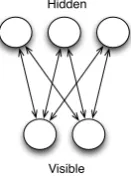
In this section we will briefly review the con-tinuous space language models using restricted Boltzmann machines (RBM). We will focus on the parts that are important for the implementa-tion of the input layers described in the next sec-tion. A restricted Boltzmann machine is a gener-ative stochastic neural network which consists of a visible and a hidden layer of neurons that have unidirectional connections between the layers but no inner layer connections as shown in Figure 1.
[image:2.595.384.450.251.341.2]Visible Hidden
Figure 1: Restricted Boltzmann Machine.
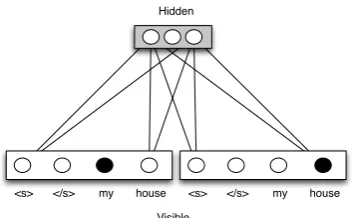
The activation of the visible neurons will be de-termined by the input data. The standard input layer for neural network language models uses a 1-of-n coding to insert a word from the vocabulary into the network. This is a vector, where only the index of the word in the vocabulary is set to one and the rest to zero. Sometimes this is also referred to as asoftmaxlayer of binary units. The activa-tion of the hidden units is usually binary and will be inferred from the visible units by using sam-pling techniques. In Niehues and Waibel (2012) an n-gram Boltzmann machine language model is proposed using such a softmax layer for each con-text. In this work, we want to explore different ways of encoding the word observations in the in-put layer. Figure 2 is an example of the original model with three hidden units, two contexts and a vocabulary of two words. In this example the bigrammy houseis modeled.
To calculate the probability of a visible config-urationvwe will use the definition of the free en-ergy in a restricted Boltzmann machine with bi-nary stochastic hidden units, which is
F(v) =−X
i
viai−
X
j
log(1 + exj) (1)
Visible
[image:3.595.93.270.66.175.2]<s> </s> my house <s> </s> my house Hidden
Figure 2: RBMLM with three hidden units and a vocabulary size of two words and two word con-texts, where activated units are marked as black.
xj is the activation of thejth hidden neuron. The
activationxj is defined as
xj =bj+
X
i
viwij (2)
wherebj is the bias of the jth hidden neuron and wij is the weight between visible unitvi and
hid-den unitxj. Using these definitions, the
probabil-ity of our visible configurationvis
p(v) = 1
Z e
−F(v) (3)
with the partition functionZ = P
ve−F(v)being
the normalization constant. Usually this normal-ization constant is not easy to compute since it is a sum over an exponential amount of values. We know that the free energy will be proportional to the true probability of our visible vector, this is the reason for using the free energy as a feature in our log-linear model instead of the true prob-ability. In order to use it as a feature inside the decoder we actually need to be able to compute the probability for a whole sentence. As shown in Niehues and Waibel (2012) we can do this by sum-ming over the free energy of all n-grams contained in the sentence.
3.1 Training
For training the restricted Boltzmann machine lan-guage model (RBMLM) we used the Contrastive Divergence (CD) algorithm as proposed in Hinton (2010). In order to do this, we need to calculate the derivation of the probability of the example given the weights
δlogp(v)
δwij
=<vihj>data−<vihj>model (4)
where<vihj>modelis the expected value ofvihj
given the distribution of the model. In other words we calculate the expectation of how often
vi and hj are activated together, given the
dis-tribution of the data, minus the expectation of them being activated together given the distribu-tion of the model, which will be calculated us-ing Gibbs-Samplus-ing techniques. Usually many steps of Gibbs-Sampling are necessary to get an unbiased sample from the distribution, but in the Contrastive Divergence algorithm only one step of sampling is performed (Hinton, 2002).
4 Letter-based Word Encoding
In this section we will describe the proposed in-put layers for the RBMLM. Compared to the word index-based representation explained above, we try to improve the capability to handle unknown words and morphology by splitting the word into subunits.
4.1 Motivation
In the example mentioned above, the word index model might be able to predict my house but it will fail onmy housesif the wordhousesis not in the training vocabulary. In this case, a neuron that classifies all unknown tokens or some other tech-niques to handle such a case have to be utilized.
In contrast, a human will look at the single let-ters and see that these words are quite similar. He will most probably recognize that the appendeds
is used to mark the plural form, but both words re-fer to the same thing. So he will be able to inre-fer the meaning although he has never seen it before.
Another example in English are be the words
happyandunhappy. A human speaker who does not know the wordunhappywill be able to know from the context whatunhappymeans and he can guess that both of the words are adjectives, that have to do with happiness, and that they can be used in the same way.
In other languages with a richer morphology, like German, this problem is even more important. The German wordsch¨on(engl.beautiful) can have 16 different word forms, depending on case, num-ber and gender.
infor-mation about the words to make better predictions for unknown words.
4.2 Features
In order to model the aforementioned morpholog-ical word forms, we need to create features for every word that represent which letters are used in the word. If we look at the example ofhouse, we need to model that the first letter is anh, the second is anoand so on.
If we want to encode a word this way, we have the problem that we do not have a fixed size of features, but the feature size depends on the length of the word. This is not possible in the framework of continuous space language models. Therefore, a different way to represent the word is needed.
An approach for having a fixed size of features is to just model which letters occur in the word. In this case, every input word is represented by a vector of dimensionn, wherenis the size of the alphabet in the text. Every symbol, that is used in the word is set to one and all the other features are zero. By using a sparse representation, which shows only the features that are activated, the word
housewould be represented by
w1=e h o s u
The main problem of this representation is that we lose all information about the order of the let-ters. It is no longer possible to see how the word ends and how the word starts. Furthermore, many words will be represented by the same feature vec-tor. For example, in our case the wordshouseand
houseswould be identical. In the case ofhouses
and house this might not be bad, but the words
shortest and others or follow and wolf will also map to the same input vector. These words have no real connection as they are different in mean-ing and part of speech.
Therefore, we need to improve this approach to find a better model for input words. N-grams of words or letters have been successfully used to model sequences of words or letters in language models. We extend our approach to model not only the letters that occur in the in the word, but the letter n-grams that occur in the word. This will of course increase the dimension of the fea-ture space, but then we are able to model the order of the letters. In the example ofmy housethe
fea-ture vector will look like
w1 =my<w>m y</w> w2 =ho ou se us<w>h e</w>
We added markers for the beginning and end of the word because this additional information is im-portant to distinguish words. Using the example of the wordhouses, modeling directly that the last letter is anscould serve as an indication of a plural form.
If we use higher order n-grams, this will in-crease the information about the order of the let-ters. But these letter n-grams will also occur more rarely and therefore, the weights of these features in the RBM can no longer be estimated as reliably. To overcome this, we did not only use the n-grams of ordern, but all n-grams of ordernand smaller. In the last example, we will not only use the bi-grams, but also the unigrams.
This meansmy houseis actually represented as
w1= m y my<w>m y</w>
w2=e h o s u ho ou se us<w>h e</w>
With this we hope to capture many morpholog-ical variants of the wordhouse. Now the represen-tations of the wordshouse andhousesdiffer only in the ending and in an additional bigram.
houses=... es s</w>
house=... se e</w>
The beginning letters of the two words will con-tribute to the same free energy only leaving the ending letter n-grams to contribute to the different usages ofhousesandhouse.
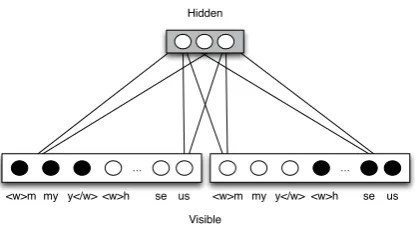
The actual layout of the model can be seen in Figure 3. For the sake of clarity we left out the unigram letters. In this representation we now do not use a softmax input layer, but a logistic input layer defined as
p(vi = on) =
1
1 + e−xi (5)
wherevi is theith visible neuron andxiis the
in-put from the hidden units for theith neuron de-fined as
xi =ai+
X
j
hjwij (6)
withaibeing the bias of the visible neuronvi and wij being the weight between the hidden unithj
Visible Hidden
<w>m my <w>h se us <w>m my y</w><w>h se
…
us y</w>
[image:5.595.79.287.66.179.2]…
Figure 3: A bigram letter index RBMLM with three hidden units and two word contexts, where activated units are marked as black.
4.3 Additional Information
The letter index approach can be extended by several features to include additional information about the words. This could for example be part-of-speech tags or other morphological informa-tion. In this work we tried to include a neuron to capture capital letter information. To do this we included a neuron that will be turned on if the first letter was capitalized and another neuron that will be turned on if the word was written in all capital letters. The word itself will be lowercased after we extracted this information.
Using the example ofEuropean Union, the new input vector will look like this
w1 =a e n o p r u an ea eu op pe ro ur <w>e n</w><CAPS> w2 =u i n o un io ni on
<w>u n</w><CAPS>
This will lead to a smaller letter n-gram vocab-ulary since all the letter n-grams get lowercased. This also means there is more data for each of the letter n-gram neurons that were treated differently before. We also introduced an all caps feature which is turned on if the whole word was written in capital letters. We hope that this can help detect abbreviations which are usually written in all cap-ital letters. For example EU will be represented as
w1 =e u eu<w>e u</w><ALLCAPS>
5 Evaluation
We evaluated the RBM-based language model on different statistical machine translation (SMT) tasks. We will first analyze the letter-based word
representation. Then we will give a brief descrip-tion of our SMT system. Afterwards, we de-scribe in detail our experiments on the German-to-English translation task. We will end with addi-tional experiments on the task of translating Eng-lish news documents into German.
5.1 Word Representation
In first experiments we analyzed whether the letter-based representation is able to distinguish between different words. In a vocabulary of 27,748 words, we compared for different letter n-gram sizes how many words are mapped to the same input feature vector.
Table 1 shows the different models, their input dimensions and the total number of unique clus-ters as well as the amount of input vectors con-taining one, two, three or four or more words that get mapped to this input vector. In the word index representation every word has its own feature vec-tor. In this case the dimension of the input vector is 27,748 and each word has its own unique input vector.
If we use only letters, as done in the unigram model, only 62% of the words have a unique repre-sentation. Furthermore, there are 606 feature vec-tors representing 4 or more words. This type of encoding of the words is not sufficient for the task. When using a bigram letter context nearly each of the 27,748 words has a unique input represen-tation, although the input dimension is only 7% compared to the word index. With the three let-ter vocabulary context and higher there is no input vector that represents more than three words from the vocabulary. This is good since we want similar words to be close together but not have exactly the same input vector. The words that are still clus-tered to the same input are mostly numbers or typ-ing mistakes like “YouTube” and “Youtube”.
5.2 Translation System Description
The translation system for the German-to-English task was trained on the European Parliament pus, News Commentary corpus, the BTEC cor-pus and TED talks1. The data was preprocessed and compound splitting was applied for German. Afterwards the discriminative word alignment ap-proach as described in Niehues and Vogel (2008) was applied to generate the alignments between source and target words. The phrase table was
#Vectors mapping to
Model Caps VocSize TotalVectors 1 Word 2 Words 3 Words 4+ Words
WordIndex - 27,748 27,748 27,748 0 0 0
[image:6.595.74.530.64.186.2]Letter 1-gram No 107 21,216 17,319 2,559 732 606 Letter 2-gram No 1,879 27,671 27,620 33 10 8 Letter 3-gram No 12,139 27,720 27,701 10 9 0 Letter 3-gram Yes 8,675 27,710 27,681 20 9 0 Letter 4-gram No 43,903 27,737 27,727 9 1 0 Letter 4-gram Yes 25,942 27,728 27,709 18 1 0
Table 1: Comparison of the vocabulary size and the possibility to have a unique representation of each word in the training corpus.
built using the scripts from the Moses package de-scribed in Koehn et al. (2007). A 4-gram language model was trained on the target side of the parallel data using the SRILM toolkit from Stolcke (2002). In addition, we used a bilingual language model as described in Niehues et al. (2011). Reordering was performed as a preprocessing step using part-of-speech (POS) information generated by the Tree-Tagger (Schmid, 1994). We used the reorder-ing approach described in Rottmann and Vogel (2007) and the extensions presented in Niehues et al. (2009) to cover long-range reorderings, which are typical when translating between German and English. An in-house phrase-based decoder was used to generate the translation hypotheses and the optimization was performed using the MERT implementation as presented in Venugopal et al. (2005). All our evaluation scores are measured us-ing the BLEU metric.
We trained the RBMLM models on 50K sen-tences from TED talks and optimized the weights of the log-linear model on a separate set of TED talks. For all experiments the RBMLMs have been trained with a context of four words. The devel-opment set consists of 1.7K segments containing 16K words. We used two different test sets to evaluate our models. The first test set contains TED talks with 3.5K segments containing 31K words. The second task was from an in-house computer science lecture corpus containing 2.1K segments and 47K words. For both tasks we used the weights optimized on TED.
For the task of translating English news texts into German we used a system developed for the Workshop on Machine Translation (WMT) eval-uation. The continuous space language models were trained on a random subsample of 100K sen-tences from the monolingual training data used for
this task. The out-of-vocabulary rates for the TED task are 1.06% while the computer science lec-tures have 2.73% and nearly 1% on WMT.
5.3 German-to-English TED Task
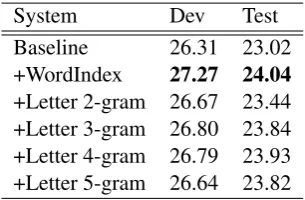
The results for the translation of German TED lec-tures into English are shown in Table 2. The base-line system uses a 4-gram Kneser-Ney smoothed language model trained on the target side parallel data. We then added a RBMLM, which was only trained on the English side of the TED corpus.
If the word index RBMLM trained for one iter-ation using 32 hidden units is added, an improve-ment of about 1 BLEU can be achieved. The let-ter bigram model performs about 0.4 BLEU points better than no additional model, but significantly worse then the word index model or the other let-ter n-gram models. The letlet-ter 3- to 5-gram-based models obtain similar BLEU scores, varying only by 0.1 BLEU point. They also achieve a 0.8 to 0.9 BLEU points improvement against the base-line system and a 0.2 to 0.1 BLEU points decrease than the word index-based encoding.
System Dev Test Baseline 26.31 23.02 +WordIndex 27.27 24.04
+Letter 2-gram 26.67 23.44 +Letter 3-gram 26.80 23.84 +Letter 4-gram 26.79 23.93 +Letter 5-gram 26.64 23.82
Table 2: Results for German-to-English TED translation task
[image:6.595.340.493.563.663.2]base-line of the systems presented in Table 3. In these experiments all letter-based models outperformed the baseline system. The bigram-based language model performs worst and the 3- and 4-gram-based models perform only slightly worse than the word index-based model.
System Dev Test Baseline+ngram 27.45 24.06 +WordIndex 27.70 24.34
[image:7.595.324.508.128.270.2]+Letter 2-gram 27.45 24.15 +Letter 3-gram 27.52 24.25 +Letter 4-gram 27.60 24.30
Table 3: Results of German-to-English TED trans-lations using an additional in-domain language model.
A third experiment is presented in Table 4. Here we also applied phrase table adaptation as de-scribed in Niehues et al. (2010). In this experiment the word index model improves the system by 0.4 BLEU points. In this case all letter-based models perform very similar. They are again performing slightly worse than the word index-based system, but better than the baseline system.
To summarize the results, we could always im-prove the performance of the system by adding the letter n-gram-based language model. Further-more, in most cases, the bigram model performs worse than the higher order models. It seems to be important for this task to have more context infor-mation. The 3- and 4-gram-based models perform almost equal, but slightly worse than the word index-based model.
System Dev Test BL+ngram+adaptpt 28.40 24.57 +WordIndex 28.55 24.96
[image:7.595.104.262.152.237.2]+Letter 2-gram 28.31 24.80 +Letter 3-gram 28.31 24.71 +Letter 4-gram 28.46 24.65
Table 4: Results of German-to-English TED trans-lations with additional in-domain language model and adapted phrase table.
5.3.1 Caps Feature
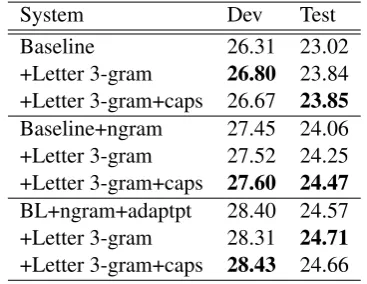
In addition, we evaluated the proposed caps fea-ture compared to the non-caps letter n-gram model and the baseline systems. As we can see in Ta-ble 5, caps sometimes improves and sometimes
decreases the BLEU score by about ±0.2 BLEU points. One reason for that might be that most English words are written lowercased, therefore we do not gain much information.
System Dev Test Baseline 26.31 23.02 +Letter 3-gram 26.80 23.84 +Letter 3-gram+caps 26.67 23.85
Baseline+ngram 27.45 24.06 +Letter 3-gram 27.52 24.25 +Letter 3-gram+caps 27.60 24.47
BL+ngram+adaptpt 28.40 24.57 +Letter 3-gram 28.31 24.71
[image:7.595.359.474.505.593.2]+Letter 3-gram+caps 28.43 24.66
Table 5: Difference between caps and non-caps letter n-gram models.
5.4 German-to-English CSL Task
After that, we evaluated the computer science lec-ture (CSL) test set. We used the same system as for the TED translation task. We did not perform a new optimization, since we wanted so see how well the models performed on a different task.
The results are summarized in Table 6. In this case the baseline is outperformed by the word in-dex approach by approximately 1.1 BLEU points. Except for the 4-gram model the results are similar to the result for the TED task. All systems could again outperform the baseline.
System Test Baseline 23.60 +WordIndex 24.76
+Letter 2-gram 24.17 +Letter 3-gram 24.36 +Letter 4-gram 23.82
Table 6: Results the baseline of the German-to-English CSL task.
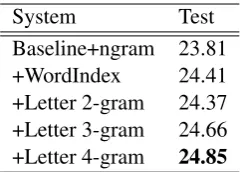
The system with the additional in-domain lan-guage model in Table 7 shows that both letter n-gram language models perform better than the baseline and the word index model, improving the baseline by about 0.8 to 1 BLEU. Whereas the word index model only achieved an improvement of 0.6 BLEU points.
[image:7.595.96.268.538.625.2]System Test Baseline+ngram 23.81 +WordIndex 24.41 +Letter 2-gram 24.37 +Letter 3-gram 24.66 +Letter 4-gram 24.85
Table 7: Results on German-to-English CSL cor-pus with additional in-domain language model.
word index model improves the baseline by 0.25 BLEU points. The letter n-gram models improve the baseline by about 0.3 to 0.4 BLEU points also improving over the word index model. The letter bigram model in this case performs worse than the baseline.
System Test
BL+ngram+adaptpt 25.00 +WordIndex 25.25 +Letter 2-gram 24.68 +Letter 3-gram 25.43
+Letter 4-gram 25.33
Table 8: Results on German-to-English CSL with additional in-domain language model and adapted phrase table.
In summary, again the 3- and 4-gram letter mod-els perform mostly better than the bigram version. They both perform mostly equal. In contrast to the TED task, they were even able to outperform the word index model in some configurations by up to 0.4 BLEU points.
5.5 English-to-German News Task
When translating English-to-German news we could not improve the performance of the base-line by using a word index model. In contrast, the performance dropped by 0.1 BLEU points. If we use a letter bigram model, we could improve the translation quality by 0.1 BLEU points over the baseline system.
System Dev Test Baseline 16.90 17.36 +WordIndex 16.79 17.29 +Letter 2-gram 16.91 17.48
Table 9: Results for WMT2013 task English-to-German.
5.6 Model Size and Training Times
In general the letter n-gram models perform al-most as good as the word index model on English language tasks. The advantage of the models up to the letter 3-gram context model is that the training time is lower compared to the word index model. All the models were trained using 10 cores and a batch size of 10 samples per contrastive diver-gence update. As can be seen in Table 10 the letter 3-gram model needs less than 50% of the weights and takes around 75% of the training time of the word index model. The four letter n-gram model takes longer to train due to more parameters.
[image:8.595.114.252.294.380.2]Model #Weights Time WordIndex 3.55 M 20 h 10 min Letter 2-gram 0.24 M 1h 24 min Letter 3-gram 1.55 M 15 h 12 min Letter 4-gram 5.62 M 38 h 59 min
Table 10: Training time and number of parameters of the RBMLM models.
6 Conclusions
In this work we presented the letter n-gram-based input layer for continuous space language models. The proposed input layer enables us to encode the similarity of unknown words directly in the input layer as well as to directly model some morpho-logical word forms.
We evaluated the encoding on different trans-lation tasks. The RBMLM using this encod-ing could always improve the translation qual-ity and perform similar to a RBMLM based on word indices. Especially in the second configu-ration which had a higher OOV rate, the letter n-gram model performed better than the word index model. Moreover, the model based on letter 3-grams uses only half the parameters of the word index model. This reduced the training time of the continuous space language model by a quarter.
Acknowledgments
References
Yoshua Bengio, R´ejean Ducharme, Pascal Vincent, and Christian Jauvin. 2003. A Neural Probabilistic
Lan-guage Model. Journal of Machine Learning
Re-search, 3:1137–1155.
Stanley F. Chen and Joshua Goodman. 1999. An
empirical study of smoothing techniques for
lan-guage modeling. Computer Speech & Language,
13(4):359–393.
Ahmad Emami, Imed Zitouni, and Lidia Mangu. 2008. Rich morphology based n-gram language models for
arabic. InINTERSPEECH, pages 829–832. ISCA.
Geoffrey E. Hinton. 2002. Training products of
ex-perts by minimizing contrastive divergence. Neural
Comput., 14(8):1771–1800, August.
Geoffrey Hinton. 2010. A Practical Guide to Training Restricted Boltzmann Machines. Technical report, University of Toronto.
Katrin Kirchhoff and Mei Yang. 2005. Improved Lan-guage Modeling for Statistical Machine Translation. In Proceedings of the ACL Workshop on Building and Using Parallel Texts, pages 125–128, Ann Ar-bor, Michigan, USA.
Philipp Koehn, Hieu Hoang, Alexandra Birch, Chris Callison-Burch, Marcello Federico, Nicola Bertoldi, Brooke Cowan, Wade Shen, Christine Moran, Richard Zens, Chris Dyer, Ondrej Bojar, Alexan-dra Constantin, and Evan Herbst. 2007. Moses: Open Source Toolkit for Statistical Machine
Trans-lation. In ACL 2007, Demonstration Session,
Prague, Czech Republic.
Hai Son Le, Ilya Oparin, Abdelkhalek Messaoudi,
Alexandre Allauzen, Jean-Luc Gauvain, and
Franc¸ois Yvon. 2011. Large vocabulary soul neural
network language models. InINTERSPEECH 2011,
12th Annual Conference of the International Speech Communication Association, Florence, Italy.
Tomas Mikolov, Martin Karafi´at, Lukas Burget, Jan Cernock´y, and Sanjeev Khudanpur. 2010.
Recur-rent neural network based language model. In
IN-TERSPEECH 2010, 11th Annual Conference of the International Speech Communication Association, Makuhari, Chiba, Japan.
Andriy Mnih and Geoffrey Hinton. 2007. Three new graphical models for statistical language modelling. InProceedings of the 24th international conference on Machine Learning, ICML ’07, pages 641–648, New York, NY, USA. ACM.
Andriy Mnih. 2010. Learning distributed
representa-tions for statistical language modelling and collabo-rative filtering. Ph.D. thesis, University of Toronto, Toronto, Ont., Canada. AAINR73159.
Masami Nakamura, Katsuteru Maruyama, Takeshi Kawabata, and Kiyohiro Shikano. 1990. Neural
network approach to word category prediction for english texts. InProceedings of the 13th conference on Computational linguistics - Volume 3, COLING ’90, pages 213–218, Stroudsburg, PA, USA.
Jan Niehues and Muntsin Kolss. 2009. A POS-Based
Model for Long-Range Reorderings in SMT. In
Fourth Workshop on Statistical Machine Translation (WMT 2009), Athens, Greece.
Jan Niehues and Stephan Vogel. 2008. Discriminative Word Alignment via Alignment Matrix Modeling. In Proceedings of the Third Workshop on Statisti-cal Machine Translation, StatMT ’08, pages 18–25, Stroudsburg, PA, USA.
Jan Niehues and Alex Waibel. 2012. Continuous
Space Language Models using Restricted
Boltz-mann Machines. InProceedings of the International
Workshop for Spoken Language Translation (IWSLT 2012), Hong Kong.
Jan Niehues, Mohammed Mediani, Teresa Herrmann, Michael Heck, Christian Herff, and Alex Waibel. 2010. The KIT Translation system for IWSLT 2010. In Proceedings of the Seventh International Work-shop on Spoken Language Translation (IWSLT), Paris, France.
Jan Niehues, Teresa Herrmann, Stephan Vogel, and Alex Waibel. 2011. Wider Context by Using Bilin-gual Language Models in Machine Translation. In
Sixth Workshop on Statistical Machine Translation (WMT 2011), Edinburgh, UK.
Kay Rottmann and Stephan Vogel. 2007. Word Re-ordering in Statistical Machine Translation with a
POS-Based Distortion Model. In TMI, Sk¨ovde,
Sweden.
Hasim Sak, Murat Saraclar, and Tunga Gungor. 2010. Morphology-based and sub-word language
model-ing for Turkish speech recognition. In 2010 IEEE
International Conference on Acoustics Speech and Signal Processing (ICASSP), pages 5402–5405.
Ruhi Sarikaya and Yonggang Deng. 2007. Joint
Morphological-Lexical Language Modeling for
Ma-chine Translation. In Human Language
Technolo-gies 2007: The Conference of the North American Chapter of the Association for Computational Lin-guistics; Companion Volume, Short Papers, pages 145–148, Rochester, New York, USA.
Helmut Schmid. 1994. Probabilistic Part-of-Speech
Tagging Using Decision Trees. In International
Conference on New Methods in Language Process-ing, Manchester, UK.
Holger Schwenk and Jean-Luc Gauvain. 2005. Train-ing neural network language models on very large
corpora. In Proceedings of the conference on
Holger Schwenk, Daniel Dchelotte, and Jean-Luc Gau-vain. 2006. Continuous Space Language mModels for Statistical Machine T ranslation. InProceedings of the COLING/ACL on Main conference poster ses-sions, COLING-ACL ’06, pages 723–730, Strouds-burg, PA, USA.
Holger Schwenk. 2007. Continuous Space Language
Models. Comput. Speech Lang., 21(3):492–518,
July.
M. Ali Basha Shaik, Amr El-Desoky Mousa, Ralf Schl¨uter, and Hermann Ney. 2011. Hybrid language models using mixed types of sub-lexical units for
open vocabulary german lvcsr. InINTERSPEECH
2011, 12th Annual Conference of the International Speech Communication Association, Florence, Italy.
Andreas Stolcke. 2002. SRILM - an extensible
language modeling toolkit. In 7th International
Conference on Spoken Language Processing, IC-SLP2002/INTERSPEECH 2002, Denver, Colorado, USA.
Ashish Venugopal, Andreas Zollman, and Alex Waibel. 2005. Training and Evaluation Error Minimization Rules for Statistical Machine Translation. In Work-shop on Data-driven Machine Translation and Be-yond (WPT-05), Ann Arbor, MI, USA.
Wei Xu and Alex Rudnicky. 2000. Can artificial neural
networks learn language models? InSixth