Evaluating State Representations for Reinforcement
Learning of Turn-Taking Policies in Tutorial Dialogue
Christopher M. Mitchell
Kristy Elizabeth Boyer
James C. Lester
Department of Computer Science
North Carolina State University
Raleigh, NC, USA
{cmmitch2, keboyer, lester}@ncsu.edu
Abstract
Learning and improving natural turn-taking behaviors for dialogue systems is a topic of growing importance. In task-oriented dia-logue where the user can engage in task ac-tions in parallel with dialogue, unrestricted turn taking may be particularly important for dialogue success. This paper presents a novel Markov Decision Process (MDP) representa-tion of dialogue with unrestricted turn taking and a parallel task stream in order to automat-ically learn effective turn-taking policies for a tutorial dialogue system from a corpus. It also presents and evaluates an approach to auto-matically selecting features for an MDP state representation of this dialogue. The results suggest that the MDP formulation and the feature selection framework hold promise for learning effective turn-taking policies in task-oriented dialogue systems.
1
Introduction
Determining when to make a dialogue move is a topic of growing importance in dialogue systems. While systems historically relied on explicit turn-taking cues, more recent work has focused on learning and improving on natural turn-taking behaviors (Raux and Eskenazi 2012; Selfridge et al. 2012). For tutorial dialogue in particular, ef-fectively timing system moves can substantially impact the success of the dialogue. For example, failing to provide helpful feedback to a student who is confused may lead to decreased learning (Shute 2008) or to disengagement (Forbes-Riley and Litman 2012), while providing tutorial feed-back or interventions at inappropriate times could also have a negative impact on the out-come of the dialogue (D’Mello et al. 2010).
Reinforcement Learning (RL) is a widely used approach to constructing effective dialogue
poli-cies using either MDPs or POMDPs (Williams and Young 2007). To date, RL has been applied to learn the most effective dialogue move to make, but has not been applied to learning the timings of these moves, although the related con-cept of when to release a turn has been explored (English and Heeman 2005). The domain of tuto-rial dialogue poses an additional modeling chal-lenge: the dialogue is task-oriented, but unlike many task-oriented dialogues in which all infor-mation is communicated via dialogue, students solve problems within a separate task stream which conveys essential information for dialogue management decisions.
This paper addresses dialogue with both unre-stricted turn taking and a parallel task stream with a novel Markov Decision Process represen-tation. Because turn boundaries are not clearly defined or enforced, we apply RL to the problem of when to make a dialogue move, rather than what type of dialogue move to make. In order to determine which criteria are most relevant to making this decision, the approach utilizes a fea-ture selection approach based on a new Separa-tion Ratio metric and compares the selected fea-tures against an existing approach based on ex-pected cumulative reward (Chi et al. 2011). Fi-nally, the resulting feature spaces are evaluated with simulated users acquired in a supervised fashion from held-out portions of the corpus. The results inform the development of turn-taking policies in task-oriented dialogue systems.
2
Corpus
The corpus used for this work was collected dur-ing 2011 and 2012 as part of the JavaTutor tuto-rial dialogue project. It consists of 66 textual dia-logues between human tutors and students, with an average of 90 tutor dialogue moves and 36 student dialogue moves. Each pair interacted for through a computer-mediated interface to
plete introductory computer programming tasks. Students edited their computer programs within a parallel task stream also collected as part of the corpus (see Appendix A). Tutors viewed the task actions synchronously through the interface. The success of each dialogue was measured by learn-ing gain between pretest and posttest. Overall the dialogues were effective; the average learning gain was 42.3% (statistically > 0; p < .0001). The substantial variation in learning gains (min =-28.6%; max= 100%) will be leveraged within the MDP reward structure.
3
MDP Representation
A Markov Decision Process (MDP) models a system in which a policy can be learned to max-imize reward (Sutton and Barto 1998). It consists of a set of states S, a set of actions A representing possible actions by an agent, a set of transition probabilities indicating how likely it is for the model to transition to each state sʹϵS from each state sϵS when the agent performs each action a
ϵA in state s, and a reward function R that maps real values onto transitions and/or states, thus signifying their utility.
Previous applications of RL to dialogue sys-tems, using both MDPs and POMDPs, have dealt with the decision of what type of dialogue move to make (Chi et al. 2011; Williams and Young 2007). These systems make this decision either at predetermined decision points (Tetreault and Litman 2008), following the trigger of a silence threshold (Raux and Eskenazi 2012), or when the system determines it has enough information to advance the dialogue (Selfridge et al. 2012). For the JavaTutor corpus, however, the tutor could choose to make a move at any time. Rather than applying handcrafted rules to determine decision points, we apply RL to learn when to make a dia-logue move in order to maximize the success of the dialogue. For this MDP, the action set is de-fined as A = {TutorMove, NoMove}.
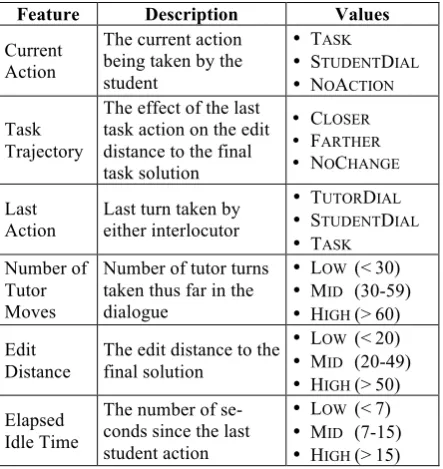
The states for the MDP consist of combina-tions of features representing the current state of the session. The possible features available for selection are described in Table 1, and are all automatically extracted from system logs. The Task Trajectory and Edit Distance features are based on computing a token-level edit distance from a student’s program with respect to that student’s final correct solution. This distance measures a student’s progress over the course of a dialogue while avoiding the need to manually annotate the task stream. In a deployed system,
this edit distance can be estimated by comparing to previously acquired solutions from other stu-dents.
Feature Description Values
Current Action
The current action being taken by the student
• TASK
• STUDENTDIAL • NOACTION
Task Trajectory
The effect of the last task action on the edit distance to the final task solution
• CLOSER • FARTHER • NOCHANGE
Last Action
Last turn taken by either interlocutor
• TUTORDIAL • STUDENTDIAL
• TASK
Number of Tutor Moves
Number of tutor turns taken thus far in the dialogue
• LOW (<30) • MID (30-59) • HIGH (>60)
Edit Distance
The edit distance to the final solution
• LOW (<20) • MID (20-49) • HIGH (>50)
Elapsed Idle Time
The number of se-conds since the last student action
[image:2.595.307.529.117.352.2]• LOW (<7) • MID (7-15) • HIGH (>15) Table 1. Features available to be selected
Tutor moves are encoded as MDP actions, while student actions are encoded as transitions to a new state with a NoMove tutor action. To account for the possibility that both interlocutors could construct messages simultaneously or that dialogue and task actions could happen at the same time, the following protocol was applied: if a tutor was making a dialogue move (i.e., typing a message), the state transition accompanying a student action was made after the tutor move was complete, and the student move was associated with that TutorMove action.
Another important consideration for this rep-resentation was how to segment the task stream into discrete actions. Through empirical investi-gation the timeout threshold of 1.5 seconds was selected as a balance between large numbers of successive task events or very few, most of which overlapped with tutor turns.
There were three additional states in the MDP: the Initial state and two final states, FinalHigh and FinalLow, occurring only at the end of a dia-logue and providing rewards of +100 and −100, respectively. A median split on student learning gains was used to assign each dialogue to either the FinalHigh state or FinalLow state.
4
Feature Selection
While retaining all six features would allow for a rich state representation, it would also lead to
issues with sparsity (Singh et al. 2002). In fact, nearly 90% of states averaged less than one visit per dialogue when using all six features, leading to inadequate coverage of the state space on which to build reliable MDP policies. This sec-tion compares two methods used to select fea-tures from among the six available.
The first approach is based on the Expected Cumulative Reward (ECR) in the initial state, a metric previously used to evaluate state represen-tations for a tutorial dialogue system using RL (Chi et al. 2011; Tetreault and Litman 2008). A higher initial-state ECR indicates a higher proba-bility of achieving a favorable outcome when following a reward-maximizing policy. Maxim-izing ECR has also been the focus of other fea-ture selection approaches for RL (Misu and Kashioka 2012, Li et al. 2009).
While initial-state ECR provides a measure of the likelihood of a favorable outcome, it does not address how well a particular state representation captures key decision points. That is, it does not directly represent the extent to which each deci-sion along the path to a successful outcome con-tributed to that outcome, or whether the second-best decision in a particular state would have been equally useful. In order to measure this dif-ference, we introduce the Separation Ratio (SR), which represents how much better a particular policy is compared to its alternatives. SR for a state is calculated by taking the absolute differ-ence between the estimated values of two actions in that state and dividing by the mean of the two values. SR for a policy is the mean of the SRs across all states.
An SR near zero for a state indicates that the decision to take one action over another in that state is likely to have little effect on the final out-come of the dialogue. On the other hand, a high SR indicates a crucial decision point, where tak-ing an off-policy action leads to a much lower probability of a successful outcome. The intui-tion behind this metric is that a state representa-tion that supports policies with high SR high-lights features that are useful in executing an ef-fective turn-taking policy, while a state represen-tation that produces policies with low SR fails to capture this information.
Using these two metrics, we evaluated the util-ity of each of the six features. Starting with two empty state representations, one for each metric, a greedy algorithm added one feature at a time to each. That is, at each step for each metric, the feature was added that led to the highest value on the metric when combined with the features
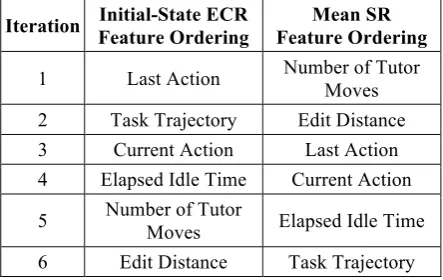
al-ready chosen. For each of the two metrics, we built a state representation and used it as the ba-sis for an MDP. This MDP was then trained with policy iteration (Sutton and Barto 1998), and the two state representations that led to the highest value on each metric were carried over to the next iteration. The goal here is to evaluate the relative utility of each feature, so we continued adding features until they were exhausted, lead-ing to a full orderlead-ing of features for each condi-tion (Table 2).
Iteration Initial-State ECR Feature Ordering
Mean SR Feature Ordering
1 Last Action Number of Tutor Moves
2 Task Trajectory Edit Distance
3 Current Action Last Action
4 Elapsed Idle Time Current Action
5 Number of Tutor
[image:3.595.306.528.220.360.2]Moves Elapsed Idle Time 6 Edit Distance Task Trajectory
Table 2. Feature selection using Expected Cumu-lative Reward (ECR) and Separation Ratio (SR)
A stopping criterion must balance two com-peting goals. On the one hand, the size of the state space must be limited to avoid issues with sparsity, as state-action pairs that are not well explored during training might not be assigned values proportional to their expected rewards in a deployed system. On the other hand, a feature space that is too small may not sufficiently repre-sent the possible states of the world, and might fail to capture the criteria most relevant to mak-ing decisions. These competmak-ing goals of com-pactness and descriptive power must both be considered when choosing an appropriate feature space for a RL model.
In an attempt to balance these goals, we pro-pose a stopping criterion based on the ratio of states that are sparse states. A sparse state is de-fined as any state that occurs less than once per dialogue on average. A sharp increase in sparse states was observed between the third and fourth iterations for both metrics (15% to 56% for ECR and 26% to 47% for SR), so feature addition stopped at the third iteration. This resulted in only one of the three selected features being shared among the two conditions: the Last Action made by either person (Table 2). In addition, both feature sets include a feature related to the task progress of the student: Task Trajectory for ECR and Edit Distance for SR. The next section reports on an experiment to evaluate these two feature spaces.
5
Evaluation
A series of simulated dialogues was used to evaluate the two resulting feature spaces via the policies derived using them. These simulations were based on five-fold cross-validation, as in prior work (Henderson et al. 2008), with policies trained on four of the five folds and simulated users learned from the remaining fold.
As noted above, the rewards in the MDP were based on student learning gain, but learning gain (like user satisfaction in other dialogue domains) is not directly observable during the dialogues. However, we found that students in the high learning gain group had fewer non-zero task ac-tions (acac-tions that changed the edit distance to the final task solution) than students in the low learning gain group (p < 0.05). Therefore, num-ber of non-zero task actions is used as a measure of dialogue success, with lower numbers being better. We derived the average change in edit distance on each state transition from the testing folds, and defined that a simulated dialogue
would end when the edit distance reached zero (i.e., the student arrived at the correct solution).
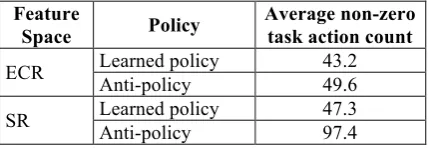
Table 3 shows the results of running 5,000 simulations in each fold for both the learned pol-icy and for an anti-polpol-icy where each decision was reversed. The anti-policy is included to pro-vide a point of comparison for the policies learned in each feature space, and offers insight into the quality of the learned policies, similar to the inverse policies learned in prior work (Chi et al. 2011). The table shows that the learned poli-cies in the ECR feature space had slightly better results overall (lower number of non-zero task actions), while the SR feature space had larger separation between the learned policies and anti-policies. These results suggest that feature selec-tion based on SR was able to identify important decision criteria with only a minor decrease in reward compared to ECR.
Feature
Space Policy
Average non-zero task action count
ECR Learned policy 43.2
Anti-policy 49.6
SR Learned policy 47.3
[image:4.595.309.524.320.395.2]Anti-policy 97.4
Table 3. Results of simulated dialogues (lower non-zero task action count is better)
6
Conclusion
Modeling unrestricted turn taking within an RL framework, particularly for task-oriented dia-logue with both a diadia-logue and a parallel task stream, presents numerous challenges. This pa-per has presented a novel representation of such dialogue with a tutoring domain, and has pre-sented and evaluated a feature selection method based on a new Separation Ratio metric, which can inform the development of turn-taking poli-cies in dialogue systems. Future work includes a more fine-grained analysis of the timing of dia-logue moves as well as an evaluation of these results in a deployed system.
Acknowledgements
This work is supported in part by the National Science Foundation through Grants DRL-1007962 and CNS-1042468. Any opinions, findings, conclusions, or recommendations expressed in this report are those of the participants, and do not necessarily represent the official views, opinions, or policy of the National Science Foundation.
References
Chi, M., VanLehn, K., Litman, D., and Jordan, P. (2011). An Evaluation of Pedagogical Tutorial Tactics for a Natural Language Tutoring System: a Reinforcement Learning Approach. International Journal of Artificial Intelligence in Educa-tion, 21(1), 83–113.
D’Mello, S.K., Olney, A., and Person, N. (2010). Mining Collaborative Patterns in Tutorial Dia-logues. Journal of Educational Data Mining, 2(1), 1–37.
English, M.S. and Heeman, P.A. (2005). Learning Mixed Initiative Dialog Strategies By Using Rein-forcement Learning On Both Conversants. In Pro-ceedings of the Conference on Human Language Technology and Empirical Methods in Natural
Language Processing, 1011–1018.
Forbes-Riley, K. and Litman, D.J. (2012). Adapting to Multiple Affective States in Spoken Dialogue. In
Proceedings of the 13th Annual SIGDIAL Meeting
on Discourse and Dialogue, 217–226.
Henderson, J., Lemon, O., and Georgila, K. (2008). Hybrid Reinforcement/Supervised Learning of Dialogue Policies from Fixed Data Sets.
Computa-tional Linguistics, 34(4), 487–511.
Li, L., Williams, J. D., and Balakrishnan, S. (2009). Reinforcement Learning for Dialog Management Using Least-Squares Policy Iteration and Fast Fea-ture Selection. In Proceedings of the Conference of
the International Speech Communication
Associa-tion. 2475–2478.
Misu, T., and Kashioka, H. (2012). Simultaneous Fea-ture Selection and Parameter Optimization for Training of Dialog Policy by Reinforcement Learn-ing. In Proceedings of the IEEE Workshop on
Spo-ken Language Technology, 1–6.
Raux, A. and Eskenazi, M. (2012). Optimizing the Turn-Taking Behavior of Task-Oriented Spoken Dialog Systems. Transactions on Speech and
Lan-guage Processing, 9(1), 1–23.
Selfridge, E.O., Arizmendi, I., Heeman, P.A., and Williams, J.D. (2012). Integrating Incremental Speech Recognition and POMDP-based Dialogue Systems. In Proceedings of the 13th Annual
SIG-DIAL Meeting on Discourse and Dialogue, 275–
279.
Shute, V.J. (2008). Focus on Formative Feedback.
Review of Educational Research, 78(1), 153–189.
Singh, S., Litman, D., Kearns, M., and Walker, M. (2002). Optimizing Dialogue Management with Reinforcement Learning: Experiments with the NJFun System. Journal of Artificial Intelligence
Research, 16, 105–133.
Sutton, R. and Barto, A. (1998). Reinforcement
Learning. MIT Press, Cambridge, MA, 1998.
Tetreault, J.R. and Litman, D.J. (2008). A Reinforce-ment Learning Approach to Evaluating State Rep-resentations in Spoken Dialogue Systems. Speech
Communication, 50(8), 683–696.
Williams, J.D. and Young, S. (2007). Partially Ob-servable Markov Decision Processes for Spoken Dialog Systems. Computer Speech & Language, 21(2), 393–422.
Appendix A. Corpus excerpt
1. Student begins declaring a String variable.
2. Student starts typing a message.
3. Student message: Could I type in String The Adventure Quest; ? or would I need to put in quotes or something?
4. Student resumes working on task.
5. Tutor starts typing a message.
6. Tutor message: TheAdventureQuest is fine
7. Student declares variable called The
Adven-ture Quest (Incorrect Java syntax)
8. Tutor starts typing a message.
9. Student catches mistake and renames variable to
TheAdventureQuest
10. Tutor message:Can't have spaces :)
11. Tutor starts typing a message