Rent Stability in the
Private Rented Sector
Final Report
Prepared for
The Housing Agency
on behalf of the
Private Residential Tenancies
Board
TABLE OF CONTENTS
EXECUTIVE SUMMARY ... I
1.
INTRODUCTION ... 1
1.1
E
CONOMICB
ACKGROUND... 1
1.2
P
URPOSE OFS
TUDY ANDT
ERMS OFR
EFERENCE... 2
1.3
L
AYOUT OFR
EPORT... 3
2.
POLICY BACKGROUND ... 4
2.1
O
VERVIEW OF THEP
RIVATER
ENTEDS
ECTOR... 4
2.2
PRTB
R
ENTI
NDEX... 8
2.3
A
FFORDABILITY IN THEI
RISHR
ENTALM
ARKET... 11
2.4
C
ONCLUSIONS... 12
3.
RENT STABILITY REGULATIONS ... 14
3.1
I
NTRODUCTION... 14
3.2
T
YPES OFR
ENTC
ONTROL... 14
3.3
E
CONOMICR
EVIEW OFR
ENTR
EGULATIONS... 15
3.4
R
ENTR
EGULATIONS INO
THERJ
URISDICTIONS... 19
3.5
C
ONCLUSIONS... 37
4.
RENT SUPPLEMENT AND THE PRIVATE RENTED SECTOR ... 38
4.1
I
NTRODUCTION... 38
4.2
R
ENTS
UPPLEMENT... 38
4.3
R
ENTL
IMITS... 41
4.4
I
SSUES WITHR
ENTS
UPPLEMENT... 45
4.5
A
DDITIONALS
TATEA
SSISTANCE FORL
OWI
NCOMEH
OUSEHOLDS... 47
4.6
C
ONCLUSIONS... 48
5.
TAXATION OF THE PRIVATE RENTED SECTOR ... 49
5.1
C
URRENTT
AXT
REATMENT OFL
ANDLORDS INI
RELAND... 49
5.2
T
AXI
SSUES FORL
ANDLORDS INP
RACTICE... 60
5.3
T
AX ISSUES FORT
ENANTS... 64
5.4
C
APITALT
AX FORP
RIVATER
ENTALS
ECTOR... 65
5.5
R
ISK ISSUES RET
AXI
NCENTIVES... 67
5.6
C
ONCLUSIONS. ... 67
6.
THE BUSINESS OF A LANDLORD ... 69
6.1
T
HEB
USINESS OF AL
ANDLORD... 69
6.2
A
RREARS IN THEB
UY-
TO-
L
ETS
ECTOR... 69
6.3
P
ROFESSIONALISING THER
ENTEDS
ECTOR... 74
6.4
C
ONCLUSIONS... 76
7.
APPROACHES TO RENT REGULATION IN IRELAND ... 77
7.1
I
NTRODUCTION... 77
7.2
O
PTIONS FORR
ENTR
EGULATION... 77
7.3
R
ENTR
EGULATIONS
CENARIOS... 81
7.4
P
OTENTIALI
MPACT OFR
ENTR
EGULATIONO
PTIONS... 85
7.5
L
EGAL BASIS FORR
ENTR
EGULATION INI
RELAND... 94
7.6
C
ONCLUSIONS... 96
8.
STRATEGIES FOR THE SECTOR ... 98
8.1
C
ONTEXT FORS
TRATEGIES... 98
8.3
P
ROTECTING THEE
XISTINGS
TOCK... 103
8.4
P
ROMOTINGI
NVESTMENT ANDS
UPPLY... 104
8.5
M
EDIUM TOL
ONGERT
ERMS
TRATEGIES... 106
8.6
S
UMMARY OFO
PTIONS... 107
APPENDIX 1: RENT SUPPLEMENT LIMITS ... 112
APPENDIX 2: RENT REGULATION SCENARIOS IN THE NATIONAL MARKET... 113
LIST OF FIGURES
F
IGURE:
1.1
T
REND INA
VERAGEP
RIVATER
ENTS IND
UBLIN AND ACROSS THES
TATE,
1995-2014E ...
IIF
IGURE:
2.1
T
OTALP
RIVATE HOUSEHOLDS BYN
ATURE OFO
CCUPANCY,
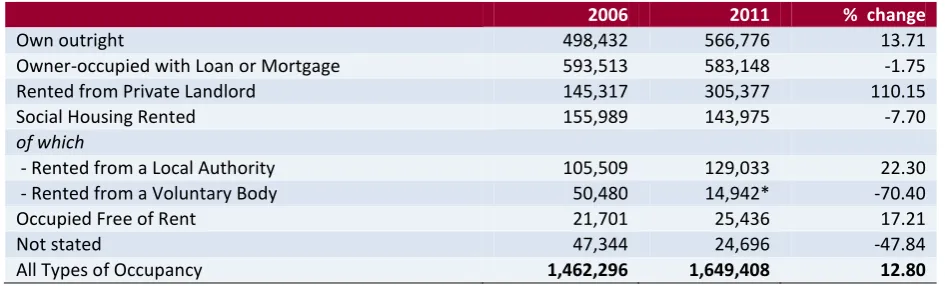
2006-2011 ... 4
F
IGURE:
2.2
D
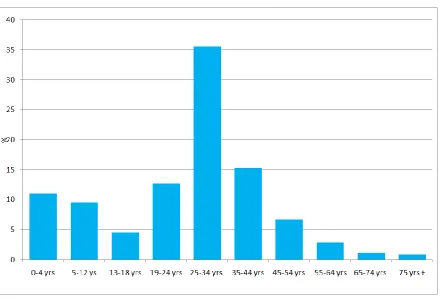
ISTRIBUTION OF PERSONS WITHIN THE PRIVATE RENTAL MARKET BYA
GE... 5
F
IGURE:
2.3
D
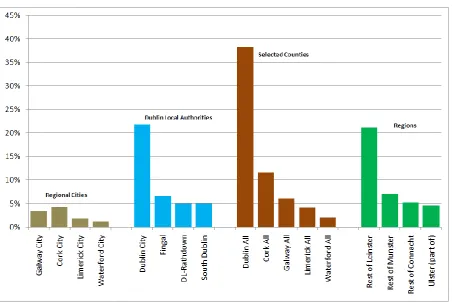
ISTRIBUTION OFP
RIVATER
ENTEDH
OUSEHOLDSA
CROSS THES
TATE... 6
F
IGURE:
2.4
P
ROPORTION OFD
WELLINGS INP
RIVATE ANDS
OCIALR
ENTEDS
ECTOR BYC
ITY ANDC
OUNTY... 7
F
IGURE:
2.5
PRTB
R
ENTI
NDEX,
N
ATIONAL,
D
UBLIN ANDO
UTSIDED
UBLIN(
EURO) ... 9
F
IGURE:
2.6
T
HEPRTB
R
ENTI
NDEX–
N
ATIONAL... 9
F
IGURE:
2.7
T
HEPRTB
R
ENTI
NDEX–
D
UBLINP
ROPERTIES... 10
F
IGURE:
2.8
T
HEPRTB
R
ENTI
NDEX–
P
ROPERTIESO
UTSIDED
UBLIN... 10
F
IGURE:
2.9
R
ENTS,
EURO PER MONTH,
Q1
2014 ... 11
F
IGURE:
2.10
A
FFORDABILITY IN THER
ENTALS
ECTOR... 12
F
IGURE:
4.1
T
RENDS INR
ENTL
IMITS IND
UBLINA
REAS2007
–
2013 ... 41
F
IGURE:
4.2
DSP
R
ENTL
IMITS FORC
OUPLE WITH3
C
HILDRENV
S35
THP
ERCENTILEPRTB
R
ENTS3
B
EDH
OUSE IND
UBLIN... 43
F
IGURE:
4.3
DSP
R
ENTL
IMITS FOR AC
OUPLE ANDS
INGLEP
ERSONV
S35
THP
ERCENTILEPRTB
M
ARKETR
ENTS1
B
EDA
PARTMENT IND
UBLIN... 43
F
IGURE:
4.4
DSP
R
ENTL
IMITS FORC
OUPLE WITH3
C
HILDRENV
S35
THP
ERCENTILEPRTB
M
ARKETR
ENTS3
B
EDH
OUSE ACROSS THEC
OUNTIES... 44
F
IGURE:
6.1
B
UY TOL
ETM
ORTGAGES INA
RREARS... 73
F
IGURE:
7.1
I
LLUSTRATION OFR
ENTC
ONTROLS USINGS
UPPLY ANDD
EMANDC
URVES... 77
F
IGURE:
7.2
T
REND INA
VERAGEP
RIVATER
ENTS ACROSS THES
TATE,
1995-2014E ... 80
F
IGURE:
7.3
R
ENTR
EGULATIONS
CENARIOS IN THED
UBLINM
ARKET,
2000-2014E ... 83
F
IGURE:
7.4
R
ENTR
EGULATIONO
PTIONS IN THED
UBLINM
ARKET:
NPV
OFM
ONTHLYR
ENTS OVER THE PERIOD2000-2014
IN2014 ... 88
F
IGUREA.2:
R
ENTR
EGULATIONS
CENARIOS IN THEN
ATIONALM
ARKET,
2000-2014E ... 113
LIST OF TABLES
T
ABLEA:
R
ENTR
EGULATIONO
PTIONS...
VIT
ABLEB:
S
UMMARY OFR
ENTR
EGULATIONO
PTIONS...
IXT
ABLEC:
S
UMMARY OFR
ENTS
TABILITYO
PTIONS...
XIIIT
ABLE2.1:
T
OTALP
RIVATEH
OUSEHOLDS BYN
ATURE OFO
CCUPANCY,
2006-2011 ... 4
T
ABLE2.2:
T
OTALP
RIVATER
ENTEDH
OUSEHOLDS BYT
YPE OFA
CCOMMODATION ANDP
OPULATION... 5
T
ABLE2.3:
S
IZE OFP
RIVATER
ENTEDS
ECTOR... 8
T
ABLE3.1:
P
OPULATION BYH
OUSINGT
ENURE FORS
ELECTEDJ
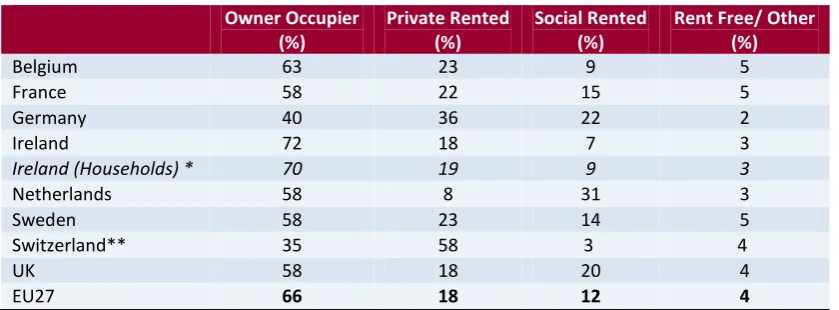
URISDICTIONS... 20
T
ABLE3.2:
I
NTERNATIONALO
VERVIEW OFR
ENTR
EGULATIONS... 21
T
ABLE4.1:
C
URRENTR
ATES OFS
UPPLEMENTARYW
ELFAREA
LLOWANCE,
2014 ... 39
T
ABLE4.2:
T
RENDS INN
UMBERS OFR
ECIPIENTS ANDE
XPENDITURE ON THER
ENTS
UPPLEMENTS
CHEME... 40
T
ABLE4.3:
D
ISTRIBUTION OFR
ECIPIENTS BYD
URATION ONS
CHEME2014 ... 40
T
ABLE4.4:
S
TATEE
XPENDITURE IN THEP
RIVATER
ENTEDS
ECTOR* ... 48
T
ABLE5.1:
E
FFECTIVET
AXR
ATES FORI
NDIVIDUALS* ... 49
T
ABLE5.2:
D
IFFERENCES IN THEC
OMPUTATION OFR
ENTALI
NCOMEC
HARGEABLE TOT
AX:
R
ESIDENTIALV
SN
ON-R
ESIDENTIALP
ROPERTY... 52
T
ABLE5.3:
E
FFECTIVET
AXP
OSITION FORL
ANDLORDS:
2007
V
S.
2014 ... 63
T
ABLE5.4:
T
AXD
EDUCTIONSA
LLOWABLE FOR THEP
RIVATER
ENTED SECTORI
NTERNATIONALLY... 63
T
ABLE6.1:
A
NNUALC
OSTS OFB
EING AL
ANDLORD... 70
T
ABLE6.2:
B
UY TOL
ETA
RREARS... 73
T
ABLE6.3:
S
TATUS OFM
ORTGAGER
EPAYMENTS FORB
UY-T
O-L
ETI
NVESTORS WHOP
URCHASED AP
ROPERTY IND
UBLIN IN2000,
2004
AND2007
ANDT
AXABLER
ENTALI
NCOME... 75
T
ABLE7.1:
R
ENTR
EGULATIONO
PTIONS... 78
T
ABLE7.2:
S
UB-I
NDICES USED FOR THEO
PERATINGC
OSTS FACED BYL
ANDLORDS... 79
T
ABLE7.3:
R
ENTR
EGULATIONO
PTIONS IN THED
UBLINM
ARKET:
I
MPACT ONR
ENTS,
2000-2014E ... 86
T
ABLE7.4:
R
ENTR
EGULATIONO
PTIONS IN THED
UBLINM
ARKET:
I
MPACT ONR
ENTS,
2000-2014E ... 86
T
ABLE7.5:
R
ENTR
EGULATIONO
PTIONS:
NPV
OFM
ONTHLYR
ENTS OVER THE PERIOD2000-2014
IN2014 ... 87
T
ABLE7.6:
B
UYT
OL
ETP
ROPERTIES:
M
ORTGAGEDA
NDO
WNEDO
UTRIGHT... 88
T
ABLE7.7:
P
ROFILE OFL
ANDLORDS WITHM
ORTGAGES... 89
T
ABLE7.8:
R
ENTR
EGULATIONO
PTIONS:
I
MPACT ONR
ENTS
UPPLEMENTC
OST INY
EAR1 ... 90
T
ABLE7.9:
R
ENTR
EGULATIONO
PTIONS:
S
UMMARY... 92
T
ABLE7.10:
L
EGAL ANDT
IMINGI
SSUES FORR
ENTR
EGULATIONO
PTIONS... 95
T
ABLE8.1:
S
UMMARY OFR
ENTS
TABILITYO
PTIONS... 108
GLOSSARY OF TERMS
ALUR Accès au Logement et un Urbanisme Rénové (Access to housing and urban renovation)
BTL Buy to Let
CGT Capital Gains Tax
CSO Central Statistics Office
DECLG Department of the Environment, Community and Local Government
DHCR Division of Housing and Community Renewal
DOF Department of Finance
DPER Department of Public Expenditure and Reform
DSP Department of Social Protection
ETPA Emergency Tenant Protection Act
FMR Fair Market Rent
HAP Housing Assistance Payment
HUD Housing and Urban Development
ITSP Interim Tenancy Sustainment Protocol
LHA Local Housing Allowance
LTV Loan to Value
MBR Maximum Base Rent
MIR Mortgage Interest Relief
NPPR Non-Principal Private Residence PPRR Principal Private Residence Relief
RAD Rental Accommodations Division
RAS Rental Accommodation Scheme
REIT Real Estate Investment Trust
SWA Supplementary Welfare Allowance
TCA Taxes Consolidation Act
TDR Test Discount Rate
ACKNOWLEDGEMENTS
This project has benefited from the generous contributions of time, information and insight from many individuals and organisations, too numerous to list here.
Particular thanks are due to the study Steering Group, the participants in the various consultations held with representative organisations, Government departments and industry experts and the personnel in the PRTB and Housing Agency who were our primary contact point during this study. In addition we would like to express our appreciation to the parties who provided written submissions for their input into this study.
Any errors or omissions in the report are solely the responsibility of the authors.
This document was prepared by:
DKM Economic Consultants Ltd., Office 6 Grand Canal Wharf, South Dock Road, Ringsend, Dublin 4, Ireland. Telephone: 00 353 1 6670372. Email: [email protected]. Website: www.dkm.ie
i
EXECUTIVE SUMMARY
This report sets out to examine the potential for rent regulation in an Irish context should a political decision be made in favour of rent regulation
This is the first of two studies on the private rented sector which considers short term and medium to long term options to address the recent escalation in rents, predominantly in the Dublin area1. It examines a range of issues in regard to rent stability; including the current tax treatment of the rental sector, the potential for indexation of Rent Supplement and the potential for rent regulation in an Irish context should a political decision be made in favour of rent regulation. The findings are informed by a comprehensive review of rent regulation in other jurisdictions with a developed private rented sector, which examines how they are administered, the pros and cons of different approaches and their impacts.
Approximately one in five households now renting their home in the private rented sector
The rented sector has grown considerably in recent years, almost doubling in size between 2006 and 2011, with approximately one in five households now renting their home in the private rented sector. Increasingly the sector is providing housing for a wide range of households, including households who have postponed house purchase due to a variety of reasons, and others who have lost their homes during the recession, as well as students and individuals and households who choose to rent by choice. The sector also provides homes for those whose rents are paid for by the State through the Rent Supplement and Rental Accommodation schemes.
As a result the demands on the private rented sector have increased substantially in recent years with the result that the current most pressing problem is how to increase the supply of private housing for rent, particularly in urban areas and most notably in Dublin. However, the underlying assumption is that the level of supply of rented accommodation or social housing will not increase in the short-term and some ‘quick-win’ solutions are required in the interim to address the recent escalation in rents in Dublin. This is giving rise to significant difficulties for vulnerable households in the Dublin area, a number of whom are being squeezed out of their homes.
The escalation in rents in a Dublin phenomenon with a clear divergence between the performance of rents in Dublin and in the rest of the country
The impact of the economic recession on rent levels is apparent from the PRTB Rent Index data which shows that average rents across the State declined from a value of €1,020 in Q4, 2007 to €762 in Q1, 2013 or by 25.3 per cent. However, rents have been increasing again since 2013 and by Q1 2014 had increased by 3.5 per cent year on year. Rents nationally in Q1 2014 amounted to €788 per month which is in line with levels last seen in 2000.
In Dublin, the peak to trough decline in average monthly rents was 26 per cent, with rents down from a value of €1,325 in Q4, 2007 to €980 in Q4, 2012. Dublin rents began to recover during 2012 with the annual rate of increase accelerating throughout 2012 and 2013. By Q1 2014 average rents in Dublin were increasing by 8.4 per cent. Rents in Dublin amounted to €1,107 per month in Q1 2014 which is in line with 2009 levels. Using the monthly CSO longer time series for private rents in urban areas, average rents were up by 9.2 per cent in the first seven months of 2014.
In contrast outside Dublin, the PRTB index shows the annual growth in monthly rents is much more subdued, recording growth of 0.8 per cent in Q1, 2104 when compared with Q1, 2013.
1
ii
Figure: 1.1Trend in Average Private Rents in Dublin and across the State, 1995-2014EAffordability differs depending on whether you are renting in Dublin or outside Dublin, and whether you are renting as a single person or as a couple, where both are working
The analysis of affordability suggests that renting as a single person in the Dublin market is not affordable and has not been so for some time. A single person on average earnings of €36,000 paying the monthly rent of €957 for a 1 bed apartment in Dublin would be allocating 41 per cent of net income to the cost of renting. This is the highest proportion of income allocated to rent since 2008, when rents were at their peak.
Assuming gross earnings are around 70 per cent below the average for a single person (€25,000), affordability would be closer to 55 per cent, which is well above what is deemed to be a sustainable rent (30 per cent of net income). Although affordability for lower income individuals, irrespective of their sector of work would be higher, the likelihood is that single income workers would share with other persons, although this may not always be possible or desirable for some individuals.
Households earning below the average income are also facing affordability problems in the main cities, most notably Dublin, as competition from medium and high income households is squeezing them out of the market plus there is an inadequate supply of housing at rents these lower income households can afford.
Market failure in the housing sector generally refers to a situation where there is an inefficient allocation of resources
iii
The main rationale generally put forward for regulating rents is due to the inadequate housing supply to meet a growing demand, with the associated price escalation negatively impacting on tenants, particularly those on lower income and in receipt of Rent Supplement.Market interventions in the form of rent control have evolved over time
First Generation Rent Controls introduced during the World Wars sought to mitigate the negative impacts of a shortage of housing by essentially imposing a freeze on rents.
Due to the negative impacts associated with First Generation Rent Controls, many jurisdictions subsequently amended the regulations to Second or Third Generation Rent Controls or in some cases there was a complete reversal of these policies.
Second Generation Rent Controls, which permit allowable increases in rent levels or Third Generation Rent Controls, which involve the control of rent increases within tenancies and tenancy decontrol between tenancies, are the most common forms of regulation found today.
The theoretical justification for rent regulation is relatively weak and is attributed to the unintended consequences which arise for tenants
The practice of changing regulations in response to market failure does not address the underlying cause of the problem, namely a lack of supply. Moreover the potential for negative impacts arising from rent regulation can include black market transactions, lower quality housing, reduced mobility and more importantly a negative impact on new and existing supply.
It is recognised, even with ‘perfect’ third-generation regulation, which in principle can benefit both landlords and tenants, that there is likely to be a negative impact on supply.
Any assessment of the performance of rent regulation in isolation from the overall intricacies of the wider housing market is tenuous
Recent research on rent regulation by the European Commission acknowledged that the rented sector sits in a broader framework of the housing market and advised policymakers, considering setting controls on both rent levels and rent increases, to bear in mind their broader implications for housing market stability. The Commission stated that such regulations should be considered within the context of existing incentives, subsidies, taxation, the attractiveness of other tenures and other relevant financial regulatory measures.
Of the jurisdictions reviewed, it is evident that regulations have had varying effects on the individual markets, which in many cases have reflected the stringency of the regulatory environment as well as government policy within the jurisdictions.
It is apparent that those jurisdictions that have strong rent regulations and a strong private rented sector also have an equitable taxation system in place and in some cases generous depreciation allowances, fiscal benefits and subsidies to promote investment.
Other factors have also played a role in the performance of the private rented sector. Access to credit and low interest rates have been a factor in attracting investors to the sector, while the efficiency of the planning process has also been noted as a key factor in attracting investment and, in some jurisdictions, a factor in the lack of construction.
iv
A key feature in the delivery of social housing has been the emergence of Rent Supplement in the provision of long term housing support The Housing (Miscellaneous Provisions) Act 2009 specifically sets out the role of the private rented sector in supporting social housing. This support is provided mainly through the Rent Supplement scheme, the Rental Accommodation Scheme (RAS) and through the leasing initiatives by housing authorities and approved housing bodies. The recent introduction of the Housing Assistance Payment (HAP), which is currently being piloted in Limerick, will also see the private rented sector continue to play a key role in the future of social housing provision.
There are currently 74,000 persons on Rent Supplement which costs the State €344m in 2013. A total of 43,000 of these recipients are waiting to move over to the Housing Assistance Payment. It is clear that the Rent Supplement Scheme, contrary to its objectives, as a short term income support, is now being used for people who have a long-term housing need, with 57 per cent of recipients receiving Rent Supplement for more than 18 months.
Given the role now being played by Rent Supplement in meeting long term housing need, it is unsurprising that the number of recipients and the overall cost of the Scheme have increased in the past decade, albeit this has been alleviated somewhat in recent times.
The decline in costs and numbers is primarily due to the slow economic recovery, the continued migration of long term recipients to the Rental Accommodation Scheme (RAS), the realignment of the minimum contribution to the Differential Rents offered by local authorities2 and from rent limit reviews.
The maximum rent limits reflect the national av erage proportion of Rent Supplement tenancies in the private market
Rent limits provide a benchmark for the Department’s staff in their respective areas; however these can be adjusted to reflect local market conditions and the circumstances of recipients.
Other jurisdictions also operate similar methodologies in setting rent assistance payments albeit there are some differences, most notably; limits are reviewed once a year or more often in other jurisdictions, there are penalties for over-consumption of housing (UK) while the rental assistance payment does not affect the amount of rent a tenant wishes to pay for accommodation (USA and UK).
A number of analyses of Rent Supplement rent limits relative to the 35th percentile of market rents suggest that rent recipients seeking accommodation are likely to find it increasingly challenging in sourcing accommodation within the rent limits for certain areas of Dublin. However, this appears to be largely confined to the Dublin area and undoubtedly reflects the wider issue of a lack of supply in the Dublin market.
It is acknowledged that a short-term temporary measure has been put in place, notably the Interim Tenancy Sustainment Protocol (ITSP)3, to help family households in Dublin who can no longer afford their Rent Supplement accommodation. There is already an existing measure under Article 38 of the Social Welfare Regulations 2007 which allows payments to be made in exceptional cases to Rent Supplement claimants across all household types.
Notwithstanding the above for Rent Supplement recipients, it must also be acknowledged that there are currently no measures in place to help low-income households who are in employment and are not receiving any form of State support but need to be accommodated in the private rented sector.
2
This has meant that an individual is being asked to pay more for their Rent Supplement dwelling than in the past. However, Minimum Contribution levels are still on the whole below the costs of differential rents
3 It is understood that a Tenancy Protection Service operated by Threshold on behalf of the four Dublin local authorities has received over
v
The mortgage arrears problem is one of the biggest remaining challenges from the financial crisis A feature of the Irish rental market in the Celtic Tiger era was that the main factor which motivated investors in the buy to let sector was future price growth. However, with the benefit of hindsight, neither high yields nor high capital growth have materialised for investors who bought buy to let properties in the past decade. Their situation has been further compounded by the adverse changes in taxation since 2007.
The mortgage arrears problem is one of the biggest remaining challenges from the financial crisis which is having an impact on tenants. There were 39,669 BTL loan account in arrears at the end of June 2014 out of a total of around 144,000 BTL mortgage accounts. This figure represents 27.5 per cent of the total BTL mortgage loan accounts or 13 per cent of the total estimated stock of 305,377 units (Census 2011) rented from private landlords. With 144,187 BTL mortgage accounts, this would imply that 104,518 are not in arrears and 161,190 or almost 53 per cent have no mortgage.
Many of these loan accounts originated between 2003 and 2008, with 2006 accounting for the largest proportion in this group. The BTL sector also has a high concentration of interest-only mortgages, particularly in Dublin, 82% of which are in negative equity. A pressing issue for the buy to let sector is that a significant number of BTL mortgages due to revert to principal and interest repayments in the next twenty four months may further fuel the arrears problem, notwithstanding the improving macroeconomic situation.
The capacity of rents to meet the much higher principal and interest repayments is an issue which either requires a quick resolution of the BTL arrears or higher rents, which in some cases may be very high and thus have adverse consequences for tenants. Equally the introduction of rent regulations in such a scenario could lead to further arrears. There is a further risk for those investors in arrears if mortgage interest rates begin to rise anytime soon. All of these issues have adverse implications for the supply of rented housing.
Currently there are no resolution strategies in place for buy to-let (BTL) mortgages, which in many cases is negatively impacting on tenants where properties are in receivership.
The fiscal changes in the period between 2007 and 2014 have increased substantially the tax burden on the part of landlords
The fiscal changes in the period between 2007 and 2014 have increased substantially the tax burden on residential landlords, particularly for those landlords with borrowings taken out in relation to the purchase of investment properties. The restriction on deductions and increased tax [including USC and local property taxes] charges may justify increases in gross rents of approximately 20% to 24%, depending on the personal circumstances of a landlord.
The tax regime for landlords investing in the residential investment sector is in the main less favourable than for inve stors in commercial investment property.
The main disadvantages arising are in relation to investors of residential investment property who are seeking to utilise borrowings to assist with the purchase of such properties. An interest deduction of 75% as against 100% for the commercial rental sector is the main disadvantage, although the lack of deduction for local property taxes also represents a less favourable position for landlords.
vi
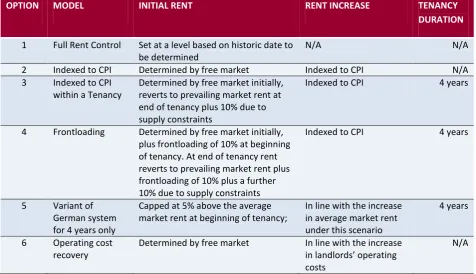
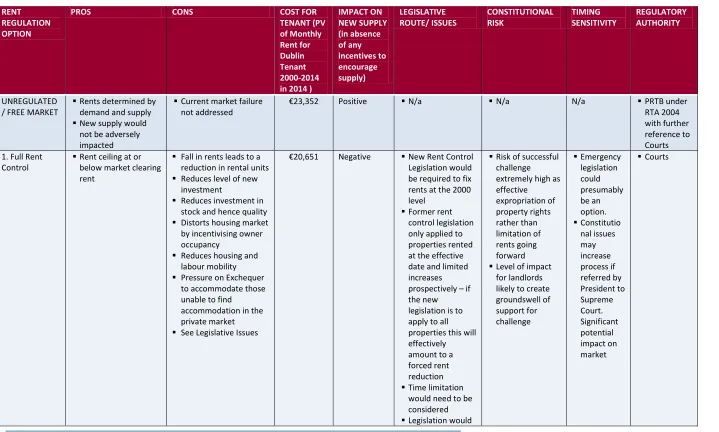
The medium and long term consequences of capping rents under any rent regulation option may eventually give rise to higher rents in the free market when the market becomes deregulated, due to the potential negative impact on supply [image:13.595.66.543.199.473.2]A total of six rent regulation options to address the issue of rent stability were examined in an Irish context, based on rent stability regulations in place in other jurisdictions. These are summarised below in Table A and Table B sets out their pros and cons and their expected cost to the Exchequer, where these can be determined.
Table A: Rent Regulation Options
OPTION MODEL INITIAL RENT RENT INCREASE TENANCY
DURATION
1 Full Rent Control Set at a level based on historic date to be determined
N/A N/A
2 Indexed to CPI Determined by free market Indexed to CPI N/A
3 Indexed to CPI
within a Tenancy
Determined by free market initially, reverts to prevailing market rent at end of tenancy plus 10% due to supply constraints
Indexed to CPI 4 years
4 Frontloading Determined by free market initially,
plus frontloading of 10% at beginning of tenancy. At end of tenancy rent reverts to prevailing market rent plus frontloading of 10% plus a further 10% due to supply constraints
Indexed to CPI 4 years
5 Variant of
German system for 4 years only
Capped at 5% above the average market rent at beginning of tenancy;
In line with the increase in average market rent under this scenario
4 years
6 Operating cost
recovery
Determined by free market In line with the increase
in landlords’ operating costs
N/A
The impacts of the regulation were assessed against the trajectory of rents in the free market by looking back retrospectively in the 2000-2014 period to ascertain what would have transpired for rents in Dublin had some form of rent regulation been introduced at that time. The regulated rents derived under each option represent the maximum rents landlords would charge. However, the market and macroeconomic conditions may be such that the actual regulated market rent may, in terms of what tenants are willing to pay, be below this maximum level.
The period under consideration captures the unprecedented boom in the housing market and the catastrophic bust which followed post 2007. The level of new housing supply increased from around 50,000 in 2000 to over 93,000 at the peak (2007). With 25 per cent of all residential mortgages going to investors in the period 2005-20084, the outturn for housing supply in a rent regulated market could have been very different.
The likelihood is that the immediate announcement of rent regulation would give rise to the expectation amongst landlords that regulated rents would be lower than what they would otherwise be. The analysis shows that, in reality, that this may not always be the case.
Average regulated rents in the short term (2000-2003) increase under all six options by less than the free market rent, albeit marginally, with option 6 (operating cost recovery) increasing by the least amount (3.8%). However, the medium and long term consequences of capping rents under either option may eventually give rise to higher rents in the market when the market becomes deregulated, due to the
4
vii
potential negative impact on supply. The latter assumes there are no corresponding measures to protect the existing stock and encourage new supply during the regulated period. Overall the annual average percentage change in actual rents over the full period was 0.8 per cent. The corresponding percentage changes are higher in all other Options. However looking at the increase in regulated rents in each four year tenancy: under options 3 and 4 average rents increase by 4.3 per cent per annum in the first four years (2000-2003), 3.8 per cent in the second four years (2004-2007) and fall by 1 per cent per annum in the third four year tenancy (2008-2011). As rents return to the prevailing market rent at the end of each tenancy and assuming there is a reduction in supply, there is a 10 per cent increase in each tenancy decontrol period.
Average regulated rents in the short term (2000-2003) increase under all options by less than in the unregulated or free market, albeit marginally, with Option 6 increasing by the least amount (3.8%).
In an assessment of regulated rents versus the unregulated or free market, regulated rents under options 2, 4 and 6 are almost always higher than the free market while rents under option 3 and 5 are higher than the free market from 2004 onwards.
Rent regulations should lead to a decrease in rents, increasing the attractiveness for tenants and thus boosting demand
Tenants are protected against sharp increases in rents and tenure security should be enhanced. The reduced rents, however, result in a reduced supply of rental accommodation due to the impact on landlords’ profitability and on rental yields. The size of the rental stock should be lower as a result, a development which would keep upward pressure on rents, notwithstanding the regulation in place.
None of the options generate a better outcome for the tenant (in present value terms) compared with the unregulated or free market. Option 2 is very close to the free market option with the other options, 3, 5, 6 and 4, in that order, generating higher present values than the free market, leaving the tenant worse off under these options, particularly under option 4. Conversely the best option for the landlord would be option 4, where the maximum income is generated; the worst options being the free market, where the least income is generated (excluding the full rent control option).
The overriding concern in the Irish market is that any form of rent regulation could potentially reduce the supply and quality o f rented accommodation and thus distort the market further, in the absence of any incentives to stimulate supply
The impact of rent regulation on supply is uncertain as in any dynamic housing market there will be a range of diverse factors which impact on housing demand and supply. However an analysis of the supply impacts under each option shows that potentially between 52,000 and 89,000 rented properties could exit the sector over time due to the impact on net yields for landlords. Rents tend to be higher the greater the contraction in supply, due to black market transactions.
The introduction of rent regulation would also affect the efforts to attract new investment in the Irish rented sector, for example as rent regulations would reduce property values and would impact on the pricing equation for foreign investors and their banks. This could lead to a further recapitalisation being required by banks by increasing the write-downs they would have to take on their BTL portfolios.
Options for achieving ren t stability and certainty
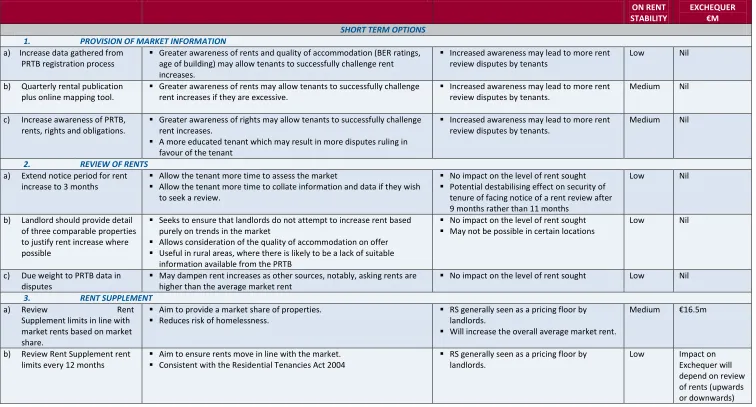
In addition to consideration of the potential for rent regulation, a set of policy options are set out to achieve greater rent stability and certainty in the Irish market. These other measures are focused on
Providing better information to ensure the sector is more informed,
Improving the situation with respect to the review of rents and the determination of Rent Supplement limits,
viii
Protecting the existing stock, Increasing the supply of rental properties, and
Providing targeted tax incentives.
Table C overleaf set out the options, their pros and cons and impacts where these can be determined.
Cost of Tax Incentive and Rent Stability Measures vers us Savings from Rent Regulation
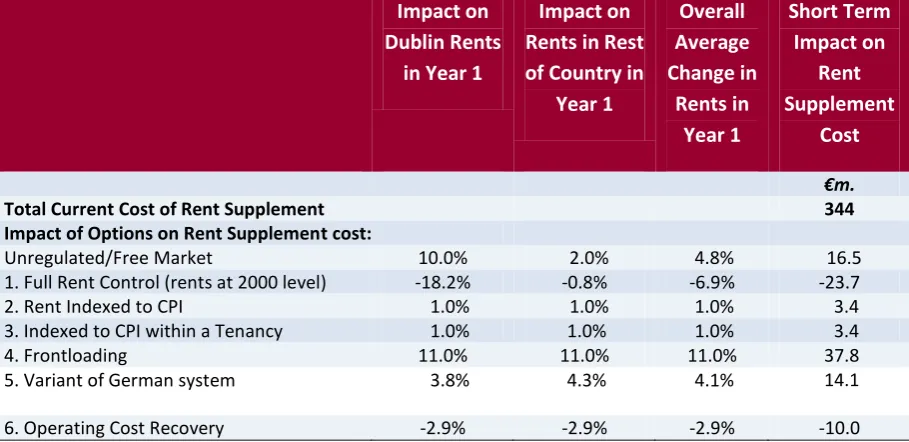
Table D summarise the relative costs to the Exchequer of the various rent stability options against the savings generated by the introduction of some form of rent regulation. The total cost, assuming Rent Supplement is increased in line with the free market, is estimated at €16.5m. Taking the cost impact on Rent Supplement under each rent regulation option, the total savings versus the free market are ascertained. The savings range from €23.7m under the full rent control option to an additional cost of €37.8m under the frontloading option. This higher cost reflects the increase of 11 per cent in regulated rents in the first year under the frontloading option. The lowest impact arises for options 2 and 3, with a cost of €3.4m reflecting the current historically low rate of inflation of 1 per cent. With Option 6, following a review of the latest components of the operating cost index using the CSO indices, operating costs have declined by 2.9 per cent in the seven months to July 2014. Assuming an annual decline of the same magnitude would generate a saving in Rent Supplement of €10 million.
TABLE D: RELATIVE COST FOR EXCHEQUER OF TAX INCENTIVES AND OTHER RENT STABILITY MEASURES VS. SAVINGS FROM RENT REGULATION IN A FULL YEAR
Impact on
Dublin Rents
in Year 1
Impact on
Rents in Rest
of Country in
Year 1
Overall
Average
Change in
Rents in
Year 1
Short Term
Impact on
Rent
Supplement
Cost
€m.
Total Current Cost of Rent Supplement 344
Impact of Options on Rent Supplement cost:
Unregulated/Free Market 10.0% 2.0% 4.8% 16.5
1. Full Rent Control (rents at 2000 level) -18.2% -0.8% -6.9% -23.7
2. Rent Indexed to CPI 1.0% 1.0% 1.0% 3.4
3. Indexed to CPI within a Tenancy 1.0% 1.0% 1.0% 3.4
4. Frontloading 11.0% 11.0% 11.0% 37.8
5. Variant of German system 3.8% 4.3% 4.1% 14.1
6. Operating Cost Recovery -2.9% -2.9% -2.9% -10.0
Summary
[image:15.595.70.525.356.577.2]ix
Table B: Summary of Rent Regulation OptionsRENT REGULATION OPTION
PROS CONS COST FOR TENANT (PV of Monthly Rent for Dublin Tenant 2000-2014 in 2014 )
IMPACT ON NEW SUPPLY (in absence of any incentives to encourage supply) LEGISLATIVE ROUTE/ ISSUES CONSTITUTIONAL RISK TIMING SENSITIVITY REGULATORY AUTHORITY UNREGULATED / FREE MARKET
Rents determined by demand and supply
New supply would not be adversely impacted
Current market failure not addressed
€23,352 Positive N/a N/a N/a PRTB under RTA 2004 with further reference to Courts 1. Full Rent
Control
Rent ceiling at or below market clearing rent
Fall in rents leads to a reduction in rental units
Reduces level of new investment
Reduces investment in stock and hence quality
Distorts housing market by incentivising owner occupancy
Reduces housing and labour mobility
Pressure on Exchequer to accommodate those unable to find accommodation in the private market
See Legislative Issues
€20,651 Negative New Rent Control Legislation would be required to fix rents at the 2000 level
Former rent control legislation only applied to properties rented at the effective date and limited increases prospectively – if the new legislation is to apply to all properties this will effectively amount to a forced rent reduction
Time limitation would need to be considered
Legislation would
Risk of successful challenge extremely high as effective expropriation of property rights rather than limitation of rents going forward
Level of impact for landlords likely to create groundswell of support for challenge
Emergency legislation could presumably be an option.
Constitutio nal issues may increase process if referred by President to Supreme Court. Significant potential impact on market
x
need to include specific calculation tools of 200 rent levels. 2. Rent Indexed
to CPI
Rent certainty for tenants
Allows landlords' costs to keep pace with inflation
Generated the highest annual rate of increase in the short-term
Rents higher in every year relative to the free market in 2000-2014
Lower inflation target in immediate future would generate poor returns for landlords
Rents in 2014 would be back to their peak levels in 2008
Landlords costs may increase in excess of the rate of inflation
Reduces quality of existing stock
Lead to some landlords exiting the sector
Reduces new entrants
€26,252 Negative Could be addressed by amendments to RTA 2004 (under current proposed Residential Tenancies legislation)
Benchmark from which increases apply would need to be set
Risk of challenge low
As above PRTB with further reference to the Courts
3. Indexed to CPI within a Tenancy
Rent certainty within a tenancy for tenants
Encourages tenants to take longer leases than the current 18 months
Lower maintenance costs for landlords
Lower tenant turnover
Biased tenant selection by landlords
Lead to some landlords exiting the sector
Reduces new entrants
€27,210 Negative Could be addressed by amendments to RTA 2004 (under current proposed Residential Tenancies legislation
Question of security of tenure would have to be addressed to be effective
Risk of challenge low subject to terms of security of tenure provisions
xi
4. Frontloading Rent certainty within a tenancy for tenants
Higher initial rents
Rents are always higher than the free market
Two-tier system as long term renters can pay less than new renters
Lower tenant turnover
Discourages labour mobility
Lead to an inefficient labour market
Misallocation of house types
Landlords seek to rent to short term tenants
Lead to some landlords exiting the sector
Reduces new entrants
€29,932 Negative Could be addressed by amendments to RTA 2004 (under current proposed Residential Tenancies legislation
Question of security of tenure would have to be addressed to be effective.
Risk of challenge low subject to terms of security of tenure provisions
As above PRTB with further reference to the Courts
5. Variant of German system
Initial rents capped at 5% above the market rent
Average rents recorded the highest rate of increase under this system, assuming it is in place indefinitely; however, more likely to be a short-term solution, assuming supply constraints are addressed;
Landlords can discriminate against tenants favouring tenants who have more secure and stable employment
May discourage renting to vulnerable low income tenants or those on Rent Supplement/HAP
Lead to some landlords exiting the sector
Reduces new entrants
€28,652 Negative Could be addressed by amendments to RTA 2004 (under current proposed Residential Tenancies legislation
Question of security of tenure would have to be addressed to be effective
Localised approach would also have to be factored in to legislation
Risk of challenge low subject to terms of security of tenure provisions
xii
6. Operating Cost Recovery
Positive measure for landlords
Landlords are faced with different operating costs
Does not provide rent certainty
Market rents are highest under this option
May not fully cover all operating costs as an average index only
Does not allow for any profit
€28,672 Positive Could be addressed by amendments to RTA 2004 (under current proposed Residential Tenancies legislation
Risk of challenge negligible
xiii
Table C: Summary of Rent Stability OptionsRENT STABILITY OPTION PROS CONS IMPACT
ON RENT STABILITY
COST TO EXCHEQUER
€M
SHORT TERM OPTIONS
1. PROVISION OF MARKET INFORMATION
a) Increase data gathered from PRTB registration process
Greater awareness of rents and quality of accommodation (BER ratings, age of building) may allow tenants to successfully challenge rent increases.
Increased awareness may lead to more rent review disputes by tenants
Low Nil
b) Quarterly rental publication plus online mapping tool.
Greater awareness of rents may allow tenants to successfully challenge rent increases if they are excessive.
Increased awareness may lead to more rent review disputes by tenants.
Medium Nil
c) Increase awareness of PRTB, rents, rights and obligations.
Greater awareness of rights may allow tenants to successfully challenge rent increases.
A more educated tenant which may result in more disputes ruling in favour of the tenant
Increased awareness may lead to more rent review disputes by tenants.
Medium Nil
2. REVIEW OF RENTS
a) Extend notice period for rent increase to 3 months
Allow the tenant more time to assess the market
Allow the tenant more time to collate information and data if they wish to seek a review.
No impact on the level of rent sought
Potential destabilising effect on security of tenure of facing notice of a rent review after 9 months rather than 11 months
Low Nil
b) Landlord should provide detail of three comparable properties to justify rent increase where possible
Seeks to ensure that landlords do not attempt to increase rent based purely on trends in the market
Allows consideration of the quality of accommodation on offer
Useful in rural areas, where there is likely to be a lack of suitable information available from the PRTB
No impact on the level of rent sought
May not be possible in certain locations
Low Nil
c) Due weight to PRTB data in disputes
May dampen rent increases as other sources, notably, asking rents are higher than the average market rent
No impact on the level of rent sought Low Nil
3. RENT SUPPLEMENT
a) Review Rent Supplement limits in line with market rents based on market share.
Aim to provide a market share of properties.
Reduces risk of homelessness.
RS generally seen as a pricing floor by landlords.
Will increase the overall average market rent.
Medium €16.5m
b) Review Rent Supplement rent limits every 12 months
Aim to ensure rents move in line with the market.
Consistent with the Residential Tenancies Act 2004
RS generally seen as a pricing floor by landlords.
xiv
c) Extend the Interim Tenancy Sustainment Protocol (ITSP)
Increases security of tenure for tenants
Will reduce homelessness
Aligned with Section 38 of the DSP Social Welfare Regulations 2007
No impact on the level of rent sought Low Only in place since June 2014
4. TAX INCENTIVES FOR RENT SUPPLEMENT/HAP TENANCIES
a) CGT relief for landlords where letting for minimum of 5 years to Rent Supplement/HAP tenants – Relief will be for time of letting to tenant – not absolute exemption
Provides incentive to let to HAP tenants Might not have perceived benefit for landlords who bought since 2004 due to property price deflation
Medium Cost depends on a number of factors but is deferred.**
b) 100% Interest Relief on borrowings for landlords letting for minimum of 5 years to Rent Supplement/HAP tenants
Provides incentive to let to HAP tenants Unavailable to landlords who have no borrowings
May distort market in favour of HAP tenants
Medium €27.5m
5. INCREASE SUPPLY OF RENTAL PROPERTIES
a) Extension of Living City Initiative to Landlords
Areas covered by relief are perhaps very suitable for provision of rental residential accommodation
Extension of relief to investors into sector may allow for access to existing disused stock that is not compliant with housing regulations.
Focus is on cities where there is a shortage of supply.
Allows conversion of non-residential dwellings into residential uses
EU State aid approval required – this is ongoing for existing scheme
Low €17M annually net cost
b) Rent a Room relief Revenue has indicated that there may be 4,073 claimants of relief based on review of Forms 11 and 12. Information likely to be incomplete
Potential short term immediate supply response.
Incentivise use of space in existing properties in the short term until the supply side is addressed.
No reduction in limits proposed but more information required to be publicised.
Tenants not subject to Residential Tenancies Act 2004
Tax free threshold has the potential to limit the rate of increase in rents.
High NIL
c) Reduce commercial rates for residential units above commercial premises
Encourages use of overhead premises for residential purposes
Focus would be on cities where there is a shortage of supply.
xv
– then LPT might provide some compensation. d) Reduce VAT on new housing
construction as opposed to sale from 13.5% to 9% for a 2 year period.
Time limitation to provide incentive to increase supply.
This form of incentive has shown to be successful in hospitality sector.
EU rules to be considered – may not be possible.
Supply side measure like this may be undermined by lack of bank funding for investors/ lack of investor appetite
Medium Cost – €40m to €60m in a full year depending on new house completions.
6. PROTECTING EXISTING STOCK
a) Code of Conduct on BTL mortgage arrears:
Set out the rules of engagement between the lender and the landlord and tenant.
Fully adhere to the requirement of the Residential Tenancies Act 2004.
Ensure that the requirements of landlord and tenant law become an explicit consideration in the receivership and repossession processes.
Safeguard the private rented sector from volatility arising from a higher scale of repossessions and receiverships.
Legislative implications of recommendations Low
7. VOLUNTARY RENT CERTAINTY LEASE
a) Introduce Rent Certainty Lease Rent certainty
Voluntary arrangement between tenant and landlord
Less voids for landlord
Assists long term renters.
Information needs to be publicised.
May reduce mobility in the sector.
May require supply incentives.
High
8. OTHERS
a) Freeze removal of tenant’s Tax Relief for low income tenants at 2013 levels to 2017
Provides small measure of relief to low income tenants who are suffering rent increases
May have little real impact on affordability as worth €200 to €400 per annum – higher for individuals over 55.
Low €10.2m
9. MEDIUM – LONG TERM OPTIONS
a) Restore full Interest Relief on borrowings to 100%
This is to incentivise investors into the market by non-cash buyers/ funds
To equalise the tax treatment with the commercial sector
Cost and current budgetary constraints are the main downsides
May encourage property price appreciation.
Medium €112M per annum per comments from DOF, based on Revenue study of 2012.
b) Implement supply side measures in Construction 2020
Should promote new supply Medium N/A
c) Clear funding strategy for the non-profit housing sector
1
1.
INTRODUCTION
1.1
ECONOMIC BACKGROUND
Following the costly lessons of a housing policy which promoted and almost enticed people into home ownership for over a decade until 2007, the Government’s Housing Policy Statement of June 20115 firmly recognises the need for a new vision for the future of the housing sector in Ireland. The vision set out is to be one based on choice, fairness, and equity across tenures and on delivering quality outcomes for the resources invested. The overall strategic objective is “to enable all households access good quality housing appropriate to household circumstances and in their particular community of choice.” While home ownership will continue to be the tenure of choice for the majority of households, the policy statement recognises that a balanced housing sector needs a strong and well-regulated private rented sector.
Important steps have and are being taken to deliver on this objective. These have included the establishment of the Private Residential Tenancies Board (PRTB) under the Residential Tenancies Act of 2004, the creation of security of tenure and the introduction and enforcement of higher minimum accommodations standards. The Residential Tenancies (Amendment) (NO.2) Bill 20126 which is currently before the Oireachtas, will cater for the incorporation of tenancies in the voluntary and cooperative sectors within the remit of the PRTB7, the inclusion of a deposit protection scheme and other issues around governance and regulation. This Bill when enacted is expected to go a considerable way towards setting down a common set of rules and equalising the treatment of all tenancies (excluding local authority tenancies), a key objective of government policy.
The rented sector has grown considerably in recent years, almost doubling in size between 2006 and 2011, with approximately one in five households now renting their home in the private rented sector.
Increasingly the private rented sector is providing housing for a wide range of households, many of
5http://www.environ.ie/en/DevelopmentHousing/Housing/Pub licationsDocuments/FileDownLoad,26867,en.pdf 6 http://www.oireachtas.ie/viewdoc.asp?fn=/documents/bills28 /bills/2012/6912/b6912d.pdf 7
The PRTB will become the Residential Tenancies Board following enactment of the legislation.
whom previously would have had their
accommodation needs met by the owner occupied or social housing sectors. Since the collapse in property prices during the recession, the sector has accommodated those households who have postponed house purchase due to a variety of reasons. More recently as a result of legacy issues in the home ownership sector, the private rented sector is accommodating those households who have lost their homes. The sector also provides homes for those whose rents are paid for by the State through the Rent Supplement and Rental Accommodation schemes. Others relying on the private rented sector include students as well as individuals and households who choose to rent by choice. As a result the demands on the private rented sector have increased substantially in recent years with the result that the current most pressing problem is how to increase the supply of private housing for rent, particularly in urban areas and most notably in Dublin.
In the absence of any short-term increase in the supply of rented accommodation or social housing to address the problem, rising rents are generating significant difficulties for vulnerable households, a number of whom are being squeezed out of their homes. This is giving rise to an increasing homelessness problem which has required substantial State funding for the provision of
emergency temporary accommodation by
voluntary service providers as well as bed and
breakfast and private rented emergency
accommodation. But the issue of homelessness must also be seen as part of a wider problem which has stemmed from the increase in unemployment and the reduction in disposable incomes since 2008 as much as from the current and ongoing general decline in the supply of available, accessible and affordable rental accommodation and social housing, particularly in the Dublin region8.
There is a general consensus that the private rented sector is in crisis in certain locations. This has led to the current study being commissioned by the Housing Agency/Private Residential Tenancies Board (PRTB) to urgently identify policy options for rent stability. This study is the first of two studies underway on the private rented sector for the Housing Agency/PRTB. The second study will examine regulatory issues and attitudes
8
Implementation Plan on the State’s Response to
Homelessness May 2014 to December 2016
2
amongst the main stakeholders - via surveys andconsultations - as well as review international experience in regard to regulation and supply measures. The findings of the surveys of landlords, estates agents and tenants are briefly referenced in this report but will be subject to wider analysis in the second study. This second study will seek to advise the PRTB on how the rental sector can be sustainable into the future and play a vital role in accommodating a wide range of households in affordable and good quality accommodation. The second study will be completed in October.
1.2
P
URPOSE OFS
TUDY ANDT
ERMS OFR
EFERENCEThis first study is specifically focused on options to address the recent escalation in rents. The current law on reviewing rents that is set down in the Residential Tenancies Act 2004 states that rents may not be greater than the open market rent and rent reviews within a tenancy may not occur more frequently than once in every twelve months, unless there has been a substantial change in the nature of the accommodation that warrants a review. However, the recent escalation in rents is giving rise to an increase in disputes in relation to rent increases9, with 109 cases in 2013 relating to disputes where the rent was increased by more than the market rate and 999 cases relating to rent arrears. These figures are up from 61 and 719 respectively in 2012.
The Terms of Reference require a range of specific issues to be examined in regard to Rent Stability as follows:
1. The current tax treatment of the rental sector and the effect on rent increases; and the range of possibilities for tax reliefs for landlords and / or tenants (including for particular segments of the market or high demand areas and time-limited initiatives). 2. The potential for indexation of Rent
Supplement and possible incentives for landlords to rent to social rented tenants. 3. Scenario testing possible rent regulation
including consideration of the pros and cons of different approaches to the regulation of rent increases within a tenancy.
4. Lessons from other countries with a developed private rented sector with (or policies acknowledging the need for) rent
9
PRTB Annual Reports 2012 and 2013.
certainty and stability. A range of countries are to be examined: Germany, Belgium, Holland, Sweden, Switzerland, France, the UK and the North American cities.
5. Proposals in relation to both short-term and medium-to-long-term strategies to achieve greater rental stability and certainty including an indication of the likely costs of any measures proposed. This would include consideration of the time lag involved in different policy measures.
6. Legal advice on the basis under which any changes might be introduced and / or operate. 1.2.1. Research Advisory Group
A Research Advisory Group was established by the Private Residential Tenancies Board to assist the researchers by providing advice on content, information and data to inform the analysis and comment on draft material.
Membership of the Advisory Group was as follows:
Damian Allen, (Alternate Catherine Higgins) Department of the Environment, Community and Local Government
Anne Marie Caulfield, (Alternate Carmel Diskin) Private Residential Tenancies Board
Patricia Coleman, (Alternate, Tom Heffernan) Department of Public Expenditure and Reform
Caren Gallagher; Irish Council for Social Housing
Aisling Greene, Department of Finance
Bob Jordan, Threshold
John Leahy, irishlandlord.com
Joseph Meehan, Department of Social
Protection
Tim Ryan, Board Member, Chair of Research Committee, Private Residential Tenancies Board
David Silke, (Chair of Advisory Group) Housing Agency.