Arabic Native Language Identification
Shervin Malmasi
Centre for Language Technology Macquarie University Sydney, NSW, Australia [email protected]
Mark Dras
Centre for Language Technology Macquarie University Sydney, NSW, Australia [email protected]
Abstract
In this paper we present the first appli-cation of Native Language Identifiappli-cation (NLI) to Arabic learner data. NLI, the task of predicting a writer’s first language from their writing in other languages has been mostly investigated with English data, but is now expanding to other languages. We use L2 texts from the newly released Ara-bic Learner Corpus and with a combina-tion of three syntactic features (CFG pro-duction rules, Arabic function words and Part-of-Speechn-grams), we demonstrate that they are useful for this task. Our sys-tem achieves an accuracy of 41% against a baseline of 23%, providing the first evi-dence for classifier-based detection of lan-guage transfer effects in L2 Arabic. Such methods can be useful for studying lan-guage transfer, developing teaching mate-rials tailored to students’ native language and forensic linguistics. Future directions are discussed.
1 Introduction
Researchers in Second Language Acquisition (SLA) investigate the multiplex of factors that influence our ability to acquire new languages and chief among these factors is the role of the learner’s mother tongue. Recently this fundamen-tal factor has been studied in Native Language Identification (NLI), which aims to infer the native language (L1) of an author based on texts writ-ten in a second language (L2). Machine Learning methods are usually used to identify language use patterns common to speakers of the same L1.
The motivations for NLI are manifold. The use of such techniques can help SLA researchers iden-tify important L1-specific learning and teaching issues. In turn, the identification of such issues can
enable researchers to develop pedagogical mate-rial that takes into consideration a learner’s L1 and addresses them. It can also be applied in a forensic context, for example, to glean information about the discriminant L1 cues in an anonymous text.
While almost all NLI research to date has fo-cused on English L2 data, there is a growing need to apply the techniques to other language in or-der to assess the cross-language applicability. This need is partially driven by the increasing number of learners of various other languages.
One such case is the teaching of Arabic as a Foreign Language, which has experienced unpar-alleled growth in the past two decades. For a long time the teaching of Arabic was not considered a priority, but this view has now changed. Arabic is now perceived as a critical and strategically use-ful language (Ryding, 2013), with enrolments ris-ing rapidly and already at an all time high (Wahba et al., 2013). This trend is also reflected in the NLP community, evidenced by the continuously increasing research focus on Arabic tools and re-sources (Habash, 2010).
A key objective of this study is to investigate the efficacy of syntactic features for Arabic, a lan-guage which is significantly different to English.
Arabic orthography is very different to English with right-to-left text that uses connective letters. Moreover, this is further complicated due to the presence of word elongation, common ligatures, zero-width diacritics and allographic variants. The morphology of Arabic is also quite rich with many morphemes that can appear as prefixes, suffixes or even circumfixes. These mark grammatical infor-mation including case, number, gender, and defi-niteness amongst others. This leads to a sophisti-cated morphotactic system.
Given the aforementioned differences with En-glish, the main objective of this study is to deter-mine if NLI techniques can be effective for detect-ing L1 transfer effects in L2 Arabic.
2 Background
NLI has drawn the attention of many researchers in recent years. With the influx of new researchers, the most substantive work in this field has come in the last few years, leading to the organization of the inaugural NLI Shared Task in 2013 which was attended by 29 teams from the NLP and SLA areas. A detailed exposition of the shared task re-sults and a review of prior NLI work can be found in Tetreault et al. (2013).
While there exists a large body of literature pro-duced in the last decade, almost all of this work has focused exclusively on L2 English. The most recent work in this field successfully presented the first application of NLI to a large non-English dataset (Malmasi and Dras, 2014a), evidencing the usefulness of syntactic features in distinguishing L2 Chinese texts.
3 Data
Although the majority of currently available learner corpora are based on English L2 (Granger, 2012), data from learners of other languages such as Chinese have also attracted attention in the past several years.
No Arabic learner corpora were available for a long time. This paucity of data has been noted by researchers (Abuhakema et al., 2008; Zaghouani et al., 2014) and is thought to be due to issues such as difficulties with non-Latin script and a lack of linguistic and NLP software to work with the data. More recently, the first version of the Arabic Learner Corpus1 (ALC) was released by Alfaifi
and Atwell (2013). The corpus includes texts by Arabic learners studying in Saudi Arabia, mostly timed essays written in class. In total, 66 different L1 backgrounds are represented. While texts by native Arabic speakers studying to improve their writing are also included, we do not utilize these.
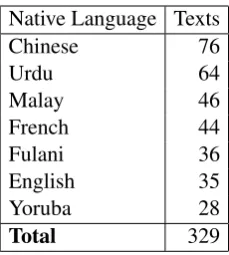
We use the more recent second version of the ALC (Alfaifi et al., 2014) as the data for our exper-iments. While there are 66 different L1s in the cor-pus, the majority of these have less than 10 texts and cannot reliably be used for NLI. Instead we use a subset of the corpus consisting of the top seven native languages by number of texts. The languages and document counts in each class are shown in Table 1.
Both plain text and XML versions of the learner
1http://www.arabiclearnercorpus.com/
Native Language Texts
Chinese 76
Urdu 64
Malay 46
French 44
Fulani 36
English 35
Yoruba 28
[image:2.595.359.474.60.188.2]Total 329
Table 1: The L1 classes included in this experi-ment and the number of texts within each class.
texts are provided with the corpus. Here we use text versions and strip the metadata information from the files, leaving only the author’s writings.
4 Experimental Methodology
In this study we employ a supervised multi-class classification approach. The learner texts are or-ganized into classes according on the author’s L1 and these documents are used for training and test-ing in our experiments. A diagram conceptualiz-ing our NLI system is shown in Figure 1.
4.1 Word Segmentation
The tokenization and word segmentation of Arabic is an important preprocessing step for addressing the orthographic issues discussed in§1. For this task we utilize the Stanford Word Segmenter2.
4.2 Parsing and Part-of-Speech Tagging
To extract the syntactic information required for our models, the Arabic texts are POS tagged and parsed using the Stanford Arabic Parser3.
4.3 Classifier
We use a linear Support Vector Machine to per-form multi-class classification in our experiments. In particular, we use the LIBLINEAR4 package
(Fan et al., 2008) which has been shown to be effi-cient for text classification problems such as this.
4.4 Evaluation Methodology
In the same manner as many previous NLI stud-ies and also the NLI 2013 shared task, we report our results as classification accuracy underk-fold cross-validation, withk= 10. In recent years this
Arabic Text Chinese L1
NLI
Arabic Text
Arabic Text
Arabic Text
French L1
English L1
[image:3.595.141.458.60.231.2]Malay L1
Figure 1: Illustration of our NLI system that identifies the L1 of Arabic learners from their writing.
has become ade factostandard for reporting NLI results.
5 Experiments
We experiment using three syntactic feature types described in this section. As the ALC is not bal-anced for topic, we do not consider the use of lex-ical features such as wordn-grams in this study. Topic bias can occur as a result of the subject mat-ters or topics of the texts to be classified not not evenly distributed across the classes. For exam-ple, if in our training data all the texts written by English L1 speakers are on topic A, while all the French L1 authors write about topic B, then we have implicitly trained our classifier on the topics as well. In this case the classifier learns to dis-tinguish our target variable through another con-founding variable.
5.1 Context-free Grammar Production Rules
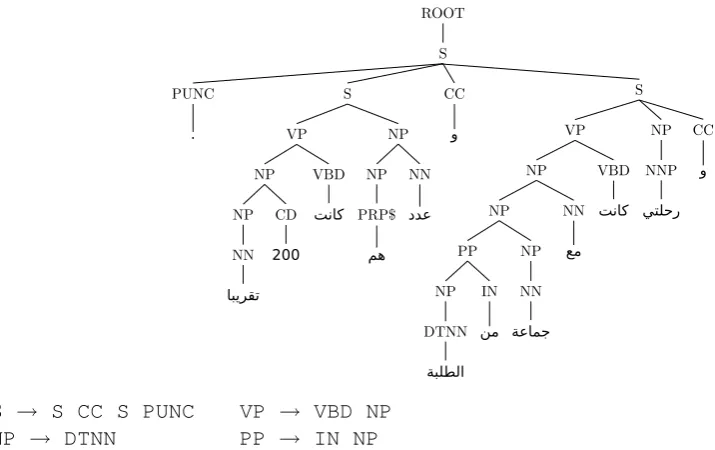
Context-free phrase structure rules (without lexi-calizations) are extracted from parse trees of the sentences in each learner text. One such con-stituent parse tree and extracted rules are shown in Figure 2. These production rules are used as classification features5. Linguistically, they
cap-ture the global syntactic struccap-tures used by writers.
5.2 Arabic Function Words
The distributions of grammatical function words such as determiners and auxiliary verbs have proven to be useful in NLI. This is considered to be a useful syntactic feature as these words indi-cate the relations between content words and are
5All models use relative frequency feature representations
سﺎﻨﻟا بﻮﻠﻗ ﰲ روﴪﻟا َﻞِﺧدُأ نأ ﺐﺣأ ﻰﻨﻧأ ﻮﻫ ﺐﻄﻟا رﺎﻴﺘﺧا ﰱ ﺐﺒﺴﻟا
ة�ﻄﺧ ﺔﻨﻣزأ ﰲ ﻢﻫﺪﻋﺎﺳأو
.
DTNN IN NN DTNN PRP VBD VBP IN VBN DTNN IN NN DTNN CC NN PRP$ IN NN JJ PUNC
Figure 3: An example of a sentence written by a learner and its Part-of-Speech tag sequence. Un-igrams, bigrams and trigrams are then extracted from this tag sequence.
topic independent. The frequency distributions of a set of 150 function words were extracted from the learner texts and used as features in this model.
5.3 Part-of-Speechn-grams
In this model POSn-grams of size 1–3 were ex-tracted. Thesen-grams capture small and very lo-cal syntactic patterns of language production and were used as classification features.
6 Results
The results from all experiments are shown in Ta-ble 2. The majority baseline is calculated by us-ing the largest class, in this case Chinese6, as
the default classification. The frequency distri-butions of the production rules yield 31.7% accu-racy, demonstrating their ability to identify struc-tures that are characteristic of L1 groups. Simi-larly, the distribution of function words is helpful, with 29.2% accuracy.
While all the models provide results well above the baseline, POS tagn-grams are the most useful features, with bigrams providing the highest accu-racy for a single feature type with 37.6%. This
The options for nodes are all handled by TikZ and are described in detail in the TikZ documentation. For example, if you have a font named\arand want to set all the leaf labels in this font:
.... ROOT... .. S. .... .. PUNC... .. . . .... .. S. .... .. VP. ....
.. NP. ....
.. NP... .. NN... .. ﺎﺒﻳﺮﻘﺗ . .. .. CD... .. 200 . .. .. VBD... .. ﺖﻧﺎﻛ . .. .. NP. ....
.. NP... .. PRP$... .. ﻢﻫ . .. .. NN... .. دﺪﻋ . .... .. CC... .. و . .. .. S. .... .. VP. ....
.. NP. ....
.. NP. ....
.. PP. ....
.. NP... .. DTNN... .. ﺔﺒﻠﻄﻟا . .. .. IN... .. ﻦﻣ . .. .. NP... .. NN... .. ﺔﻋﺎﻤﺟ . .. .. NN... .. ﻊﻣ . .. .. VBD... .. ﺖﻧﺎﻛ . .... .. NP... .. NNP... .. ﻲﺘﻠﺣر . .. .. CC... .. و 1
S → S CC S PUNC VP → VBD NP
[image:4.595.77.435.60.285.2]NP → DTNN PP → IN NP
Figure 2: A constituent parse tree for a sentence from the corpus along with some of the context-free grammar production rules extracted from it.
Feature Accuracy (%)
Majority Baseline 23.1
CFG Production Rules 31.7
Function Words 29.2
Part-of-Speech unigrams 36.0 Part-of-Speech bigrams 37.6 Part-of-Speech trigrams 36.5 All features combined 41.0 Table 2: Arabic Native Language Identification accuracy for the three experiments in this study.
seems to suggest that the greatest difference be-tween groups lies in their word category ordering. Combining all of the models into a single fea-ture space provides the highest accuracy of 41%. This demonstrates that the information captured by the various models is complementary and that the feature types are not redundant.
7 Discussion
The most prominent finding here is that NLI tech-niques can be successfully applied to Arabic, a morphologically complex language differing sig-nificantly from English, which has been the focus of almost all previous research.
This is one of the very first applications of NLI to a language other than English and an important step in the growing field of NLI, particularly with the current drive to investigate other languages. This research, though preliminary, presents an
ap-proach to Arabic NLI and can serve as a step to-wards further research in this area.
NLI technology has practical applications in various fields. One potential application of NLI is in the field of forensic linguistics (Gibbons, 2003; Coulthard and Johnson, 2007), a juncture where the legal system and linguistic stylistics intersect (Gibbons and Prakasam, 2004; McMe-namin, 2002). In this context NLI can be used as a tool for Authorship Profiling (Grant, 2007) in or-der to provide evidence about the linguistic back-ground of an author.
There are a number of situations where a text, such as an anonymous letter, is the central piece of evidence in an investigation. The ability to extract additional information from an anonymous text can enable the authorities and intelligence agen-cies to learn more about threats and those respon-sible for them. Clues about the native language of a writer can help investigators in determining the source of anonymous text and the importance of this analysis is often bolstered by the fact that in such scenarios, the only data available to users and investigators is the text itself. One recently studied example is the analysis of extremist related activ-ity on the web (Abbasi and Chen, 2005).
[image:4.595.82.282.340.459.2]interest and funding from intelligence agencies (Perkins, 2014, p. 17).
In addition to applications in forensic linguis-tics, Arabic NLI can aid the development of re-search tools for SLA rere-searchers investigating lan-guage transfer and cross-linguistic effects. Simi-lar data-driven methods have been recently applied to generate potential language transfer hypothe-ses from the writings of English learners (Malmasi and Dras, 2014c). With the use of an error anno-tated corpus, which was not the case in this study, the annotations could be used in conjunction with similar linguistic features to study the syntactic contexts in which different error types occur (Mal-masi and Dras, 2014b).
Results from such approaches could be used to create teaching material that is customized for the learner’s L1. This approach has been pre-viously shown to yield learning improvements (Laufer and Girsai, 2008). The need for such SLA tools is particularly salient for a complex lan-guage such as Arabic which has several learning stages (Mansouri, 2005), such as phrasal and inter-phrasal agreement morphology, which are hierar-chical and generally acquired in a specific order (Nielsen, 1997).
The key shortcoming of this study, albeit be-yond our control, is the limited amount of data available for the experiments. To the best of our knowledge, this is the smallest dataset used for this task in terms of document count and length. In this regard, we are surprised by relatively high classifi-cation accuracy of our system, given the restricted amount of training data available.
While it is hard to make comparisons with most other experiments due to differing number of classes, one comparable study is that of Wong and Dras (2009) which used some similar features on 7-class English dataset. Despite their use of a much larger dataset7, our individual models are
only around 10% lower in accuracy.
We believe that this is a good result, given our limited data. In their study of NLI corpora, Brooke and Hirst (2011) showed that increasing the amount of training data makes a very signifi-cant difference in NLI accuracy for both syntactic and lexical features. This was verified by Tetreault et al. (2012) who showed that there is a very steep rise in accuracy as the corpus size is increased
to-7Wong and Dras (2009) had 110 texts per class, with av-erage text lengths of more than 600 words.
wards 11,000 texts8. Based on this, we are
con-fident that given similarly sized training data, an Arabic NLI system can achieve similar accuracies. On a broader level, this highlights the need for more large-scale L2 Arabic corpora.
Future work includes the application of our methods to large-scale Arabic learner data as it be-comes available. With the ongoing development of the Arabic Learner Corpus and other projects like the Qatar Arabic Language Bank (Mohit, 2013), this may happen in the very near future.
The application of more linguistically sophisti-cated features also merits further investigation, but this is limited by the availability of Arabic NLP tools and resources. From a machine learning per-spective, classifier ensembles have been recently used for this task and shown to improve classifi-cation accuracy (Malmasi et al., 2013; Tetreault et al., 2012). Their application here could also in-crease system accuracy.
We also leave the task of interpreting the lin-guistic features that differentiate and characterize L1s to future work. This seems to be the next log-ical phase in NLI research and some methods to automate the detection of language transfer fea-tures have been recently proposed (Swanson and Charniak, 2014; Malmasi and Dras, 2014c). This research, however, is still at an early stage and could benefit from the addition of more sophisti-cated machine learning techniques.
More broadly, additional NLI experiments with different languages are needed. Comparative stud-ies using equivalent syntactic features but with dis-tinct L1-L2 pairs can help us better understand Cross-Linguistic Influence and its manifestations. Such a framework could also help us better un-derstand the differences between different L1-L2 language pairs.
8 Conclusion
In this work we identified the appropriate data and tools to perform Arabic NLI and demonstrated that syntactic features can be successfully applied, de-spite a scarcity of available L2 Arabic data. Such techniques can be used to generate cross-linguistic hypotheses and build research tools for Arabic SLA. As the first machine learning based inves-tigation of language transfer effects in L2 Ara-bic, this work contributes important additional ev-idence to the growing body of NLI work.
References
Ahmed Abbasi and Hsinchun Chen. 2005. Applying authorship analysis to extremist-group Web forum
messages. IEEE Intelligent Systems, 20(5):67–75.
Ghazi Abuhakema, Reem Faraj, Anna Feldman, and Eileen Fitzpatrick. 2008. Annotating an Arabic
Learner Corpus for Error. InLREC.
Abdullah Alfaifi and Eric Atwell. 2013. Arabic Learner Corpus v1: A New Resource for Arabic Language Research.
Abdullah Alfaifi, Eric Atwell, and I Hedaya. 2014. Arabic learner corpus (ALC) v2: a new written and
spoken corpus of Arabic learners. InProceedings of
the Learner Corpus Studies in Asia and the World (LCSAW), Kobe, Japan.
Julian Brooke and Graeme Hirst. 2011.
Na-tive language detection with ‘cheap’ learner
cor-pora. In Conference of Learner Corpus Research
(LCR2011), Louvain-la-Neuve, Belgium. Presses universitaires de Louvain.
Malcolm Coulthard and Alison Johnson. 2007. An
in-troduction to Forensic Linguistics: Language in evi-dence. Routledge.
Rong-En Fan, Kai-Wei Chang, Cho-Jui Hsieh, Xiang-Rui Wang, and Chih-Jen Lin. 2008. LIBLINEAR:
A library for large linear classification. Journal of
Machine Learning Research, 9:1871–1874.
John Gibbons and Venn Prakasam. 2004. Language in
the Law. Orient Blackswan.
John Gibbons. 2003. Forensic Linguistics: An Intro-duction To Language In The Justice System.
Sylviane Granger. 2012. Learner corpora. The
Ency-clopedia of Applied Linguistics.
Tim Grant. 2007. Quantifying evidence in forensic
authorship analysis. International Journal of Speech
Language and the Law, 14(1):1–25.
Nizar Y Habash. 2010. Introduction to Arabic natural
language processing. Synthesis Lectures on Human
Language Technologies, 3(1):1–187.
Batia Laufer and Nany Girsai. 2008. Form-focused instruction in second language vocabulary learning:
A case for contrastive analysis and translation.
Ap-plied Linguistics, 29(4):694–716.
Shervin Malmasi and Mark Dras. 2014a. Chinese
Native Language Identification. Proceedings of the
14th Conference of the European Chapter of the As-sociation for Computational Linguistics.
Shervin Malmasi and Mark Dras. 2014b. From Vi-sualisation to Hypothesis Construction for Second
Language Acquisition. InGraph-Based Methods for
Natural Language Processing, Doha, Qatar, Octo-ber. Association for Computational Linguistics.
Shervin Malmasi and Mark Dras. 2014c. Language Transfer Hypotheses with Linear SVM Weights.
Proceedings of the 2014 Conference on Empir-ical Methods in Natural Language Processing (EMNLP).
Shervin Malmasi, Sze-Meng Jojo Wong, and Mark Dras. 2013. Nli shared task 2013: Mq submission. In Proceedings of the Eighth Workshop on Innova-tive Use of NLP for Building Educational Applica-tions, pages 124–133, Atlanta, Georgia, June. Asso-ciation for Computational Linguistics.
Fethi Mansouri. 2005. Agreement morphology in
Ara-bic as a second language. Cross-linguistic aspects of
Processability Theory, pages 117–253.
Gerald R McMenamin. 2002. Forensic linguistics:
Advances in Forensic Stylistics. CRC press. Behrang Mohit. 2013. QALB: Qatar Arabic language
bank. InQatar Foundation Annual Research
Con-ference, number 2013.
Helle Lykke Nielsen. 1997. On acquisition order of agreement procedures in Arabic learner language.
Al-Arabiyya, 30:49–93.
Ria Perkins. 2014. Linguistic identifiers of L1 Persian
speakers writing in English: NLID for authorship analysis. Ph.D. thesis, Aston University.
Karin C. Ryding. 2013. Teaching Arabic in the United States. In Kassem M Wahba, Zeinab A Taha, and
Liz England, editors,Handbook for Arabic language
teaching professionals in the 21st century. Rout-ledge.
Ben Swanson and Eugene Charniak. 2014. Data
Driven Language Transfer Hypotheses.EACL 2014,
page 169.
Joel Tetreault, Daniel Blanchard, Aoife Cahill, Beata Beigman-Klebanov, and Martin Chodorow. 2012. Native Tongues, Lost and Found: Resources and Empirical Evaluations in Native Language
Identifi-cation. InProc. Internat. Conf. on Computat.
Lin-guistics (COLING).
Joel Tetreault, Daniel Blanchard, and Aoife Cahill. 2013. A report on the first native language
identi-fication shared task. InProceedings of the Eighth
Workshop on Innovative Use of NLP for Build-ing Educational Applications, pages 48–57, Atlanta, Georgia, June. Association for Computational Lin-guistics.
Kassem M Wahba, Zeinab A Taha, and Liz England.
2013. Handbook for Arabic language teaching
pro-fessionals in the 21st century. Routledge.
Wajdi Zaghouani, Behrang Mohit, Nizar Habash, Os-sama Obeid, Nadi Tomeh, Alla Rozovskaya, Noura Farra, Sarah Alkuhlani, and Kemal Oflazer. 2014. Large Scale Arabic Error Annotation: Guidelines and Framework. In Nicoletta Calzolari (Conference Chair), Khalid Choukri, Thierry Declerck, Hrafn Loftsson, Bente Maegaard, Joseph Mariani, Asun-cion Moreno, Jan Odijk, and Stelios Piperidis,
ed-itors, Proceedings of the Ninth International