NAIST at the HOO 2012 Shared Task
Keisuke Sakaguchi, Yuta Hayashibe, Shuhei Kondo, Lis Kanashiro Tomoya Mizumoto, Mamoru Komachi, Yuji Matsumoto
Graduate School of Information Science Nara Institute of Science and Technology 8916-5, Takayama, Ikoma, Nara 630-0192, Japan
{ keisuke-sa, yuta-h, shuhei-k, lis-k, tomoya-m, komachi, matsu }@is.naist.jp
Abstract
This paper describes the Nara Institute of Sci-ence and Technology (NAIST) error correc-tion system in the Helping Our Own (HOO) 2012 Shared Task. Our system targets prepo-sition and determiner errors with spelling cor-rection as a pre-processing step. The re-sult shows that spelling correction improves the Detection, Correction, and Recognition F-scores for preposition errors. With regard to preposition error correction, F-scores were not improved when using the training set with cor-rection of all but preposition errors. As for determiner error correction, there was an im-provement when the constituent parser was trained with a concatenation of treebank and modified treebank where all the articles ap-pearing as the first word of an NP were re-moved. Our system ranked third in preposi-tion and fourth in determiner error correcpreposi-tions.
1 Introduction
Researchers in natural language processing have fo-cused recently on automatic grammatical error de-tection and correction for English as a Second Lan-guage (ESL) learners’ writing. There have been a lot of papers on these challenging tasks, and remark-ably, an independent session for grammatical error correction took place in the ACL-2011.
The Helping Our Own (HOO) shared task (Dale and Kilgarriff, 2010) is proposed for improving the quality of ESL learners’ writing, and a pilot run with six teams was held in 2011.
The HOO 2012 shared task focuses on the cor-rection of preposition and determiner errors. There
has been a lot of work on correcting preposition and determiner errors, where discriminative models such as Maximum Entropy and Averaged Perceptron (De Felice and Pulman, 2008; Rozovskaya and Roth, 2011) and/or probablistic language models (Gamon, 2010) are generally used.
In addition, it is pointed out that spelling and punctuation errors often disturb grammatical error correction. In fact, some teams reported in the HOO 2011 that they corrected spelling and punc-tuation errors before correcting grammatical errors (Dahlmeier et al., 2011).
Our strategy for HOO 2012 follows the above procedure. In other words, we correct spelling er-rors at the beginning, and then train classifiers for correcting preposition and determiner errors. The result shows our system achieved 24.42% (third-ranked) in F-score for preposition error correc-tion, 29.81% (fourth-ranked) for determiners, and 27.12% (fourth-ranked) for their combined.
In this report, we describe our system architec-ture and the experimental results. Sections 2 to 4 describe the system for correcting spelling, prepo-sition, and determiner errors. Section 5 shows the experimental design and results.
2 System Architecture for Spelling Correction
Spelling errors in second language learners’ writing often disturb part-of-speech (POS) tagging and de-pendency parsing, becoming an obstacle for gram-matical error detection and correction tasks. For ex-ample, POS tagging for learners’ writing fails
e.g. I think it is *verey/very *convent/convenient for the group.
without spelling error correction: ... (‘it’, ‘PRP’), (‘is’, ‘VBZ’), (‘verey’, ‘PRP’), (‘convent’, ‘NN’), ... with spelling error correction : ... (‘It’, ‘PRP’), (‘is’, ‘VBZ’), (‘very’, ‘RB’), (‘convenient’, ‘JJ’), ...
Figure 1: POS tagging for learners’ writing without and with spelling error correction.
cause of misspelled words (Figure 1).1
To reduce errors derived from misspelled words, we conduct spelling error correction as a pre-processing task. The procedure of spelling error cor-rection we use is as follows. First of all, we look for misspelled words and suggest candidates by GNU Aspell2, an open-source spelling checker. The can-didates are ranked by the probability of 5-gram lan-guage model built from Google N-gram (Web 1T 5-gram Version 1)3 (Brants and Franz, 2006) with IRST LM Toolkit (Federico and Cettolo, 2007).4 Fi-nally, according to the rank, we changed the mis-spelled word into the 1-best candidate word.
In a preliminary experiment, where we use the original CLC FCE dataset,5 our spelling error cor-rection obtains 52.4% of precision, 72.2% of recall, and 60.7% of F-score.
We apply the spelling error correction to the train-ing and test sets provided, and use both spelltrain-ing- spelling-error and spelling-spelling-error-free sets for comparison.
3 System Architecture for Preposition Error Correction
There are so many prepositions in English. Because it is difficult to perform multi-class classification, we focus on twelve prepositions: of, in, for, to, by, with, at, on, from, as, about, since, which account for roughly 91% of preposition usage (Chodorow et al., 2010).
The errors are classified into three categories ac-cording to their ways of correction. First, replace-ment error indicates that learners use a wrong preposition. For instance,with in Example (1) is a
1
The example is extracted from the CLC FCE dataset and part-of-speech tagged by Natural Language Toolkit (NLTK). http://www.nltk.org/
2GNU Aspell 0.60.6.1 http://aspell.net/
3http://www.ldc.upenn.edu/Catalog/CatalogEntry.jsp?
catalogId=LDC2006T13
4irstlm5.70 http://sourceforge.net/projects/irstlm/
5In the CLC FCE dataset, misspelled words are corrected
and tagged with a label “S”.
replacement error.
I went there withbybus. (1)
Second, insertion error points out they incor-rectly inserted a preposition, such as “about” in Ex-ample (2).6
We discussed aboutNONEthe topic. (2)
Third, deletion error means they fail to write obligatory prepositions. For example, “NONE” in Example (3) is an deletion error.
This is the place to relax NONEin. (3)
Replacement and insertion error correction can be regarded as a multi-class classification task at each preposition occurrence. However, deletion errors differ from the other two types of errors in that they may occur at any place in a sentence. Therefore, we build two models, a combined model for replace-ment and insertion errors and a model for deletion errors, taking the difference into account.
For the model of replacement and insertion errors, we simultaneously perform error detection and cor-rection with a single model.
For the model of deletion errors, we only check whether direct objects of verbs need prepositions, because it is time consuming to check all the gaps between words. Still, it covers most deletion errors.7 We merge the outputs of the two models to get the final output.
We used two types of training sets extracted from the original CLC-FCE dataset. One is the “gold” set, where training sentences are corrected except for preposition errors. In the gold set, spelling er-rors are also corrected to the gold data in the corpus. The other is the “original” set, which includes the
6
“NONE” means there are no words.
72,407 out of 5,324 preposition errors in CLC-FCE are
Type Name Description (NP and PRED refer a noun phrase and a predicate.) Lexical Token n-gram Token n-grams in a 2 word window around the preposition
POS n-gram POS n-grams in a 2 word window around the preposition HEAD PREC VP The head verb in the preceding verb phrase
HEAD PREC NP The head noun in the preceding noun phrase HEAD FOLLOW NP The head noun in the following noun phrase
Parsing HEAD Head of the preposition
HEAD POS POS of the head
COMP Complement of the preposition
COMPLEMENT POS POS of the complement HEAD RELATION Prep-Head relation name COMPLEMENT RELATION Prep-Comp relation name Phrase Structure PARENT TAG TAG of the preposition’s parent
GRANDPARENT TAG TAG of the preposition’s grandparent PARENT LEFT Left context of the preposition parent PARENT RIGHT Right context of the preposition’s parent
Web N-gram COUNT For the frequencyfprep,iofi(3 to 5) window size phrase including the prepositionprep, the value oflog100(fi+ 1)
PROPORTION The proportionpprep,i(iis 3 to 5). pprep,i=
fprep,i ∑
k∈Tfk,i, given the set of target prepositionsT.
[image:3.612.73.519.48.322.2]Semantic WORDNET CATEGORY WordNet lexicographer classes which are about 40 broad semantic categories for all words used as surface features. As De Felice and Pulman (2008) did not perform word sense disambiguation, neither did we.
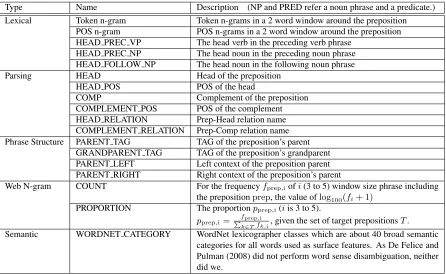
Table 1: Baseline features for English preposition error correction.
original CLC-FCE plain sentences.
We performed sentence splitting using the im-plementation of Kiss and Strunk (2006) in NLTK 2.0.1rc2. We conducted dependency parsing by Stanford parser 1.6.9.8
We used the features described in (Tetreault et al., 2010) as shown in Table 1 with Maximum Entropy (ME) modeling (Berger et al., 1996) as a multi-class classifier. We used the implementation of Maximum Entropy Modeling Toolkit9with its default parame-ters. For web n-gram calculation, we used Google N-gram with a search system for giga-scale n-gram corpus, called SSGNC 0.4.6.10
4 System Architecture for Determiner Error Correction
We focused on article error correction in the deter-miner error correction subtask, because the errors related to articles significantly outnumber the errors unrelated to them. Though more than twenty types of determiners are involved in determiner error cor-rections of the HOO training set, over 90% of errors
8
http://nlp.stanford.edu/software/lex-parser.shtml
9
https://github.com/lzhang10/maxent
10
http://code.google.com/p/ssgnc/
are related to three articlesa,anandthe. We defined article error correction as a multi-class classification problem with three classes,a, the andnull article, and assumed that target articles are placed at the left boundary of a noun phrase (NP). The indefinite ar-ticleanwas normalized toain training and testing, and restored toan later in an example-based post-processing step. If the system output wasaand the word immediately afteraappeared more frequently withanthan withain the training corpus,awas re-stored toan. If the word appeared equally frequently withaandanor didn’t appear in the training corpus,
awas restored toanif the word’s first character was one of a, e, i, o, u.
Each input sentence was parsed using the Berke-ley Parser11 with two models, “normal” and “mixed”. The “normal” model was trained on a tree-bank of normal English sentences. In preliminary experiments, the “normal” model sometimes mis-judged the span of NPs in ESL writers’ sentences due to missing articles. So we trained the “mixed” model on a concatenation of the normal treebank and a modified treebank in which all the articles ap-pearing as the first word of an NP were removed. By
11
Name Description
HeadNounWord The word form of the head noun
HeadNounTag The POS tag of the head noun
ObjOfPrep Indicates that the head noun is an object of a preposition
PrepWord The word form of the preposition
PrepHeadWord The word form of the preposition’s syntactic parent PrepHeadTag The POS tag of the preposition’s syntactic parent
ContextWindowTag
The POS tag of the words in a 3 word window around the candidate position for the article
ContextWindowWord
The word form of the word immediately following the candidate position for the article
[image:4.612.114.502.47.310.2]ModByDetWord The word form of the determiner that modifies the head noun ModByAdjWord The word form of the adjective that modifies the head noun ModByAdjTag The POS tag of the adjective that modifies the head noun ModByPrep Indicates that the head noun is modified by a preposition ModByPrepWord The word form of the preposition that modifies the head noun ModByPossesive Indicates that the head noun is modified by a possesive ModByCardinal Indicates that the head noun is modified by a cardinal number ModByRelative Indicates that the head noun is modified by a relative clause
Table 2: Feature templates for English determiner correction.
augmenting the training data for the parser model with sentences lacking articles, the span of NPs that lack an article might have better chance of being cor-rectly recognized. In addition, dependency informa-tion was extracted from the parse using the Stanford parser 1.6.9.
For each NP in the parse, we extracted a feature vector representation. We used the feature templates shown in Table 2, which are inspired by (De Felice, 2008) and adapted to the CFG representation.
For the parser models, we trained the “normal” model on the WSJ part of Penn Treebank sections 02-21 with the NP annotation by Vadas and Curran (2007). The “mixed” model was trained on the con-catenation of the WSJ part and its modified version. For the classification model, we used the written part of the British National Corpus (BNC) in addition to the CLC FCE Dataset, because the amount of in-domain data was limited. In examples taken from the CLC FCE Dataset, the true labels after the cor-rection were used. In examples taken from the BNC, the article of each NP was used as the label. We trained a linear classifier using opal12 with the PA-I algorithm. We also used the feature augmentation
12
http://www.tkl.iis.u-tokyo.ac.jp/∼ynaga/opal/
Subsystem Parameters
Run Spelling Preposition Determiner
0 no change gold mixed
1 no change gold normal
2 no change original mixed 3 no change original normal
4 corrected gold mixed
5 corrected gold normal
6 corrected original mixed 7 corrected original normal
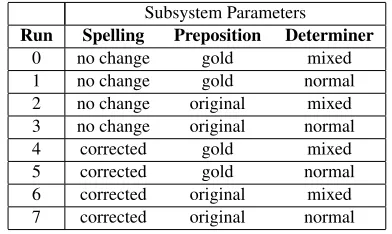
Table 3: Distinct configurations of the system.
approach of (Daum´e III, 2007) for domain adapta-tion.
5 Experiment and Result
Previously undisclosed data extracted from the CLC-FCE dataset was provided as a test set by the HOO organizers. The test set includes 100 essays and each contains 180.1 word tokens on average.
We defined eight distinct configurations based on our subsystem parameters (Table 3). The offi-cial task evaluation uses three metrics (Detection, Recognition, and Correction), and three measures Precision, Recall, and F-score were computed13 for
13
[image:4.612.328.524.354.471.2]Detection Correction Recognition
Run R P F R P F R P F
0 29.58 34.09 31.67 19.86 22.90 21.27 26.71 30.78 28.60 1 28.69 36.41 32.09 19.42 24.64 21.72 25.82 32.77 28.88
[image:5.612.146.468.50.164.2]2∗ 28.91 37.21 32.54 20.97 26.98 23.60 26.26 33.80 29.56 3 28.03 40.18 33.02 20.52 29.43 24.18 25.38 36.39 29.90 4 30.24 33.66 31.86 20.75 23.09 21.86 27.37 30.46 28.83 5 29.13 35.57 32.03 19.64 23.98 21.60 26.26 32.07 28.88 6 29.35 36.23 32.43 21.41 26.43 23.65 26.26 32.42 29.02 7 28.25 38.67 32.65 20.30 27.29 23.46 25.16 34.44 29.08
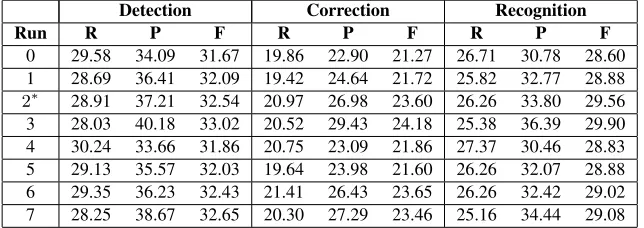
Table 4: Result for preposition and determiner errors combined before revisions.
∗We re-evaluated the Run2 because we submitted the Run2 with the same condition as Run0.
Detection Correction Recognition
Spelling Preposition R P F R P F R P F
no change gold 25.00 34.70 29.06 14.40 20.00 16.74 20.76 28.82 24.13 no change original 23.30 42.63 30.13 16.52 30.23 21.36 19.91 36.43 25.75 corrected gold 26.69 34.80 30.21 15.25 19.88 17.26 22.45 29.28 25.41 corrected original 24.57 41.13 30.76 16.52 27.65 20.68 20.33 34.04 25.46
Table 5: Result for preposition errors before revisions.
each metric.
Table 4 to Table 9 show the overall results of our systems. In terms of the effect of pre-processing, spelling correction improved the F-score of Detec-tion, CorrecDetec-tion, and Recognition for preposition er-rors after revision, whereas there were fluctuations in other conditions. This may be because there were a few spelling errors corrected in the test set.14 An-other reason why no stable improvement was found in determiner error correction is because spelling correction often produces nouns that affect the de-terminer error detection and correction more sensi-tively than prepositions. For example, a misspelled word*freewho / free who was corrected asfreezer. This type of error may have increased false posi-tives. The example*National Filharmony / the Na-tional Philharmonywas corrected asNational Flem-ing, where the proper nounFlemingdoes not need a determiner and this type of error increased false neg-atives.
As for preposition error correction, the classifier performed better when it was trained with the “origi-nal” set rather than the error-corrected (all but prepo-sition errors) “gold” set. The reason for this is that the gold set is trained with the test set that contains
correcttext.org/hoo2012/eval.html
14
There was one spelling correction per document in average.
several types of errors which the original CLC-FCE dataset also contains. Therefore, the “original” clas-sifier is more optimised and suitable for the test set than the “gold” one.
For determiner error correction, the “mixed” model improved precision and F-score in the addi-tional experiments.
5.1 Error Analysis of Preposition Correction
We briefly analyze some errors in our proposed model according to the three categories of errors.
First, most replacement errors require deep under-standing of context. For instance,forin Example (4) must be changed toto. However,modifications ofis also often used, so it is hard to decide eithertoorof
is suitable based on the values of N-gram frequen-cies.
Its great news to hear you have been given extra money and that you will spend it in modifications fortothe cinema.
(4)
Second, most insertion errors need a grammatical judgement rather than a semantic one. For instance, “in” in Example (5) must be changed to “NONE.”
Their love had always been kept inN ON E
se-cret (5)
recog-Detection Correction Recognition
Spelling Determiner R P F R P F R P F
[image:6.612.108.507.49.120.2]no change mixed 34.10 33.18 33.63 25.80 25.11 25.45 33.17 32.28 32.72 no change normal 32.25 37.43 34.65 24.88 28.87 26.73 31.33 36.36 33.66 corrected mixed 33.64 32.30 32.95 26.72 25.66 26.18 32.71 31.41 32.05 corrected normal 31.33 35.78 33.41 24.42 27.89 26.04 30.41 34.73 32.43
Table 6: Result for determiner errors before revisions.
Detection Correction Recognition
Run R P F R P F R P F
0 31.28 37.65 34.18 22.62 27.22 24.71 28.54 34.35 31.17 1 30.44 40.33 34.69 22.19 29.41 25.30 27.69 36.69 31.56
[image:6.612.144.468.151.270.2]2∗ 31.07 41.76 35.63 23.04 30.96 26.42 28.11 30.96 32.24 3 30.23 45.25 36.24 22.62 33.86 27.12 27.27 40.82 32.69 4 31.92 37.10 34.31 23.46 27.27 25.22 29.17 33.90 31.36 5 30.86 39.35 34.59 22.41 28.57 25.11 28.11 35.84 31.51 6 31.71 40.87 35.71 23.89 30.79 26.90 28.75 37.05 32.38 7 30.65 43.80 36.06 22.83 32.62 26.86 27.69 39.57 32.58
Table 7: Result for preposition and determiner errors combined after revisions.
∗We re-evaluated the Run2 because we submitted the Run2 with the same condition as Run0.
nize “keep” takes an object and a complement; in Example (5) “love” is the object and “secret” is the complement of “keep” while the former is left-extraposed. A rule-based approach may be better suited for these cases than a machine learning ap-proach.
Third, most deletion errors involve discrimination between transitive and intransitive. For instance, “NONE” in Example (6) must be changed to “for”, because “wait” is intransitive.
I’ll wait NONEf or your next letter. (6)
To deal with these errors, we may use rich knowl-edge about verbs such as VerbNet (Kipper et al., 2000) and FrameNet (Baker et al., 1998) in order to judge whether a verb is transitive or intransitive.
5.2 Error Analysis of Determiner Correction
We conducted additional experiments for determiner errors and report the results here because the sub-mitted system contained a bug. In the submit-ted system, while the test data were parsed by the “mixed” model, the training data and the test data were parsed by the default grammar provided with Berkeley Parser. Moreover, though there were about 5.5 million sentences in the BNC corpus, only about
2.7 million of them had been extracted. Though these errors seem to have improved the performance, it is difficult to specify which errors had positive ef-fects.
Table 10 shows the result of additional experi-ments. Unlike the submitted system, the “mixed” model contributed toward a higher precision and F-score. Though the two parser models parsed the sentences differently, the difference in the syntactic analysis of test sentences did not always led to dif-ferent output by the downstream classifiers. On the contrary, the classifiers often returned different out-puts even for an identically parsed sentence. In fact, the major source of the performance gap between the two models was the number of the wrong outputs rather than the number of correct ones. While the “mixed” model without spelling correction returned 146 outputs, of which 83 were spurious, the “nor-mal” model without spelling correction produced 209 outputs, of which 143 were spurious. This may suggest the difference of the two models can be at-tributed to the difference in the syntactic analysis of the training data.
Detection Correction Recognition
Spelling Preposition R P F R P F R P F
no change gold 26.63 38.23 31.40 17.62 25.29 20.77 23.36 33.52 27.53 no change original 26.22 49.61 34.31 18.44 34.88 24.12 22.54 42.63 29.49 corrected gold 28.27 38.12 32.47 18.44 24.86 21.17 25.00 33.70 28.70 corrected original 27.86 48.22 35.32 19.26 33.33 24.41 24.18 41.84 30.64
Table 8: Result for preposition errors after revisions.
Detection Correction Recognition
Spelling Determiner R P F R P F R P F
no change mixed 35.37 36.32 35.84 27.94 28.69 28.31 34.06 34.97 34.51 no change normal 33.62 41.17 37.01 27.07 33.15 29.80 32.31 39.57 35.57 corrected mixed 34.93 35.39 35.16 28.82 29.20 29.01 33.62 34.07 33.84 corrected normal 32.75 39.47 35.79 26.63 32.10 29.11 31.44 37.89 34.36
Table 9: Result for determiner errors after revisions.
Detection Correction Recognition
Spelling Determiner R P F R P F R P F
[image:7.612.107.507.49.120.2]no change mixed 27.39 43.15 33.51 23.04 36.30 28.19 27.39 43.15 33.51 no change normal 28.69 31.57 30.06 22.61 24.88 23.69 28.69 31.57 30.06 corrected mixed 27.39 41.44 31.98 22.61 34.21 27.22 26.96 40.79 32.46 corrected normal 30.43 33.33 31.82 24.34 26.67 25.45 30.00 32.86 31.36
Table 10: Result of additional experiments for determiner errors after revisions.
NP without a determiner resulting in a false posi-tive such as*a yours letter. Among the other types of errors, several seemed to be caused by the infor-mation from the context window. For instance, the system output for It was last month and ... was it was *the last month and .... It is likely that the word
last triggered the misinsertion here. Such kind of errors might be avoided by conjunctive features of context information and the head word. Last but not least, compound errors were also frequent and prob-ably the most difficult to solve. For example, it is quite difficult to correct*for a monthtoper month
if we are dealing with determiner errors and prepo-sition errors separately. A more sophisticated ap-proach such as joint modeling seems necessary to correct this kind of errors.
6 Conclusion
This report described the architecture of our prepo-sition and determiner error correction system. The experimental result showed that spelling correction advances the performance of Detection, Correction and Recognition for preposition errors. In terms of preposition error correction, F-scores were not
im-proved when the error-corrected dataset was used. As to determiner error correction, there was an im-provement when the constituent parser was trained on a concatenation of treebank and modified tree-bank where all the articles appearing as the first word of an NP were removed.
Acknowledgements
References
Collin F Baker, Charles J Fillmore, and John B Lowe. 1998. The Berkeley FrameNet Project. In Proceed-ings of the 36th Annual Meeting of the Association for Computational Linguistics, pages 86–90, Montreal, Quebec, Canada.
Adam L. Berger, Vincent J. Della Pietra, and Stephen A. Della Pietra. 1996. A Maximum Entropy Ap-proach to Natural Language Processing. Computa-tional Linguistics, 22(1):39–71.
Thorsten Brants and Alex Franz. 2006. Web 1T 5-gram Corpus Version 1.1.Linguistic Data Consortium. Martin Chodorow, Michael Gamon, and Joel Tetreault.
2010. The Utility of Article and Preposition Error Cor-rection Systems for English Language Learners: Feed-back and Assessment. Language Testing, 27(3):419– 436.
Daniel Dahlmeier, Hwee Tou Ng, and Thanh Phu Tran. 2011. NUS at the HOO 2011 Pilot Shared Task. In
Proceedings of the 13th European Workshop on Nat-ural Language Generation, pages 257–259, Nancy, France.
Robert Dale and Adam Kilgarriff. 2010. Helping Our Own: Text Massaging for Computational Linguistics as a New Shared Task. InProceedings of the 6th In-ternational Natural Language Generation Conference, pages 261–266, Trim, Co. Meath, Ireland.
Hal Daum´e III. 2007. Frustratingly Easy Domain Adap-tation. InProceedings of the 45th Annual Meeting of the Association of Computational Linguistics, pages 256–263, Prague, Czech Republic.
Rachele De Felice and Stephen G. Pulman. 2008. A Classifier-Based Approach to Preposition and Deter-miner Error Correction in L2 English. In Proceed-ings of the 22nd International Conference on Compu-tational Linguistics, pages 169–176, Manchester, UK. Rachele De Felice. 2008. Automatic Error Detection in Non-native English. Ph.D. thesis, University of Ox-ford.
Marcello Federico and Mauro Cettolo. 2007. Efficient Handling of N-gram Language Models for Statistical Machine Translation. In Proceedings of the Second Workshop on Statistical Machine Translation, pages 88–95, Prague, Czech Republic.
Michael Gamon. 2010. Using Mostly Native Data to Correct Errors in Learners’ Writing. InHuman Lan-guage Technologies: The 2010 Annual Conference of the North American Chapter of the Association for Computational Linguistics, pages 163–171, Los An-geles, California.
Karin Kipper, Hoa Trang Dang, and Martha Palmer. 2000. Class-based Construction of a Verb Lexicon. In
Proceedings of the 7th National Conference on Artifi-cial Intelligence, pages 691–696, Austin, Texas, USA. Tibor Kiss and Jan Strunk. 2006. Unsupervised Multi-lingual Sentence Boundary Detection. Computational Linguistics, 32(4):485–525.
Alla Rozovskaya and Dan Roth. 2011. Algorithm Selec-tion and Model AdaptaSelec-tion for ESL CorrecSelec-tion Tasks. InProceedings of the 49th Annual Meeting of the As-sociation for Computational Linguistics: Human Lan-guage Technologies, pages 924–933, Portland, Ore-gon, USA.
Joel Tetreault, Jennifer Foster, and Martin Chodorow. 2010. Using Parse Features for Preposition Selec-tion and Error DetecSelec-tion. InProceedings of the 47th Annual Meeting of the Association for Computational Linguistics Short Papers, pages 353–358, Uppsala, Sweden.