Exploiting Machine-Transcribed Dialog Corpus to Improve Multiple Dialog
States Tracking Methods
Sungjin Lee1,2 and Maxine Eskenazi1
1Language Technologies Institute, Carnegie Mellon University, Pittsburgh, Pennsylvania 2Computer Science and Engineering, Pohang University of Science and Technology, South Korea
{sungjin.lee, max}@cs.cmu.edu1, [email protected]2
Abstract
This paper proposes the use of unsuper-vised approaches to improve components of partition-based belief tracking systems. The proposed method adopts a dynamic Bayesian network to learn the user action model directly from a machine-transcribed dialog corpus. It also addresses confidence score calibration to improve the observation model in a unsuper-vised manner using dialog-level grounding in-formation. To verify the effectiveness of the proposed method, we applied it to the Let’s Go domain (Raux et al., 2005). Overall system performance for several comparative models were measured. The results show that the pro-posed method can learn an effective user ac-tion model without human intervenac-tion. In addition, the calibrated confidence score was verified by demonstrating the positive influ-ence on the user action model learning process and on overall system performance.
1 Introduction
With present Automatic Speech Recognition (ASR) and Spoken Language Understanding (SLU) errors, it is impossible to directly observe the true user goal and action. It is crucial, therefore, to efficiently infer this true state from erroneous observations over mul-tiple dialog turns. The Partially Observable Markov Decision Process (POMDP) framework has offered a well-founded theory for this purpose (Henderson et al., 2008; Thomson and Young, 2010a; Williams and Young, 2007; Young et al., 2010). Several approximate methods have also emerged to tackle the vast complexity of representing and maintaining
belief states, e.g., partition-based approaches (Ga-sic and Young, 2011; Williams, 2010; Young et al., 2010) and Bayesian network (BN)-based meth-ods (Raux and Ma, 2011; Thomson and Young, 2010a). The partition-based approaches attempt to group user goals into a small number of partitions and split a partition only when a distinction is re-quired by observations. This property endows it with the high scalability that is suitable for fairly complex domains. However, the parameter learn-ing procedures for the partition-based methods is still limited to hand-crafting or the use of a sim-ple maximum likelihood estimation (Keizer et al., 2008; Roy et al., 2000; Thomson and Young, 2010a; Williams, 2008). In contrast, several unsupervised methods which do not require human transcription and annotation have been recently proposed to learn BN-based models (Jurcicek et al., 2010; Syed and Williams, 2008; Thomson et al., 2010b). In this pa-per we describe an unsupa-pervised process that can be applied to the partition-based methods. We adopt a dynamic Bayesian network to learn the user action model which defines the likelihood of user actions for a given context. In addition, we propose a simple confidence score calibration method to improve the observation model which represents the probability of an observation given the true user action.
This paper is structured as follows. Section 2 de-scribes previous research and the novelty of our ap-proach. Section 3 and Section 4 elaborate on our proposed unsupervised approach. Section 5 explains the experimental setup. Section 6 presents and dis-cusses the results. Finally, Section 7 concludes with a brief summary and suggestions for future research.
2 Background and Related Work
In order to reduce the complexity of the belief states over the POMDP states, the following factorization of the belief state has been commonly applied to the belief update procedure (Williams et al., 2005):
b(gt,ut,ht) ∝ p(ot|ut)
| {z }
observation model
X
ht−1
p(ht|ht−1,ut,st)
| {z }
dialog history model
p(ut|gt,st,ht−1)
| {z }
user action model
X
gt−1
p(gt|gt−1,st−1)
| {z }
user goal model
X
ut−1
b(gt−1,ut−1,ht−1)
(1)
wheregt,st,ut,ht,otrepresents the user goal, the
system action, the user action, the dialog history, and the observed user action for each time slice, re-spectively. The user goal model describes how the user goal evolves. In the partition-based approaches, this model is further approximated by assuming that the user does not change their mind during the dia-log (Young et al., 2010):
X
gt−1
p(gt|gt−1,st−1) =p(pt|pt−1) (2)
whereptis a partition from the current turn. The
di-alog history model indicates how the didi-alog history changes and can be set deterministically by simple discourse rules, for example:
p(ht=Informed|ht−1,ut,st) =
(
1 ifht−1 =Informedorut=Inform(·), 0 otherwise.
(3)
The user action model defines how likely user ac-tions are. By employing partiac-tions, this can be ap-proximated by the bigram model of system and user action at the predicate level, and the matching func-tion (Keizer et al., 2008):
p(ut|gt,st,ht−1)
∝p(T(ut)|T(st))· M(ut,pt,st)
(4)
where T(·) denotes the predicate of the action
and M(·) indicates whether or not the user action
matches the partition and system action. However, it turned out that the bigram user action model did not provide an additional gain over the improve-ment achieved by the matching function according to (Keizer et al., 2008). This might indicate that it is necessary to incorporate more historical infor-mation. To make use of historical information in an unsupervised manner, theExpectation Maximiza-tionalgorithm was adopted to obtain maximum like-lihood estimates (Syed and Williams, 2008). But these methods still require a small amount of tran-scribed data to learn the observation confusability, and they suffer from overfitting as a general prop-erty of maximum likelihood. To address this prob-lem, we propose a Bayesian learning method, which requires no transcribed data.
The observation model represents the probability of an observation given the true user action. The observation model is usually approximated with the confidence score computed from the ASR and SLU results:
p(ot|ut)≈p(ut|ot) (5)
It is therefore of vital importance that we obtain the most accurate confidence score as possible. We pro-pose an efficient method that can improve the confi-dence score by calibrating it using grounding infor-mation.
3 User Action Model
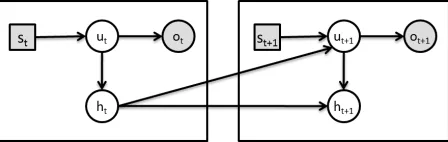
To learn the user action model, a dynamic Bayesian network is adopted with several conditional inde-pendence assumptions similar to Equation 1. This gives rise to the graphical structure shown in Fig-ure 1. As mentioned in Section 2, the user ac-tion model deals with acac-tions at the predicate level1.
This abstract-level handling enables the user action model to employ exact inference algorithms such as thejunction treealgorithm (Lauritzen and Spiegel-halter, 1988) for more efficient reasoning over the graphical structure.
Figure 1: The graphical structure of the dynamic Bayesian network for the user action model. The shaded items are observable and the transparent ones are latent.
The joint distribution for this model is given by
p(S,H,U,O|Θ)
=p(h0|π) Y
t
p(ut|st,ht−1,φ)
·p(ht|ht−1,ut,η)p(ot|ut,ζ)
(6)
where a capital letter stands for the set of corresponding random variables, e.g., U = {u1, . . . ,uN}, and Θ = {π,φ,η,ζ} denotes the
set of parameters governing the model2.
Unlike previous research which learns ζ using maximum likelihood estimation, we use a determin-istic function that yields a fraction of an observed confidence score in accordance with the degree of agreement betweenutandot:
p(ot|ut) =CS(ot)·
|ot∩ut| |ot∪ut|
+ (7)
whereCS(·)returns the confidence score of the
as-sociated observation. As mentioned above, π and ηare deterministically set by simple discourse rules (Equation 3). This only leaves the user action model φto be learned. In a Bayesian model, any unknown parameter is given a prior distribution and is ab-sorbed into the set of latent variables, thus it is not feasible to directly evaluate the posterior distribution of the latent variables and the expectations with re-spect to this distribution. Therefore a determinis-tic approximation, called mean fieldtheory (Parisi, 1988), is applied.
Inmean fieldtheory, the family of posterior distri-butions of the latent variables is assumed to be par-titioned into disjoint groups:
q(Z) = M
Y
i=1
qi(Zi) (8)
2Here, a uniform prior distribution is assigned onS
whereZ={z1, . . . ,zN}denotes all latent variables
including parameters and Zi is a disjoint group.
Amongst all distributions q(Z) having the form of
Equation 8, we then seek the member of this family for which the divergence from the true posterior dis-tribution is minimized. To achieve this, the follow-ing optimization with respect to each of theqi(Zi)
factors is to be performed in turn (Bishop, 2006):
lnqj∗(Zj) =Ei6=j
ln(X,Z)+const (9)
whereX={x1, . . . ,xN}denotes all observed
vari-ables andEi6=jmeans an expectation with respect to
theqdistributions over all groupsZifori6=j.
Now we apply the mean field theory to the user model. Before doing so, we need to introduce the prior over the parameter φ which is a product of
Dirichletdistributions3.
p(φ) =Y
k
Dir(φk|α0k)
=Y
k
C(α0k)Y l
φα0k−1 k,l
(10)
wherekrepresents the joint configuration of all of the parents andC(α0k)is the normalization constant
for theDirichletdistribution. Note that for symme-try we have chosen the same parameterα0
kfor each of the components.
Next we approximate the posterior distribution,
q(H,U,φ) using a factorized form, q(H,U)q(φ).
Then we first apply Equation 9 to find an expression for the optimal factorq∗(φ):
3Note that priors over parameters for deterministic
[image:3.612.74.298.58.129.2]lnq∗(φ) =EH,Ulnp(S,H,U,O,Θ)+const
=EH,U X
t
lnp(ut|st,ht−1,φ)
+ lnp(φ) +const
=X
t
X
i,j,k
EH,U
δi,j,k
lnφi,j,k
+X
i,j,k
(αoi,j,k−1) lnφi,j,k+const
=X
i,j,k
EH,U[ni,j,k] + (αoi,j,k−1)
·lnφi,j,k
+const
(11)
whereδ(·,·)denotesKroneckerdelta andδi,j,k
de-notesδ(st, i)δ(ht−1, j) δ(ut, k). ni,j,k is the
num-ber of times where,st =i,ht−1 =j, andut =k.
This leads to a product ofDirichletdistributions by taking the exponential of both sides of the equation:
q∗(φ) =Y i,j
Dir(φi,j|αi,j),
αi,j,k =α0i,j,k+EH,U[ni,j,k]
(12)
To evaluate the quantity EH,U[ni,j,k], Equation 9
needs to be applied once again to obtain an op-timal approximation of the posterior distribution
q∗(H,U).
lnq∗(H,U) =Eφ
lnp(S,H,U,O,Θ)+const
=Eφ
X
t
lnp(ut|st,ht−1,φ)
+ lnp(ht|ht−1,ut)
+ lnp(ot|ut)
+const =X t Eφ
lnp(ut|st,ht−1,φ)
+ lnp(ht|ht−1,ut)
+ lnp(ot|ut)
+const
(13)
whereEφ
lnp(ut|st,ht−1,φ)
can be obtained us-ing Equation 12 and properties of theDirichlet dis-tribution:
Eφ
lnp(ut|st,ht−1,φ)
=X
i,j,k
δi,j,kEφ
lnφi,j,k
=X
i,j,k
δi,j,k(ψ(αi,j,k)−ψ( ˆαi,j))
(14)
where ψ(·) is the digamma function with αˆi,j =
P
kαi,j,k. Because computing EH,U[ni,j,k] is
equivalent to summing each of the marginal poste-rior probabilities q∗(ht−1,ut) with the same
con-figuration of conditioning variables, this can be done efficiently by using thejunction treealgorithm. Note that the expression on the right-hand side for bothq∗(φ) andq∗(H,U) depends on expectations
computed with respect to the other factors. We will therefore seek a consistent solution by cycling through the factors and replacing each in turn with a revised estimate.
4 Confidence Score Calibration
As shown in Section 2, we can obtain a better obser-vation model by improving confidence score accu-racy. Since the confidence score is usually computed using the ASR and SLU results, it can be enhanced by adding dialog-level information. Basically, the confidence score represents how likely it is that the recognized input is correct. This means that a well-calibrated confidence score should satisfy that prop-erty such that:
p(ut=a|ot=a)'
P
kδ(uk, a)δ(ok, a)
P
kδ(ok, a)
(15)
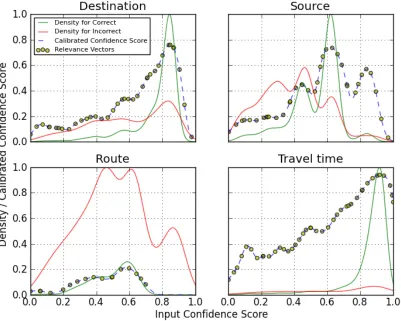
Figure 2: Illustrations of confidence score calibration for the representative concepts in the Let’s Go domain
a mapping function for each instance, but rather for each concept, since the former could cause se-vere data sparseness. In order to estimate the em-pirical distribution in an unsupervised manner, we exploit grounding information4 as true labels. We
first parse dialog logs to look for the grounding in-formation that the users have provided. Each time we encounter grounding information that includes the constraints used in the backend queries, this is added to the list. If two actions contradict each other, the later action overwrites the earlier one. Then, for each observation in the data, we determine its correctness by comparing it with the grounding in-formation. Next, we gather two sets of confidence scores with respect to correctness, on which we ap-ply a Gaussian kernel-based density estimation.
Af-4Specifically, we used explicitly confirmed information by
the system for this study
ter that, we scale the two estimated densities by their total number of elements to see how the ratio of cor-rect ones over the sum of corcor-rect and incorcor-rect ones varies according to the confidence score. The ratio computed above will be the calibrated score:
c0 = dc(c)
dc(c) +dinc(c) (16)
where c0 indicates the calibrated confidence score
andc is the input confidence score. dc(·) denotes
the scaled density for the correct set anddinc(·) is
the scaled density for the incorrect set.
virtue of the sparse representation, we only need to consider a few so-called relevance vectorsto com-pute the score:
y(x) = X
xn∈RV
wnk(x,xn) +b (17)
where RV denotes the set of relevance vectors,
|RV| |{xn}|. k(·,·)represents a kernel function
andbis a bias parameter. Figure 2 shows the
afore-mentioned process for several representative con-cepts in the Let’s Go domain.
5 Experimental Setup
To verify the proposed method, three months of data from the Let’s Go domain were used to train the user action model and the observation model. The training data consists of 2,718 dialogs and 23,044 turns in total. To evaluate the user action model, we compared overall system performance with three different configurations: 1) the uniform distribution, 2) the user action model without historical infor-mation5 which is comparable to the bigram model
of (Keizer et al., 2008), 3) the user action model with historical information included. For system perfor-mance evaluation, we used a user simulator (Lee and Eskenazi, 2012) which provides a large number of dialogs with statistically similar conditions. Also, the simulated user enables us to examine how per-formance changes over a variety of error levels. This simulated user supports four error levels and each model was evaluated by generating 2,000 dialogs at each error level. System performance was measured in terms of average dialog success rate. A dialog is considered to be successful if the system provides the bus schedule information that satisfies the user goal.
To measure the effectiveness of the calibration method, we conducted two experiments. First, we applied the calibration method to parameter learn-ing for the user action model by uslearn-ing the calibrated confidence score in Equation 7. We compared the log-likelihood of two models, one with calibration and the other without calibration. Second, we com-pared overall system performance with four differ-ent settings: 1) the user action model with
histori-5This model was constructed by marginalizing out the
his-torical variables.
cal information and the observation model with cal-ibration, 2) the user action model with historical in-formation and the observation model without cali-bration, 3) the user action model without historical information and the observation model with calibra-tion, 4) the user action model without historical in-formation and the observation model without cali-bration.
6 Results
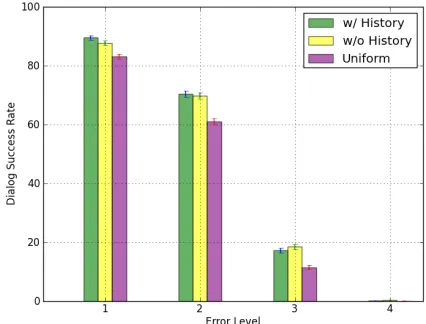
[image:6.612.322.535.489.651.2]The effect of parameter learning of the user action model on average dialog success rate is shown in Figure 3. While, in the previous study, the bigram model unexpectedly did not show a significant ef-fect, our result here indicates that our comparable model, i.e. the model with historical information ex-cluded, significantly outperformed the baseline uni-form model. The difference could be attributed to the fact that the previous study did not take tran-scription errors into consideration, whereas our ap-proach handles the problem by treating the true user action as hidden. However, we cannot directly com-pare this result with the previous study since the tar-get domains are different. The model with historical information included also consistently surpassed the uniform model. Interestingly, there is a noticeable trend: the model without historical information per-forms better as the error level increases. This result may indicate that the simpler model is more robust
Figure 4: The effect of confidence score calibration on the log-likelihood of the user action model during the training process.
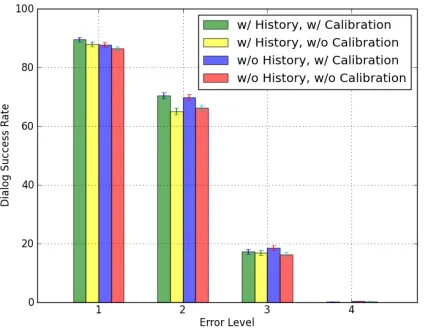
Figure 5: The effect of confidence score calibration for the observation model on overall system performance. The error bar shows standard error.
to error. Although average dialog success rates be-came almost zero at error level four, this result is a natural consequence of the fact that the majority of the dialogs in this corpus are failed dialogs.
Figure 4 shows the effect of confidence score calibration on the log-likelihood of the user action model during the training process. To take into ac-count the fact that different confidence scores result in different log-likelihoods regardless of the qual-ity of the confidence score, we shifted both log-likelihoods to zero at the beginning. This
modifica-tion more clearly shows how the quality of the confi-dence score influences the log-likelihood maximiza-tion process. The result shows that the calibrated confidence score gives greater log-likelihood gains, which implies that the user action model can better describe the distribution of the data.
The effect of confidence score calibration for the observation model on average dialog success rate is presented in Figure 5. For both the user action model with historical information included and excluded, the application of the confidence score calibration consistently improved overall system performance. This result implies the possibility of automatically improving confidence scores in a modularized man-ner without introducing a dependence on the under-lying methods of ASR and SLU.
7 Conclusion
In this paper, we have presented novel unsupervised approaches for learning the user action model and improving the observation model that constitute the partition-based belief tracking method. Our pro-posed method can learn a user action model directly from a machine-transcribed spoken dialog corpus. The enhanced system performance shows the effec-tiveness of the learned model in spite of the lack of human intervention. Also, we have addressed con-fidence score calibration in a unsupervised fashion using dialog-level grounding information. The pro-posed method was verified by showing the positive influence on the user action model learning process and the overall system performance evaluation. This method may take us a step closer to being able to automatically update our models while the system is live. Although the proposed method does not deal with N-best ASR results, the extension to support N-best results will be one of our future directions, as soon as the Let’s Go system uses N-best ASR re-sults.
Acknowledgments
This work was supported by the second Brain Korea 21 project.
References
[image:7.612.84.296.319.483.2]M. Gasic and S. Young, 2011. Effective handling of dialogue state in the hidden information state POMDP-based dialogue manager. ACM Transactions
on Speech and Language Processing, 7(3).
J. Henderson, O. Lemon, K. Georgila, 2008. Hybrid Re-inforcement / Supervised Learning of Dialogue Poli-cies from Fixed Datasets. Computational Linguistics, 34(4):487-511.
F. Jurcicek, B. Thomson and S. Young, 2011. Natu-ral Actor and Belief Critic: Reinforcement algorithm for learning parameters of dialogue systems modelled as POMDPs. ACM Transactions on Speech and Lan-guage Processing, 7(3).
S. Keizer, M. Gasic, F. Mairesse, B. Thomson, K. Yu, S. Young, 2008. Modelling User Behaviour in the HIS-POMDP Dialogue Manager. In Proceedings of SLT. S. Lauritzen and D. J. Spiegelhalter, 1988. Local
Com-putation and Probabilities on Graphical Structures and their Applications to Expert Systems. Journal of Royal Statistical Society, 50(2):157–224.
S. Lee and M. Eskenazi, 2012. An Unsuper-vised Approach to User Simulation: toward Self-Improving Dialog Systems. In Proceedings of SIG-DIAL. http://infinitive.lti.cs.cmu.edu:9090.
G. Parisi, 1988. Statistical Field Theory. Addison-Wesley.
A. Raux, B. Langner, D. Bohus, A. W Black, and M. Eskenazi, 2005. Let’s Go Public! Taking a Spoken Dialog System to the Real World. In Proceedings of Interspeech.
A. Raux and Y. Ma, 2011. Efficient Probabilistic Track-ing of User Goal and Dialog History for Spoken Dia-log Systems. In Proceedings of Interspeech.
N. Roy, J. Pineau, and S. Thrun, 2000. Spoken dia-logue management using probabilistic reasoning. In
Proceedings of ACL.
U. Syed and J. Williams, 2008. Using automatically transcribed dialogs to learn user models in a spoken dialog system. In Proceedings of ACL.
B. Thomson and S. Young, 2010. Bayesian update of dialogue state: A POMDP framework for spoken dialogue systems. Computer Speech & Language, 24(4):562-588.
B. Thomson, F. Jurccek, M. Gasic, S. Keizer, F. Mairesse, K. Yu, S. Young, 2010. Parameter learning for POMDP spoken dialogue models. In Proceedings of SLT.
M. Tipping, 2001. Sparse Bayesian Learning and the Relevance Vector Machine. Journal of Machine
Learning Research, 1:211–244.
J. Williams, P. Poupart, and S. Young, 2005. Factored Partially Observable Markov Decision Processes for Dialogue Management. In Proceedings of Knowledge and Reasoning in Practical Dialogue Systems.
J. Williams and S. Young, 2007. Partially observable Markov decision processes for spoken dialog systems.
Computer Speech & Language, 21(2):393-422. J. Williams, 2008. Exploiting the ASR N-best by
track-ing multiple dialog state hypotheses. In Proceedings of Interspeech.
J. Williams, 2010. Incremental partition recombination for efficient tracking of multiple dialog states. In
Pro-ceedings of ICASSP.
S. Young, M. Gasic, S. Keizer, F. Mairesse, J. Schatz-mann, B. Thomson and K. Yu, 2010. The Hidden Information State Model: a practical framework for POMDP-based spoken dialogue management.