Semi-supervised learning for automatic conceptual property extraction
Colin Kelly
Computer Laboratory University of Cambridge Cambridge, CB3 0FD, UK
colin.kelly @cl.cam.ac.uk
Barry Devereux
Centre for Speech, Language, and the Brain University of Cambridge Cambridge, CB2 3EB, UK [email protected]
Anna Korhonen
Computer Laboratory University of Cambridge Cambridge, CB3 0FD, UK
anna.korhonen @cl.cam.ac.uk
Abstract
For a given concrete noun concept, humans are usually able to cite properties (e.g.,
ele-phant is animal, car has wheels) of that
con-cept; cognitive psychologists have theorised that such properties are fundamental to un-derstanding the abstract mental representation of concepts in the brain. Consequently, the ability to automatically extract such properties would be of enormous benefit to the field of experimental psychology. This paper investi-gates the use of semi-supervised learning and support vector machines to automatically ex-tract concept-relation-feature triples from two large corpora (Wikipedia and UKWAC) for concrete noun concepts. Previous approaches have relied on manually-generated rules and hand-crafted resources such as WordNet; our method requires neither yet achieves bet-ter performance than these prior approaches, measured both by comparison with a property norm-derived gold standard as well as direct human evaluation. Our technique performs particularly well on extracting features rele-vant to a given concept, and suggests a number of promising areas for future focus.
1 Introduction
The representation of concrete concepts (e.g.,car, banana,spanner) in the human brain has long been an important area of investigation for cognitive psy-chologists. Recent theories of this mental repre-sentation have proposed a componential, property-based and distributed model of conceptual knowl-edge (e.g., Farah and McClelland (1991), Randall et al. (2004), Tyler et al. (2000)).
In order to empirically test these cognitive the-ories, researchers have moved towards employing real-world knowledge in their experiments. This knowledge has usually been procured from
human-derived lists of properties taken from property norm-ing studies (Garrard et al., 2001; McRae et al., 2005). In such studies, human participants are asked to describe and note properties of a given concept (e.g., has shell for turtle). Synonymous responses are grouped together as a single prop-erty and those meeting a certain minimum response-frequency threshold are taken as valid properties. The most wide-ranging study to date was that con-ducted by McRae et al. (2005): some sample prop-erties from this set are in Table 1.
As others have noted (Murphy, 2002; McRae et al., 2005), property norming studies are prone to a number of deficiencies. One such weakness is the incongruity of shared properties across even highly-related concepts: human respondents exhibit a lack of consistency when listing properties that are com-mon to many similar concepts. For example, while
has legs is listed as a property of crocodile in the McRae norms, it is absent as a property of alliga-tor. A related issue is the non-comprehensive nature of the generated norms – although they may cover the most salient properties for a given concept, they are unlikely to comprise all of a concept’s properties (e.g.,has heart does not appear as a property of any of the 92 animal concepts).
Our research aims to use NLP techniques to cre-ate a system able to emulcre-ate the output of such studies, and overcome some of the aforementioned weaknesses. Our proposed system begins by search-ing dependency-parsed corpora for those sentences containing concept and feature terms which are also found in a McRae norm-derived training set of properties. For these sentences, the system generates grammatical relation/part-of-speech struc-tural attributes and applies support vector machines (SVMs) to learn sets of attributes likely to indicate the instantiation of a property in a sentence. These
turtle bowl
has a shell 25 is round 19 lays eggs 16 used for eating 12
swims 15 used for soup 11
[image:2.612.72.306.58.195.2]is green 14 used for food 11 lives in water 14 used for liquids 10 is slow 13 used for eating cereal 10 an animal 11 made of plastic 8 walks 10 used for holding things 7 walks slowly 10 is curved 7 has 4 legs 9 found in kitchens 7 Table 1: Top ten properties from McRae norms with pro-duction frequencies forturtleandbowl.
learned patterns of salient attributes are finally ap-plied to a corpus to derive new properties for unseen concepts.
Our task is a challenging one: the properties we seek are extremely diverse in their form. They range from the simple (e.g., banana is yellow) to the com-plex (e.g., bayonet found at the end of a gun). Al-though the properties can broadly be divided into a number of categories (encyclopedic, taxonomic, functional, etc) there is not a great deal of regular-ity in the nature of the properties a given noun will likely possess: it is highly concept-dependent.
Furthermore, we hope to derive these properties from corpora, with the assumption that these prop-erties will manifest themselves therein. Indeed, An-drews et al. (2005) discuss a theory of human knowl-edge which relies on a combination of both dis-tributional (i.e., derived from spoken and written language) and experiential data (i.e., that derived from our interactions with the real world), claiming that the necessary contribution of each data-type for a comprehensive human semantic representation is non-trivial. Finally, there are difficulties associated with evaluating our system’s output directly against a set of human-generated property norms: we dis-cuss these in further detail later.
Given their provenance, the properties found in property norms are free-form. To simplify our task we apply a more rigid representation to the proper-ties we already have and to those we aim to seek. We delineate each property into aconcept relation fea-ture triple (see Section 2.2) and our task becomes one of finding validrelation featurepairs given a par-ticularconcept. This recoding renders our task more well-defined and makes evaluation of our method
reptile1NNS
include2 VBP
species0 IN
of3IN
turtle5NN dobj five1DT
ncmod ncmod
dobj marine0
NNP
ncmod ncsubj
Figure 1: C&C-derived GR-POS graph for the sentence
Marine reptiles include five species of turtle.
more comparable to previous and related work. Having framed our task in this way, there is an obvious parallel with relation extraction: both ne-cessitate the selection/classification of relationships between individual entities (in our case, between concept and feature). Hearst (1992) was the first to propose a pattern-based approach to this task us-ing lexico-syntactic patterns to automatically extract hyponyms and this technique has frequently been used for ontology learning. For example, Pantel and Pennacchiotti (2008) linked instantiations of a set of semantic relations into existing semantic ontologies and Davidov et al. (2007) employed seed concepts from a given semantic class to discover relations shared by concepts in that class.
Our task is more complex than classic relation ex-traction for two main reasons: 1) the relations which we aim to extract are not limited to a small set of just a few well-defined relations (e.g.,is-aand part-of) nor to the relations of a specific semantic class (e.g., capital-isfor countries). Indeed the relations can be as many and diverse as the concepts them-selves (e.g., each concept could possess a unique and distinguishing relation and feature). 2) We are attempting to simultaneously extract two pieces of information: features of the concept and those fea-tures’ defining relationship with the concept, but only those relations and features which would be classified as ‘common-sense’, something which is easy for humans to recognise but difficult (if not im-possible) to describe rigorously or formally.
[image:2.612.356.500.59.231.2]ex-traction of binary relations that scale to a web cor-pus, for example the ReVerb (Etzioni et al., 2011) and WOE (Wu and Weld, 2010) systems. These systems are designed to extract legitimate relations from a given sentence. In contrast, our aim is to cap-ture more general relationships which are ‘common-sense’; just because an extracted relation is correct in a given context does not automatically make it true in general. Previous reasoned approaches to our task have taken their lead from Hearst and her suc-cessors, employing manually-created rulesets to ex-tract such properties from corpora (e.g., Baroni et al. (2009), Devereux et al. (2010), and our comparison system (Kelly et al., 2010)). Baroni et al. extract re-lational information in the form of ‘type-sketches’, which give an approximate, implicit description of the relationship whereas we are aiming to extract explicit relations between the target concept and its corresponding features. Devereux et al. and Kelly et al. have attempted this, but both employ WordNet (Fellbaum, 1998) to extract semantic relatedness in-formation.
We use semi-supervised learning as it offers a flexible technique of harnessing small amounts of labelled data to derive information from unlabelled datasets/corpora and allows us to guide the extrac-tion towards our desired ‘common-sense’ output. We chose SVMs as they have been used for a va-riety of tasks in NLP (e.g., Joachims et al. (1998), Gim´enez and Marquez (2004)). We will demon-strate that our system’s performance exceeds that of Kelly et al. (2010) and Etzioni et al. (2011). It is, as far as we are aware, the first work to employ semi-supervised learning for this task.
2 Method
We will use SVMs to learn lexico-syntactic pat-terns in our corpora corresponding to known prop-erties in order to find new ones. Training an SVM requires a labelled training set. To generate this set we harness our already-known concepts/features (and their relationships) from the McRae norms to find instantiations of said relationships within our corpora. We use parsed sentence information from our corpora to create a set of attributes describing each relationship, our learning patterns. In doing so, we are assuming that across sentences in our corpora containing a concept/feature pair found in
the McRae norms, there will be a set of consistent lexico-syntactic patterns which indicate the same re-lationship as that linking the pair in the norms.
Thus we iterate over our chosen corpora, parsing each concept-containing sentence to yield grammat-ical relation (GR) and part-of-speech (POS) infor-mation from which we can create a GR-POS graph relating the two. Then for each triple, we find any/all paths through the graph which link theconceptto its feature and use the corresponding relationto label this path. We collect descriptive information about the path in the form of attributes describing it (e.g., path nodes, labels, length) to create a training pattern specific to that concept relation feature triple and sentence. It is these lists of attributes (and their rela-tionlabels) which we employ as the labelled training set and as input for our SVM.
2.1 Corpora
We employ two corpora for our experiments: Wikipedia and the UKWAC corpus (Ferraresi et al., 2008). These are both publicly available and web-based: the former a source of encyclopedic infor-mation and the latter a source of general text. Our Wikipedia corpus is based on a Sep 2009 version of English-language Wikipedia and contains around 1.84 million articles (>1bn words). Our UKWAC corpus is an English-language corpus (>2bn words) obtained by crawling the.ukinternet domain.
2.2 Training data
Our experiments use a British-English version of the McRae norms (see Taylor et al. (2011) for de-tails). We needed to recode the free-form McRae properties into relation-classes and features which would be usable for our learning algorithm. As we will be matching the features from these prop-erties with individual words in the training corpus it was essential that the features we generated con-tained only one lemmatised word. In contrast, the relations were merely labels for the relationship de-scribed (they did not need to occur in the sentences we were training from) and therefore needed only to be single-string relations. This allowed preposi-tional verbs as distinct relations, something which has not been attempted in previous work yet can be semantically significant (e.g., the relationsused-in,
process to our set of free-form properties to distill them to triples of the formconcept relation feature, whererelationcan be a multi-word string andfeature is a single word:
1. Translation of implicit properties to their correct re-lations (e.g., pig an animal→pig is an animal).
2. Removal of indefinite and definite articles.
3. Behavioural properties become “does” properties (e.g., turtle beh eats→turtle does eats).
4. Negative properties given their own relation classes (e.g., turkey does cannot fly→turkey doesnt fly).
5. All numbers are translated to named cardinals (e.g.,
spider has 8 legs→spider has eight legs).
6. Some of the norms already contained synonymous terms: these were split into separate triples for each synonym (e.g., pepper tastes hot/spicy → pepper tastes hot and pepper tastes spicy).
7. Prepositional verbs were translated to one-word, hyphenated strings (e.g., made of →made-of ).
8. Properties with present participles as the penulti-mate word were split into one including the verb as the feature and one including it in the relation (e.g.,
envelope used for sending letters→envelope used-for-sending letters and envelope used-for sending).
9. Any remaining multi-word properties were split with the first term after the concept acting as the relation (e.g., bull has ring in its nose→bull has ring, bull has in, bull has its and bull has nose).
10. All remaining stop-words were removed; properties ending in stop-words (e.g., bull has in and bull has
its) were removed completely.
This yielded 7,518 property-triples with 254 distinct relations and an average of 14.7 triples per concept.
2.3 Parsing
We parsed both corpora using the C&C parser (Clark and Curran, 2007) as we employ both GR and POS information in our learning method. To ac-celerate this stage, we process only sentences con-taining a form (e.g., singular/plural) of one of our training/testing concepts. We lemmatise each word using the WordNet NLTK lemmatiser (Bird, 2006). Parsing our corpora yields around 10Gb and 12Gb of data for UKWAC and Wikipedia respectively.
The C&C dependency parse output contains, for a given sentence, a set of GRs forming an acyclic graph whose nodes correspond to words from the sentence, with each node also labelled with the POS of that word. Thus the GR-POS graph interrelates all
lexical, POS and GR information for the entire sen-tence. It is therefore possible to construct a GR-POS graph rooted at our target term (the concept in ques-tion), with POS-labelled words as nodes, and edges labelled with GRs linking the nodes to one another. An example graph can be seen in Figure 1.
2.4 Support vector machines
We use SVMs (Cortes and Vapnik, 1995) for our experiments as they have been widely used in NLP and their properties are well-understood, showing good performance on classification tasks (Meyer et al., 2003). In their canonical form, SVMs are non-probabilistic binary linear classifiers which take a set of input data and predict, for each given input, which of two possible classes it corresponds to.
There are more than two possible relation-labels to learn for our input patterns, so ours is a multi-class classification task. For our experiments we use the SVM Light Multiclass (v. 2.20) software (Joachims, 1999) which applies the fixed-point SVM algorithm described by Crammer and Singer (2002) to solve multi-class problem instances. Joachims’ software has been widely used to implement SVMs (Vinok-ourov et al., 2003; Godbole et al., 2002).
2.5 Attribute selection
Previous techniques for our task have made use of lexical, syntactic and semantic information. We are deliberately avoiding the use of manually-created semantic resources, so we rely only on lexical and syntactic attributes for our learning stage (i.e., the GR-POS paths described earlier).
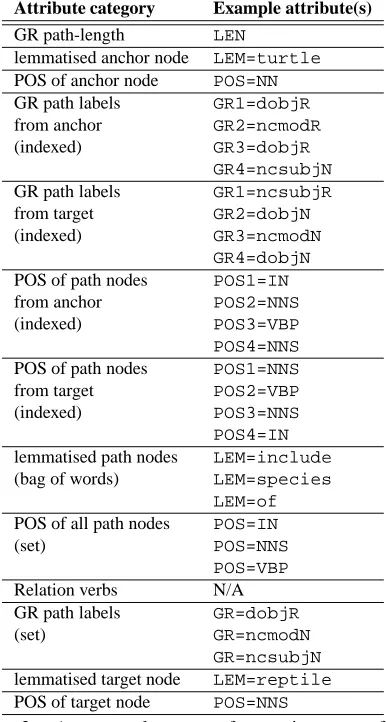
A table of all the categories of attributes we ex-tract for each GR-POS path are in Table 2.4, together with attributes from the path linkingturtleandreptile in our example sentence (see Figure 1).
Attribute category Example attribute(s)
GR path-length LEN
lemmatised anchor node LEM=turtle POS of anchor node POS=NN
GR path labels GR1=dobjR
from anchor GR2=ncmodR
(indexed) GR3=dobjR
GR4=ncsubjN GR path labels GR1=ncsubjR
from target GR2=dobjN
(indexed) GR3=ncmodN
GR4=dobjN POS of path nodes POS1=IN
from anchor POS2=NNS
(indexed) POS3=VBP
POS4=NNS POS of path nodes POS1=NNS
from target POS2=VBP
(indexed) POS3=NNS
POS4=IN lemmatised path nodes LEM=include (bag of words) LEM=species
LEM=of POS of all path nodes POS=IN
(set) POS=NNS
POS=VBP
Relation verbs N/A
GR path labels GR=dobjR
(set) GR=ncmodN
GR=ncsubjN lemmatised target node LEM=reptile POS of target node POS=NNS
Table 2: An example vector for an instance of the relation-label is. The attributes are distinguished from one another by their attribute category. Relation verbs only appear in the verb-augmented vector-type and no such verbs appear in our example sentence, so this cat-egory of attribute is empty. All attributes in the table will receive the value1.0except theLENattribute which will have the value0.2(the reciprocal of the path length, 5).
We considered allocating a ‘no-rel’ relation la-bel to those sets of attributes corresponding to paths through the GR-POS graph which did not link the concept to a feature found in our training data; however our initial experiments indicated the SVM model would assign every pattern we tested to the ‘no-rel’ relation. Therefore we used only positive instances in our training pattern data.
We cycle through all training concepts/features, finding sentences containing both. For each such sentence, our system generates the attributes from the GR-POS path linking the concept to the fea-ture (the linking-path) to create a pattern for that pair, in the form of a relation-labelled vector
con-taining real-valued attributes. The system assigns 1.0 to all attributes occurring in a given path and the LEN value receives the reciprocal of the path-length.1 Each linking-path is collected into a
relation-labelled, sparse vector in this manner. In the larger UKWAC corpus this corresponds to over 29 million unique attributes across all found linking-paths (this figure corresponds to the dimensionality of our vectors). We then pass all vectors to the learn-ing module2 of SVM Light to generate a learned model across all training concepts.
2.6 Extracting candidate patterns
Having trained our model, we must now find po-tential features and relations for our test concepts in our corpora. We again only examine sentences which contain at least one of our test concepts. Fur-thermore, to avoid a combinatorial explosion of pos-sible paths rooted at those concepts we only permit as candidates those paths whose anchor node is a singular or plural noun and whose target node is ei-ther a singular/plural noun or adjective. This filter-ing corresponds to choosfilter-ing patterns containfilter-ing one of the three most frequent anchor node POS tags (NN,NNSand NNP) and target node POS tags (NN, JJandNNS) found during our training stage. These candidate patterns constitute 92.6% and 87.7% of all the vectors, respectively, from our training set of patterns (on the UKWAC corpus). This pattern pre-selection allows us to immediately ignore paths which, despite being rooted at a test concept, are un-likely to contain property norm-like information.
2.7 Generating and ranking triples
We next classified our test concepts’ candidate patterns using the learned model. SVM Light as-signs each pattern a relation-class from the training set and outputs the values of the decision functions from the learned model when applied to that par-ticular pattern. The sign of these values indicates the binary decision function choice, and their mag-nitude acts as a measure of confidence. We wanted those vectors which the model was most confident in across all decision functions, so we took the sum of the absolute values of the decision values to gen-erate a pattern score for each vector/relation-label.
1All other possible attributes are assigned the value0.0. 2
[image:5.612.89.282.59.420.2]Vector-type Corpus βLL βPMI βSVM Prec. Recall F
Ignoring relation.
Non-augmented
Wikipedia 0.3 0.00 1.00 0.2214 0.3197 0.2564 UKWAC 0.10 0.05 0.60 0.2279 0.3330 0.2664 UKWAC-Wikipedia 0.35 0.00 0.75 0.2422 0.3533 0.2829
Verb-augmented
Wikipedia 0.20 0.00 0.65 0.2217 0.3202 0.2568 UKWAC 0.30 0.00 0.95 0.2326 0.3400 0.2720 UKWAC-Wikipedia 0.40 0.05 1.00 0.2444 0.3577 0.2859
With relation.
Non-augmented
Wikipedia 0.05 0.00 1.00 0.1199 0.1732 0.1394 UKWAC 0.05 0.00 1.00 0.1126 0.1633 0.1312 UKWAC-Wikipedia 0.05 0.00 0.65 0.1241 0.1808 0.1449
Verb-augmented
Wikipedia 0.05 0.00 1.00 0.1215 0.1747 0.1410 UKWAC 0.05 0.00 1.00 0.1190 0.1724 0.1387 UKWAC-Wikipedia 0.05 0.00 0.70 0.1281 0.1860 0.1494
Table 3: Parameter estimation both with and without relation, using our augmented and non-augmented vector-types and across our two corpora and the combined corpora set.
From these patterns we derived an output set of triples where the concept and feature of a triple cor-responded to the anchor and target nodes of its pat-tern and the relation corresponded to the patpat-tern’s relation-label. Identical triples from differing pat-terns had their pattern scores summed to give a final ‘SVM score’ for that triple.
2.8 Calculating triple scores
A brief qualitative evaluation of our system’s out-put indicates that although the higher-ranked (by SVM score) features and relations were, for the most part, quite sensible, there were some obvious output errors (e.g., non-dictionary strings or verbs appear-ing as features). Therefore we restricted our fea-tures to those which appear as nouns or adjectives in WordNet and excluded features containing an NLTK (Bird, 2006) corpus stop-word. Despite these exclu-sions, some general (and therefore less informative) relation/feature combinations (e.g.,is good,is new) were still ranking highly. To mitigate this, we ex-tract both log-likelihood (LL) and pointwise mutual information (PMI) scores for each concept/feature pair to assess the relative saliency of each extracted feature, with a view to downweighting common but less interesting features. To speed up this and later stages, we calculate both statistics for the top 1,000 triples extracted for each concept only.
PMI was proposed by Church and Hanks (1990) to estimate word association. We will use it to mea-sure the strength of association between a concept and its feature. We hope that emphasising concept-feature pairs with high mutual information will ren-der our triples more relevant/informative.
We also employ the LL measure across our set of concept-feature pairs. Proposed by Dunning (1993), LL is a measure of the distribution of linguistic phe-nomena in texts and has been used to contrast the relative corpus frequencies of words. Our aim is to highlight features which are particularly distinctive for a given concept, and hence likely to be features of that concept alone.
We calculate an overall score for a triple, t, by a weighted combination of the triple’s SVM, PMI and LL scores using the following formula:
score(t) =βPMI·PMI(t)+βLL·LL(t)+βSVM·SVM(t)
where the PMI, SVM and LL scores are normalised so they are in the range [0, 1]. The relativeβweights thus give an estimate of the three measures’ impor-tance relative to one another and allows us to gauge which combination of these scores is optimal.
2.9 Datasets
We also wanted to ascertain the extent to which the output from both our corpora could be combined to improve results, balancing the encyclopedic but somewhat specific nature of Wikipedia with the gen-erality and breadth of the UKWAC corpus. We com-bined the output by summing individual SVM scores of each triple from both corpora to yield a combined SVM score. PMI and LL scores were then calcu-lated as usual from this combined set of triples.
3 Experimental Evaluation
3.1 Evaluation methodology
Relation Prec. Recall F
Kelly et al. Without 0.1943 0.3896 0.2592 With 0.1102 0.2210 0.1471
ReVerb Without 0.1142 0.2258 0.1514 With 0.0431 0.0864 0.0576
[image:7.612.313.556.57.203.2]Our method Without 0.2417 0.4847 0.3225 With 0.1238 0.2493 0.1654 Table 4: Our best scores on the ESSLLI set compared to Kelly et al. (2010) and the ReVerb system (Etzioni et al., 2011). Our results are from the verb-augmented vector-type, using the combined UKWAC-Wikipedia corpus and using theβparameters highlighted in Table 3.
510 to use in our final system testing and split the remaining 466 concepts randomly and evenly into 10 folds. We apply the training steps above to nine of the folds, generating predictions for the single held-out fold. We repeat this for all ten folds, yield-ing relations and features with SVM, LL and PMI scores for our full set of 466 training concepts on the UKWAC, Wikipedia and combined corpora.
We varied the β values from our scoring equa-tion in the range [0,1] (interval 0.05) and com-pared the top twenty triples for each concept directly against the held-out training set. The best F-scores and their correspondingβvalues (evaluating on full triples and concept-feature pairs alone) are in Ta-ble 3. We can see that our best results employ the verb-augmented vector-type and the combined cor-pus, with a best F-score of 0.2859 when ignoring the relation term and 0.1494 when including it in the evaluation. The main difference between these two results is the relative contribution of the reweighting factors: the SVM score is the most important over-all, but the LL and PMI scores come into play when evaluating without the relation. This could be ex-plained by the fact that the PMI and LL scores do not use any relation terms in their calculations.
3.2 Quantitative evaluation
The unseen subset of the McRae norms is a set of human-generated common-sense properties with which our extracted properties can be compared. However, an issue with the McRae norms is that semantically identical properties can be represented by lexically different triples. This problem was ac-knowledged by Baroni et al. (2008) who created a synonym-expanded set of properties for 44 con-cepts (selected evenly across six semantic classes; the 44 concepts we excluded for testing) to
par-Judge Judge
turtle A B bowl A B
is green c c is large p p
is small c c used for food c c
is species c c used for mixing c c
is marine c c used for storing food c c
used for sea r r used for storing soup r r
is animal c c is ceramic c c
is many p c is small p p
has shell c c used for storing cereal r r
is large c p used for storing spoon r r
is reptile c c used for storing sugar p c
Table 5: Our judges’ assessments of the correctness of the top ten relation/feature pairs for two concepts extracted from our best system.
tially solve it. This expansion set comprises the con-cepts’ top ten properties from the McRae norms with semi-automatically generated synonyms for each of the ten distinct features. For example, the triple turtle has shell was expanded to also include tur-tle has shieldandturtle has carapace.
We use the two best systems (i.e., including and excluding the relation; highlighted in Table 3) to generate two sets of top twenty output triples for our 44 concepts. We then calculate precision, re-call and F-scores for each against our synonym-expanded set.3 Using this expanded set allows us to compare our work with that of Kelly et al. (2010). We also compare with the top twenty output of the Reverb system Etzioni et al. (2011) using their pub-licly available relations derived from the ClueWeb09 corpus, employing their normalized triples ranked by frequency. All sets of results are in Table 4. We note that even though Kelly et al. optimised their algorithm on the ESSLLI set to yield a theoretical best-possible score—we are evaluating ‘blind’—our performance still shows an advance on theirs: the improvement on both sets when comparing the pop-ulation of F-scores across all 44 concepts is statisti-cally significant at the 0.5% level.4
3.3 Human evaluation
The above does not quite offer the full picture: unlike the features, the relations are not synonym-expanded. Furthermore, it is possible that there
3
We note that we are incorporating an upper bound for pre-cision of 0.500 by comparing with only the top ten properties.
4
Relation A B κ Agreements
With c / p 146 161 0.7421 261 (87%) r / w 153 138
Without c / p 226 235 0.5792 255 (85%) r / w 74 65
Table 6: Inter-annotator agreement for our best system, both including and excluding the relation.
are correct properties being generated which simply don’t appear in the ESSLLI evaluation set.
In order to address these concerns, we also per-formed a human evaluation on 15 of our concepts.5 We asked two native English-speaking judges to de-cide whether a given triple was correct,6plausible,7 wrong but related,8 or wrong.9 We executed the human evaluation on our two best systems (as de-scribed above). As there were shared triples and concept-feature pairs across the two output sets, each triple and pair was evaluated only once. The judges were aware of the purposes of the study but were blind to the source sets. Some example judge-ments are in Table 5.
The agreement results across all 15 concepts to-gether with their κ coefficients (Cohen, 1960) are in Table 6. In our evaluation we conflated the
cor-rect/plausible and wrong but related/wrong
cate-gories (see also Kelly et al. (2010) and Devereux et al. (2010)). We did this because of the subjective na-ture of the judgements, and because we are seeking properties which are indeed correct or at least plausi-ble. These results indicate that our system is extract-ing correct or plausible triples 51.1% of the time (ris-ing to 76.8% when consider(ris-ing features only). They also demonstrate a marked discrepancy between the results for our two evaluations, reflecting the neces-sity of human evaluation when assessing our partic-ular task.
4 Discussion
In this paper we have shown that semi-supervised learning techniques can automatically learn
lexico-5
The 44 evaluation concepts had been separated into super-ordinate categories for unrelated psycholinguistic research and we selected our 15 proportionally and at random from these su-perordinate categories.
6
A correct, valid, feature. 7
A triple which is plausible but only in a specific set of cir-cumstances or a feature which was correct but very general.
8The triple is incorrect but there existed some sort of
rela-tionship between the concept and relation and/or feature. 9
When the triple is simply wrong.
syntactic patterns indicative of property norm-like relations and features. Using these patterns, our system can extract relevant and accurate properties from any parsed corpus and allows for multi-word relation labels, allowing greater semantic precision.
As already mentioned, the work of Baroni et al. (2009) is relevant to our own. Their approach achieves a precision score of 0.239 on the top ten returned features evaluated against the ESSLLI set: our best system offers precision of 0.370 on the same evaluation. Moreover, Baroni et al. do not explicitly derive relation terms. We better the performance of a comparable system (Kelly et al., 2010), even when evaluating against an unseen set of concepts, and our system does not use manually-generated rules or se-mantic information. Furthermore, human evaluation shows over half of our extracted properties are cor-rect/plausible.
For future work, we have already mentioned that we are ignoring a large amount of potentially in-structive training data, specifically those GR-POS paths in our corpus which don’t terminate on one of our training features, as well as those paths through sentences containing one of our concepts but none of our training features. It might therefore be worth-while investigating the use of this “negative” infor-mation. Another potential avenue for exploration would be the expansion of the learning vector-types. Although we already use a significant number of learning attributes (an average of 37.9 per training pattern), we could include more: there may be addi-tional information not directly on the GR-POS path linking a concept and feature (e.g., nodes adjacent to said path) which might be indicative of their re-lationship. We would also consider using active-learning, introducing a feedback loop and human-annotation to better distinguish between relations which our algorithm tends to classify incorrectly. For example, we could supplement input pattern data with disambiguating POS-GR graphs, drawing a distinction between valid and non-valid relations.
Acknowledgements
This research was supported by EPSRC grant EP/F030061/1. We are grateful to McRae and col-leagues for making their norms publicly available, and to the anonymous reviewers for their helpful in-put.
References
M. Andrews, G. Vigliocco, and D. Vinson. 2005. Integrating attributional and distributional informa-tion in a probabilistic model of meaning representa-tion. In Timo Honkela et al., editor, Proceedings of
AKRR’05, International and Interdisciplinary Confer-ence on Adaptive Knowledge Representation and Rea-soning, pages 15–25, Espoo, Finland: Helsinki
Uni-versity of Technology.
M. Baroni, S. Evert, and A. Lenci, editors. 2008. ESSLLI
2008 Workshop on Distributional Lexical Semantics.
M. Baroni, B. Murphy, Barbu E., and Poesio M. 2009. Strudel: A corpus-based semantic model based on properties and types. Cognitive Science, pages 1–33. S. Bird. 2006. NLTK: The natural language toolkit. In
Proceedings of the COLING/ACL on Interactive pre-sentation sessions, pages 69–72. Association for
Com-putational Linguistics.
K.W. Church and P. Hanks. 1990. Word association norms, mutual information, and lexicography.
Com-putational Linguistics, 16(1):22–29.
S. Clark and J.R. Curran. 2007. Wide-coverage effi-cient statistical parsing with CCG and log-linear mod-els. Computational Linguistics, 33(4):493–552. J. Cohen. 1960. A coefficient of agreement for nominal
scales. Educational and psychological measurement. C. Cortes and V. Vapnik. 1995. Support-vector networks.
Machine learning, 20(3):273–297.
K. Crammer and Y. Singer. 2002. On the algorithmic implementation of multiclass kernel-based vector ma-chines. The Journal of Machine Learning Research, 2:265–292.
D. Davidov, A. Rappoport, and M. Koppel. 2007. Fully unsupervised discovery of concept-specific relation-ships by web mining. In Annual Meeting-Association
For Computational Linguistics, volume 45, page 232.
B. Devereux, N. Pilkington, T. Poibeau, and A. Korho-nen. 2010. Towards unrestricted, large-scale acquisi-tion of feature-based conceptual representaacquisi-tions from corpus data. Research on Language & Computation, pages 1–34.
T. Dunning. 1993. Accurate methods for the statistics of surprise and coincidence. Computational linguistics, 19(1):61–74.
O. Etzioni, A. Fader, J. Christensen, S. Soderland, and M.T. Center. 2011. Open information extraction: The second generation. In Twenty-Second International
Joint Conference on Artificial Intelligence.
M.J. Farah and J.L. McClelland. 1991. A computational model of semantic memory impairment: Modality specificity and emergent category specificity. Journal
of Experimental Psychology: General, 120(4):339–
357.
C. Fellbaum. 1998. WordNet: An electronic lexical database. The MIT press.
A. Ferraresi, E. Zanchetta, M. Baroni, and S. Bernardini. 2008. Introducing and evaluating ukwac, a very large web-derived corpus of english. In Proceedings of the
4th Web as Corpus Workshop (WAC-4) Can we beat Google, pages 47–54.
P. Garrard, M.A.L. Ralph, J.R. Hodges, and K. Patterson. 2001. Prototypicality, distinctiveness, and intercorre-lation: Analyses of the semantic attributes of living and nonliving concepts. Cognitive Neuropsychology, 18(2):125–174.
J. Gim´enez and L. Marquez. 2004. Svmtool: A gen-eral pos tagger generator based on support vector ma-chines. In In Proceedings of the 4th International
Conference on Language Resources and Evaluation.
Citeseer.
S. Godbole, S. Sarawagi, and S. Chakrabarti. 2002. Scal-ing multi-class support vector machines usScal-ing inter-class confusion. In Proceedings of the eighth ACM
SIGKDD international conference on Knowledge dis-covery and data mining, pages 513–518. ACM.
M.A. Hearst. 1992. Automatic acquisition of hyponyms from large text corpora. In Proceedings of the 14th
conference on Computational linguistics-Volume 2,
pages 539–545. Association for Computational Lin-guistics.
T. Joachims, C. Nedellec, and C. Rouveirol. 1998. Text categorization with support vector machines: learning with many relevant. In Machine Learning:
ECML-98 10th European Conference on Machine Learning, Chemnitz, Germany, pages 137–142. Springer.
T. Joachims. 1999. Svmlight: Support vector machine.
SVM-Light Support Vector Machine http://svmlight. joachims. org/, University of Dortmund, 19.
C. Kelly, B. Devereux, and A. Korhonen. 2010. Ac-quiring human-like feature-based conceptual represen-tations from corpora. In First Workshop on
Computa-tional Neurolinguistics, page 61. Citeseer.
K. McRae, G.S. Cree, M.S. Seidenberg, and C. McNor-gan. 2005. Semantic feature production norms for a large set of living and nonliving things. Behav-ioral Research Methods, Instruments, and Computers,
D. Meyer, F. Leisch, and K. Hornik. 2003. The support vector machine under test. Neurocomputing,
55(1-2):169–186.
G. Murphy. 2002. The big book of concepts. The MIT Press, Cambridge, MA.
P. Pantel and M. Pennacchiotti. 2008. Automatically har-vesting and ontologizing semantic relations. In
Pro-ceeding of the 2008 conference on Ontology Learning and Population: Bridging the Gap between Text and Knowledge, pages 171–195. IOS Press.
B. Randall, H.E. Moss, J.M. Rodd, M. Greer, and L.K. Tyler. 2004. Distinctiveness and correlation in con-ceptual structure: Behavioral and computational stud-ies. Journal of Experimental Psychology Learning Memory and Cognition, 30(2):393–406.
K.I. Taylor, B.J. Devereux, K. Acres, B. Randall, and L.K. Tyler. 2011. Contrasting effects of feature-based statistics on the categorisation and basic-level identifi-cation of visual objects. Cognition.
L.K. Tyler, H.E. Moss, M.R. Durrant-Peatfield, and J.P. Levy. 2000. Conceptual structure and the structure of concepts: A distributed account of category-specific deficits. Brain and Language, 75(2):195–231. A. Vinokourov, J. Shawe-Taylor, and N. Cristianini.
2003. Inferring a semantic representation of text via cross-language correlation analysis. Advances in
neu-ral information processing systems, 15:1473–1480.
F. Wu and D.S. Weld. 2010. Open information extraction using wikipedia. In Proceedings of the 48th Annual
Meeting of the Association for Computational Linguis-tics, pages 118–127. Association for Computational