Evaluation of a Substitution Method for Idiom Transformation in
Statistical Machine Translation
Giancarlo D. Salton and Robert J. Ross and John D. Kelleher
Applied Intelligence Research Centre School of Computing
Dublin Institute of Technology Ireland
[email protected] {robert.ross,john.d.kelleher}@dit.ie
Abstract
We evaluate a substitution based technique for improving Statistical Machine Transla-tion performance on idiomatic multiword expressions. The method operates by per-forming substitution on the original idiom with its literal meaning before translation, with a second substitution step replac-ing literal meanreplac-ings with idioms follow-ing translation. We detail our approach, outline our implementation and provide an evaluation of the method for the lan-guage pair English/Brazilian-Portuguese. Our results show improvements in trans-lation accuracy on sentences containing either morphosyntactically constrained or unconstrained idioms. We discuss the con-sequences of our results and outline poten-tial extensions to this process.
1 Introduction
Idioms are a form of figurative multiword expres-sions (MWE) that are ubiquitous in speech and written text across a range of discourse types. Idioms are often characterized in terms of their having non-literal and non-compositional mean-ing whilst occasionally sharmean-ing surface realiza-tions with literal language uses (Garrao and Dias, 2001). For example the multiword expressions/he took the biscuit can have both a figurative mean-ing of bemean-ing (pejoratively) remarkable, and a lit-eral meaning of removing the cookie.
It is notable that idioms are a compact form of language use which allow large fragments of meaning with relatively complex social nuances to be conveyed in a small number of words, i.e., idioms can be seen as a form of compacted regu-larized language use. This is one reason why id-iom use is challenging to second language learners (see, e.g., Cieslicka(2006)).
Another difficulty for second language learners in handling idioms is that idioms can vary in terms of their morphosyntactic constraints or fixedness (Fazly et al., 2008). On one hand some idiomatic expressions such aspopped the questionare highly fixed with syntactic and lexical variations consered unacceptable usage. On the other hand id-ioms such ashold fireare less fixed with variations such ashold one’s fireandheld fireconsidered to be acceptable instances of the idiom type.
For reasons such as those outlined above id-ioms can be challenging to human speakers; but they also pose a great challenge to a range of Natural Language Processing (NLP) applications (Sag et al., 2002). While idiomatic expressions, and more generally multiword expressions, have been widely studied in a number of NLP domains (Acosta et al., 2011; Moreno-Ortiz et al., 2013), their investigation in the context of machine trans-lation has been more limited (Bouamor et al., 2011; Salton et al., 2014).
The broad goal of our work is to advance ma-chine translation by improving the processing of idiomatic expressions. To that end, in this paper we introduce and evaluate our initial approach to the problem. We begin in the next section by giv-ing a brief review of the problem of idiom pro-cessing in a Statistical Machine Translation (SMT) context. Following that we outline our substitu-tion based solusubstitu-tion to idiom processing in SMT. We then outline a study that we have conducted to evaluate our initial method. This is followed with results and a brief discussion before we draw con-clusions and outline future work.
2 Translation & Idiomatic Expressions The current state-of-the-art in machine transla-tion is phrase-based SMT (Collins et al., 2005). Phrase-based SMT systems extend basic word-by-word SMT by splitting the translation process into 3 steps: the input source sentence is segmented
into “phrases” or multiword units; these phrases are then translated into the target language; and fi-nally the translated phrases are reordered if needed (Koehn, 2010). Although the term phrase-based translation might imply the system works at the semantic or grammatical phrasal level, it is worth noting that the concept of a phrase in SMT is simply a frequently occurring sequence of words. Hence, standard SMT systems do not model id-ioms explicitly (Bouamor et al., 2011).
Given the above, the question arises as to how SMT systems can best be enhanced to account for idiom usage and other similar multiword expres-sions. One direct way is to use a translation dic-tionary to insert the idiomatic MWE along with its appropriate translation into the SMT model phrase table along with an estimated probability. While this approach is conceptually simple, a notable drawback with such a method is that while the MWEs may be translated correctly the word or-der in the resulting translation is often incorrect (Okuma et al., 2008).
An alternative approach to extending SMT to handle idiomatic and other MWEs is to leave the underlying SMT model alone and instead perform intelligent pre- and post-processing of the transla-tion material. Okuma et al. (2008) is an example of this approach applied to a class of multi- and single word expressions. Specifically, Okuma et al. (2008) proposed a substitution based pre and post processing approach that uses a dictionary of surrogate wordsfrom the same word class to re-place low frequency (or unseen) words in the sen-tences before the translation with high frequency words from the same word class. Then, follow-ing the translation step, the surrogate words are replaced with the original terms. Okuma et al.’s direct focus was not on idioms but rather on place names and personal names. For example, given an English sentence containing the relatively in-frequent place nameCardiff, Okuma et al.’s ap-proach would: (1) replace this low frequency place name with a high frequencysurrogateplace name, e.g.New York; (2) translate the updated sentence; and (3) replace thesurrogate wordswith the cor-rect translation of the original term.
The advantage of this approach is that the word order of the resulting translation has a much higher probability of being correct. While this method was developed for replacing just one word (or a highly fixed name) at a time and those words must
be of the same open-class category, we see the ba-sic premise of pre- and post- substitution as also applicable to idiom substitution.
3 Methodology
The hypothesis we base our approach on is that the work-flow that a human translator would have in translating an idiom can be reproduced in an al-gorithmic fashion. Specifically, we are assuming a work-flow whereby a human translator first iden-tifies an idiomatic expression within a source sen-tence, then ‘mentally’ replaces that idiom with its literal meaning. Only after this step would a trans-lator produce the target sentence deciding whether or not to use an idiom on the result. For simplicity we assumed that the human translator should use an idiom in the target language if available. While this work-flow is merely a proposed method, we see it as plausible and have developed a compu-tational method based on this work-flow and the substitution technique employed by (Okuma et al., 2008).
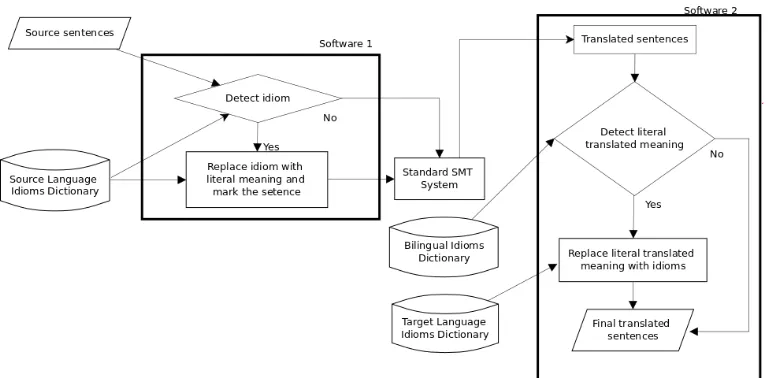
Our idiom translation method can be explained briefly in terms of a reference architecture as de-picted in Figure 1. Our method makes use of 3 dictionaries and 2 pieces of software. The first dictionary contains entries for the source language idioms and their literal meaning, and is called the “Source Language Idioms Dictionary”. The sec-ond dictionary meanwhile contains entries for the target language idioms and their literal meaning, and is called the “Target Language Idioms Dictio-nary”. The third dictionary is a bilingual dictio-nary containing entries for the idioms in the source language pointing to their translated literal mean-ing in the target language. This is the “Bilmean-ingual Idiom Dictionary”.
mean-Figure 1: Reference Architecture for Substitution Based Idiom Translation Technique.
ing in the target translation. If the literal mean-ing is identified, it then checks the “Target Lan-guage Idioms Dictionary” for a corresponding id-iom for the literal use in the target language. If found, the literal wording in the target translation is then replaced with an idiomatic phrase from the target language. However if in the post-processing step the original idiom substitution is not found, or if there are no corresponding idioms in the target language, then the post-processing software does nothing.
4 Study Design
We have developed an initial implementa-tion of our substituimplementa-tion approach to SMT based idiom translation for the language pair English/Brazillian-Portugese. To evaluate our method we created test corpora where each sen-tence contained an idiom, and compared the BLEU scores (Papineni et al., 2002) of a baseline SMT system when run on these test corpora with the BLEU scores for the same SMT system when we applied our pre and post processing steps. No sentences with literal uses of the selected idiom form were used in this experiment.
Consequently, three corpora were required for this experiment in addition to the three idiomatic resources introduced in the last section. The first corpus was an initial large sentence-aligned bilingual corpus that was used to build a SMT model for the language pair English/Brazilian-Portuguese. The second corpus was the first of two test corpora. This corpus contained sentences with
“highly fixed” idioms and will be referred to as the “High Fixed Corpus”. Finally a second test corpus containing sentences with “low fixed” idioms, the “Low Fixed Corpus”, was also constructed. In or-der to make results comparable across test corpora the length of sentences in each of the two test cor-pora were kept between fifteen and twenty words. To create the initial large corpus a series of small corpora available on the internet were com-piled into one larger corpus which was used to train a SMT system. The resources used in this step were Fapesp-v2 (Aziz and Specia, 2011), the OpenSubtitles20131corpus, the PHP Manual Cor-pus2 and the KDE4 localizaton files (v.2)3. No special tool was used to clean these corpora and the files were compiled as is.
To create the “High Fixed Corpus” and “Low Fixed Corpus” we built upon the previous work of Fazly et al. (2008) who identified a dataset of 17 “highly fixed” English verb+noun idioms, and 11 “low fixed” English verb+noun idioms. Based on these lists our two test corpora were built by ex-tracting English sentences from the internet which contained instances of each of the high and low fixed idiom types. Each collected sentence was manually translated into Brazilian-Portuguese, be-fore each translations was manually checked and corrected by a second translator. Ten sentences were collected for each idiom type. This resulted in a High Fixed corpus consisting of 170 sentences
1http://opus.lingfil.uu.se/OpenSubtitles2013.php 2http://opus.lingfil.uu.se/PHP.php
[image:3.612.116.501.57.246.2]containing idiomatic usages of those idioms, and a Low-Fixed corpus consisting of 110 sentences containing instances of low-fixed idioms.
As indicated three idiomatic resources were also required for the study. These were: a dic-tionary of English idioms and their literal mean-ings; a dictionary of Brazilian-Portuguese idioms and their literal meanings; and a bilingual dictio-nary from English to Brazilian-Portuguese. The English idioms dictionary contained entries for the idioms pointing to their literal English meanings, along with some morphological variations of those idioms. The Brazilian-Portuguese idioms dictio-nary similarly contained entries for the idioms pointing to their literal meanings with some mor-phological variations of those idioms. Finally, the bilingual dictionary contained entries for the same idioms along with morphological variations of the English idioms dictionary but pointing to their lit-eral translated meaning. The Oxford Dictionary of English idioms and the Cambridge Idioms Dictio-nary were used to collect the literal meanings of the English idioms. Literal meanings were manu-ally translated to Brazilian-Portuguese.
Following resource collection and construction a SMT model for English/Brazilian-Portuguese was trained using the Moses toolkit (Koehn et al., 2007) using its baseline settings. The corpus used for this training consisted of 17,288,109 pairs of sentences (approximately 50% of the initial col-lected corpus), with another 34,576 pairs of sen-tences used for the “tuning” process. Following this training and tuning process the baseline trans-lation accuracy, or BLEU scores, were calculated for the two test corpora, i.e., for the “High Fixed Corpus”, and the “Low Fixed Corpus”.
Having calculated the baseline BLEU scores, the substitution method was then applied to re-translate each of the two test corpora. Specifi-cally both the “High Fixed Corpus” and the “Low Fixed Corpus” were passed through our extended pipeline with new substitution based translations constructed for each of the test corpora. BLEU scores were then calculated for these two out-put corpora that were built using the substitution method.
5 Results and Discussion
Table 1 presents the results of the evaluation. The BLEU scores presented in the table compare the baseline SMT system against our proposed
method for handling English idiomatic MWE of the verb+noun type.
Corpus Baseline Substitution
High Idiomatic 23.12 31.72 Low Idiomatic 24.55 26.07
Table 1: Experiment’s results.
Overall the results are positive. For both the high and low idiomatic corpora we find that apply-ing the pre- and post-processapply-ing substitution ap-proach improves the BLEU score of the SMT sys-tem. However, it is notable that the High-Fixed idiomatic corpus showed a considerably larger in-crease in BLEU score than was the case for the Low-Fixedness idiomatic cases, i.e., a positive in-crease of 8.6versus1.52. To investigate further we applied a paired t-test to test for significance in mean difference between baseline and substitu-tion methods for both the high-fixed and low-fixed test corpora. While the results for the “High Id-iomatic Corpus” demonstrated a statistically sig-nificant difference in BLEU scores (p 0.05), the difference between the baseline and substitu-tion method was not statistically significant for the case of the “Low Idiomatic Corpus” (p ≈ 0.7). We believe the lack of improvement in the case of low fixed idioms may be caused by a higher morphosyntactic variation in the translations of the low fixed idioms. This higher variation makes the post-processing step of our approach (which re-quires matching a substring in the translated sen-tence) more difficult for low fixed idioms with the result that our approach is less effective for these idioms.
6 Conclusion
Our results indicate that this substitution approach does improve the performance of the system. However, we are aware that this method is not the entire solution for the MWE problem in SMT. The effectiveness of the approach is dependent on the fixedness of the idiom being translated.
This approach relies on several language re-sources, including: idiomatic dictionaries in the source and target languages and a bilingual dic-tionary containing entries for the idioms in the source language aligned with their translated lit-eral meaning in the target language. In future work we investigate techniques that we can use to (semi)automatically address dictionary construc-tion. We will also work on enabling the system to distinguish between idiomatic vs. literal usages of idioms.
Acknowledgments
Giancarlo D. Salton would like to thank CAPES (“Coordenac¸˜ao de Aperfeic¸oamento de Pessoal de N´ıvel Superior”) for his Science Without Borders scholarship, proc n. 9050-13-2. We would like to thank Acassia Thabata de Souza Salton for her corrections on the Brazilian-Portuguese transla-tion of sentences containing idioms.
References
Otavio Costa Acosta, Aline Villavicencio, and Vi-viane P. Moreira. 2011. Identification and Treat-ment of Multiword Expressions applied to Informa-tion Retrieval. InProceedings of the Workshop on Multiword Expressions: from Parsing and Genera-tion to the Real World (MWE 2011), pages 101–109. Wilker Aziz and Lucia Specia. 2011. Fully automatic compilation of a english and portuguese-spanish parallel corpus for statistical machine trans-lation. InSTIL 2011.
Dhouha Bouamor, Nasredine Semmar, and Pierre Zweigenbaum. 2011. Improved Statistical Machine Translation Using MultiWord Expressions. In Pro-ceedings of the International Workshop on Using Linguistic Information for Hybrid Machine Trans-lation), pages 15–20.
Anna Cie´slicka. 2006. Literal salience in on-line pro-cessing of idiomatic expressions by second language learners. 22(2):115–144.
Michael Collins, Philipp Koehn, and Ivona Kuˇcerov´a. 2005. Clause Restructuring for Statistical Machine Translation. In Proceedings of the 43rd Annual Meeting of the ACL, pages 531–540.
Afsanesh Fazly, Paul Cook, and Suzanne Stevenson. 2008. Unsupervised Type and Token Identification of Idiomatic Expressions. In Computational Lin-guistics, volume 35, pages 61–103.
Milena U. Garrao and Maria C. P. Dias. 2001. Um Estudo de Express˜oes Cristalizadas do Tipo V+Sn e sua Inclus˜ao em um Tradutor Autom´atico Bil´ıng¨ue (Portuguˆes/Inglˆes). InCadernos de Traduc¸˜ao, vol-ume 2, pages 165–182.
Philipp Koehn, Hieu Hoang, Alexandra Birch, Chris Callison-Burch, Marcello Federico, Nicola Bertoldi, Brooke Cowan, Wade Shen, Christine Moran, Richard Zens, Chris Dyer, Ondrej Bojar, Alexandra Constantin, and Evan Herbst. 2007. Moses: Open Source Toolkit for Statistical Machine Translation. In45th Annual Meeting of the Association for Com-putational Linguistics.
Philipp Koehn. 2010. Statistical Machine Translation. Cambridge University Press, New York. 2 Ed. Antonio Moreno-Ortiz, Chantal P´erez-Hern´andez, and
M. ´Angeles Del-Olmo. 2013. Managing Multiword Expressions in a Lexicon-Based Sentiment Analysis System for Spanish. InProceedings of the 9th Work-shop on Multiword Expressions (MWE 2013), pages 1–10.
Hideo Okuma, Hirofumi Yamamoto, and Eiichiro Sumita. 2008. Introducing Translation Dictionary Into Phrase-based SMT. InIEICE - Transactions on Information and Systems, number 7, pages 2051– 2057.
Kishore Papineni, Salim Roukos, Todd Ward, and Wei-Jing Zhu. 2002. BLEU: a method for automatic evaluation of machine translation. InProceedings of the 40th Annual Meeting of the Association for Computational Linguistics (ACL), pages 311–318. Ivan A. Sag, Thimothy Baldwin, Francis Bond, Ann
Copestake, and Dan Flickinger. 2002. Multiword Expressions: A Pain in the Neck for NLP. In Computational Linguistics and Intelligent Text Pro-cessing: Third International Conference: CICLing-2002, Lecture Notes in Computer Science, volume 2276, pages 1–15.