Generating Music from Literature
Hannah Davis
New York University
Saif M. Mohammad
National Research Council Canada
Abstract
We present a system,TransProse, that au-tomatically generates musical pieces from text. TransProse uses known relations be-tween elements of music such as tempo and scale, and the emotions they evoke. Further, it uses a novel mechanism to de-termine sequences of notes that capture the emotional activity in text. The work has applications in information visualization, in creating audio-visual e-books, and in developing music apps.
1 Introduction
Music and literature have an intertwined past. It is believed that they originated together (Brown, 1970), but in time, the two have developed into separate art forms that continue to influence each other.1 Music, just as prose, drama, and poetry, is often used to tell stories.2 Opera and ballet tell sto-ries through music and words, but even instrumen-tal music, which is devoid of words, can have a powerful narrative form (Hatten, 1991). Mahler’s and Beethoven’s symphonies, for example, are re-garded as particularly good examples of narrative and evocative music (Micznik, 2001).
In this paper, for the first time, we present a method to automatically generate music from liter-ature. Specifically, we focus on novels and gener-ate music that captures the change in the distribu-tion of emodistribu-tion words. We list below some of the benefits in pursuing this general line of research:
• Creating audio-visual e-books that generate music when certain pages are opened—music that accentuates the mood conveyed by the text in those pages.
1The termmusiccomes frommuses—the nine Greek
god-desses of inspiration for literature, science, and arts.
2Music is especially close to poetry as songs often tend to
be poems set to music.
• Mapping pieces of literature to musical pieces according to compatibility of the flow of emotions in text with the audio character-istics of the musical piece.
• Finding songs that capture the emotions in different parts of a novel. This could be use-ful, for example, to allow an app to find and play songs that are compatible with the mood of the chapter being read.
• Generating music for movie scripts.
• Appropriate music can add to good visualiza-tions to communicate information effectively, quickly, and artfully.
Example 1: A tweet stream that is accom-panied by music that captures the aggregated sentiment towards an entity.
Example 2: Displaying the world map where clicking on a particular region plays music that captures the emotions of the tweets ema-nating from there.
Given a novel (in an electronically readable form), our system, which we callTransProse, gen-erates simple piano pieces whose notes are depen-dent on the emotion words in the text. The chal-lenge in composing new music, just as in creat-ing a new story, is the infinite number of choices and possibilities. We present a number of map-ping rules to determine various elements of music, such as tempo, major/minor key, etc. according to the emotion word density in the text. We intro-duce a novel method to determine the sequence of notes (sequences of pitch and duration pairs) to be played as per the change in emotion word density in the text. We also list some guidelines we followed to make the sequence of notes sound like music as opposed to a cacophonous cascade of sounds.
Certainly, there is no one right way of capturing the emotions in text through music, and there is no one right way to produce good music. Generating
compelling music is an art, and TransProse can be improved in a number of ways (we list several ad-vancements in the Future Work section). Our goal with this project is to present initial ideas in an area that has not been explored before.
This paper does not assume any prior knowl-edge of music theory. Section 2 presents all the terminology and ideas from music theory needed to understand this paper. We present related work in Section 3. Sections 4, 5, 6, and 7 describe our system. In Sections 8 and 9, we present an analysis of the music generated by our system for various popular novels. Finally in Section 10 we present limitations and future work.
2 Music
In physical terms, music is a series of possibly overlapping sounds, often intended to be pleasing to the listener. Sound is what our ears perceive when there is a mechanical oscillation of pressure in some medium such as air or water. Thus, differ-ent sounds are associated with differdiffer-ent frequen-cies. In music, a particular frequency is referred to as pitch. A note has two aspects: pitch and relative duration.3 Examples of relative duration arewhole-note,half-note,quarter-note, etc. Each successive element in this list is of half the dura-tion as the preceding element. Consider the exam-ple notes: 400Hz–quarter-note and 760Hz–whole-note. The first note is the sound corresponding to 400Hz, whereas the second note is the sound corresponding to 760Hz. Also, the first note is to be played for one fourth the duration the second note is played. It is worth repeating at this point thatnoteandwhole-notedo not refer to the same concept—the former is a combination of pitch and relative duration, whereas whole-note (and oth-ers such as quarter-note and half-note) are used to specify the relative duration of a note. Notes are defined in terms ofrelative duration to allow for the same melody to be played quickly or slowly.
A series of notes can be grouped into a mea-sure(also calledbar).Melody(also calledtune) is a sequence of measures (and therefore a sequence of notes) that creates the musical piece itself. For example, a melody could be defined as 620Hz– half-note, 1200Hz-whole-note, 840Hz-half-note,
3Confusingly,noteis also commonly used to refer topitch
alone. To avoid misunderstanding, we will not usenotein that sense in this paper. However, some statements, such asplay that pitchmay seem odd to those familiar with music, who may be more used toplay that note.
660Hz–quarter-note, and so on. There can be one melody (for example, in the song Mary Had A Little Lamb) or multiple melodies; they can last throughout the piece or appear in specific sections. A challenge for TransProse is to generate appro-priate sequences of notes, given the infinite possi-bilities of pitch, duration, and order of the notes.
Tempo is the speed at which the piece should be played. It is usually indicated by the num-ber of beats per minute. A beat is a basic unit of time. A quarter-note is often used as one beat. In which case, the tempo can be under-stood simply as the number of quarter-notes per minute. Consider an example. Let’s assume it is decided that the example melody specified in the earlier paragraph is to be played at a tempo of 120 quarter-notes per minute. The total number of quarter-notes in the initial sequence (620Hz–half-note, 1200Hz–whole-(620Hz–half-note, 840Hz–half-(620Hz–half-note, and 660Hz–quarter-note) is 2 + 4 + 2 + 1 = 9. Thus the initial sequence must be played in9/120minutes, or4.5seconds.
The time signature of a piece indicates two things: a) how many beats are in a measure, and b) which note duration represents one beat. It is written as one number stacked on another num-ber. The upper number is the number of beats per measure, and the lower number is the note dura-tion that represents one beat. For example, a time signature of 68 would mean there are six beats per measure, and an eighth note represents one beat. One of the most common time signatures is 44, and it is referred to ascommon time.
posi-tion 1, 13, 25, 37, and so on, form a pitch class. Similarly keys at position 2, 14, 26, 38, and so on, form another pitch class. The pitch classes on a piano are given names C, C#, D, D#, E, F, F#, G, G#, A, A#, B. (The # is pronouncedsharp). The same names can also be used to refer to a partic-ular key in an octave. (In an octave, there exists only one C, only one D#, and so on.) The octaves are often referred to by a number. On a standard piano, the octaves in increasing order are 0, 1, 2, and so on. C2 refers to the key in octave 2 that is in the pitch class C.4
The difference in frequency between successive piano keys is called asemitoneorHalf-Tone(Half
for short). The interval between two keys sep-arated by exactly one key is called Whole-Tone
(Whole for short). Thus, the interval between C and C# is half, whereas the interval between C and D is whole. A scale is any sequence of pitches ordered by frequency. A major scale is a sequence of pitches obtained by applying the ascending pattern: Whole–Whole–Half–Whole– Whole–Whole–Half. For example, if one starts with C, then the corresponding C major scale con-sists of C, D (frequency of C + Whole interval), E (frequency of D + Whole interval), F (frequency of E + Half interval), G, A, B, C. Major scales can begin with any pitch (not just C), and that pitch is called thebase pitch. Amajor keyis the set of pitches corresponding to the major scale. Playing in the key of C major means that one is primarily playing the keys (pitches) from the corresponding scale, C major scale (although not necessarily in a particular order).
Minor scales are series of pitches obtained by applying the ascending pattern: Whole-Half– Whole–Whole–Half–Whole–Whole. Thus, C mi-nor is C, D, D#, F, G, G#, A#, C. A minor key
is the set of pitches corresponding to the minor scale. Playing in major keys generally creates lighter sounding pieces, whereas playing in minor keys creates darker sounding pieces.
Consonanceis how pleasant or stable one per-ceives two pitches played simultaneously (or one after the other). There are many theories on what makes two pitches consonant, some of which are
4The frequencies of piano keys at a given position across
octaves is in log scale. For example, frequencies of C1, C2,. . . , and so on are in log scale. The perception of sound (frequency) in the human ear is also roughly logarithmic. Also, the frequency 440Hz (mentioned above) is A4 and it is the customary tuning standard for musical pitch.
culturally dependent. The most common notion (attributed to Pythagoras) is that the simpler the ratio between the two frequencies, the more con-sonant they are (Roederer, 2008; Tenney, 1988).
Given a particular scale, some have argued that the order of the pitches in decreasing consonance is as follows: 1st, 5th, 3rd, 6th, 2nd, 4th, and 7th (Perricone, 2000). Thus for the C major—C (the base pitch, or 1st), D (2nd) , E (3rd), F (4th), G (5th) , A (6th) , B (7th)—the order of the pitches in decreasing consonance is—C, G, E, A, D, F, B. Similarly, for C minor—C (the base pitch, or 1st), D (2nd), D# (3rd), F (4th), G (5th), G# (6th), A# (7th)—the order of pitches in decreasing conso-nance is—C, G, D#, G#, D, F, A#. We will use these orders in TransProse to generate more dis-cordant and unstable pitches to reflect higher emo-tion word densities in the novels.
3 Related Work
This work is related to automatic sentiment and emotion analysis of text (computational linguis-tics), the generation of music (music theory), as well as the perception of music (psychology).
Sentiment analysis techniques aim to determine the evaluative nature of text—positive, negative,
Some prior empirical sentiment analysis work focuses specifically on literary texts. Alm and Sproat (2005) analyzed twenty two Brothers Grimm fairy tales to show that fairy tales often began with a neutral sentence and ended with a happy sentence. Mohammad (2012) visualized the emotion word densities in novels and fairy tales. Volkova et al. (2010) study human annotation of emotions in fairy tales. However, there exists no work connecting automatic detection of sentiment with the automatic generation of music.
Methods for both sentiment and emotion analy-sis often rely on lexicons of words associated with various affect categories such as positive and neg-ative sentiment, and emotions such as joy, sad-ness, fear, and anger. The WordNet Affect Lexi-con (WAL) (Strapparava and Valitutti, 2004) has a few hundred words annotated with associations to a number of affect categories including the six Ek-man emotions (joy, sadness, anger, fear, disgust, and surprise).5 The NRC Emotion Lexicon, com-piled by Mohammad and Turney (2010; 2013), has annotations for about 14000 words with eight emotions (six of Ekman, trust, and anticipation).6 We use this lexicon in our project.
Automatic or semi-automatic generation of mu-sic through computer algorithms was first popular-ized by Brian Eno (who coined the termgenerative music) and David Cope (Cope, 1996). Lerdahl and Jackendoff (1983) authored a seminal book on the generative theory of music. Their work greatly in-fluenced future work in automatic generation of music such as that of Collins (2008) and Biles (1994). However, these pieces did not attempt to explicitly capture emotions.
Dowling and Harwood (1986) showed that vast amounts of information are processed when listen-ing to music, and that the most expressive quality that one perceives is emotion. The communication of emotions in non-verbal utterances and in music show how emotions in music have an evolutionary basis (Rousseau, 2009; Spencer, 1857; Juslin and Laukka, 2003). There are many known associa-tions between music and emoassocia-tions:
• Loudness: Loud music is associated with in-tensity, power, and anger, whereas soft music is associated with sadness or fear (Gabriels-son and Lindstr¨om, 2001).
5http://wndomains.fbk.eu/wnaffect.html 6http://www.purl.org/net/
NRCemotionlexicon
• Melody: A sequence of consonant notes is associated with joy and calm, whereas a se-quence of disconsonant notes is associated with excitement, anger, or unpleasantness (Gabrielsson and Lindstr¨om, 2001).
• Major and Minor Keys: Major keys are as-sociated with happiness, whereas minor keys are associated with sadness (Hunter et al., 2010; Hunter et al., 2008; Ali and Peynirci-olu, 2010; Gabrielsson and Lindstr¨om, 2001; Webster and Weir, 2005).
• Tempo: Fast tempo is associated with hap-piness or excitement (Hunter et al., 2010; Hunter et al., 2008; Ali and Peynirciolu, 2010; Gabrielsson and Lindstr¨om, 2001; Webster and Weir, 2005).
Studies have shown that even though many of the associations mentioned above are largely uni-versal, one’s own culture also influences the per-ception of music (Morrison and Demorest, 2009; Balkwill and Thompson, 1999).
4 Our System: TransProse
Our system, which we call TransProse, generates music according to the use of emotion words in a given novel. It does so in three steps: First, it analyzes the input text and generates an emotion profile. The emotion profile is simply a collection of various statistics about the presence of emotion words in the text. Second, based on the emotion profile of the text, the system generates values for tempo, scale, octave, notes, and the sequence of notes for multiple melodies. Finally, these values are provided to JFugue, an open-source Java API for programming music, that generates the appro-priate audio file. In the sections ahead, we de-scribe the three steps in more detail.
5 Calculating Emotion Word Densities
The number of sections, the number of subsec-tions per section, and the number of notes gener-ated for each of the subsections together determine the total number of notes generated for the novel. Even though we set the number of sections and number of sub-sections to four each, these settings can be varied, especially for significantly longer or shorter pieces of text.
For each section and for each sub-section the ra-tio of emora-tion words to the total number of words is calculated. We will refer to this ratio as the over-all emotions density. We also calculate densities of particular emotions, for example, the joy den-sity,anger density, etc. As described in the section ahead, the emotion densities are used to generate sequences of notes for each of the subsections.
6 Generating Music Specifications
Each of the pieces presented in this paper are for the piano with three simultaneous, but differ-ent, melodies coming together to form the musical piece. Two melodies sounded too thin (simple), and four or more melodies sounded less cohesive.
6.1 Major and Minor Keys
Major keys generally create a more positive atmo-sphere in musical pieces, whereas minor keys tend to produce pieces with more negative undertones (Hunter et al., 2010; Hunter et al., 2008; Ali and Peynirciolu, 2010; Gabrielsson and Lindstr¨om, 2001; Webster and Weir, 2005). No consensus has been reached on whether particular keys them-selves (for example, A minor vs E minor) evoke different emotions, and if so, what emotions are evoked by which keys. For this reason, the pro-totype of Transprose does not consider different keys; the chosen key for the produced musical pieces is limited to either C major or C minor. (C major was chosen because it is a popular choice when teaching people music. It is simple because it does not have any sharps. C minor was chosen as it is the minor counterpart of C major.)
Whether the piece is major or minor is de-termined by the ratio of the number of positive words to the number of negative words in the en-tire novel. If the ratio is higher than 1, C major is used, that is, only pitches pertaining to C major are played. If the ratio is 1 or lower, C minor is used.
Experimenting with keys other than C major and C minor is of interest for future work.
Further-more, the eventual intent is to include mid-piece key changes for added effect. For example, chang-ing the key from C major to A minor when the plot suddenly turns sad. The process of changing key is called modulation. Certain transitions such as moving from C major to A minor are commonly used and musically interesting.
6.2 Melodies
We use three melodies to capture the change in emotion word usage in the text. The notes in one melody are based on the overall emotion word density (the emotion words associated with any of the eight emotions in the NRC Emotion Lexicon). We will refer to this melody, which is intended to capture the overarching emotional movement, as
melody o orMo (the ‘o’ stands for overall emo-tion). The notes in the two other melodies,melody e1 (Me1) and melody e2 (Me2), are determined by the most prevalent and second most prevalent emotions in the text, respectively. Precisely how the notes are determined is described in the next sub-section, but first we describe how the octaves of the notes is determined.
The octave of melody o is proportional to the difference between the joy and sadness densities of the novel. We will refer to this difference byJS. We calculated the lowest density difference (JSmin) and highest JS score (JSmax) in a collection of nov-els. For a novel with density difference, JS, the score is linearly mapped to octave 4, 5, or 6 of a standard piano, as per the formula shown below:
Oct(Mo) = 4 +r((JS−JSJSmin)∗(6−4) max−JSmin ) (1)
The functionrrounds the expression to the closest integer. Thus scores closer to JSmin are mapped to octave 4, scores closer toJSmaxare mapped to octave 6, and those in the middle are mapped to octave 5.
The octave ofMe1is calculated as follows:
Oct(Me1) =
Oct(Mo) + 1,ife1is joy or trust
Oct(Mo)−1,ife1is anger, fear,
sadness, or disgust Oct(Mo), otherwise
(2) That is,Me1is set to:
• an octave higher than the octave ofMo ife1
• an octave lower than the octave ofMoife1is
a negative emotion,
• the same octave as that ofMoife1is surprise
or anticipation.
Recall that higher octaves evoke a sense of positiv-ity, whereas lower octaves evoke a sense of nega-tivity. The octave ofMe2 is calculated exactly as that ofMe1, except that it is based on the second most prevalent emotion (and not the most preva-lent emotion) in the text.
6.3 Structure and Notes
As mentioned earlier, TransProse generates three melodies that together make the musical piece for a novel. The method for generating each melody is the same, with the exception that the three melodies (Mo, Me1, and Me2) are based on the overall emotion density, predominant emotion’s density, and second most dominant emotion’s den-sity, respectively. We describe below the method common for each melody, and useemotion word densityas a stand in for the appropriate density.
Each melody is made up of four sections, repre-senting four sections of the novel (the beginning, early middle, late middle, and end).In turn, each section is represented by four measures. Thus each measure corresponds to a quarter of a section (a sub-section). A measure, as defined earlier, is a series of notes. The number of notes, the pitch of each note, and the relative duration of each note are determined such that they reflect the emotion word densities in the corresponding part of the novel.
Number of Notes: In our implementation, we decided to contain the possible note durations to whole notes, half notes, quarter notes, eighth notes, and sixteenth notes. A relatively high emo-tion density is represented by many notes, whereas a relatively low emotion density is represented by fewer notes. We first split the interval between the maximum and minimum emotion density for the novel into five equal parts (five being the num-ber of note duration choices – whole, half, quar-ter, eighth, or sixteenth). Emotion densities that fall in the lowest interval are mapped to a single whole note. Emotion densities in the next interval are mapped to two half-notes. The next interval is mapped to four quarter-notes. And so on, until the densities in the last interval are mapped to six-teen sixsix-teenth-notes (1/16th). The result is shorter notes during periods of higher emotional activity
(with shorter notes making the piece sound more active), and longer notes during periods of lower emotional activity.
Pitch: If the number of notes for a measure isn, then the corresponding sub-section is parti-tioned into n equal parts and the pitch for each note is based on the emotion density of the cor-responding sub-section. Lower emotion densities are mapped to more consonant pitches in the key (C major or C minor), whereas higher emotion densities are mapped to less consonant pitches in the same scale. For example, if the melody is in the key of C major, then the lowest to highest emo-tion densities are mapped linearly to the pitches C, G, E, A, D, F, B. Thus, a low emotion value would create a pitch that is more consonant and a high emotion value would create a pitch that is more dissonant (more interesting and unusual).
Repetition: Once the four measures of a section are played, the same four measures are repeated in order to create a more structured and melodic feeling. Without the repetition, the piece sounds less cohesive.
6.4 Tempo
We use a 44 time signature (common time) be-cause it is one of the most popular time signatures. Thus each measure (sub-section) has 4 beats. We determined tempo (beats per minute) by first de-termining how active the target novel is. Each of the eight basic emotions is assigned to be ei-ther active, passive, or neutral. In TransProse, the tempo is proportional to theactivity score, which we define to be the difference between the aver-age density of the active emotions (anger and joy) and the average density of the passive emotions (sadness). The other five emotions (anticipation, disgust, fear, surprise, and trust) were considered ambiguous or neutral, and did not influence the tempo.
We subjectively identified upper and lower bounds for the possible tempo values to be 180 and 40 beats/minute, respectively. We determined ac-tivity scores for a collection of novels, and identi-fied the highest activity score (Actmax) and the low-est activity score (Actmin). For a novel whose ac-tivity score wasAct, we determined tempo as per the formula shown below:
tempo= 40 +(Act−ActActmin)∗(180−40)
tempo values closer to 180 and lower activity scores were represented by tempo values closer to 40. The lowest activity score in our collection of texts, Actmin, was -0.002 whereas the highest ac-tivity score,Actmax, was 0.017.
7 Converting Specifications to Music
JFugue is an open-source Java API that helps cre-ate generative music.7 It allows the user to easily experiment with different notes, instruments, oc-taves, note durations, etc within a Java program. JFugue requires a line of specifically-formatted text that describes the melodies in order to play them. The initial portion of the string of JFugue to-kens for the novelPeter Panis shown below. The string conveys the overall information of the piece as well as the first eight measures (or one section) for each of the three melodies (or voices).
KCmaj X[VOLUME]=16383 V0 T180 A6/0.25 D6/0.125 F6/0.25 B6/0.25 B6/0.125 B6/0.25 B6/0.25...
K stands for key and Cmaj stands for C major. This indicates that the rest of the piece will be in the key of C major. The second token controls the volume, which in this example is at the loudest value (16383). V0 stands for the first melody (or voice). The tokens with the letter T indicate the tempo, which in the case of this example is 180 beats per minute.
The tokens that follow indicate the notes of the melody. The letter is the pitch class of the note, and the number immediately following it is the octave. The number following the slash char-acter indicates the duration of the note. (0.125 is an eighth-note (1/8th), 0.25 is a quarter note, 0.5 is a half note, and 1.0 is a whole note.) We used JFugue to convert the specifications of the melodies into music. JFugue saves the pieces as a midi files, which we converted to MP3 format.8
8 Case Studies
We created musical pieces for several popular novels through TransProse. These pieces are available at: http://transprose.weebly.com/ final-pieces.html. Since these novels are
7http://www.jfugue.org
8The MP3 format uses a lossy data compression, but the
resulting files are significantly smaller in size. Further, a wider array of music players support the MP3 format.
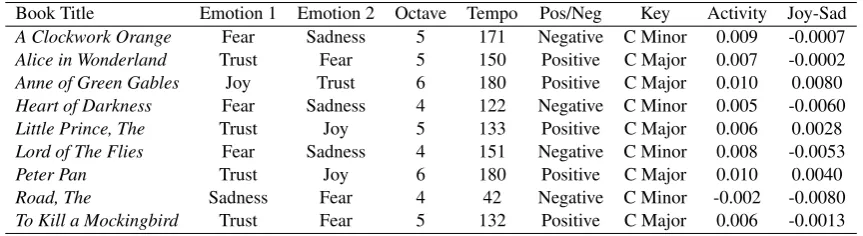
likely to have been read by many people, the read-ers can compare their undread-erstanding of the story with the music generated by TransProse. Table 1 presents details of some of these novels.
8.1 Overall Tone
TransProse captures the overall positive or nega-tive tone of the novel by assigning an either major or minor key to the piece. Peter Pan and Anne of Green Gables, novels with overall happy and uplifting moods, created pieces in the major key. On the other hand, novels such asHeart of Dark-ness, A Clockwork Orange, and The Road, with dark themes, created pieces in the minor key. The effect of this is pieces that from the start have a mood that aligns with the basic mood of the novel they are based on.
8.2 Overall Happiness and Sadness
The densities of happiness and sadness in a novel are represented in the baseline octave of a piece. This representation instantly conveys whether the novel has a markedly happy or sad mood. The overall high happiness densities inPeter Pan and
Anne of Green Gablescreate pieces in an octave above the average, resulting in higher tones and a lighter overall mood. Similarly, the overall high sadness densities inThe RoadandHeart of Dark-nessresult in pieces an octave lower than the aver-age, and a darker overall tone to the music. Nov-els, such as A Clockwork Orange, andThe Little Prince, where happiness and sadness are not dra-matically higher or lower than the average novel remain at the average octave, allowing for the cre-ation of a more nuanced piece.
8.3 Activeness of the Novel
Novels with lots of active emotion words, such asPeter Pan, Anne of Green Gables, Lord of the Flies, and A Clockwork Orange, generate fast-paced pieces with tempos over 170 beats per minute. On the other hand,The Road, which has relatively few active emotion words is rather slow (a tempo of 42 beats per minute).
8.4 Primary Emotions
Table 1: Emotion and audio features of a few popular novels that were processed by TransProse. The musical pieces are available at:http://transprose.weebly.com/final-pieces.html.
Book Title Emotion 1 Emotion 2 Octave Tempo Pos/Neg Key Activity Joy-Sad A Clockwork Orange Fear Sadness 5 171 Negative C Minor 0.009 -0.0007 Alice in Wonderland Trust Fear 5 150 Positive C Major 0.007 -0.0002 Anne of Green Gables Joy Trust 6 180 Positive C Major 0.010 0.0080 Heart of Darkness Fear Sadness 4 122 Negative C Minor 0.005 -0.0060 Little Prince, The Trust Joy 5 133 Positive C Major 0.006 0.0028 Lord of The Flies Fear Sadness 4 151 Negative C Minor 0.008 -0.0053
Peter Pan Trust Joy 6 180 Positive C Major 0.010 0.0040
Road, The Sadness Fear 4 42 Negative C Minor -0.002 -0.0080
To Kill a Mockingbird Trust Fear 5 132 Positive C Major 0.006 -0.0013 are both positive, such as Anne of Green Gables
(trust and joy), the pieces sound especially light and joyful. For novels where the top two emotions are both negative, such asThe Road(sadness and fear), the pieces sound especially dark.
8.5 Emotional Activity
Unlike the overall pace of the novel, individual segments of activity were also identified in the pieces through the number and duration of notes (with more and shorter notes indicating higher emotion densities). This can be especially heard in the third section ofA Clockwork Orange, the fi-nal section ofThe Adventures of Sherlock Holmes, the second section ofTo Kill a Mockingbird, and the final section ofLord of the Flies. InA Clock-work Orange, the main portion of the piece is chaotic and eventful, likely as the main charac-ters cause havoc; at the end of the novel (as the main character undergoes therapy) the piece dra-matically changes and becomes structured. Sim-ilarly, in Heart of Darkness, the piece starts out only playing a few notes; as the tension in the novel builds, the number of notes increases and their durations decrease.
9 Comparing Alternative Choices
We examine choices made in TransProse by com-paring musical pieces generated with different al-ternatives. These audio clips are available here:
http://transprose.weebly.com/clips.html.
Pieces with two melodies (based on overall emotion density and the predominant emotion’s density) and pieces based on four melodies (based on the top three emotions and the overall emotion density) were generated and uploaded in the clips webpage. Observe that with only two melodies, the pieces tend to sound thin, whereas with four melodies the pieces sound less cohesive and
some-times chaotic. The effect of increasing and de-creasing the total number of sections and sub-sections is also presented. Additionally, the web-page displays pieces with tempos and octaves be-yond the limits chosen in TransProse. We also show other variations such as pieces for relatively positive novels generated in C minor (instead of C major). These alternatives are not necessarily incorrect, but they tend to often be less effective.
10 Limitations and Future work
References
[Agarwal et al.2011] Apoorv Agarwal, Boyi Xie, Ilia Vovsha, Owen Rambow, and Rebecca Passonneau.
2011. Sentiment analysis of twitter data. In
Pro-ceedings of the Workshop on Languages in Social Media, LSM ’11, pages 30–38, Portland, Oregon. [Aisopos et al.2012] Fotis Aisopos, George Papadakis,
Konstantinos Tserpes, and Theodora Varvarigou. 2012. Textual and contextual patterns for sentiment
analysis over microblogs. In Proceedings of the
21st International Conference on World Wide Web Companion, WWW ’12 Companion, pages 453– 454, New York, NY, USA.
[Ali and Peynirciolu2010] S Omar Ali and Zehra F Peynirciolu. 2010. Intensity of emotions con-veyed and elicited by familiar and unfamiliar mu-sic. Music Perception: An Interdisciplinary Journal, 27(3):177–182.
[Alm and Sproat2005] Cecilia O. Alm and Richard
Sproat, 2005. Emotional sequencing and
develop-ment in fairy tales, pages 668–674. Springer. [Aman and Szpakowicz2007] Saima Aman and Stan
Szpakowicz. 2007. Identifying expressions of emo-tion in text. In Vclav Matouˇsek and Pavel Mautner, editors,Text, Speech and Dialogue, volume 4629 of
Lecture Notes in Computer Science, pages 196–205. Springer Berlin / Heidelberg.
[Bakliwal et al.2012] Akshat Bakliwal, Piyush Arora, Senthil Madhappan, Nikhil Kapre, Mukesh Singh, and Vasudeva Varma. 2012. Mining sentiments
from tweets. InProceedings of the 3rd Workshop on
Computational Approaches to Subjectivity and Sen-timent Analysis, WASSA ’12, pages 11–18, Jeju, Re-public of Korea.
[Balkwill and Thompson1999] Laura-Lee Balkwill and William Forde Thompson. 1999. A cross-cultural investigation of the perception of emotion in music: Psychophysical and cultural cues. Music perception, pages 43–64.
[Bellegarda2010] Jerome Bellegarda. 2010. Emotion analysis using latent affective folding and
embed-ding. In Proceedings of the NAACL-HLT 2010
Workshop on Computational Approaches to Analy-sis and Generation of Emotion in Text, Los Angeles, California.
[Biles1994] John Biles. 1994. Genjam: A genetic al-gorithm for generating jazz solos. pages 131–137. [Bollen et al.2009] Johan Bollen, Alberto Pepe, and
Huina Mao. 2009. Modeling public mood and emo-tion: Twitter sentiment and socio-economic
phe-nomena. CoRR.
[Boucouvalas2002] Anthony C. Boucouvalas. 2002. Real time text-to-emotion engine for expressive
in-ternet communication. Emerging Communication:
Studies on New Technologies and Practices in Com-munication, 5:305–318.
[Brody and Diakopoulos2011] Samuel Brody
and Nicholas Diakopoulos. 2011.
Cooooooooooooooollllllllllllll!!!!!!!!!!!!!!:
us-ing word lengthenus-ing to detect sentiment in
microblogs. In Proceedings of the Conference on
Empirical Methods in Natural Language
Process-ing, EMNLP ’11, pages 562–570, Stroudsburg, PA,
USA. Association for Computational Linguistics. [Brown1970] Calvin S Brown. 1970. The relations
be-tween music and literature as a field of study. Com-parative Literature, 22(2):97–107.
[Collins2008] Nick Collins. 2008. The analysis
of generative music programs. Organised Sound,
13(3):237–248.
[Cope1996] David Cope. 1996. Experiments in
musi-cal intelligence, volume 12. AR Editions Madison, WI.
[Dowling and Harwood1986] W Jay Dowling and
Dane L Harwood. 1986. Music cognition, volume
19986. Academic Press New York.
[Gabrielsson and Lindstr¨om2001] Alf Gabrielsson and Erik Lindstr¨om. 2001. The influence of musical structure on emotional expression.
[Genereux and Evans2006] Michel Genereux and
Roger P. Evans. 2006. Distinguishing affective
states in weblogs. In Proceedings of the AAAI
Spring Symposium on Computational Approaches to Analysing Weblogs, pages 27–29, Stanford, California.
[Hatten1991] Robert Hatten. 1991. On narrativity in music: expressive genres and levels of discourse in beethoven.
[Hunter et al.2008] Patrick G Hunter, E Glenn Schel-lenberg, and Ulrich Schimmack. 2008. Mixed affective responses to music with conflicting cues.
Cognition & Emotion, 22(2):327–352.
[Hunter et al.2010] Patrick G Hunter, E Glenn Schel-lenberg, and Ulrich Schimmack. 2010. Feelings and perceptions of happiness and sadness induced by music: Similarities, differences, and mixed emo-tions. Psychology of Aesthetics, Creativity, and the Arts, 4(1):47.
[Iida et al.2000] Akemi Iida, Nick Campbell, Soichiro Iga, Fumito Higuchi, and Michiaki Yasumura. 2000. A speech synthesis system with emotion for
assist-ing communication. InISCA Tutorial and Research
Workshop (ITRW) on Speech and Emotion.
[Juslin and Laukka2003] Patrik N Juslin and Petri Laukka. 2003. Communication of emotions in vocal expression and music performance:
Differ-ent channels, same code? Psychological bulletin,
129(5):770.
[Kim et al.2009] Elsa Kim, Sam Gilbert, Michael J. Ed-wards, and Erhardt Graeff. 2009. Detecting sadness in 140 characters: Sentiment analysis of mourning michael jackson on twitter.
[Lerdahl and Jackendoff1983] Fred Lerdahl and Ray S
Jackendoff. 1983. A generative theory of tonal
mu-sic. MIT press.
[Liu et al.2003] Hugo Liu, Henry Lieberman, and Ted Selker. 2003. A model of textual affect sensing us-ing real-world knowledge. InProceedings of the 8th International Conference on Intelligent User Inter-faces, pages 125–132, New York, NY. ACM. [Micznik2001] Vera Micznik. 2001. Music and
nar-rative revisited: degrees of narrativity in beethoven
and mahler. Journal of the Royal Musical
Associa-tion, 126(2):193–249.
[Mihalcea and Liu2006] Rada Mihalcea and Hugo Liu. 2006. A corpus-based approach to finding
happi-ness. In Proceedings of the AAAI Spring
Sympo-sium on Computational Approaches to Analysing Weblogs, pages 139–144. AAAI Press.
[Mohammad and Turney2010] Saif M. Mohammad and Peter D. Turney. 2010. Emotions evoked by com-mon words and phrases: Using Mechanical Turk
to create an emotion lexicon. In Proceedings of
the NAACL-HLT Workshop on Computational Ap-proaches to Analysis and Generation of Emotion in Text, LA, California.
[Mohammad and Turney2013] Saif M. Mohammad and Peter D. Turney. 2013. Crowdsourcing a word-emotion association lexicon. 29(3):436–465. [Mohammad and Yang2011] Saif M. Mohammad and
Tony (Wenda) Yang. 2011. Tracking sentiment in mail: How genders differ on emotional axes. In Pro-ceedings of the ACL Workshop on Computational Approaches to Subjectivity and Sentiment Analysis, WASSA ’11, Portland, OR, USA.
[Mohammad2012] Saif M. Mohammad. 2012. From once upon a time to happily ever after: Tracking
emotions in mail and books. Decision Support
Sys-tems, 53(4):730–741.
[Morrison and Demorest2009] Steven J Morrison and Steven M Demorest. 2009. Cultural constraints on
music perception and cognition. Progress in brain
research, 178:67–77.
[Neviarouskaya et al.2009] Alena Neviarouskaya, Hel-mut Prendinger, and Mitsuru Ishizuka. 2009. Com-positionality principle in recognition of fine-grained
emotions from text. InProceedings of the
Proceed-ings of the Third International Conference on We-blogs and Social Media (ICWSM-09), pages 278– 281, San Jose, California.
[Pak and Paroubek2010] Alexander Pak and Patrick Paroubek. 2010. Twitter as a corpus for
senti-ment analysis and opinion mining. In
Proceed-ings of the 7th Conference on International Lan-guage Resources and Evaluation, LREC ’10, Val-letta, Malta, May. European Language Resources Association (ELRA).
[Pang and Lee2008] Bo Pang and Lillian Lee. 2008.
Opinion mining and sentiment analysis.
Founda-tions and Trends in IR, 2(1–2):1–135.
[Perricone2000] J. Perricone. 2000. Melody in
Song-writing: Tools and Techniques for Writing Hit Songs. Berklee guide. Berklee Press.
[Picard2000] Rosalind W Picard. 2000.Affective
com-puting. MIT press.
[Pierre-Yves2003] Oudeyer Pierre-Yves. 2003. The production and recognition of emotions in speech:
features and algorithms. International Journal of
Human-Computer Studies, 59(1):157–183.
[Roederer2008] Juan G Roederer. 2008. The physics
and psychophysics of music: an introduction. Springer Publishing Company, Incorporated.
[Rousseau2009] Jean-Jacques Rousseau. 2009. Essay
on the origin of languages and writings related to music, volume 7. UPNE.
[Schr¨oder2009] Marc Schr¨oder. 2009. Expressive speech synthesis: Past, present, and possible futures. InAffective information processing, pages 111–126. Springer.
[Spencer1857] Herbert Spencer. 1857. The origin and
function of music. Frasers Magazine, 56:396–408.
[Strapparava and Valitutti2004] Carlo Strapparava and Alessandro Valitutti. 2004. WordNet-Affect: An
Affective Extension of WordNet. InProceedings of
the 4th International Conference on Language Re-sources and Evaluation (LREC-2004), pages 1083– 1086, Lisbon, Portugal.
[Tao and Tan2005] Jianhua Tao and Tieniu Tan. 2005.
Affective computing: A review. In Affective
com-puting and intelligent interaction, pages 981–995. Springer.
[Tenney1988] James Tenney. 1988. A history of
conso-nance and dissoconso-nance. Excelsior Music Publishing Company New York.
[Thelwall et al.2011] Mike Thelwall, Kevan Buckley, and Georgios Paltoglou. 2011. Sentiment in Twitter
events. Journal of the American Society for
Infor-mation Science and Technology, 62(2):406–418. [Tumasjan et al.2010] Andranik Tumasjan, Timm O
Sprenger, Philipp G Sandner, and Isabell M Welpe. 2010. Predicting elections with twitter : What 140
characters reveal about political sentiment. Word
Journal Of The International Linguistic Association, pages 178–185.
[Turney and Littman2003] Peter Turney and Michael L Littman. 2003. Measuring praise and criticism: Inference of semantic orientation from association.
ACM Transactions on Information Systems, 21(4). [Volkova et al.2010] Ekaterina P Volkova, Betty J
Mohler, Detmar Meurers, Dale Gerdemann, and Heinrich H B¨ulthoff. 2010. Emotional perception of fairy tales: Achieving agreement in emotion
annota-tion of text. InProceedings of the NAACL HLT 2010
Workshop on Computational Approaches to Analysis and Generation of Emotion in Text, pages 98–106. Association for Computational Linguistics.
[Webster and Weir2005] Gregory D Webster and Catherine G Weir. 2005. Emotional responses to music: Interactive effects of mode, texture, and
tempo. Motivation and Emotion, 29(1):19–39.
[Zhe and Boucouvalas2002] Xu Zhe and A
Boucou-valas, 2002. Text-to-Emotion Engine for Real Time