In-Car Multi-Domain Spoken Dialogs: A Wizard of Oz Study
Sven Reichel, Ute Ehrlich, Andr´e Berton
Speech Dialogue Systems Daimler AG Ulm, Germany
{sven.reichel, ute.ehrlich, andre.berton}@daimler.com
Michael Weber
Institute of Media Informatics Ulm University
Germany
Abstract
Mobile Internet access via smartphones puts demands on in-car infotainment sys-tems, as more and more drivers like to ac-cess the Internet while driving. Spoken dialog systems support the user by less distracting interaction than visual/haptic-based dialog systems. To develop an intu-itive and usable spoken dialog system, an extensive analysis of the interaction con-cept is necessary. We conducted a Wizard of Oz study to investigate how users will carry out tasks which involve multiple ap-plications in a speech-only, user-initiative infotainment system while driving. Re-sults show that users are not aware of dif-ferent applications and use anaphoric ex-pressions in task switches. Speaking styles vary and depend on type of task and di-alog state. Users interact efficiently and provide multiple semantic concepts in one utterance. This sets high demands for fu-ture spoken dialog systems.
1 Introduction
The acceptance of smartphones is a success story. These devices allow people to access the Internet nearly anywhere at anytime. While driving, using a smartphone is prohibited in many countries as it distracts the driver. Regardless of this prohibition, people use their smartphone and cause severe in-juries (National Highway Traffic Safety Adminis-tration (NHTSA), 2013). In order to reduce driver distraction, it is necessary to integrate the smart-phone’s functionality safely into in-car infotain-ment systems. Since hands and eyes are involved in driving, a natural and intuitive speech-based in-terface increases road safety (Maciej and Vollrath, 2009). There are already infotainment systems with Internet applications like e.g. weather, music
streaming, gas prices, news, and restaurant search. However, not all of them can be controlled by nat-ural speech.
In systems based on graphic and haptic modal-ity, the functionality is often grouped into various applications. Among other things, this is due to the limited screen size. The user has to start an application and select the desired functionality. A natural speech interface does not require a frag-mentation of functionalities into applications, as people can express complex commands by speech. In single-application tasks, such as calling some-one, natural speech interfaces are established and proven. However, users often encounter complex tasks, which involve more than one application. For example, while hearing the news about a new music album, the driver might like to start listen-ing to this album via Internet radio. Spoken lan-guage allows humans to express a request such as “Play this album” easily, since the meaning is clear. However, will drivers also use this kind of interaction while using an in-car spoken dialog system (SDS)? Or is the mental model of ap-plication interaction schema dominant in human-computer interaction? In a user experiment, we confront drivers with multi-domain tasks, to ob-serve how they interact.
While interacting with an SDS, one crucial problem for users is to know which utterances the system is able to understand. People use different approaches to solve this problem, for example by reading the manual, using on-screen help, or rely-ing on their experiences. In multi-domain dialog systems, utterances can be quite complex, thus re-membering all utterances from the manual or dis-playing them on screen would not be possible. As a result, users have to rely on their experience in communications to know what to say. Thus, an advanced SDS needs to understand what a user would naturally say in this situation to execute a certain task.
In this paper, we present results from aWizard of Oz (WoZ) experiment on multi-domain in-teraction with an in-car SDS. The goal of this study is to build a corpus and analyze it ac-cording to application awareness, speaking styles, anaphoric references, and efficiency. Our results provide a detailed insight how drivers start multi-application tasks and switch between multi-applications by speech. This will answer the question whether they are primed to application-based-interaction or use a natural approach known from human-human-communication. The results will be used to design grammars or language models for work-ing prototypes, which establish a basis for real user tests. Furthermore, we provide guidelines for multi-domain SDSs.
The remainder of this paper is structured as fol-lows: Section 2 provides an overview of other studies in this context. Section 3 describes the do-main for the user experiment which is presented in Section 4. Data analysis methods are defined in Section 5. We present the results in Section 6 and discuss them in Section 7. Finally, we con-clude and give guidelines for multi-domain SDSs in Section 8.
2 Related Work
Many studies exist which evaluate SDSs concern-ing performance, usability, and driver distraction (a good overview provides Ei-Wen Lo and Green (2013)). Usually, participants are asked to com-plete a task, while driving in a simulated envi-ronment or in real traffic. Geutner et al. (2002), for example, showed that a virtual co-driver con-tributes to ease of use with little distraction effects. In their WoZ experiment, natural language was preferred to command-and-control input. How-ever, no in-depth analysis of user utterances is pre-sented. Cheng et al. (2004) performed an analy-sis of natural user utterances. They observed that drivers, occupied in a driving task, use disfluent and distracted speech and react differently than by concentrating on the speech interaction task. None of the studies provide in-depth analysis of multi-domain tasks, as our work does.
Multi-domain SDS exist like e.g. SmartKom (Reithinger et al., 2003) or CHAT (Weng et al., 2007). They presented complex systems with many functionalities, however, they do not eval-uate subtask switching from users’ point of view. In CHAT, the implicit application switch was even disabled due to “extra burden on the system”.
Do-main switches are analyzed in human-human com-munication as e.g. in Villing et al. (2008). How-ever, people interact differently with a system than with a human. Even in human-computer commu-nication, speaking styles differ depending on type of task, as (Hofmann et al., 2012) showed in a web-based user study. In order to develop an intu-itive multi-application SDS, it is necessary to an-alyze how users interact in a driving situation by completing tasks across different domains.
3 User Tasks
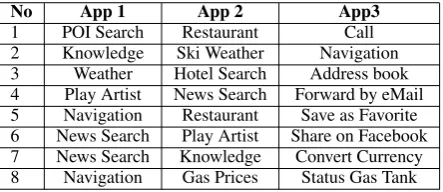
In a user experiment it is crucial to set real tasks for users, since artificial tasks will be hard to re-member and can reduce their attention. We ana-lyzed current in-car infotainment systems with In-ternet access and derived eight multi-domain tasks from their functionality (see Table 1). The sub-tasks were classified according to Kellar et al. (2006)’s web information classification schema in information seeking (Inf), information exchange, and information maintenance. Since information maintenance is not a strong automotive use case, these tasks were grouped together with informa-tion exchange. We call them acinforma-tion subtasks (Act) as they initiate an action of the infotainment sys-tem (e.g. “turn on the radio”).
No App 1 App 2 App3
[image:2.595.308.530.437.533.2]1 POI Search Restaurant Call 2 Knowledge Ski Weather Navigation 3 Weather Hotel Search Address book 4 Play Artist News Search Forward by eMail 5 Navigation Restaurant Save as Favorite 6 News Search Play Artist Share on Facebook 7 News Search Knowledge Convert Currency 8 Navigation Gas Prices Status Gas Tank
4 User Experiment
Developing an SDS means specifying a grammar or training statistical language models for speech recognition. These steps precede any real user test. In system-initiated dialogs, with a few possible ut-terances, specifying a grammar is feasible. How-ever, in strictly user-initiative dialogs with mul-tiple applications, this is rather complicated. A WoZ study does not require to develop speech recognition and understanding as this is performed by a human. Analyzing the user utterances of a WoZ experiment provides a detailed view of how a user will interact with the SDS. This helps in de-signing spoken dialogs and specifying grammars and/or training language models for further eval-uations (Fraser and Gilbert, 1991; Glass et al., 2000).
Interaction schemes of people vary among each other and depend on age, personality, experience, context, and many more. It is essential to con-duct a user study with people who might use the SDS later on. A study by the NHTSA (National Highway Traffic Safety Administration (NHTSA), 2013) showed that in 2011 73% of the drivers in-volved in fatal crashes due to cell phone use, were less than 40 years old. For this reason, our study considers drivers between 18 and 40 years who are technically affine and are likely to buy a car equipped with an infotainment system with Inter-net access.
4.1 Experimental Set-Up
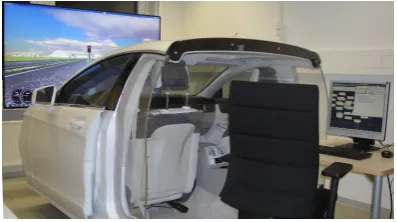
When designing a user interaction experiment, it is important that it takes place in a real environ-ment. As driving on a real road is dangerous, we used a fixed-base driving simulator in a laboratory. In front of the car, a screen covers the driver’s field of view (see Figure 1). Steering and pedal signals are picked from the car’s CAN bus. It is impor-tant that the user assumes he is interacting with a computer as “human-human interactions are not the same as human-computer interactions” (Fraser and Gilbert, 1991). The wizard, a person in charge of the experiment, was located behind the car and mouse clicks or any other interaction of the wizard was not audible in the car. To ensure a consistent behavior of the wizard, we used SUEDE (Klem-mer et al., 2000) to define the dialog, which also provides an interface for the wizard. SUEDE de-fines a dialog in a state machine, in which the sys-tem prompts are states and user inputs are edges
between them. The content of system prompts was synthesized with NUANCE Vocalizer Expressive1
[image:3.595.317.516.167.278.2]version 1.2.1 (Voice: anna.full). During the ex-periment, after each user input the wizards clicks the corresponding edge and SUEDE plays the next prompt. All user utterances are recorded as audio files.
Figure 1:Experimental Set-Up
4.2 Experiment Design
Infotainment systems in cars are used while driv-ing. This means the user cannot concentrate on the infotainment system only, but also has to focus on the road. According to multiple resource theory, the human’s performance is reduced when human resources overlap (Wickens, 2008). In a dual-task scenario, like using the infotainment system while driving, multiple resources are allocated and may interfere. Considering this issue, we use a driving task to keep the participants occupied while they interact with the SDS. This allows us to observe user utterances in a stressful situation.
Infotainment systems in cars are often equipped with large displays providing visual and haptic interaction. These kinds of interaction compete for human resources which are needed for driv-ing. This results in driver distraction, especially in demanding secondary tasks (Young and Regan, 2007). Furthermore, a visual interface can also in-fluence the communication of users (e.g. they ut-ter visual ut-terms). As we intent to study how a user interacts naturally with a multi-domain SDS, we avoid priming effects by not using any visual in-terface.
4.2.1 Primary Task: Driving Simulator One major requirement for the driving task is to keep the driver occupied at a constant level all the time. Otherwise, we would not be able to analyze user utterances on a fine-grained level.
1
Therefore, we used theContinuousTracking and Reaction (ConTRe) task (Mahr et al., 2012) which allows controlled driving conditions. It consists of a steering and a reaction task, which require oper-ating the steering wheel and pedals. In the steering task, a yellow cylinder moves unpredictable right and left at a constant distance from the driver and the driver must always steer towards it. This is similar to driving on a curved road. Sometimes a driver needs to react to sudden events to prevent an accident. For this a traffic light shows randomly red and green and requires the driver to push the throttle or brake pedal. The movement of the yel-low cylinder and the appearance of the stop light can be controlled by manipulating control vari-ables. The “hard driving setting” from Mahr et al. (2012) was used in this study.
4.2.2 Secondary Task: cross application tasks with speech interaction
As described in Section 3, a task consists of three subtasks and each subtask requires two to four se-mantic concepts. For a user it is possible to insert multiple concepts at once:
U: “Search an Italian restaurant at the destination”
or as single utterances in a dialog:
U: “Search an Italian restaurant”
S: “Where do you search an Italian restaurant?” U: “At my destination”
For all possible combinations prompts were speci-fied. SUEDE provides a GUI for the wizard to se-lect which semantic concept a user input contains. Dependent on the selection, either another concept is requested or the answer is provided. Further-more, a user input can optionally contain a verb expressing what the system should do. For exam-ple, if users say “Italian Restaurant” the reaction is the same as they would say “Search an Italian restaurant”.
The user has basically two options to select or switch to an application. Either an explicit selec-tion such as:
U: “Open restaurant application” S: “Restaurant, what do you want?”
or an implicit selection such as:
U: “Search an Italian restaurant”
By using an explicit selection, users assume they have to set the context to a specific application. After that, they can use the functionality of this application. This is a common interaction schema for visual-based infotainment systems or smart-phones, as they cluster their functionality into
var-ious applications. An implicit selection is rather like current personal assistants interact, as they do not cluster their functionality. Implicit selection facilitates the interaction for users since they can get an answer right away. After the user provided the necessary input for one subtask, the system re-sponds for example:
S: “There is one Italian restaurant: Pizzeria San Marco.”
Then the user needs to initiate an application switch to proceed with his task.
A system enabling user-initiated dialogs cannot always understand the user correctly. Especially in implicit selection, the language models increase, and thus recognition as well as understanding is error prone (Carstensen et al., 2010). Further-more, the user could request a functionality which is not supported by the system. Therefore, error handling strategies need to be applied. In terms of miscommunication, it can be distinguished be-tween misunderstanding and non-understanding (Skantze, 2007). In the experiment, two of our tasks do not support an implicit application switch, but require an explicit switch. So if users try to switch implicitly, the system will not understand their input in one task and will misinterpret it in the other task. A response to misunderstanding might look like:
U: “Search an Italian restaurant”
S: “In an Italian restaurant you can eat pizza”
A non-understanding informs the user and encour-ages him to try another request:
S: “Action unknown, please change your request”
These two responses are used until the user changes his strategy to explicit selection. If that does not happen, the task is aborted by the wizard if the user gets too frustrated. This enables us to analyze whether users will switch their strategy or not and how many turns it will take.
4.3 Procedure
is no explanation or example of the SDS, apart from a start command for activation. After the start command, the system plays a beep and the user can say whatever he likes to achieve his task. The exploration phase consists of four tasks, in which users can switch applications implic-itly and explicimplic-itly. Then they rate the usability of the system with the questionnaire: Subjective Assessment ofSpeechSystemInterfaces (SASSI) (Hone and Graham, 2000). In the second part of the experiment, four tasks with different interac-tion schemes for applicainterac-tion switches are com-pleted randomly: implicit & explicit switch pos-sible, misunderstanding, non-understanding, and dialog-initiative change.
5 Dialog Data Analysis
All audio files of user utterances were transcribed and manually annotated by one person concerning the application selection/switch, speaking style, anaphoric references, and semantic concepts.
First of all, for each application entry and switch it was classified whether the participant used an implicit or explicit utterance. Additionally, the non-understanding and misunderstanding data sets were marked whether the dialog strategy was changed and how many dialog turns this took.
Since most of the user utterances were implicit ones (see Section 6.1), we classified them fur-ther into different speaking styles. In the data set of implicit utterances, five different speaking styles could be identified. Table 2 shows them with an example. The illocutionary speech act to search a hotel is always the same, but how users express their request varies. Keyword style and explicit demand is rather how we expect people to speak with machines, as these communication forms are short commands and might be regarded as impolite between humans. Kinder and gentler communications forms are implicit demands, Wh-questions, and Yes-No-Questions. This is how we would expect people to interact with each other.
Keyword Style “Restaurant search. Berlin” Implicit Demand “I’d like to search a restaurant in
Berlin.”
Wh-Question “Which restaurants are in Berlin?” Yes-No-Question “Are there any restaurants in Berlin?” Explicit Demand “Search restaurants in Berlin”
Table 2: Speaking styles of user utterances. Two applications are always linked with a com-mon semantic concept. The user has to refer to
this concept which he can do in various ways with anaphoric expressions. The annotation of the data set is based on Fromkin et al. (2003) and shown in Table 3 (Examples are user utterances in re-sponse to the system prompt “Navigation to Berlin started”). In an elliptic anaphoric reference the concept is not spoken, but still understood because of context - also called gapping. Furthermore, pronominalization can be used as an anaphor. We distinguish between a pronoun or adverb anaphor and an anaphor with a definite noun phrase, since the later contains the type of semantic concept. Another way is simply to rephrase the semantic concept.
Elliptic “Search restaurants.” Pronoun, Adverb “Search restaurants there.” Definite Noun Phrase “Search restaurants in this city.” Rephrase “Search restaurants in Berlin.”
Table 3: Anaphoric reference types.
6 Results
In the following, results on application awareness, speaking style, anaphoric expressions, efficiency, and usability are presented. We analyzed data from 31 participants (16m/15f), with average age of 26.65 (SD: 3.32). 26 people possess and use a smartphone on a regular basis and 25 of them are used to application-based interaction (18 people use 1-5 apps and 7 people use 6-10 apps each day). Their experience with SDS is little (6-Likert Scale, avg: 3.06, SD: 1.48) as well as the usage of SDSs (5-Likert Scale, avg: 2.04, SD: 1.16). We asked them how they usually approach a new system or app to learn its interaction schema and scope of operation. On the smartphone, all 31 of them try a new app without informing themselves how it is used. Concerning infotainment systems, trying is also the most used learning approach, even while driving (26 people). This means, people do not read a manual, but the system has to be naturally usable.
236 actions and 208 information seekings for task switches.
6.1 Application Awareness
The SDS was designed to be strictly user-initiative: after a beep users could say whatever they liked. We counted 4.9% of user utterances as explicit entries to start a task, which means users in general assume either the SDS is already in the right application context or it is not based on dif-ferent applications. This is an interaction schema which would rather be used with a human com-munication partner. 1.1% explicit utterances in subtask switches reinforce this assumption. Utter-ances addressing more than one application could not be observed.
Furthermore, we analyzed whether users change their strategy from implicit to explicit subtask switch if the system does not react as expected. The implicit switch was prevented and the system answered as if a misunderstand-ing or a non-understandmisunderstand-ing has occurred. Ta-ble 4 shows results for the number of subtask switches (subt. sw.), number of successful strategy changes (succ.), and average number of user utter-ances (avg. UDT) till the strategy was changed. In total, only in 43.7% subtask switches users changed their strategy. The difference between non-understanding and misunderstanding was not significant (p=0.051), however, this might due to small sample size.
subt. sw. succ. avg. UDT
non-underst. 42 15 2.93 (SD=1.91)
misunderst. 45 23 3.74 (SD=1.79)
Table 4: Dialog repair changes to explicit strategy.
In summary, only 6% of user utterances ad-dressed the application explicitly and only 43.7% of users changed their strategy from implicit to ex-plicit. These results reveal that most users are not aware of different applications or do not address applications differently in a speech-only infotain-ment system. They interact rather like with a hu-man being or with a personal assistant than with a typical in-car SDS.
6.2 Speaking styles of implicit application selection
Even if people interact without being aware of dif-ferent applications, they might speak to a system in another way than to a human. We analyzed
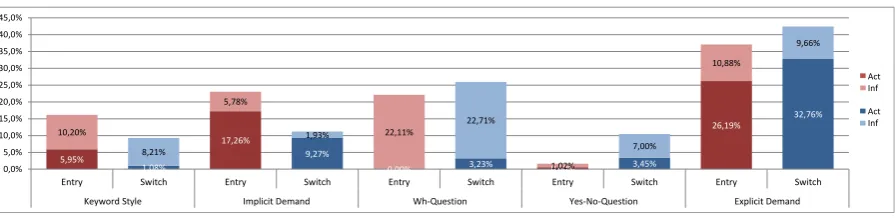
the implicit user utterances according to different speaking styles (see Figure 2). Overall, explicit demand dominates with 37.07% for task entry and 42.42% for subtask switching. Keyword style is used in 16.16% for task entry and 9.29% for sub-task switches. As mentioned, explicit demand and keyword style are rather used in human-computer interaction. Here, slightly more than half of the participants (entry: 53.23%; switch: 51.71%) use this kind of interaction. The other half interacts in kinder and gentler forms known from human-human communication.
Comparing task entry and subtask switch, dif-ferences could be found in keyword style, implicit demand, and Yes-No-Question. In the first contact with the system, users might be unsure what it is capable of, therefore, often keywords were used to find out how the system reacts. Additionally, the task description was formulated in implicit de-mand style, thus an unsure user might remember this sentence and use it. Concerning the Yes-No-Questions, they might be a reaction to the naturally formulated system prompts, thus the user adapts to a human-human-like communication style.
Finally, we compare information seeking sub-tasks with action subsub-tasks. In action subsub-tasks, im-plicit and exim-plicit demand style dominate. This is reasonable, as people give commands in either form and expect a system reaction. Likewise, it was anticipated that question styles are used for in-formation seeking. One interesting finding is that keyword style is more often used in information seeking. This could be due to priming effects of using search engines like Google2, in which users
only insert the terms they are interested in and Google provides the most likely answers.
In summary, speaking styles vary. Sometimes the system is considered as a human-like commu-nication partner and sometimes users try to reach their goal as fast as possible by giving short com-mands. However, speaking styles depend on the type of subtask and dialog state.
6.3 Anaphoric Expressions
In a cross-application task, it is of interest how users refer to application-linking semantic con-cepts. Figure 3 shows which kind of anaphoric ex-pressions were used in implicit utterances. Nearly half of the utterances (47.68%) contain a rephrase of the semantic concept and further 31.57% a
5,95%
1,08%
17,26%
9,27%
0,00% 3,23% 0,60% 3,45%
26,19%
32,76%
10,20%
8,21%
5,78%
1,93% 22,11%
22,71%
1,02%
7,00%
10,88%
9,66%
0,0% 5,0% 10,0% 15,0% 20,0% 25,0% 30,0% 35,0% 40,0% 45,0%
Entry Switch Entry Switch Entry Switch Entry Switch Entry Switch
Keyword Style Implicit Demand Wh-Question Yes-No-Question Explicit Demand
Inf Act Act Inf
[image:7.595.77.525.60.169.2]Act Inf
Figure 2: Speaking styles of implicit task entry and subtask switch distinguished by action (Act) and information seeking (Inf)
inite noun phrase. A rephrase utterance can be interpreted easily for an SDS, since there is no need to determine the right antecedent from dia-log history. A definite noun phrase contains the semantic type of the antecedent and can be ref-ered easily in a semantic annotated dialog history. However, a pronoun or elliptic anaphoric expres-sion is harder to resolve, as the former only de-scribes the syntactic form of the antecedent and the later does not contain any information of the antecedent. Sometimes, also humans are not able to resolve an anaphoric expression easily. Com-paring information seeking and action subtasks, the only difference can be identified between def-inite noun phrases and rephrase. In information seeking subtasks, participants rephrased more of-ten than using definite noun phrases.
4,98% 8,87%
17,53% 18,61% 2,22%
4,68%
14,04%
29,06%
0,0% 10,0% 20,0% 30,0% 40,0% 50,0% 60,0%
Elliptic Pronoun, Adverb
Definite NP Rephrase Inf Act
Figure 3: Anaphoric expressions used in implicit application switches.
6.4 Efficiency
Especially in the car it is essential to support short and efficient interactions. In this study, partici-pants used on average 6.27 (SD: 2.62) words for one utterance. However, the word length of a user utterance is only one part which influences dialog length. The number of semantic concepts uttered is more important, as the more semantic concepts are spoken, the less system prompts are needed to request missing information. The semantic con-cepts of each user utterance were annotated and
counted (avg: 2.77; SD: 0.73; min: 1; max: 6). They are set in relation to the maximum required semantic concepts (avg: 3.26; SD: 0.59; min: 2; max: 4) for the corresponding subtask. We divide the spoken concepts by the maximum concepts to calculate an efficiency score (avg: 0.86; SD: 0.22). This means 86% of user utterances contain all nec-essary semantic concepts to answer the request. Therefore, in-car SDS need to understand multiple semantic concepts in one utterance to keep a dia-log short, such as the city, street and street number for a destination entry.
0,88 0,91
0,69 0,87
0 0,2 0,4 0,6 0,8 1
Entry Switch
Act Inf Act Inf
[image:7.595.314.517.388.469.2]Act Inf
Figure 4: Efficiency scores of user utterances. Figure 4 shows efficiency scores split into task entry and subtask switch as well as action and information seeking. In total, there is no sig-nificant difference between task entry and sub-task switch concerning number of words, seman-tic concepts, or efficiency score. Comparing types of subtasks at task entry, the efficiency score for action subtasks (avg: 0.69; SD: 0.2) is signifi-cantly (p=0.0018) less than for information seek-ing subtasks (avg. 0.88; SD 0.22). Although, sig-nificantly (p=0.0003) more semantic concepts in actions were required (avg: 3.66; SD: 0.48) than in information seekings (avg: 3.2; SD: 0.4), users do not utter more semantic concepts. How many semantic concepts users can utter in one sentence while driving, needs to be addressed in the future. 6.5 Usability
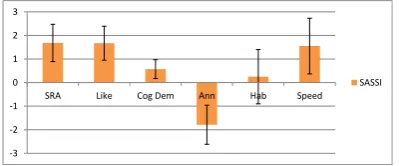
[image:7.595.80.282.457.558.2]provide valid evidence of a system’s usability. Fig-ure 5 shows results separated into the six dimen-sions System Response Accuracy (SRA), Like-ability (Like), Cognitive Demand (Cog Dem), An-noyance (Ann), Habitability (Hab), and Speed. A 7-Likert scale was used and recoded to values [-3, ..., 3]. If a system is less annoying, its usabil-ity will be better. Thus, except of cognitive de-mand and habitability, the usability of our SDS is rated good. The low habitability score is due to the fact that we did not explain the SDS and after four tasks users are not completely accustomed to the system.
-3 -2 -1 0 1 2 3
SRA Like Cog Dem Ann Hab Speed SASSI
Figure 5: SASSI Usability scores.
7 Discussion and Further Research
The results show, that users are in general not aware of different applications in speech-only in-car SDSs and switch implicitly between different domains. This interaction schema is similar to human-human communication, but may differ if the user is primed through a visual representation. Concerning speaking styles, more than half of the participants used keyword style and explicit de-mand, which might be regarded impolite between humans. They are aware to communicate with a system lacking emotions. A user, who is not sure about the system’s functions, will rather start with keywords and, after hearing natural formu-lated system prompts, is likely to adapt to natu-ral speaking styles. A human-like prompt (instead of our beep) may ensure the user from the begin-ning. Obviously, speaking styles depend on type of task, thus question and keyword style is used for information seeking and demand style to initi-ate an action. More than 50% of the participants used anaphoric expressions, which have to be re-solved within dialog context. This is comprehen-sible, as for people it is usually easier and more ef-ficient to pronounce an anaphor than to pronounce the antecedent. For reaching their interaction goal fast and efficient, the participants used multiple se-mantic concepts in utterances. In total, 86% of user utterances contain all necessary information
to answer the request. This results in less dialog turns and thus is fundamental for in-car systems. In addition, the usability is rated good, thus the system might be accepted by drivers.
Another crucial point for in-car systems is that they should distract the driver as little as possible. It can be assumed that without visual and haptic distractions, the driver would keep his focus on the road. However, cognitive demand also causes distraction. The moderate SASSI score for cogni-tive demand requires an objeccogni-tive test. Therefore, we will analyze multi-domain interactions with re-spect to mental pressure and driver performance for further research. So far, we have only consid-ered multi-domain dialogs with one common se-mantic concept. By referring to multiple seman-tic concepts, drivers might use more anaphoric ex-pressions or aggregate them with a general term, which needs to be address in further experiments.
8 Conclusions
This paper presents results on how young and technically affine people interact with in-car SDSs in performing multi-domain tasks. 31 participants completed all together 243 tasks (each with two application switches) while driving in a fixed-base driving simulator. In this experiment, a controlled WoZ setup was used instead of a real speech recognition system.
The results identify important guidelines for multi-domain SDSs. Since users are in general not aware of applications in speech-only dialog sys-tems, implicit application switching is required. However, this should not replace explicit switch-ing commands. Speakswitch-ing styles vary and depend on type of task, and dialog state. Thus language models must therefore consider this issue. Peo-ple rely on anaphora, which means an SDS must maintain a extensive dialog history across multi-ple applications to enable coreference resolution. It is further necessary that the SDS supports multi-ple semantic concepts in one utterance since it en-ables an efficient interaction and drivers use this. The SDS’s usability was rated good by the partici-pants. For further research, we will analyze multi-domain interaction with respect to driver perfor-mance and multiple semantic concept anaphora.
Acknowledgments
References
Kai-Uwe Carstensen, Christian Ebert, Cornelia Ebert, Susanne Jekat, Ralf Klabunde, and Hagen Langer.
2010. Computerlinguistik und Sprachtechnologie.
Spektrum, Akad. Verl.
Hua Cheng, Harry Bratt, Rohit Mishra, Elizabeth Shriberg, Sandra Upson, Joyce Chen, Fuliang Weng, Stanley Peters, Lawrence Cavedon, and John Niekrasz. 2004. A wizard of oz framework for
col-lecting spoken human-computer dialogs. InProc. of
ICSLP-2000.
Victor Ei-Wen Lo and Paul A. Green. 2013. Devel-opment and evaluation of automotive speech inter-faces: Useful information from the human factors and the related literature. Int. Journal of Vehicular Technology, 2013:13.
Norman M. Fraser and G.Nigel Gilbert. 1991.
Sim-ulating speech systems. Computer Speech &
Lan-guage, 5(1):81 – 99.
Victoria Fromkin, Robert Rodman, and Nina Hyams.
2003. An Introduction to Language. Rosenberg,
Michael, 7 edition.
Petra Geutner, Frank Steffens, and Dietrich Manstetten. 2002. Design of the vico spoken dialogue system: Evaluation of user expectations by wizard-of-oz
ex-periments. In Proc. of the Int. Conf. on Language
Resources and Evaluation, volume 2.
James Glass, Joseph Polifroni, Stephanie Seneff, and Victor Zue. 2000. Data collection and performance evaluation of spoken dialogue systems: The mit ex-perience. InProc. of 6th INT.
Hansj¨org Hofmann, Ute Ehrlich, Andr´e Berton, and Wolfgang Minker. 2012. Speech interaction with the internet - a user study. In Intelligent Environ-ments, Guanajuato, Mexico.
Kate S Hone and Robert Graham. 2000. Towards a tool for the subjective assessment of speech system
interfaces (sassi). Natural Language Engineering,
6(3&4):287–303.
Melanie Kellar, Carolyn Watters, and Michael Shep-herd. 2006. A goal-based classification of web
in-formation tasks. InIn 69th Annual Meeting of the
American Society for Information Science and Tech-nology (ASIST).
Scott R. Klemmer, Anoop K. Sinha, Jack Chen, James A. Landay, Nadeem Aboobaker, and Annie Wang. 2000. Suede: a wizard of oz prototyping tool for speech user interfaces. InProc. of the 13th annual ACM symposium on User interface software and technology, New York. ACM.
Jannette Maciej and Mark Vollrath. 2009. Compari-son of manual vs. speech-based interaction with
in-vehicle information systems. Accident Analysis and
Prevention, 41(5):924 – 930.
Angela Mahr, Michael Feld, Mohammad Mehdi Moniri, and Rafael Math. 2012. The contre (con-tinuous tracking and reaction) task: A flexible ap-proach for assessing driver cognitive workload with high sensitivity. In Andrew L. Kun, Linda Ng Boyle,
Bryan Reimer, and Andreas Riener, editors, Adj.
Proc. of the 4th International Conference on Au-tomotive User Interfaces and Interactive Vehicular Applications, Portsmouth. ACM.
National Highway Traffic Safety Administra-tion (NHTSA). 2013. Distracted driving 2011. Technical report.
Norbert Reithinger, Jan Alexandersson, Tilman Becker, Anselm Blocher, Ralf Engel, Markus L¨ockelt, Jochen M¨uller, Norbert Pfleger, Peter Poller, Michael Streit, and Valentin Tschernomas. 2003. Smartkom: Adaptive and flexible multimodal
access to multiple applications. In Multimodal
interfaces, New York.
Gabriel Skantze. 2007. Error Handling in Spoken
Di-alogue Systems. Ph.D. thesis, KTH Computer Sci-ence and Communication.
Jessica Villing, Cecilia Holtelius, Staffan Larsson, An-ders Lindstrm, Alexander Seward, and Nina berg. 2008. Interruption, resumption and domain switch-ing in in-vehicle dialogue. In Bengt Nordstrm and
Aarne Ranta, editors, Advances in Natural
Lan-guage Processing, volume 5221 ofLecture Notes in Computer Science, pages 488–499. Springer Berlin Heidelberg.
Fuliang Weng, Baoshi Yan, Zhe Feng, Florin Ratiu, Madhuri Raya, Brian Lathrop, Annie Lien, Se-bastian Varges, Rohit Mishra, Feng Lin, Matthew Purver, Harry Bratt, Yao Meng, Stanley Peters, To-bias Scheideck, Badri Raghunathan, and Zhaoxia
Zhang. 2007. Chat to your destination. InProc. of
8th SIGdial Workshop on Discourse and Dialogue. Christopher D Wickens. 2008. Multiple resources and
mental workload. In Human factors, volume 50,
pages 449–55. USA.