Active Learning with Multiple Annotations for Comparable Data
Classification Task
Vamshi Ambati, Sanjika Hewavitharana, Stephan Vogel and Jaime Carbonell {vamshi,sanjika,vogel,jgc}@cs.cmu.edu
Language Technologies Institute, Carnegie Mellon University 5000 Forbes Avenue, Pittsburgh, PA 15213, USA
Abstract
Supervised learning algorithms for identify-ing comparable sentence pairs from a domi-nantly non-parallel corpora require resources for computing feature functions as well as training the classifier. In this paper we pro-pose active learning techniques for addressing the problem of building comparable data for low-resource languages. In particular we pro-pose strategies to elicit two kinds of annota-tions from comparable sentence pairs: class label assignment and parallel segment extrac-tion. We also propose an active learning strat-egy for these two annotations that performs significantly better than when sampling for ei-ther of the annotations independently.
1 Introduction
The state-of-the-art Machine Translation (MT) sys-tems are statistical, requiring large amounts of paral-lel corpora. Such corpora needs to be carefully cre-ated by language experts or speakers, which makes building MT systems feasible only for those lan-guage pairs with sufficient public interest or finan-cial support. With the increasing rate of sofinan-cial media creation and the quick growth of web media in guages other than English makes it relevant for lan-guage research community to explore the feasibility of Internet as a source for parallel data. (Resnik and Smith, 2003) show that parallel corpora for a variety of languages can be harvested on the Internet. It is to be observed that a major portion of the multilingual web documents are created independent of one an-other and so are only mildly parallel at the document level.
There are multiple challenges in building compa-rable corpora for consumption by the MT systems. The first challenge is to identify the parallelism be-tween documents of different languages which has been reliably done using cross lingual information retrieval techniques. Once we have identified a sub-set of documents that are potentially parallel, the second challenge is to identify comparable sentence pairs. This is an interesting challenge as the avail-ability of completely parallel sentences on the inter-net is quite low in most language-pairs, but one can observe very few comparable sentences among com-parable documents for a given language-pair. Our work tries to address this problem by posing the identification of comparable sentences from com-parable data as a supervised classification problem. Unlike earlier research (Munteanu and Marcu, 2005) where the authors try to identify parallel sentences among a pool of comparable documents, we try to first identify comparable sentences in a pool with dominantly non-parallel sentences. We then build a supervised classifier that learns from user annota-tions for comparable corpora identification. Train-ing such a classifier requires reliably annotated data that may be unavailable for low-resource language pairs. Involving a human expert to perform such annotations is expensive for low-resource languages and so we propose active learning as a suitable tech-nique to reduce the labeling effort.
There is yet one other issue that needs to be solved in order for our classification based approach to work for truly low-resource language pairs. As we will describe later in the paper, our comparable sen-tence classifier relies on the availability of an
ini-69
tial seed lexicon that can either be provided by a hu-man or can be statistically trained from parallel cor-pora (Och and Ney, 2003). Experiments show that a broad coverage lexicon provides us with better cov-erage for effective identification of comparable cor-pora. However, availability of such a resource can not be expected in very low-resource language pairs, or even if present may not be of good quality. This opens an interesting research question - Can we also elicit such information effectively at low costs? We propose active learning strategies for identifying the most informative comparable sentence pairs which a human can then extract parallel segments from.
While the first form of supervision provides us with class labels that can be used for tuning the fea-ture weights of our classifier, the second form of su-pervision enables us to better estimate the feature functions. For the comparable sentence classifier to perform well, we show that both forms of supervi-sion are needed and we introduce an active learning protocol to combine the two forms of supervision under a single joint active learning strategy.
The rest of the paper is organized as follows. In Section 2 we survey earlier research as relevant to the scope of the paper. In Section 3 we discuss the supervised training setup for our classifier. In Sec-tion 4 we discuss the applicaSec-tion of active learning to the classification task. Section 5 discusses the case of active learning with two different annotations and proposes an approach for combining them. Section 6 presents experimental results and the effectiveness of the active learning strategies. We conclude with further discussion and future work.
2 Related Work
There has been a lot of interest in using compara-ble corpora for MT, primarily on extracting paral-lel sentence pairs from comparable sources (Zhao and Vogel, 2002; Fung and Yee, 1998). Some work has gone beyond this focussing on extracting sub-sentential fragments from noisier comparable data (Munteanu and Marcu, 2006; Quirk et al., 2007). The research conducted in this paper has two pri-mary contributions and so we will discuss the related work as relevant to each of them.
Our first contribution in this paper is the appli-cation of active learning for acquiring comparable
data in the low-resource scenario, especially rele-vant when working with low-resource languages. There is some earlier work highlighting the need for techniques to deal with low-resource scenar-ios.(Munteanu and Marcu, 2005) propose bootstrap-ping using an existing classifier for collecting new data. However, this approach works when there is a classifier of reasonable performance. In the ab-sence of parallel corpora to train lexicons human constructed dictionaries were used as an alternative which may, however, not be available for a large number of languages. Our proposal of active learn-ing in this paper is suitable for highly impoverished scenarios that require support from a human.
The second contribution of the paper is to ex-tend the traditional active learning setup that is suit-able for eliciting a single annotation. We highlight the needs of the comparable corpora scenario where we have two kinds of annotations - class label as-signment and parallel segment extraction and pro-pose strategies in active learning that involve multi-ple annotations. A relevant setup ismultitask learn-ing (Caruana, 1997) which is increasingly becom-ing popular in natural language processbecom-ing for learn-ing from multiple learnlearn-ing tasks. There has been very less work in the area of multitask active learn-ing. (Reichart et al., 2008) proposes an extension of the single-sided active elicitation task to a multi-task scenario, where data elicitation is performed for two or more independent tasks at the same time. (Settles et al., 2008) propose elicitation of annotations for image segmentation under a multi-instance learning framework.
3 Supervised Comparable Sentence Classification
In this section we discuss our supervised training setup and the classification algorithm. Our classifier tries to identify comparable sentences from among a large pool of noisy comparable sentences. In this pa-per we define comparable sentences as being lations that have around fifty percent or more trans-lation equivalence. In future we will evaluate the ro-bustness of the classifier by varying levels of noise at the sentence level.
3.1 Training the Classifier
Following (Munteanu and Marcu, 2005), we use a Maximum Entropy classifier to identify comparable sentences. The classifier probability can be defined as:
P r(ci|S, T) = 1 Z(S, T)exp
n X
j=1
λjfij(ci, S, T)
where (S, T) is a sentence pair, ci is the class, fij
are feature functions andZ(S)is a normalizing
fac-tor. The parametersλi are the weights for the
fea-ture functions and are estimated by optimizing on a training data set. For the task of classifying a sen-tence pair, there are two classes,c0 = comparable andc1 = non parallel. A value closer to one for
P r(c1|S, T)indicates that(S, T)are comparable.
To train the classifier we need comparable sen-tence pairs and non-parallel sensen-tence pairs. While it is easy to find negative examples online, ac-quiring comparable sentences is non-trivial and re-quires human intervention. (Munteanu and Marcu, 2005) construct negative examples automatically from positive examples by pairing all source sen-tences with all target sensen-tences. We, however, as-sume the availability of both positive and negative examples to train the classifier. We use the GIS learning algorithm for tuning the model parameters.
3.2 Feature Computation
The features are defined primarily based on trans-lation lexicon probabilities. Rather than computing word alignment between the two sentences, we use lexical probabilities to determine alignment points
as follows: a source word s is aligned to a target
word t if p(s|t) > 0.5. Target word alignment is computed similarly. Long contiguous sections of aligned words indicate parallelism. We use the fol-lowing features:
• Source and target sentence length ratio
• Source and target sentence length difference
• Lexical probability score, similar to IBM model 1
• Number of aligned words
• Longest aligned word sequence
• Number of un-aligned words
[image:3.612.321.535.376.522.2]Lexical probability score, and alignment features generate two sets of features based on translation lexica obtained by training in both directions. Fea-tures are normalized with respect to the sentence length.
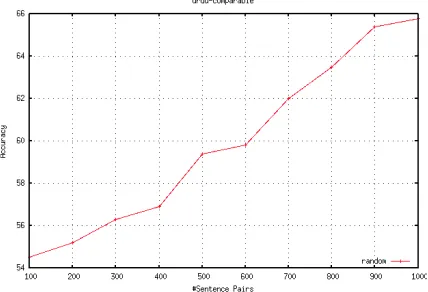
Figure 1: Seed parallel corpora size vs. Classifier perfor-mance in Urdu-English language pair
the initial size of the corpus used to construct the probabilistic lexicon on x-axis and its effect on the accuracy of the classifier on y-axis. The sentences were drawn randomly from a large pool of Urdu-English parallel corpus and it is clear that a larger pool of parallel sentences leads to a better lexicon and an improved classifier.
4 Active Learning with Multiple Annotations
4.1 Cost Motivation
Lack of existing annotated data requires reliable human annotation that is expensive and effort-intensive. We propose active learning for the prob-lem of effectively acquiring multiple annotations starting with unlabeled data. In active learning, the learner has access to a large pool of unlabeled data and sometimes a small portion of seed labeled data. The objective of the active learner is then to se-lect the most informative instances from the unla-beled data and seek annotations from a human ex-pert, which it then uses to retrain the underlying su-pervised model for improving performance.
A meaningful setup to study multi annotation ac-tive learning is to take into account the cost involved for each of the annotations. In the case of compara-ble corpora we have two annotation tasks, each with cost modelsCost1andCost2respectively. The goal of multi annotation active learning is to select the optimal set of instances for each annotation so as to maximize the benefit to the classifier. Unlike the tra-ditional active learning, where we optimize the num-ber of instances we label, here we optimize the se-lection under a provided budgetBkper iteration of
the active learning algorithm.
4.2 Active Learning Setup
We now discuss our active learning framework for building comparable corpora as shown in Algo-rithm 1. We start with an unlabeled dataset U0 = {xj =< sj, tj >}and a seed labeled datasetL0 = {(< sj, tj >, ci)}, where c ∈ 0,1 are class
la-bels with0being the non-parallel class and1being the comparable data class. We also haveT0 = {<
sk, tk >} which corresponds to parallel segments
or sentences identified fromL0 that will be used in training the probabilistic lexicon. Both T0 andL0
can be very small in size at the start of the active learning loop. In our experiments, we tried with as few as 50 to 100 sentences for each of the datasets.
We perform an iterative budget motivated active learning loop for acquiring labeled data over k
it-erations. We start the active learning loop by first training a lexicon with the availableTkand then
us-ing that we train the classifier over Lk. We, then
score all the sentences in theUkusing the model θ
and apply our selection strategy to retrieve the best scoring instance or a small batch of instances. In the simplest case we annotate this instance and add it back to the tuning setCk for re-training the
classi-fier. If the instance was a comparable sentence pair, then we could also perform the second annotation conditioned upon the availability of the budget. The identified sub-segments (ssi,tti) are added back to
the training dataTk used for training the lexicon in
the subsequent iterations.
Algorithm 1ACTIVELEARNINGSETUP 1: Given Unlabeled Comparable Corpus:U0
2: Given Seed Parallel Corpus:T0
3: Given Tuning Corpus:L0
4: fork= 0toKdo
5: Train Lexicon usingTk 6: θ= Tune Classifier usingCk 7: whileCost < Bkdo 8: i= Query(Uk,Lk,Tk,θ)
9: ci= Human Annotation-1 (si, ti) 10: (ssi,tti) = Human Annotation-2xi 11: Lk=Ck∪(si, ti, ci)
12: Tk=Tk∪(ssi, tti) 13: Uk=Uk-xi
14: Cost=Cost1+Cost2
15: end while
16: end for
5 Sampling Strategies for Active Learning
5.1.1 Certainty Sampling
This strategy selects instances where the current model is highly confident. While this may seem redundant at the outset, we argue that this crite-ria can be a good sampling strategy when the clas-sifier is weak or trained in an impoverished data scenario. Certainty sampling strategy is a lot sim-ilar to the idea of unsupervised approaches like boosting or self-training. However, we make it a semi-supervised approach by having a human in the loop to provide affirmation for the selected instance. Consider the following scenario. If we select an instance that our current model prefers and obtain a contradicting label from the human, then this in-stance has a maximal impact on the decision bound-ary of the classifier. On the other hand, if the label is reaffirmed by a human, the overall variance re-duces and in the process, it also helps in assigning higher preference for the configuration of the deci-sion boundary. (Melville et al., 2005) introduce a certainty sampling strategy for the task of feature labeling in a text categorization task. Inspired by the same we borrow the name and also apply this as an instance sampling approach. Given an in-stancexand the classifier posterior distribution for
the classes asP(.), we select the most informative
instance as follows:
x∗=arg maxxP(c= 1|x)
5.1.2 Margin-based Sampling
The certainty sampling strategy only considers the instance that has the best score for the comparable sentence class. However we could benefit from in-formation about the second best class assigned to the same instance. In the typical multi-class clas-sification problems, earlier work shows success us-ing such a ‘margin based’ approach (Scheffer et al., 2001), where the difference between the probabil-ities assigned by the underlying model to the first best and second best classes is used as the sampling criteria.
Given a classifier with posterior distribution over classes for an instance P(c = 1|x),
the margin based strategy is framed as x∗ = arg minxP(c1|x)−P(c2|x), where c1 is the best prediction for the class and c2 is the second best
prediction under the model. It should be noted that for binary classification tasks with two classes, the margin sampling approach reduces to an uncertainty sampling approach (Lewis and Catlett, 1994).
5.2 Acquiring Parallel Segments for Lexicon Training
We now propose two sampling strategies for the sec-ond annotation. Our goal is to select instances that could potentially provide parallel segments for im-proved lexical coverage and feature computation. 5.2.1 Diversity Sampling
We are interested in acquiring clean parallel seg-ments for training a lexicon that can be used in fea-ture computation. It is not clear how one could use a comparable sentence pair to decide the potential for extracting a parallel segment. However, it is highly likely that if such a sentence pair has new cover-age on the source side, then it increases the chances of obtaining new coverage. We, therefore, propose a diversity based sampling for extracting instances that provide new vocabulary coverage . The scor-ing function tc score(s) is defined below, where V oc(s) is defined as the vocabulary of source
sen-tencesfor an instancexi =< si, ti >,T is the set
of parallel sentences or segments extracted so far.
tc score(s) = |T| X
s=1
sim(s, s0)∗ 1
|T| (1)
sim(s, s0) =|(V oc(s)∩V oc(s0)| (2)
5.2.2 Alignment Ratio
We also propose a strategy that provides direct in-sight into the coverage of the underlying lexicon and prefers a sentence pair that is more likely to be com-parable. We call thisalignment ratio and it can be easily computed from the available set of features discussed in Section 3 as below:
a score(s) = #unalignedwords
#alignedwords (3) s∗=arg maxsa score(s) (4)
a potential to offer new vocabulary from the com-parable sentence pair. However while the diver-sity approach looks only at the source side coverage and does not depend upon the underlying lexicon, the alignment ratio utilizes the model for computing coverage. It should also be noted that while we have coverage for a word in the sentence pair, it may not make it to the probabilistically trained and extracted lexicon.
5.3 Combining Multiple Annotations
Finally, given two annotations and corresponding sampling strategies, we try to jointly select the sen-tence that is best suitable for obtaining both the an-notations and is maximally beneficial to the classi-fier. We select a single instance by combining the scores from the different selection strategies as a geometric mean. For instance, we consider a mar-gin based sampling (margin) for the first
annota-tion and a diversity sampling (tc score) for the
sec-ond annotation, we can jointly select a sentence that maximizes the combined score as shown below:
total score(s) =margin(s)∗tc score(s) (5) s∗=arg maxstotal score(s) (6)
6 Experiments and Results
6.1 Data
This research primarily focuses on identifying com-parable sentences from a pool of dominantly non-parallel sentences. To our knowledge, there is a dearth of publicly available comparable corpora of this nature. We, therefore, simulate a low-resource scenario by using realistic assumptions of noise and parallelism at both the corpus-level and the sentence-level. In this section we discuss the pro-cess and assumptions involved in the creation of our datasets and try to mimic the properties of real-world comparable corpora harvested from the web.
We first start with a sentence-aligned parallel cor-pus available for the language pair. We then divide the corpus into three parts. The first part is called the ’sampling pool’ and is set aside to use for draw-ing sentences at random. The second part is used to act as a parallel corpus. We achieve non-parallelism by randomizing the mapping of the tar-get sentences with the source sentences. This is a
slight variation of the strategy used in (Munteanu and Marcu, 2005) for generating negative examples for their classifier. The third part is used to synthe-size a comparable corpus at the sentence-level. We perform this by first selecting a parallel sentence-pair and then padding either sides by a source and target segment drawn independently from the sam-pling pool. We control the length of the non-parallel portion that is appended to be lesser than or equal to the original length of the sentence. Therefore, the resulting synthesized comparable sentence pairs are guaranteed to contain at least 50% parallelism.
We use this dataset as the unlabeled pool from which the active learner selects instances for label-ing. Since the gold-standard labels for this corpus are already available, which gives us better control over automating the active learning process, which typically requires a human in the loop. However, our active learning strategies are in no way limited by the simulated data setup and can generalize to the real world scenario with an expert providing the la-bels for each instance.
We perform our experiments with data from two language pairs: Urdu-English and Spanish-English. For Urdu-English, we use the parallel corpus NIST 2008 dataset released for the translation shared task. We start with 50,000 parallel sentence corpus from the released training data to create a corpus of 25,000 sentence pairs with 12,500 each of compa-rable and non-parallel sentence pairs. Similarly, we use 50,000 parallel sentences from the training data released by the WMT 2008 datasets for Spanish-English to create a corpus of 25,000 sentence pairs. We also use two held-out data sets for training and tuning the classifier, consisting of 1000 sentence pairs (500 non-parallel and 500 comparable).
6.2 Results
We perform two kinds of evaluations: the first, to show that our active learning strategies perform well across language pairs and the second, to show that multi annotation active learning leads to a good im-provement in performance of the classifier.
instances that contribute to the maximal improve-ment of the classifier. The effectiveness of active learning is typically tested by the number of queries the learner asks and the resultant improvement in the performance of the classifier. The classifier per-formance in the comparable sentence classification task can be computed as the F-score on the held out dataset. For this work, we assume that both the an-notations require the same effort level and so assign uniform cost for eliciting each of them. Therefore the number of queries is equivalent to the total cost of supervision.
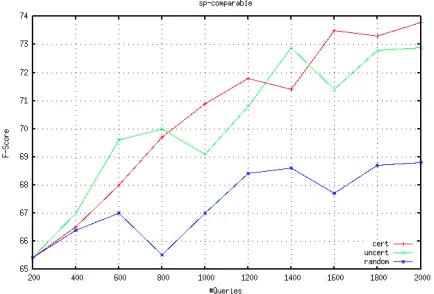
Figure 2: Active learning performance for the compara-ble corpora classification in Urdu-English language-pair
Figure 3: Active learning performance for the compara-ble corpora classification in Spanish-English language-pair
Figure 2 shows our results for the Urdu-English language pair, and Figure 3 plots the Spanish-English results with the x-axis showing the total
number of queries posed to obtain annotations and the y-axis shows the resultant improvement in accu-racy of the classifier. In these experiments we do not actively select for the second annotation but ac-quire the parallel segment from the same sentence. We compare this over a random baseline where the sentence pair is selected at random and used for elic-iting both annotations at the same time.
Firstly, we notice that both our active learn-ing strategies: certainty sampllearn-ing and margin-based sampling perform better than the random baseline. For the Urdu-English language pair we can see that for the same effort expended (i.e 2000 queries) the classifier has an increase in accuracy of 8 absolute points. For Spanish-English language pair the ac-curacy improvement is 6 points over random base-line. Another observation from Figure 3 is that for the classifier to reach an fixed accuracy of 68 points, the random sampling method requires 2000 queries while the from the active selection strategies require significantly less effort of about 500 queries.
6.2.2 Performance of Joint Selection with Multiple Annotations
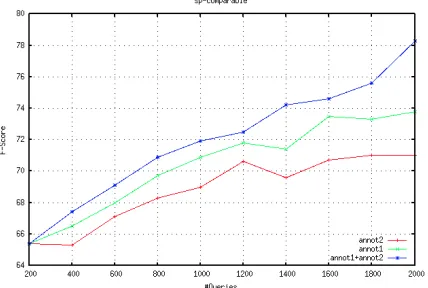
We now evaluate our joint selection strategy that tries to select the best possible instance for both the annotations. Figure 4 shows our results for the Urdu-English language pair, and Figure 5 plots the Spanish-English results for active learning with mul-tiple annotations. As before, the x-axis shows the total number of queries posed, equivalent to the cu-mulative effort for obtaining the annotations and the y-axis shows the resultant improvement in accuracy of the classifier.
[image:7.612.78.295.455.602.2]anno-tation and alignment ratio does not perform as well. So, for the second single-sided baseline we use the diversity based sampling strategy (annot2) and get the first annotation for the same instance. Finally we compare this with the joint selection approach proposed earlier that combines both the annotation strategies (annot1+annot2). In both the language pairs we notice that joint selection for both anno-tations performs better than the baselines.
Figure 4: Active learning with multiple annotations and classification performance in Urdu-English
Figure 5: Active learning with multiple annotations and classification performance in Spanish-English
7 Conclusion and Future Work
In this paper, we proposed active learning with mul-tiple annotations for the challenge of building com-parable corpora in low-resource scenarios. In par-ticular, we identified two kinds of annotations: class labels (for identifying comparable vs. non-parallel
data) and clean parallel segments within the com-parable sentences. We implemented multiple inde-pendent strategies for obtaining each of the abve in a cost-effective manner. Our active learning experi-ments in a simulated low-resource comparable cor-pora scenario across two language pairs show signif-icant results over strong baselines. Finally we also proposed a joint selection strategy that selects a sin-gle instance which is beneficial to both the annota-tions. The results indicate an improvement over sin-gle strategy baselines.
There are several interesting questions for future work. Throughout the paper we assumed uniform costs for both the annotations, which will need to be verified with human subjects. We also hypoth-esize that obtaining both annotations for the same sentence may be cheaper than getting them from two different sentences due to the overhead of context switching. Another assumption is that of the exis-tence of a single contiguous parallel segment in a comparable sentence pair, which needs to be veri-fied for corpora on the web.
Finally, active learning assumes availability of an expert to answer the queries. Availability of an ex-pert for low-resource languages and feasibility of running large scale experiments is difficult. We, therefore, have started working on crowdsourcing these annotation tasks on Amazon Mechanical Turk (MTurk) where it is easy to find people and quickly run experiments with real people.
Acknowledgement
This material is based upon work supported in part by the U. S. Army Research Laboratory and the U. S. Army Research Office under grant W911NF-10-1-0533, and in part by NSF under grant IIS 0916866.
References
Peter F. Brown, Stephen A. Della Pietra, Vincent J. Della Pietra, and Robert L. Mercer. 1993. The mathematics of statistical machine translation: Parameter estima-tion. Computational Linguistics, 19(2):263–311. Rich Caruana. 1997. Multitask learning. InMachine
Learning, pages 41–75.
[image:8.612.81.295.414.558.2]Nat-ural Language Processing (EMNLP 2009), pages 81– 90.
Jenny Rose Finkel and Christopher D. Manning. 2010. Hierarchical joint learning: Improving joint parsing and named entity recognition with non-jointly labeled data. InProceedings of ACL 2010.
Pascale Fung and Lo Yen Yee. 1998. An IR approach for translating new words from nonparallel, comparable texts. InProceedings of the 36th Annual Meeting of the Association for Computational Linguistics, pages 414–420, Montreal, Canada.
David D. Lewis and Jason Catlett. 1994. Heterogeneous uncertainty sampling for supervised learning. In In Proceedings of the Eleventh International Conference on Machine Learning, pages 148–156. Morgan Kauf-mann.
Prem Melville, Foster Provost, Maytal Saar-Tsechansky, and Raymond Mooney. 2005. Economical active feature-value acquisition through expected utility esti-mation. InUBDM ’05: Proceedings of the 1st interna-tional workshop on Utility-based data mining, pages 10–16, New York, NY, USA. ACM.
Dragos Stefan Munteanu and Daniel Marcu. 2005. Im-proving machine translation performance by exploit-ing non-parallel corpora. Computational Linguistics, 31(4):477–504.
Dragos Stefan Munteanu and Daniel Marcu. 2006. Ex-tracting parallel sub-sentential fragments from non-parallel corpora. InProceedings of the 21st Interna-tional Conference on ComputaInterna-tional Linguistics and the 44th Annual Meeting of the Association for Com-putational Linguistics, pages 81–88, Sydney, Aus-tralia.
Franz Josef Och and Hermann Ney. 2003. A system-atic comparison of various statistical alignment mod-els. Computational Linguistics, 29(1):19–51.
Sinno Jialin Pan and Qiang Yang. 2010. A survey on transfer learning. IEEE Transactions on Knowledge and Data Engineering, 22(10):1345–1359, October. Chris Quirk, Raghavendra U. Udupa, and Arul Menezes.
2007. Generative models of noisy translations with applications to parallel fragment extraction. In Pro-ceedings of the Machine Translation Summit XI, pages 377–384, Copenhagen, Denmark.
Roi Reichart, Katrin Tomanek, Udo Hahn, and Ari Rap-poport. 2008. Multi-task active learning for linguis-tic annotations. In Proceedings of ACL-08: HLT, pages 861–869, Columbus, Ohio, June. Association for Computational Linguistics.
Philip Resnik and Noah A. Smith. 2003. The web as a parallel corpus. Comput. Linguist., 29(3):349–380. Tobias Scheffer, Christian Decomain, and Stefan
Wro-bel. 2001. Active hidden markov models for informa-tion extracinforma-tion. In IDA ’01: Proceedings of the 4th
International Conference on Advances in Intelligent Data Analysis, pages 309–318, London, UK. Springer-Verlag.
Burr Settles, Mark Craven, and Soumya Ray. 2008. Multiple-instance active learning. InIn Advances in Neural Information Processing Systems (NIPS, pages 1289–1296. MIT Press.