Extraction Programs: A Unified Approach to Translation Rule Extraction
Mark Hopkins and Greg Langmead and Tai Vo SDL Language Technologies Division
6060 Center Drive, Suite 150 Los Angeles, CA 90045
{mhopkins,glangmead,tvo}@sdl.com
Abstract
We provide a general algorithmic schema for translation rule extraction and show that several popular extraction methods (includ-ing phrase pair extraction, hierarchical phrase pair extraction, and GHKM extraction) can be viewed as specific instances of this schema. This work is primarily intended as a survey of the dominant extraction paradigms, in which we make explicit the close relationship be-tween these approaches, and establish a lan-guage for future hybridizations. This facili-tates a generic and extensible implementation of alignment-based extraction methods.
1 Introduction
The tradition of extracting translation rules from aligned sentence pairs dates back more than a decade. A prominent early example is phrase-based extraction (Och et al., 1999).
Around the middle of the last decade, two ex-traction paradigms were proposed for syntax-based machine translation: the Hiero paradigm of (Chi-ang, 2005) and the GHKM paradigm of (Galley et al., 2004). From these papers followed two largely independent lines of research, respectively dubbed
formally syntax-based machine translation(Chiang, 2007; Zollmann and Venugopal, 2006; Venugopal et al., 2007; Lopez, 2007; Marton and Resnik, 2008; Li et al., 2009; de Gispert et al., 2010) and linguis-tically syntax-based machine translation(Galley et al., 2006; Marcu et al., 2006; Liu et al., 2006; Huang et al., 2006; Liu et al., 2007; Mi and Huang, 2008; Zhang et al., 2008; Liu et al., 2009).
In this paper, we unify these strands of research by showing how to express Hiero extraction, GHKM
extraction, and phrase-based extraction as instances of a single master extraction method. Specifically, we express each technique as a simple “program” given to a generic “evaluator”. Table 1 summarizes how to express several popular extraction methods as “extraction programs.”
Besides providing a unifying survey of popular alignment-based extraction methods, this work has the practical benefit of facilitating the implementa-tion of these methods. By specifying the appropri-ate input program, the generic evaluator (coded, say, as a Python module) can be used to execute any of the extraction techniques in Table 1. New extraction techniques and hybridizations of existing techniques can be supported with minimal additional program-ming.
2 Building Blocks
The family of extraction algorithms under consider-ation share a common setup: they extract translconsider-ation rules from a sentence pair and an alignment. In this section, we define these concepts.
2.1 Patterns and Sentences
Assume we have a global vocabulary of atomic sym-bols, containing the reservedsubstitution symbol∇. Define apattern as a sequence of symbols. Define therankof a pattern as the count of its∇symbols.
Let∇k ,h k
z }| {
∇,∇, ...,∇i.
We will typically use space-delimited quotations to represent example patterns, e.g. “ne∇pas” rather than hne,∇,pasi. We will use the dot operator to represent the concatenation of patterns, e.g. “il ne”· “va pas” = “il ne va pas”.
Extraction Program
Method Primary Secondary Labeling
Protocol Protocol Protocol
PBMT(Och et al., 1999) RANKPP0 TRIVSPA TRIVLP
Hiero(Chiang, 2005) RANKPP∞ TRIVSPA TRIVLP
GHKM(Galley et al., 2004) MAPPPt TRIVSPA PMAPLPt
SAMT (Zollmann and Venugopal, 2006) RANKPP∞ TRIVSPA PMAPLPt˜ Forest GHKM (Mi and Huang, 2008) MAPPPT TRIVSPA PMAPLPT
[image:2.612.106.508.52.211.2]Tree-to-Tree GHKM (Liu et al., 2009) MAPPPt MAPSPτ,A IMAPLP{t},{τ} Forest-to-Forest GHKM (Liu et al., 2009) MAPPPT MAPSPT,A IMAPLPT ,T Fuzzy Dual Syntax (Chiang, 2010) MAPPP˜t MAPSP˜τ ,A IMAPLP{˜t},{τ˜}
Table 1: Various rule extraction methods, expressed as extraction programs. Boldfaced methods are proven in this paper; the rest are left as conjecture. Parameters: t, τ are spanmaps (see Section 3); ˜t,τ˜are fuzzy spanmaps (see Section 7);T,T are sets of spanmaps (typically encoded as forests);Ais an alignment (see Section 2).
We refer to a contiguous portion of a pattern with aspan, defined as either thenull spanφ, or a pair
[b, c]of positive integers such thatb ≤ c. We will treat span [b, c] as the implicit encoding of the set {b, b+ 1, ..., c}, and employ set-theoretic operations on spans, e.g. [3,8]∩[6,11] = [6,8]. Note that the null span encodes the empty set.
If a setIof positive integers is non-empty, then it has a uniqueminimal enclosing span, defined by the operatorspan(I) = [min(I),max(I)]. For instance, span({1,3,4}) = [1,4]. Definespan({}) =φ.
Finally, define asentenceas a pattern of rank 0.
2.2 Alignments
Analignment is a triplehm, n,Ai, where m andn
are positive integers, andAis a set of ordered integer pairs(i, j)such that1≤i≤mand1≤j≤n.
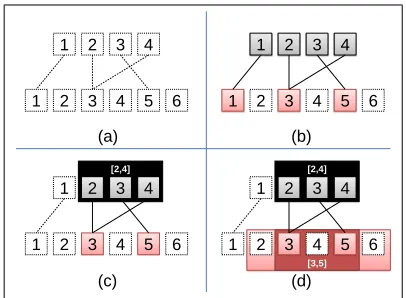
In Figure 1(a), we show a graphical depiction of alignment h4,6,{(1,1),(2,3),(4,3),(3,5)}i. Ob-serve that alignments have aprimaryside (top) and a secondary side (bottom)1. For alignment A =
hm, n,Ai, define|A|p = m and|A|s = n. A pri-mary index(resp.,secondary index) ofAis any pos-itive integer less than or equal to|A|p (resp.,|A|s).
Aprimary span(resp.,secondary span) ofAis any span[b, c]such that1≤b≤c≤ |A|p(resp.,|A|s).
Definea∼A αto mean that(a, α)∈ A(in words, we say thatAalignsprimary indexato secondary
1The terms
primaryandsecondaryallow us to be agnostic about how the extracted rules are used in a translation system, i.e. the primary side can refer to the source or target language.
[3,5] [2,4] [2,4]
1 2 3 4
2 3 4 5
1 6
1 2 3 4
2 3 4 5
1 6
1 2 3 4
2 3 4 5
1 6
(a)
(d) (c)
(b) 1 2 3 4
2 3 4 5
1 6
Figure 1: A demonstration of alignment terminology. (a) An alignment is a relation between positive integer sets. (b) Theprimary domainof the example alignment is {1,2,3,4} and thesecondary domain is {1,3,5}. (c) Theimageof primary span [2,4] is{3,5}. (d) The mini-mal projectionof primary span [2,4] is [3,5]. Secondary spans [2,5], [3,6], and [2,6] are alsoprojectionsof pri-mary span [2,4].
indexα), and definea6∼A αto mean that(a, α)6∈A. Define an aligned sentence pair as a triple hs, σ,Ai whereAis an alignment ands, σ are sen-tences of length|A|pand|A|s, respectively.
[image:2.612.325.528.271.420.2]{1,2,3,4}andsdom(A) ={1,3,5}.
Image: Theimageof a set I of primary indices (denoted pimageA(I)) is the set of secondary in-dices to which the primary inin-dices of I align. In Figure 1(c), for instance, the image of primary span
[2,4]is the set{3,5}. Formally, for a setI of pri-mary indices of alignmentA, define:
pimageA(I) ={α|∃a∈I s.t.(a, α)∈A}
Projection: Theminimal projectionof a setI of primary indices (denoted pmprojA(I)) is the min-imal enclosing span of the image of I. In other words, pmprojA(I) = span(pimageA(I)). In Fig-ure 1(d), for instance, the minimal projection of pri-mary span[2,4]is the secondary span[3,5].
Consider Figure 1(d). We will also allow a more relaxed type of projection, in which we allow the broadening of the minimal projection to include un-aligned secondary indices. In the example, sec-ondary spans [2,5], [3,6], and [2,6] (in addition to the minimal projection [3,5]) are all considered
projections of primary span [2,4]. Formally, de-fine pprojA([b, c]) as the set of superspans [β, γ] of pmprojA([b, c]) such that [β, γ]∩ sdom(A) ⊆ pmprojA([b, c]).
2.3 Rules
We define anunlabeled ruleas a tuplehk, s∗, σ∗, πi where k is a nonnegative integer, s∗ and σ∗
are patterns of rank k, and π is a permuta-tion of the sequence h1,2, ..., ki. Such rules can be rewritten using a more standard Syn-chronous Context-Free Grammar (SCFG) format, e.g. h3, “le∇ ∇de∇”,“∇’s∇ ∇”,h3,2,1iican be written: ∇ → hle∇1∇2 de∇3,∇3’s∇2∇1i.
A labeled ruleis a pair hr, li, wherer is an un-labeled rule, and lis a “label”. The unlabeled rule defines the essential structure of a rule. The label gives us auxiliary information we can use as decod-ing constraints or rule features. This deliberate mod-ularization lets us unify sequence-based and tree-based extraction methods.
Labels can take many forms. Two examples (de-picted in Figure 2) are:
1. AnSCFG labelis a(k+ 1)-length sequence of symbols.
DT NN JJ NPB
NP
< NP, NN, JJ, NNP >
IN NNP PP
* *
NNP POS JJ NP
* NN
NP < le NN1 JJ2 de NNP3 ,
NNP3’s JJ2NN1 >
DT NN JJ NPB
NP
IN NNP PP
le de
NNP POS JJ
NP ‘s
NN
label labeled rule
Figure 2: An example SCFG label (top) and STSG label (bottom) for unlabeled rule ∇ → hle∇1∇2de∇3,∇3’s∇2∇1i.
2. AnSTSG label (from Synchronous Tree Sub-stitution Grammar (Eisner, 2003)) is a pair of trees.
STSG labels subsume SCFG labels. Thus STSG extraction techniques can be used as SCFG extrac-tion techniques by ignoring the extra hierarchical structure of the STSG label. Due to space con-straints, we will restrict our focus to SCFG labels. When considering techniques originally formulated to extract STSG rules (GHKM, for instance), we will consider their SCFG equivalents.
3 A General Rule Extraction Schema
In this section, we develop a general algorithmic schema for extracting rules from aligned sentence pairs. We will do so by generalizing the GHKM al-gorithm (Galley et al., 2004). The process goes as follows:
• Repeatedly:
– Choose a “construction request,” which consists of a “primary subrequest” (see Figure 3a) and a “secondary subrequest” (see Figure 3b).
– Construct the unlabeled rule correspond-ing to this request (see Figure 3, bottom).
[1,4]
[4,4] [1,1]
ne va pas il
he does not go
INDEX SORT
1 4 2 3
▼ ▼ does not
[1,4]
[3,3] [1,1]
[1,4]
[4,4] [1,1]
ne va pas il
he does not go
▼ does not ▼
INDEX SORT
1 3 2 4
▼ ▼ ne pas
▼ ne ▼ pas
INDEX SORT
1 3
1 2
1 2
primary
pattern
secondary
pattern
permutation
[image:4.612.91.526.50.379.2](a) (b)
Figure 3: Extraction of the unlabeled rule ∇ → h∇1does not∇2,∇1ne∇2pasi. (a) Choose primary
subre-quest [1,4] [1,1][4,4]. (b) Choose secondary subrequest [1,4] [1,1][3,3]. (bottom) Construct the rule
∇ → h∇1does not∇2,∇1ne∇2pasi.
3.1 Choose a Construction Request
The first step in the extraction process is to choose a “construction request,” which directs the algorithm about which unlabeled rule(s) we wish to construct. A “construction request” consists of two “subre-quests.”
Subrequests: A subrequest is a
nonempty sequence of non-null spans h[b0, c0],[b1, c1], ...,[bk, ck]i such that, for all 1 ≤ i < j ≤ k, [bi, ci] and [bj, cj] are disjoint
proper2 subsets of [b0, c0]. If it also true that
ci < bj, for all1≤ i < j ≤k, then the subrequest
is calledmonotonic. We refer tokas therankof the subrequest.
We typically write subrequest h[b0, c0],[b1, c1], ...,[bk, ck]iusing the notation:
2
If unary rules are desired, i.e. rules of the form∇ → ∇, then this condition can be relaxed.
[b0, c0] [b1, c1]...[bk, ck]
or as[b0, c0] ifk= 0.
For subrequest x = [b0, c0] [b1, c1]...[bk, ck],
define:
covered(x) =∪k
i=1[bi, ci]
uncovered(x) = [b0, c0]\covered(x)
Primary Subrequests: Given an alignment A, define the setfrontier(A)as the set of primary spans
[b, c] of alignment A such that pmprojA([b, c])) is nonempty and disjoint frompimageA([1, b−1])∪ pimageA([c+ 1,|A|p]).3
3Our definition of the frontier property is an equivalent
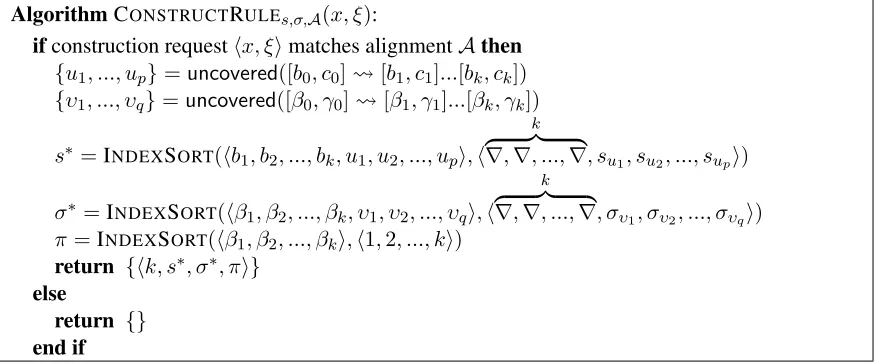
AlgorithmCONSTRUCTRULEs,σ,A(x, ξ):
ifconstruction requesthx, ξimatches alignmentAthen
{u1, ..., up}=uncovered([b0, c0] [b1, c1]...[bk, ck])
{υ1, ..., υq}=uncovered([β0, γ0] [β1, γ1]...[βk, γk])
s∗=INDEXSORT(hb1, b2, ..., bk, u1, u2, ..., upi,h k
z }| {
∇,∇, ...,∇, su1, su2, ..., supi)
σ∗=INDEXSORT(hβ1, β2, ..., βk, υ1, υ2, ..., υqi,h k
z }| {
∇,∇, ...,∇, συ1, συ2, ..., συqi)
π=INDEXSORT(hβ1, β2, ..., βki,h1,2, ..., ki) return {hk, s∗, σ∗, πi}
else
return {}
[image:5.612.88.528.56.238.2]end if
Figure 4: Pseudocode for rule construction. Arguments: s=“s1s2 ... sm” andσ =“σ1σ2... σn” are sentences, A=hm, n,Aiis an alignment,x= [b0, c0] [b1, c1]...[bk, ck]andξ= [β0, γ0] [β1, γ1]...[βk, γk]are subrequests.
Define preqs(A) as the set of monotonic subre-quests whose spans are all infrontier(A). We refer to members ofpreqs(A)asprimary subrequestsof alignmentA. Figure 3a shows a primary subrequest of an example alignment.
Secondary Subrequests: Given a primary sub-request x = [b0, c0] [b1, c1]...[bk, ck] of
align-mentA, definesreqs(x,A)as the set of subrequests
[β0, γ0] [β1, γ1]...[βk, γk] such that [βi, γi] ∈
pprojA([bi, ci]), for all 0 ≤ i ≤ k. We refer to
members of sreqs(x,A) as secondary subrequests
of primary subrequestxand alignmentA. Figure 3b shows a secondary subrequest of the primary subre-quest selected in Figure 3a.
Construction Requests: Aconstruction request
is a pair of subrequests of equivalent rank. Con-struction requesthx, ξimatchesalignmentAifx∈ preqs(A)andξ ∈sreqs(x,A).
3.2 Construct the Unlabeled Rule
The basis of rule construction is the INDEXSORT operator, which takes as input a sequence of integers I = hi1, i2, ..., iki, and an
equivalent-length sequence of arbitrary values hv1, v2, ..., vki,
and returns a sequence hvj1, vj2, ..., vjki, where hj1, j2, ..., jki is a permutation of sequence I in ascending order. For instance, INDEX -SORT(h4,1,50,2i,h“a”, “b”, “c”, “d”i) = property is a propertyof the alignment alone. It is independent of the auxiliary information that GHKM uses, in particular the tree.
Primary ProtocolRANKPPk:
{[b0, c0] [b1, c1]...[bj, cj]
s.t.1≤b0≤c0and0≤j≤k}
Primary ProtocolMAPPPt:
{[b0, c0] [b1, c1]...[bk, ck]
s.t.∀0≤i≤k[bi, ci]∈spans(t)}
Primary ProtocolMAPPPT:
[
t∈T
[image:5.612.319.535.286.473.2]MAPPPt
Figure 5: Various primary protocols. Parameters: kis a nonnegative integer; tis a spanmap;T is a set of span-maps (typically encoded as a forest).
h“b”, “d”, “a”, “c”i. Note that the output of INDEXSORT(I, V) is nondeterministic if sequence
I has repetitions. In Figure 4, we show the pseu-docode for rule construction. We show an example construction in Figure 3 (bottom).
3.3 Label the Rule
Rule construction produces unlabeled rules. To label these rules, we use alabeling protocol, defined as a function that takes a construction request as input, and returns a set of labels.
la-Secondary ProtocolTRIVSPA(x):
return sreqs(x,A)
Secondary ProtocolMAPSPτ,A(x):
{[β0, γ0] [β1, γ1]...[βk, γk]∈sreqs(x,A)
s.t.∀0≤i≤k: [βi, γi]∈spans(τ)}
Figure 6: Various secondary protocols. Parameters: τ
is a spanmap; A is an alignment; x = [b0, c0]
[b1, c1]...[bk, ck]is a subrequest.
beling protocols. Some of these are driven by trees. We will represent a tree as a spanmap, defined as a function that maps spans to symbol sequences. For instance, if a parse tree has constituent NP over span [4,7], then the corresponding spanmap t has
t([4,7]) =hNPi. We map spans tosequencesin or-der to accommodate unary chains in the parse tree. Nonconstituent spans are mapped to the empty se-quence. For spanmap t, let spans(t) be the set of spans [b, c] for which t([b, c]) is a nonempty se-quence.
4 Extraction Programs
In the previous section, we developed a general technique for extracting labeled rules from aligned sentence pairs. Note that this was not an algorithm, but rather an algorithmic schema, as it left two ques-tions unanswered:
1. What construction requests do we make?
2. What labeling protocol do we use?
We answer these questions with anextraction pro-gram, defined as a triplehX,Ξ,Li, where:
• X is a set of subrequests, referred to as the pri-mary protocol. It specifies the set of primary subrequests that interest us. Figure 5 defines some general-purpose primary protocols.
• Ξ maps every subrequest to a set of subre-quests. We refer toΞas thesecondary protocol. It specifies the set of secondary subrequests that interest us, given a particular primary subre-quest. Figure 6 defines some general-purpose secondary protocols.
Labeling ProtocolTRIVLP(x, ξ):
return ∇k+1
Labeling ProtocolPMAPLPt(x, ξ):
{hl0, ..., lkis.t. ∀0≤i≤k:li∈t([bi, ci])}
Labeling ProtocolPMAPLPT(x, ξ):
[
t∈T
PMAPLPt(x, ξ)
Labeling ProtocolSMAPLPτ(x, ξ):
{hλ0, ..., λkis.t.∀0≤i≤k:λi ∈τ([βi, γi])}
Labeling ProtocolSMAPLPT(x, ξ):
[
τ∈T
SMAPLPτ(x, ξ)
Labeling ProtocolIMAPLPT ,T(x, ξ):
{h(l0, λ0), ...,(lk, λk)i
s.t. hl0, ..., lki ∈PMAPLPT(x, ξ)
[image:6.612.321.533.47.409.2]andhλ0, ..., λki ∈SMAPLPT(x, ξ)}
Figure 7: Various labeling protocols. Parameters:t, τare spanmaps; T,T are sets of spanmaps; x = [b0, c0]
[b1, c1]...[bk, ck] andξ = [β0, γ0] [β1, γ1]...[βk, γk]
are subrequests.
• Lis a labeling protocol. Figure 7 defines some general-purpose labeling protocols.
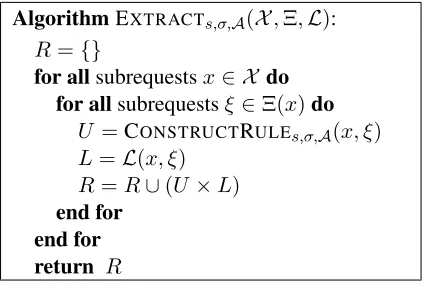
Figure 8 shows the pseudocode for an “evaluator” that takes an extraction program (and an aligned sen-tence pair) as input and returns a set of labeled rules.
4.1 The GHKM Extraction Program
As previously stated, we developed our extraction schema by generalizing the GHKM algorithm (Gal-ley et al., 2004). To recover GHKM as an instance of this schema, use the following program:
EXTRACTs,σ,A(MAPPPt,TRIVSPA,PMAPLPt)
AlgorithmEXTRACTs,σ,A(X,Ξ,L): R={}
for allsubrequestsx∈ X do for allsubrequestsξ ∈Ξ(x)do
U =CONSTRUCTRULEs,σ,A(x, ξ) L=L(x, ξ)
R=R∪(U×L) end for
[image:7.612.80.293.54.196.2]end for return R
Figure 8: Evaluator for extraction programs. Parameters:
hs, σ,Aiis an aligned sentence pair;X is a primary pro-tocol;Ξis a secondary protocol;Lis a labeling protocol. 5 The Phrase Pair Extraction Program
In this section, we express phrase pair extraction (Och et al., 1999) as an extraction program.
For primary span[b, c]and secondary span[β, γ]
of alignmentA, let[b, c] ∼A [β, γ] if the following three conditions hold:
1. a∼A αfor somea∈[b, c]andα∈[β, γ]
2. a A
6∼αfor alla∈[b, c]andα6∈[β, γ]
3. a A
6∼αfor alla6∈[b, c]andα∈[β, γ]
Define the ruleset PBMT(s, σ,A)to be the set of la-beled ruleshr,∇1isuch that:
• r=h0,“sb...sc”,“σβ...σγ”,∅i
• [b, c]∼A [β, γ]
We want to express PBMT(s, σ,A)as an extrac-tion program. First we establish a useful lemma and corollary.
Lemma 1. [b, c]∼A [β, γ]iff[b, c]∈frontier(A)and [β, γ]∈pprojA([b, c]).
Proof. Let[b, c]c= [1, b−1]∪[c+ 1,|A|p].
[b, c]∈frontier(A)and[β, γ]∈pprojA([b, c])
(1) ⇐⇒
(
pmprojA([b, c])∩pimageA([b, c]c) ={}
[β, γ]∈pprojA([b, c])
(2) ⇐⇒
(
[β, γ]∩pimageA([b, c]c) ={} [β, γ]∈pprojA([b, c])
(3) ⇐⇒
(
[β, γ]∩pimageA([b, c]c) ={} pimageA([b, c])⊆[β, γ]
(4) ⇐⇒
(
conditions 2 and 3 hold
[β, γ]6={}
(5)
⇐⇒ conditions 1, 2 and 3 hold
Equivalence 1 holds by definition of frontier(A). Equivalence 2 holds because [β, γ] differs from pmprojA([b, c]) only in unaligned indices. Equiv-alence 3 holds because given the disjointness from pimageA([b, c]c), [β, γ] differs from pimageA([b, c])only in unaligned indices. Equiva-lences 4 and 5 are a restatement of conditions 2 and 3 plus the observation that empty spans can satisfy conditions 2 and 3.
Corollary 2. Consider monotonic subrequestx = [b0, c0] [b1, c1]...[bk, ck]and arbitary subrequest ξ = [β0, γ0] [β1, γ1]...[βk, γk]. Construction request hx, ξi matches alignment A iff [bi, ci]
A
∼
[βi, γi]for all0≤i≤k.
We are now ready to express the rule set PBMT(s, σ,A)as an extraction program.
Theorem 3. PBMT(s, σ,A) =
EXTRACTs,σ,A(RANKPP0,TRIVSPA,TRIVLP)
Proof.
hr, li ∈EXTs,σ,A(RANKPP0,TRIVSPA,TRIVLP)
(1) ⇐⇒
x= [b, c] andξ= [β, γ]
hx, ξimatches alignmentA
{r}=CONSTRUCTRULEs,σ,A(x, ξ) l=∇1
(2) ⇐⇒
x= [b, c] andξ= [β, γ]
hx, ξimatches alignmentA
r =h0,“sb...sc”,“σβ...σγ”,∅i l=∇1
(3) ⇐⇒
[b, c]∼A [β, γ]
r =h0,“sb...sc”,“σβ...σγ”,∅i l=∇1
(4)
Equivalence 1 holds by the definition of EXTRACT and RANKPP0. Equivalence 2 holds by the pseu-docode of CONSTRUCTRULE. Equivalence 3 holds from Corollary 2. Equivalence 4 holds from the def-inition of PBMT(s, σ,A).
6 The Hiero Extraction Program
In this section, we express the hierarchical phrase-based extraction technique of (Chiang, 2007) as an extraction program. Define HIERO0(s, σ,A) = PBMT(s, σ,A). For positive integer k, define HIEROk(s, σ,A) as the smallest superset of HI
-EROk−1(s, σ,A)satisfying the following condition: • For any labeled rulehhk−1, s∗, σ∗, πi,∇ki ∈
HIEROk−1(s, σ,A)such that:
1. s∗ =s∗1·“sb...sc”·s∗2 2. σ∗ =σ∗1·“σβ...σγ”·σ∗2 3. π =hπ1, π2, ..., πk−1i 4. s∗2has rank 0.4 5. σ∗1 has rankj.
6. [b, c]∼A [β, γ]
it holds that labeled rulehr,∇k+1iis a member of HIEROk(s, σ,A), whereris:
hk, s∗1·“∇”·s∗2, σ1∗·“∇”·σ2∗,
hπ1, ..., πj, k, πj+1, ..., πk−1ii
Theorem 4. HIEROk(s, σ,A) =
EXTRACTs,σ,A(RANKPPk,TRIVSPA,TRIVLP)
Proof. By induction. Define ext(k) to mean EXTRACTs,σ,A(RANKPPk,TRIVSPA,TRIVLP). From Theorem 3, HIERO0(s, σ,A) = ext(0). Assume that HIEROk−1(s, σ,A) = ext(k−1)and prove that HIEROk(s, σ,A)\HIEROk−1(s, σ,A) = ext(k)\ext(k−1).
hr0, l0i ∈ext(k)\ext(k−1)
(1) ⇐⇒
x0= [b0, c0] [b1, c1]...[bk, ck] ξ0 = [β0, γ0] [β1, γ1]...[βk, γk]
hx0, ξ0imatches alignmentA
{r0}=CONSTRUCTRULEs,σ,A(x0, ξ0)
l0=∇k+1
4This condition is not in the original definition. It is a
cos-metic addition, to enforce the consecutive ordering of variable indices on the rule LHS.
(2) ⇐⇒
x= [b0, c0] [b1, c1]...[bk−1, ck−1]
ξ = [β0, γ0] [β1, γ1]...[βk−1, γk−1] {r}=CONSTRUCTRULEs,σ,A(x, ξ) π =hπ1, ..., πk−1i
r =hk−1,s ∗
1·“sbk...sck”·s
∗
2,
σ1∗·“σβk...σγk”·σ
∗
2, πi
s∗2has rank 0 andσ1∗has rankj
x0= [b0, c0] [b1, c1]...[bk, ck] ξ0 = [β0, γ0] [β1, γ1]...[βk, γk]
hx0, ξ0imatches alignmentA
π0 =hπ1, ..., πj, k, πj+1, ..., πk−1i
r0 =hk, s∗1·“∇”·s2∗, σ1∗·“∇”·σ2∗, π0i
l0 =∇k+1
(3) ⇐⇒
π =hπ1, ..., πk−1i
r =hk−1,s ∗
1·“sbk...sck”·s
∗
2,
σ1∗·“σβk...σγk”·σ
∗
2, πi
s∗2has rank 0 andσ1∗has rankj
hr,∇ki ∈H
IEROk−1(s, σ,A)
π0 =hπ1, ..., πj, k, πj+1, ..., πk−1i
r0 =hk, s∗1·“∇”·s2∗, σ1∗·“∇”·σ2∗, π0i
[bi, ci]
A
∼[βi, γi]for all0≤i≤k
l0 =∇k+1
(4)
⇐⇒ hr0, l0i ∈HIEROk(s, σ,A)\HIEROk−1(s, σ,A)
Equivalence 1 holds by the definition of ext(k)\ext(k − 1). Equivalence 2 holds by the pseudocode of CONSTRUCTRULE. Equivalence 3 holds by the inductive hypothesis and Corol-lary 2. Equivalence 4 holds by the definition of HIEROk(s, σ,A)\HIEROk−1(s, σ,A).
7 Discussion
hybridization of Hiero and GHKM that uses the pri-mary protocol of Hiero and the labeling protocol of GHKM. To bridge the approaches, SAMT employs a fuzzy version5of the spanmaptthat assigns a triv-ial label to non-constituent primary spans:
˜
t([b, c]) =
t([b, c]) if[b, c]∈spans(t)
h∇i otherwise
Other approaches can be similarly expressed as straightforward variants of the extraction programs we have developed in this paper.
Although we have focused on idealized meth-ods, this framework also allows a compact and pre-cise characterization of practical restrictions of these techniques. For instance, (Chiang, 2007) lists six criteria that he uses in practice to restrict the gener-ation of Hiero rules. His condition 4 (“Rules can have at most two nonterminals.”) and condition 5 (“It is prohibited for nonterminals to be adjacent on the French side.”) can be jointly captured by replac-ing Hiero’s primary protocol with the followreplac-ing:
{[b0, c0] [b1, c1]...[bj, cj]s.t.1≤b0 ≤c0
0≤j≤2 b2>c1+1}
His other conditions can be similarly captured with appropriate changes to Hiero’s primary and sec-ondary protocols.
This work is primarily intended as a survey of the dominant translation rule extraction paradigms, in which we make explicit the close relationship be-tween these approaches, and establish a language for future hybridizations. From a practical perspective, we facilitate a generic and extensible implementa-tion which supports a wide variety of existing meth-ods, and which permits the precise expression of practical extraction heuristics.
5
This corresponds with the original formulation of Syntax Augmented Machine Translation (Zollmann and Venugopal, 2006). More recent versions of SAMT adopt a more refined “fuzzifier” that assigns hybrid labels to non-constituent primary spans.
References
David Chiang. 2005. A hierarchical phrase-based model for statistical machine translation. InProceedings of ACL, pages 263–270.
David Chiang. 2007. Hierarchical phrase-based transla-tion. Computational Linguistics, 33(2):201–228. David Chiang. 2010. Learning to translate with source
and target syntax. InProceedings of ACL, pages 1443– 1452.
A. de Gispert, G. Iglesias, G. Blackwood, E.R. Banga, and W. Byrne. 2010. Hierarchical phrase-based translation with weighted finite state transducers and shallow-n grammars. Computational Linguistics, 36(3):505–533.
Jason Eisner. 2003. Learning non-isomorphic tree map-pings for machine translation. InProceedings of ACL, pages 205–208.
Michel Galley, Mark Hopkins, Kevin Knight, and Daniel Marcu. 2004. What’s in a translation rule? In Pro-ceedings of HLT/NAACL.
Michel Galley, Jonathan Graehl, Kevin Knight, Daniel Marcu, Steve DeNeefe, Wei Wang, and Ignacio Thayer. 2006. Scalable inference and training of context-rich syntactic models. InProceedings of ACL-COLING.
Liang Huang, Kevin Knight, and Aravind Joshi. 2006. Statistical syntax-directed translation with extended domain of locality. InProceedings of AMTA.
Zhifei Li, Chris Callison-Burch, Chris Dyer, Juri Gan-itkevitch, Sanjeev Khudanpur, Lane Schwartz, Wren Thornton, Jonathan Weese, and Omar Zaidan. 2009. Joshua: An open source toolkit for parsing-based ma-chine translation. InProceedings of the Fourth ACL Workshop on Statistical Machine Translation, pages 135–139.
Yang Liu, Qun Liu, and Shouxun Lin. 2006. Tree-to-string alignment template for statistical machine trans-lation. InProceedings of ACL/COLING, pages 609– 616.
Yang Liu, Yun Huang, Qun Liu, and Shouxun Lin. 2007. Forest-to-string statistical translation rules. In Pro-ceedings of ACL.
Yang Liu, Yajuan Lu, and Qun Liu. 2009. Improving tree-to-tree translation with packed forests. In Pro-ceedings of ACL/IJCNLP, pages 558–566.
Adam Lopez. 2007. Hierarchical phrase-based transla-tion with suffix arrays. In Proceedings of EMNLP-CoNLL.
Yuval Marton and Philip Resnik. 2008. Soft syntactic constraints for hierarchical phrased-based translation. InProceedings of ACL.
Haitao Mi and Liang Huang. 2008. Forest-based transla-tion rule extractransla-tion. InProceedings of EMNLP. Franz J. Och, Christof Tillmann, and Hermann Ney.
1999. Improved alignment models for statistical ma-chine translation. InProceedings of the Joint Conf. of Empirical Methods in Natural Language Processing and Very Large Corpora, pages 20–28.
Ashish Venugopal, Andreas Zollmann, and Stephan Vo-gel. 2007. An efficient two-pass approach to synchronous-cfg driven statistical mt. InProceedings of HLT/NAACL.
Min Zhang, Hongfei Jiang, Aiti Aw, Haizhou Li, Chew Lim Tan, and Sheng Li. 2008. A tree se-quence alignment-based tree-to-tree translation model. InProceedings of ACL.
![Figure 3: Extraction of the unlabeled rule ∇quest→ ⟨ ∇1 does not ∇2, ∇ 1 ne ∇2 pas⟩ .(a) Choose primary subre- [ 1, 4]⇝ [ 1, 1] [ 4, 4] .(b) Choose secondary subrequest [ 1, 4]⇝ [ 1, 1] [ 3, 3] .(bottom) Construct the rule→ ⟨ ∇1 does not ∇2, ∇ 1 ne ∇2 pas⟩ .](https://thumb-us.123doks.com/thumbv2/123dok_us/1536617.697566/4.612.91.526.50.379/figure-extraction-unlabeled-primary-choose-secondary-subrequest-construct.webp)
![Figure 7: Various labeling protocols. Parameters: t , τ[ b arespanmaps; T , Tare sets of spanmaps; x=[ b 0 , c 0 ] ⇝ 1 , c 1 ]](https://thumb-us.123doks.com/thumbv2/123dok_us/1536617.697566/6.612.321.533.47.409/figure-various-labeling-protocols-parameters-arespanmaps-tare-spanmaps.webp)