Proceedings of the 2nd Workshop on Computational Approaches to Subjectivity and Sentiment Analysis, ACL-HLT 2011, pages 161–167,
A Cross-corpus Study of Unsupervised Subjectivity Identification
based on Calibrated EM
Dong Wang Yang Liu
The University of Texas at Dallas
{dongwang,yangl}@hlt.utdallas.edu
Abstract
In this study we investigate using an unsu-pervised generative learning method for sub-jectivity detection in text across different do-mains. We create an initial training set using simple lexicon information, and then evaluate a calibrated EM (expectation-maximization) method to learn from unannotated data. We evaluate this unsupervised learning approach on three different domains: movie data, news resource, and meeting dialogues. We also per-form a thorough analysis to examine impact-ing factors on unsupervised learnimpact-ing, such as the size and self-labeling accuracy of the ini-tial training set. Our experiments and analysis show inherent differences across domains and performance gain from calibration in EM.
1 Introduction
Subjectivity identification is to identify whether an
expression contains opinion or sentiment.
Auto-matic subjectivity identification can benefit many natural language processing (NLP) tasks. For ex-ample, information retrieval systems can provide af-fective or informative articles separately (Pang and Lee, 2008). Summarization systems may want to summarize factual and opinionated content differ-ently (Murray and Carenini, 2008). In this paper, we perform subjectivity detection at sentence level, which is more appropriate for some subsequent pro-cessing such as opinion summarization.
Previous work has shown that when enough la-beled data is available, supervised classification methods can achieve high accuracy for subjectivity detection in some domains. However, it is often ex-pensive to create such training data. On the other hand, a lot of unannotated data is readily available in various domains. Therefore an interesting and important problem is to develop semi-supervised or unsupervised learning methods that can learn from an unannotated corpus. In this study, we use an un-supervised learning approach where we first use a
knowledge-based method to create an initial train-ing set, and then apply a calibrated EM method to learn from an unannotated corpus. Our experi-ments show significant differences among the three domains: movie, news article, and meeting dialog. This can be explained by the inherent difference of the data, especially the task difficulty and classifier’s performance for a domain. We demonstrate that for some domains (e.g., movie data) the unsupervised learning methods can rival the supervised approach.
2 Related Work
In the early age, knowledge-based methods were widely used for subjectivity detection. They used a lexicon or patterns and rules to predict whether a target is subjective or not. These methods tended to yield a high precision and low recall, or low precision and high recall (Kim and Hovy, 2005). Recently, machine learning approaches have been adopted more often (Ng et al., 2006). There are limitations in both methods. In knowledge-based approaches, a predefined subjectivity lexicon may not adapt well to different domains. While in ma-chine learning approach, human labeling efforts are required to create a large training set.
To overcome the above drawbacks, unsupervised or semi-supervised methods have been explored in sentiment analysis. For polarity classification, some previous work used spectral techniques (Dasgupta and Ng, 2009) or co-training (Li et al., 2010) to mine the reviews in a semi-supervised manner. For subjectivity identification, Wiebe and Riloff (Wiebe and Riloff, 2005) applied a rule-based method to create a training set first and then used it to train a naive Bayes classifier. Melville et al. (Melville et al., 2009) used a pooling multinomial method to combine lexicon derived probability and statistical probability.
unannotated corpus. However, there are two key dif-ferences. First, unlike the self-training method they used, we use a calibrated EM iterative learning ap-proach. Second, we compare the results on three dif-ferent corpora in order to evaluate the domain/genre
effect of the unsupervised method. Our
cross-corpus study shows how the unsupervised learning approach performs in different domains and helps us understand what are the factors impacting the learn-ing methods.
3 Data
We use three data sets from different domains: movie, news resource, and meeting conversations. The first two are from written text domain and have been widely used in many previous studies for sen-timent analysis (Pang and Lee, 2004; Raaijmakers and Kraaij, 2008). The third one is from speech transcripts. It has been used in a few recent stud-ies (Raaijmakers et al., 2008; Murray and Carenini, 2009), but not as much as those text data. The fol-lowing provides more details of the data.
• The first corpus is movie data (Pang and Lee,
2004). It contains 5,000 subjective sentences collected from movie reviews and 5,000 objec-tive sentences collected from movie plot sum-maries. The sentences in each collection are randomly ordered.
• The second one is extracted from MPQA
cor-pus (version 2.0) (Wilson and Wiebe, 2003), which is collected from news articles. This data has been annotated with subjective information at phrase level. We adopted the same rules as in (Riloff and Wiebe, 2003) to create the sentence level label: if a sentence has at least one pri-vate state of strength medium or higher, then the sentence is labeled SUBJECTIVE, other-wise it is labeled OBJECTIVE. We randomly extracted 5,000 subjective and 5,000 objective sentences from this corpus to make it compara-ble with the movie data.
• The third data set is from AMI meeting
cor-pus. It has been annotated using the scheme described in (Wilson, 2008). There are 3 main categories of annotations regarding sentiments: subjective utterances, subjective questions, and
objective polar utterances. We consider the
union of subjective utterance and subjective question as subjective and the rest as objective. The subjectivity classification task is done at the dialog act (DA) levels. We label each DA using the label of the utterance that has over-lap with it. We create a balanced data set us-ing this corpus, containus-ing 9,892 DAs in to-tal. This number is slightly less than those for movie and MPQA data because of the available data size in this corpus. The data is also ran-domly ordered without considering the role of the speaker and which meeting it belongs to.
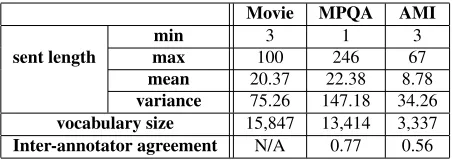
Table 1 summarizes statistics for the three data sets. We can see that sentences in meeting dialogs (AMI data) are generally shorter than the other do-mains, and that sentences in news domain (MPQA) are longer, and also have a larger variance. In ad-dition, the inter-annotator agreement on AMI data is quite low, which shows it is even difficult for hu-man to determine whether an utterance contains sen-timent in meeting conversations.
Movie MPQA AMI
min 3 1 3
sent length max 100 246 67
mean 20.37 22.38 8.78
[image:2.612.314.540.377.458.2]variance 75.26 147.18 34.26 vocabulary size 15,847 13,414 3,337 Inter-annotator agreement N/A 0.77 0.56
Table 1: Statistics for the three data sets: movie, MPQA, and AMI data. The inter-annotator agreement on movie data is not available because it is not annotated by human.
4 Unsupervised Subjectivity Detection
In this section, we describe our unsupervised learn-ing process that uses a knowledge-based method to create an initial training set, and then uses a cali-brated EM approach to incorporate unannotated data into the learning process. We use a naive Bayes clas-sifier as the base supervised clasclas-sifier with a bag-of-words model.
4.1 Create Initial Training Set
This lexicon contains 8,221 entries that are catego-rized into strong and weak subjective clues.
For each word w, we assign a subjectivity score
sub(w): 1 to strong subjective clues, 0.5 to weak
clues, and 0 for any other word. Then the subjec-tivity score of a sentence is the sum of the values of all the words in the sentence, normalized by the sen-tence length. We noticed that for sensen-tences labeled as SUBJECTIVE in the three corpora, the subjective clues appear more frequently in movie data than the other two corpora. Thus we perform different nor-malization for the three data sets to obtain the sub-jectivity score for each sentence,sub(s): Equation 1 for the movie data, and Equation 2 for MPQA and AMI data.
sub(s) =X w∈s
sub(w)/sent length (1)
sub(s) =X w∈s
sub(w)/log(sent length) (2)
We label the topmsentences with the highest
sub-jective scores as SUBJECTIVE, and label m
sen-tences with the lowest scores as OBJECTIVE. These
2msentences form the initial training set for the it-erative learning methods.
4.2 Calibrated EM Naive Bayes
Expectation-Maximization (EM) naive Bayes
method is a semi-supervised algorithm proposed in (Nigam et al., 2000) for learning from both labeled and unlabeled data. In the implementation of EM, we iterate the E-step and M-step until model param-eters converge or a predefined iteration number is reached. In E-step, we use naive Bayes classifier to estimate the posterior probabilities of each sentence
si belonging to each class cj (SUBJECTIVE and
OBJECTIVE),P(cj|si):
P(cj|si) =
P(cj)Q|si|
k=1P(wk|cj) P
cl∈CP(cl)
Q|si|
k=1P(wk|cl) (3)
The M-step uses the probabilistic results from the E-step to recalculate the parameters in the naive Bayes classifier, the probability of wordwtin class
cj and the prior probability of classcj:
P(wt|cj) = 0.1 +
P
si∈SN(wt, si)P(cj|si)
0.1× |V|+P|V|
k=1 P
si∈SN(wk, si)P(cj|si)
(4)
P(cj) = 0.1 +
P
si∈SP(cj|si)
0.1× |C|+|S| (5)
S is the set of sentences. N(wt, si) is the count of
wordwtin a sentence si. We use additive
smooth-ing withα = 0.1for probability parameter
estima-tion. |C|is the number of classes, which is 2 in our
case, and|V|is the vocabulary size, obtained from
the entire data set.
In the first iteration, we assignP(cj|si)using the pseudo training data generated based on lexicon in-formation. If a sentence is labeled SUBJECTIVE, thenP(sub|si)is 1 andP(obj|si)is 0; for the sen-tences with OBJECTIVE labels,P(sub|si)is 0 and
P(obj|si)is 1.
In our work, we use a variant of standard EM: calibrated EM, introduced by (Tsuruoka and Tsujii, 2003). The basic idea of this approach is to shift the probability values of unlabeled data to the ex-tent such that the class distribution of unlabeled data is identical to the distribution in labeled data (bal-anced class in our case). In our approach, before model training (“M-step”) in each iteration, we ad-just the posterior probability of each sentence in the following steps:
• Transform the posterior probabilities through
the inverse function of the sigmoid function. The outputs are real values.
• Sort them and use the median of all the values
as the border value. This is because our data is balanced.
• Subtract this border value from the transformed
values.
• Transform the new values back into probability
values using a sigmoid function.
Note that there is a caveat here. We are assum-ing we know the class distribution, based on labeled training data or human knowledge. This is often a reasonable assumption. In addition, we are assum-ing that this class distribution is the same for the unlabeled data. If this is not true, then the distri-bution adjustment performed in calibrated EM may hurt system performance.
5 Empirical Evaluation
In preprocessing, we removed the punctuation and numbers from the data and performed word stem-ming. To measure performance, we use classifica-tion accuracy.
5.1 Unsupervised Learning Results
In experiments of unsupervised learning, we per-form 5-fold cross validation. We divide the cor-pus into 5 parts with equal size (each with balanced class distribution). In each run we reserve one part as the test set. From the remaining data, we use the lexicon-based method to create the initial train-ing data, containtrain-ing 1,000 SUBJECTIVE and 1,000 OBJECTIVE sentences. The rest is used as unla-beled data to perform iterative learning. The final model is then applied to the reserved test set. Fig-ure 1 shows the learning curves of calibrated EM on movie, MPQA and AMI data respectively.
55 60 65 70 75 80 85 90 95
0 1 2 3 4 5 6 7 8 9 10 11 12 13 14 15 16 17 18 19
iteration
accuracy(%)
55 60 65 70 75 80 85 90 95
[image:4.612.76.298.341.495.2]movie MPQA AMI
Figure 1: Calibrated EM results using unsupervised setting (2,000 self-labeled initial samples) on movie, MPQA, and AMI data.
On movie data, calibrated EM improves the per-formance significantly (p<0.005), compared to that based on the initial training set (iteration 0). It takes only a few iterations for the EM method to converge and at the end of the iteration, it achieves 90.15% accuracy, which rivals the fully supervised learn-ing performance (91.31% when uslearn-ing all the 8,000
labeled sentences for training). On MPQA data,
this method yields some improvement (p<0.1)
com-pared to the initial point. But there is a peak accu-racy in the first couple of iterations, and then perfor-mance starts dropping thereafter. On AMI data, the performance degrades after the first iteration.
5.2 Analysis and Discussion
5.2.1 Effect of initial set
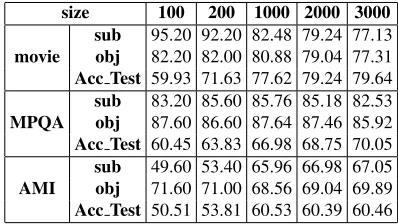
For unsupervised learning, our first question is how the accuracy and size of the initial training set affect performance. We calculate the self-labeling accuracy for the initial set using the lexicon based method. Table 2 shows the labeling accuracy when using different initial size, measured for SUBJEC-TIVE and OBJECSUBJEC-TIVE class separately. In addi-tion, we present the classification performance on the test set when using the naive Bayes classifier trained from the initial set. Each size in the table represents the total number of sentences in the ini-tial set.
Table 2 shows that when the size is 2,000 (as we used in previous experiments), the accuracy for both classes on MPQA are even better than on movies, even though we have seen that iterative learning methods perform much better on movies, suggest-ing that the initial data set accuracy is not the reason for the worse performance on MPQA than movies. It also shows that on movie data, as the initial size increases, the accuracy of the pseudo training set de-creases, which is as expected (the top ranked self-labeled samples are more confident and accurate). However, this is not the case on MPQA and AMI data. There is no obvious drop of accuracy, rather in many cases accuracy even increases when the initial size increases. It shows that on these two corpora, our lexicon-based method does not perform very well because the most highly ranked sentences ac-cording to the subjective lexicon are not those most subjective sentences.
size 100 200 1000 2000 3000
movie
sub 95.20 92.20 82.48 79.24 77.13 obj 82.20 82.00 80.88 79.04 77.31 Acc Test 59.93 71.63 77.62 79.24 79.64
MPQA
sub 83.20 85.60 85.76 85.18 82.53 obj 87.60 86.60 87.64 87.46 85.92 Acc Test 60.45 63.83 66.98 68.75 70.05
AMI
[image:4.612.326.525.535.647.2]sub 49.60 53.40 65.96 66.98 67.05 obj 71.60 71.00 68.56 69.04 69.89 Acc Test 50.51 53.81 60.53 60.39 60.46
Table 2: Initial pseudo training accuracy for SUBJECTIVE (sub) and OBJECTIVE (obj) class, and performance on the test using this initial training set (Acc Test). Results (all in %) are shown for different initial data size.
the size is smaller, such as containing 100 or 200 samples, the accuracy on test set is lower than using a bigger initial set. This is mainly because there is not sufficient data for model training. For AMI data, this is also due to the low accuracy in the training set. When the initial size is large enough, the improve-ment from a larger training set is not as substantial, for example, using 1,000, 2,000, or 3,000 sentences. On AMI data, there is almost no difference among the three sets. There is a tradeoff between the two factors, self-labeling accuracy and the data size. Of-ten an improvement in one aspect causes degrada-tion of the other. A reasonable starting point needs to be chosen considering both factors. Overall, it shows that the performance on test set can benefit more from using a larger initial training set, though it may be noisy.
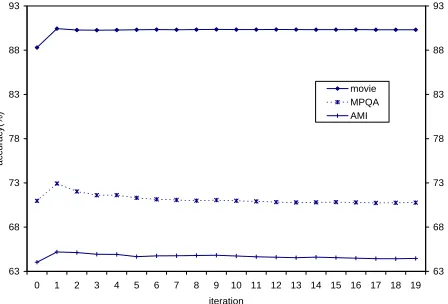
In order to further investigate the impact of self-labeled initial data set, we perform standard semi-supervised learning using reference labels in the initial data set. The learning curve of this semi-supervised setting is shown in Figure 2.
63 68 73 78 83 88 93
0 1 2 3 4 5 6 7 8 9 10 11 12 13 14 15 16 17 18 19 iteration
accuracy(%)
63 68 73 78 83 88 93
movie MPQA AMI
Figure 2: Calibrated EM results using semi-supervised learn-ing (2,000 labeled seed) on movie, MPQA, and AMI data.
On movie data, calibrated EM yields better per-formance over that based on the initial training data (iteration 0). We can see that calibrated EM con-verges very fast and achieves very high performance in the first iteration. On MPQA and AMI data, cali-brated EM increases the accuracy at the first iteration but then degrades thereafter. This shows that incor-porating unlabeled data in training is helpful, how-ever, more EM iterations do not yield further gain.
We noticed that on AMI data, even when the ini-tial set has 100% accuracy (i.e., semi-supervised set-ting), it still fails to yield any performance gain on
AMI data. It shows that the low accuracy of initial training set does not explain the poor performance
of unsupervised learning method. Therefore, we
conducted another set of experiments which use the same semi-supervised setting but start from different initial training sizes. We observed that on MPQA and AMI data, calibrated EM is able to increase the accuracy only when the initial training set is small (less than 100 instances) and the performance at the start point is poor. We believe this is related to the data property and the assumptions used in EM. Sim-ilar patterns have been found in some previous stud-ies (Chapelle et al., 2006). They attribute this to the incorrect model assumption, i.e., when the modeling assumptions for a particular classifier do not match the characteristics of the distribution of the data, un-labeled data may degrade the performance of classi-fiers.
[image:5.612.75.299.374.526.2]5.2.2 Effect of calibration
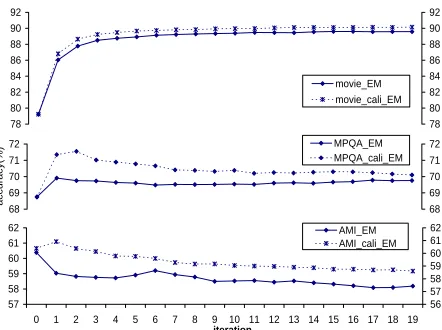
Figure 3 compares calibrated EM with standard EM using unsupervised learning on the three do-mains. We can see that calibrated EM outperforms standard EM, with a larger improvement on MPQA and AMI data. When using standard EM, we find that there is a larger difference between the number of instances in the two classes based on the model’s prediction on MPQA and AMI data than movie data. For example, in one run using EM, in the first iter-ation the ratio of the two classes is2.21, 1.88, and
1.23for MPQA, AMI, and movie data respectively.
Calibrated EM is more effective on the two domains because it adjusts the posterior probability of each sample according to the class distribution in the data, making it more accurate in training the model in the next iteration.
5.2.3 Error analysis
There are two points worth discussing based on our error analysis.
A. Domain difference.
78 80 82 84 86 88 90 92
78 80 82 84 86 88 90 92
movie_EM movie_cali_EM
68 69 70 71 72
accuracy(%)
68 69 70 71 72 MPQA_EM MPQA_cali_EM
57 58 59 60 61 62
0 1 2 3 4 5 6 7 8 9 10 11 12 13 14 15 16 17 18 19
iteration
[image:6.612.76.297.71.236.2]56 57 58 59 60 61 62 AMI_EM AMI_cali_EM
Figure 3:Comparison of standard EM and calibrated EM.
the following sentence as an example: “The United States is prepared to fight terrorism alone”. It is la-beled as SUBJECTIVE because it expresses a deter-mination. However, it may also be interpreted as an objective statement.
The AMI corpus consists of meeting conversa-tions. The free-style dialogues are very different from the style in review and news articles. There are many incomplete sentences and disfluencies. More importantly, the meaning of a sentence is often con-text dependent. In the examples shown below, the two sentences look very similar, however, the first sentence is labeled as “OBJECTIVE”, and the sec-ond one as “SUBJECTIVE”. This is because of the different context and speaker information – the sec-ond sentence expresses agreement, but the first ex-ample is just a sequence of discourse marker words.
• Alright yeah okay • Yeah okay, true, true.
We notice that many of the classification errors in AMI occur in very short sentences, like in the ex-ample shown above. These short sentences are very ambiguous for subjectivity classification.
B. Limitation of the bag-of-word model.
Our analysis also showed that some sentences are difficult to classify if simply using surface words. In the following, we show some examples of system errors.
False negatives: subjective sentences recognized as objective
• Johnson has, in his first film, set himself a task he is not nearly up to. (movie data)
• The news from Israel is almost earth-shattering. (MPQA)
• We can stick with what we already get. (AMI)
False positives: objective sentences recognized as subjective
• Cathy (Julianne Moore) is theperfect50s house-wife, living theperfect50s life:healthykids, suc-cessfulhusband, socialprominence. (movie data) • The committee Wednesday opened a formal
de-bate on human rights questions, including alterna-tive approaches forimprovingtheeffective enjoy-ment of human rights andfundamental freedoms. (MPQA)
• um uh you know apple been reallysuccessfulwith this surgical white kind of business or thissleek
kind of (AMI)
In the first three examples, there are no explicit subjective clues, resulting in false negative errors. The subjective word “earth-shattering” is not in-cluded in subjective lexicon and rarely used in the corpus. The last three examples contain several sub-jective words, and are therefore labeled as subjec-tive. These are the problems with the current word based approaches.
6 Conclusion and Future Work
This paper investigates an unsupervised learning procedure for subjectivity identification at sentence level. We use a lexicon-based method to create ini-tial training data and then apply a calibrated EM to utilize unlabeled corpus. We evaluate this method across three different data sets and observe
signif-icant difference. It yields good performance on
movie data but does not achieve much performance gain on MPQA corpus, while on AMI corpus it fails to yield improvement. Our analysis showed that per-formance of the base classifier has a substantial im-pact on iterative learning methods. In addition, we found that calibrated EM outperforms the standard EM method when the class distribution based on classifier’s hypotheses does not match the real one.
7 Acknowledgment
The authors thank Theresa Wilson for sharing annotation for the AMI corpus and helping with data processing for that data. Part of this work is supported by an NSF award CNS-1059226.
References
O. Chapelle, B. Sch¨olkopf, and A. Zien, editors. 2006. Semi-supervised learning. MIT Press.
Sajib Dasgupta and Vincent Ng. 2009. Mine the easy, classify the hard: a semi-supervised approach to
auto-matic sentiment classification. InProceedings of
ACL-IJCNLP, pages 701–709.
Soo-Min Kim and Eduard Hovy. 2005. Automatic
de-tection of opinion bearing words and sentences. In
Proceedings of ACL.
Shoushan Li, Chu-Ren Huang, Guodong Zhou, and Sophia Yat Mei Lee. 2010. Employing per-sonal/impersonal views in supervised and
semi-supervised sentiment classification. InProceedings of
ACL, pages 414–423.
Prem Melville, Wojciech Gryc, and Richard D. Lawrence. 2009. Sentiment analysis of blogs by
com-bining lexical knowledge with text classification. In
Proceedings of ACM SIGKDD, pages 1275–1284.
Gabriel Murray and Giuseppe Carenini. 2008.
Summa-rizing spoken and written conversations. In
Proceed-ings of EMNLP, pages 773–782.
Gabriel Murray and Giuseppe Carenini. 2009.Detecting
subjectivity in multiparty speech. InProceedings of
Interspeech.
Vincent Ng, Sajib Dasgupta, and S. M. Niaz Arifin. 2006.
Examining the role of linguistic knowledge sources in the automatic identification and classification of
re-views. InProceedings of COLING/ACL, pages 611–
618.
Kamal Nigam, Andrew Kachites McCallum, Sebastian Thrun, and Tom Mitchell. 2000. Text classification
from labeled and unlabeled documents using EM.
Ma-chine Learning, 39:103–134.
Bo Pang and Lilian Lee. 2004. A sentimental educa-tion: sentiment analysis using subjectivity
summariza-tion based on minimum cuts. InProceedings of ACL,
pages 271–278.
Bo Pang and Lillian Lee. 2008. Using very simple
statis-tics for review search: An exploration. InProceedings
of COLING, pages 73–76.
Stephan Raaijmakers and Wessel Kraaij. 2008. A
Shal-low approach to subjectivity classification. In
Pro-ceedings of ICWSM.
Stephan Raaijmakers, Khiet Truong, and Theresa Wilson. 2008. Multimodal subjectivity analysis of multiparty
conversation. InProceedings of EMNLP, pages 466–
474.
Ellen Riloff and Janyce Wiebe. 2003. Learning
extrac-tion patterns for subjective expressions. In
Proceed-ings of EMNLP, pages 105–112.
Yoshimasa Tsuruoka and Jun’ichi Tsujii. 2003. Train-ing a naive bayes classifier via the EM algorithm
with a class distribution constraint. In Proceedings
of NAACL, pages 127–134.
Janyce Wiebe and Ellen Riloff. 2005. Creating subjec-tive and objecsubjec-tive sentence classifiers from
unanno-tated texts. In Proceedings of CICLing, pages 486–
497.
Theresa Wilson and Janyce Wiebe. 2003. Annotating
opinions in the world press. In Proceedings of
SIG-dial, pages 13–22.
Theresa Wilson, Janyce Wiebe, and Paul Hoffmann. 2005. Recognizing contextual polarity in phrase-level
sentiment analysis. InProceedings of HLT-EMNLP,
pages 347–354.
Theresa Wilson. 2008. Annotating subjective content in