Proceedings of the SIGDIAL 2011: the 12th Annual Meeting of the Special Interest Group on Discourse and Dialogue, pages 307–311, Portland, Oregon, June 17-18, 2011. c2011 Association for Computational Linguistics
Improving Pronominal and Deictic Co-Reference Resolution with
Multi-Modal Features
Lin Chen, Anruo Wang, Barbara Di Eugenio
Department of Computer Science University of Illinois at Chicago 851 S Morgan ST, Chicago, IL 60607, USA
{lchen43,awang28,bdieugen}@uic.edu
Abstract
Within our ongoing effort to develop a com-putational model to understand multi-modal human dialogue in the field of elderly care, this paper focuses on pronominal and deictic co-reference resolution. After describing our data collection effort, we discuss our anno-tation scheme. We developed a co-reference model that employs both a simple notion of markable type, and multiple statistical mod-els. Our results show that knowing the type of the markable, and the presence of simulta-neous pointing gestures improve co-reference resolution for personal and deictic pronouns.
1 Introduction
Our ongoing research project, called RoboHelper, focuses on developing an interface for older people to effectively communicate with a robotic assistant that can help them perform Activities of Daily Liv-ing (ADLs)(Krapp, 2002), so that they can safely re-main living in their home (Di Eugenio et al., 2010). We are devising a multi-modal interface since peo-ple communicate with one another using a variety of verbal and non-verbal signals, including haptics, i.e., force exchange (as when one person hands a bowl to another person, and lets go only when s/he senses that the other is holding it). We have collected a mid size multi-modal human-human dialogue cor-pus, that we are currently processing and analyz-ing. Meanwhile, we have started developing one core component of our multi-modal interface, a co-reference resolution system. In this paper, we will present the component of the system that resolves
pronouns, both personal (I, you, it, they), and deictic (this, that, these, those, here, there). Hence, this pa-per presents our first steps toward a full co-reference resolution module, and ultimately, the multi-modal interface.
Co-reference resolution is likely the discourse and dialogue processing task that has received the most attention. However, as Eisenstein and Davis (2006) notes, research on co-reference resolution has mostly been applied to written text; this task is more difficult in dialogue. First, utterances may be informal, ungrammatical or disfluent; second, people spontaneously use hand gestures, body ges-tures and gaze. Pointing gestures are the eas-iest gestures to identify, and vision researchers in our project are working on recognizing pointing and other hand gestures (Di Eugenio et al., 2010). In this paper, we replicate the results from (Eisenstein and Davis, 2006), that pointing gestures help improve co-reference, in a very different domain. Other work has shown that gestures can help detect sentence boundaries (Chen and Harper, 2010) or user inten-tions (Qu and Chai, 2008).
The rest of the paper is organized as follows. In Section 2 we describe the data collection and the on-going annotation. In Section 3 we discuss our co-reference resolution system, and we present experi-ments and results in Section 4.
2 The ELDERLY-AT-HOME corpus
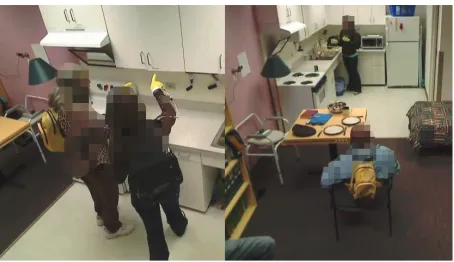
Figure 1: Experiment Excerpts
we undertook a new data collection effort. Our ex-periments were conducted in a fully functional stu-dio apartment at Rush University in Chicago – Fig-ure 1 shows two screen-shots from our recorded ex-periments. We equipped the room with 7 web cam-eras to ensure multiple points of view. Each of the two participants in the experiments wears a micro-phone, and a data glove on their dominant hand to collect haptics data. The ADLs we focused on in-clude ambulating, getting up from a bed or a chair, finding pots, opening cans and containers, putting pots on a stove, setting the table etc. Two students in gerontological nursing play the role of the helper (HEL), both in pilot studies and with real subjects. In 5 pilot dialogues, two faculty members played the role of the elderly person (ELD). In the 15 real ex-periments, ELD resides in an assisted living facil-ity and was transported to the apartment mentioned above. All elderly subjects are highly functioning at a cognitive level and do not have any major physical impairment.
The size of our collected video data is shown in Table 1. The number of subjects refers to the number of different ELD’s and does not include the helpers; we do include our 5 pilot dialogues though, since those pilot interactions do not measurably dif-fer from those with the real subjects. Usually one experiment lasts about 50’ (recording starts after in-formed consent and after the microphones and data gloves have been put on). Further, we eliminated irrelevant content such as interruptions, e.g. by the person who accompanied the elderly subjects, and further explanations of the tasks. This resulted in about 15 minutes of what we calleffective data for
each subject; the effective data comprises 4782 turns (see Table 1).
Subjects Raw(Mins) Effective(Mins) Turns
20 482 301 4782
Table 1: ELDERLY-AT-HOME Corpus Size
The effective portion of the data was transcribed by the first two authors using the Anvil video anno-tation tool (Kipp, 2001). A subset of the transcribed data was annotated for co-reference, yielding 114 sub-dialogues corresponding to the tasks subjects perform, such as finding bowls, filling a pot with wa-ter, etc. (see Table 2).
An annotation excerpt is shown in Figure 2. Markable tokens are classified into PLC(Place), PERS(Person), OBJ(Object) types, and numbered by type, e.g., PLC#5. Accordingly, we mark pro-nouns with types as well,RPLC, RPERS, ROBJ, e.g. RPLC#5. If a subject produced a pointing gesture, we generate a markable token to mark what is being pointed to at the end of the utterance (see Utt. 4 and 5 in Figure 2). Within the same task, if two markables have the same type and the same markable index, they are taken to co-refer (hence, longer chains of reference across tasks are cut into shorter spans).
Haptics annotation is at the beginning. We have identifiedgrab,hold,giveandreceiveas high-level haptics phonemes that may be useful from the lan-guage point of view. We have recently started anno-tating our corpus with those labels.
Subjects Tasks Utterances Gestures Pronouns
12 114 1920 896 1635
Table 2: Annotated Corpus Size
In order to test the reliability of our annotation, we double coded about 18% of the data, namely 21 sub-dialogues comprising 213 pronouns, on which we computed the Kappa coefficient (Carletta, 1996). Similar to (Rodrıguez et al., 2010), we measured the reliability ofmarkable annotations, and oflink to
the antecedentannotations. As concerns the
mark-ablelevel, we obtainedκ=0.945, which is high but no surprisingly for such a simple task. At thelink to
the antecedent level, we compared the links from
pronouns to antecedents in a specified context of 4 utterances, obtaining a reasonableκ=0.723.
3:PERS#1(HEL/NNP) : RPERS#1(I/PRP) do/VBP n’t/RB see/VB any/DT OBJ#3(pasta/NN) ./.
4:PERS#2(ELD/NNP) : Try/VB over/IN RPLC#5(there/RB) ./.{PLC#5(cabinet/NN)}
5:PERS#1(HEL/NNP) : This/DT RPLC#5(one/NN) ?/.{PLC#5(cabinet/NN)}
[image:3.612.65.282.168.261.2]6:PERS#2(ELD/NNP) : Oh/UH ,/, yes/RB ./.
Figure 2: Annotation Excerpt
3 Our approach
Utterances and Gestures
Find Markables Generate Candidates Coreference Pairs
Preprocessing
Markable Model Coreference Model
Figure 3: Co-reference System Architecture
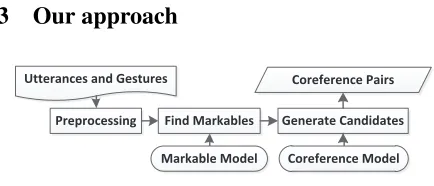
The architecture of our co-reference resolution system is shown in Figure 3.
We first pre-process a dialogue by splitting turns into sentences, tokenizing sentences into tokens, POS tagging tokens. The Markablemodel is used to classify whether a token can be referred to and what type of markable it is. TheMarkablemodel’s feature set includes the POS tag of the token, the word, the surrounding tokens’ POS tags in a win-dow size of 3. The model outputs markable classes: Place/Object/Person, or None, which means the to-ken is not markable. A pointed-to entity serves as a markable by default.
To perform resolution, each pronoun to be re-solved (I, you, it, they; this, that, these, those, here, there) is paired with markables in the context of the previous 2 utterances, the current utterance and the utterance that follows, by using{pronoun, markable type} compatibility rules. For example, let’s con-sider the excerpt in Figure 2. To resolve one in utterance 5, the system will generate 3 candidate token pairs: <one(5,2), pasta(3,6)>, <one(5,2), cabinet(4,-1)>, <one(5,2), cabinet(5,-1)> (includ-ing the pointed-to markable is a way of roughly ap-proximating information that will be returned by the vision component). The elements in those pairs are tokens with their coordinates in the format ( Sen-tenceIndex, TokenIndex); markables pointed to are given negative token indices.
The Co-reference model will filter out the pairs <pronoun, markable> that it judges to be incor-rect. For the Co-reference model, we adopted a
subset of features which are commonly used in co-reference resolution in written text. These features apply to each <pronoun, markable> pair and in-clude: Lexicalfeatures, i.e. words and POS tags for both anaphora and antecedent; Syntactic features, i.e. syntactic constraints such as number and per-son agreement;Distancefeatures, i.e. sentence dis-tance, token distance and markable distance. Addi-tionally, the Co-reference model uses pointing ges-ture information. If the antecedent in the<pronoun, markable>was pointed to, the pair is tagged as Is-Pointed. In our data, people often use pronouns and hand gestures instead of nouns when introduc-ing new entities. It is not possible to map these pronouns to a textual antecedent since none exists. This confirms the findings from (Kehler, 2000): in a multi-modal corpus, he found that no pronoun is used without a gesture when it refers to a referent which is not in focus.
4 Experiments and Discussion
The classification models described above were im-plemented using the Weka package (Hall et al., 2009). Specifically, for each model, we experi-mented with J48 (a decision tree implementation) and LibSVM (a Support Vector Machine implemen-tation). All the results reported below are calculated using 10 fold cross-validation.
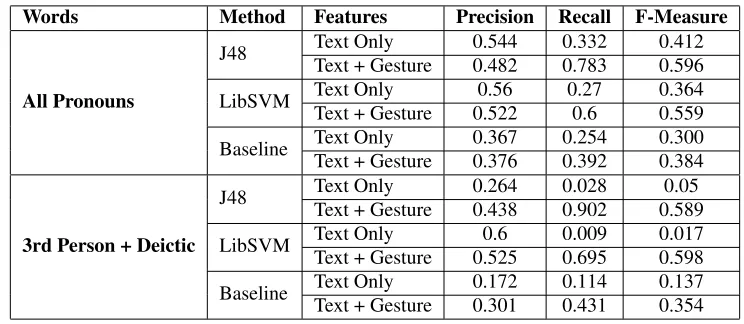
We evaluated the performances of individual models separately (Tables 3 and 4), and of the sys-tem as a whole (Table 5).
Algorithm Precision Recall F-Measure
J48 0.984 0.984 0.984
LibSVM 0.979 0.936 0.954
Baseline 0.971 0.971 0.971
Table 3: Markable Model Performance
Method J48 LibSVM
Precision Recall F-Measure Precision Recall F-Measure
Text + Gesture 0.700 0.684 0.686 0.672 0.669 0.670
[image:4.612.112.486.80.133.2]Text Only 0.655 0.656 0.656 0.624 0.624 0.624
Table 4: Co-reference Model Performance
Words Method Features Precision Recall F-Measure
All Pronouns
J48 Text Only 0.544 0.332 0.412
Text + Gesture 0.482 0.783 0.596
LibSVM Text Only 0.56 0.27 0.364
Text + Gesture 0.522 0.6 0.559
Baseline Text Only 0.367 0.254 0.300
Text + Gesture 0.376 0.392 0.384
3rd Person + Deictic
J48 Text Only 0.264 0.028 0.05
Text + Gesture 0.438 0.902 0.589
LibSVM Text Only 0.6 0.009 0.017
Text + Gesture 0.525 0.695 0.598
Baseline Text Only 0.172 0.114 0.137
Text + Gesture 0.301 0.431 0.354
Table 5: Co-reference System Performance (Markable + Co-reference Models)
high as well. We compute the baseline by assigning to the potential markable (i.e., each word) its most frequent class in the training set (recall that the four classes includeNoneas well).
For theCo-referencemodel, we conducted 2 sets of experiments to ascertain the effect of including
Gesturein the model. As shown in Table 4, both J48 and LibSVM obtain better results when we include gestures in the model. χ2 shows that differences in precision and recall1 are significant at the p≤0.01 level, though the absolute improvement is not high.
As concerns the evaluation of the whole system, we ran a 4-way experiment, where we examine the performance of the system on all pronouns, and on those pronouns left after eliminating first and second person pronouns, without and withGesture informa-tion. We also ran two sets of baseline experiments. In the baseline experiments, we link each pronoun we want to resolve, to the most recent utterance-markable token and to a pointed-to utterance-markable token (if applicable). Markables are filtered by the same compatibility rules mentioned above.
Regarding the metrics we used for evaluation, we used the same method as Strube and M¨uller (2003), which is also similar to MUC standard (Hirschman,
1χ2
does not apply to the F-Measure.
1997). As the golden set, we used the human an-notated links from the pronouns to markables in the same context of four utterances used by the system. Then, we compared the co-reference links found by the system against the golden set, and we finally cal-culated precision, recall and F-Measure.
Table 5 shows that the F-measure is higher when including gestures, no matter the type of pronouns. When we include gestures, there is no difference be-tween “All Pronouns” and “3rd Person + Deictic”. In the “3rd Person + Deictic” experiments, we ob-served huge drops in recall, from 0.902 to 0.028 for J48, and from 0.695 to 0.009 for LibSVM algorithm. This confirms the point we made earlier, that 3rd person pronouns/deictic words (Kehler, 2000) often do not have textual antecedents, since when accom-panied by simultaneous pointing they introduce new entities in a dialogue.
[image:4.612.110.482.162.324.2]sults are similar to Eisenstein and Davis (2006), but there are two main differences. First, the corpus they used is smaller than what we used in this pa-per. Their corpus was collected by themselves and consisted of 16 videos, each video was 2-3 minutes in length. Second, they used a difference measure-ment metrics called CEAF (Luo, 2005).
5 Conclusions
In this paper, we presented the new ELDERLY-AT-HOME multi-modal corpus we collected. A co-reference resolution system for personal and deic-tic pronouns has been developed on the basis of the annotated corpus. Our results confirm that gestures improve co-reference resolution; a simple notion of type also helps. The Markable and Co-reference
modules we presented are a first start in developing a full multi-modal co-reference resolution module. Apart from completing the annotation of our cor-pus, we will develop an annotation scheme for hap-tics, and investigate how haptics information affects co-reference and other dialogue phenomena. Ulti-mately, both pointing gestures and haptic informa-tion will automatically be recognized by the collab-orators in the project we are members of.
Acknowledgments
This work is supported by award IIS 0905593 from the National Science Foundation. Thanks to the other members of the RoboHelper project, for their many contributions, especially to the data collection effort.
References
Jean Carletta. 1996. Assessing agreement on classifi-cation tasks: The kappa statistic. Computational Lin-guistics, 22:249–254.
Lei Chen and Mary P. Harper. 2010. Utilizing gestures to improve sentence boundary detection. Multimedia Tools and Applications, pages 1–33.
Barbara Di Eugenio, Miloˇs ˇZefran, Jezekiel Ben-Arie, Mark Foreman, Lin Chen, Simone Franzini, Shankaranand Jagadeesan, Maria Javaid, and Kai Ma. 2010. Towards Effective Communication with Robotic Assistants for the Elderly: Integrating Speech, Vision and Haptics. InDialog with Robots, AAAI 2010 Fall Symposium, Arlington, VA, USA, November.
Jacob Eisenstein and Randall Davis. 2006. Gesture Improves Coreference Resolution. InProceedings of the Human Language Technology Conference of the NAACL, Companion Volume: Short Papers, pages 37– 40.
Mark Hall, Eibe Frank, Geoffrey Holmes, Bernhard Pfahringer, Peter Reutemann, and Ian H. Witten. 2009. The WEKA data mining software: An update. SIGKDD Explorations, 11(1).
Lynette Hirschman. 1997. Muc-7 coreference task defi-nition.
Andrew Kehler. 2000. Cognitive Status and Form of Reference in Multimodal Human-Computer Interac-tion. InAAAI 00, The 15th Annual Conference of the American Association for Artificial Intelligence, pages 685–689.
Michael Kipp. 2001. Anvil-a generic annotation tool for multimodal dialogue. In Proceedings of the 7th European Conference on Speech Communication and Technology, pages 1367–1370.
Kristine M. Krapp. 2002. The Gale Encyclopedia of Nursing & Allied Health. Gale Group, Inc. Chapter Activities of Daily Living Evaluation.
Xiaoqiang Luo. 2005. On coreference resolution perfor-mance metrics. In Proceedings of the conference on Human Language Technology and Empirical Methods in Natural Language Processing, HLT ’05, pages 25– 32, Stroudsburg, PA, USA. Association for Computa-tional Linguistics.
Shaolin Qu and Joyce Y. Chai. 2008. Beyond attention: the role of deictic gesture in intention recognition in multimodal conversational interfaces. InProceedings of the 13th international conference on Intelligent user interfaces, pages 237–246.
Kepa Joseba Rodrıguez, Francesca Delogu, Yannick Ver-sley, Egon Stemle, and Massimo Poesio. 2010. Anaphoric annotation of wikipedia and blogs in the live memories corpus. In Proceedings of the 7th In-ternational Conference on Language Ressources and Evaluation (LREC 2010), pages 157–163.
Michael Strube and Christoph M¨uller. 2003. A machine learning approach to pronoun resolution in spoken di-alogue. InProceedings of the 41st Annual Meeting on Association for Computational Linguistics-Volume 1.