Mining Transliterations from Wikipedia using Pair HMMs
Peter Nabende
Alfa-Informatica, University of Groningen The Netherlands
Abstract
This paper describes the use of a pair Hidden Markov Model (pair HMM) sys-tem in mining transliteration pairs from noisy Wikipedia data. A pair HMM vari-ant that uses nine transition parameters, and emission parameters associated with single character mappings between source and target language alphabets is identified and used in estimating transliteration sim-ilarity. The system resulted in aprecision of 78% andrecallof 83% when evaluated on a random selection of English-Russian Wikipedia topics.
1 Introduction
The transliteration mining task as defined in the NEWS 2010 White paper (Kumaran et al., 2010) required identifying single word transliteration pairs from a set of candidate transliteration pairs. In the case of Wikipedia data, we have a collection of corresponding source and target language topics that can be used for extracting candidate translit-erations. We apply a pair HMM edit-distance based method to obtain transliteration similarity estimates. The similarity estimates for a given set of source and target language words are then com-pared with the aim of identifying potential translit-eration pairs. Generally, the pair HMM method uses the notion of transforming a source string to a target string through a series of edit opera-tions. The three edit operations that we consider for use in transliteration similarity estimation in-clude: substitution,insertion, anddeletion. These edit operations are represented as hidden states of a pair HMM. Depending on the source and target language alphabets, it is possible to design or use a specific pair HMM algorithm for estimating paired character emission parameters in the edit opera-tion states, and transiopera-tion parameters for a given
design of transitions between the pair HMM’s states. Before applying the pair HMM method, we use external datasets to identify a pair HMM vari-ant that we consider as suitable for application to transliteration similarity estimation. We then use the shared task datasets to train the selected pair HMM variant, and finally apply an algorithm that is specific to the trained pair HMM for comput-ing transliteration similarity estimates. In section 2, we discuss transliteration similarity estimation with regard to applying the pair HMM method; section 3 describes the experimental setup and re-sults; section 4 concludes the paper with pointers to future work.
2 Transliteration Similarity Estimation using Pair HMMs
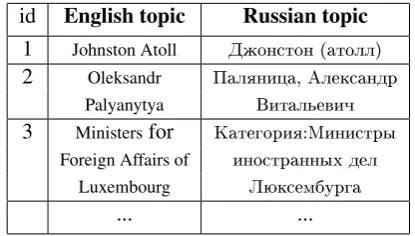
To describe the transliteration similarity estima-tion process, consider examples of corresponding English (assourcelanguage) and Russian (as tar-getlanguage) Wikipedia topics as shown in Table 1. Across languages, Wikipedia topics are written in different ways and all words in a topic could be important for mining transliterations. One main step in the transliteration mining task is to identify a set of words in each topic for consideration as candidate transliterations. As seen in Table 1, it is very likely that some words will not be selected as
id English topic Russian topic
1 Johnston Atoll Äæîíñòîí (àòîëë) 2 Oleksandr Ïàëÿíèöà, Àëåêñàíäð
Palyanytya Âèòàëüåâè÷ 3 Ministersfor Êàòåãîðèÿ:Ìèíèñòðû
Foreign Affairs of èíîñòðàííûõ äåë Luxembourg Ëþêñåìáóðãà
[image:1.595.312.520.620.738.2]... ...
Table 1: Example of corresponding English Rus-sian Wikipedia topics
candidate transliterations depending on the criteria for selection. For example, if a criterion is such that we consider only words starting with upper-case characters for English and Russian datasets, then the Russian word ‘àòîëë’ in the topic pair 1 in Table 1 will not be used as a candidate translit-eration and that in turn makes the system loose the likely pair of ‘Atoll,àòîëë’. After extracting candidate transliterations, the approach we use in this paper takes each candidate word on the source language side and determines a transliteration es-timate with each candidate word on the target lan-guage side. Consider the example for topic id 1 in Table 1 where we expect to have ‘Johnston’ and ‘Atoll’ as candidate source language translitera-tions, and ‘Äæîíñòîí’ and ‘àòîëë’ as candidate target language transliterations. The method used is expected to compare ‘Johnston’ against ‘
Äæîí-ñòîí’ and ‘àòîëë’, and then compare ‘Atoll’ to the Russian candidate transliterations. We expect the output to be ‘Johston,Äæîíñòîí’ and ‘Atoll,
àòîëë’ as the most likely single word transliter-ations from topic pair 1 after sorting out all the four transliteration similarity estimates in this par-ticular case. We employ the pair HMM approach to estimate transliteration similarity for candidate source-target language words.
A pair HMM has an emission state or states that generate two observation sequences instead of one observation sequence as is the case in standard HMMs. Pair HMMs originate from work in Bi-ological sequence analysis (Durbin et al., 1998; Rivas and Eddy, 2001) from which variants were created and successfully applied in cognate identi-fication (Mackay and Kondrak, 2005), Dutch di-alect comparison (Wieling et al., 2007), translit-eration identification (Nabende et al., 2010), and transliteration generation (Nabende, 2009). As mentioned earlier, we have first, tested two pair HMM variants on manually verified English-Russian datasets which we obtain from the previ-ous shared task on machine transliteration (NEWS 2009) (Kumaran and Kellner, 2007). This pre-liminary test is aimed at determining the effect of pair HMM parameter changes on the quality of the transliteration similarity estimates. For the first pair HMM variant, no transitions are modeled be-tween edit states; we only use transtion parame-ters associated with transiting from a start state to each of the edit operation states, and from each of the edit operation states to an end state. The
I
M End
1-δD-δI-τM
1- εD - λD - τD
1 - εI - λI - τI εI εD
λI
λD
τM
τD
τI δD
δI
D
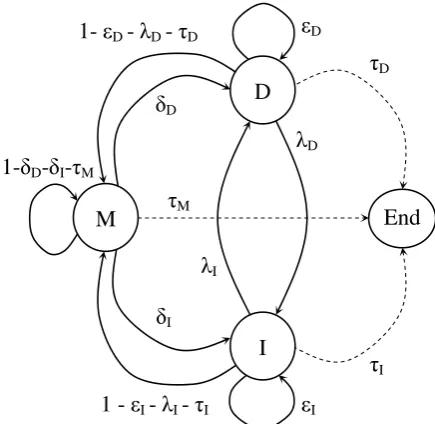
Figure 1: Pair HMM with nine distinct transi-tion parameters. Emission parameters are speci-fied with emitting states and their size is dependent on the characters used in the source and target lan-guages
second pair HMM variant uses nine distinct tran-sition parameters between the pair HMM’s states as shown in Figure 1. The node M in Figure 1 rep-resents the substitution state in which emission pa-rameters encode relationships between each of the source and target language characters. D denotes the deletion state where emission parameters spec-ify relationships between source language charac-ters and a target language gap. I denotes the inser-tion state where emission parameters encode rela-tionships between target language characters and a source language gap. Starting parameters for the pair HMM in Figure 1 are assoicated with transit-ing from the M state to one of the edit operation states including transiting back to M.
The pair HMM parameters are estimated using the well-known Baum-Welch Expectation Maxi-mization (EM) algorithm (Baum et al., 1970). For each pair HMM variant, the training algorithm starts with a uniform distribution for substitution, deletion, insertion, and transition parameters, and iterates through the data until a local maximum.
(Ku-Pair HMM Model CVA CVMRR
phmm00edtrans Viterbi 0.788 0.809 Forward 0.927 0.954
[image:3.595.76.290.72.146.2]phmm09edtrans Viterbi 0.943 0.952 Forward 0.987 0.991
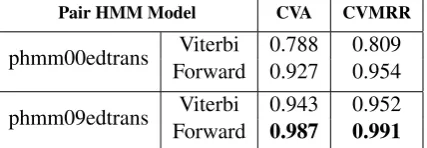
Table 2: CVA and CVMRR results two pair HMM variants on a preliminary transliteration identifica-tio experiment. phmm00edtrans is the pair HMM variant with no transition parameters between the edit states while phmm09edtrans is the pair HMM variant with nine distinct transition parameters.
maran and Kellner, 2007) are used for training and 784 name pairs for testing. The Cross Valida-tion Accuracy (CVA) and Cross ValidaValida-tion Mean Reciprocal Rank (CVMRR) results obtained from applying the Forward and Viterbi algorithms of the two pair HMM variants on this particular dataset are shown in Table 2.
The CVA and CVMRR values in Table 2 sug-gest that it is necessary to model for transition pa-rameters when using pair HMMs for translitera-tion similarity estimatranslitera-tion. Table 2 also suggests that it is better to use the Forward algorithm for a given pair HMM variant. Based on the results in Table 2, the pair HMM variant illustrated in Figure 1 is chosen for application in estimating transliter-ation similarity for the mining task.
3 Experimental setup and Results
To simplify the analysis of the source and tar-get strings, the pair HMM system requires unique whole number representations for each character in the source and target language data. This is not suitable for all the different types of writing sys-tems. In this paper, we look at only the English and Russian languages where many characters are associated with a phonemic alphabet and where numbered representations are hardly expected to contribute to errors from loss of information in-herent in the original orthography. A preliminary run on Chinese-English1 datasets from the previ-ous shared task on machine transliteration (NEWS 2009) resulted in anaccuracyof 0.213 andMRR of 0.327 using the pair HMM variant in Figure 1. In the following subsection we discuss some data preprocessing steps on the English-Russian
1
In this case Chinese is the source language while English is the target language
Wikipedia dataset.
3.1 English and Russian candidate transliteration extraction
The English-Russian Wikipedia dataset that was provided for the transliteration mining task is very noisy meaning that it has various types of other en-tities in addition to words for each language’s or-thography. A first step in simplifying the translit-eration mining process was to remove any unnec-essary entities.
We observed the overlap of writing systems in both the English and Russian Wikipedia datasets. We therefore made sure that there is no topic where the same writing system is used in both the English and Russian data. Any strings that contain characters that are not associated with the writ-ing systems for English and Russian were also re-moved.
We also observed the presence of many tempo-ral and numerical expressions that are not neces-sary on both the English and Russian Wikipedia datasets. We applied different sets of rules to re-move such expressions while leaving any neces-sary words.
Using knowledge about the initial formatting of strings in both the English and Russian data, a set of rules was applied to split most of the strings based on different characters. For ex-ample almost all strings in the English side had the underscore ‘ ’ character as a string separa-tor. We also removed characters such as: colons, semi-colons, commas, question marks, exclama-tion marks, dashes, hyphens, forward and back slashes, mathematical operator symbols, currency symbols, etc. Some strings were also split based on string patterns, for example where different words are joined into one string and it was easy to identify that the uppercase character for each word still remained in the combined string just like when it is alone. We also removed many abbrevia-tions and titles in the datasets that were not neces-sary for analysis during the transliteration mining process.
miss-ing characters are then hand picked from the can-didate words dataset and added to the seed data before training the pair HMM variant that is se-lected from the previous section. The process for identifying missing characters and words that have them is carried out seperately for each language. However, a matching word in the other language is identified to constitute a transliteration pair that can be added to the seed dataset. For the English-Russian dataset, we use 142 transliteration pairs in addition to the 1000 transliteration pairs in the ini-tial seed data. We hence apply the Baum-Welch algorithm for the selected pair HMM specification from section 2 on a total of 1142 transliteration pairs. The algorithm performed 182 iterations be-fore converging for this particular dataset.
3.2 Results
To obtain transliteration similarity measures, we apply the Forward algorithm of the trained pair HMM from section 3.1 to all the remaining Wikipedia topics. For each word in an English topic, the algorithm computes transliteration simi-larity estimates for all words in the Russian topic. After observing transliteration similarity estimates for a subset of candidate transliteration words, we specify a single threshold value (th) and use it for identifying potential transliteration pairs. A threshold value of 1 × 10⁻¹³ was chosen after observing that many of the pairs that had a sim-ilarity estimate above this threshold were indeed transliteration pairs. Therefore, a pair of words was taken as a potential transliteration pair only when its transliteration estimate (tr sim) was such that tr sim > th. This resulted in a total of 299389 potential English-Russian transliteration pairs. This collection of potential transliteration pairs has been evaluated using a random set of cor-responding English and Russian Wikipedia topics as specified in the NEWS 2010 White paper for the transliteration mining task (Kumaran et al., 2010). Table 3 shows the precision, recall, and f-scoreresults2 that were obtained after applying the Forward algorithm for the pair HMM of Fig-ure 1.
Despite using the pair HMM method with its basic probabilistic one-to-one mapping for each
2The numbers in Table 3 were obtained from a post eval-uation after correcting a number of processing errors in the pair HMM transliteration mining system. The errors initially led to relatively lower values associated with the measures in this Table. The values in this Table are therefore not part of the initial shared task results
Model precision recall f-score
phmm09edtrans 0.780 0.834 0.806
Table 3: Evaluation results for the Pair HMM of Figure 1 on a random selection of 1000 corre-sponding English Russian Wikipedia topics.
of the source target character representations, the result in Table 3 suggests a promising applica-tion of pair HMMs in mining transliteraapplica-tions from Wikipedia.
4 Conclusions and Future Work
We have described the application of Pair HMMs to mining transliterations from Wikipedia. The transliteration mining evaluation results suggest a valuable application of Pair HMMs to mining transliterations. Currently, the pair HMM system is considered to be best applicable to languages whose writing system mostly uses a phonemic al-phabet. Although an experimental test run was done for Chinese-English data, a conclusion about the general applicability of the pair HMM neces-sitates additional tests using other language pairs such as Hindi and Tamil which were also part of the shared task.
As future work, we would like to investigate the performance of Pair HMMs on additional writ-ing systems. This may require additional modi-fications to a pair HMM system to minimize on input formatting errors for other types of writ-ing systems. It is also necessary to determine the transliteration mining performance of pair HMMs when more tolerant criteria are used on the noisy Wikipedia data. Currently, the pair HMM is ap-plied in its most basic form, that is, no complex modifications have been implemented for example modeling for context in source and target language words, and other factors that may affect the quality of a transliteration similarity estimate; it should be interesting to investigate perfromance of complex pair HMM variants in transliteration mining.
Acknowledgments
Research in this paper is funded through a second NPT (Uganda) Project.
References
Transliteration Mining.
A Kumaran and Tobias Kellner. 2007. A Generic Framework for Machine Transliteration. Proceed-ings of the 30thAnnual International ACM SIGIR Conference on Research and Development in Infor-mation Retrieval (SIGIR 2007), pp 721–722, Ams-terdam, The Netherlands.
Leonard E. Baum, Ted Petrie, George Soules, and Nor-man Weiss. 1970. A Maximization Technique Oc-curring in the Statistical Analysis of Probabilistic Functions of Markov Chains. Annals of Mathemati-cal Statistics, 41(1):164–171.
David L. Olson and Dursun Delen. 2008. Advanced Data Mining Techniques. Springer.
Elena Rivas and Sean R. Eddy. 2001. Noncoding RNA Gene Detection using Comparative Sequence Anal-ysis. BMC Bioinformatics 2001, 2:8.
Martijn Wieling, Therese Leinonen, and John Ner-bonne. 2007. Inducing Sound Segment Differences using Pair Hidden Markov Models. In John Ner-bonne, Mark Ellison, and Grzegorz Kondrak (eds.)
Computing Historical Phonology: 9th Meeting of
the ACL Special Interest Group for Computational Morphology and Phonology Workshop, pp 48–56, Prague, Czech Republic.
Peter Nabende. 2009. Transliteration System using Pair HMMs with Weighted FSTs. Proceedings of the Named Entities Workshop, NEWS’09, pp 100– 103, Suntec, Singapore.
Peter Nabende, Jorg Tiedemann, and John Nerbonne. 2010. Pair Hidden Markov Model for Named Entity Matching. In Tarek Sobh (ed.)Innovations and Ad-vances in Computer Sciences and Engineering, pp 497–502, Springer, Heidelberg.
Richard Durbin, Sean R. Eddy, Anders Krogh, Graeme Mitchison. 1998. Biological Sequence Analysis: Probabilistic Models of Proteins and Nucleic Acids. Cambridge University Press, Cambridge, UK.