Poor man’s lemmatisation for automatic error classi
fi
cation
Maja Popovi´c1 Mihael Arcanˇ 2 Eleftherios Avramidis1
Aljoscha Burchardt1 Arle Lommel1
1DFKI – Language Technology Lab, Berlin, Germany
2Insight Centre for Data Analytics, National University of Galway, Ireland
Abstract
This paper demonstrates the possibility to make an existing automatic error
classi-fier for machine translations independent from the requirement of lemmatisation. This makes it usable also for smaller and under-resourced languages and in situa-tions where there is no lemmatiser at hand. It is shown that cutting all words into the
first four letters is the best method even for highly inflective languages, preserving both the detected distribution of error types within a translation output as well as over various translation outputs.
The main cost of not using a lemmatiser is the lower accuracy of detecting the
in-flectional error class due to its confusion with mistranslations. For shorter words, actual inflectional errors will be tagged as mistranslations, for longer words the other way round. Keeping all that in mind, it is possible to use the error classifier without target language lemmatisation and to ex-trapolate inflectional and lexical error rates according to the average word length in the analysed text.
1 Introduction
Future improvement of machine translation (MT) systems requires reliable automatic evaluation and error classification tools in order to minimise ef-forts of time and money consuming human clas-sification. Therefore automatic error classification tools have been developed in recent years (Zeman
c
�2015 The authors. This article is licensed under a Creative Commons 3.0 licence, no derivative works, attribution, CC-BY-ND.
et al., 2011; Popovi´c, 2011) and are being used to facilitate the error analysis. Although these tools are completely language independent, for obtain-ing a precise error distribution over classes a lem-matiser for the target language is required. For the languages strongly supported in language re-sources and tools this does not pose a problem. However, for a number of languages a lemmatiser might not be at hand, or it does not exist at all. This paper investigates possibilities for obtaining reasonable error classification results without lem-matisation. To the best of our knowledge, this issue has not been investigated so far.
2 Motivation and explored methods We investigate the edit-distance i.e. word error rate (WER) approach implemented in the Hjer-son tool (Popovi´c, 2011), which enables detec-tion of five error categories: inflectional errors, word order errors,missing words(omissions), ex-tra words(additions) andlexical errors (mistrans-lations). For a given MT output and reference translation, the classication results are provided in the form of thefive error rates, whereby the num-ber of errors for each category is normalised over the total number of words.
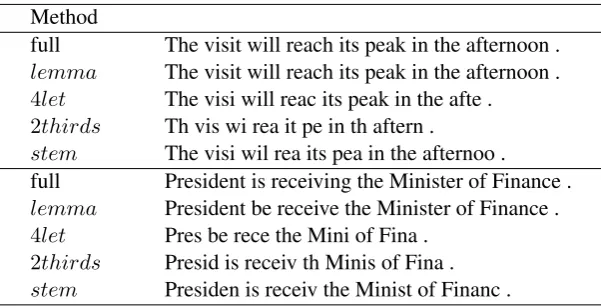
Method
full The visit will reach its peak in the afternoon .
lemma The visit will reach its peak in the afternoon .
4let The visi will reac its peak in the afte .
2thirds Th vis wi rea it pe in th aftern .
stem The visi wil rea its pea in the afternoo .
full President is receiving the Minister of Finance .
lemma President be receive the Minister of Finance .
4let Pres be rece the Mini of Fina .
[image:2.595.148.449.70.224.2]2thirds Presid is receiv th Minis of Fina . stem Presiden is receiv the Minist of Financ .
Table 1: Examples for each of the word reduction methods.
based on lemmas instead of full words in order to increase the precision with regard to human error annotation, which makes the algorithm even more susceptible to possible lack of lemmas.
If the full word forms were used as a replace-ment for lemmas, it would not be possible to de-tect any inflectional error thus setting the infl ec-tional error rate to zero, and noise would be intro-duced in omission, addition and mistranslation er-ror rates. Therefore, a simple use of the full forms instead of lemmas is not advisable, especially for the highly inflective languages. The goal of this work is to examine possible methods for process-ing of the full words in a more or less simple way in order to yield a reasonable error classification results by using them as a replacement for lemmas. Following methods for word reduction are ex-plored:
• first four letters of the word (4let)
The simplest way for word reduction is to use only itsfirstnletters. The choice offirst four
letters has been shown to be successful for improvement of word alignments (Fraser and Marcu, 2005), therefore we decided to setn
to four.
• first two thirds of the word length (2thirds)
In order to take the word length into account, the words are reduced to 2/3 of their original length (rounded down).
• word stem (stem)
A more refined method which splits words into stems and suffixes based on harmonic mean of their frequencies is used, similar to the compound splitting method described
in (Koehn and Knight, 2003). The suffix of each word is removed and only the stem is preserved. For calculation of stem and suffix frequencies, both the translation out-put and its corresponding reference transla-tion are used.
Examples of two English sentences processed by each of the methods is shown in Table 1.
The methods are tested on various distinct tar-get languages and domains, some of the languages being very morphologically rich. Detailed descrip-tion of the texts can be found in the next secdescrip-tion. 3 Experiments and results
The two main objectives of automatic error
classi-fier are:
• to estimate the error distribution within a translation output
• to compare different translation outputs in terms of error categories
Therefore we tested the described methods for both these aspects by comparing the results with those obtained when using lemmatised words, i.e. we used the error rates obtained with lemmas as the “reference” error rates. The best way for the assessment would be, of course, a comparison with human error classification. Nevertheless, this has not been done for two reasons: first, the original method using lemmas is already thoroughly tested in previous work (Popovi´c and Ney, 2011) and is shown to correlate well with human judgements. Second, human evaluation is resource and time-consuming.
originating from news, technical texts, client data of Language Service Providers, pharmaceutical domain, Europarl (Koehn, 2005), as well as the OpenSubtitles1 spoken language corpus. In addi-tion, one Basque translation output from technical domain has been available as well. The publicly available texts are described in (Callison-Burch et al., 2011), (Specia, 2011) and (Tiedemann, 2012). The majority of translation outputs has been cre-ated by statistical systems but a number of trans-lations has been produced by rule-based systems. It should be noted that not all target languages were available for all domains, however the to-tal amount of texts and the diversity of languages and domains are sufficient to obtain reliable re-sults – about 36000 sentences with average num-ber of words ranging from 8 (subtitles) through 15 (domain-specific corpora) up to 25 (Europarl and news) have been analysed.
Lemmas for English, Spanish and German texts are generated using TreeTagger,2 Slovenian lem-mas are produced by the Obeliks tagger (Grcar etˇ
al., 2012), and Czech texts are lemmatised using theCOMPOSTtagger (Spoustov´a et al., 2009).
It should be noted that all the reported results are calculated usingWERof lemmas (or corresponding substitutions) since no changes related to lemma substitution techniques were observed in compari-son with the use of the standard full wordWER.
3.1 Error distributions within a translation output
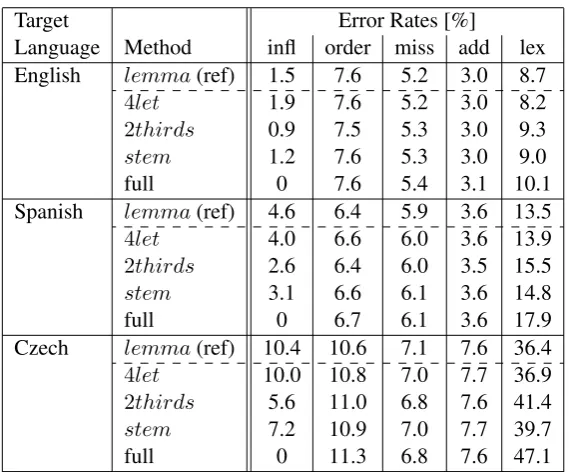
Our first experiment consisted of calculating dis-tributions offive error rates within one translation output using all word reduction methods described in Section 2 and comparing the obtained results with the reference distributions of error rates ob-tained using lemmas. The results for three distinct target languages are presented in Table 2: English as the least inflective, Spanish having very rich verb morphology, and Czech as generally highly inflective.
Reference distributions are presented in thefirst row, followed by the investigated word reduction methods; in the last row the results obtained us-ing full words are shown as well, and the intu-itively suspected effects can be clearly seen: no inflectional errors are detected, and the vast major-ity of them are tagged as lexical error (mistransla-1http://www.opensubtitles.org/
2http://www.ims.uni-stuttgart.de/
projekte/corplex/TreeTagger/
tion). Furthermore, it is confirmed that the varia-tions in word order errors, omissions and addivaria-tions are small, whereas the most affected error classes are inflections and mistranslations.
As for different target languages, in the English output the differences between the error rates are small for all error classes, but for the more
in-flected Spanish text and the highly inflected Czech text the situation is fairly different: 4let
distribu-tion is closest to the reference lemma error dis-tribution, whereas2thirdsandstemdistributions are lying between the lemma and the full word distributions. In addition, it can be observed that thestemmethod performs better than the2thirds
method.
In Table 3, the parts of the reference transla-tions from Table 1 containing inflectional errors are shown together with the corresponding parts of the translation output in order to better understand the different performance of the methods. Each of the sentences contains one (verb) inflectional error. Thefirst error, “receives” instead of “receiving”, is correctly detected by all methods. The second one, “reached” instead of “reach” is correctly tagged by all methods except by2thirdsbecause the reduced
word forms are not the same in the translation and in the reference. Thestemmethod often exhibits
the same problem, however less frequently.
3.2 Comparing translation outputs
For the comparison of different translation outputs, only the4letmethod has been investigated because
it produces the best error distributions (closest to those obtained by lemmas) and it is also the sim-plest to perform.
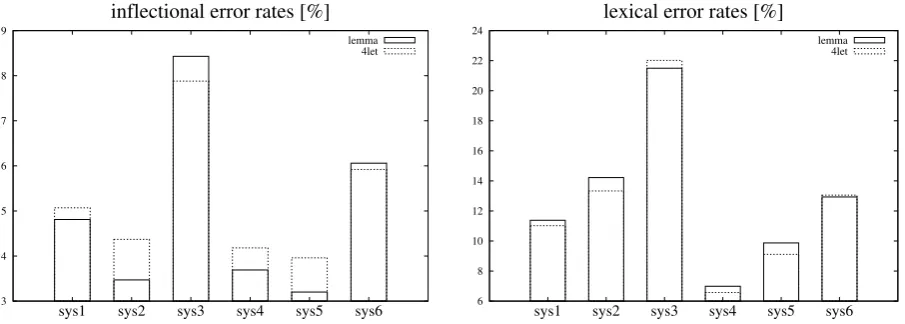
Figure 1 illustrates the results for the two highly inflectional languages, namely Slovenian (above) and Czech (below). Slovenian translations orig-inating from six statistical MT systems (dealing with three different domains and two source lan-guages) and Czech outputs produced by four dif-ferent MT systems have been analysed. Only the two most critical error classes are presented, namely inflectional (left) and lexical (right) error rates – for other error categories no significant per-formance differences between the reduction meth-ods were observed.
For the Slovenian translations, the correlation between 4let and reference lemma system
lex-Target Error Rates [%]
Language Method infl order miss add lex English lemma(ref) 1.5 7.6 5.2 3.0 8.7
4let 1.9 7.6 5.2 3.0 8.2
2thirds 0.9 7.5 5.3 3.0 9.3
stem 1.2 7.6 5.3 3.0 9.0
full 0 7.6 5.4 3.1 10.1
Spanish lemma(ref) 4.6 6.4 5.9 3.6 13.5
4let 4.0 6.6 6.0 3.6 13.9
2thirds 2.6 6.4 6.0 3.5 15.5
stem 3.1 6.6 6.1 3.6 14.8
full 0 6.7 6.1 3.6 17.9
Czech lemma(ref) 10.4 10.6 7.1 7.6 36.4
4let 10.0 10.8 7.0 7.7 36.9
2thirds 5.6 11.0 6.8 7.6 41.4
stem 7.2 10.9 7.0 7.7 39.7
full 0 11.3 6.8 7.6 47.1
Table 2: Comparison of error rates obtained by each of the described word reduction methods with the reference lemma error rates for three translation outputs: English (above), Spanish (middle) and Czech (below). Error rates using full words as lemma replacement are shown as well, illustrating why this method is not recommended.
Method Reference translation MT output full The visit will reach Visit reached
lemma The visit willreach Visitreach 4let The visi willreac Visitreac
2thirds Th vis wirea Visrea
stem The visi willrea Visrea
full President is receiving President receives
lemma President bereceive Presidentreceive
4let Pres berece Presrece
2thirds Presid isreceiv Presidentrecei
[image:4.595.157.442.113.349.2]stem Presiden isreceiv Presidentreceiv
Table 3: Illustration of the main problem for inflectional error detection: if the reduced word form is not exactly the same in the reference and in the translation output (bold), the error will not be tagged as inflectional. This phenomenon occurs most frequently for the2thirdsmethod, therefore this method
3 4 5 6 7 8 9
sys1 sys2 sys3 sys4 sys5 sys6
inflectional error rates [%]
lemma 4let
6 8 10 12 14 16 18 20 22 24
sys1 sys2 sys3 sys4 sys5 sys6
lexical error rates [%]
lemma 4let
(a) Comparing six Slovenian MT outputs
8 8.5 9 9.5 10 10.5 11
sys1 sys2 sys3 sys4
inflectional error rates [%]
lemma 4let
30 32 34 36 38 40 42
sys1 sys2 sys3 sys4
lexical error rates [%]
lemma 4let
[image:5.595.83.536.199.361.2](b) Comparing four Czech MT outputs
Figure 1: Comparison of translation outputs for highly inflective languages based on the two most critical error classes, i.e. inflectional (left) and lexical errors (right) – six Slovenian (above) and four Czech (below) translation outputs. Reference lemma error rates are presented by full lines,4leterror rates by
ical error rates, but not for the Czech inflections though: lemma method ranks the error rates (from highest to lowest)1, 3, 2, 4whereas the4let
rank-ing is2, 3, 4, 1. However, the important fact is that the relative differences between the systems are very small for inflectional errors; all the systems contain a high number of inflectional errors (be-tween 9.6 and 10.8%), whereas the absolute differ-ences between the systems range only between 0.2 and 1%. This means that the4letmethod is
gen-erally well capable of system comparison, but it is not able to capture very small relative differences correctly.
3.3 Analysis of confusions
In previous sections it is shown that the 4let
method, despite certain disadvantages, is well ca-pable to substitute the lemmas both for estimating error distributions within an output as well as for comparing error rates across the translation out-puts. However, an important remaining question is: what is exactly happening? Results presented in previous sections indicate that a number of infl ec-tional errors is substituted by lexical errors. How-ever, they also show that the4letinflectional error
rates sometimes are lower and sometimes higher than the lemma-based ones, thus indicating that not only a simple substitution of inflectional errors by mistranslations is taking place.
In order to explore these underlying phenomena, accuracies and confusions between error classes are calculated and confusion matrix is presented in Table 4. Since there are practically no variations in reordering error rates, the confusions are presented only for inflections, additions3and lexical errors.
As afirst step, the confusions are calculated for all merged texts and the results are presented in the
first row. It is confirmed that the low accuracy of the inflections and their confusions with mistrans-lations are indeed the main problems, however there is a number of reverse confusions, i.e. cer-tain mistranslations are tagged as inflectional er-rors. Apart from that, there is also certain amount of confusions between inflections and additions.
Since some of the used reference translations were independent (“free”) human translations and some were post-edited translation outputs, we sep-arated the texts into two sets and calculated con-fusions for each one. Nevertheless, no important
3The situation regarding omissions is analogous to the one regarding additions.
differences could be observed, as it can be seen in the corresponding rows in Table 4.
The next step was to analyse each of the target languages separately, and the results are presented further below in the table. Although the numbers are more diverse, all the important phenomena are practically same for all languages, namely low ac-curacy of inflections due to confusion with mis-translations. Only for the Basque translation the percentage is similar for confusions in both direc-tions.
Last step was division of texts into written text and spoken language transcriptions, and, contrary to the other set-ups, several notable differences were observed. First of all, the accuracy of infl ec-tions is significantly lower for spoken language, and the percentage of confusions with mistransla-tions is much higher. On the other hand, in written text much more mistranslations are substituted by inflections.
3.3.1 Word length effects
The differences between written and spoken language, together with the observations about Basque where the words can be very long, showed that the word length is an important factor which is neglected by the simple cutting of words intofirst four letters. The inflections of very short words such as articles and auxiliary verbs cannot be cap-tured, and some long words which are not related at all can be easily tagged as inflectional errors only because they share the first four characters – see Table 5. Furthermore, reception, receipt, recent andreceiver all sharefirst four letters and could possibly be tagged as inflectional error. On the other hand, such coincidences are not very fre-quent and therefore there are less substitutions of lexical errors. We calculated the average lengths of words for which each of the two substitution types occur, and obtained an average word length of 3.44 for inflection→mistranslation substitution
and 8.64 for the reverse one.
Neglecting the word length by the4letmethod
was the reason to explore the other two methods (2thirds and stem) in the first place. However,
they produced significantly worse error distribu-tions due to the often inconsistent word cutting. Since the stem method could be potentially
im-proved (contrary to the2thirdsmethod), we
anal-ysed its confusions and compared with those of the 4letmethod in order to better understand the
4let infl infl→lex infl→add lex lex→infl add add→infl
Overall 57.1 36.0 5.6 89.5 8.0 88.9 8.0
Reference 56.2 37.4 5.5 90.5 7.2 90.4 3.7
Post-edit 57.9 34.3 5.8 87.5 9.8 86.8 6.1
English 47.1 46.8 5.5 93.2 5.4 94.7 2.8
Spanish* 55.6 35.2 5.3 89.4 8.6 91.8 2.6
German 43.2 47.0 7.3 87.9 8.5 84.9 8.1
Slovenian 51.6 41.8 6.2 91.9 6.2 86.7 2.1
Czech* 66.3 28.4 5.2 90.0 7.3 81.3 6.3
Basque* 79.2 16.4 3.8 84.0 13.4 86.3 5.6
Written 65.7 27.4 5.0 87.0 10.1 87.6 6.4
[image:7.595.103.493.422.507.2]Spoken 44.4 49.2 6.0 94.1 4.6 89.7 1.6
Table 4: Accuracies and confusions between reference lemma error categories and those obtained by the 4letmethod; for all texts (Overall), separately for post-editions and for references, separately for each
target language, and separately for written and spoken language.
Method Reference translation MT output
full There were ergonomic There was ergonomische
problems . problems .
lemma There be ergonomic Therebeinf lergonomischelex
problem . problem .
4let Ther were ergo prob . Therwaslexergoinf l prob .
Table 5: Illustration of the word length problem for the4letmethod: inflectional errors for short words
(were/was) are impossible to detect and are considered as lexical errors; on the other hand, a lexical error (untranslated German wordergonomische) is tagged as inflectional error because it sharesfirst four letters with the reference translationergonomic.
Method infl infl→lex infl→add lex lex→infl add add→infl
Overall 4let 57.1 36.0 5.6 89.5 8.0 88.9 8.0
stem 48.4 44.2 6.0 94.2 4.8 89.7 4.3
[image:7.595.100.499.664.706.2]outputs (Overall) presented in Table 6 show that thestemmethod is better in avoiding substitutions of mistranslations and additions with inflections, but the problem with low inflection error accuracy is worse. One possible reason is that the stem and the suffix frequencies are estimated from the very small amount of data (only the reference and the translation output) and therefore is often not able to perform consistent cuttings for all words. This method should be investigated in future work, trained on the large target language corpus as well as in combination with the4letmethod.
4 Conclusions and Future Work
The experiments presented in this paper show that it is possible to use an existing automatic error classifier without target language lemmas. It is shown that cutting all words intofirst four letters is the best method even for highly inflective lan-guages, preserving both the distribution of error types within a system as well as distribution of each error type over various systems. However, it might not be able to capture very small variations correctly.
The main issue is the low accuracy of infl ec-tional error class due to confusions with mistrans-lations. For shorter words, actual inflectional er-rors tend to be tagged as mistranslations, for longer words the other way round. Keeping all that in mind, it is possible to use the error classifier with-out target language lemmatisation and to extrapo-late inflectional and lexical error rates according to the dominant word length in the analysed text.
Our further work will concentrate on combining the4letmethod with more refined methods which take into account the word length, and also inves-tigating other fixed reduction lengths, e.g. 5 and 6. Comparison with human error classification re-sults as well as manual inspection of problematic words and error confusion types should be carried out as well.
Acknowledgments
This publication has emanated from research sup-ported by QTLEAPproject – ECs FP7 (FP7/2007-2013) under grant agreement number 610516: “QTLEAP: Quality Translation by Deep Lan-guage Engineering Approaches” and by a research grant from Science Foundation Ireland (SFI) under Grant Number SFI/12/RC/2289. We are grateful to the reviewers for their valuable feedback.
References
Callison-Burch, Chris, Philipp Koehn, Christof Monz, and Omar Zaidan. 2011. Findings of the 2011 Workshop on Statistical Machine Translation. In
Proceedings of the Sixth Workshop on Statistical Ma-chine Translation (WMT 2011), pages 22–64, Edin-burgh, Scotland, July.
Fraser, Alexander and Daniel Marcu. 2005. ISI’s Par-ticipation in the Romanian-English Alignment Task. In Proceedings of the ACL Workshop on Building and Using Parallel Texts, pages 91–94, Ann Arbor, Michigan, June.
Grˇcar, Miha, Simon Krek, and Kaja Dobrovoljc. 2012. Obeliks: statisticni oblikoskladenjski oznaˇ cevalnikˇ in lematizator za slovenski jezik. In Proceedings of the 8th Language Technologies Conference, pages 89–94, Ljubljana, Slovenia, October.
Koehn, Philipp and Kevin Knight. 2003. Empirical methods for compound splitting. InProceedings of the 10th Conference of the European Chapter of the Association for Computational Linguistics (EACL 03), pages 347–354, Budapest, Hungary, April.
Koehn, Philipp. 2005. Europarl: A Parallel Corpus for Statistical Machine Translation. InProceedings of the 10th Machine Translation Summit, pages 79–86, Phuket, Thailand, September.
Popovi´c, Maja and Hermann Ney. 2011. Towards Au-tomatic Error Analysis of Machine Translation Out-put.Computational Linguistics, 37(4):657–688, De-cember.
Popovi´c, Maja. 2011. Hjerson: An Open Source Tool for Automatic Error Classification of Machine Translation Output. The Prague Bulletin of Mathe-matical Linguistics, (96):59–68, October.
Specia, Lucia. 2011. Exploiting Objective Annota-tions for Measuring Translation Post-editing Effort. In Proceedings of the 15th Annual Conference of the European Association for Machine Translation (EAMT 11), pages 73–80, Leuven, Belgium, May. Spoustov´a, Drahom´ıra “Johanka”, Jan Hajic, Jan Raab,ˇ
and Miroslav Spousta. 2009. Semi-Supervised Training for the Averaged Perceptron POS Tagger. InProceedings of the 12th Conference of the Euro-pean Chapter of the ACL (EACL 2009), pages 763– 771, Athens, Greece, March.
Tiedemann, J¨org. 2012. Parallel data, tools and inter-faces in OPUS. InProceedings of the 8th Interna-tional Conference on Language Resources and Eval-uation (LREC12), pages 2214–2218, May.