A Study on Dependency Tree Kernels
for Automatic Extraction of Protein-Protein Interaction
Md. Faisal Mahbub Chowdhury† ‡ and Alberto Lavelli‡ and Alessandro Moschitti† †Department of Information Engineering and Computer Science, University of Trento, Italy
‡Human Language Technology Research Unit, Fondazione Bruno Kessler, Trento, Italy
{chowdhury,lavelli}@fbk.eu, [email protected]
Abstract
Kernel methods are considered the most ef-fective techniques for various relation extrac-tion (RE) tasks as they provide higher accu-racy than other approaches. In this paper, we introduce new dependency tree (DT) ker-nels for RE by improving on previously pro-posed dependency tree structures. These are further enhanced to design more effective ap-proaches that we call mildly extended depen-dency tree (MEDT) kernels. The empirical re-sults on the protein-protein interaction (PPI) extraction task on the AIMed corpus show that tree kernels based on our proposed DT struc-tures achieve higher accuracy than previously proposed DT and phrase structure tree (PST) kernels.
1 Introduction
Relation extraction (RE) aims at identifying in-stances of pre-defined relation types in text as for example the extraction of protein-protein interaction (PPI) from the following sentence:
“NativeC8also formed a heterodimer with C5, and low concentrations of polyionic ligands such as protamine and suramin inhibited the interaction.”
After identification of the relevant named entities (NE, in this caseproteins)C8 andC5, the RE task determines whether there is a PPI relationship be-tween the entities above (which istruein the exam-ple).
Kernel based approaches for RE have drawn a lot of interest in recent years since they can exploit a
huge amount of features without an explicit repre-sentation. Some of these approaches are structure kernels (e.g. tree kernels), which carry out struc-tural similarities between instances of relations, rep-resented as phrase structures or dependency trees, in terms of common substructures. Other kernels simply use techniques such as bag-of-words, subse-quences, etc. to map the syntactic and contextual information to flat features, and later compute simi-larity.
One variation of tree kernels is the dependency tree (DT) kernel (Culotta and Sorensen, 2004; Nguyen et al., 2009). A DT kernel (DTK) is a tree kernel that is computed on a dependency tree (or subtree). A dependency tree encodes grammati-cal relations between words in a sentence where the words are nodes, and dependency types (i.e. gram-matical functions of children nodes with respect to their parents) are edges. The main advantage of a DT in comparison with phrase structure tree (PST) is that the former allows for relating two words di-rectly (and in more compact substructures than PST) even if they are far apart in the corresponding sen-tence according to their lexical word order.
Several kernel approaches exploit syntactic de-pendencies among words for PPI extraction from biomedical text in the form of dependency graphs or dependency paths (e.g. Kim et al. (2010) or Airola et al. (2008)). However, to the best of our knowl-edge, there are only few works on the use of DT kernels for this task. Therefore, exploring the po-tential of DTKs applied to different structures is a worthwhile research direction. A DTK, pioneered by Culotta and Sorensen (2004), is typically applied to the minimal or smallest common subtree that in-cludes a target pair of entities. Such subtree reduces
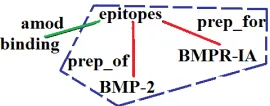
Figure 1: Part of the DT for the sentence “The binding epitopes ofBMP-2forBMPR-IAwas characterized using BMP-2 mutant proteins”. The dotted area indicates the minimal subtree.
unnecessary information by placing word(s) closer to its dependent(s) inside the tree and emphasizes local features of relations. Nevertheless, there are cases where a minimal subtree might not contain im-portant cue words or predicates. For example, con-sider the following sentence where a PPI relation holds betweenBMP-2andBMPR-IA, but the mini-mal subtree does not contain the cue word “binding” as shown in Figure 1:
The binding epitopes of BMP-2 for
BMPR-IAwas characterized using BMP-2 mutant proteins.
In this paper we investigate two assumptions. The first is that a DTK based on a mild extension of minimal subtrees would produce better results than the DTK on minimal subtrees. The second is that previously proposed DT structures can be further improved by introducing simplified representation of the entities as well as augmenting nodes in the DT tree structure with relevant features. This paper presents an evaluation of the above assumptions.
More specifically, the contributions of this paper are the following:
• We propose the use of new DT structures, which are improvement on the structures de-fined in Nguyen et al. (2009) with the most gen-eral (in terms of substructures) DTK, i.e. Par-tial Tree Kernel (PTK) (Moschitti, 2006).
• We firstly propose the use of the Unlexicalized PTK (Severyn and Moschitti, 2010) with our dependency structures, which significantly im-proves PTK.
• We compare the performance of the proposed DTKs on PPI with the one of PST kernels and
show that, on biomedical text, DT kernels per-form better.
• Finally, we introduce a novel approach (called mildly extended dependency tree (MEDT) ker-nel1, which achieves the best performance among various (both DT and PST) tree kernels.
The remainder of the paper is organized as fol-lows. In Section 2, we introduce tree kernels and re-lation extraction and we also review previous work. Section 3 describes the unlexicalized PTK (uPTK). Then, in Section 4, we define our proposed DT struc-tures including MEDT. Section 5 describes the ex-perimental results on the AIMed corpus (Bunescu et al., 2005) and discusses their outcomes. Finally, we conclude with a summary of our study as well as plans for future work.
2 Background and Related Work
The main stream work for Relation Extraction uses kernel methods. In particular, as the syntactic struc-ture is very important to derive the relationships be-tween entities in text, several tree kernels have been designed and experimented. In this section, we in-troduce such kernels, the problem of relation extrac-tion and we also focus on the biomedical domain.
2.1 Tree Kernel types
The objective behind the use of tree kernels is to compute the similarity between two instances through counting similarities of their sub-structures. Among the different proposed methods, two of the most effective approaches are Subset Tree (SST) kernel (Collins and Duffy, 2001) and Partial Tree Kernel (PTK) (Moschitti, 2006).
The SST kernel generalizes the subtree ker-nel (Vishwanathan and Smola, 2002), which consid-ers all common subtrees in the tree representation of two compared sentences. In other words, two sub-trees are identical if the node labels and order of chil-dren are identical for all nodes. The SST kernel re-laxes the constraint that requires leaves to be always included in the sub-structures. In SST, for a given node, either none or all of its children have to be in-cluded in the resulting subset tree. An extension of
1
the SST kernel is the SST+bow (bag-of-words) ker-nel (Zhang and Lee, 2003; Moschitti, 2006a), which considers individual leaves as sub-structures as well. The PT kernel (Moschitti, 2006) is more flexi-ble than SST by virtually allowing any tree sub-structure; the only constraint is that the order of child nodes must be identical. Both SST and PT kernels are convolution tree kernels2.
The PT kernel is the most complete in terms of structures. However, the massive presence of child node subsequences and single child nodes, which in a DT often correspond to words, may cause overfit-ting. Thus we propose the use of the unlexicalized (i.e. PT kernel without leaves) tree kernel (uPTK) (Severyn and Moschitti, 2010), in which structures composed by only one lexical element, i.e. single nodes, are removed from the feature space (see Sec-tion 3).
2.2 Relation Extraction using Tree Kernels
A first version of dependency tree kernels (DTKs) was proposed by Culotta and Sorensen (2004). In their approach, they find the smallest common sub-tree in the DT that includes a given pair of enti-ties. Then, each node of the subtree is represented as a feature vector. Finally, these vectors are used to compute similarity. However, the tree kernel they defined is not a convolution kernel, and hence it gen-erates a much lower number of sub-structures result-ing in lower performance.
For any two entities e1 ande2 in a DT, Nguyen et al. (2009) defined the following three dependency structures to be exploited by convolution tree ker-nels:
• Dependency Words (DW) tree: a DW tree is the minimal subtree of a DT, which includese1 ande2. An extra node is inserted as parent of the corresponding NE, labeled with the NE cat-egory. Only words are considered in this tree.
• Grammatical Relation (GR) tree: a GR tree is similar to a DW tree except that words are replaced by their grammatical functions, e.g. prep,nsubj, etc.
2Convolution kernels aim to capture structural information
in term of sub-structures, providing a viable alternative to flat features (Moschitti, 2004).
• Grammatical Relation and Words (GRW) tree: a GRW tree is the minimal subtree that uses both words and grammatical functions, where the latter are inserted as parent nodes of the for-mer.
Using PTK for the above dependency tree struc-tures, the authors achieved an F-measure of 56.3 (for DW), 60.2 (for GR) and 58.5 (for GRW) on the ACE 2004 corpus3.
Moschitti (2004) proposed the so called path-enclosed tree (PET)4 of a PST for Semantic Role Labeling. This was later adapted by Zhang et al. (2005) for relation extraction. A PET is the smallest common subtree of a PST, which includes the two entities involved in a relation.
Zhou et al. (2007) proposed the so called context-sensitive tree kernel approach based on PST, which expands PET to include necessary contextual in-formation. The expansion is carried out by some heuristics tuned on the target RE task.
Nguyen et al. (2009) improved the PET represen-tation by inserting extra nodes for denoting the NE category of the entities inside the subtree. They also used sequence kernels from tree paths, which pro-vided higher accuracy.
2.3 Relation Extraction in the biomedical domain
There are several benchmarks for the PPI task, which adopt different PPI annotations. Conse-quently the experimental results obtained by dif-ferent approaches are often difficult to compare. Pyysalo et al. (2008) put together these corpora (in-cluding the AIMed corpus used in this paper) in a common format for comparative evaluation. Each of these corpora is known asconverted corpusof the corresponding original corpus.
Several kernel-based RE approaches have been reported to date for the PPI task. These are based on various methods such as subsequence kernel (Lodhi et al., 2002; Bunescu and Mooney, 2006), depen-dency graph kernel (Bunescu and Mooney, 2005), etc. Different work exploited dependency analy-ses with different kernel approaches such as
bag-of-3
http://projects.ldc.upenn.edu/ace/
4
words kernel (e.g. Miwa et al. (2009)), graph based kernel (e.g. Kim et al. (2010)), etc. However, there are only few researches that attempted the exploita-tion of tree kernels on dependency tree structures.
Sætre et al. (2007) used DT kernels on AIMed corpus and achieved an F-score of 37.1. The re-sults were far better when they combined the out-put of the dependency parser with that of a Head-driven Phrase Structure Grammar (HPSG) parser, and applied tree kernel on it. Miwa et al. (2009) also proposed a hybrid kernel5, which is a composition
of all-dependency-paths kernel (Airola et al., 2008), bag-of-words kernel and SST kernel. They used multiple parser inputs. Their system is the current state-of-the-art for PPI extraction on several bench-marks. Interestingly, they applied SST kernel on the shortest dependency paths between pairs of proteins and achieved a relatively high F-score of 55.1. How-ever, the trees they constructed from the shortest de-pendency paths are actually not dede-pendency trees. In a dependency tree, there is only one node for each individual word whereas in their constructed trees (please refer to Fig. 6 of Miwa et al. (2009)), a word (that belongs to the shortest path) has as many node representations as the number of dependency rela-tions with other words (those belonging to the short-est path). Perhaps, this redundancy of information might be the reason their approach achieved higher result. In addition to work on PPI pair extraction, there has been some approaches that exploited de-pendency parse analyses along with kernel methods foridentifying sentencesthat might contain PPI pairs (e.g. Erkan et al. (2007)).
In this paper, we focus on finding the best repre-sentation based on a single structure. We speculate that this can be helpful to improve the state-of-the-art using several combinations of structures and fea-tures. As a first step, we decided to use uPTK, which is more robust to overfitting as the description in the next section unveil.
5The term “hybrid kernel” is identical to “combined kernel”.
It refers to those kernels that combine multiple types of kernels (e.g., tree kernels, graph kernels, etc)
3 Unlexicalized Partial Tree Kernel (uPTK)
The uPTK was firstly proposed in (Severyn and Moschitti, 2010) and experimented with semantic role labeling (SRL). The results showed no improve-ment for such task but it is well known that in SRL lexical information is essential (so in that case it could have been inappropriate). The uPTK defini-tion follows the general setting of tree kernels.
A tree kernel function over two trees,T1 andT2,
is defined as
T K(T1, T2) =
X
n1∈NT1
X
n2∈NT2
∆(n1, n2),
whereNT1 andNT2 are the sets of nodes inT1and
T2, respectively, and
∆(n1, n2) =
|F |
X
i=1
χi(n1)χi(n2).
The∆function is equal to the number of common fragments rooted in nodesn1 and n2 and thus
de-pends on the fragment type.
The algorithm for the uPTK computation straight-forwardly follows from the definition of the∆ func-tion of PTK provided in (Moschitti, 2006). Given two nodesn1andn2in the corresponding two trees
T1 andT2,∆is evaluated as follows:
1. if the node labels ofn1andn2are different then
∆(n1, n2) = 0;
2. else ∆(n1, n2) = µ
λ2 +
X
~
I1,~I2,l(I~1)=l(I~2)
λd(I~1)+d(I~2) l(~I1)
Y
j=1
∆(cn1(I~1j), cn2(I~2j))
,
where:
1. ~I1 = hh1, h2, h3, ..i and ~I2 = hk1, k2, k3, ..i
are index sequences associated with the ordered child sequencescn1ofn1andcn2 ofn2,
respec-tively;
2. ~I1j and~I2j point to thej-th child in the
corre-sponding sequence;
4. d(~I1) =I~1l(I~1)−~I11+ 1andd(I~2) =I~2l(I~2)−
~
I21+ 1; and
5. µ andλ are two decay factors for the size of the tree and for the length of the child subse-quences with respect to the original sequence, i.e. we account for gaps.
The uPTK can be obtained by removingλ2from
the equation in step 2. An efficient algorithm for the computation of PTK is given in (Moschitti, 2006). This evaluates ∆ by summing the contribution of tree structures coming from different types of se-quences, e.g. those composed by p children such as:
∆(n1, n2) =µ λ2+Pplm=1∆p(cn1, cn2)
, (1)
where∆pevaluates the number of common subtrees
rooted in subsequences of exactlypchildren (ofn1
andn2) andlm=min{l(cn1), l(cn2)}. It is easy to
verify that we can use the recursive computation of
∆pby simply removingλ2from Eq. 1.
4 Proposed dependency structures and MEDT kernel
Our objective is twofold: (a) the definition of im-proved DT structures and (b) the design of new DT kernels to include important words residing outside of the shortest dependency tree, which are neglected in current approaches. For achieving point (a), we modify the DW, GR and GRW structures, previously proposed by Nguyen et al. (2009). The new pro-posed structures are the following:
• Grammatical Relation and lemma (GRL) tree: A GRL tree is similar to a GRW tree except that words are replaced by their corresponding lemmas.
[image:5.612.368.488.51.115.2]• Grammatical Relation, PoS and lemma (GRPL) tree: A GRPL tree is an extension of a GRL tree, where the part-of-speech (PoS) tag of each of the corresponding words is inserted as a new node between its grammatical func-tion and its lemma, i.e. the new node becomes the parent node of the node containing the lemma.
Figure 2: Part of the DT for the sentence “Interaction was identified betweenBMP-2andBMPR-IA”. The dot-ted area indicates the minimal subtree.
Figure 3: Part of the DT for the sentence “Phe93 forms extensive contacts with a peptide ligand in the crystal structure of theEBP bound to anEMP1”. The dotted area indicates the minimal subtree.
• Ordered GRL (OGRL) or ordered GRW
(OGRW) tree: in a GRW (or GRL) tree, the node containing the grammatical function of a word is inserted as the parent node of such word. So, if the word has a parent node con-taining its NE category, the newly inserted node with grammatical function becomes the child node of the node containing NE category, i.e. the order of the nodes is the following –“NE category⇒ grammatical relation⇒ word (or lemma)”. However, in OGRW (or OGRL), this ordering is modified as follows –“grammatical relation⇒NE category⇒word (or lemma)”.
• Ordered GRPL (OGRPL) tree: this is similar to the OGRL tree except for the order of the nodes, which is the following –“grammatical relation⇒NE category⇒PoS⇒lemma”.
• Simplified (S) tree: any tree structure would become an S tree if it contains simplified repre-sentations of the entity types, where all its parts except the head word of a multi-word entity are not considered in the minimal subtree.
[image:5.612.362.493.175.268.2]in the minimal subtree. We do so by mildly expand-ing the minimal subtree, i.e. we define the mildly extended DT (MEDT) kernel. We propose three dif-ferent expansion rules for three versions of MEDT as follows:
• Expansion rule for MEDT-1 kernel:If the root of the minimal subtree is not a modifier (e.g. adjective) or a verb, then look for such node in its children or in its parent (in the original DT tree) to extend the subtree.
The following example shows a sentence where this rule would be applicable:
The binding epitopes ofBMP-2
forBMPR-IAwas characterized us-ing BMP-2 mutant proteins.
Here, the cue word is “binding”, the root of the minimal subtree is “epitopes” and the target en-tities are BMP-2 and BMPR-IA. However, as shown in Figure 1, the minimal subtree does not contain the cue word.
• Expansion rule for MEDT-2 kernel:If the root of the minimal subtree is a verb and its subject (or passive subject) in the original DT tree is not included in the subtree, then include it.
Consider the following sentence:
Interaction was identified be-tweenBMP-2andBMPR-IA.
Here, the cue word is “Interaction”, the root is “identified” and the entities areBMP-2 and BMPR-IA. The passive subject “Interaction” does not belong to the minimal subtree (see Figure 2).
• Expansion rule for MEDT-3 kernel:If the root of the minimal subtree is the head word of one of the interacting entities, then add the parent node (in the original DT tree) of the root node as the new root of the subtree.
This is an example sentence where this rule is applicable (see Figure 3):
Phe93 forms extensive contacts with a peptide ligand in the crystal structure of the EBP bound to an
EMP1.
5 Experiments and results
We carried out several experiments with different dependency structures and tree kernels. Most portantly, we tested tree kernels on PST and our im-proved representations for DT.
5.1 Data and experimental setup
We used the AIMed corpus (Bunescu et al., 2005) converted using the software provided by Pyysalo et al. (2008). AIMed is the largest benchmark corpus (in terms of number of sentences) for the PPI task. It contains 1,955 sentences, in which are annotated 1,000 positive PPI and 4,834 negative pairs.
We use the Stanford parser6for parsing the data.7 The SPECIALIST lexicon tool8is used to normalize words to avoid spelling variations and also to pro-vide lemmas. For training and evaluating tree ker-nels, we use the SVM-LIGHT-TK toolkit9 (Mos-chitti, 2006; Joachims, 1999). We tuned the param-etersµ,λandcfollowing the approach described by Hsu et al. (2003), and used biased hyperplane.10 All the other parameters are left as their default values.
Our experiments are evaluated with 10-fold cross validation using the same split of the AIMed corpus used by Bunescu et al. (2005).
5.2 Results and Discussion
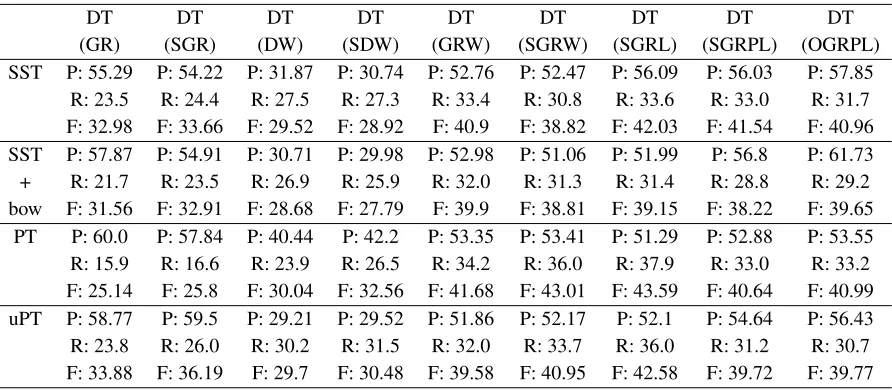
The results of different tree kernels applied to dif-ferent structures are shown in Tables 1 and 2. All the tree structures are tested with four different tree kernel types: SST, SST+bow, PTK and uPTK.
According to the empirical outcome, our new DT structures perform better than the existing tree struc-tures. The highest result (F: 46.26) is obtained by applying uPTK to MEDT-3 (SOGRL). This is 6.68 higher than the best F-measure obtained by previous DT structures proposed in Nguyen et al. (2009), and 0.36 higher than the best F-measure obtained using PST (PET).
6http://nlp.stanford.edu/software/lex-parser.shtml 7
For some of the positive PPI pairs, the connecting depen-dency tree could not be constructed due to parsing errors for the corresponding sentences. Such pairs are considered as false negative (FN) during precision and recall measurements.
8
http://lexsrv3.nlm.nih.gov/SPECIALIST/index.html
9
http://disi.unitn.it/moschitti/Tree-Kernel.htm
10Please refer to http://svmlight.joachims.org/ and
DT DT DT DT DT DT DT DT DT (GR) (SGR) (DW) (SDW) (GRW) (SGRW) (SGRL) (SGRPL) (OGRPL) SST P: 55.29 P: 54.22 P: 31.87 P: 30.74 P: 52.76 P: 52.47 P: 56.09 P: 56.03 P: 57.85
R: 23.5 R: 24.4 R: 27.5 R: 27.3 R: 33.4 R: 30.8 R: 33.6 R: 33.0 R: 31.7 F: 32.98 F: 33.66 F: 29.52 F: 28.92 F: 40.9 F: 38.82 F: 42.03 F: 41.54 F: 40.96 SST P: 57.87 P: 54.91 P: 30.71 P: 29.98 P: 52.98 P: 51.06 P: 51.99 P: 56.8 P: 61.73 + R: 21.7 R: 23.5 R: 26.9 R: 25.9 R: 32.0 R: 31.3 R: 31.4 R: 28.8 R: 29.2 bow F: 31.56 F: 32.91 F: 28.68 F: 27.79 F: 39.9 F: 38.81 F: 39.15 F: 38.22 F: 39.65
[image:7.612.84.530.53.248.2]PT P: 60.0 P: 57.84 P: 40.44 P: 42.2 P: 53.35 P: 53.41 P: 51.29 P: 52.88 P: 53.55 R: 15.9 R: 16.6 R: 23.9 R: 26.5 R: 34.2 R: 36.0 R: 37.9 R: 33.0 R: 33.2 F: 25.14 F: 25.8 F: 30.04 F: 32.56 F: 41.68 F: 43.01 F: 43.59 F: 40.64 F: 40.99 uPT P: 58.77 P: 59.5 P: 29.21 P: 29.52 P: 51.86 P: 52.17 P: 52.1 P: 54.64 P: 56.43 R: 23.8 R: 26.0 R: 30.2 R: 31.5 R: 32.0 R: 33.7 R: 36.0 R: 31.2 R: 30.7 F: 33.88 F: 36.19 F: 29.7 F: 30.48 F: 39.58 F: 40.95 F: 42.58 F: 39.72 F: 39.77
Table 1: Performance of DT (GR), DT (DW) and DT (GRW) (proposed by (Nguyen et al., 2009)) and their modified and improved versions on theconvertedAIMed corpus.
RE experiments carried out on newspaper text corpora (such as ACE 2004) have indicated that ker-nels based on PST obtain better results than kerker-nels based on DT. Interestingly, our experiments on a biomedical text corpus indicate an opposite trend. Intuitively, this might be due to the different na-ture of the PPI task. PPI can be often identified by spotting cue words such asinteraction,binding, etc, since the interacting entities (i.e. proteins) usually have direct syntactic dependency relation on such cue words. This might have allowed kernels based on DT to be more accurate.
Although tree kernels applied on DT and PST structures have produced high performance on cor-pora of news text (Zhou et al., 2007; Nguyen et al., 2009), in case of biomedical text the results that we obtained are relatively low. This may be due to the fact that biomedical texts are different from newspa-per texts: more variation in vocabulary, more com-plex naming of (bio) entities, more diversity of the valency of verbs and so on.
One important finding of our experiments is the effectiveness of the mild extension of DT struc-tures. MEDT-3 achieves the best result for all ker-nels (SST, SST+bow, PTK and uPTK). However, the other two versions of MEDT appear to be less effec-tive.
In general, the empirical outcome suggests that uPTK can better exploit our proposed DT structures
as well as PST. The superiority of uPTK on PTK demonstrates that single lexical features (i.e. fea-tures with flat structure) tend to overfit.
Finally, we have performed statistical tests to as-sess the significance of our results. For each kernel (i.e. SST, SST+bow, PTK, uPTK), the PPI predic-tions using the best structure (i.e. MEDT-3 applied to SOGRL) are compared against the predictions of the other structures. The tests were performed using the approximate randomization procedure (Noreen, 1989). We set the number of iterations to 1,000 and the confidence level to 0.01. According to the tests, for each kernel, our best structure produces signifi-cantly better results.
5.3 Comparison with previous work
DT DT DT DT MEDT-1 MEDT-2 MEDT-3 PST (SOGRPL) (OGRL) (SOGRW) (SOGRL) (SOGRL) (SOGRL) (SOGRPL) (PET) SST P: 57.59 P: 54.38 P: 51.49 P: 54.08 P: 58.15 P: 54.46 P: 59.55 P: 52.72
R: 33.0 R: 33.5 R: 31.2 R: 33.8 R: 34.6 R: 33.6 R: 37.1 R: 35.9
F: 41.96 F: 41.46 F: 38.86 F: 41.6 F: 43.39 F: 41.56 F: 45.72 F: 42.71
SST P: 60.31 P: 53.22 P: 50.08 P: 53.26 P: 58.84 P: 52.87 P: 59.35 P: 52.88
+ R: 30.7 R: 33.1 R: 30.9 R: 32.7 R: 32.6 R: 32.2 R: 34.9 R: 37.7
bow F: 40.69 F: 40.82 F: 38.22 F: 40.52 F: 41.96 F: 40.02 F: 43.95 F: 44.02
PT P: 55.45 P: 49.78 P: 51.05 P: 51.61 P: 52.94 P: 50.89 P: 54.1 P: 58.39
R: 34.6 R: 34.6 R: 34.1 R: 36.9 R: 36.0 R: 37.0 R: 38.9 R: 36.9
F: 42.61 F: 40.82 F: 40.89 F: 43.03 F: 42.86 F: 42.85 F: 45.26 F: 45.22
uPT P: 56.2 P: 50.87 P: 50.0 P: 52.74 P: 55.0 P: 52.17 P: 56.85 P: 56.6
R: 32.2 R: 35.0 R: 33.0 R: 35.6 R: 34.1 R: 34.8 R: 39.0 R: 38.6
F: 40.94 F: 41.47 F: 39.76 F: 42.51 F: 42.1 F: 41.75 F: 46.26 F: 45.9
Table 2: Performance of the other improved versions of DT kernel structures (including MEDT kernels) as well as PST (PET) kernel (Moschitti, 2004; Nguyen et al., 2009) on theconvertedAIMed corpus.
a better result.
In this work, we compare the performance of tree kernels applied of DT with that of PST. Previously, Tikk et al. (2010) applied similar kernels on PST for exactly the same task and data set. They reported that SST and PTK (on PST) achieved F-scores of 26.2 and 34.6, respectively on the converted AIMed corpus (refer to Table 2 in their paper). Such results do not match our figures obtained with the same kernels on PST. We obtain much higher results for those kernels. It is difficult to understand the rea-son for such differences between our and their re-sults. A possible explanation could be related to pa-rameter settings. Another source of uncertainty is given by the tool for tree kernel computation, which in their case is not mentioned. Moreover, their de-scription of PT and SST (in Figure 1 of their paper) appears to be imprecise: for example, in (partial or complete) phrase structure trees, words can only ap-pear as leaves but in their figure they apap-pear as non-terminal nodes.
The comparison with other kernel approaches (i.e. not necessarily tree kernels on DT or PST) shows that there are model achieving higher results (e.g. Giuliano et al. (2006), Kim et al. (2010), Airola et al. (2008), etc). State-of-the-art results on most of the PPI data sets are obtained by the hybrid kernel presented in Miwa et al. (2009). As noted earlier, our work focuses on the design of an effective DTK
for PPI that can be combined with others and that can hopefully be used to design state-of-the-art hy-brid kernels.
6 Conclusion
In this paper, we have proposed a study of PPI ex-traction from specific biomedical data based on tree kernels. We have modeled and experimented with new kernels and DT structures, which can be ex-ploited for RE tasks in other domains too.
More specifically, we applied four different tree kernels on existing and newly proposed DT and PST structures. We have introduced some extensions of DT kernel structures which are linguistically moti-vated. We call these as mildly extended DT kernels. We have also shown that in PPI extraction lexical information can lead to overfitting as uPTK outper-forms PTK. In general, the empirical results show that our DT structures perform better than the previ-ously proposed PST and DT structures.
The ultimate objective of our work is to improve tree kernels applied to DT and then combine them with other types of kernels and data to produce more accurate models.
Acknowledgments
References
A Airola, S Pyysalo, J B¨jorne, T Pahikkala, F Gin-ter, and T Salakoski. 2008. A graph kernel for protein-protein interaction extraction. InProceedings of BioNLP 2008, pages 1–9, Columbus, USA. R Bunescu and R Mooney. 2005. A shortest path
depen-dency kernel for relation extraction. InProceedings of Human Language Technology Conference and Confer-ence on Empirical Methods in Natural Language Pro-cessing, pages 724–731, Vancouver, British Columbia, Canada, October. Association for Computational Lin-guistics.
R Bunescu and RJ Mooney. 2006. Subsequence ker-nels for relation extraction. In Proceedings of the 19th Conference on Neural Information Processing Systems, pages 171–178.
R Bunescu, R Ge, RJ Kate, EM Marcotte, RJ Mooney, AK Ramani, and YW Wong. 2005. Compara-tive experiments on learning information extractors for proteins and their interactions. Artificial Intelli-gence in Medicine (Special Issue on Summarization and Information Extraction from Medical Documents), 33(2):139–155.
M Collins and N Duffy. 2001. Convolution kernels for natural language. InProceedings of Neural Informa-tion Processing Systems (NIPS’2001).
A Culotta and J Sorensen. 2004. Dependency tree ker-nels for relation extraction. InProceedings of the 42nd Annual Meeting of the Association for Computational Linguistics, Barcelona, Spain.
G Erkan, A Ozgur, and DR Radev. 2007. Semi-Supervised Classification for Extracting Protein Inter-action Sentences using Dependency Parsing. In Pro-ceedings of the 2007 Joint Conference on Empirical Methods in Natural Language Processing and Compu-tational Natural Language Learning (EMNLP-CoNLL 2007), pages 228–237.
C Giuliano, A Lavelli, and L Romano. 2006. Exploit-ing shallow lExploit-inguistic information for relation extrac-tion from biomedical literature. InProceedings of the 11th Conference of the European Chapter of the As-sociation for Computational Linguistics (EACL’2006), pages 401–408, Trento, Italy.
CW Hsu, CC Chang, and CJ Lin, 2003. A practical guide to support vector classification. Department of Com-puter Science and Information Engineering, National Taiwan University, Taipei, Taiwan.
T Joachims. 1999. Making large-scale support vec-tor machine learning practical. In Advances in ker-nel methods: support vector learning, pages 169–184. MIT Press, Cambridge, MA, USA.
S Kim, J Yoon, J Yang, and S Park. 2010. Walk-weighted subsequence kernels for protein-protein interaction ex-traction. BMC Bioinformatics, 11(1).
H Lodhi, C Saunders, J Shawe-Taylor, N Cristianini, and C Watkins. 2002. Text classification using string ker-nels. Journal of Machine Learning Research, 2:419– 444, March.
M Miwa, R Sætre, Y Miyao, T Ohta, and J Tsujii. 2009. Protein-protein interaction extraction by leveraging multiple kernels and parsers. International Journal of Medical Informatics, 78.
A Moschitti. 2004. A study on convolution kernels for shallow semantic parsing. InProceedings of the 42nd Annual Meeting of the Association for Computational Linguistics, ACL ’04, Barcelona, Spain.
A Moschitti. 2006. Efficient convolution kernels for de-pendency and constituent syntactic trees. In Johannes F¨urnkranz, Tobias Scheffer, and Myra Spiliopoulou, editors,Machine Learning: ECML 2006, volume 4212 ofLecture Notes in Computer Science, pages 318–329. Springer Berlin / Heidelberg.
A Moschitti. 2006a. Making Tree Kernels Practical for Natural Language Learning. In Proceedings of the 11th Conference of the European Chapter of the As-sociation for Computational Linguistics, Trento, Italy. TT Nguyen, A Moschitti, and G Riccardi. 2009. Con-volution kernels on constituent, dependency and se-quential structures for relation extraction. In Proceed-ings of the 2009 Conference on Empirical Methods in Natural Language Processing (EMNLP’2009), pages 1378–1387, Singapore, August.
EW Noreen. 1989. Computer-Intensive Methods for Testing Hypotheses: An Introduction. Wiley-Interscience.
S Pyysalo, A Airola, J Heimonen, J Bj¨orne, F Ginter, and T Salakoski. 2008. Comparative analysis of five protein-protein interaction corpora. BMC Bioinfor-matics, 9(Suppl 3):S6.
R Sætre, K Sagae, and J Tsujii. 2007. Syntactic features for protein-protein interaction extraction. In Proceed-ings of the Second International Symposium on Lan-guages in Biology and Medicine (LBM 2007), pages 6.1–6.14, Singapore.
A Severyn and A Moschitti. 2010. Fast cutting plane training for structural kernels. In Proceedings of ECML-PKDD.
D Tikk, P Thomas, P Palaga, J Hakenberg, and U Leser. 2010. A Comprehensive Benchmark of Kernel Meth-ods to Extract Protein-Protein Interactions from Liter-ature.PLoS Computational Biology, 6(7), July. SVN Vishwanathan and AJ Smola. 2002. Fast kernels on
strings and trees. InProceedings of Neural Informa-tion Processing Systems (NIPS’2002), pages 569–576, Vancouver, British Columbia, Canada.
26th annual international ACM SIGIR conference on Research and development in information retrieval, SIGIR ’03, pages 26–32, Toronto, Canada.