Unsupervised Entailment Detection between Dependency Graph Fragments
Marek Rei
Computer Laboratory University of Cambridge
United Kingdom
Ted Briscoe
Computer Laboratory University of Cambridge
United Kingdom
Abstract
Entailment detection systems are generally designed to work either on single words, re-lations or full sentences. We propose a new task – detecting entailment between depen-dency graph fragments of any type – which relaxes these restrictions and leads to much wider entailment discovery. An unsupervised framework is described that uses intrinsic sim-ilarity, multi-level extrinsic similarity and the detection of negation and hedged language to assign a confidence score to entailment rela-tions between two fragments. The final system achieves84.1%average precision on a data set of entailment examples from the biomedical domain.
1 Introduction
Understanding that two different texts are semanti-cally similar has benefits for nearly all NLP tasks, including IR, IE, QA and Summarisation. Similar-ity detection is usually performed either on single words (synonymy) or full sentences and paragraphs (paraphrasing). A symmetric similarity relation im-plies that both elements can be interchanged (syn-onymy and paraphrasing), while directional similar-ity suggests that one fragment can be substituted for the other but not the opposite (hyponymy and entail-ment).
All of these language phenomena can be ex-pressed using a single entailment relation. For para-phrases and synonyms the relation holds in both di-rections (observe↔notice), whereas entailment and hyponymy are modelled as a unidirectional relation
(overexpress → express). Such relations, however, can be defined between text fragments of any size and shape, ranging from a single word to a complete text segment. For example (argues against→does not support;the protein has been implicated↔the protein has been shown to be involved).
We propose a new task – detecting entailment relations between any kinds of text fragments. A unified approach is not expected to perform better when compared to systems optimised only for a spe-cific task (e.g. recognising entailment between sen-tences), but constructing a common theory to cover all text fragments has important benefits. A broader approach will allow for entailment discovery among a much wider range of fragment types for which no specialised systems exist. In addition, entailment re-lations can be found between different types of frag-ments (e.g. a predicate entailing an adjunct). Finally, a common system is much easier to develop and in-tegrate with potential applications compared to hav-ing a separate system for each type of fragment.
In this paper we present a unified framework that can be used to detect entailment relations between fragments of various types and sizes. The system is designed to work with anything that can be rep-resented as a dependency graph, including single words, constituents of various sizes, text adjuncts, predicates, relations and full sentences. The ap-proach is completely unsupervised and requires only a large plain text corpus to gather information for calculating distributional similarity. This makes it ideal for the biomedical domain where the availabil-ity of annotated training data is limited. We ap-ply these methods by using a background corpus
of biomedical papers and evaluate on a manually constructed dataset of entailing fragment pairs, ex-tracted from biomedical texts.
2 Applications
Entailment detection between fragments is a vital step towards entailment generation – given textT, the system will have to generate all texts that ei-ther entailT or are entailed byT. This is motivated by applications in Relation Extraction, Information Retrieval and Information Extraction. For example, if we wish to find all genes that are synthesised in the larval tissue, the following IE query can be con-structed (withxandymarking unknown variables):
(1) xis synthesised in the larval tissue
Known entailment relations can be used to mod-ify the query: (overexpression→synthesis), (larval fat body →larval tissue) and (the synthesis of x in y ↔ x is synthesised in y). Pattern (2) entails pat-tern (1) and would also return results matching the information need.
(2) the overexpression ofxin the larval fat body
A system for entailment detection can automati-cally extract a database of entailing fragments from a large corpus and use them to modify any query given by the user. Recent studies have also inves-tigated how complex sentence-level entailment re-lations can be broken down into smaller consecu-tive steps involving fragment-level entailment (Sam-mons et al., 2010; Bentivogli et al., 2010). For ex-ample:
(3) Text: The mitogenic effects of the B beta chain of fibrinogen are mediated through cell surface calreticulin.
Hypothesis: Fibrinogen beta chain interacts with CRP55.
To recognise that the hypothesis is entailed by the text, it can be decomposed into five separate steps involving text fragments:
1. B beta chain of fibrinogen→Fibrinogen beta chain 2. calreticulin→CRP55
3. the mitogenic effects of x are mediated through y→
y mediates the mitogenic effects of x
4. y mediates the mitogenic effects of x→y interacts with x
5. y interacts with x→x interacts with y
This illustrates how entailment detection between various smaller fragments can be used to construct an entailment decision between more complicated sentences. However, only the presence of these con-structions has been investigated and, to the best of our knowledge, no models currently exist for auto-mated detection and composition of such entailment relations.
3 Modelling entailment between graph fragments
In order to cover a wide variety of language phe-nomena, a fragment is defined in the following way:
Definition 1. A fragment is any connected subgraph of a directed dependency graph containing one or more words and the grammatical relations between them.
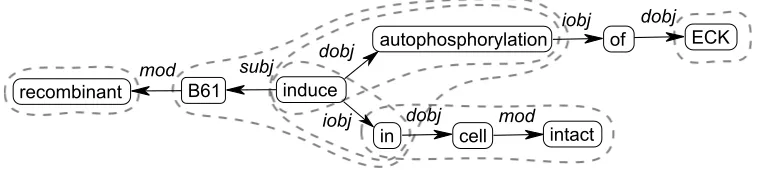
This definition is intended to allow extraction of a wide variety of fragments from a dependency tree or graph representation of sentences found using any appropriate parser capable of returning such output (e.g. K¨ubler et al., 2009). The definition covers single- or multi-word constituents functioning as de-pendents (e.g.sites,putative binding sites), text ad-juncts (in the cell wall), single- or multi-word pred-icates (* binds to receptors in the airways) and rela-tions (* binds and activates *) including ones with ‘internal’ dependent slots (* inhibits * at *), some of which may be fixed in the fragment (* induces au-tophosphorylation of * in * cells), and also full sen-tences1. An example dependency graph and some selected fragments can be seen in Figure 1.
Our aim is to detect semantically similar frag-ments which can be substituted for each other in text, resulting in more general or more specific versions of the same proposition. This kind of similarity can be thought of as an entailment relation and we define entailment between two fragments as follows:
1
induce
in B61
recombinant
autophosphorylation of ECK
cell intact
mod
mod subj
iobj
iobj dobj
dobj
[image:3.612.117.497.56.141.2]dobj
Figure 1: Dependency graph for the sentence:Recombinant B61 induces autophosphorylation of ECK in intact cells. Some interesting fragments are marked by dotted lines.
Definition 2. Fragment A entails fragment B (A→
B) if A can be replaced by B in sentence S and the re-sulting sentence S’ can be entailed from the original one (S→S’).
This also requires estimating entailment relations between sentences, for which we use the definition established by Bar-Haim et al. (2006):
Definition 3. Text T entails hypothesis H (T→ H) if, typically, a human reading T would infer that H is most likely true.
We model the semantic similarity of fragments as a combination of two separate directional similarity scores:
1. Intrinsic similarity: how similar are the com-ponents of the fragments.
2. Extrinsic similarity: how similar are the con-texts of the fragments.
To find the overall score, these two similarity measures are combined linearly using a weighting parameterα:
Score(A→B) =α×IntSim(A→B) +(1−α)×ExtSim(A→B)
In this paper f(A → B) designates an asym-metric function between AandB. When referring only to single words, lowercase letters (a,b) are used; when referring to fragments of any size, including single words, then uppercase letters are used (A,B). Score(A→B)is the confidence score that frag-ment A entails fragment B – higher score indi-cates higher confidence and0means no entailment. IntSim(A→B)is the intrinsic similarity between
two fragments. It can be any function that compares them, for example by matching the structure of one fragment to another, and outputs a similarity score in the range of[0,1]. ExtSim(A → B)is a measure of extrinsic similarity that compares the contexts of the two fragments. α is set to 0.5 for an unsuper-vised approach but the effects of tuning this param-eter are further analysed in Section 5.
The directional similarity score is first found be-tween words in each fragment, which are then used to calculate the score between the two fragments.
3.1 Intrinsic similarity
IntSim(A→B)is the intrinsic similarity between the two words or fragments. In order to best capture entailment, the measure should be non-symmetrical. We use the following simple formula for word-level score calculation:
IntSim(a→b) = length(c)
length(b)
wherecis the longest common substring for aand b. This measure will show the ratio ofbthat is also contained ina. For example:
IntSim(overexpress→expression) = 0.70
IntSim(expression→overexpress) = 0.64
The intrinsic similarity function for fragments is defined using an injective function between compo-nents ofAand components ofB:
IntSim(A→B) = M apping(A→B)
|B|
where M apping(A → B) is a function that goes through all the possible word pairs {(a, b)|a ∈
with the highest entailment score, returning the sum of those scores. Figure 2 contains pseudocode for the mapping process. Dividing the value of M apping(A → B) by the number of components inB gives an asymmetric score that indicates how well B is covered by A. It returns a lower score ifB contains more elements thanAas some words cannot be matched to anything. While there are ex-ceptions, it is common that if B is larger than A, then it cannot be entailed byA as it contains more information.
whileunused elements in A and Bdo bestScore= 0
fora∈A, b∈B, a and b are unuseddo ifScore(a→b)> bestScorethen
bestScore=Score(a→b)
end if end for
total+ =bestScore end while
return total
Figure 2: Pseudocode for mapping between two frag-ments
The word-level entailment score Score(a → b)
is directly used to estimate the entailment score be-tween fragments,Score(A → B). In this case we are working with two levels – fragments which in turn consist of words. However, this can be extended to a truly recursive method where fragments consist of smaller fragments.
3.2 Extrinsic similarity
The extrinsic similarity between two fragments or words is modelled using measures of directional dis-tributional similarity. We define a context relation as a tuple(a, d, r, a0)whereais the main word,a0 is a word connected to it through a dependency relation, ris the label of that relation anddshows the direc-tion of the reladirec-tion. The tuplef : (d, r, a0)is referred to as a feature ofa.
To calculate the distributional similarity between two fragments, we adopt an approach similar to Weeds et al. (2005). Using the previous notation,
(d, r, a0) is a feature of fragmentA if(d, r, a0) is a feature for a word which is contained inA. The gen-eral algorithm for feature collection is as follows:
1. Find the next instance of a fragment in the background corpus.
2. For each word in the fragment, find dependency relations which connect to words not contained in the fragment.
3. Count these dependency relations as distribu-tional features for the fragment.
For example, in Figure 1 the fragment(* induces * in *)has three features: (1, subj, B61), (1, dobj, autophosphorylation)and(1, dobj, cell).
The BioMed Central2 corpus of full papers was used to collect distributional similarity features for each fragment. 1000 papers were randomly selected and separated for constructing the test set, leaving 70821 biomedical full papers. These were tokenised and parsed using the RASP system (Briscoe et al., 2006) in order to extract dependency relations.
We experimented with various schemes for fea-ture weighting and found the best one to be a varia-tion of Dice’s coefficient (Dice, 1945), described by Curran (2003):
wA(f) =
2P(A, f)
P(A,∗) +P(∗, f)
wherewA(f)is the weight of featureffor fragment
A, P(∗, f) is the probability of the feature appear-ing in the corpus with any fragment,P(A,∗)is the probability of the fragment appearing with any fea-ture, andP(A, f)is the probability of the fragment and the feature appearing together.
Different measures of distributional similarity, both symmetrical and directonal, were also tested andClarkeDE (Clarke, 2009) was used for the fi-nal system as it achieved the highest performance on graph fragments:
ClarkeDE(A→B) =
P
f∈FA∩FBmin(wA(f), wB(f))
P
f∈FAwA(f)
whereFAis the set of features for fragmentAand
wA(f)is the weight of featuref for fragmentA. It
quantifies the weighted coverage of the features ofA by the features ofBby finding the sum of minimum weights.
TheClarkeDEsimilarity measure is designed to detect whether the features ofAare a proper subset of the features of B. This works well for finding more general versions of fragments, but not when comparing fragments which are roughly equal para-phrases. As a solution we constructed a new mea-sure based on the symmetrical Lin meamea-sure (Lin, 1998).
LinD(A→B) =
P
f∈FA∩FB[wA(f) +wB(f)]
P
f∈FAwA(f) +
P
f∈FA∩FBwB(f)
Compared to the original, the features ofBwhich are not found in A are excluded from the score calculation, making the score non-symmetrical but more balanced compared to ClarkeDE. We ap-plied this for word-level distributional similarity and achieved better results than with other common sim-ilarity measures.
The LinD similarity is also calculated between fragment levels to help detect possible paraphrases. If the similarity is very high (greater than 85%), then a symmetric relationship between the fragments is assumed and the value ofLinDis used asExtSim. Otherwise, the system reverts to the ClarkeDE measure for handling unidirectional relations.
3.3 Hedging and negation
Language constructions such as hedging and nega-tion typically invert the normal direcnega-tion of an en-tailment relation. For example, (biological discov-ery→discovery) becomes (no biological discovery
←no discovery) and (is repressed by→is affected by) becomes (may be repressed by←is affected by). Such cases are handled by inverting the direction of the score calculation if a fragment is found to contain a special cue word that commonly indicates hedged language or negation. In order to find the list of indicative hedge cues, we analysed the train-ing corpus of CoNLL 2010 Shared Task (Farkas et al., 2010) which is annotated for speculation cues and scopes. Any cues that occurred less than5times or occurred more often as normal text than as cue words were filtered out, resulting in the following list:
(4) suggest, may, might, indicate that, appear, likely, could, possible, whether, would, think,
seem, probably, assume, putative, unclear, propose, imply, possibly
For negation cues we used the list collected by Morante (2009):
(5) absence, absent, cannot, could not, either, except, exclude, fail, failure, favor over, impossible, instead of, lack, loss, miss, negative, neither, nor, never, no, no longer, none, not, rather than, rule out, unable, with the exception of, without
This is a fast and basic method for estimating the presence of hedging and negation in a fragment. When dealing with longer texts, the exact scope of the cue word should be detected, but for relatively short fragments the presence of a keyword acts as a good indication of hedging and negation.
4 Evaluation
A “pilot” dataset was created to evaluate different entailment detection methods between fragments3. In order to look for valid entailment examples, 1000 biomedical papers from the BioMed Central full-text corpus were randomly chosen and analysed. We hypothesised that two very similar sentences orig-inating from the same paper are likely to be more and less general versions of the same proposition. First, the similarities between all sentences in a sin-gle paper were calculated using a bag-of-words ap-proach. Then, ten of the most similar but non-identical sentence pairs from each paper were pre-sented for manual review and 150 fragment pairs were created based on these sentences, 100 of which were selected for the final set.
When applied to sentence-level entailment extrac-tion, similar methods can suffer from high lexical overlap as sentences need to contain many match-ing words to pass the initial filter. However, for the extraction of entailing fragments most of the match-ing words are discarded and only the non-identical fragments are stored, greatly reducing the overlap problem. Experiments in Section 5 demonstrate that a simple bag-of-words approach performs rather poorly on the task, confirming that the extraction method produces a diverse selection of fragments.
Two annotators assigned a relation type to can-didate pairs based on how well one fragment can be substituted for the other in text while preserving meaning (A ↔ B, A → B,A ← B orA 6= B). Cohen’s Kappa between the annotators was0.88, in-dicating very high agreement. Instances with dis-agreement were then reviewed and replaced for the final dataset.
Each fragment pair has two binary entailment de-cisions (one in either direction) and the set is evenly balanced, containing 100 entailment and 100 non-entailment relations. An example sentence with the first fragment is also included. Fragment sizes range from 1 to 20 words, with the average of 2.86 words. The system assigns a score to each entailment re-lation, with higher values indicating higher confi-dence in entailment. All the relations are ranked based on their score, and average precision (AP) is used to evaluate the performance:
AP = 1
R
N
X
i=1
E(i)×CorrectU pT o(i)
i
where R is the number of correct entailment re-lations, N is the number of possible relations in the test set, E(i) is 1 if the i-th relation is en-tailment in the gold standard and 0 otherwise, and CorrectU pT o(i) is the number of correctly re-turned entailment relations up to rank i. Average precision assigns a higher score to systems which rank correct entailment examples higher in the list.
As a secondary measure we also report the Break-Even Point (BEP) which is defined as precision at the rank where precision is equal to recall. Using the previous annotation, this can also be calculated as precision at rankR:
BEP = CorrectU pT o(R)
R
BEP is a much more strict measure, treating the task as binary classification and ignoring changes to the ranks within the classes.
5 Results
The test set is balanced, therefore random guessing would be expected to achieve an AP and BEP of
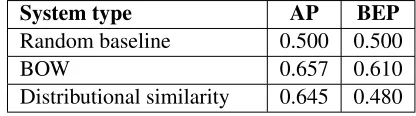
0.5which can be regarded as the simplest (random) baseline. Table 1 contains results for two more basic
approaches to the task. For the bag-of-words (BOW) system, the score ofAentailingBis the proportion of words inB that are also contained inA.
Scorebow(A→B) =
|{b|b∈A, B}| |{b|b∈B}|
We also tested entailment detection when using only the directional distributional similarity between fragments as it is commonly done for words. While both of the systems perform better than random, the results are much lower than those for more informed methods. This indicates that even though there is some lexical overlap between the fragments, it is not enough to make good decisions about the entailment relations.
System type AP BEP
Random baseline 0.500 0.500
BOW 0.657 0.610
[image:6.612.321.529.287.345.2]Distributional similarity 0.645 0.480
Table 1: Results for basic approaches.
Table 2 contains the results for the system de-scribed in Section 3. We start with the most basic version and gradually add components. Using only the intrinsic similarity, the system performs better than any of the basic approaches, delivering 0.71 AP.
System type AP BEP
Intrinsic similarity only 0.710 0.680
+ Word ExtSim 0.754 0.710
+ Fragment ExtSim 0.801 0.710
+ Negation & hedging 0.831 0.720
+ Paraphrase check 0.841 0.720
Table 2: Results for the system described in Section 3. Components are added incrementally.
Next, the extrinsic similarity between words is in-cluded, raising the AP to 0.754. When the string-level similarity fails, the added directional distri-butional similarity helps in mapping semantically equivalent words to each other.
larger and occur less often in a corpus, their distribu-tional similarity can still be used as a valuable com-ponent to detect semantic similarity and entailment. Checking for negation and hedge cues raises the AP to0.831. The performance is already high and a3%improvement shows that hedging and negation affect fragment-level entailment and other compo-nents do not manage to successfully capture this in-formation.
Finally, applying the fragment-level check for paraphrases with a more appropriate distributional similarity measure, as described in Section 3.2, re-turns an AP of0.841. The results of this final con-figuration are significantly different compared to the initial system using only intrinsic similarity, accord-ing to the Wilcoxon signed rank test at the level of
0.05.
The formula in Section 3 contains parameter α which can be tuned to adjust the balance of intrinsic and extrinsic similarity. This can be done heuristi-cally or through machine learning methods and dif-ferent values can be used for fragments and words. In order to investigate the effects of tuning on the system, we tried all possible combinations ofαword
andαf ragmentwith values between0and1at
incre-ments of0.05. Table 3 contains results for some of these experiments.
αword αf ragment AP BEP
0.5 0.5 0.841 0.720
* 0.0 0.656 0.480
0.0 1.0 0.813 0.720
1.0 1.0 0.765 0.690
[image:7.612.84.289.435.520.2]0.45 0.65 0.847 0.740
Table 3: Results of tuning the weights for intrinsic and distributional similarity.
The best results were obtained withαword = 0.45
and αf ragment = 0.65, resulting in 0.847 AP and 0.74BEP. This shows that parameter tuning can im-prove the results, but the 0.6% increase is modest and a completely unsupervised approach can give competitive results. In addition, the optimal values ofα are close to0.5, indicating that all four com-ponents (intrinsic and distributional similarities be-tween words and fragments) are all contributing to the performance of the final system.
6 Previous work
Most work on entailment has focused on compar-ing sentences or paragraphs. For example, Haghighi et al. (2005) represent sentences as directed depen-dency graphs and use graph matching to measure se-mantic overlap. This method also compares the de-pendencies when calculating similarity, which sup-ports incorporation of extra syntactic information. Hickl et al. (2006) combine lexico-syntactic features and automatically acquired paraphrases to classify entailing sentences. Lintean and Rus (2009) make use of weighted dependencies and word semantics to detect paraphrases. In addition to similarity they look at dissimilarity between two sentences and use their ratio as the confidence score for paraphrasing.
Lin and Pantel (2001) were one of the first to extend the distributional hypothesis to dependency paths to detect entailment between relations. Szpek-tor et al. (2004) describe the TEASE method for ex-tracting entailing relation templates from the Web. Szpektor and Dagan (2008) use the distributional similarity of arguments to detect unary template en-tailment, whilst Berant et al. (2010) apply it to bi-nary relations in focused entailment graphs.
Snow et al. (2005) described a basic method of syntactic pattern matching to automatically discover word-level hypernym relations from text. The use of directional distributional similarity measures to find inference relations between single words is explored by Kotlerman et al. (2010). They propose new mea-sures based on feature ranks and compare them with existing ones for the tasks of lexical expansion and text categorisation.
In contrast to current work, each of the ap-proaches described above only focuses on detecting entailment between specific subtypes of fragments (either sentences, relations or words) and optimis-ing the system for a soptimis-ingle scenario. This means only limited types of entailment relations are found and they cannot be used for entailment generation or compositional entailment detection as described in Section 2.
a syntax tree and then used to compose the result-ing entailment decision. However, their system fo-cuses more on natural logic and uses a predefined set of compositional rules to capture a subset of valid inferences with high precision but low recall. It also relies on a supervised classifier and information from WordNet to reach the final entailment decision. Androutsopoulos and Malakasiotis (2010) have assembled a survey of different tasks and approaches related to paraphrasing and entailment. They de-scribe three different goals (paraphrase recogni-tion, generation and extraction) and analyse various methods for solving them.
7 Conclusion
Entailment detection systems are generally devel-oped to work on specific text units – either single words, relations, or full sentences. While this re-duces the complexity of the problem, it can also lead to important information being disregarded. In this paper we proposed a new task – detecting en-tailment relations between any kind of dependency graph fragments. The definition of a fragment cov-ers the language structures mentioned above and also extends to others that have not been fully in-vestigated in the context of entailment recognition (such as multi-word constituents, predicates and ad-juncts).
To perform entailment detection between various types of dependency graph fragments, a new sys-tem was built that combines the directional intrin-sic and extrinintrin-sic similarities of two fragments to reach a final score. Fragments which contain hedg-ing or negation are identified and their score cal-culation is inverted to better model the effect on entailment. The extrinsic similarity is found with two different distributional similarity measures, first checking for symmetric similarity and then for di-rectional containment of distributional features. The system was evaluated on a manually constructed dataset of fragment-level entailment relations from the biomedical domain and each of the added meth-ods improved the results.
Traditionally, the method for entailment recogni-tion is chosen based on what appears optimal for the task – either structure matching or distributional similarity. Our experiments show that the
combina-tion of both gives the best performance for all frag-ment types. It is to be expected that single words will benefit more from distributional measures while full sentences get matched by their components. How-ever, this separation is not strict and evidence from both methods can be used to strengthen the decision. The experiments confirmed that entailment be-tween dependency graph fragments of various types can be detected in a completely unsupervised set-ting, without the need for specific resources or an-notated training data. As our method can be applied equally to any domain and requires only a large plain text corpus, we believe it is a promising direction for research in entailment detection. This can lead to useful applications in biomedical information ex-traction where manually annotated datasets are in short supply.
We have shown that a unified approach can be used to detect entailment relations between depen-dency graph fragments. This allows for entail-ment discovery among a wide range of fragentail-ment types, including ones for which no specialised sys-tems currently exist. The framework for fragment-level entailment detection can be integrated into var-ious applications that require identifying and rewrit-ing semantically equivalent phrases - for example, query expansion in IE and IR, text mining, sentence-level entailment composition, relation extraction and protein-protein interaction extraction.
References
Ion Androutsopoulos and Prodromos Malakasiotis. 2010. A survey of paraphrasing and textual entailment methods. Journal of Artificial Intelligence Research, 38(7):135–187.
Roy Bar-Haim, Ido Dagan, Bill Dolan, Lisa Ferro, Danilo Giampiccolo, Bernardo Magnini, and Idan Szpektor. 2006. The second pascal recognising textual entail-ment challenge. In Proceedings of the Second PAS-CAL Challenges Workshop on Recognising Textual Entailment, pages 1–9. Citeseer.
Jonathan Berant, Ido Dagan, and Jacob Goldberger. 2010. Global learning of focused entailment graphs. InProceedings of the 48th Annual Meeting of the Asso-ciation for Computational Linguistics, number Section 6, pages 1220–1229. Association for Computational Linguistics.
Ted Briscoe, John Carroll, and Rebecca Watson. 2006. The second release of the RASP system. In Proceed-ings of the COLING/ACL 2006 Interactive Presenta-tion Sessions, number July, pages 77–80, Sydney, Aus-tralia. Association for Computational Linguistics. Daoud Clarke. 2009. Context-theoretic semantics for
natural language: an overview. In Proceedings of the Workshop on Geometrical Models of Natural Lan-guage Semantics, number March, pages 112–119. As-sociation for Computational Linguistics.
James Richard Curran. 2003. From distributional to se-mantic similarity. Ph.D. thesis, University of Edin-burgh.
Lee R. Dice. 1945. Measures of the amount of ecologic association between species. Ecology, 26(3):297–302. Rich´ard Farkas, Veronika Vincze, Gy¨orgy M´ora, J`anos Csirik, and Gy¨orgy Szarvas. 2010. The CoNLL-2010 Shared Task: Learning to Detect Hedges and their Scope in Natural Language Text. In Proceedings of the Fourteenth Conference on Computational Natural Language Learning — Shared Task, pages 1–12. As-sociation for Computational Linguistics.
Aria D. Haghighi, Andrew Y. Ng, and Christopher D. Manning. 2005. Robust textual inference via graph matching. In Proceedings of the conference on Hu-man Language Technology and Empirical Methods in Natural Language Processing, Morristown, NJ, USA. Association for Computational Linguistics.
Andrew Hickl, Jeremy Bensley, John Williams, Kirk Roberts, Bryan Rink, and Ying Shi. 2006. Recog-nizing textual entailment with LCC’s GROUNDHOG system. InProceedings of the Second PASCAL Chal-lenges Workshop.
Lili Kotlerman, Ido Dagan, Idan Szpektor, and Maayan Zhitomirsky-Geffet. 2010. Directional distributional similarity for lexical inference. Natural Language En-gineering, 16(04):359–389.
Sandra K¨ubler, Ryan McDonald, and Joakim Nivre. 2009. Dependency Parsing. Synthesis Lectures on Hu-man Language Technologies, 2:1–127.
Dekang Lin and Patrick Pantel. 2001. Discovery of infer-ence rules for question-answering. Natural Language Engineering, 7(04):343–360.
Dekang Lin. 1998. Automatic retrieval and cluster-ing of similar words. In Proceedings of the 17th in-ternational conference on Computational linguistics-Volume 2, pages 768–774. Association for Computa-tional Linguistics.
Mihain C. Lintean and Vasile Rus. 2009. Para-phrase Identification Using Weighted Dependencies and Word Semantics. InProceedings of the FLAIRS-22, volume 22, pages 19–28.
Bill MacCartney and Christopher D. Manning. 2008. Modeling semantic containment and exclusion in natu-ral language inference. InProceedings of the 22nd In-ternational Conference on Computational Linguistics-Volume 1, pages 521–528. Association for Computa-tional Linguistics.
Roser Morante. 2009. Descriptive analysis of negation cues in biomedical texts. InProceedings of the Sev-enth International Language Resources and Evalua-tion (LREC10), pages 1429–1436.
Mark Sammons, V.G. Vinod Vydiswaran, and Dan Roth. 2010. Ask not what textual entailment can do for you... InProceedings of the Annual Meeting of the As-sociation of Computational Linguistics (ACL), pages 1199–1208. Association for Computational Linguis-tics.
Rion Snow, Daniel Jurafsky, and Andrew Y. Ng. 2005. Learning syntactic patterns for automatic hypernym discovery. In Advances in Neural Information Pro-cessing Systems.
Idan Szpektor and Ido Dagan. 2008. Learning entail-ment rules for unary templates. InProceedings of the 22nd International Conference on Computational Lin-guistics - COLING ’08, pages 849–856, Morristown, NJ, USA. Association for Computational Linguistics. Idan Szpektor, Hristo Tanev, Ido Dagan, and
Bonaven-tura Coppola. 2004. Scaling web-based acquisition of entailment relations. InProceedings of EMNLP, vol-ume 4, pages 41–48.