http://dx.doi.org/10.4236/jis.2013.41006 Published Online January 2013 (http://www.scirp.org/journal/jis)
Technology of Secure File Archiving in the Uniformly
Random Distributed Archive Scheme
Ahmed Tallat, Hiroshi Yasuda, Kilho Shin
Applied Information Engineering, Tokyo Denki University, Tokyo, Japan Email: [email protected]
Received September 29, 2012; revised October 30, 2012; accepted November 10, 2012
ABSTRACT
This paper investigates the security features of the distributed archive scheme named Uniformly Random Distributed Archive (URDA). It is a simple, fast and practically secure algorithm that meets the needs of confidentiality and avai- lability requirements of data. URDA cuts a file archived into fragments, and distributes each fragment into randomly selected n− k + 1 storages out of n storages. As the result, users only need to access at least k storages to recover origi-nal file, whereas stolen data from k − 1 storages cannot cover original file. Thus, archived files are nothing but se-quences of a large number of fixed length fragments. URDA is proved of disappearing both characters and biased bits of original data in archived files, indicating the probabilities of both a fragment and a bit appearing at particular position are uniformly constant respectively. Yet, through running experiments, we found out the risk of likelihood that URDA might be vulnerable to bit pattern attack due to the different ratios of characters appearing in real world files. However, we solved the problem by modifying URDA with variable fragment lengths, which results in that all the bits in revealed sequences are distributed uniformly and independently at random.
Keywords: Cloud Computing; Archive; Secret Sharing; Character Set
1. Introduction
Cloud computing is attracting attentions of people of a wide variety of fields including users, service providers and facility manufacturers. From the users’ point of view, the most attractive advantages of cloud computing must be the ubiquity and affordability of services that cloud computing can realize. Since cloud computing is con- structed on top of the Internet, users can take advantage of services anytime and anywhere. The recent rapid sp- read of mobile computing certainly enhances the de- mands for the ubiquity of service provision. On the other hand, the affordability of cloud computing is based on exploitation of public infrastructures. The Internet itself is apparently public good, and cloud computing is enlar- geing its scope to computational powers and storages that are available in the Internet. For example, the data back- up services provided by data center companies are very expensive, and small and middle-sized enterprises cannot afford them. In contrast, the same services are now being provided at significantly lower prices based on cloud computing.
Thus, the advantages of cloud computing are due to the fundamental idea of exploiting the Internet and public goods existing in the Internet. This, however, can pro- duce disadvantages as well. In particular, in terms of se-
curity, the Internet has serious problems. ISO 17799 [1] determines that confidentiality, integrity and availability (CIA) are the three important factors in considering se- curity issues, and the Internet has vulnerability in all of them: Communication over the Internet is in principle subject to eavesdropping and tampering; Nobody con- trols the overall the services of the Internet, and cutoff and delay of communication can happen anytime. Fur- thermore, we cannot deny the possibility that the provid- ers of services are malicious. Although cryptographic technology will provide us with strong countermeasures with respect to confidentiality and integrity, we need different technologies to solve the issue of availability.
Let’s consider a data backup service based on cloud computing. A user uploads his or her data to the Internet for the backup purpose, and the data are distributed across many inexpensive storages unknown to the user. Different storage providers operate different storages under different policies. Even their connectivity may vary. Thus, the user can have a problem when he or she needs to restore the data. In the worst case scenario, it is still possible that some of storage providers have ceased their services without notification, and therefore, a part of the backup data has been lost forever.
already had technologies to realize availability by re- dundant storing.
RAID [2] (Redundant Array of Inexpensive Disks) is daily use technology, and combines more than one physical hard disks into a single logical unit by distribut- ing the whole data mostly with redundancy across multi- ple disks, which is necessary in case of data lost; A failed disk is replaced by a new one, and the lost data will be built from the remaining data and the redundancy such as parity data. This technology enables computer users to achieve high level storage reliability from PC-class com- ponents.
Although RAID is appropriate to apply to “home” servers, it has evidently issues in its scalability. In par- ticular, RAID can accept failures of only one (RAID 3 and 5) or two disks, and will not be able to apply to the Internet, where users may lose access to more than two storages.
The technology known as “secret sharing” also pro- vide a method to distribute secret information with re- dundancy: For , n members have their shares derived from a secret, and the secret will be completely reconstructed when k members exhibit their own shares; By contrast, collusion of (k − 1) members will reveal none or only a few bits of the secret. This property of secret sharing is referred to as k-out-of-n threshold se-crecy. The initial (k, n) threshold secret sharing scheme (SSS) known in the literature were independently in-vented by Adi Shamir [3] and George Blackley [4] in 1979, and since then the scheme has been widely studied and applied on a variety of fields. (for example, Rabin [5], Bai [6,7], Blundo [8], He [9], Wang [10]).
0 n k
Although these schemes support the severe require- ment of k-out-of-n threshold secrecy, their computational complexity is extremely high, and it cannot show practi- cal performance when applied to archive of bulky data: data should be fragmented into a number of fragments so that they are short enough to be dealt with by the secret sharing algorithms, and the algorithms need heavy com- putation such as modular exponentiation and matrix ma- nipulation in calculating shares from each fragment.
The recent technology of P2P also provides the func- tion of storing data with redundancy. P2P aims at sharing decentralized resources (CPU, storage, bandwidth and contents) of each participant, while eliminating conven- tional centralized unit to provide browsing and down- loading, and thus the participants are both consumer and provider of the resources in distributed networks. The principle is simply uploading and downloading simulta- neously and continuously, and the acceleration of data transferring can be improved significantly by download- ing desired pieces simultaneously with random order from multiple providers that treat distributed contents as
sequence of pieces through fragmenting them into se- quences. We already have several P2P based global sto- rage products (for example, OceanStore [11] and PAST [12]).
The most important problem of the P2P technology when applying to our purpose should be its extremely low efficiency in storage spaces and bandwidth. The ini- tial aim of P2P is to realize sharing data among an un- specified number of people, and hence, data are ex- changed and stored with very high redundancy exceeding the necessity for the backup purpose.
In our previous work [13], we investigated a simple scheme, called the uniformly random distributed archive scheme (URDA). The algorithm of URDA is extremely simple and easy: The original data is fragmented into a number of tiny fragments (several bits long), and each fragment is distributed across n − k + 1 storages out of n storages: The most important feature of URDA consists in that the selection of the n − k + 1 storages is domi-nated by a completely random process: Storages are se-lected uniformly and independently at random per frag-ment. By this, URDA meets the condition of k-out-of-n threshold robustness: that is, even if the owner of the data loses access to k− 1 storages of the entire n storages, the user can restore the original data from the data fragments retrieved from the remaining k storages.
In terms of confidentiality, it has been revealed in pre- vious work that URDA has a couple of remarkable prop- erties.
1) Except for bits existing in the very narrow neigh- borhood of the start and the end of the original file, the probability that a guess on the position where a particular fragment of the original file appears in a distributed backup file is very small, and almost constant.
2) When assuming that the original data consists of ASCII characters selected at random from the entire pos-sible values, the probability that a particular bit pattern appears at a particular position in a distri- buted backup file is independent of the position. To be precise, we can theoretically derive the following formula.
11 1 7 9
Pr 0
8 2 2 2
t t l l l l
l l l b b
4 (1)
The symbol bt represents the t-th bit from the head of
the backup data, and the formula holds unless the bit falls into narrow neighborhoods of the head and the tail of the distributed backup file.
pears every eight bits, disappears in distributed backup files. Thus, these properties indicate the possibility that URDA can provide confidentiality of a certain degree, without relying on cryptographic techniques. This would be an important advantage of URDA in terms of time- efficiency of the scheme.
In this paper, we further investigate the second prop- erty. In the real world, any text files have particular bi- ases in the distributions of bit patterns, and the theoretic- cal conclusion of URDA might not hold true for data in the real world. We struggle with this problem through experiments.
In the experiments, we downloaded 200 ASCII files from the Internet, applied URDA to these files to gene- rate 1000 backup files, and looked into the statistical features of the backup files. First, we found that the Equation (1) still holds true for the backup files we in- vestigated in our experiments. This was verified by per- forming the one-sample t-test: It has turned out that the “null” hypothesis that the Equation (1) does hold cannot be rejected even with a large significance level. Secondly, we synthetically generated 200 random ASCII files and 1000 backup files in the same way as for the downloaded ASCII files. Then, we compared between the synthetic and the real backup files in terms of the variance of the distributions of the particular bit pattern. The result this time showed that the null hypothesis can be rejected with the significance level 0.05 by the F-test. This means that the distributions of bit patterns between the real and syn- thetic backup files are different, and therefore, we cannot deny the possibility that a clever attacker can invent an effective pattern analysis to guess the original contents from the contents of the backup files.
Based on the result of this experiment, we modified the algorithm of URDA so that the length of fragments are to be determined at random per fragment, and per- formed the same experiment using this modified URDA. The result was surprising. The two groups of distribu- tions, one for the real backup files generated by the modified URDA and the other for the synthetic backup files, are concluded to be the same. To be precise, even with a large significance level, we could not reject the null hypotheses that claim that the distributions are the same as Gaussian distributions. This consequence is sig- nificant: The backup files of real ASCII files generated by the modified URDA are indistinguishable from the synthetic backup files. By definition, the synthetic backup files show the uniform randomness in terms of bit pattern distributions, and hence, we can conclude backup files generated by the modified URDA are secure against bit pattern analysis.
Following Section 2 describes some related studies followed by URDA scheme proposed in previous paper for the consistency of the paper, and it also includes
analyses of security feature of URDA. Section 3 clarifies problem that the paper is tackling, and provides solution by running experiments and applying statistical methods. We conclude the paper with future work in section 4.
2. Distributed Archive Schemes
In this section, we provide a brief review over the data storage techniques of redundancy known in the literature, and then describe URDA proposed in our previous work.
2.1. Distributed Schemes in Storage Pools
Digital high density recording technologies have made a variety of data recorded in storage medium. As a result, the form of utilizing storage devices has been greatly changed, and a variety of home appliances, computers/ servers, and even micro device in mobiles have become to have their own storages and to utilize them at a higher level.
However, with the advent of the Internet the need of sharing information made rapid increase of data in terms of variability and amount, which in turn led to creation of high technical processing power of computers and also posed strong demand to the scale of flexibility of stor- ages for these ever-increasing data. Since there are limits of computational power and capacity within conventional devices having attached to individual storages inside, they are no longer able to meet the need the way of data being accessed, stored and shared. Furthermore, tracking and backing up files distributed into a variety of storages constitute significant hardship. Some storage techniques [14] try to address these problems by allowing all the files to be stored in a single, secure storage that can be accessed by other clients and servers regardless of the operating systems from anywhere within the same do- main.
However, to guarantee the availability, integrity and confidentiality of the data stored in storage medium is not easy task. Because every system is vulnerable to cer- tain damages caused by natural, physical and technical attacks, and thus these data can be lost, delayed or even stolen. Redundancy probably is the only feasible solution to address the issues. The fastest method to realize re- dundancy is replication [16], which distributes redun- dantly copied fragments of data across infrastructure, but it is space inefficient, and p2p is a typical example of the replication-based systems. Another resilient method is erasure coding that splits data into n fragments, which are then further redundantly encoded into k additional fragments using parity, matrix, polynomial etc. Thus, k specifies the level of resiliency or Maximum Distance Separable (MDS), where k = MDS.
techniques when applying them to cloud computing in the context of robustness and security, and to provide affordable backup techniques, we have introduced URDA in our previous work.
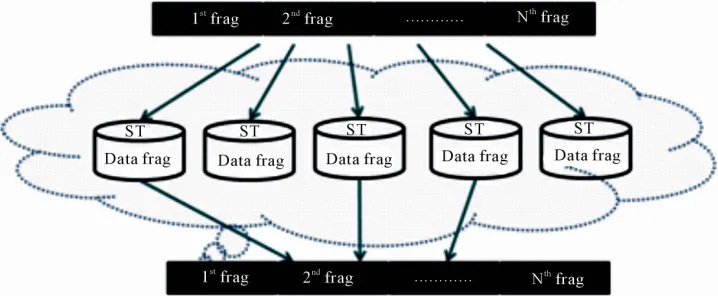
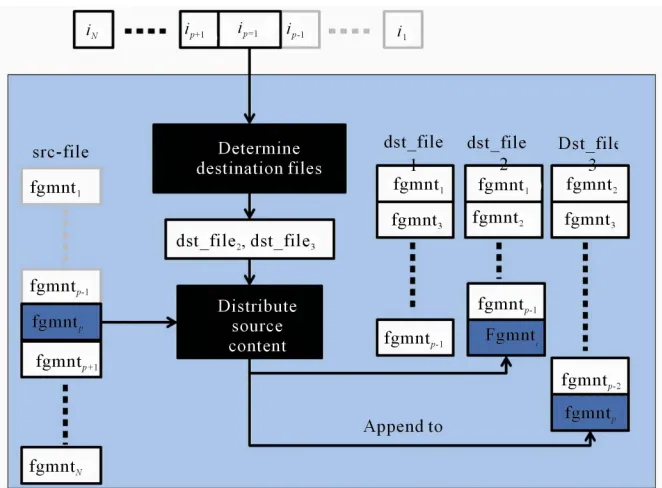
The outline of the algorithm of URDA is as follows: URDA first fragment the source file to archive into mul- tiple tiny fragments, and then distributes each fragment to n − k + 1 destination storages selected out of the entire n storages. The n − k + 1 storages are selected uniformly and independently at random per fragment. Thus, the source file is distributed across n storages, and each fragment is archived at exactly n − k + 1 different stora- ges. The simple image of URDA is shown in Figure 1.
To be specific, URDA consists of a smartcard and a host (e.g. client/server software), and they communicate with each other through a standardized interface like IC card interface [17], Near Field Communication [18] and Infrared Link Access Protocol [19]. The role of the smar- tcard is to generate random distribution keys taking ad- vantage of the key generator RNGK receiving seeds from
the seed generator RNGS, both RNGK and RNGS are in-
stalled inside the smartcard, whereas the host fragments the source file, duplicates the fragments, and distributing the copies generated across multiple storages, following the indication by the random distribution keys. In the following, we give a brief description of the archival and retrieval phases of URDA. The flow chart of the algo- rithm is shown in Figure 2.
Despite their values, widespread utilities, and reliabi- lities due to the capabilities of meeting the various needs for disaster recoveries, they all have drawbacks in terms of heavy cost and complex computational procedures. Because they use matrices, cryptography and heavy ma- thematical calculation etc. for producing redundancy, and applying them to large amount of data is very expensive, due to extremely time-consuming computational re- quirements, and even they are relatively inflexible, due to the complexity and difficulty of meeting various levels of desired security requirements as needed. What is more, dealing with cloud computing environment, for example for the purpose of backup of datacenter, is not easy with these schemes, due to lack of utilization of cost-effect readiness to use available storages provided. Thus, the currently heavy set-up cost and computational complex- ity cause significant hardship to utilize currently avai- lable storage services in order to realize secure backup services.
(1) Archival phase: The role of the smart card in the archival phase is to generate a series of distribution keys and to transmit them to the host. The algorithm of the smart card in the archival phase is as follows;
1) Receive the START_ARCHIVAL signal accompa- nying the identifier of the source file through the card- host interface. The identifier is denoted by crr_fid. 2.2. URDA-Uniformly Random Distributed
[image:4.595.119.478.570.718.2]Archive Scheme The seed is denoted by crr_seed. 2) Generate a random seed taking advantage of RNGS. 3) Store the pair of crr_fid and crr_seed in the internal In order to address aforementioned issues of current
Figure 2. The flow chart of URDA. database. The pair will be used in the retrieval phase.
4) Input crr_seed into RNGK.
5) Let RNGK generate a random number, which is an
index to determine the (n; k)-distribution key to be used by the host. The smart card outputs the random number to the host program.
6) Repeat Step 5 until it receives the END_OF_FILE signal from the host program.
On the other hand, the role of the host program in the archival phase is to distribute the contents of the source file over n destination files.
1) Fragment the source file into the b-bit long frag- ments of fgmnt1,···,fgmntlast, and create a pointer p to
indicate the current fragment fgmntp. The initial value of
p is 1.
2) Send the START_ARCHIVAL signal to the smart card.
3) Receive an index ip from the smart card.
4) Identify the distribution with index ip. The distribu-
tion key determines the set of n − k + 1 destination files to which the current fragment fgmntp is to be appended.
5) Take away the current fragment fgmntp from the
source file, and increment the pointer p by 1.
6) Append the fragment fgmntp to the destination files
determined in Step 4.
7) Repeat the steps from 3 to 6 until all the fragments are taken away from the source file.
8) Send the END_OF_File signal to the smart card. 9) The host program sends the resultant n destination files to n storages via networks.
(2) Retrieval phase: The algorithm of the smartcard in the retrieval phase is as follows:
1) Receive the START_RETRIEVAL signal accom- panying the identifier crr_fid of the target file from the host program.
2) Look up crr_fid in the internal database, and re- trieve the seed crr_seed paired with crr_fid.
3) Input crr seed into RNGK.
4) Output the random numbers ip that RNGK gener-
ates to the host program.
5) Repeat Step 4 until the END_OF_FILE signal is received.
On the other hand, algorithm of the host is described as follows.
1) Fragment the destination files into b-bit length frag- ments, create a pointer for each destination file. Initially, each pointer is set so that it indicates the first fragment.
2) Send the START_RETRIEVAL signal to the smart card.
3) Receive an index ipfrom the smart card. The initial
value of p shall be 1.
4) Determine the set of n − k + 1 destination files in which the current fragment fgmntpare included.
5) For each of the destination files determined in Step 4, take away the fragment indicated by the pointer asso-ciated with the destination file, and change the pointer so that it points the next fragment.
6) Append fgmntpto the source file, and increment p
by 1.
7) Repeat the steps of 3 to 6 until all of the destination files are empty.
The size of the resultant destination files is exactly
source file and the expected size of each destination file is
n k 1
n times smaller than the size of the source file, and thus it supports
k n,
robustness and
k n, security, which means that downloading from k storages is enough to recover original file and that even
k1
storages are attacked, the stolen data cannot cover total amount of the file.2.3. Security Features of URDA
In this clause, we summarize the security features of URDA that are presented in our previous work.
The probability that a specific fragment is not included in any of specific r storages is
1
1 1
n k n k n k r
n n n r
Thus, if r storages are compromised, the probability that all of the fragments are revealed is
1
1
1
N r
i
n k i n i
(2)
N is the total number of the fragments. When , the Equation (2) is 1, whereas, when r < k, it approaches 0, as N increases. This implies the k-out-of-n threshold secrecy: Even if k − 1 storages are compromised, the entire original contents will not be revealed.
r k
Definition 1. Let N and m denote the number of frag-
ments in a source file and a revealed sequence, and a and j denote the positions of a fragment in both the source file and the revealed sequence
respectively. Then we define thatdenotes the probability that a fragment at the position of a in the source file appears at the position of j in the re- vealed sequence.
1, 1
N a m j
a j N m, ; ,
MatchWhen a is fixed and j moves, following holds for the maximum value of Match
a j N m, ; ,
.1, ,
, ; , , 1
1 1
j m
am am
a j N m
N N
argmax Match
Thus, the maximum of when a is fixed and j moves, is given by the following formula.
, ; ,
a j N m
Match
1 4
1
, ; ,
1 π 1
am m N
a N m
N N a
Match
N a (3)
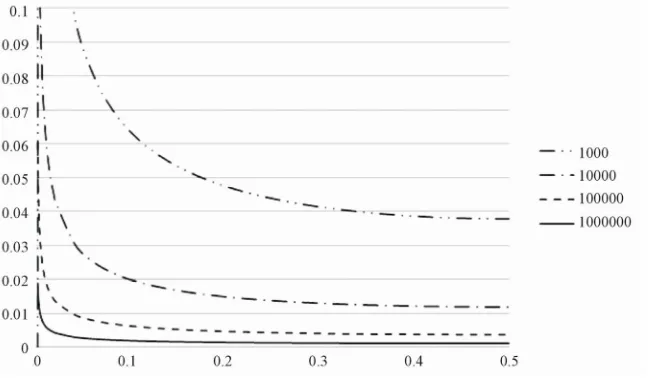
The minimum value of the equation can be reached at 1
2
N
a , and Figure 3 is its simulation result for the
value of N = 103,104, 105, 106 and 3 4 m N .
Thus, we can conclude that the security against identi- fying the position of a fragment is uniformly small ex- cept the fragments located in heads and tails. Further- more, obtaining further safety can be possible by adding dummy data at the heads and tails.
Next, we run a thought experiment. In the experiment, we see that the certain significant pattern of the bit dis- tribution of ASCII text files disappears in archived backup files. For the ASCII text files to use in the ex- periment, we assume that ASCII characters in the files are selected uniformly and independently at random per character from the entire possible values. Therefore, the bit distribution of the files is as follows: The most sig- nificant bit (MSB) of every byte is always 0, whereas the remaining bits are distributed uniformly and indepen- dently at random. Then, we define
mod8
, ,
a
q j a j N m
Match ; ,
to represent the probability that amod 8 holds when fgmntj is a copy of . Then, the probabi-
lity that the ρ-th bit
fgmnta
1,,7
of fgmntj is 0 turns [image:6.595.138.462.532.726.2]out to be
71
Pr 0 , 1 ,
2
j
b q j q j
(4)
A remarkable fact is that
,
1 8q j holds except
for narrow neighborhoods of j1 and j m . Hence, h
when t is not close to 1 or m, we ave the f wing ap- proximation.
ollo
1 41 1 7
0
8 2 2 2
t t l l l l
l l l 9
b
Through the same computation as above, we have the fo
P b
llowing.
Corollary 1. When t is not close to 1 or m,
Pr bt t, , bt l t l is approximately constant.
Corollary 2. When t is not close to 1 or m,
Pr
Corollary 1 and 2 impl , ,
t t t l t l
b b is approximately constant.
y that most of the bits in the re- ve
dentifying the problem,
g that source files include aled contents look almost the same in the attacker’s eye.
3. Problem and Solution
In following sections, through iwe provide particular solutions to address it. To proceed, we investigate experimentally on ASCII characters to see if bit patterns of source files can be disappeared in ar- chived files, and further demonstrate that practical secu- rity of plain text archiving can be obtain by varying fragment length in bit distribution.
3.1. Identified Problems
Our previous work, assumin
only ASCII characters selected uniformly and independ- ently at random, we mathematically proved that an ar- chived file consisting of seven-bit-long fragments shows uniformly constant distributions with respect to the probabilities that particular bit patterns appear in it. To be precise, we let C1CL be the byte contents of a file, where ci is an A haracter selected uniformly at
random om the entire space of ASCII characters. Then, we apply URDA to this file by setting the fragment length to be seven bits, and hence, the file content is fragmented into seven-bit-long fragments. The resulting archived files are collections of these fragments. Focus- ing on one of the archived files, we proved that the probability
SCII c fr
1 1 0
Pr bt l,bt l , , bt is
approximately f t,
unless t is too small or too large. bt denotes the bit at
the position t in the archived file, an 1, , 0
co regardless of the choice o
d nstant
is
an arbitrary bit pattern with i
0,1 hat we can view the archived file gainst bit pattern analysis, since the source file does not include any bitOn the other hand, text files found in the real world, even when they consist of ASCII characters, cannot help s. Thus,
. This means t as secure a
pattern except that the bit 0 appears every 8 bits, and this
pattern proves to disappear in the archived file.
s with a large e internet.
II files from diverse
ven as fol-
1) ternet, and download
them.
including biases in the distribution of character
the hypothesis of the aforementioned investigation does not necessarily hold, and hence, it is not certain that the conclusion of the investigation holds true for the real files.
The problem that we solve in this paper is first to in- vestigate whether the property that we proved in our pre- vious work also holds true for real files that include bi- ases in the distributions of characters. Then, we will an- swer the question whether URDA is secure against bit pattern analysis when applied to real files.
3.2. How to Solve the Problem
To solve this problem, we run experiment number of files that we obtain from th
To be specific, we download ASC
sites to apply URDA to these files, and then investigate the distributions of bit patterns that appear in the result- ing archived files. We first examine whether the mean of the probabilities that particular bit patterns (in the ex- periments, we focus on four bit patterns that are se- quences of 0) is identical to what was theoretically de- rived in Equation (1).
When we naturally assume that the probabilities ob- served follow Gaussian distributions, it is not sufficient to investigate only the means. We have to investigate the variances as well. For this purpose, in addition to the files obtained from the Internet, we generate synthetic ASCII files based on the uniformly random process: For each position in a file, an ASCII character is selected uniformly and independently at random. Then we com- pare the distributions of the probabilities of the same bit patterns between the archived files generated from the downloaded files and those derived from the synthetic files. The comparison will be made in terms of the means and the variances, since we assume that the distributions follow Gaussian distribution. Since the synthetic files are generated based on the same probabilistic model as what Equation (1) was based on, and since we concluded that such files are secure against bit pattern analysis, this comparison shows an answer to the question whether the same conclusion with respect to confidentiality holds true for real ASCII files.
3.3. URDA with the Setting of the Fragment Length = 7 bits
The procedures to run the experiment are gi lows.
2) Apply URDA to the downloaded files with n = 5 and k = 3, and hence, obtain 1000 archived files, each of w
ngth to be seven bits as specified in Section 2.2. hich is at least 100 KB length. Here, we set the frag- ment le
3) For t = 1 to 400,000, count the number nt of oc-
currence of btbt0 for 0,1, 2,3 over the 1,000 archived files, and calculate Pr
bt bt0
by1000. Thus, we have 400,000 scores of
t
n
Pr bt bt0 for each respect- tively.
0,1, 2,3
We plot these scores in the graphs of Figure 4.
Yet we are still unable to estimate whether the mathe- matical formula can a the real wor
files with fixed fragment length, without evaluat- in
rastically when s close to the head of the files),
to Equation (1).
lso apply to ld biased ASCII
g dispersion of the scores from means.
3.4. Statistical Tests
According to the mathematical evaluation given in URDA in previous work, the scores vary d
t is small (the position i but they quickly converge
In fact, when looking at Figure 4, the scores observed
in this experiment seem to follow this rule: The values of
4
9 2l
l
are 0.5625, 0.3125, 0.1719 and 0.0938 respec-
low t
ved in previous work.
tively for l = 0,1,2,3. In the following, we will investi- gate this, that is, whether the scores observed in fact fol- he statistically calculated mathematical formula pro-
3.4.1. Examining the Means
By the one-sample t-test, we investigate whether the
population means underlying the observed scores are identical to the test means calculated by Equation (1).
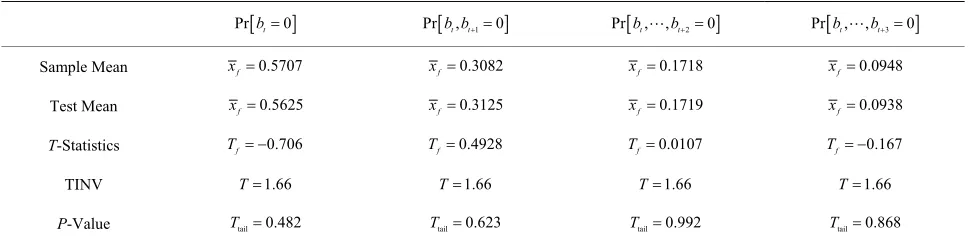
The null hypothesis here is of course that the popula- tion means are identical to the test means. Table 1 shows
the results of one-sample t-test.
The t statistics are calculated from the equation
x t
s n
, where x, , and n s stand for the sample
mean, test mean, sample size and standard deviation of the sample respectively. From Table 1, we see that we
cannot reject the null hypothesis even with very large significance level, say 0.2: Typically, we use the signify- cance level 0.05 or 0.01. Hence, we can reasonably guess that the null hypothesis is right, that is, the population means are identical to the theoretical value calculated by Equation (1).
3.4.2. Examining the Variances
In the previous clause, we see that the population means are identical to the theoretical means calculated from Equation (1). This result alone, however, is insufficient, since this result tells nothing about how the scores vary around the means. Thus, we have to investigate whether the population variances are sufficiently small. The prob- lem here is that, unlike the calculation of means, we do not have a formula to give the theoretical expectation for the variances. As an alternative method, we generate synthetic files that are generated based on the same probability model as the mathematical model that under- lies Equation (1), and compare the scores obtained from the experiment and the scores derived from these syn- thetic files.
1
57
144
114
287
1714
30
2285
73
2857
16
3428
59
1
57
144
114
287
1714
30
2285
73
2857
16
3428
59
1
57
144
114
287
17
14
30
22
85
73
28
57
16
34
28
59
1
5714
4
11
428
7
1714
30
2285
73
2857
16
3428
59
1
0.5
0
0.4
0.2
0
0.2
0 0.4
0.2
[image:8.595.112.484.506.722.2]0
Table 1. Comparing of observed scores and test means.
Prbt0 Prb bt, t10 Prbt, ,bt20 Prbt, ,bt30
0.5707
f
x xf0.3082 xf0.1718 xf0.0948
Sample Mean
0.5625
f
x xf0.3125 xf0.1719 xf0.0938
Test Mean
T-Statistics
TINV
0.706
f
T Tf0.4928 Tf0.0107 Tf 0.167
1.66
T 1.66T 1.66T 1.
P-Value
66 T
tail 0.482
T Ttail0.623 Ttail0.992 Ttail0.868
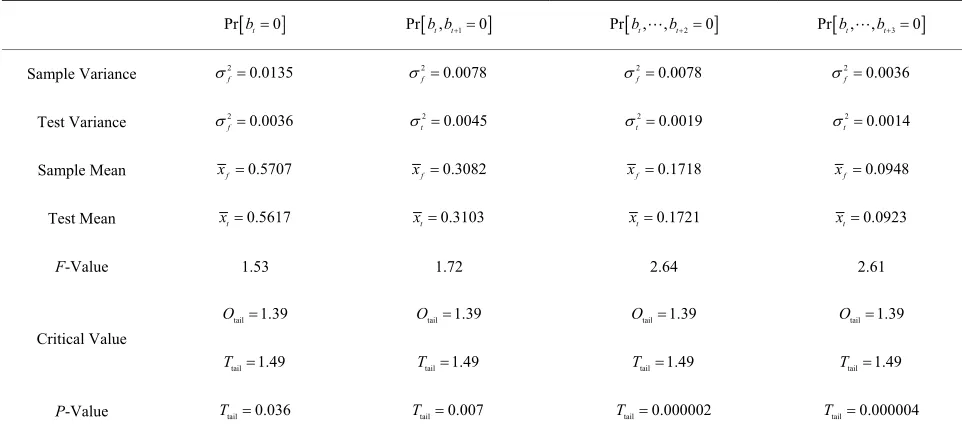
To be specific, we generate 200 files that include only ASCII characters selected uniformly and independently at random regardless of the position of the characters. Then, we apply Step 2 and 3 of Section 3.3 to obtain 400,000 scores for each of We call these scores test scores to distinguish them from the sample scores generated in
To verify this statistically, we
to the sample scores and the test scores. Consequently, the null h pothesis to use should be that the population vari ying the sample sco entical to those underlying the test scores.
Ta ws the result of the test, where 0,1, 2,3
.
Section 3.3.
apply two-sample F-test
y
ances underl res are id
ble 2 sho 2f and
2, and
t xf xt are
the variances and the he
sample scores and the test scores, resp ing to T 2, we see that the va
means of t ectively. Accord-
able riance 2f is greater
than 2 t
, while the means xf andxt
ng the P-v ce level 0.05,
are o
each en investigati alue ted in
e t with the significan nu
l model t
DA with the aforemen- tio
the Fragment
variable.
In the same way as Section 3.3, we obtain 400,000 sample scores for each of , and plot them in
Figure 5.
At a glance, the means of the sample scores are iden- tical to their theoretically expected values o
ve s prese
ry close t n we see that the ot
able her. Wh th
ll hypothesis should be rejected for all cases of 0,1, 2,3
. Thus, when we apply URDA to ASCII files downloaded from the Internet with the fixed fragment length seven bits, the resulting archived files will not be explained by the mathematica hat is a basis of Equation (1). In other words, we cannot prove that the archived files generated by UR
ned setting are secure against the bit pattern analysis, and we cannot recommend use of URDA with this set- ting.
3.5. URDA with the Setting of Length = Variable
As seen in the above, using URDA with the fixed frag-ment length cannot be recommended from the security point of view. In this clause, we investigate the security of URDA with a different setting, that is, we assume that the fragment length is variable, and is selected at random per fragment in the range of 1 to 32 bits.
For the experiment, we use the same ASCII files stated in Section 3.3. The difference consists in Step 2, and we run URDA with the setting of the fragment length =
0,1, 2,3
f
49
Pr 0
2
t t
l b b
l
, and the variances have be-
come smaller compared with the case of the fixed g- ment length. In the following, we verify these observa-
ons by means of statistics.
5.1. Examining the M
the same way as the previous subsection, we apply the one-sample t-test to verify that the population means of the sample scores are identical to the theoretical expecta-
on.
Table 3 shows that the P-values obtained are large
fra
ti
3. eans
In
ti
(the minimum is 0.188), and we cannot reject the null hy- potheses with a small significance level, for example, 0.05. Hence the population means of the target probabili-
ties are identical to the values given by 94 2l
l
for
0,1, 2,3
.
3.5.2. Examining the Variances
ores ores gene ing the synthetic ASCII files.
ained are large (th
nsequence, we can conclude that the population va
her.
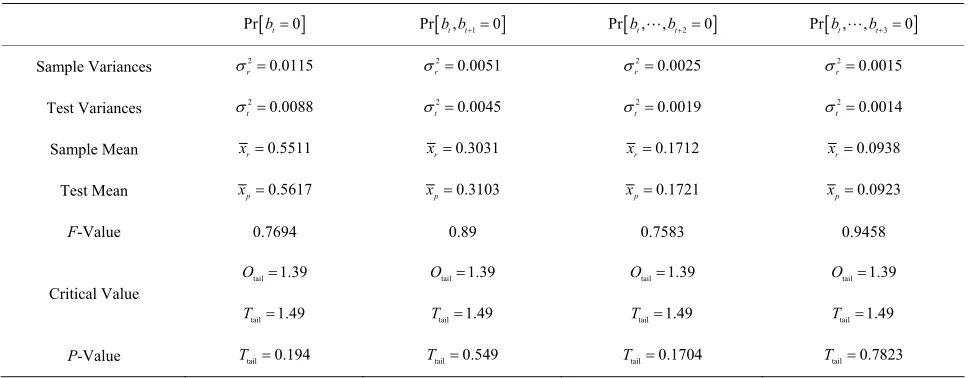
As shown in Table 4, the variances of the sample sc
are close to those of the test scores, which are the sc rated in Section 3.3 us
If this is true, this will be a clear contrast with the former case where we ran URDA with the fixed fragment length. In the following, we verify that the population variances of the sample scores and the test scores are identical to each other by means of the two-sample F-test.
Table 4 shows that the P-values obt
e smallest is 0.1704), and we cannot reject the null hypotheses with a small significance level, for example, 0.05.
As a co
1
5714
4
11
428
7
17
143
0
22
857
3
28
571
6
34
285
9
1 0.5
0.5
0 0
0.2
0 0.4
0.2
1
5714
4
11
428
7
17
143
0
22
857
3
28
571
6
34
285
9
1
57
144 87 30 73 16 59
114
2
1714 2285 2857 3428
0
1
144 287 30 73 16 59 57 11 1 2 2 3
= bt−l = 0] (l = 0,1,2,3, t = 1, ··· , 400,000).
[image:10.595.106.492.85.311.2]4 714 285 857 428
[image:10.595.56.537.352.569.2]Figure 5. Variable-fragment-length Pr[bt = ···
Table 2. Comparing of fixed variances and test variances.
Prbt0 Prb bt, t10 Prbt, ,bt20 Prbt, ,bt30
2 0.0135
f
2 0.0078
f
2 0.0078
f
2 0.0036
f
Sample Variance
2 0.0036
f
2 0.0045
t
2 0.0019
t
2 0.0014
t
0.5707
f
x xf0.3082 xf0.1718 xf0.0948
Test Variance
Sample Mean
Test Mean xt0.5617 xt0.3103 xt0.1721 xt0.0923
F-Value 1.53 1.72 2.64 2.61
Critical Value
P-Value
tail 1.39
O Otail1.39 Otail1.39 Otail1.39
tail 1.49
T Ttail1.49 Ttail1.49 Ttail1.49
tail 0.036 tail tail
T T 0.007 T 0.000002 Ttail0. 000400
Table 3. Comparing of variable means and test means.
Prbt0 Prb bt, t10 Prbt, ,bt20 Prbt, ,bt30
Test Mean xt0.5625 xt0.3125 xt0.1719 xt0.0938
Sample Mean xr0.5511 xr0.3031 xr0.1712 xr0.0938
TINV T1.66 T1.66 T1.66 T1.66
T
P-Value
-Statistics Tr1.067 Tr1.3261 Tr0.1437 Tr 0.021
tail 0.288
[image:10.595.60.538.597.735.2]Table 4. Comparing of variable variances and test variances.
Prbt0 Prb bt, t10 Prbt, ,bt20 Prbt, ,bt30
Sample Varianc 2 0.0115
r
2 0.0051
r
2 0.0025
r
2 0.0015
r
es
2 0.0088
t
2 0.0045
t
2 0.0019
t
2 0.0014
t
Test Variances
ean
Sample M xr0.5511 xr0.3031 xr0.1712 xr0.0938
Test Mean xp0.5617 xp0.3103 xp0.1721 xp0.0923
F alue 0.7694 0. 0.7583 0.9458
P-Value
-V 89
tail 1.39
O Otail1.39 Otail1.39 Otail1.39
Critical Value
tail 1.49
T Ttail1.49 Ttail1.49 Ttail1.49
tail 0.194
T Ttail0.549 Ttail0.1704 Ttail0.7823
3.6. Summary of This Experiments
In our previous work, assuming that source files include ASCI ters selected uniformly and independentl at random per character, we h
that an archived file consisting
ments shows uniformly constant distributions with re- spect to the probabilities that particular bit patterns ap- pear s, we can view th archived file as secure against the bit pattern analysis. On the other hand, the distributions of characters that appear in files of the real w ainly biased, and hence, it was not cer- tain that the same conclusion holds true when applying URDA the real world with th same setting. To investigate this problem, we first compared the following two sce terms of the m nd variances of t probability distribution of some particular bit patterns. - A to files taken from the Internet with the
setting of seven-bit-long fragments.
- Apply URDA to synthetic files generated so that ever character appears with the same prob- ability regardless of the position in the files.
bility are iden-
I charac y
ave mathematically proved of seven-bit-long frag-
. In other word e
orld are cert
to files of e
narios in eans a he
pply URDA
y ASCII
As we expected, the means of the proba
tical to their theoretical expectation of 49 2l
l
for
0,1, 2,3
, but the variances for the first scenario are significantly larger than those for the second scenario. Therefore, we cannot deny the possibility that there exist some clever attacks that take advantage of this difference in the variance.
Hence, we ran the same experiments after modifying the first scenario. In the new scenario, the length of each fragment is not fixed, but is determined at random be- tween 1 bit to 32 bits per fragment. The results of the comparison is surprising, we cannot detect statistically significant differences in either the means or the vari-
ances between the scores for the downloaded and ran- domly fragmented ASCII files and those for the ynthetic ASCII files. In oth ords, we cannot statistically dis- tinguish between the archived files generated from the
nthetic files.
Thus, we cannot conclu hat use of URDA with the d fragment length is secure, while use of URDA e randomly variable fragment length is secure gainst
4. Conclusion and Future Work
We investigated whether the formulas er w
downloaded files and the sy de t
fixe with
th
bit pattern analysis.
a
49 0
2
t t l l
l P b b
applies to real ASCII te s that include biases in the distributions of characters. Applying URDA to down-
d text files by fra menting the files into seven bit long, we found that the resulting archived files might be ulnerable to bit patter nalysis attacks. Thus, in the same way as the previous experiment, we ran another
ch w
n in ages and how it affects security issues in plain text ar- chiving. Co
xt file
loade g
v n a
experiment by modifying URDA in the way how to se- lect fragment lengths, that is, the length of each fragment is determined at random per fragment between 1 bit to 32
t
bi s, and showed this modified URDA with the randomly variable fragment length is secure against the bit pattern analysis.
As the next step, we will investigate the security of URDA when applied to text files that include a variety of aracter sets and their corresponding code units. We ill specify the significance of biased bits in these code units, which includes their actual representatio stor-
files with various bit distributions. In addition, we also investigate some sorts of file existed in the real world th
. 313.
ormation for Se-ance,” Journal of 35-348.
at are said close to random files like video, image and compressed files etc.
REFERENCES
[1] http://www.iso.org/iso/iso_catalogue/catalogue_tc/catalog ue_detail.htm?csnumber=39612
[2] P. M. Chen, E. K. Lee, G. A. Gibson, R. H. Katz and D. A. Patterson, “Aid: High-performance, Reliable Secon-dary Storage,” ACM Computing Surveys, Vol. 26, No. 2, 1994, pp. 145-185.
[3] A. Shamir, “How to Share a Secret,” Communication of ACM, Vol. 22, No. 11, 1979, pp. 612-613.
[4] G. Blakley, “Safeguarding Cryptographic Keys,” 1979
Proceedings of the National Computer Conference, New
York, 4-7 July 1979, p
[5] M. O. Rabin, “Efficient Dispersal of Inf curity, Load Balancing, and Fault Toler
the ACM, Vol. 36, No. 2, 1989, pp. 3
doi:10.1145/62044.62050
[6] L. Bai, “A Strong Ramp Secret Sharing Scheme Us Matrix Projection,” Proceedings of the 2006 International
ing
Symposium on a World of Wireless, Mobile and Multime-
dia Networks, New York, 26-29 July 2006, pp. 652-656.
[7] L. Bai and X. K. Zou, “A Proactive Secret Sharing Sche- me in Matrix Projection Method,” International Journal
of Security and Networks, Vol. 4, No. 4, 2009, pp. 201-
209.
[8] C. Blundo, “Alfredo de Santis and Ugo Vaccaro, Efficient Sharing of Many Secrets,” Springer Verlag, Berlin, 1993. [9] J. M. He and E. Dawson, “Multistage Secret Sharing Ba-
sed on One-Way Function,” Electronic Letters, Vol. 30, No. 19, 1994, pp. 1591-1592. doi:10.1049/el:19941076 [10] K. Wang, X. K. Zou and Y. Sui, “A Multiple Secret Shar-
ing Scheme Based on Matrix Projection,” Proceedings of
Eaton, D. Geels, B. Zhao, H. Weathe-
5, No. 5, 2001,
the 33rd Annual IEEE International Computer Software
and Applications Conference, Seattle, 20-24 July 2009,
pp. 400-405. [11] S. Rhea, C. Wells, P.
rspoon and J. Kubiatowicz, “Maintenance-Free Global Da- ta Storage,” IEEE Internet Computing, Vol.
pp. 40-49. doi:10.1109/4236.957894
[12] A. Rowstron and P. Druschel, “Storage Management and Caching in PAST, a Large-Scale, Persistent Peer-to-Peer
and H. Yasuda, “Some Remar-
C
rmation Technology-Telecomunications and
sociation: Serial in- Storage Utility,” Proceeding SOSP’01 Proceedings of the Eighteenth ACM Symposium on Operating Systems Prin-
ciples, Banff, 21-24 October 2001, pp. 188-201.
[13] A. Tallat, K. Shin, H. Lee
kable Property of the Uniformly Random Distributed Ar- chive Scheme,” Advances in Information Sciences and
Service Sciences, Vol. 4, No. 11, 2012, pp. 114-124.
[14] Cisco System, “Storage Networking 101,” Cisco System, San Jose, 2001.
[15] International Business Machines Corporation, “Introduc- tion to Storage Area Networks,” 2012.
http://www.redbooks.ibm.com/
[16] S. Ratnasamy, P. Francis, M. Handley, R. Karp and S. Shenker, “A scalable Content-Addressable Network”,
SIGCOMM ‘01 Proceedings of the 2001 Conference on
Applications, Technologies, Architectures, and Protocols
for Computer Communications, 2001, pp. 161-172.
[17] International Organization for Standardization, “ISO/IE 7816 Series: Identification Cards-Integrated Circuits(s) Cards with Contacts,” International Organization for Stan- dardization, Geneva, 1999.
[18] International Organization for Standardization, “ISO/IEC 18092-3: Info
Information Exchange between Systems-Near Field Com- munication-Interface and Protocol (NFCIP-1),” Interna- tional Organization for Standardization, Geneva, 2004. [19] IBM Corporation, “Infrared Data As
![Figure 4. Fixed-fragment-length Pr[bt = ··· = bt−l = 0] (l = 0,1,2,3, t = 1, ··· , 400,000)](https://thumb-us.123doks.com/thumbv2/123dok_us/1575767.703766/8.595.112.484.506.722/figure-fixed-fragment-length-pr-bt-bt-l.webp)