Measuring the State of the Art of Automated Pathway Curation Using
Graph Algorithms - A Case Study of the mTOR Pathway
Michael Spranger Sony Computer Science
Laboratories Inc. Tokyo, Japan michael.spranger
@gmail.com
Sucheendra K. Palaniappan INRIA,
Campus de Beaulieu, Rennes, France
sucheendra.palaniappan @inria.fr
Samik Ghosh
The Systems Biology Institute, Minato-ku,
Tokyo, Japan [email protected]
Abstract
This paper evaluates the difference be-tween human pathway curation and cur-rent NLP systems. We propose graph anal-ysis methods for quantifying the gap be-tween human curated pathway maps and the output of state-of-the-art automatic NLP systems. Evaluation is performed on the popular mTOR pathway. Based on analyzing where current systems perform well and where they fail, we identify pos-sible avenues for progress.
1 Introduction
Biological pathways encode sequences of biologi-cal reactions, such as phosphorylation, activations etc, involving various biological species, such as genes, proteins etc., in response to certain stim-uli or spontaneous at times (Aldridge et al., 2006; Kitano, 2002). Studying and analyzing pathways is crucial to understanding biological systems and for the development of effective disease treatments and drugs (Creixell et al., 2015; Khatri et al., 2012). There have been numerous efforts to re-construct detailed process-based and disease level pathway maps such as Parkinson disease map (Fu-jita et al., 2014), Alzheimers disease Map (Mizuno et al., 2012), mTOR pathway Map (Caron et al., 2010), and the TLR pathway map (Oda and Ki-tano, 2006)). Traditionally, these maps are con-structed and curated by expert pathway curators who manually read numerous biomedical docu-ments, comprehend and assimilate the knowledge in them and construct the pathway.
Manual curation of pathways is rather challeng-ing given the ever increaschalleng-ing barrage of scientific publications. It is basically common place in this community that manual curation is not sufficient
(Baumgartner et al., 2007). Consequently,
Auto-TEES ST2SBML ANNOTAT Biologist
mTOR papers
NLP system
SBML model
SBML model ==?
Figure 1: Comparing human pathway curation to NLP extraction.
mated Pathway Curationhas been an active area
of research - particularly in the BioNLP commu-nity (Miwa et al., 2012; Valenzuela-Esc´arcega et al., 2015). It is also the goal of large scale research efforts such as DARPA’s Big Mechanism Project (Cohen, 2015).
NLP systems have shown to perform well in BioNLP competitions (N´edellec et al., 2013; Ohta et al., 2013; Ananiadou et al., 2010), but so far we do not have systems that automatically assemble and curate pathways of the scope and complexity of, for example, the mTOR pathway. This paper investigates why this is the case. We measure the state of the art by closing the gap between NLP representations and biological networks, then we apply graph theory and in particular graph match-ing to quantify how much overlap there is between the NLP output and the information that humans assemble (see also Figure 1). The evaluation is performed on the popular mTOR pathway.
This paper starts by introducing our approach, followed by a description of data sets and evalua-tion results. We conclude by discussing where cur-rent system seem to fail and how to make progress.
Figure 2: Example sentence with NLP event rep-resentations extracted.
Figure 3: Phosphorylation reaction.
2 Bridging the Gap
In this paper, we close the representational gaps between current NLP systems and humgenerated pathways, measure the overlap and an-alyze possible shortcomings of current systems. Evaluation is performed on the popular, hand-curated mTOR pathway map (Caron et al., 2010). Experts have curated and assembled the informa-tion from 522 papers into one large map using CellDesigner (Funahashi et al., 2008) - a soft-ware for modeling but also executing mechanistic models of pathways. CellDesigner represents in-formation using a heavily customized XML-based SBML format (Hucka et al., 2003).
mTOR has been published along with a list of the 522 papers used to build the map. This al-lows us to treat the same papers with state-of-the-art NLP extraction systems. Here we used one of the most successful NLP systems around - the TURKU event extractions system (Bj¨orne, 2014, TEES). TEES has won 1st place in BioNLP 2009 ST, 2011 ST and DDI 2011 (Bj¨orne et al., 2012). The system integrates various NLP techniques to extract events from text. Processing roughly pro-ceeds as follows 1) A number of external tools de-tect protein names and parse the sentences. 2) The event detector detects trigger words such as verbs, which is followed by detection of interactions. 3) Complex events are constructed. 4) The system detects modifiers such as negation and specula-tion.
NLP systems typically operate on something called the standoff format. From a sentence such
as in Figure 2, standoff containing entities and
events will be extracted. These in principle cor-respond to biological species and reactions. We translate the NLP representation into SBML
path-ways and perform additional annotation (Spranger et al., 2015) of species and reactions. For the sen-tence in Figure 2, the extracted SBML is visual-ized in Figure 2.
Datasets
We compared 3 different sets of data all related to mTOR pathway.
MTOR-HMN is a mTOR pathway map manu-ally constructed by human expert pathway cura-tors. (Caron et al., 2010). The pathway is encoded in a dialect of SBML used by CellDesigner (Fu-nahashi et al., 2008). We convert the CellDesigner format into pure SBML and annotate reactions and species further by automatically assigning reaction types and gene/protein identifers (see description below).
MTOR-ANN consists of 57 abstracts of scien-tific papers from Pubmed related to the
mTOR-pathway map. The data set washuman-annotated
for NLP system training (Ohta et al., 2011,
Cor-pus annotations (c) GENIA Project1). This
cor-pus gives an idea of the potential performance of a machine with human-level NLP extraction capa-bilities. Annotated NLP entities and events were used to create SBML representations and further annotated using various tools (discussed below).
MTOR-NLP consists of 522 full text papers mentioned in the mTOR pathway map. Paper pdfs were downloaded automatically and trans-lated into raw txt files using CERMINE (Tkaczyk et al., 2015). We managed to extract text from 501 papers. The 501 papers were processed using the Turku Event Extraction System mentioned earlier. From the extracted NLP events we created SBML representations of pathway maps for each text us-ing (Spranger et al., 2015). The SBML was further annotated using various tools (discussed below) and, finally, loaded into a single pathway map.
Notice that MTOR-ANN and MTOR-NLP are different in how they are constructed and conse-quently what kind of conclusion we can draw from them. MTOR-ANN is a human-annotated dataset which contains much less data than MTOR-NLP. However, because it is human-annotated it allows us to evaluate a human-level performance extrac-tion systems. So we cannot expect that ANN is able to reconstruct everything in
HMN (recall). However, as we will argue in this paper, we might expect that what is extracted in MTOR-ANN does occur in MTOR-HMN (high precision).
The following table shows number of species, reactions and edges between them for the different datasets.
Dataset # species # reactions # edges
MTOR-HMN 2242 777 2457
MTOR-ANN 2457 857 2343
MTOR-NLP 292049 100130 203042
Annotation
Annotation SBO Reactions in datasets MTOR-HMN, MTOR-ANN and MTOR-NLP were
auto-matically annotated using Systems Biology
On-tology (SBO) (Le Nov`ere, 2006) and Gene Ontol-ogy (GO) terms. SBO provides a class hierarchy of reactions. Reactions can be of a certain type. For instance, NLP systems often identify regula-tion events. Regularegula-tion reacregula-tions form a hierar-chy. For instance, positive regulation is a subclass of regulation reactions. Phosphorylation reactions are a subclass of conversion reactions.
All reactions in MTOR-HMN, MTOR-ANN, and MTOR-NLP are annotated using SBO/GO (coverage 100%). SBO/GO annotations are com-puted using different approaches. For MTOR-ANN and MTOR-NLP we used an automated an-notation system that is also used to convert NLP event representations to SBML (Spranger et al., 2015). For MTOR-HMN, we used annotations provided by humans extended by automatic an-notations. Automatic annotations were deduced by examining the reactants and products of reac-tions. For example, if a phosphoryl group is added the reaction is annotated using the SBO term for phosphorylation. Notice, in MTOR-HMN each reaction can be annotated with multiple SBO/GO terms. For instance, a single reaction can be an-notated as phosphorylation and activation. This is not the case for MTOR-ANN and MTOR-NLP where each reaction corresponds to exactly one SBO/GO term.
Annotation Entrez Gene Species in all three datasets were annotated using the gene/protein named entity recognition and normalization soft-ware GNAT (Hakenberg et al., 2011) - a publicly available gene/protein normalization tool. GNAT returns a set of Entrez Gene identifiers (Maglott et al., 2005) for each input string. Species were an-notated using all returned Entrez Gene identifiers for a particular species (organism human). We
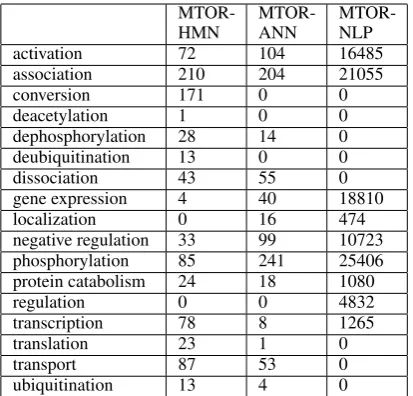
MTOR-HMN MTOR-ANN MTOR-NLP
activation 72 104 16485
association 210 204 21055
conversion 171 0 0
deacetylation 1 0 0
dephosphorylation 28 14 0
deubiquitination 13 0 0
dissociation 43 55 0
gene expression 4 40 18810
localization 0 16 474
negative regulation 33 99 10723 phosphorylation 85 241 25406 protein catabolism 24 18 1080
regulation 0 0 4832
transcription 78 8 1265
translation 23 1 0
transport 87 53 0
[image:3.595.313.520.61.259.2]ubiquitination 13 4 0
Table 1: Reaction types extracted and annotated for various data sets. All reactions are annotated with their most specific type. Numbers are non-cumulative. For instance, the 171 conversion op-erations in MTOR-HMN are only annotated with the general conversion (SBO:182) and not more specific reaction types.
call the set of Entrez Gene identifiers returned by
GNAT for each speciesEntrez Gene signature.
# species coverage # Entrez ids
MTOR-HMN 2242 90% 538
MTOR-ANN 2457 87% 317
MTOR-NLP 292049 83% 4194
3 Species
Pathways contain many references to the same protein or gene. We measured the number of unique genes and proteins in each dataset using various ways of identifying (normalizing) genes and proteins in a particular dataset.
MTOR-HMN MTOR-ANN MTOR-NLP
# species 2242 2457 291218
# names 582 359 27928
# appr names 568 316 4517
# Entrez signatures 443 201 6220
with a set of Entrez Gene ids. The set of the En-trez Gene identifiers for each species is taken as a signature.
The numbers show the degree of redundancy or reuse of species within each pathway. They also suggest that there are far more species implicated in MTOR-NLP than there are in MTOR-HMN. In other words, human annotators of mTOR have se-lected 568 species and not the 4517 found by the NLP systems (approx names).
Unique Species Overlap To better understand species identification we can measure the overlap of ANN and NLP with MTOR-HMN based on the unique species. Here we
con-sider names equal (nmeq), names approximately
equal (appeq), Entrez Gene id signature equal (
en-teq) and Entrez Gene id signature overlap (entov).
The focus is on unique items.
precision recall f-score MTOR-HMN/MTOR-ANN
nmeq 20.89 12.89 15.94
appeq 27.30 15.64 19.88
enteq 45.27 20.54 28.26
entov 83.08 55.53 66.57
MTOR-HMN/MTOR-NLP
nmeq 0.96 45.88 1.87
appeq 1.59 51.20 3.08
enteq 4.60 64.56 8.58
entov 58.04 99.55 73.33
The rows nmeq show precision and recall for
unique species names in MTOR-NLP with respect to MTOR-HMN. Precision is low - meaning that only a small percentage of unique species names in MTOR-NLP actually appear in MTOR-HMN. On the other hand, recall is higher. This shows that the few correctly identified species in MTOR-NLP overlap with large parts of MTOR-HMN species. Less than a percent of unique species names in MTOR-NLP cover 46% of species in HMN. What is interesting is that MTOR-ANN does not fair too great on precision either. 79% of the unique annotated names do not ap-pear in MTOR-HMN. Especially the annotated version dataset MTOR-ANN, lets us conclude that many species mentioned in papers actually do NOT make it into the pathway or at least not as mentioned in the papers. These analyses point to the fact that researchers building pathways select
species. In other words, pathway curation isnot
just extraction, but active selection and, in fact, identification of species with proteins and genes known to the scientist.
Complex Species MTOR-HMN pathway con-tains a lot of complex species - i.e. species that contain other species. There are 351 complex species with a total of 1192 total constituents. 16 complexes are part of other complexes. Together this accounts for more than 70% of the species in MTOR-HMN. In other words, this is important in-formation. Both MTOR-NLP and MTOR-ANN do not provide information about complexes ex-plicitly. However, for this paper complexes are es-sentially treated like any other species.
4 Reactions
We first measured how many unique reaction types there are for each of the datasets.
# reactions # SBO/GO
terms # SBO/GOsignatures
MTOR-HMN 777 15 29
MTOR-ANN 857 13 13
MTOR-NLP 100130 9 9
MTOR-HMN contains 777 reactions with 12 SBO/GO terms, i.e. reaction types. MTOR-ANN contains 12 and MTOR-NLP slightly less. Each reaction can have multiple SBO/GO terms associ-ated with it. We call this the SBO/GO signature of a reaction. For instance, a particular reaction can be typed as phosphorylation and activation. Its signature are then the SBO/GO terms for these 2 reactions. The table shows that this actually only happens in MTOR-HMN. Human annotators are free to combine various reactions into a single re-action if they see fit. There is no replication of this in the automated data.
Unique Reaction Signature Overlap We then measured how much unique signatures overlap across the different datasets. We checked three
different measures: 1)sboeqrequires that both
sig-natures are the same, 2)sboovrequires that the
in-tersection of the signatures overlaps - i.e. is not
empty - and 3)sboisarequires that there is at least
one SBO/GO term in each signature that relate in a is a relationship in the SBO reaction type hierar-chy. For instance, if there is a phosphorylation
re-action and a conversion rere-action, thensboisawill
precision recall f-score MTOR-HMN/MTOR-ANN
sboeq 69.23 31.03 42.86
sboov 45.51 50.19 47.74
sboisa 92.31 93.10 92.70
MTOR-HMN/MTOR-NLP
sboeq 55.56 17.24 26.32
sboov 77.78 68.97 73.11
sboisa 88.89 79.31 83.83
MTOR-ANN catches 1/3 of the reaction SBO/GO signatures directly and up to 93% when we allow for overlap sbo is a relationship. MTOR-NLP only directly includes 1 out of 5 re-action signatures. However, the overlap is higher when allowing for reaction SBO/GO signatures to overlap and individual SBO terms to be in a is a relationship.
These results also show that there are reactions in MTOR-NLP and MTOR-ANN that are not part of MTOR-HMN (see also Table 2)
From this preliminary data, we can immediately identify an important difference between human annotation and automated NLP event extraction. Human annotators combine multiple reactions into a single reaction representation to condense infor-mation.
5 Networks - Connectedness
Ultimately we are interested in networks of reac-tions and species. Studying the output of NLP sys-tems it becomes immediately clear that the result of these systems differs from hand-curated data in
an important aspect: connectedness. To show this
we measured isolation of species and networks (reactions cannot be isolated for structural reasons in SBML).
# isolated networks # isolated species
MTOR-HMN 4 6
MTOR-ANN 475 632
MTOR-NLP 83,093 110,490
In MTOR-HMN there are 4 separate subgraphs (no connection between them). 3 of them are modeling mistakes by human curators. Basically MTOR-HMN is one connected network. On the other hand, MTOR-ANN and MTOR-NLP consist of numerous unconnected networks. Each of them is quite small as the following data shows.
We measured min, max, mean and median num-ber of species and reactions in each connected component subgraph.
dataset min mean median max
MTOR-ANN 1 3.00 1.0 24
MTOR-NLP 1 2.02 1.0 215
Results show that subgraphs in MTOR-ANN and MTOR-NLP on average contain between 2 and 3 species and reactions. So very often there will be a single reaction in a subgraph plus some reactant and maybe a product. On the other hand MTOR-HMN consists of essentially one large connected graph. So here is another
fundamen-tal difference: human modelerscomposea single
large graph, as opposed to just extracting single reactions.
6 Networks - Overlap
Arguably the most important question is how much overlap there is between disconnected reac-tions extracted by MTOR-ANN/MTOR-NLP with MTOR-HMN. For this, we measure subgraph iso-morphisms of MTOR-ANN and MTOR-NLP sub-graphs with the MTOR-HMN graph. We
mea-sured max overlap and allow multiple hits for
each subgraph from ANN and MTOR-NLP with parts of MTOR-HMN. We compare dif-ferent strategies for node (species and reactions) and edge matching.
Species matching We investigated name
matches (nmeq), approximate name matches
(appeq), Entrez Gene signature equal (enteq)
and Entrez Gene signature overlaps (entov) and
combinations thereof. For example, appeq/enteq
matches two species if either their names match approximately OR their Entrez Gene signatures
are equal. appeq/entov matches two species
if their names match approximately OR their
Entrez Gene signatures overlap. Since there
is no information on complexes in MTOR-ANN/MTOR-NLP, we also allowed matches not only on the complex itself but also on its
con-stituents (wc). So a link present in MTOR-NLP
between some protein and its phosphorylated ver-sion, will match if a link is present in a complex that contains that protein in MTOR-HMN.
Reaction matching Reaction matching relies on SBO/GO signatures. We checked with
signa-tures equal (sboeq), signatures overlapping
over-lap (sboov) and signatures overlapping with
indi-vidual SBO terms in is a relationship (sboisa).
MTOR-HMN MTOR-NLP
mTORC2
mTOR Rictor Sin1.1 mLST8
activation
mTOR
mTORC2
activated mTOR Rictor mLST8 Sin1.1
[image:6.595.95.269.62.197.2]positively regulated mTOR activation Insulin/IGF
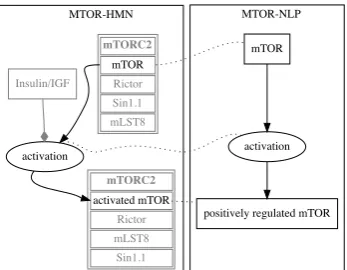
Figure 4: Example of a successful match (nmeq,
sboeq). Black - matched nodes and edges, grey
not mached context. Insulin/IGF is a modifier of this reaction. It is not captured by MTOR-NLP. Modifiers are less frequently detected than reac-tants and products.
MTOR-HMN MTOR-NLP
activation, phosphorylation
activated phosphorylated phosphorylated SGK1
phosphorylation
[image:6.595.94.270.303.385.2]phosphorylated SGK1 phosphorylated SGK1 SGK1 activated PDK1
Figure 5: Example of a successful match (appeq,
sbois) with a reaction that has multiple reaction types.
MTOR-HMN MTOR-NLP
5'cap-eIF4F-eIF4B-eIF3-PABP
PABP eIF3 m7GTP mRNA eIF4G activated eIF4A
eIF4E eIF4B
bound eIF4E association
association
5'cap-eIF4F-eIF4B-eIF3
eIF3 m7GTP
mRNA eIF4G activated eIF4A
eIF4E eIF4B
eIF4E
PABP
Figure 6: Example of a successful match
(appeq/wc, sboeq) but ultimately incorrect map-ping. It is not eIF4E that gets bound but the whole complex of 5’cap-eIF4F-eIF4B-eIF3 that includes eIF4E.
The final point to note for the results of match-ing is that we removed isolated nodes (which are always species) from ANN and MTOR-NLP, because here we are really interested in graph structure.
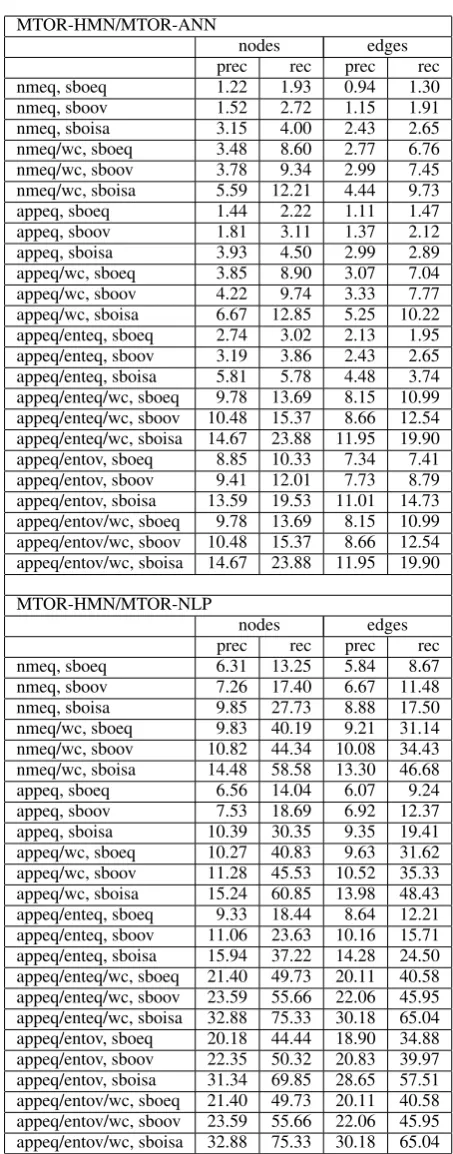
Network overlap results Table 2 shows preci-sion and recall for max overlap of different match-ing strategies (see also Figures 4 to 6). The ta-ble shows results for ANN and
MTOR-NLP successively. In general the first rows (nmeq,
sboeq) represent very strict matching strategies.
The last row (appeq/entov/wc, sbois) shows results
for the most “relaxed” strategy.
Let us first analyze the performance of MTOR-NLP. The automated NLP system is able to re-trieve roughly 9% of all edges given the strictest matching strategy. This means that 1 in 10 edges in the NLP extracted dataset actually appears as is in the human curated data (MTOR-HMN). Also, if we look at the most relaxed matching strategy appeq/entov/wc, sbois, we find that roughly 2 of 3 edges and 3 of 4 nodes (species and reactions) in the human curated MTOR have something to do with the NLP extracted data. In particular, the conversion and regulation reactions play a part in the 20 percentage points jump from 45.59 to
65.04 for edges from appeq/entov/wc, sboov to
appeq/entov/wc, sboisamatching. Conversion and regulation are super classes for a whole range of reactions (conversion: phosphorylation etc; regu-lation: activation, inactivation etc).
Matching strategies that allow for matching complex constituents always have a higher re-call and precision performance than their non constituent matching counterparts. For instance,
nmeq, sboeq matches almost 20 percentage
points less edges than nmeq/wc, sboeq
(MTOR-HMN/MTOR-NLP). This increase in performance of constituent matching points to the fact that human modelers often attribute reactions to the whole complex. For instance, a phosphorylation may be acting on a constituent of a complex but the human modeler chooses to connect the reac-tion with the whole complex. These matching strategies do account for that and therefore are able to improve the numbers (in some cases) consider-ably.
[image:6.595.99.265.451.686.2]match-ing strategies sboov and sboisa account for that by looking at overlaps. This means that reac-tions in MTOR-ANN and MTOR-NLP will match with a reaction MTOR-HMN if the reaction type signatures intersection is not empty. In reality this means that the reaction in MTOR-ANN or MTOR-NLP has to be an element of the reaction in MTOR-HMN.
Lastly, let us take a look at
MTOR-HMN/MTOR-ANN. MTOR-ANN contains
much less data than MTOR-NLP but the reason we include it here is because MTOR-ANN consists of human annotated data. It therefore gives an idea about the limits of the annotation data and the limits of human annotation. If all of the problems discussed so far are purely a problem of the NLP system, then MTOR-ANN should do better than MTOR-NLP in terms of precision but not in terms of recall. Recall will be low because the MTOR-ANN consists of less data. However, we would expect high precision numbers. Interestingly, data shows that even for NLP-ANN precision is low. With relaxed
matching strategies appeq/enteq/wc, sboisa and
appeq/entov/wc, sboisa, we see some substantial recall 20% (remember NLP-ANN is only ab-stracts). Nevertheless precision for edges is only 1 in 10 and for nodes about the same.
Caveats There are number of issues that need to be taken into account when analyzing these results. For instance, SBO/GO term annotation for MTOR-HMN is not perfect, as can be seen from the large number of conversion operations. Similarly, Entrez Gene id normalization has its problems, especially when dealing with complex species. Lastly, reaction signature overlap does not count reactions with multiple reaction types as separate. We are currently working on dealing with each of these issues. Some will arguably im-prove performance, others decrease precision and recall numbers. We are confident though that the general trends in the results will uphold.
7 Discussion
The last section quantitatively demonstrated dif-ferences between extraction and curation. Cura-tion involves processes such as annotaCura-tion, selec-tion and, in particular, composiselec-tion (of subgraphs into a large graph). The next paragraphs summa-rize the most important problems.
MTOR-HMN/MTOR-ANN
nodes edges
prec rec prec rec
nmeq, sboeq 1.22 1.93 0.94 1.30
nmeq, sboov 1.52 2.72 1.15 1.91
nmeq, sboisa 3.15 4.00 2.43 2.65
nmeq/wc, sboeq 3.48 8.60 2.77 6.76 nmeq/wc, sboov 3.78 9.34 2.99 7.45 nmeq/wc, sboisa 5.59 12.21 4.44 9.73
appeq, sboeq 1.44 2.22 1.11 1.47
appeq, sboov 1.81 3.11 1.37 2.12
appeq, sboisa 3.93 4.50 2.99 2.89 appeq/wc, sboeq 3.85 8.90 3.07 7.04 appeq/wc, sboov 4.22 9.74 3.33 7.77 appeq/wc, sboisa 6.67 12.85 5.25 10.22 appeq/enteq, sboeq 2.74 3.02 2.13 1.95 appeq/enteq, sboov 3.19 3.86 2.43 2.65 appeq/enteq, sboisa 5.81 5.78 4.48 3.74 appeq/enteq/wc, sboeq 9.78 13.69 8.15 10.99 appeq/enteq/wc, sboov 10.48 15.37 8.66 12.54 appeq/enteq/wc, sboisa 14.67 23.88 11.95 19.90 appeq/entov, sboeq 8.85 10.33 7.34 7.41 appeq/entov, sboov 9.41 12.01 7.73 8.79 appeq/entov, sboisa 13.59 19.53 11.01 14.73 appeq/entov/wc, sboeq 9.78 13.69 8.15 10.99 appeq/entov/wc, sboov 10.48 15.37 8.66 12.54 appeq/entov/wc, sboisa 14.67 23.88 11.95 19.90 MTOR-HMN/MTOR-NLP
nodes edges
prec rec prec rec
nmeq, sboeq 6.31 13.25 5.84 8.67
[image:7.595.305.532.94.672.2]nmeq, sboov 7.26 17.40 6.67 11.48 nmeq, sboisa 9.85 27.73 8.88 17.50 nmeq/wc, sboeq 9.83 40.19 9.21 31.14 nmeq/wc, sboov 10.82 44.34 10.08 34.43 nmeq/wc, sboisa 14.48 58.58 13.30 46.68 appeq, sboeq 6.56 14.04 6.07 9.24 appeq, sboov 7.53 18.69 6.92 12.37 appeq, sboisa 10.39 30.35 9.35 19.41 appeq/wc, sboeq 10.27 40.83 9.63 31.62 appeq/wc, sboov 11.28 45.53 10.52 35.33 appeq/wc, sboisa 15.24 60.85 13.98 48.43 appeq/enteq, sboeq 9.33 18.44 8.64 12.21 appeq/enteq, sboov 11.06 23.63 10.16 15.71 appeq/enteq, sboisa 15.94 37.22 14.28 24.50 appeq/enteq/wc, sboeq 21.40 49.73 20.11 40.58 appeq/enteq/wc, sboov 23.59 55.66 22.06 45.95 appeq/enteq/wc, sboisa 32.88 75.33 30.18 65.04 appeq/entov, sboeq 20.18 44.44 18.90 34.88 appeq/entov, sboov 22.35 50.32 20.83 39.97 appeq/entov, sboisa 31.34 69.85 28.65 57.51 appeq/entov/wc, sboeq 21.40 49.73 20.11 40.58 appeq/entov/wc, sboov 23.59 55.66 22.06 45.95 appeq/entov/wc, sboisa 32.88 75.33 30.18 65.04
Species Normalization There has been a lot of work on this topic (Van Landeghem et al., 2013; Wei et al., 2015b; Sohn et al., 2008; Do˘gan et al., 2014; Hakenberg et al., 2011) provide impres-sive performance. But there is the problem of how to use the information provided by tools such as GNAT. GNAT, for instance, returns hypotheses of possible identifiers. It is then up to subsequent sys-tems to use this information and reject certain hy-potheses based on other information in the text.
Complex formation Identification of com-plexes is missing from NLP extraction systems. To the best of our knowledge, there is very little work on extraction of complexes and their par-ticipants from text (except generally in terms of Named Entity Recognition). However, complexes are extremely important for the mTOR pathway. For a large part the pathway consists of complexes that form and subsequently modify other reac-tions. Not being able to extract such information is a significant disadvantage for automated systems.
Composition of pathways The NLP system produces pathway maps that consist of scattered reactions without integrating them into one. The human map on the other hand is all about a single network of reactions. Composition is a combina-torial problem constrained by cues in the Natural Language as well as biology. This paper proposed a number of matching strategies. These strategies are not only useful for measuring the state-of-the-art. For instance, matching of species based on En-trez Gene normalization could be useful in path-way composition.
Understanding levels of detail of representation
A fundamental problem in pathway curation is that information can be represented on different levels of specificity. For instance, it might be sufficient to capture phosphorylation instead of capturing the exact sites or the number of phosphoryl groups added. Often human modelers make various ab-stractions and conceptualizations of the same un-derlying biological process. Final pathway maps are affected by prior knowledge of the curator and this shapes the pathway that a human produces. The problem then becomes how to build machines that can extract knowledge on various levels of ab-straction.
It is important to realize that these issues are not just a problem of more data or more precise an-notation. Current NLP systems are good at
clas-sifying strings and their relations but they have no notion of the underlying processes (in this case the biological processes involved). The learning sig-nal of NLP systems is annotated text and it is not the human-curated biological model. The human as an expert in Systems Biology reading the text will pick out relevant detail and try to build a con-sistent overall model based on the information in the various texts. The NLP system relies on in-formation detected in the text without any actual notion of what the text actually means, i.e. with-out building an internal model and integrating it with prior information.
8 Conclusion
To the best of our knowledge, this paper is the first to evaluate automated pathway extraction systems by measuring the difference between automated systems and human curation. We believe this kind of analysis is crucial to make progress towards the ultimate goal of complete automation of pathway curation. The contribution of this paper is twofold: 1) we propose a number of measures that can be used to quantify the state-of-the-art; 2) we identify a number of areas where progress can improve the state-of-the-art measurably.
This paper is part of a larger trend in NLP to move from event extraction to knowledge base creation (Kim et al., 2015) and construction of bi-ologically relevant networks (Rinaldi et al., 2016). It is therefore perfectly aligned with people trying to automatically build mechanistic dynamic path-way models (Cohen, 2015) that could ultimately have a big scientific impact (Kitano, 2016).
References
Bree B Aldridge, John M Burke, Douglas A Lauffen-burger, and Peter K Sorger. 2006. Physicochemical
modelling of cell signalling pathways. Nature cell
biology, 8(11):1195–1203.
S. Ananiadou, S. Pyysalo, J. Tsujii, and D. Kell. 2010. Event extraction for systems biology by text mining the literature. Trends in biotechnology, 28(7):381– 90.
W. Baumgartner, B. Cohen, L. Fox, et al. 2007. Man-ual curation is not sufficient for annotation of ge-nomic databases. Bioinformatics, 23(13):i41–i48.
J. Bj¨orne. 2014. Biomedical Event Extraction with Machine Learning. Ph.D. thesis, University of Turku.
E. Caron, S. Ghosh, Y. Matsuoka, et al. 2010. A comprehensive map of the mtor signaling network.
Molecular systems biology, 6(1).
P. Cohen. 2015. Darpa’s big mechanism program.
Physical Biology, 12(4):045008.
P. Creixell, J. Reimand, S. Haider, et al. 2015.
Path-way and network analysis of cancer genomes.
Na-ture methods, 12(7):615.
Rezarta Islamaj Do˘gan, Donald C Comeau, Lana Yeganova, and W John Wilbur. 2014. Finding abbreviations in biomedical literature: three bioc-compatible modules and four bioc-formatted
cor-pora. Database, 2014:bau044.
K. Fujita, M. Ostaszewski, Y. Matsuoka, et al. 2014. Integrating pathways of parkinson’s disease in a
molecular interaction map. Molecular
neurobiol-ogy, 49(1):88–102.
A. Funahashi, Y. Matsuoka, A. Jouraku, et al. 2008. Celldesigner 3.5: a versatile modeling tool for
biochemical networks. Proceedings of the IEEE,
96(8):1254–1265.
J¨org Hakenberg, Martin Gerner, Maximilian Haeus-sler, Ill´es Solt, Conrad Plake, Michael Schroeder, Graciela Gonzalez, Goran Nenadic, and Casey M Bergman. 2011. The gnat library for local and
re-mote gene mention normalization. Bioinformatics,
27(19):2769–2771.
M. Hucka, A. Finney, H. Sauro, et al. 2003. The sys-tems biology markup language (sbml): a medium for representation and exchange of biochemical
net-work models. Bioinformatics, 19(4):524–531.
P. Khatri, M. Sirota, and A. Butte. 2012. Ten years of pathway analysis: current approaches and outstand-ing challenges.PLoS Comput Biol, 8(2).
Jin-Dong Kim, Jung-jae Kim, Xu Han, and Dietrich Rebholz-Schuhmann. 2015. Extending the evalua-tion of genia event task toward knowledge base con-struction and comparison to gene regulation
ontol-ogy task. BMC bioinformatics, 16(Suppl 10):S3.
H. Kitano. 2002. Computational systems biology.
Na-ture, 420(6912):206–210.
H. Kitano. 2016. Artificial intelligence to win the no-bel prize and beyond: Creating the engine for scien-tific discovery. AI Magazine.
N. Le Nov`ere. 2006. Model storage, exchange and integration. BMC neuroscience.
Donna Maglott, Jim Ostell, Kim D Pruitt, and Tatiana Tatusova. 2005. Entrez gene: gene-centered
infor-mation at ncbi. Nucleic acids research, 33(suppl
1):D54–D58.
M. Miwa, P. Thompson, J. McNaught, et al. 2012. Ex-tracting semantically enriched events from biomedi-cal literature. BMC bioinformatics, 13(1):1. S. Mizuno, R. Iijima, S. Ogishima, et al. 2012.
Alz-pathway: a comprehensive map of signaling
path-ways of alzheimer’s disease. BMC systems biology,
6(1):52.
C. N´edellec, R. Bossy, J.-D. Kim, et al. 2013.
Overview of bionlp shared task 2013. ACL, page 1.
K. Oda and H. Kitano. 2006. A comprehensive map of the toll-like receptor signaling network. Molecular systems biology, 2(1).
T. Ohta, S. Pyysalo, and J. Tsujii. 2011. From pathways to biomolecular events: opportunities and
challenges. InProceedings of BioNLP 2011
Work-shop, pages 105–113. ACL.
T. Ohta, S. Pyysalo, R. Rak, et al. 2013. Overview of the pathway curation (pc) task of bionlp shared task
2013. In Proceedings of the BioNLP Shared Task
2013 Workshop, pages 67–75. ACL.
F. Rinaldi, T. Effendorf, and S. Madan. 2016. Biocre-ative 5 track 4: A shared task for the extraction of causal network information in biological expression
language.Database.
S. Sohn, D. Comeau, W. Kim, and J Wilbur. 2008. Abbreviation definition identification based on
au-tomatic precision estimates. BMC bioinformatics,
9(1):1.
M. Spranger, S. Palaniappan, and S. Ghosh. 2015. Ex-tracting biological pathway models from nlp event
representations. InProceedings of the 2015
Work-shop on Biomedical Natural Language Processing (BioNLP 2015), pages 42—51. ACL.
D. Tkaczyk, P. Szostek, M. Fedoryszak, et al. 2015. Cermine: automatic extraction of structured meta-data from scientific literature. International Journal on Document Analysis and Recognition (IJDAR), 18(4):317–335.
M. Valenzuela-Esc´arcega, G. Hahn-Powell, T. Hicks, and M. Surdeanu. 2015. A domain-independent
rule-based framework for event extraction. In
Pro-ceedings of the 53rd Annual Meeting of the Associ-ation for ComputAssoci-ational Linguistics (ACL-IJCNLP), pages 127–132. ACL.
S. Van Landeghem, J. Bj¨orne, C.-H. Wei, et al. 2013. Large-scale event extraction from literature
with multi-level gene normalization. PloS one,
8(4):e55814.
Chih-Hsuan Wei, Robert Leaman, and Zhiyong Lu. 2015. Simconcept: A hybrid approach for simpli-fying composite named entities in biomedical text.