Automatic Classification by Topic Domain for Meta Data Generation,
Web Corpus Evaluation, and Corpus Comparison
Roland Sch¨afer
Freie Universit¨at Berlin Habelschwerdter Allee 45
14196 Berlin, Germany
Felix Bildhauer
Institut f¨ur Deutsche Sprache R5, 6–13
68161 Mannheim, Germany
Abstract
In this paper, we describe preliminary re-sults from an ongoing experiment wherein we classify two large unstructured text corpora—a web corpus and a newspaper corpus—by topic domain (or subject area). Our primary goal is to develop a method that allows for the reliable annotation of large crawled web corpora with meta data required by many corpus linguists. We are especially interested in designing an anno-tation scheme whose categories are both intuitively interpretable by linguists and firmly rooted in the distribution of lexi-cal material in the documents. Since we use data from a web corpus and a more traditional corpus, we also contribute to the important field of corpus comparison and corpus evaluation. Technically, we use (unsupervised) topic modeling to automat-ically induce topic distributions over gold standard corpora that were manually anno-tated for 13 coarse-grained topic domains. In a second step, we apply supervised ma-chine learning to learn the manually anno-tated topic domains using the previously induced topics as features. We achieve around 70% accuracy in 10-fold cross val-idations. An analysis of the errors clearly indicates, however, that a revised classi-fication scheme and larger gold standard corpora will likely lead to a substantial in-crease in accuracy.
1 Introduction
In the experiment reported here, we classified
large unstructured text corpora by topic domain.
The topic domain of a document—along with
other high-level classifications such as genre or
register—is among the types of meta data most
essential to many corpus linguists. Therefore, the lack of reliable meta data in general is often mentioned as a major drawback of large, crawled web corpora, and the automatic generation of such meta data is an active field of research.1 It must be
noted, however, that such high-level annotations are not reliably available for many very large tradi-tional corpora (such as newspaper corpora), either. When it comes to the automatic identification of
high-level categories like register (such as
Opin-ion, Narrative, Informational Persuation; Biber
and Egbert 2016), even very recent approaches based on very large amounts of training data can-not deliver satisfying (arguably can-not even encourag-ing) results. For instance, Biber and Egbert (2016, 23) report accuracy=0.421, precision=0.268, re-call=0.3. It is not even clear whether categories such as register and genre can be operationalized such that a reliable annotation is possible for hu-mans.
By contrast, automatic text categorization by
content yielded much more promising results
years ago already (Sebastiani, 2002).
Further-more, data-driven induction of topics (topic
mod-eling) has proven quite successful, and it is in
many respects a very objective way of organizing a collection of documents by content. Deriving topic classifications from text-internal criteria is also advocated in the EAGLES (1996) guidelines, among others. However, topic modeling usually does not come with category labels that are use-ful for linguistic corpus users. In our project, we explore the possibility of inferring a small, more
traditional set of topic domains (or subject
ar-eas) from the topics induced in an unsupervised
manner by Latent Semantic Indexing (Landauer and Dumais, 1994; Landauer and Dumais, 1997). 1See, for example, many of the contributions in Mehler et
al. (2010).
Since we classify and compare one large German web corpus and one large German newspaper cor-pus with respect to their distribution of topic do-mains, our paper also contributes to the area of corpus comparison, another important issue in cor-pus linguistics (Kilgarriff, 2001; Biemann et al., 2013). For the construction of crawled web cor-pora, such comparisons are vital because next to nothing is known about their composition.
The computational tools used in our method (unsupervised topic induction and supervised clas-sifiers) are by now well-established and highly de-veloped. This paper contributes to the field of ap-plying such methods and making them usable for real-life problems of data processing and the de-velopment of suitable annotation schemes rather than to the development of the underlying mathe-matics and algorithms.
2 Gold Standard Data
Our gold standard corpora were prepared by man-ual annotation of documents from two large Ger-man corpora. The first data set consists of 870 randomly selected documents from DECOW14A, a crawled web corpus (Sch¨afer and Bildhauer,
2012; Sch¨afer, 2015), henceforth Web. The
sec-ond data set contains 886 documents randomly se-lected from DeReKo, a corpus composed predom-inantly of newspaper texts (Kupietz et al., 2010),
henceforthNews. Our choice of corpora was
moti-vated by fact that we expected some overlap w. r. t. to topics covered in them, but also some major dif-ferences. The documents in these gold standard corpora were classified according to a custom an-notation scheme for topic domain which builds on previous work by Sharoff (2006). The design goal was to a have moderate number (about 10–20) of topic domains that can be thought of as subsum-ing more fine-grained topic distinctions. We de-veloped the annotation scheme in a cyclic fash-ion, taking into account annotator feedback after repeated annotation processes. For the experiment reported here, we used a version that distinguishes
13 topic domains, namely Science, Technology,
Medical, Public Life and Infrastructure, Politics
and Society, History, Business, Law, Fine Arts,
Philosophy,Beliefs,Life and Leisure,Individuals.
3 Experiment Setup
Our general approach was to infer a topic
distribu-tion over a corpus usingunsupervisedtopic
mod-eling algorithms as a first step. In the second step, rather than examining and interpreting the inferred topical structure, we used the resulting document– topic matrix to learn topic domain distinctions for the documents from their assignment to the topics
in a supervised manner. To achieve this,
super-vised classifiers were used. Through permutation of virtually all available classifiers (with the appro-priate capabilities) available in the Weka toolkit (Hall and Witten, 2011), LM Trees (Landwehr et al., 2005) and SVMs with a Pearson VII kernel ( ¨Ust¨un et al., 2006) were found to be most accu-rate. Due to minimally higher accuracy, SVMs were used in all subsequent experiments. Some topic domains occurred only rarely in the gold standard, and we did not expect the classifier to be able to generalize well from just a few instances. Therefore, we evaluated the results on thefulldata set and areduceddata set with rare categories re-moved.
For the first step (unsupervised topic induction), we used LSI and LDA (Latent Dirichlet Alloca-tion, Blei et al. 2003) as implemented in the Gen-sim toolkit ( ˇReh˚uˇrek and Sojka, 2010). In our first experiments, the LDA topic distribution was un-stable, and results were generally unusable, possi-bly due to the comparatively small gold standard corpora used. We consequently only report LSI results here and will return to LDA in further ex-periments (cf. Section 5). However, for any topic modeling algorithm, our corpora can be consid-ered small. Therefore, we inferred topics not just based on the annotated gold standard data sets, but also on larger datasets which consisted of the gold standard mixed with additional documents from the source corpora. For the training of the SVM classifiers, the documents that had been mixed in were removed again because no gold standard an-notation was available for them. We systemati-cally increased the number of mixed-in document in increments of roughly half as many documents as contained in the gold standard corpora.
We pre-processed both corpora in exactly the same way (tokenization, lemmatization, POS-tagging, named entity recognition). Using the lemma and the simplified POS tags (such as
kindergarten nn) as terms in combination with
50
60
70
80
90
100
Web (gold standard only)
Number of topics
Accur
acy
20 30 40 50 60 70 80 90
red. cat., eval. on training data all cat., eval. on training data red. cat., 10CV all cat., 10CV
50
60
70
80
90
100
Web (gold standard + 400 mix−in doc.)
Number of topics
Accur
acy
red. cat., eval. on training data all cat., eval. on training data red. cat., 10CV all cat., 10CV
20 30 40 50 60 70 80 90
50
60
70
80
90
100
Web (gold standard + 800 mix−in doc.)
Number of topics
Accur
acy
20 30 40 50 60 70 80 90
red. cat., eval. on training data all cat., eval. on training data red. cat., 10CV all cat., 10CV
50
60
70
80
90
100
Web (gold standard + 1,200 mix−in doc.)
Number of topics
Accur
acy
20 30 40 50 60 70 80 90
[image:3.595.75.519.65.244.2]red. cat., eval. on training data all cat., eval. on training data red. cat., 10CV all cat., 10CV
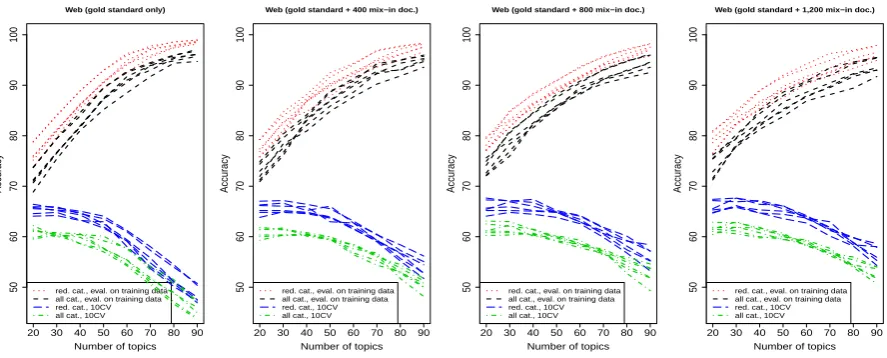
Figure 1: Accuracy with different numbers of topics for the Web dataset
4 Results
Figure 1 shows the classification accuracy using 20 to 90 LSI topics. Each line corresponds to one sub-experiment (with slightly different pre-processing options for lines of the same color and style), and the lines form well distinguishable bands. The highest accuracy is achieved with the reduced set of topic domains (minor categories re-moved) when the evaluation is performed on the training data. The full set of topic domains leads to a drop in accuracy of about 5%. The two lower bands show the classification accuracy in a 10-fold cross-validation (10CV), again with the reduced set of topic domains performing roughly 5% bet-ter. While a higher number of topics improves re-sults on the training data, the accuracy in the cross-validation drops. Too large numbers of topics ob-viously allow the method to pick up idiosyncratic features of single documents or very small clusters of documents, leading to extreme overfitting.
The four panels show results based on differ-ent topic models. Panel (a) uses a topic model in-ferred only from the (more than 800) gold stan-dard documents. Results in panel (b) through (d) are based on topic models inferred on larger data sets as described in Section 3. In the experiment reported in panel (d), for example, 1,200 docu-ments were added to the 870 gold standard doc-uments. While the results of the 10CV are slightly improved by mixing in more documents, the max-imum achieved accuracy does not change signifi-cantly. We mixed in up to 8,000 additional doc-uments (not all results shown here) with no sig-nificant change compared to panel (d) in Figure 1.
We consider the maximum 10CV accuracy with the reduced set of topic domains most informative w. r. t. the potential quality of our method, and we report it in Table 1.
A very similar plot for the News data is shown in Figure 3. The best results are also given in Ta-ble 1. The added accuracy (4.23% according to Table 1) is a side effect of the more skewed distri-bution of topic domains in the News gold standard data.
The κ statistic for the Web and Newspaper
re-sults from Table 1 is κWeb = 0.575and κNews =
0.582, indicating that achieving a higher accuracy for the web data is actually slightly harder than for the newspaper data (see also the analysis of the confusion matrices below).
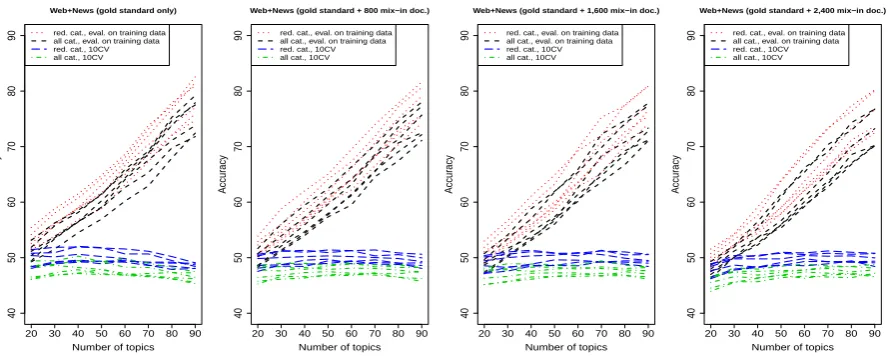
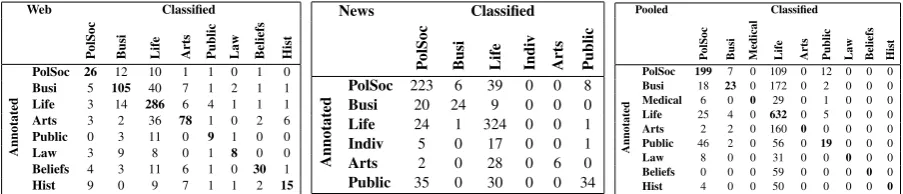
When the Web and News data are pooled, how-ever, quality drops below any acceptable level, cf. Figure 3 and Table 1. Mixing in more documents (panels b–d) improves the evaluation results on the training data, but the 10CV results remains steady at around 50%. This is remarkable because larger training data sets should lead to increased, not de-graded accuracy. While a deeper analysis of the LSI topic distributions remains to be undertaken, it is evident what most likely causes these below average results on the side of the SVM classifier when looking at the confusion matrices, cf. Ta-ble 2. In the Web gold standard (panel a), the dom-inant modal category isLife and Leisure. The dis-tribution of topic domains is reasonably skewed, and the confusion is distributed roughly uniformly across categories. The News gold standard (panel b) consists mainly of two clusters of documents
in the domains Politics and Societyand Life and
50
60
70
80
90
100
News (gold standard only)
Number of topics
Accur
acy
20 30 40 50 60 70 80 90
red. cat., eval. on training data all cat., eval. on training data red. cat., 10CV all cat., 10CV
50
60
70
80
90
100
News (gold standard + 400 mix−in doc.)
Number of topics
Accur
acy
red. cat., eval. on training data all cat., eval. on training data red. cat., 10CV all cat., 10CV
20 30 40 50 60 70 80 90
50
60
70
80
90
100
News (gold standard + 800 mix−in doc.)
Number of topics
Accur
acy
20 30 40 50 60 70 80 90
red. cat., eval. on training data all cat., eval. on training data red. cat., 10CV all cat., 10CV
50
60
70
80
90
100
News (gold standard + 1,200 mix−in doc.)
Number of topics
Accur
acy
20 30 40 50 60 70 80 90
[image:4.595.74.520.66.243.2]red. cat., eval. on training data all cat., eval. on training data red. cat., 10CV all cat., 10CV
Figure 2: Accuracy with different numbers of topics for the News dataset
Corpus Mixed-in Attribute Topics Accuracy Precision∗ Recall∗ F-Measure∗
Web 3,200 token 20 68.765% 0.688 0.688 0.674
News 3,600 lemma + POS 40 72.999% 0.725 0.730 0.696
[image:4.595.71.527.282.336.2]Web + News 0 lemma + POS 30 51.872% 0.431 0.519 0.417
Table 1: Evaluation at best achievable accuracy with the reduced set of topic domains in 10-fold cross-validation (∗weighted average across all categories)
40
50
60
70
80
90
Web+News (gold standard only)
Number of topics
Accur
acy
20 30 40 50 60 70 80 90
red. cat., eval. on training data all cat., eval. on training data red. cat., 10CV all cat., 10CV
40
50
60
70
80
90
Web+News (gold standard + 800 mix−in doc.)
Number of topics
Accur
acy
red. cat., eval. on training data all cat., eval. on training data red. cat., 10CV all cat., 10CV
20 30 40 50 60 70 80 90
40
50
60
70
80
90
Web+News (gold standard + 1,600 mix−in doc.)
Number of topics
Accur
acy
20 30 40 50 60 70 80 90
red. cat., eval. on training data all cat., eval. on training data red. cat., 10CV all cat., 10CV
40
50
60
70
80
90
Web+News (gold standard + 2,400 mix−in doc.)
Number of topics
Accur
acy
20 30 40 50 60 70 80 90
red. cat., eval. on training data all cat., eval. on training data red. cat., 10CV all cat., 10CV
Figure 3: Accuracy with different numbers of topics for the pooled Web + News datasets
leads to a situation in which the classifier simply
assigns most documents to Life and Leisure and
the rest mostly toPolitics and Society. This indi-cates that for such skewed distributions of topic domains, larger gold standard data sets are re-quired. It is not indicative of a general failure of the method or a general incompatibility of news-paper and web data in the context of our method. The confusion matrices in Table 2 clearly indicate, however, that topic domains are represented quite differently in newspaper and web corpora.
5 Conclusions and Outlook
[image:4.595.76.521.384.563.2]Web Classified
PolSoc Busi Life Arts Public Law Beliefs Hist
Annotated
PolSoc 26 12 10 1 1 0 1 0
Busi 5 105 40 7 1 2 1 1
Life 3 14 286 6 4 1 1 1
Arts 3 2 36 78 1 0 2 6
Public 0 3 11 0 9 1 0 0
Law 3 9 8 0 1 8 0 0
Beliefs 4 3 11 6 1 0 30 1
Hist 9 0 9 7 1 1 2 15
News Classified
PolSoc Busi Life Indi
v
Arts Public
Annotated
PolSoc 223 6 39 0 0 8 Busi 20 24 9 0 0 0 Life 24 1 324 0 0 1 Indiv 5 0 17 0 0 1 Arts 2 0 28 0 6 0 Public 35 0 30 0 0 34
Pooled Classified
PolSoc Busi Medical Life Arts Public Law Beliefs Hist
Annotated
PolSoc 199 7 0 109 0 12 0 0 0
Busi 18 23 0 172 0 2 0 0 0
Medical 6 0 0 29 0 1 0 0 0
Life 25 4 0 632 0 5 0 0 0
Arts 2 2 0 160 0 0 0 0 0
Public 46 2 0 56 0 19 0 0 0
Law 8 0 0 31 0 0 0 0 0
Beliefs 0 0 0 59 0 0 0 0 0
[image:5.595.73.525.62.159.2]Hist 4 0 0 50 0 0 0 0 0
Table 2: Confusion matrices for the best achievable results on the Web (a), News (b), and pooled (c) data sets as reported in Table 1; different sets of categories are the result of excluding low-frequency topic domains (below 20 for Web and News, below 30 for pooled data)
Secondly, there appears to be a significant dif-ference in the topic distribution and the topic/ domain mapping in newspaper and web corpora. This might be one of the reasons behind the col-lapse of the classifier when newspaper and web data are pooled. In future experiments, it remains to be discovered whether larger gold standard cor-pora can alleviate such problems. This will even-tually enable us to decide whether separate models or pooled models for the two kinds of corpora are more appropriate.
Thirdly, the highly skewed topic distributions in both newspaper and web corpora indicate that splitting up some topic domains might lead to a better fit. In fact, annotators have independently
asked whether Politics and Society and Life and
Leisure—the critical categories which make the
classifier collapse (cf. Section 4)—could not be split up into at least two categories each.
Additionally, we will investigate whether alter-native topic modeling algorithms lead to a better
fit.2 Moreover, as suggested by an anonymous
re-viewer, our results could be compared with a base-line classification that does not make use of topic modeling algorithms. Finally, we are currently ex-perimenting with an extended annotation scheme that allows for multiple weighted assignments of documents to topic domains.
The ultimate goal of our project is to automati-cally annotate existing web corpora that are sev-eral billion tokens large with meta data such as their topic domain and to release the data freely (under a maximally permissive Creative
Com-mons Attribution license).3 The experiments
re-2The Gensim toolkit offers a wide array of algorithms,
includingdoc2vec and an alternative LDA implementation ldamallet.
3The software and the classifiers will be made available
under permissive open source licenses allowing even their use in commercial applications.
ported here indicate that with some tweaking, it will be possible to create such free resources and achieve very high levels of quality.
Acknowledgments
Roland Sch¨afer’s research on the project presented here was funded by the German Research Coun-cil (Deutsche Forschungsgemeinschaft, DFG)
through grant SHA/1916-1 Linguistic Web
Char-acterization.
References
Douglas Biber and Jesse Egbert. 2016. Using gram-matical features for automatic register identification in an unrestricted corpus of documents from the open web. Journal of Research Design and Statistics in Linguistics and Communication Science, 2:3–36. Chris Biemann, Felix Bildhauer, Stefan Evert, Dirk Goldhahn, Uwe Quasthoff, Roland Sch¨afer, Jo-hannes Simon, Leonard Swiezinski, and Torsten Zesch. 2013. Scalable construction of high-quality web corpora. Journal for Language Technology and Computational Linguistics, 28(2):23–60.
David M. Blei, Andrew Y. Ng, and Michael I. Jordan. 2003. Latent dirichlet allocation. Journal of Ma-chine Learning Research, 3:993–1022.
EAGLES. 1996. Preliminary recommendations on text typology. Technical report EAG-TCWG-TTYP/P, EAGLES.
Mark Hall and Ian H. Witten. 2011. Data mining: practical machine learning tools and techniques. Kaufmann, Burlington, 3rd edition.
Adam Kilgarriff. 2001. Comparing corpora. Interna-tional Journal of Corpus Linguistics, 6(1):97–133. Marc Kupietz, Cyril Belica, Holger Keibel, and
Piperidis, Mike Rosner, and Daniel Tapias, editors, Proceedings of the Seventh International Confer-ence on Language Resources and Evaluation (LREC ’10), pages 1848–1854, Valletta, Malta. European Language Resources Association (ELRA).
Thomas K. Landauer and Susan T. Dumais. 1994. Latent semantic analysis and the measurement of knowledge. In R. M. Kaplan and J. C. Burstein, ed-itors,Educational testing service conference on nat-ural language processing techniques and technology in assessment and education. Educational Testing Service, Princeton, NJ.
Thomas K. Landauer and Susan T. Dumais. 1997. A solution to plato’s problem: the latent semantic analysis theory of acquisition, induction and rep-resentation of knowledge. Psychological Review, 104(2):211–240.
Niels Landwehr, Mark Hall, and Eibe Frank. 2005. Logistic model trees. Machine Learning, 95(1– 2):161–205.
Alexander Mehler, Serge Sharoff, and Marina Santini, editors. 2010. Genres on the Web. Computational Models and Empirical Studies, volume 42 of Text, Speech and Language Technology. Springer, Dor-drecht.
Radim ˇReh˚uˇrek and Petr Sojka. 2010. Software Framework for Topic Modelling with Large Cor-pora. InProceedings of the LREC 2010 Workshop on New Challenges for NLP Frameworks, pages 45– 50, Valletta, Malta. ELRA.
Roland Sch¨afer and Felix Bildhauer. 2012. Build-ing large corpora from the web usBuild-ing a new ef-ficient tool chain. In Nicoletta Calzolari, Khalid Choukri, Thierry Declerck, Mehmet U˘gur Do˘gan, Bente Maegaard, Joseph Mariani, Jan Odijk, and Stelios Piperidis, editors, Proceedings of the Eight International Conference on Language Resources and Evaluation (LREC’12), pages 486–493, Istan-bul. ELRA.
Roland Sch¨afer. 2015. Processing and querying large web corpora with the COW14 architecture. In Pi-otr Ba´nski, Hanno Biber, Evelyn Breiteneder, Marc Kupietz, Harald L¨ungen, and Andreas Witt, editors, Proceedings of Challenges in the Management of Large Corpora 3 (CMLC-3), Lancaster. UCREL. Fabrizio Sebastiani. 2002. Machine learning in
au-tomated text categorization. ACM Computing Sur-veys, 34(1):1–47.
Serge Sharoff. 2006. Creating general-purpose cor-pora using automated search engine queries. In Marco Baroni and Silvia Bernardini, editors,Wacky! Working papers on the Web as Corpus. GEDIT, Bologna.
B¨ulent ¨Ust¨un, Willem J. Melssen, and Lutgarde M.C. Buydens. 2006. Facilitating the application of Sup-port Vector Regression by using a universal Pearson