Reference Resolution in Situated Dialogue with Learned Semantics
Xiaolong Li
Computer & Information Science & Engineering
University of Florida
Kristy Elizabeth Boyer
Computer & Information Science & Engineering
University of Florida
Abstract
Understanding situated dialogue requires identifying referents in the environment to which the dialogue participants refer. This reference resolution problem, often in a complex environment with high ambigu-ity, is very challenging. We propose an approach that addresses those challenges by combining learned semantic structure of referring expressions with dialogue his-tory into a ranking-based model. We eval-uate the new technique on a corpus of human-human tutorial dialogues for com-puter programming. The experimental re-sults show a substantial performance im-provement over two recent state-of-the-art approaches. The proposed work makes a stride toward automated dialogue in com-plex problem-solving environments.
1 Introduction
The content of a situated dialogue is very closely related to the environment in which it happens (Grosz and Sidner, 1986). As dialogue systems move toward assisting users in increasingly com-plex tasks, these systems must understand users’ language within the environment of the tasks. To achieve this goal, dialogue systems must perform reference resolution, which involves identifying the referents in the environment that the user refers to (Iida et al., 2010; Liu et al., 2014; Liu and Chai, 2015; Chai et al., 2004). Imagine a dialogue sys-tem that assists a novice student in solving a pro-gramming problem. To understand a question or statement the student poses, such as, “Should I use the 2 dimensional array?”, the system must link thereferring expression“the 2 dimensional array” to anobject1in theenvironment.
1The word “object” has a technical meaning within the
domain of object-oriented programming, which is the domain
This process is illustrated in Figure 1, which shows an excerpt from a corpus of tutorial dia-logue situated in an introductory computer pro-gramming task in the Java propro-gramming language. The arrows link referring expressions in the sit-uated dialogue to their referents in the environ-ment. To identify the referent of each referring expression, it is essential to capture the semantic structure of the referring expression of the object it refers to, such as“the 2 dimensional array” con-tains two attributes,“2 dimensional”and“array”. At the same time, the dialogue history and the his-tory of user task actions (such as editing the code) play a key role. To disambiguate the referent of
“my array”, temporal information is needed: in this case, the referent is a variable namedarra, which is an array that the student has just created. Reference resolution in situated dialogue is challenging because of the ambiguity inherent within dialogue utterances and the complexity of the environment. Prior work has leveraged dia-logue history and task history information to im-prove the accuracy of reference resolution (Iida et al., 2010; Iida et al., 2011; Funakoshi et al., 2012). However, these prior approaches have employed relatively simple semantic information from the referring expressions, such as a manually created lexicon, or have operated within an environment with a limited set of pre-defined objects. Besides reference resolution in situated dialogue, there is also a research direction in which machine learn-ing models are used to learn the semantics of noun phrases in order to map noun phrases to ob-jects in a related environment (Kennington and Schlangen, 2015; Liang et al., 2009; Naim et al., 2014; Kushman et al., 2014). However, these prior approaches operated at the granularity of single
of the corpus utilized in this work. However, we follow the standard usage of “object” in situated dialogue (Iida et al., 2010), which for programming is any portion of code in the environment.
Tutor: Tutor:
…
Tutor: …
Student:
Tutor:
[image:2.595.73.506.66.327.2]Student:
table = new int[10][5];
that is where they initialize the size of the 2 dimensional array
…
[student adds line of code: arra = new int[s.length()];] great!
…
[student adds line of code:
new2=Integer.parseInt(parse1);]
does my array look like it is set up correctly now
umm... in the for loop, what should you be storing in the array?
:)
setTitle("Postal Code Generator"); setDefaultCloseOperation(EXIT_ON_CLOSE); setVisible(true);
table = new int[10][5]; initTable();
}
/**
* Extract the individual digits stored in the ZIP code * and store their values as private data
*/
private void extractDigits() {
//You must complete this method!! String s = Integer.toString(zipCode); String parse1;
Char num; int arra[]; int new2;
arra = new int[s.length()];
for(int i=0, i<s.length(); i++) {
num=s.charAt(i);
parse1=""+num;
new2=Integer.parseInt(parse1);
arra[i]=num;
}
Dialogue and task history Environment
Figure 1 Excerpt of tutorial dialogue illustrating reference resolution. Referring expressions are shown in bold italics.2
spoken utterances not contextualized within a dia-logue history, and they too focus on environments with a limited number (and a pre-defined set) of objects. As this paper demonstrates, these prior approaches do not perform well in situated dia-logues for complex problem solving, in which the user creates, modifies, and removes objects from the environment in unpredictable ways.
To tackle the problem of reference resolu-tion in this type of situated dialogue, we pro-pose an approach that combines semantics from a conditional-random-field-based semantic parser along with salient features from dialogue history and task history. We evaluate this approach on the JavaTutor corpus, a corpus of textual tutorial dialogue collected within an online environment for computer programming. The results show that our approach achieves substantial improvement over two existing state-of-the-art approaches, with existing approaches achieving 55.2% accuracy at best, and the new approach achieving 68.5% accu-racy.
2Typos and syntactic errors are shown as they appear in
the original corpus.
2 Related Work
The work in this paper is informed by research in coreference resolution for text as well as reference resolution in situated dialogue and multi-modal environments. This section describes related work in those areas.
The classic reference resolution problem for discourse aims to resolve coreference relation-ships within a given text (Martschat and Strube, 2015; McCarthy and Lehnert, 1995; Soon et al., 2001). Effective approaches for discourse cannot be directly applied to the problem of linking re-ferring expressions to their referents in a rich situ-ated dialogue environment, because the informa-tion embedded within the environment plays an important role in understanding the referring rela-tionships in the situated dialogue. Our approach combines referring expressions’ semantic infor-mation along with dialogue history, task history, and a representation of the environment in which the dialogue is situated.
re-searchers have used multimodal information, in-cluding vision, gestures, speech, and eye gaze, to contribute to the problem of reference resolution. Given that the focus of these works is on employ-ing rich multimodal information, the research is usually conducted on a limited number of objects, and typically uses spatial relationship between ob-jects as constraints to solve the reference resolu-tion problem. We conduct reference resoluresolu-tion in an environment with a dynamic number of refer-ents and there is no obvious spatial relationship between the objects.
More closely related work to our own involves reference resolution in dialogue situated within a collaborative game (Iida et al., 2010; Iida et al., 2011; Funakoshi et al., 2012). To link referring expressions to one of the seven gamepiece ob-jects, they encoded dialogue history and task his-tory, and our proposed approach leverages these features as well. However, in contrast to our com-plex problem-solving domain of computer pro-gramming, their domain has a small number of possible referents, so they used a manually cre-ated lexicon to extract semantic information from referring expressions. Funakoshi et al. (2012) went further, using Bayesian networks to model the relationship between referents and words used in referring expressions. That model is based on a hand-crafted concept dictionary and distribution over different referents. This approach cannot be directly applied to a dialogue with a dynamic en-vironment because it is not possible to manually define the distribution over all possible referents beforehand, since objects in the environment are not known before they are created. So we chose Iida et al.’s work (2010) as one of the two most recent approaches to compare with.
Another closely related research direction in-volves reference resolution in physical environ-ments (Kennington and Schlangen, 2015; Kush-man et al., 2014; Naim et al., 2014; Liang et al., 2009). Although not within situated dialogue per se (because only one participant speaks), these lines of investigation have produced approaches that link natural language noun phrases to objects in an environment, such as a set of objects of dif-ferent type and color on a table (Kennington and Schlangen, 2015) or a variable in a mathemati-cal formula (Kushman et al., 2014). Some of these learn the mapping relationship by learning the semantics of words in the referring expressions
(Kennington and Schlangen, 2015; Liang et al., 2009) with referring expression-referent pairs as input. Most recently, Kennington and Schlangen (2015) used a word-as-classifier approach to learn word semantics to map referring expressions to a set of 36 Pentomino puzzle pieces on a table. We implement their word-as-classifier approach and compare it with our novel approach.
3 Reference Resolution Approach
This section describes a new approach to refer-ence resolution in situated dialogue. It links each referring expression from the dialogue to a most likely referent object in the environment. Our ap-proach involves three main steps. First, referring expressions from the situated dialogue are seg-mented and labeled according to their semantic structure. Using a semantic segmentation and la-beling approach we have previously developed (Li and Boyer, 2015), we use a conditional random field (CRF) for this joint segmentation and label-ing task, and the values of the labeled attributes are then extracted (Section 3.1). The result of this step islearned semantics, which are attributes of objects expressed within each referring expres-sion. Then, these learned semantics are utilized within the novel approach reported in this paper. As Section 3.2 describes, dialogue and task history are used to filter the objects in the environment to build a candidate list of referents, and then as Sec-tion 3.3 describes, a ranking-based classificaSec-tion approach is used to select the best matching refer-ent.
For situated dialogue we define Etas the state of the environment at time t. Et consists of all objects present in the environment. Importantly, the objects in the environment vary along with the dialogue: at each moment, new objects could be created (|Et|>|Et−1|), and existing objects could be removed (|Et| < |Et−1|) because of the task performed by the user.
Et={oi|oiis an object in the environment at time t}
3.1 Referring Expression Semantic Interpretation
In situated dialogues, a referring expression may contain rich semantic information about the ref-erent, especially when the context of the situated dialogue is complex. Approaches such as domain-specific lexicons are limited in their ability to ad-dress this complexity, so we utilize a linear-chain CRF to parse the semantic structure of the refer-ring expression. This more automated approach can also potentially avoid the manual labor re-quired in creating and maintaining a lexicon.
In this approach, every object within the envi-ronment must be represented according to its at-tributes. We treat the set of all possible attributes of objects as a vector, and for each object oi in the environment we instantiate and populate an at-tribute vectorAtt V eci. For example, the attribute vector for a two-dimensional array in a computer program could be[CATEGORY = ‘array, DIMEN-SION = ‘2, LINE = ‘30, NAME = ‘table, ...]. We ultimately represent Et = {oi} as the set of all attribute vectorsAtt V eci, and for a referring ex-pression we aim to identify Att V ecj, the actual referent.
Since a referring expression describes its refer-ents either implicitly or explicitly, the attributes expressed in it should match the attributes of its referent. We segment referring expressions and la-bel the semantics of each segment using the CRF and the result is a set of segments, each of which represents some attribute of its referent. This pro-cess is illustrated in (Figure 2 (a)). After segment-ing and labelsegment-ing attributes in the referrsegment-ing expres-sions, the attributevaluesare extracted from each semantic segment using regular expressions (Fig-ure 2 (b)), e.g., value 2 is extracted from 2 di-mensionalto fill in theARRAY DIMelement in an emptyAtt V ec. The result is an attribute vector that represents the referring expression.
3.2 Generating a List of Candidate Referents Once the referring expression is represented as an object attribute vector as described above, we wish to link that vector to the closest-matching object in the environment. Each object is represented by its own attribute vector, and there may be a large number of objects inEt. Given a referring expres-sionRk, we would like to trim the list to keep only those objects that are likely to be referent forRk.
[image:4.595.309.528.67.190.2]There are two desired criteria for generating the
Figure 2 Semantic interpretation of referring ex-pressions.
list of candidate referents. First, the actual ref-erent must be in the candidate list. At the same time, the candidate list should be as short as pos-sible. We can pare down the set of all objects in Et by considering focus of attention in dia-logue. Early approaches performed reference res-olution by estimating each dialogue participant’s focus of attention (Lappin and Leass, 1994; Grosz et al., 1995). According to Ariel’s accessibility theory (Ariel, 1988), people tend to use more pre-cise descriptions such as proper names in refer-ring expressions for referents in long term mem-ory, and use less precise descriptions such as pro-nouns for referents in short term memory. In a precise description, there is more semantic infor-mation, while in a more vague description like a pronoun, there is less semantic information. Thus, these two sources of information, semantics and focus of attention, work together in identifying a referent.
Our approach employs this idea in the process of candidate referent selection by tracking the fo-cus of attention of the dialogue participants from the beginning of the dialogue through dialogue history and task history, as has been done in prior work we use for comparison within our experi-ments (Iida et al., 2010). We also use the learned semantics of the referring expression (represented as the referring expression’s attribute vector) as fil-tering conditions to select candidates.
The candidate generation process consists of three steps.
1. Candidate generation from dialogue history DH.
DH=< Od, Td>
the beginning of the dialogue. Td =< t1
d, t2d, ..., tmd >is a sequence of timestamps when corresponding objects were mentioned. All of the objects inEt that were ever men-tioned in the dialogue history, {oi|oi ∈ DH&oi ∈Et}, will also be added into the candidate list.
2. Candidate generation from task historyT H. Similarly,T H =< Ob, Tb >, which is all of the objects inEtthat were ever manipulated by the user, will be added into the candidate list.
3. Candidate generation using learned seman-tics, which are the referent’s attributes. Given a set of attributes extracted from a referring expression, all objects inEt with one of the same attribute values will be added into the candidate list. The attributes are considered separately to avoid the case in which a single incorrectly extracted attribute could rule out the correct referent. Table 1 shows the algo-rithm used in this step.
Given a referring expression Rk, whose at-tribute vectorAtt V eckhas been extracted. for each elementatti ofAtt V eck
ifattiis not null for eachoinEt
ifatti==o.atti
addointo candidate listCk
Table 1 Algorithm to select candidates using learned semantics
3.3 Ranking-based classification
With the list of candidate referents in hand, we em-ploy a ranking-based classification model to iden-tify the most likely referent. Ranking-based mod-els have been shown to perform well for refer-ence resolution problems in prior work (Denis and Baldridge, 2008; Iida et al., 2010). For a given referring expressionRkand its candidate referent listCk ={o1, o2, ..., oNk}, in which eachoi is an object identified as a candidate referent, we com-pute the probability of each candidateoibeing the true referent ofRk,p(Rk, oi) =f(Rk, oi), where f is the classification function. (Note that our ap-proach is classifier-agnostic. As we describe in
Section 5, we experimented with several differ-ent models.) Then, the candidates are ranked by p(Rk, oi), and the object with the highest proba-bility is taken as the referent ofRk.
4 Corpus
Human problem solving represents a highly com-plex domain that poses great challenges for refer-ence resolution. We evaluate our new referrefer-ence resolution approach on a corpus of human-human textual dialogue in the domain of computer pro-gramming (Boyer et al., 2011). In each dialogue, a human tutor assisted a student remotely using typed dialogue as the student completed given programming tasks in the Java programming lan-guage. The programming tasks involved array ma-nipulation and control flow, which are challenging for students with little programming experience. Students’ and tutors’ view of the task were syn-chronized in real time. At the beginning of each problem-solving session students were provided a framework of code to fill in, which is around 200 lines initially. The corpus contains 45 tutoring ses-sions, 4857 utterances in total, 108 utterances for each session on average. We manually annotated the referring expressions in the dialogue and their referents in the corresponding Java code for six dialogues from the corpus (346 referring expres-sions). These six sessions contain 758 utterances. The dialogues focus on the details of solving the programming problems, with very little social or off-task talk. Figure 1 shows an excerpt of this dialogue.
5 Experiments & Result
To evaluate the new approach, we performed a set of experiments that compare our approach with two state-of-the-art approaches.
5.1 Semantic Parsing
The referring expressions were extracted from the tutorial dialogues and their semantic segments and labels were manually annotated. A linear-chain CRF was trained on that data and used to per-form referring expression segmentation and label-ing (Li and Boyer, 2015). The current paper re-ports the first use of that learned semantics ap-proach for reference resolution.
learned semantic structure, we may know that 2 dimensional refers to the dimension of the array, the attributeARRAY DIM. (In the current domain there are 14 attributes that comprise the generic attribute vectorV, such as ARRAY DIM, NUM, and CATEGORY.) To actually extract the attribute values, we use regular expressions that capture our three types of attribute values: categorical, nu-meric, and strings. For example, the value type ofCATEGORYis categorical, likemethodor vari-able. Its values are taken from a closed set.NAME
has values that are strings. LINE NUMBER’s value is numeric. For categorical attributes, we add the categorical attribute values into the se-mantic tag set of the CRF used for segmenta-tion. In this way, the attribute values of categori-cal attributes will be generated by the CRF. For at-tributes with text string values, we take the whole surface string of the semantic segment as its at-tribute value. The accuracy of the entire seman-tic parsing pipeline is 93.2% using 10-fold cross-validation. The accuracy is defined as the percent-age of manually labeled attribute values that were successfully extracted from referring expressions.
5.2 Candidate Referent Generation
We applied the approach described in Section 3.2 on each session to generate a list of candidate ref-erents for each referring expression. In a program, there could be more than one appearance of the same object. We take all of the appearances of the same object to be the same, since they all re-fer to the same artifact in the program. The aver-age number of generated candidates for each ring expression was 44.8. The percentage of refer-ring expressions whose actual referents were in the generated candidate list, or ’“hit rate” is 90.5%, based on manual tagging. This performance in-dicates that the candidate referent list generation performs well.
A referring expression could be a pronoun, such as “it” or “that”, which does not contain at-tribute information. In previous reference reso-lution research, it was shown that training sep-arate models for different kinds of referring ex-pressions could improve performance (Denis and Baldridge, 2008). We follow this idea and split the dataset into two groups: referring expressions con-taining attributes, REatt, (270 referring expres-sions), and referring expressions that do not con-tain attributes,REnon(76 referring expressions).
The candidate generation approach performed better for the referring expressions without at-tributes (hit rate 94.7%), compared to referring ex-pressions with attributes (hit rate 89.3%). Since the candidate list for referring expressions without attributes relies solely on dialogue and task his-tory, 94.7% of those referents had been mentioned in the dialogue or manipulated by the user previ-ously. For referring expressions with attribute in-formation, the generation of the candidate list also used learned semantic information. Only 70.0% of those referents had been mentioned in the dialogue or manipulated by the user before.
5.3 Identifying Most Likely Referent
We applied the approach described in section 3.3 to perform reference resolution on the corpus of tutorial dialogue. The data from the six manually labeled Java tutoring sessions were split into a training set and a test set. We used leave-one-dialogue-out cross validation (which leads to six folds) for the reference resolution experiments. In each fold, annotated referring expressions from one of the tutoring sessions were taken as the test set, and data from the other five sessions were the training set. We tested logistic regression, decision tree, naive Bayes, and neural networks as classifiers to compute the p(Rk, oi) for each
(referring expression, candidate) pair for the ranking-based model. The features provided to each classifier are shown in Table 2.
lexi-Learned Semantic Features (SF)
SF1: whether RE has CATEGORY attribute SF2: whether RE.CATEGORY == o.CATEGORY SF3: whether RE has RE.NAME
SF4: whether RE.NAME == o.NAME SF5: RE.NAME≈o.NAME
SF6: RE.VAR TYPE exist
SF7: RE.VAR TYPE == o.VAR TYPE SF8: RE.LINE NUMBER exist
SF9: RE.LINE NUMBER == o.LINE NUMBER SF10: RE.ARRAY DIMENSION exist
SF11: RE.ARRAY DIMENSION == o.ARRAY DIMENSION
SF12: CATEGORY of o
Dialogue History (DH) Features
DH1: whether o is the latest mentioned object DH2: whether o was mentioned in the last 30 seconds DH3: whether o was mentioned in the last [30, 60] seconds DH4: whether o was mentioned in the last [60, 180] sec-onds
DH5: whether o was mentioned in the last [180, 300] sec-onds
DH6: whether o was mentioned in the last [300, 600] sec-onds
DH7: whether o was mentioned in the last [600, infinite] seconds
DH8: whether o was never mentioned from the beginning DH9: String matching between o and RE
Task History (TH) Features
TH1: whether o is the most recent object manipulated TH2: whether o was manipulated in the last 30 seconds TH3: whether o was manipulated in the last [30, 60] sec-onds
TH4: whether o was manipulated in the last [60, 180] sec-onds
TH5: whether o was manipulated in the last [180, 300] seconds
TH6: whether o was manipulated in the last [300, 600] seconds
TH7: whether o was manipulated in the last [600, infinite] seconds
TH8: whether o was never manipulated from the beginning TH9: whether o is in the current working window
Table 2 Features used for segmentation and label-ing.
con. Although the necessary data to do this would not be available in a real application of the tech-nique, it ensures that the lexicon for the baseline condition has good coverage and creates a high baseline for our new approach to compare against. Additionally, for fairness of comparison, for each
semantic feature used in our model, we extracted the same feature using the lexicon. There were three kinds of attribute values in the domain: cat-egorical, string, and numeric (as described in Sec-tion 5.1). We extracted categorical attribute values using the appearance of tokens in the lexicon. We used regular expressions to determine whether a referring expression contains the name of a candi-date referent. We also used regular expressions to extract attribute values from referring expressions, such as line number. We also provided the Iida
baseline model (2010) with a feature to indicate string matching between referring expressions and candidate referents, since this feature was captured in our model as an attribute.
We also compared our approach against a very recent technique that leveraged a word-as-classifier approach to learn semantic compatibility between referring expressions and candidate ref-erents (Kennington and Schlangen, 2015). To create this comparison model we used a word-as-classifier to learn the semantics of referring ex-pressions instead of CRF. This weakly supervised approach relies on co-appearance between words and object’s attributes. We then used the resulting semantic compatibility in a ranking-based model to select the most likely referent.
The three conditions for our experiment are as follows.
• Iida Baseline Condition: Features including dialogue history, task history, andsemantics from a handcrafted lexicon (Iida et al., 2010).
• Kennington Baseline Condition: Features including dialogue history, task history, and learned semantics from a word-as-classifier model (Kennington and Schlangen, 2015).
• Proposed approach: Features including dia-logue history, task history, and learned se-mantics from CRF.
To measure the performance of the reference resolution approaches, we analyzed accuracy, de-fined to be the percent of referring expressions that were successfully linked to their referents. We chose accuracy for our metric following stan-dard practice (Iida et al., 2010; Kennington and Schlangen, 2015) because it provides an overall measure of the number of (Rk,oi) pairs that were correctly identified. For the rare cases in which one referring expression referred to multiple refer-ents, the output referent of the algorithm was taken as correct if it selected any of the multiple refer-ents.
The results are shown in Table 3. We focus on comparing the results on referring expressions that contain attribute information, shown in the table asREFAT T. REFAT T accounts for 78% of all of the cases (270 out of 346). Among the three approaches, our proposed approach outperformed both prior approaches. Compared to the Iida 2010 approach which achieved a maximum of 55.2% accuracy, our approach achieved 68.5% accuracy using a neural net classifier, and this difference is statistically significant based on the results of a Wilcoxon signed-rank test (n= 6;p = 0.046). Our approach outperformed the Kennington 2015 approach even more substantially, as its best per-formance was 46.3% accuracy (p= 0.028). Intu-itively, the better performance of our model com-pared to the Iida approach is due to its ability to more accurately model referring expressions’ se-mantics. Compared to a lexicon, semantic parsing finds optimal segmentation for a referring expres-sion, while a lexicon approach extracts different attribute information from referring expressions separately. Note that our approach and the Iida 2010 approach achieved the same performance on REFNON referring expressions. Since these re-ferring expressions do not contain attribute infor-mation, these two approaches used the same set of features.
Interestingly, the model using a word-as-classifier approach to learn the semantic compati-bility between referring expressions and referent’s attributes performs the worst. We believe that the reason for this poor performance is mainly from the way it performs semantic compositions. It cannot learn structures in referring expressions, such as that 2 dimensional is a segment, dimen-sionalrepresents the type of the attribute, and2is the value of the attribute. The word-as-classifier
model cannot deal with this complex semantic composition.
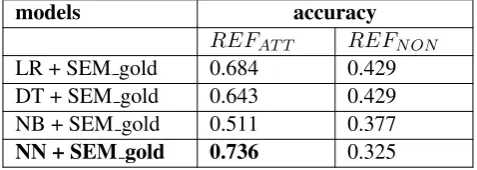
The results reported above relied on learned se-mantics. We also performed experiments using manually labeled, gold-standard semantics of re-ferring expressions. The result in Table 4 shows that ranking-based models have the potential to achieve a considerably better result, 73.6%, with more accurate semantic information. Given the 85.3% agreement between two human annotators, the model performs very well, since the semantics of whole utterances in situated dialogue also play a very important role in identifying a given referring expression’s referent.
experimental
condition fclassi-(Rk, oi) fier
accuracy
REFAT T REFNON
LR 0.500 0.440
Iida DT 0.537 0.453
2010 NB 0.466 0.413
NN 0.552 0.373
LR 0.4627 0.3867
Kennington DT 0.3769 0.3333
2015 NB 0.3209 0.4000
NN 0.4216 0.4000
LR 0.631 0.440
Our DT 0.631 0.453
approach NB 0.493 0.413
[image:8.595.306.532.263.487.2]NN 0.685 0.373
Table 3 Reference resolution results.
models accuracy
REFAT T REFNON
LR + SEM gold 0.684 0.429
DT + SEM gold 0.643 0.429
NB + SEM gold 0.511 0.377
NN + SEM gold 0.736 0.325
Table 4 Reference resolution results with gold se-mantic labels.
6 Conclusion
[image:8.595.306.545.540.625.2]learned semantics to reference resolution in situ-ated dialogue for collaborative tasks. The exper-iments with human-human dialogue on a collab-orative programming task showed a tremendous improvement using semantic information that was learned with a CRF-based semantic parsing proach compared to the previous state-of-art ap-proaches. The accuracy was improved substan-tially, from 55.2% to 68.5%.
There are several important future research di-rections in reference resolution for situated dia-logues. First, models should incorporate more se-mantic information from discourse structure and utterance understanding besides semantics from referring expressions. This is illustrated by the observation that the reference resolution accuracy using gold-standard semantic information from re-ferring expressions is still substantially lower than the agreement rate between human annotators. Another research direction that holds promise is to use an unsupervised approach to extract seman-tic information from referring expressions. It is hoped that this line of investigation will enable rich natural language dialogue interactions to sup-port users in a wide variety of complex situated tasks.
Acknowledgments
The authors wish to thank the members of the LearnDialogue group at the University of Florida and North Carolina State University, particularly Joseph Wiggins, along with Wookhee Min and Adam Dalton for their helpful input. This work is supported in part by Google through a Capac-ity Research Award and by the National Science Foundation through grant CNS-1622438. Any opinions, findings, conclusions, or recommenda-tions expressed in this report are those of the au-thors, and do not necessarily represent the official views, opinions, or policy of the National Science Foundation.
References
Ariel, Mira. 1988. Referring and Accessibility.
Jour-nal of Linguistics, 24, 65-87.
Bj¨orkelund, Anders and Kuhn, Jonas. 2014. Learn-ing Structured Perceptrons for Coreference Reso-lution with Latent Antecedents and Non-local Fea-tures. Proceedings of the 52nd Annual Meeting of the Association for Computational Linguistics
(Vol-ume 1: Long Papers), 47-57.
Boyer, Kristy Elizabeth and Ha, Eun Young and Phillips, Robert and Lester, James C.. 2011. The Impact of Task-Oriented Feature Sets on HMMs for Dialogue Modeling.Proceedings of the 12th Annual Meeting of the Special Interest Group on Discourse
and Dialogue, 49–58.
Chai, Joyce and Hong, Pengyu and Zhou, Michelle. 2004. A Probabilistic Approach to Reference Reso-lution in Multimodal User Interfaces. Proceedings of the 9th International Conference on Intelligent
User Interfaces SE - IUI ’04, 70-77.
Denis, Pascal and Baldridge, Jason. 2008. Specialized Models and Reranking for Coreference Resolution.
Proceedings of the Conference on Empirical
Meth-ods in Natural Language Processing, 660-669.
Devault, David and Kariaeva, Natalia and Kothari, Anubha and Oved, Iris and Stone, Matthew. 2005. An Information-State Approach to Collaborative Reference. Proceedings of the ACL 2005 on
Inter-active Poster and Demonstration Sessions, 1-4.
Funakoshi, Kotaro and Nakano, Mikio and Tokunaga, Takenobu and Iida, Ryu. 2012. A Unified Prob-abilistic Approach to Referring Expressions. Pro-ceedings of the 13th Annual Meeting of the
Spe-cial Interest Group on Discourse and Dialogue,
237-246.
Graesser, A C and Lu, S and Jackson, G T and Mitchell, H H and Ventura, M and Olney, A and Louwerse, M M. 2004. AutoTutor: A Tutor with Dialogue in Natural Language. Behavior Research Methods,
Instruments, & Computers, 36, 180-192.
Grosz, B J and Weinstein, S and Joshi, A K. 1995. Centering - a Framework for Modeling the Local Coherence of Discourse. Computational Linguis-tics, 21(2), 203-225.
Grosz, Barbara J and Sidner, Candace L. 1986. At-tention, Intentions, and the Structure of Discourse.
Computational Linguistics, 175-204.
Harabagiu, Sanda M. and R¨azvan C. Bunescu and Maiorano, Steven J.. 2001. Text and Knowledge Minding for Coreference Resolution. Proceedings of the second meeting of the North American Chap-ter of the Association for Computational Linguistics
on Language technologies. (NAACL-HLT ), 1-8.
Heeman, Peter a. and Hirst, Graeme. 1995. Collab-orating on Referring Expressions. Computational
Linguistics, 21, 351-382.
Huwel, Sonja and Wrede, Britta. 2006. Spon-taneous Speech Understanding for Robust Multi-modal Human-robot Communication. Proceedings
of the COLING/ACL, 391-398.
Meeting of the Association for Computational
Lin-guistics, 1259-1267.
Iida, Ryu and Yasuhara, Masaaki and Tokunaga, Takenobu. 2011. Multi-modal Reference Reso-lution in Situated Dialogue by Integrating Linguis-tic and Extra-LinguisLinguis-tic Clues. Proceedings of the 5th International Joint Conference on Natural
Lan-guage Processing (IJCNLP 2011), 84-92.
Kennington, Casey and Schlangen, David. 2015. Sim-ple Learning and Compositional Application of Per-ceptually Grounded Word Meanings for Incremental Reference Resolution. Proceedings of the 53rd An-nual Meeting of the Association for Computational Linguistics and the 7th International Joint
Confer-ence on Natural Language Processing, 292-301.
Krishnamurthy, Jayant and Kollar, Thomas. 2013. Jointly Learning to Parse and Perceive: Connecting Natural Language to the Physical World.
Associa-tion for ComputaAssocia-tional Linguistics, 193-206.
Kruijff, Geert-Jan M and Lison, Pierre and Benjamin, Trevor. 2010. Situated dialogue processing for human-robot interaction. Cognitive Systems
Mono-graphs, 8, 311-364.
Kushman, Nate and Artzi, Yoav and Zettlemoyer, Luke and Barzilay, Regina. 2014. Learning to Automat-ically Solve Algebra Word Problems. Proceedings of the 52nd Annual Meeting of the Association for
Computational Linguistics, 271-281.
Lappin, Shalom and Leass, Herbert J.. 1994. An Algo-rithm for Pronominal Anaphora Resolution.
Com-putational Linguistics, 535-561.
Li, Xiaolong and Boyer, Kristy Elizabeth. 2015. Se-mantic Grounding in Dialogue for Complex Prob-lem Solving. Proceedings of the Conference of the North American Chapter of the Association for Computational Linguistics and Human Language
Technology (NAACL HLT), 841-850.
Liang, Percy and Jordan, Michael I and Klein, Dan. 2009. Learning Semantic Correspondences with Less Supervision. Proceedings of the Joint Confer-ence of the 47th Annual Meeting of the ACL and the 4th International Joint Conference on Natural
Lan-guage Processing of the AFNLP, 91–99.
Liu, Changsong and Chai, Joyce Y. 2015. Learning to Mediate Perceptual Differences in Situated Human-Robot Dialogue. Proceedings of AAAI 2015, 2288-2294.
Liu, Changsong and She, Lanbo and Fang, Rui and Chai, Joyce Y. 2014. Probabilistic Labeling for Efficient Referential Grounding Based On Collab-orative Discourse. Proceedings of the 52nd Annual Meeting of the Association for Computational
Lin-guistics (ACL), 13-18.
Liu, Changsong and Fang, Rui and She, Lanbo and Chai, Joyce. 2013. Modeling Collaborative Refer-ring for Situated Referential Grounding. Proceed-ings of the 14th Annual Meeting of the Special
Inter-est Group on Discourse and Dialogue, 78–86.
Manning, Christopher D and Bauer, John and Finkel, Jenny and Bethard, Steven J. 2014. The Stanford CoreNLP Natural Language Processing Toolkit.
Proceedings of the 52nd Annual Meeting of the Association for Computational Linguistics: System
Demonstrations, 55-60.
Martschat, Sebastian and Strube, Michael. 2015. La-tent Structures for Coreference Resolution. Trans-actions of the Association for Computational
Lin-guistics, 3, 405-418.
Matuszek, Cynthia and FitzGerald, Nicholas and Zettlemoyer, Luke and Liefeng, Bo and Fox, Di-eter. 2012. A Joint Model of Language and Per-ception for Grounded Attribute Learning. Proceed-ings of the 29th International Conference on
Ma-chine Learning, 1671-1678.
McCarthy, Joseph F. and Lehnert, Wendy G.. 1995. Using Decision Trees for Coreference Resolution.
Proceedings of the Fourteenth International Joint
Conference on Artificial Intelligence (IJCAI), 1-5.
Naim, I and Song, Yc and Liu, Q and Kautz, H and Luo, J and Gildea, D. 2014. Unsupervised Align-ment of Natural Language Instructions with Video Segments.Proceedings of AAAI 2014, 1558-1564. Ponzetto, Simone Paolo and Strube, Michael. 2006.
Exploiting Semantic Role Labeling, WordNet and Wikipedia for Coreference Resolution.Proceedings of the Main Conference on Human Language Tech-nology Conference of the North American
Chap-ter of the Association of Computational Linguistics,
192-199.
Soon, Wee Meng and Ng, Hwee Tou and Lim, Daniel Chung Yong. 2001. Incorporating Extra-linguistic Information into Reference Resolution in Collabora-tive Task Dialogue. Computational Linguistics, 27, 521-544.
VanLehn, Kurt and Jordan, P W and Ros´e, C P and Bhembe, D and Bottner, M and Gaydos, A and Makatchev, M and Pappuswamy, U and Ringenberg, M and Roque, A. 2002. The Architecture of Why2-Atlas: A Coach for Qualitative Physics Essay
Writ-ing. Proceedings of the Sixth International
![table = new int[10][5];](https://thumb-us.123doks.com/thumbv2/123dok_us/1484617.688288/2.595.73.506.66.327/table-new-int.webp)