Organic Syntheses, Coll. Vol. 2, p.389 (1943); Vol. 18, p.54 (1938).
METHYL BENZYL KETONE
[2-Propanone, 1-phenyl-]
[(A) (From Phenylacetic and Acetic Acids)]
Submitted by R. M. Herbst and R. H. Manske. Checked by C. R. Noller and C. F. Love.
1. Procedure
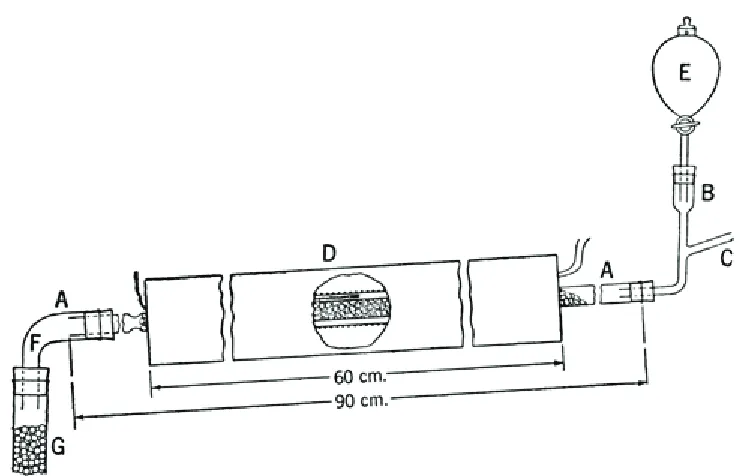
[image:1.612.120.490.433.671.2]The reaction is carried out in the apparatus shown in Fig. 13. A-A is a Pyrex combustion tube, 90 cm. long and 2 cm. in diameter, fitted with an inlet chamber B, having a sealed-in side arm C and bearing a separatory funnel E. The center 60 cm. of the tube is filled with thorium oxide catalyst (Note 1) held in place at the lower end by indentations in the combustion tube. The hot junction D of a pyrometer is placed in contact with the glass tube at its center, and the catalyst-filled section of the tube is wrapped with a thin layer of asbestos paper. The tube is supported in an electrically heated cylindrical furnace, 60 cm. in length, which is inclined slightly from the horizontal. The annular space between the tube and the furnace is plugged at the ends with asbestos in order to produce a uniform temperature throughout the tube and to hold the glass tube in place. The lower end of the reaction tube is connected through the adapter F to a vertical glass tube G, 40 cm. long and 2 cm. in diameter, which is filled with glass beads and serves as the condenser. An Erlenmeyer flask or other suitable receiver is placed at the lower end of G.
Fig. 13
moles) of glacial acetic acid is placed in the separatory funnel E and is introduced into the inlet chamber B at the rate of twelve to fifteen drops per minute. The entire solution should run through in twelve to fifteen hours. Meanwhile a very slow stream of carbon dioxide (one bubble per second) is passed through the tube C, to keep the gases in motion. After all the solution has been added, the funnel is rinsed with 10 cc. of glacial acetic acid, and this is passed through the reaction tube to facilitate removal of the product. The distillate consists of a slightly fluorescent light brown oil and an aqueous layer; both layers are treated with 300 g. of a mixture of ice and water, and rendered alkaline to litmus with a slight excess of 50 per cent sodium hydroxide solution (Note 2).
The oil is separated (Note 3), and the aqueous layer is extracted with two 50-cc. portions of
benzene. The extracts are combined with the oil, and the solvent is removed by distillation. Fractionation of the residue under reduced pressure gives 80–95 g. of a methyl benzyl ketone fraction, boiling at 110–120°/21–22 mm., and a residue of dibenzyl ketone (Note 4). The main fraction on redistillation yields 74–87 g. (55–65 per cent of the theoretical amount) of methyl benzyl ketone boiling at 110–115°/21–22 mm. (Note 5), (Note 6), and (Note 7).
2. Notes
1. The catalyst is prepared as follows: Enough pea-sized pieces of screened pumice to fill the tube is soaked in hot concentrated nitric acid and then washed thoroughly with hot distilled water. In a porcelain dish the pumice is mixed with a solution of 40 g. of thorium nitrate crystals [Th(NO3)4 + 12H2O] in 100 cc. of water and is evaporated to dryness, with frequent stirring to ensure uniform deposition of the salt. The impregnated pumice is ignited over a Bunsen burner until decomposition of the nitrate is complete. The pumice carries about 15 g. of thorium oxide.
2. From the alkaline solution about 10–15 per cent of the phenylacetic acid may be recovered by acidification with sulfuric acid. The acid separates as an oil which crystallizes slowly on cooling.
3. Salt may be added to facilitate the separation.
4. When several runs are made, the residues may be combined and distilled under reduced pressure. The fraction boiling at 190–210°/20 mm. amounts to about 19 g. per run and is chiefly dibenzyl ketone. 5. Further purification of the product may be effected by converting the ketone into the bisulfite compound, washing this with ether, decomposing with sodium bicarbonate, and steam-distilling.
6. When several runs are to be made, the catalyst should be regenerated after each run by passing air through the reaction tube for about three hours while the temperature is raised gradually to 550°. The yield in the first run may be low, especially if all the oxides of nitrogen have not been removed from the reaction tube.
7. Using the same procedure the following ketones may be obtained in similar yields: ethyl benzyl ketone from phenylacetic acid and propionic acid, methyl β-phenylethyl ketone from hydrocinnamic acid and acetic acid, and ethyl β-phenylethyl ketone from hydrocinnamic acid and propionic acid.
[(B) (From α
-Phenylacetoacetonitrile
)]
Submitted by Percy L. Julian and John J. Oliver. Checked by C. R. Noller
1. Procedure
1750 cc. of water added rapidly, and the flask placed on a vigorously boiling water bath and heated for two hours, with occasional shaking. The ketone forms a layer and, after cooling, is separated and the acid layer extracted with 600 cc. of ether. The oil and ether layers are washed successively with 100 cc. of water, the ether combined with the oil and dried over 20 g. of anhydrous sodium sulfate. The sodium sulfate is collected on a filter, washed with ether, and discarded. The ether is removed from the filtrates, and the residue distilled from a modified Claisen flask with a 25-cm. fractionating side arm. The fraction boiling at 109–112°/24 mm. is collected; it weighs 125–150 g. (77–86 per cent of the theoretical amount) (Note 2).
2. Notes
1. If pure dry α-phenylacetoacetonitrile is used, half its weight of water should be added to the sulfuric acid or charring will take place on the steam bath.
2. Usually almost the entire crude product distils in this range with practically no fore-run or residue. Occasionally, however, as much as 30 g. of high-boiling residue, chiefly unchanged nitrile, is obtained. When this happens the yield is correspondingly decreased.
3. Discussion
Methyl benzyl ketone has been prepared by distilling a mixture of the barium1 or calcium2 salts of
phenylacetic and acetic acids; by passing the vapors of these acids over a heated thorium oxide
catalyst;3, 4 and by heating phenylacetic acid, sodium acetate, and acetic anhydride.5 Methyl benzyl
ketone has also been prepared from phenylacetyl chloride and zinc methyl;6 from acetyl chloride and
cadmium dibenzyl;7 by rearrangement of α-phenyl-β-methylethylene oxide;8 by heating α-phenyl-β
-methylethylene glycol with dilute sulfuric acid;9 by heating the addition product of chloroacetone and
phenylmagnesium bromide;9 by treating chloroacetone and benzene with aluminum chloride;10 and by
the hydrolysis of α-phenylacetoacetic ester11 or phenacylmalonic ester.12
The procedure in Part (A) above is based on that of Senderens3 and Pickard and Kenyon.4 It has
been reported that "thoria aërogel" is superior to other forms of thoria catalysts for the preparation of ketones from aliphatic acids or esters.13
This preparation is referenced from:
z Org. Syn. Coll. Vol. 2, 487 z Org. Syn. Coll. Vol. 3, 276 z Org. Syn. Coll. Vol. 3, 399
References and Notes
1. Radziszewski, Ber. 3, 198 (1870). 2. Young, J. Chem. Soc. 59, 621 (1891).
3. Senderens, Ann. chim. phys. (8) 28, 318 (1913). 4. Pickard and Kenyon, J. Chem. Soc. 105, 1124 (1914).
5. Magidson and Garkusha, J. Gen. Chem. (U.S.S.R.) 11, 339 (1941) [C. A. 35, 5868 (1941)]. 6. Popow, Ber. 5, 500 (1872).
7. Gilman and Nelson, Rec. trav. chim. 55, 518 (1936). 8. Fourneau and Tiffeneau, Compt. rend. 141, 663 (1905). 9. Tiffeneau, Ann. chim. phys. (8) 10, 345, 368 (1907). 10. Mason and Terry, J. Am. Chem. Soc. 62, 1622 (1940). 11. Beckh, Ber. 31, 3163 (1898).
12. Metzner, Ann. 298, 378 (1897).
Appendix
Chemical Abstracts Nomenclature (Collective Index Number);
(Registry Number)
oxides of nitrogen
Phenylacetic and Acetic Acids
zinc methyl
cadmium dibenzyl
thoria
sulfuric acid (7664-93-9)
acetic acid (64-19-7)
Benzene (71-43-2)
ether (60-29-7)
acetic anhydride (108-24-7)
sodium acetate (127-09-3)
sodium hydroxide (1310-73-2)
acetyl chloride (75-36-5)
sodium bicarbonate (144-55-8)
nitric acid (7697-37-2)
propionic acid (79-09-4)
sodium sulfate (7757-82-6)
carbon dioxide (124-38-9)
thorium oxide
aluminum chloride (3495-54-3)
Phenylacetic acid (103-82-2)
Phenylmagnesium bromide (100-58-3)
Hydrocinnamic acid (501-52-0)
2-Propanone, 1-phenyl- (103-79-7)
chloroacetone (78-95-5)
phenylacetyl chloride (103-80-0)
α-phenylacetoacetonitrile (4468-48-8)
dibenzyl ketone (102-04-5)
thorium nitrate (13823-29-5)
ethyl benzyl ketone (1007-32-5)
ethyl β-phenylethyl ketone
α-phenyl-β-methylethylene oxide (14212-54-5)
α-phenyl-β-methylethylene glycol
methyl β-phenylethyl ketone (2550-26-7)