Semantically Enriched Models for Modal Sense Classification
Mengfei Zhou1 Anette Frank1,2
1Department of Computational Linguistics, Heidelberg University, Germany
2Research Training Group AIPHES, Dept. of Computational Linguistics, Heidelberg University {zhou,frank,palmer}@cl.uni-heidelberg.de
3Department of Computational Linguistics, Universit¨at des Saarlandes, Germany [email protected]
Annemarie Friedrich3 Alexis Palmer1
Abstract
Modal verbs have different interpretations depending on their context. Previous approaches to modal sense classification achieve relatively high performance using shallow lexical and syntactic features. In this work we uncover the difficulty of par-ticular modal sense distinctions by elimi-nating both distributional bias and sparsity of existing small-scale annotated corpora used in prior work. We build a seman-tically enriched model for modal sense classification by novelly applying features that relate to lexical, proposition-level, and discourse-level semantic factors. Besides improved classification performance, es-pecially for difficult sense distinctions, closer examination of interpretable feature sets allows us to obtain a better under-standing of relevant semantic and contex-tual factors in modal sense classification.
1 Introduction
Factuality recognition (de Marneffe et al., 2011) is an important subtask in information extraction. Beyond bare filtering aspects of veridicality recog-nition, classification ofmodal sensesplays an im-portant role in text understanding, plan recogni-tion, and the emerging field of argumentation min-ing. Communication revolves abouthypothetical,
planned, apprehended or desired states of affairs.
Such ‘extrapropositional’ meanings are often lin-guistically marked using modal verbs, adverbs, or attitude verbs, as in (1) for hypothetical situations.
(1) a. Hemust’ve hurt himself.
b. He hascertainlyfound the place by now. c. Weanticipatethat no one will leave. Following Kratzer (1991)’s seminal work in for-mal semantics, recent computational approaches
such as Ruppenhofer and Rehbein (2012) distin-guish different modal ‘senses’, most prominently,
epistemic(2.a),deontic/bouletic(2.b) and
circum-stantial/dynamic(2.c) modality.
(2) a. Geez, Buddhamustbe so annoyed! (epistemic – possibility)
b. Wemusthave clear European standards. (deontic – permission/request)
c. Shecan’t even read them. (dynamic – ability)
Modal sense tagging is typically framed as a supervised classification task, as in Ruppenhofer and Rehbein (2012), who manually annotated the modal verbs must, may, can, could, shall and
shouldin the MPQA corpus of Wiebe et al. (2005).
The obtained data set comprises 1340 instances. Maximum entropy classifiers trained on this data yield accuracies from 68.7 to 93.5 for the differ-ent lexical classifier models. While these accu-racies seem high, we note a strong distributional bias in their data set. Due to the small data set size (200-600 instances per modal verb) and its distri-butional bias, classifiers trained on this corpus are prone to overfitting and hardly beat the majority baseline. Indeed, none of the classification models in Ruppenhofer and Rehbein (2012) (henceforth R&R) is able to beat the baseline with uniform set-tings across all modal verb types.
Of particular concern in our work are specific sense ambiguities that are difficult to discriminate, such as dynamic vs. deontic readings ofcan(3.a), epistemic vs. dynamic readings of could(3.b) or epistemic vs. deontic readings ofshould(3.c).
(3) a. Youcando this, if you want. ability (dy) vs. permission (de) b. Hecouldhave arrived in time.
possibility (ep) vs. ability (dy) c. Heshouldbe aware of the issue.
In this paper we reexamine prior work on modal sense classification and show that specific distinc-tions are difficult for state-of-the art models. We show that modal sense classification is a challeng-ing problem that profits from lexical, proposition-level and discourse-proposition-level semantic information.
Our goals and contributionsare as follows: (i) We investigate the impact ofsemantic and discourse-related factors for modal sense clas-sification, looking in particular at difficult modal sense distinctions. Accordingly, we define a range of semantically inspired linguistic feature classes. The feature groups are related to lexical and propositional semantics, as well as discourse-level semantics, ranging from tense and aspect to speaker/hearer orientation.
As an example, one of our hypotheses is that aspectual event types play a decisive role in deon-tic vs. epistemic sense disambiguation for modal verbs such asmust. Our intuition is that events are more likely to co-occur with the deontic sense of
must (4.a,b), whereas statives are more likely to co-occur with the epistemic sense (4.c).
(4) a. The prisonersmustreturn their weapons. b. Prisoners of warmustbe returned to their
home countries.
c. Theymustbe so scared.
(ii) As a precondition for the aims of this work, we construct a large corpus that is balanced for modal sense distribution and less prone to overfit-ting compared to prior work. To this end we apply aparaphrase-driven cross-lingual modal sense projection approachusing parallel corpora. We show that this automatic acquisition method yields modal sense annotations of very high accuracy.
(iii) Using this corpus as training data, we de-vise a novel, semantically enriched model for modal sense classification. We assess the impact of diverse feature groups for modal sense classifi-cation in unbiased classificlassifi-cation settings and ana-lyze to what extent they contribute to solving dif-ficult disambiguation problems.
Overview. We review related work in Section 2. Section 3 outlines an automatic modal sense pro-jection approach using parallel corpora. We ap-ply this method to bilingual corpora and evalu-ate the quality of the obtained data set. Section 4 motivates and describes semantic and discourse-oriented features for modal sense classification. These are examined in classification experiments
in Section 5. We reconstruct the modal sense classifier of Ruppenhofer and Rehbein (2012) to compare against prior work. We evaluate the per-formance of different models in unbiased classi-fication experiments, using the harvested sense-labeled corpora for training. We analyze the im-pact of different feature groups on disambiguation performance and relate them to specific difficult disambiguation classes. Section 6 concludes.
2 Related Work
Most relevant to our work is the state of the art in modal sense classification in Ruppenhofer and Rehbein (2012). They manually annotated modal verbs in the MPQA corpus of Wiebe et al. (2005). Their annotation scheme departs from both the earlier setting in Baker et al. (2010) and a more re-cent proposal in Nissim et al. (2013). Baker et al. (2010) distinguish 8 categories. Next to
require-ment, permissive, want and ability, they include
success, effort, intention and belief. They
mea-sured precision in automatic tagging of 86.3% by examining 249 modality-tagged sentences. Nis-sim et al. (2013) propose a fine-grained hierarchi-cal modality annotation scheme that can be ap-plied cross-linguistically. It includes (subtypes) of factuality, as well as speaker attitude. To our knowledge their annotation scheme has not been used for computational tagging.
Ruppenhofer and Rehbein (2012) apply the well-established modal sense categories of Kratzer (1991): epistemic, deontic/bouletic and
circum-stantial/dynamic modality. They add the
cat-egories: concessive, conditional and optative. Their annotation scheme proves reliable both in inter-annotator agreement, which ranges from
3 Paraphrase-driven Sense Projection
Given the sparsity and distributional bias in ex-isting modal sense annotated corpora such as the MPQA, we propose a method for cross-lingual sense projection to alleviate the manual annotation bottleneck. Our approach exploits the paraphras-ing behaviour of modal senses, which holds across modal verbs, modal adverbs and certain attitude verbs. As illustrated in (5) and (6), this paraphras-ing behaviour is applicable across languages.
(5) a. Hemaybe home by now. (possibility) b. Youmayenter this building. (permission) c. Mayyou live 100 years. (wish)
(6) a. Vielleichtist er schon zu Hause.
MAYBE IS HE ALREADY AT HOME.
b. Es istgestattet, das Geb¨aude zu betreten.
IT IS PERMITTED THE BUILDING TO ENTER
c. Hoffentlichwerden Sie 100 Jahre.
HOPEFULLY BECOME YOU100YEARS
Capitalizing on the paraphrasing capacity of such expressions, we apply a semi-supervised cross-lingual projection approach, similar to prior work in annotation projection (Yarowsky and Ngai, 2001; Diab and Resnik, 2002):
(i) we select a seed set of cross-lingual sense in-dicating paraphrases,
(ii) we extract modal verbs in context that are in direct alignment with one of the seed expres-sions in word-aligned parallel corpora, and (iii) we project the label of the sense-indicating
paraphrase to the aligned modal verb. Experimental setup and annotation scheme. German is our source language, and we project into English. We adopt R&R’s annotation scheme, which is grounded in Kratzer’s modal senses
epis-temic, deonticanddynamic. While R&R add the
novel categoriesconditional, concessiveand opta-tive,1we subsume the former two as cases of
epis-temicand optative as a subtype ofdeontic.
Seed selection. The seeds were manually se-lected from PPDB (Ganitkevitch et al., 2013) and parallel corpora from OPUS (Tiedemann, 2012). The major criterion, besides frequency of occur-rence, was non-ambiguity regarding the modal 1Examples: “Should anyone call, please take a message”
(conditional), “But, fool though he may be, he is powerful” (concessive), and “Long may she live!” (optative). (R&R)
sense. We chose 30 seed phrases. Examples are adverbs likewahrscheinlich(probably – epis-temic), hoffentlich (hopefully – deontic), adjec-tives likeerforderlich(necessary – deontic), verbs
likegelingen(succeed – dynamic),erlauben
(ad-mit – deontic) or affixes such as -bar (-able) as
in (lesbar (readable) – dynamic). For projection
we employed the word-aligned Europarl (Koehn, 2005) and OpenSubtitles parallel corpora.
Projection and validation. We extracted 11,610 instances with direct alignment of modal sense paraphrase and modal verb. 80.6% were labeled epistemic, 8.2% deontic, 11.2% dynamic.
In order to assess the quality of the heuristically sense-labeled modal verbs we performed manual annotation on a balanced subset of the acquired data consisting of 420 sentences. We established annotation guidelines that ask the annotators to consider four paraphrasing possibilities for modal verbs: possibility (epistemic), request (deontic),
permission (deontic)2 and ability (dynamic). We
performed annotation by two linguistically trained experts. They also annotated a balanced subset of 103 instances from R&R’s MPQA data set, in or-der to calibrate our annotation quality against the MPQA gold standard.
On the automatically acquired data (from Eu-roparl and Open Subtitles) we obtain high anno-tator agreement atK=0.87.3 Evaluating projected
sense labels against ground truth, we observe high accuracy of .92. Agreement for MPQA is lower. There we achieve moderate agreement: Kof 0.66 and 0.77 against the gold standard and 0.78 be-tween annotators. In R&R, agreement averaged over the different modal verbs was 0.67. Our an-notation reliability is largely comparable.
4 Semantic Features for Modal Sense Classification
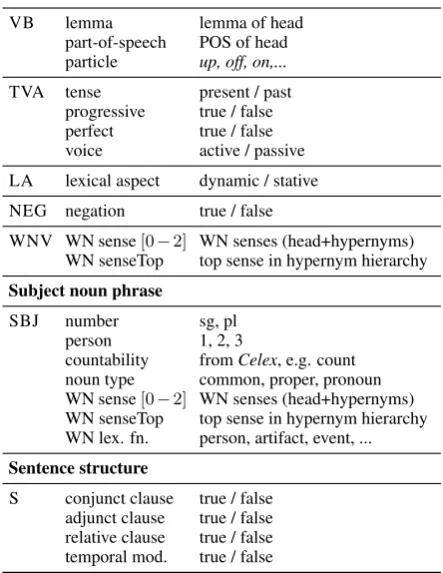
In our work we expand the feature inventory used for modal sense classification to incorporate se-mantic factors at various levels. An overview of our semantic features is given in Table 1. We de-fine specific feature groups for focused experimen-tal investigation in Section 5. Feature extraction is performed using Stanford’s CoreNLP (Manning et al., 2014) and Stanford parser (Klein and Man-ning, 2002) to obtain syntactic dependencies.
2We split permission and request to make the task more
accessible and merged them to deontic later.
VB: Lexical features of the embedded verb.
The embedded verb in the scope of the modal
plays an important role in determining modal sense. For instance, with the embedded verbflyin (7.a), we prefer a dynamic reading ofcan, whereas witheatin (7.b) we find a deontic reading.
(7) a. The childrencanfly(if they just believe, says Peter Pan)!
b. The childrencaneat(ice cream) now.
We extract thelemmaof the embedded verb and itspart-of-speechtag in the sentence. We also extract whether the verb has aparticle(e.g. the
plane could takeoff), and if yes, which.
SBJ: Subject-related features. These features capture syntactic and semantic properties of the subject of the modal construction. In (8) a non-animate, abstract subject favors an epistemic read-ing for could, whereas with an animate subject, a dynamic reading is preferred. Other factors in-volve speaker/hearer/third party distinctions (9).
(8) (The conflict|He)couldnow move to a next stage. (ep|dy)
(9) a. Imustbe home by noon. (deontic only) b. Hemustbe home by noon. (de or ep)
We extractperson and number of the subject and the noun type (common, proper, pronoun). Person is identified via personal pronoun features, and the other features are extracted from POS tags. Thecountabilityof the noun is obtained from the Celex database (Baayen et al., 1996).
Lexical semantic features for the subject NP are extracted from WordNet (Fellbaum, 1999). Following Reiter and Frank (2010), we take the most frequent sense of the noun in WN (subject sense0), add the direct hypernym of this sense, the direct hypernym of that hypernym, etc., resulting in features subject sense[1-3]. We also extract the top sense in the WN hierar-chysubject sense top(e.g. entity) and the WN lexical filename(e.g.person).
TVA: Tense/voice/grammatical aspect features. These features capture tense and grammatical as-pect of the embedded verb complex. LA below notes how grammatical aspect influences modal sense. At the same time, tense is an important fac-tor for modal sense disambiguation. (10) clearly favors an epistemic reading, as the event is located
Embedded verb
VB lemma lemma of head
part-of-speech POS of head particle up, off, on,...
TVA tense present / past progressive true / false perfect true / false voice active / passive LA lexical aspect dynamic / stative NEG negation true / false
WNV WN sense[0−2] WN senses (head+hypernyms) WN senseTop top sense in hypernym hierarchy
Subject noun phrase
SBJ number sg, pl
person 1, 2, 3
countability fromCelex, e.g. count noun type common, proper, pronoun WN sense[0−2] WN senses (head+hypernyms) WN senseTop top sense in hypernym hierarchy WN lex. fn. person, artifact, event, ...
Sentence structure
[image:4.595.303.525.76.363.2]S conjunct clause true / false adjunct clause true / false relative clause true / false temporal mod. true / false
Table 1: Individual features and feature groups. in the past, whereas deontic sense is favored with future events in indicative mood as in (4.a).
We restrict the tense feature to the values
{past, present}, determined via patterns of POS tags. We capture grammatical aspect fea-tures using sequences of POS tags of the verbal complex, following Loaiciga et al. (2014). The boolean featuresperfectandprogressive indi-cate the respective grammatical aspect;voice in-dicates active or passive voice.
LA: Lexical aspectual class. Verbs can be used
in adynamicor stativesense, e.g. Iatean apple
vs. Ilikeapples(Vendler, 1957). The lexical
as-pect of a verb in context influences modal sense in some cases. In contrast to (4.a), for example, where the eventive verbreturntriggers the deontic sense, perfect aspect in (10) coerces the clause to stative, triggering the epistemic sense ofmust. (10) The prisoners must have returned their
weapons.
parsed but otherwise unlabeled corpus. Accuracy for this prediction task is reported as around 84%.
NEG: Negation. Negation is a semantic feature at the proposition level that can have reflections in modal sense selection.Should, e.g., seems to favor a deontic meaning when negated in (11.a). Also, negation can interact with disambiguation of epis-temic vs. deontic readings depending on proposi-tional or discourse context. In (11.b), the favored reading is deontic in the negative sentence.
(11) a. Heshould(not) have returned. (ep/de (pos) vs. de (neg))
b. Hemay(not) drink more gin tonight. (ep/de (pos) vs. de (neg))
Thenegation feature captures the presence or absence of negation in the modal construction. We use the dependency labelNEGto identify negation.
WNV: Lexical semantic features of the embed-ded verb. This feature group encourages seman-tic generalization for lexical features of the em-bedded verb. It can play a role in interaction with other features, such as lexical and grammat-ical aspect and proposition-level features such as negation or the combined lexical semantic fea-tures described below (WN). The feafea-tures in this group are parallel to the WordNet features de-scribed for the SBJ feature group above (minus lexical filename), but apply to the embedded verb instead of the subject NP.
S: Features of sentence structure. When modals appear as part of a complex sentence, certain structural configurations can reflect the-matic or temporal relations between the proposi-tion modified by the modal and dependent clauses. An example are telic clauses that can favor a de-ontic over a dynamic or epistemic reading (12).
(12) Youcoulduse a shortcut to save time.
We extract features from the constituent tree to capture such effects: whether the modal clause is conjoined to the main clause (embedded ConjunctSentence), whether it em-beds adjunct clauses (and if so, the conjunction) (adjunctSentence), and whether it is in a relative clause (relativeSentence). Finally, has tmod indicates the presence of a temporal modifier.
WN: All WordNet features. This feature group aims to capture aspects of proposition-level se-mantics by combining semantic features of the subject NP with those of the embedded verb. This feature group simply includes both the WordNet features described in SBJ and those in WNV.
The intuition is that certain subject-predicate combinations may have a preference for certain modal senses. In (13), for example, canappears with a proposition that is subject to specific pre-scriptions or “laws”: soldiers are subject to restric-tions with respect to consuming alcohol.
(13) a. Soldierscandrink when off duty.
TVA/LA: Features of the verb complex. Fi-nally, this feature group uses both lexical aspect (LA) and tense, voice, and grammatical aspect (TVA) features. The goal is to investigate whether these two views of the verb complex are more ef-fective separately or in combination.
5 Experiments & Results
Our experiments have several objectives:
(i.) We aim to show that modal sense clas-sification, especially difficult sense distinctions, can profit from semantic and discourse-oriented features. To this end we construct contrast-ing classifier models with different feature sets: R&R’s shallow lexical and syntactic path features (FR&R), a feature set consisting of only our newly
designed semantic features (FSem), and a
com-bined set Fallconsisting of both FR&Rand FSem.
However, any classifier trained only on the highly unbalanced MPQA data set will have dif-ficulty separating the effect of distributional bias in the training data from the predictive force of its feature set. A classifier that follows the majority class in the training data will neutralize the poten-tial impact of its feature set. In order to counter-balance the distributional bias and also the sparsity inherent in the data, we evaluate the different clas-sifier models indifferent classification settings:
(ii.) We extend the training set using heuris-tically labeled instances obtained from modal sense projection (cf. Section 3), thereby eliminat-ing sparsity and reduceliminat-ing distributional bias.
(iv.) Finally we measure the impact of individ-ual feature groupsvia ablation (Section 5.3).
A note on notation: Subscripts on classifier names indicate the source of the training data. CLM denotes a classifier trained only on MPQA
data; CLMH combines MPQA and
heuristically-tagged data; CLH is a classifier trained only on
heuristically-tagged data. Superscripted+bor−b
indicates a balanced vs. unbalanced training set.
5.1 Experimental settings
Replicating R&R’s modal sense classifier. We replicate R&R’s classifier by reimplementing their feature set,4a mixture of target and contextual
fea-tures that take into account surface, lemma and PoS information, as well as syntactic labels and path features linking targets to surrounding words and constituents (cf. R&R, Table 5).
We train one classifier per modal verb, us-ing R&R’s best feature settus-ing (context fea-ture window=3 tokens left and right of target, target-specific features). Averaged accuracies for the replicated classifiers appear in Table 4 as CL−Mb(feature set FR&R). Our scores are very
sim-ilar to their published results, which appear in the same table in the column headed “R&R”.5
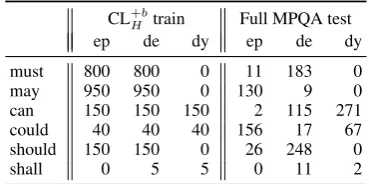
Extending and balancing training data sets. From the 11,610 heuristically sense tagged in-stances (Section 3), we construct balanced (+b) training corpora for each modal verb. The compo-sition of this data is shown in Table 2. To alleviate training data sparsity, we add this data to the (un-balanced) MPQA data; this configuration results in CL−MHb . Finally, we re-balance both CLM and
CLMH by under- and oversampling.6
Classification setup and test data. Training on balanced data reduces distributional bias, but eval-uating performance on an unbalanced, naturally-distributed data set gives us a more realistic pic-ture. To this end, and in order to compare to prior work, our test data is drawn exclusively from MPQA. For CL+Hb, we evaluate on R&R’s full data set; the composition of the test set appears in the 4Following R&R we use the Stanford parser for
process-ing and induce maximum entropy models usprocess-ing OpenNLP with default parameter settings.
5R&R performed 10-fold cross-validation (CV) for
eval-uation. We perform 5-fold cross-validation instead.
6When doing oversampling, we generally perform a
mix-ture of over- and undersampling, targeting about half the size of the larger class. The data sets are available athttp: //projects.cl.uni-heidelberg.de/modals.
CL+b
H train Full MPQA test
ep de dy ep de dy
must 800 800 0 11 183 0
may 950 950 0 130 9 0
can 150 150 150 2 115 271
could 40 40 40 156 17 67
should 150 150 0 26 248 0
[image:6.595.318.503.64.156.2]shall 0 5 5 0 11 2
Table 2: Heuristic (+b) training data and MPQA (-b) training and test data
right-hand side of Table 2. The other two models (CLM and CLMH) are evaluated in a 5-fold CV
setting, with testing on the naturally distributed MPQA instances. For each CV setting, only the training section is adapted, by addition of heuris-tic data, and/or balancing. Table 3 exemplifies one run of our cross-validation setting. First, we split MPQA into 80% train (CL−Mb) and 20% test, then we add the heuristically-tagged data (CL−MHb ) and re-balance (to produce CL+Mband CL+MHb ).
Baselines. For unbalanced classifiers, we com-pare to the MFS baseline (BLMaj M), taking the
most frequent sense for each modal verb from the MPQA training data. For balanced classifiers, we compare to the random baseline (BLRan),
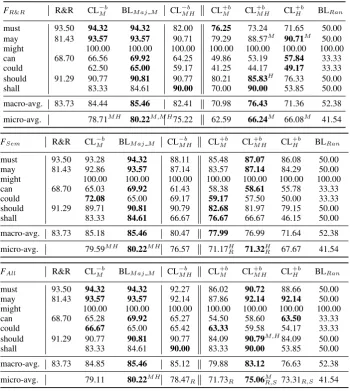
deter-mined by the (evenly distributed) number of class labels seen in training for each modal verb. 5.2 Comparative performance evaluation Table 4 compares accuracy of classifiers trained on ±balanced data, from different sources, and with different feature sets. We report results for individual classifiers (per modal verb) and macro-and micro-average across all verbs. The two bold-faced numbers per table row indicate the best mod-els for unbalanced and for balanced data. For the balanced classifiers, where we find more interest-ing differences, we test significance usinterest-ing McNe-mar’s test (p<0.05) (McNemar, 1947). Within a row (for+bclassifiers and micro-averages), a su-perscript on a number indicates which classifier is significantly outperformed by the result. Across feature sets, we compare micro-averages and mark significance by subscripts (R=FR&R, S=FSem).
We first discuss the classifiers trained on un-balanced data. With FR&R, CL−Mb yields
perfor-mance comparable to R&R’s results, at 84.44% accuracy, 1.02pp below the majority baseline. In-dividual lexical classifiers also approach R&R’s performance, though never beating the baseline.7
CL−b
M train CL−MHb train CLM+btrain CL+MHb train MPQA test
ep de dy ep de dy ep de dy ep de dy ep de dy
must 6 149 0 806 949 0 70 70 0 870 870 0 5 34 0
may 105 6 0 1055 956 0 50 50 0 999 1000 0 25 3 0
can 1 98 212 151 248 362 100 100 100 250 250 250 1 17 60
could 120 15 57 160 55 97 54 54 54 94 94 94 36 2 10
should 21 196 0 171 355 0 100 100 0 250 250 0 5 52 0
[image:7.595.97.497.64.158.2]shall 0 9 1 0 14 6 0 10 10 0 15 15 0 2 1
Table 3: Cross-validation, one run: representative class distributions of training and test data.
FR&R R&R CL−Mb BLMaj M CL−MHb CL+Mb CL+MHb CL+Hb BLRan
must 93.50 94.32 94.32 82.00 76.25 73.24 71.65 50.00
may 81.43 93.57 93.57 90.71 79.29 88.57M 90.71M 50.00
might 100.00 100.00 100.00 100.00 100.00 100.00 100.00
can 68.70 66.56 69.92 64.25 49.86 53.19 57.84 33.33
could 62.50 65.00 59.17 41.25 44.17 49.17 33.33
should 91.29 90.77 90.81 90.77 80.21 85.83H 76.33 50.00
shall 83.33 84.61 90.00 70.00 90.00 53.85 50.00
macro-avg. 83.73 84.44 85.46 82.41 70.98 76.43 71.36 52.38 micro-avg. 78.71MH 80.22M,MH75.22 62.59 66.24M 66.08M 41.54
FSem R&R CL−b
M BLMaj M CL−MHb CLM+b CL+MHb CL+Hb BLRan
must 93.50 93.28 94.32 88.11 85.48 87.07 86.08 50.00
may 81.43 92.86 93.57 87.14 83.57 87.14 84.29 50.00
might 100.00 100.00 100.00 100.00 100.00 100.00 100.00
can 68.70 65.03 69.92 61.43 58.38 58.61 55.78 33.33
could 72.08 65.00 69.17 59.17 57.50 50.00 33.33
should 91.29 89.71 90.81 90.79 82.68 81.97 79.15 50.00
shall 83.33 84.61 66.67 76.67 66.67 46.15 50.00
macro-avg. 83.73 85.18 85.46 80.47 77.99 76.99 71.64 52.38 micro-avg. 79.59MH 80.22MH 76.57 71.17H
R 71.32HR 67.67 41.54
FAll R&R CL−b
M BLMaj M CL−MHb CLM+b CL+MHb CL+Hb BLRan
must 93.50 94.32 94.32 92.27 86.02 90.72 88.66 50.00
may 81.43 93.57 93.57 92.14 87.86 92.14 92.14 50.00
might 100.00 100.00 100.00 100.00 100.00 100.00 100.00
can 68.70 65.28 69.92 65.27 54.50 58.60 63.50 33.33
could 66.67 65.00 65.42 63.33 59.58 54.17 33.33
should 91.29 90.77 90.81 90.77 84.09 90.79M,H84.09 50.00
shall 83.33 84.61 90.00 83.33 90.00 53.85 50.00
macro-avg. 83.73 84.85 85.46 85.12 79.88 83.12 76.63 52.38
micro-avg. 79.11 80.22MH 78.47
R 71.73R 75.06MR,S 73.31R,S 41.54
Table 4: Classifier accuracy for various training data and feature sets. See text for details.
Changing from FR&R to FSem and FAll,
classi-fier CL−Mb forcouldis now able to beat the base-line. The effect is stronger for FSem, which
re-flects the impact of the semantic features. Interest-ingly, accuracy of FSem is comparable to FR&R,
even though the classifiers learn only on the ba-sis of semantic features. Combining the two fea-ture sets (FAll) produces minimal differences for
CL−b
M, but yields stronger gains for CL−MHb .
may/might and shall/should.
The addition of heuristically-tagged data in CL−MHb helps for some verbs, but hurts for others. Despite the larger training set size, individual clas-sifier performances tend to drop, meaning they do not profit much from the reduced training bias.
For classifiers trained on balanced data, the picture changes. Accuracies on balanced data are lower, reflecting the lack of distributional bias. But all results are well above the random BL.8
[image:7.595.121.472.188.580.2]Compared to CL+b
M and CL+Hb, we observe the
best results for CL+b
MH , which mixes MPQA and
out-of-domain data. Here, the best performance is obtained with FAll. In fact, CL+MHb with 83.12%
on balanced mixed data closely approaches the performance of the classifiers trained on biased training data and their majority baseline, with about 2pp difference, and being almost identical to R&R’s published results.
Looking at individual modal classifiers, we see even more interesting results. can andcould, both with 3-fold sense distinctions and lowest per-formance overall, suffer the greatest loss in the balanced setting, in ranges of 41-57% for FR&R.
These verbs are hard to classify, and here we see a marked performance rise as the training data changes (from CL+b
M to CL+Hb), though these
dif-ferences are not significant. Comparing FSem to
FR&R , we obtain better results overall, always
above 50% accuracy. With FAllwe reach a range
of 54-63%, achieving strong gains of more than +20pp forcould, and about +5pp forcan. We also note an almost continous rise forshouldwith a fi-nal +5pp gain over FR&R. Across different
fea-ture sets, CL+MHb performs best, that is, combining MPQA and out-of-domain data is effective.
To summarize, with increasingly refined mod-els and a tendency of CLMH and CLH
outper-forming CLM, we obtain a coherent picture:
se-mantic features contribute important information and reach their best performance with a mixture of training sets. We also note that FSem and
FAll jointly yield significant gains over FR&R for
could, must, should, canandmay.9
5.3 Impact of feature groups
A confusion analysis of the predictions made by CL+Hb using FR&R yields some insight into the
most difficult sense distinctions for specific modal verbs. Table 5 highlights the most prominent mis-classification classes: for instance, deonticcanis misclassified asdynamic in 106 cases; epistemic
couldis misclassified as dynamic in 53 cases, etc.
For a deeper analysis of the impact of our se-mantic features, particularly on specific sense dis-tinctions, we conducted a quantitative and qual-itative evaluation by ablating individual feature groups (FGs) from the full feature sets FSem and
except: CL+b
M and CL+MHb with FSem forshould, and
any-thing involvingshall.
9Cross-feature set significance for individual verbs is not
marked in Table 4.
can ep de dy could ep de dy
ep 1 0 1 ep 92 11 53
de 8 1 106 de 6 2 9
dy 28 21 223 dy 30 6 31
must ep de should ep de
ep 5 6 ep 4 22
[image:8.595.316.505.65.162.2]de 43 140 de 48 209
Table 5: Confusion analysis: CL+HbusingFR&R
FAll, for all balanced classifiers.
It turns out that precisely for the modal verbs that exhibit prominent confusion classes in Table 5 we observe a significant performance drop when omitting individual feature groups (FGs): Table 6 reports all configurations where omitting a partic-ular FG yielded a significant accuracy loss. In the following we analyze these cases in more detail. Analysis. Gains (or rescues) due to FGx are
cases in which including FGxturns a wrong
clas-sification into a correct one, compared to a model that ablates FGx. Lossesrecord the opposite: a
correct classification made without FGx becomes
incorrect when FGxis active.
Overall, for both models FSemand FAllwe
ob-servemore gains than lossesdue to the FGs SBJ, NEG, TVA(/LA) and WN: 140 vs. 41 (29% losses) for FSemand 195 vs. 42 (22% losses) for FAll. For
mustthere are only gains and no losses at all. We observe different performance for correc-tion of misclassificacorrec-tions for the different modal verbs, and we see clearly distinct contribution of FGs for the individual modal verb classifiers.
The most clear-cut positive effects are obtained formust, with the highest number of gains (62/81 for FSem/FAll) and no losses. Here, exclusively
the FGs TVA and TVA/LA are effective, leading to a majority of rescues ofdeonticreadings that oth-erwise would be misclassified asepistemic. 5 res-cues in the other direction occur, only with FSem.
Rescues formustthrough FG TVA/LA all meet the assumption that dynamic event readings of the verb go along withdeonticsense (14.a), while sta-tive readings (14.b) go along withepistemicsense.
(14) a. “Everythingmustbedoneby everyone to bring about de-escalation” [..]
b. And as allmust now know [..] Mugabe has no chance of winning any ballot [..]
instances ofmustas epistemic. All cases follow the pattern in (15.a): the verb is not in past tense, and we prefer a deontic interpretation, whereas past tense in (15.b) indicates epistemic usage. (15) a. [..] whoever is on the other side is the
evil that mustbedestroyed [..]
b. The event musthaverocked the halls of power [..]
shoulddisplays similar sense ambiguities and confusion patterns, but here the picture is less clear: as withmust we obtain rescues ofdeontic
readings, but here the WN features are most effec-tive, jointly with SBJ. In contrast tomust, we ob-serve a mixture of gains (30/13) and losses (11/7) due mostly to over-correction. While for the other modal verbs, the gains/losses ratio is best for the FAll model,shouldperforms best with FSem.
Forcould, with a 3-way ambiguity, a different feature set is active: SBJ and NEG. Most res-cues to epistemic are due to including SBJ fea-tures, and a strong effect is also seen for NEG. For both FGs we also observe gains ofdynamic read-ings fromepistemicmisclassifications, while this effect is stronger for NEG, also in avoiding over-correction. On the losses side, we observe 32% of losses as opposed to gains for FAll.
SBJ features apparently capture a preference for inanimate, abstract subjects for epistemicas op-posed to deontic (or dynamic) readings, as with
the messageor propositional anaphora in (16.a,b).
The same pattern is observed withshould(16.c). (16) a. “the messagecouldnot be clearer.”
b. [..] officials saidthis could prompt in-dustries to change behavior . . . .
c. [..] if that should prove necessary, De Winne will [..] pilot the space ship. For NEG we see a clear effect that could, if negated, is correctly analyzed asdynamic, while non-negated instances are classified asepistemic. (17) a. Baghdad insisted [..] it could not be a
threat to the United States.
b. Two basic principlescouldstill, perhaps, make it possible.
Finally,can is our most difficult case. We ob-tain moderate gains (15) by rescues of dynamic
readings fromepistemic/deontic, through the SBJ feature. As we see no gains with FSem, this means
we are still lacking precise features that can differ-entiate epistemic and dynamic readings.
verb FG comp. impact
to CL+b
M CL+MHb CL+Hb
can SBJ FAll 2.83∗
could SBJ FSem 12.50∗∗
FAll 6.25∗ 11.25∗∗
NEG FSem 4.58∗
FAll 6.25∗∗
must TVA FSem 5.69∗∗ 9.79∗∗
FAll 10.32∗∗11.86∗∗
TVA FSem 6.21∗∗ 10.31∗∗
/LA FAll 3.09∗ 10.32∗∗
12.37∗∗
should SBJ FSem 10.60∗∗
FAll 5.64∗∗
WN FSem 6.01∗
∗∗: p=0.01;∗: p=0.05
Table 6: Accuracy loss by FG omission. 3rd col-umn specifies from which feature set we ablate.
6 Conclusion
We show that difficult problems in modal sense disambiguation can be addressed with seman-tically enriched classification models that draw upon lexical, propositional and discourlevel se-mantic information. Our model obtains significant improvements, especially for difficult sense dis-tinctions, in balanced training setups. This will prove advantageous when applying the classifiers to documents with sense distributions that differ from training. We further presented a method for automatic induction of training corpora that helps to alleviate sparsity and can be used to tailor train-ing data to specific genres and domains.
The insights we gain from analyzing the im-pact of feature groups indicate avenues for future work: The sensitivity of modal senses to seman-tic properties of the subject calls for integration of antecedent information with pronominal sub-jects. The dependence on temporal information calls for temporal resolution. Our current model offers only a simple approximation of proposi-tional semantics. We expect further improvements with a more effective representation of proposi-tional content and addition of more training data.
References
Baayen, H. R., Piepenbrock, R., and Gulikers, L. (1996). CELEX2. Philadelphia: Linguistic Data Consortium.
Baker, K., Bloodgood, M., Dorr, B. J., Filardo, N. W., Levin, L., and Piatko, C. (2010). A Modality Lexicon and its use in Automatic Tag-ging. In Proceedings of LREC, pages 1402– 1407.
Cohen, J. (1960). A coefficient for agreement for nominal scales. Education and Psychological
Measurement, (20):37–46.
de Marneffe, M.-C., Manning, C. D., and Potts, C. (2011). Veridicality and Utterance
Understand-ing. 2011 IEEE Fifth International Conference
on Semantic Computing, pages 430–437.
Diab, M. and Resnik, P. (2002). An unsupervised method for word sense tagging using parallel corpora. In Proceedings of ACL 2002, pages 255–262, Philadelphia, Pennsylvania, USA. Fellbaum, C. (1999). WordNet. Wiley Online
Li-brary.
Friedrich, A. and Palmer, A. (2014). Automatic prediction of aspectual class of verbs in context.
InProceedings of the ACL 2014.
Ganitkevitch, J., Van Durme, B., and Callison-Burch, C. (2013). PPDB: The Paraphrase Database. In Proceedings of the ACL-HLT 2013, pages 758–764, Atlanta, Georgia. Klein, D. and Manning, C. D. (2002). Fast
ex-act inference with a fex-actored model for natural language parsing. InAdvances in neural
infor-mation processing systems, pages 3–10.
Koehn, P. (2005). Europarl: A parallel corpus for statistical machine translation. InProceedings
of Machine Translation Summit X, pages 79–86.
Kratzer, A. (1991). Modality. In von Stechow, A. and Wunderlic, D., editors, Semantics: An International Handbook of Contemporary
Re-search, pages 639–650. Berlin: de Gruyter.
Loaiciga, S., Meyer, T., and Popescu-Belis, A. (2014). English-French Verb Phrase Alignment in Europarl. InProceedings of LREC 2014. Manning, C. D., Surdeanu, M., Bauer, J., Finkel,
J., Bethard, S. J., and McClosky, D. (2014). The Stanford CoreNLP natural language processing toolkit. InProceedings of ACL 2014: System
Demonstrations, pages 55–60.
McNemar, Q. (1947). Note on the sampling error of the difference between correlated proportions or percentages. Psychometrika.
Nissim, M., Pietrandrea, P., Sanso, A., and Mauri, C. (2013). Cross-linguistic annotation of modality: a data-driven hierarchical model. In
Proceedings of the 9th Joint ISO - ACL SIGSEM Workshop on Interoperable Semantic Annota-tion, pages 7–14, Potsdam, Germany.
Reiter, N. and Frank, A. (2010). Identifying Generic Noun Phrases. In Proceedings of the
ACL 2010, pages 40–49, Uppsala, Sweden.
Ruppenhofer, J. and Rehbein, I. (2012). Yes we can !? Annotating the senses of English modal verbs. InProceedings of the LREC 2012, pages 1538–1545.
Siegel, E. V. and McKeown, K. R. (2000). Learn-ing methods to combine lLearn-inguistic indicators: Improving aspectual classification and reveal-ing lreveal-inguistic insights. Computational Linguis-tics, 26(4):595–628.
Tiedemann, J. (2012). Parallel Data, Tools and Interfaces in OPUS. In Calzolari, N., Choukri, K., Declerck, T., Do˘gan, M. U., Maegaard, B., Mariani, J., Odijk, J., and Piperidis, S., editors,
Proceedings of LREC-2012, pages 2214–2218,
Istanbul, Turkey.
Vendler, Z. (1957). Linguistics in Philosophy, chapter Verbs and Times, pages 97–121. Cor-nell University Press, Ithaca, New York. Wiebe, J., Wilson, T., and Cardie, C. (2005).
An-notating expressions of opinions and emotions in language. Language resources and evalua-tion, 39(2-3):165 – 210.
Yarowsky, D. and Ngai, G. (2001). Inducing Multilingual POS Taggers and NP Bracketers via Robust Projection Across Aligned Corpora.
In Proceedings of the Second Meeting of ACL