Dependency Parsing with Graph Rewriting
Bruno GuillaumeUniversité de Lorraine, CNRS LORIA, UMR 7503, Vandœuvre-lès-Nancy, France Inria, Villers-lès-Nancy, France
Guy Perrier
Université de Lorraine, CNRS LORIA, UMR 7503, Vandœuvre-lès-Nancy, France Inria, Villers-lès-Nancy, France
Abstract
We propose to use Graph Rewriting for parsing syntactic dependencies. We present a system of rewriting rules dedi-cated to French and we evaluate it by pars-ing the SEQUOIAcorpus.
1 Introduction
The most popular frameworks (TAG, CG, LFG, HPSG) for symbolic parsing are based on the notion of grammar. They defined a set of ini-tial structures (often strongly linked to a lexicon) and a set of rules to express how initial struc-tures can combine into larger ones. In this set-ting, parsing consists in searching for a syntac-tic structure predicted by the grammar for an in-put sentence. Among drawbacks of these meth-ods, there is the fact that they may be inefficient when large-coverage grammar are considered (the search space grows very quickly for large sen-tences) and that they are not easy to use in con-texts where robust parsing is needed (grammars describe set of correct sentences but do not give structures to sentences that are not completely covered by the grammar). Another problem with grammar-based parsing is that it is a difficult task to maintain the global consistency of the grammar. Moreover, development of large coverage gram-mar is known to be a time-consuming task.
On the other side, statistical methods build lan-guage models with learning algorithm applied to large annotated corpora. With respect to sym-bolic methods, it is easier to build robust parser with these methods and it is also easier to adapt a method to a new kind of corpus or to a new natural language. The main drawbacks are that good results are obtained only if large and well-annotated corpora are available. It is also dif-ficult to improve a system: learning provides a language model which is essentially a black box
which cannot be read by a human; external mech-anism must be used if someone want to include linguistic knowledge in the system.
In this paper we propose a symbolic method which is defined in a Graph Rewriting (GR) frame-work. The output format is dependency syntax of natural language sentences. We propose to de-scribe the parsing process as a sequence of atomic transformations starting from a list of lexical units (a tokenized sentence) to a dependency tree1built
on the same lexical units. Each atomic transforma-tion is described by a handcrafted rule. Then, in-stead of defining a grammar that describes the set of well-formed structures, we define rules which describe linguistic contexts in which a dependency relation can appear.
The rule system input is made of lemmatized and POS-tagged sentences. For the experiments in this paper, we use the SEQUOIA corpus (Candito
and Seddah, 2012) (version 6.02) as the gold
stan-dard. We experiment our system in two settings: on gold POS-tagged text (taken from SEQUOIA
data) and on POS-tagging given by the MElt tag-ger (Denis and Sagot, 2012).
We use the general framework of GR where each transformation is given by two parts: first, the conditions that control when the transforma-tion may apply (thepattern) and second, a descrip-tion of the way the structure should be modified.
In the system we proposed, the input format is a tokenized sentence where each lexical unit is given a lemma and a POS-tag; the output format is a de-pendency structure; hence, both input and output structure can be represented as trees. Neverthe-less, we use GR to describe our rules. At a first sight, it may be surprising to use such a formalism to manipulate only trees. But, the first thing to no-tice is that matching algorithms used in GR are di-rect generalization of matching algorithm that can
1The output may a partial dependency trees. 2https://gforge.inria.fr/projects/sequoiabank/
be used in tree transformation: it means that, if all structures and patterns happen to be trees, the pattern matching in the GR setting will be as effi-cient as the pattern matching in the tree rewriting setting. A second benefit of GR is that it becomes possible to express more information in the inter-mediate structures. In the rule system, we use two kinds of relation to express linear order between lexical entities: the relation SUC links the heads of two partial dependency structures; the relation INIT_SUClinks two successive lexical unit of the sentence, even if they have also been integrated in partial dependency structures. Structures with these two kinds of relations are graphs and cannot be represented as trees.
In a comparison with other works from the lit-erature, we left out data-driven approaches which are far from our proposal. In (Foth et al., 2000), (Debusmann et al., 2004), weighted rules are used to described valid dependency structures and the parsing is expressed as a constraints resolution problem. (Covington, 2000) and (Nivre, 2003) propose rule-based processes to produce depen-dency structures but they are presented as kind of shift-reduce algorithm where word are treated one by one following the reading order, rules describ-ing how each word can be link to the current state. Each rule only tells that a dependency from a word to another word is acceptable.
More close to our work is the proposal of (Oflazer, 2003) which defines a set of rules that are used iteratively until a fixpoint is reached and the rules application do not necessarily fol-low the reading order of the sentence. However, in (Oflazer, 2003) rules are encoded as regular ex-pressions and are less flexible than a GR rule can be. To our knowledge, our proposal is the first use of the Graph Rewriting framework for symbolic dependency parsing.
In Section 2, we describe more precisely the GR framework used in the paper. In Section 3, the GR system considered is detailed. We finally give experimental results in Section 4.
2 Graph Rewriting
Unfortunately, there is no canonical formal GR definition. In this experiment, we use the GR def-inition which is implemented in the GREW
soft-ware3. Rules are defined by two parts: a pattern
and a set of commands. GREWwas used for
in-3http://grew.loria.fr
[P]
_ Jean[S] cat=N
[V] mange
cat=V
une
cat=D pommecat=N cat=PONCT. det
e1:SUC e2:SUC SUC SUC
_ Jean
cat=N mangecat=V unecat=D pommecat=N cat=PONCT.
suj det
SUC
[image:2.595.313.523.69.183.2]SUC SUC
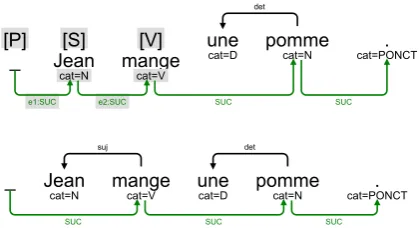
Figure 1: An example of application for the rule subject_noun
stance in (Bonfante et al., 2011) to build a seman-tic annotation of a French Treebank.
The reader can refer to the GREW
documenta-tion for a complete descripdocumenta-tion of the GR frame-work and of the syntax of the rules with GREW.
We give here a simple example of rule and of its application; more elaborated rules are shown in the next section. The code below is a simplified version of a rule for the subject relation.
1 rule subject_noun { 2 match {
3 S [cat=N|PRO];
4 V [cat=V, m=ind|subj];
5 e1:S -[SUC]-> V; 6 P []; e2:P -[SUC]-> S;
7 }
8 without { V -[suj]-> * }
9 without { S [lemma="que"|"dont"] } 10 commands {
11 del_edge e1; 12 del_edge e2;
13 add_edge V -[suj]-> S; 14 add_edge P -[SUC]-> V;
15 }
16 }
Different parts of rule are as follows. One matchpart (lines 2 to 7) describes the subgraph that must be found: here, the subgraph contains 3 nodes S, V andPlinked by two relations SUC (lines 5 and 6). Any number ofwithout parts describe negative application patterns; if any of these negative patterns is found, the rule applica-tion is blocked. For instance (line 8), if there is al-ready asujdependency starting fromV, the rule does not apply (it prevents from putting two sub-jects for the same verb). Finally, a commands part describes how the graph is transformed by the rule application, in the example: add a suj re-lation from the Vnode to theSnode and update the SUC relations (the verb is now the successor of the P node). On a very simple sentence Jean
mange une pomme. (John eats an apple.), the two
respec-tively the structure before (with identifiaction of matched nodesS,VandP) and after the rule ap-plication. With GREW, it is also possible to
mod-ify feature structures in thecommandspart: add a new feature, modify or remove an existing fea-ture. The rule above uses some lexical information in the secondwithoutpart. As some rules make a strong usage of lexical information, it is possible to parametrize rules by external lexicons with the lex_rulekeyword. For instance, in the rule be-low, a relationobjin added (line 18) only if the verb lemma (line 7) is one on the lemmas given in the lexical file verb_with_obj_noun.lp (line 3). This file contains a list of more than 3,000 French transitive verbs.
1 lex_rule verb_object_noun 2 ( feature $lemma;
3 file "verb_with_obj_noun.lp"
4 ) {
5 match {
6 OBJ [cat=N|PRO];
7 V [cat=V, lemma=$lemma, m=ind|subj];
8 POST [];
9 e1: V -[SUC]-> OBJ; 10 e2: OBJ -[SUC]-> POST; 11 V -[suj]-> *
12 }
13 without ... 14 without ... 15 commands { 16 del_edge e1; 17 del_edge e2;
18 add_edge V -[obj]-> OBJ; 19 add_edge V -[SUC]-> POST;
20 }
21 }
When the number of rules increases, some con-straint should be put on the order in which the rules can be used. In this respect, a last feature, which is essential in the GREWusage, is the
orga-nization of rules into subsets calledmodules. The whole rewriting process is controlled by a total or-der on modules that are applied one after another; inside a module, no ordering is given and any rule may be apply anywhere in the graph.
Moreover in a general GR setting, the process may be non-confluent. Even if a total ordering is provided between modules, an arbitrary number of structures can be produced inside a module. In this work, we restrict ourself to deterministic GR, this means that we focus on the set of dependency re-lation that can be produced in a deterministic way. We can imagine many cases where non-confluent rewriting system can be used: for instance, PP-attachment is known to be a task that cannot be decided only with syntactic information. We leave as future work the development of non-confluent system and the problem of ranking in case of non-deterministic process.
3 FRDEP-PARSE: a System of Graph Rewriting Rules for Dependency Parsing
3.1 Input and Output Formats
FRDEP-PARSEtakes a French sentence annotated
with POS-tags and lemmas as input and returns a dependency syntax annotation for the same sen-tence as output. Let us describe the input and the output more precisely.
The input sentence is a sequence of tokens. Each token is equipped with a set of features:
• phon: the phonological form of the token;
• lemma: the lemma of the token;
• pos: the value of which is one of the 28 tags defined in the annotation guide of the French TreeBank4;
• position: an integer indicating the posi-tion of the token in the sequence (this fea-ture is used to express linear order between tokens).
At the beginning of the process, the 28 POS-tags are interpreted in terms of 13 grammatical categories (featurecat) and some other features. For instance, the 6 POS-tagsV,VINF,VIMP,VS, VPP, VPR are all interpreted by feature cat=V and a mfeature recording the mood (respectively indicative, infinitive, imperative, subjunctive, past participle and present participle).
Initially, the only relations between tokens are SUC relations of immediate succession between adjacent tokens.
The parsing output is the sentence annotated with syntactic dependencies according to the tagset used in SEQUOIA. The annotation may be
partial. Figure 2 shows an example of syntactic annotation obtained with FRDEP-PARSE.
3.2 A CKY Basic Architecture
The basic form for the rewriting rules of FRDEP
-PARSEaims at the implementation of a CKY-like
algorithm in the dependency syntax framework. The dependency tree of a sentence is built bottom-up step by step. When two partial treesT1 andT2
have their terminal yields which are adjacent, a de-pendency may be added between the rootsw1and
w2of the two trees.
Après
P avoirV coupéV leD rubanN PROqui enCL marqueV symboliquementADV l'D entréeN
aux.tps det mod det
obj.p obj
suj
mod.rel obj
[image:4.595.86.495.72.123.2]dep
Figure 2: A non-projective result of syntactic annotation with FRDEP-PARSE.
To express adjacency between two yields,SUC is used with a larger meaning: if there is a SUC relation from a tokenw1 to a tokenw2, it means
that w1 andw2 are roots of intermediate
depen-dency trees, the yield of the first tree immediately preceding the yield of the second tree.
(Eisner, 1996) already proposed a CKY-like al-gorithm for parsing with dependencies, but he dif-fers from our proposal on two points: he uses a sta-tistical approach and to link two dependency trees, he takes only their roots into account and ignores information coming from deeper nodes.
The use of GREW for implementing the CKY
algorithm in a strict manner has no point, but the Graph Rewriting approach allows to enrich the al-gorithm in various directions. One of them is to add internal and external constraints on theT1and
T2trees.
Here is an example of constraints introduced by a rule of FRDEP-PARSE.
1 lex_rule verb_right-modif_adv
2 (feature $lem; file "quant_adv.lp") { 3 match {
4 %positive constraint on T1
5 V [cat=V];
6
7 %positive constraints on T2
8 ADV[cat=ADV];
9 POST [ ];
10 e1: ADV -[SUC]-> POST 11
12 % adjacency between T1 and T2
13 e2: V -[SUC]-> ADV
14 }
15
16 % negative constraints on T1
17 without { ADV[pos=ADVWH] } 18
19 %negative constraints on T2
20 without { POST[cat=V,m=pastp] } 21 without {
22 ADV[lemma=$lem];
23 POST[cat=P,lemma="de"]
24 }
25
26 commands{ 27 del_edge e1; 28 del_edge e2;
29 add_edge V -[mod]-> ADV; 30 add_edge V -[SUC]-> POST
31 }
32 }
The rule above is a lexical rule in which the pa-rameter$lemrepresents the lemma of an adverb coming from the quant_adv.lpfile gathering
adverbs of quantity. It says that any adverbADV, the yield of which immediately follows the yield of a verbV, is a modifier of the verbV. It includes three negative constraints:
• An internal constraint:ADVmust be different from an interrogative adverb. For instance, in the sentencePierre demande combien ça
coûte (Pierre asks how much it is),combienis
not a modifier ofdemandebut a complement
ofcoûte.
• An external constraint: POST that immedi-ately followsADVis not a past participle be-cause in this case, ADV depends on the past participle POST. For instance, in the sen-tencePierre a beaucoup travaillé (Pierre has
worked a lot), beaucoupis not a modifier of
the auxiliarya but of the past participle tra-vaillé.
• A mixed constraint: ADV is not an adverb of quantity followed with the prepositionde. For instance, in the sentencePierre connaît beaucoup de personnes (Pierre knows a lot
of persons), beaucoup is not a modifier of
connaît but of personnes at the opposite to
the sentencePierre travaille beaucoup la nuit
(Pierre works a lot in the night).
The following example highlights the expres-sivity of the graph rewriting approach, which al-lows the representation of constraints on deep lev-els in theT1andT2trees .
1 lex_rule impers_verb_obj_de_inf 2 (feature $lem;
3 file "il_verb_with_obj_de_inf.lp"){ 4 match {
5 %positive constraints on T1
6 V[cat=V,lemma=$lem];
7 IL[phon="il"|"Il"]; 8 V -[suj]-> IL; 9
10 %positive constraints on T2
11 PREP[cat=P,lemma="de"];
12 OBJP[cat=V,m=inf];
13 PREP -[obj.p]-> OBJP;
14 POST[];
15 e1: PREP -[SUC]-> POST; 16
17 % adjacency between T1 and T2
19 } 20
21 % negative constraints on T1
22 without{SE[pos=CLR]; V -> SE} 23
24 commands{ 25 del_edge e1; 26 del_edge e2;
27 add_edge V -[obj]-> PREP; 28 add_edge V -[SUC]-> POST
29 }
30 }
The rule above realizes the direct object of an impersonal verb, when this object is an infinitive introduced with the prepositionde. The rule is lex-ical because it verifies that the verb is able to enter such a construction. The parameter of the rule is the lemma$lemof the verb.
A positive constraint on T1 says that the verb
Vmust have a subjectiland a positive constraint on T2 says that the tree is made of PREP de, a
preposition introducing an infinitiveOBJP. Such constraints cannot be expressed with the classical CKY algorithm in a constituency ap-proach, where constraints are limited to the exter-nal constituents of partial syntactic trees.
3.3 Non Projective and Disambiguation Rules
If all rules of FRDEP-PARSE had the form
de-scribed above, the dependency structure resulting from their application would be projective. There-fore, we should be not able to represent some phe-nomena from the French grammar, which are es-sentially non-projective, and are present in the SE -QUOIAcorpus.
In FRDEP-PARSE, non-projectivity is
intro-duced in two ways:
• in iterative modules, some rules link partial dependency trees with non-projective depen-dencies;
• specific rules are added in final modules with the aim of moving dependencies from pro-visional positions with propro-visional labels in order to obtain non-projective dependencies with definitive labels.
There are other final modules used for disam-biguation. Indeed, at some intermediate steps of the parsing process, there is no sufficient informa-tion for deciding between several dependency la-bels. We could divide the search path into several paths. The repetition of such choice points would entail the time explosion of the parsing process. In
this situation, we keep a unique search path by la-belling the concerned dependencies with disjunc-tion of elementary funcdisjunc-tions. At the end of pars-ing, the ambiguity is solved with specific rules us-ing the information accumulated durus-ing the pars-ing process.
The following rule illustrates both functions: label disambiguation and expression of non-projectivity. It applies to Sentence
[ann-odis.er_00026] from the SEQUOIA corpus, more
specifically to the part le ruban qui en marque symboliquement l’entrée (the ribbon, which
sym-bolically marks the entry of it). Figure 1 shows the
syntactic annotation produced by FRDEP-PARSE.
The clitic pronounenrepresents a complement of
entrée. It is modelled with a dependency dep
crossing the object dependency mod.rel from the nounrubanto the verbmarque. The rule pro-ducing non-projectivity is the following:
1 lex_rule obj_dep_en 2 (feature $lem ;
3 file "verb_with_obj_deobj.lp") { 4 match{
5 CLIT[pos=CLO, phon="en"];
6 V[cat=V];
7 iobj_rel: V -[DE_OBJ-OBJ]-> CLIT
8 OBJ[cat=N];
9 V -[obj]-> OBJ
10 }
11 without { V [lemma=$lem] } 12 commands {
13 del_edge iobj_rel;
14 add_edge OBJ -[dep]-> CLIT
15 }
16 }
Initially,CLITendepends on the verbV, which it cliticizes in an ambiguous relationde_obj (in-direct object introduced with the preposition de) orobj(direct object). When the verbVhas found a direct objectOBJ, the source of the dependency forCLITenis transferred from the verb to the ob-ject and its label becomesdep.
The lexicalization of the rule concerns the neg-ative constraint. It aims at verifying thatVis not a verb simultaneously taking a direct object and an indirect object introduced withde. In this case,en
would be thede_objcomplement of the verbV.
3.4 Modules for Controlling the Parsing Process
If we put all rewriting rules of FRDEP-PARSE in
a unique bag with the same priority, the system is untractable because of the ambiguity, which will entail an time explosion of the parsing process. But GREWoffers the possibility of grouping rules
by modules and ordering the modules.
pars-les
cat=D lemma=le pos=DET
versements
cat=N det=y lemma=versement
pos=NC s=c
qui
cat=PRO det=y lemma=qui pos=PROREL
s=rel
ont
cat=V lemma=avoir
m=ind pos=V
pu
cat=V initm=pastp lemma=pouvoir
m=ind pos=VPP
être
cat=V lemma=être
m=inf pos=VINF
retracés
cat=V diat=passif initm=pastp lemma=retracer
m=inf pos=VPP
avoisineraient
cat=V lemma=avoisiner
m=ind pos=V
les
cat=D lemma=le pos=DET
850_000
cat=A lemma=850_000
pos=ADJ
F
cat=N det=y lemma=F
pos=NC s=c
det aux.tps aux.pass mod
det
INIT_SUC INIT_SUC
INIT_SUC
INIT_SUC INIT_SUC INIT_SUC
INIT_SUC SUC INIT_SUC
INIT_SUC
SUC
INIT_SUC
SUC SUC
SUC
les
D versementsN quiPRO ontV puV êtreV retracésV avoisineraientV lesD 850_000A FN
det aux.tps aux.pass mod
suj obj det
mod.rel obj
[image:6.595.90.507.70.201.2]suj
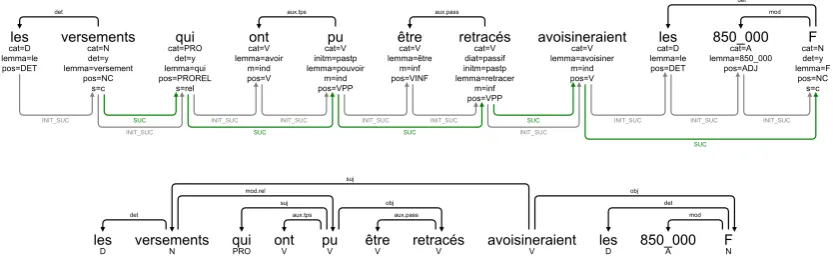
Figure 3: The annotation of a sentence after running the initial modules and at the end of parsing.
ing process. The rewriting rules model particular grammatical rules of the language (French in our case) and they are grouped by modules according to their linguistic proximity. We distinguish three classes of modules with respect to their position in the parsing process: initial modules, iterative modules and final modules.
3.4.1 Initial modules
Initial modules are carried out at the beginning of parsing. They have two different functions. Some modules, which are related to the specific annota-tion format, are used to prepare the actual syntactic annotation.
Other modules have a linguistic function: they realize close dependencies to verbs, nouns, adjec-tives and adverbs. They realize them with a great determinism, and thus they can be very well fore-seen. They link verbs with their auxiliaries and clitics, nouns with their determiner and left adjec-tives. Finally, they make specific adverbs modi-fiers of verbs, adjectives or other adverbs.
Figure 3 shows an example of annotation step produced with FRDEP-PARSE on a part of
Sen-tence[frwiki_50.1000_00854]from the SEQUOIA
corpus. The first annotation is produced by the application of the initial modules. The module
verb_aux realizes the dependencies aux.tps
andaux.passof the respective verbspuand
re-tracés. The modulenoun_deprealizes the
depen-denciesdetandmodfor the nounFbut also the dependencydetfor the nounversements.
3.4.2 Iterative modules
Iterative modules realize arguments of verbs, ad-jectives, nouns and adverbs, as well as their mod-ifiers that can be put more or less far from them. They are called iterative because they can be
re-peated several times, which is made necessary by the CKY form of the syntactic composition in-duced by the form of rules and the recursivity of the syntactic composition for natural languages.
In the bottom part of Figure 3, the suj, obj andmod.reldependencies of the second anno-tation are realized by iterative modules. In par-ticular, thesubjectmodule is used twice: first, it realizes the subjectqui ofpu; second, it realizes the subject versementsofavoisineraient. With a CKY strategy, both dependencies cannot be real-ized in the same application of the module sub-ject because versementsmust be composed with the relative clause that modifies it, before being composed with the verbavoisineraient.
There is a specificcoordmodule, which is ded-icated to coordination. It is also iterative be-cause coordination may be performed at more or less deep levels of syntax: word, noun phrase, clause. . .
3.4.3 Final modules
Final modules are carried out at the end of parsing. There are three classes of final modules.
In the order of their execution, the first class includes modules that realize disambiguation and transformation of projective trees into non-projective trees (see Subsection 3.3).
Then, a second class includes modules that aim at closing the dependency structure of the sen-tence in two ways: adding default dependencies between non-connected partial trees and removing relations that are not syntactic dependencies but that were used by FRDEP-PARSEin intermediate
steps.
linguistic choices of annotation differ from those made for annotating SEQUOIAon some points.
First, we aim at simplifying the system of rewriting rules with a more uniform representation of dependencies. For instance, all contractions be-tween a preposition and a determiner (for instance
à le is contracted inau) are decomposed, so that rules related to determiners or prepositions can ap-ply to these cases in the same way as in the stan-dard cases.
Second, for some phenomena, there are good arguments for two different interpretations and we have made another choice than SEQUOIA. For
in-stance, we consider that the head of a coordination is the conjunction of coordination. The main argu-ment is that it allows the modifiers or arguargu-ments of a coordination to be distinguished from those of the first conjunct, which is not possible if we choose the head of the first conjunct as the head of the coordination.
3.5 Relaxing the CKY strategy
The goal of grouping rewriting rules by modules and ordering these ones, is the efficiency of pars-ing. The challenge is to keep accuracy at the same time. For this, we can play with two factors:
• the delimitation of modules (between two ex-tremes, all rules in one module and one sepa-rate module for each rule),
• the order between modules, taking into ac-count that iterative modules can be repeated as many times as needed,
If we constrain all iterative rules to respect the form described in Subsection 3.2, which induces a CKY strategy of parsing, we cannot obtain some needed dependency structures: for most iterative modules, the constraints imposed by the French grammar are contradictory.
Let us take again Example 1 to illustrate this contradiction. The first dependency obj
from coupé to ruban must be realized after the
dependency mod.rel, which entails the
or-der head_verb_obj / head_noun_modrel
be-tween the corresponding modules. At the op-posite, the second dependency obj from
mar-que to entrée must be realized before the
de-pendency mod.rel, which entails the order
head_noun_modrel/head_verb_obj.
The contradiction cannot be solved by iteration of the module head_verb_obj because both
de-pendencies will be realized at the first pass through the module.
We choose to relax the CKY strategy, which allows to link two partial dependency trees only by their roots. From empirical considerations, we propose new rules in the following form: if the yield of a partial dependency treeT1immediately
precedes the yield of another partial dependency treeT2, the rule tries to realize a dependency
be-tween the rightmost tokenwr1of theT1yield with
the root ofT2.
This new kind of rules aims at implementing a strategy of parsing that gives priority to clos-est dependencies, contrary to the rules implement-ing a CKY-like strategy aimimplement-ing at linkimplement-ing heads of dependency trees. We call the first rulesclose
linking rules and the second ones head linking
rules. The corresponding modules are
respec-tively calledclose linking modulesandhead
link-ing modules.
As for the head linking rules, the adjacency be-tween T1 and T2 in a close linking rule is
ex-pressed with aSUCrelation between their rootsr1
andr2. The difference is that anINIT_SUC
rela-tion expresses the immediate succession between wr1 and the left borderwl2 of the T2 yield. The
tokenwl2is linked tor2by an explicit chain of
de-pendencies, which may reduce to the empty chain. The rule introduces a dependency fromwr1tor2.
Let us illustrate this new kind of rules with Ex-ample 1. Using only head linking rules, we ob-tain the annotation shown on Figure 4. We fail to link the wordruban with the head marque of the relative clause because the concerned module
head_noun_modrel, the function of which is to
realize mod.reldependencies, comes after the modulehead_verb_objrealizing the dependency
objfromcoupétoruban.
To solve the problem, we introduce the follow-ing close linkfollow-ing rule:
1 rule close-noun_modrel_verb { 2 match {
3 % positive constraints on T1
4 PRE [];
5 N [cat=N|PRO];
6
7 % positive constraints on T2
8 PROREL [pos=PROREL];
9 V [cat=V, m=ind|subj];
10 POST [];
11 V -> PROREL;
12 e2: V -[SUC]-> POST; 13
14 %adjacency between T1 and T2
15 e1: PRE -[SUC]-> V; 16
17 % N rightmost token in T1 yield
18 N -[INIT_SUC]-> PROREL
Après
cat=P lemma=après
pos=P
avoir
cat=V lemma=avoir
m=inf pos=VINF
coupé
cat=V initm=pastp lemma=couper
m=inf pos=VPP
le
cat=D lemma=le pos=DET
ruban
cat=N det=y lemma=ruban
pos=NC s=c
qui
cat=PRO det=y lemma=qui pos=PROREL
s=rel
en
cat=CL det=y lemma=en pos=CLO s=obj
marque
cat=V lemma=marquer
m=ind pos=V
symboliquement
cat=ADV lemma=symboliquement
pos=ADV
l'
cat=D lemma=le pos=DET
entrée
cat=N det=y lemma=entrée
pos=NC
aux.tps det mod det
obj.p obj
suj
obj dep
INIT_SUC INIT_SUC INIT_SUC
INIT_SUC INIT_SUC
INIT_SUC INIT_SUC INIT_SUC INIT_SUC INIT_SUC
[image:8.595.92.505.70.142.2]SUC
Figure 4: The annotation of the phrase from Figure 1 with the CKY strategy
20
21 % PROREL leftmost token in T2 yield
22 without {
23 DEP []; V -> DEP;
24 DEP.position < PROREL.position
25 }
26 without { V -> N} 27
28 commands { 29 del_edge e1; 30 del_edge e2;
31 add_edge N -[mod.rel]-> V; 32 add_edge PRE -[SUC]-> POST;
33 }
34 }
The rule links a nounNwith the head verbVof a relative clause in a mod.rel dependency, ex-pressing the modification of the noun by the rela-tive clause.
The tokenPREis a node ofT1, without any
spe-cific features. N is also a node of T1 but the
re-lationship between PRE and T1 is not specified.
Some constraints will be added further to make PRE the root of T1 andNthe rightmost token of
its yield. The treeT2 is made of the verbV
gov-erning a relative pronounPROREL.
Any rule from an initial or iterative module pre-serves the following property for theSUCrelation: the two tokens linked by the relation are roots and they have adjacent yields. This entails that PRE andVare roots of respectivelyT1andT2and their
yields are adjacent.
As the initial and iterative modules preserve projectivity, the negative constraints express that PRORELis the leftmost tokenwl2of theT2 yield.
Since the relationINIT_SUCexpresses the ad-jacency of two tokens, therefore PROREL is the immediate successor ofN. AsPRORELis the left-most token of the T2 yield and the T1 yield
im-mediately precedes theT2yield, it entails that the
rightmost tokenwr1of theT1yield isN.
The rewriting commands link the headVof the relative clause with its antecedentNin amod.rel relation and they update theSUCrelations.
As the experimental results shows it in the next section, both head linking and close link-ing strategies capture most configurations of
syn-tactic dependencies but they fail to parse such phrases as the following one extracted from
[fr-wiki_50.1000_00464]: des listings de comptes de
la chambre de compensation luxembourgeoise. If
we ignore agreement constraints, the head link-ing strategy leads to bindlink-ing of the adjective
lux-embourgeoisewith the headlistingsof the
depen-dency tree ofdes listings de comptes de la
cham-bre de compensation. With the close linking
strat-egy, binding is realized with the closest leaf
com-pensation. Both solutions are wrong because
lux-embourgeoiseis a modifier ofchambre. We need
a more flexible strategy to cover all different cases of linking between two partial dependency trees.
4 Experimental results
The gold standard data used for evaluation is SE -QUOIA version 6.0, which contains 3,099 French
sentences taken from various sources (newspa-per, medical texts, Europarl and Wikipedia). The full corpus was divided in two homogeneous sub-corpora (DEV-SEQUOIA and TEST-SEQUOIA) of
the same size. We used the DEV-SEQUOIA
cor-pus to develop and to improve the rule system; the final evaluation reported below being done on the other part TEST-SEQUOIA.
The input of our rule-based system FRDEP
-PARSEare sentences which are tokenized,
lemma-tized and tagged with the refined system of 28pos labels defined in (Candito et al., 2011). In order to evaluate the FRDEP-PARSErule system alone,
we have made a first experiment (called GOLD
-POS) where the input data are taken from the gold corpus: we consider the tokenization, lemmatiza-tion and enriched POS of SEQUOIA version 6.0
sec-ond experiment MELT-POS.
In SEQUOIA, there is no clear rules in the
anno-tation guide which explain how punctuation sign should be linked to the rest of the sentence; hence, the punctuation is not annotated in a consistent way. Here, we report scores on the Corpus TEST
-SEQUOIAwithout taking into account the relation
punctuation; nevertheless, comma used as a co-ordination in enumeration are annotated with re-lation coordanddep.coord and so there are included in the evaluation. In this context, the LAS (Labelled Attachment Score) corresponds to what is usually called the recall (i.e. the propor-tion of relapropor-tions in the reference corpus which are correctly predicted by the system). The objective of FRDEP-PARSEis not to build complete
depen-dency parse and when it is not sensible to com-pute a relation with a deterministic rewrite rule, only partial dependency structures are returned and some lexical units are left unattached. This explain why the precision (i.e. the proportion of relations predicted by the system which are cor-rect) is much higher than the recall.
LAS(recall) prec. F-measure GOLD 80.61% 89.21% 84.69%
MELT 76.04% 85.96% 80.69%
Figure 5: Experimental results
The TEST-SEQUOIAcorpus contains 1,550
sen-tences and 33,662 lexical units. This corpus is parsed in 51.9 seconds (with a 2.4GHz Intel Core i7) and 32,035 relations are produced; this corre-sponds to a mean of 617 relations produced per second.
We provide below some comparison with other dependency parsers evaluated on French.
The talismane parser (Urieli, 2013) is a statis-tical parsed where some rules based on linguistic knowledge can be used to guide the parser. For the same reason we gave above about punctuation, Talismane is evaluated on the set of dependencies different from the punctuation. On a corpus sim-ilar to the one we used, the LAS (labelled attach-ment score) ranges from 86% to 88%.
In (Villemonte De La Clergerie, 2014), some experiments on the SEQUOIA corpus are also
re-ported. Again, results are given without taking into account the punctuation. Different combina-tion of parsers are tested on different sub-corpora; the LAS scores obtained range from 83.53% to
88.94%.
The scores we obtain with FRDEP-PARSE are
significantly lower than the two other systems but we still consider them as very encouraging. In-deed, the FRDEP-PARSE system was written in
a few weeks and is the first attempt to write of a set of graph rewriting rules for dependency pars-ing. Moreover, we make two very strong restric-tions on our system: we consider only determin-istic application of rules and we do not use any statistical information. Relaxing these restrictions is far from being an easy task. If we consider non-deterministic uses of Graph Rewriting in the gen-eral setting, we will necessarily have to deal with exponential number of solutions. It will be needed to use statistical information to guide the graph rewriting process and to avoid exponential explo-sion. This challenge is part of the future work to do in this area.
5 Conclusion
References
Guillaume Bonfante, Bruno Guillaume, Mathieu Morey, and Guy Perrier. 2011. Modular Graph Rewriting to Compute Semantics. In Johan Bos and Stephen Pulman, editors,9th International Con-ference on Computational Semantics - IWCS 2011, pages 65–74, Oxford, United Kingdom, January. Marie Candito and Djamé Seddah. 2012. Le corpus
Sequoia : annotation syntaxique et exploitation pour l’adaptation d’analyseur par pont lexical. InProc. of TALN, Grenoble, France.
Marie Candito, Benoît Crabbé, and Mathieu Falco, 2011. Dépendances syntaxiques de surface pour le français (version 1.2).
Michael A. Covington. 2000. A fundamental algo-rithm for dependency parsing. InIn Proceedings of the 39th Annual ACM Southeast Conference, pages 95–102.
Ralph Debusmann, Denys Duchier, and Geert-Jan Kruijff. 2004. Extensible dependency grammar: A new methodology. In Recent Advances in Depen-dency Grammars, August.
Pascal Denis and Benoît Sagot. 2012. Coupling an annotated corpus and a lexicon for state-of-the-art POS tagging. Language Resources and Evaluation, 46(4):721–736.
Jason M. Eisner. 1996. Three new probabilistic mod-els for dependency parsing: An exploration. In Pro-ceedings of the 16th Conference on Computational Linguistics - Volume 1, COLING ’96, pages 340– 345. Association for Computational Linguistics. Kilian Foth, Ingo Schröder, and Wolfgang Menzel.
2000. A transformation-based parsing technique with anytime properties. In in proceedings of the 4th International Workshop on Parsing Technolo-gies, pages 89–100.
Joakim Nivre. 2003. An efficient algorithm for pro-jective dependency parsing. In Proceedings of the 8th International Workshop on Parsing Technologies (IWPT, pages 149–160.
Kemal Oflazer. 2003. Dependency parsing with an extended finite-state approach. Computational Lin-guistics, 29:515–544.
Assaf Urieli. 2013. Robust French syntax analysis: reconciling statistical methods and linguistic knowl-edge in the Talismane toolkit. Ph.D. thesis, Univer-sité de Toulouse II le Mirail.