________________________________
* formerly with the Medical Imaging Informatics Group, Dept. of Radiological Sciences, University of California - Los Angeles, Los Angeles, CA 90024
Incorporating syntactic dependency information towards improved
coding of lengthy medical concepts in clinical reports
Vijayaraghavan Bashyam, PhD* Monster Worldwide Inc. Mountain View, CA 94043
Ricky K Taira, PhD
Medical Imaging Informatics Group University of California, Los Angeles
Los Angeles, CA 90024
Abstract
Medical concepts in clinical reports can be found with a high degree of variability of ex-pression. Normalizing medical concepts to standardized vocabularies is a common way of accounting for this variability. One of the challenges in medical concept normalization is the difficulty in comparing two concepts which are orthographically different in repre-sentation but are identical in meaning. In this work we describe a method to compare medi-cal phrases by utilizing the information found in syntactic dependencies. We collected a large corpus of radiology reports from our university medical center. A shallow semantic parser was used to identify anatomical phras-es. We performed a series of transformations to convert the anatomical phrase into a norma-lized syntactic dependency representation. The new representation provides an easy in-tuitive way of comparing the phrases for the purpose of concept normalization.
1 Introduction
A vast amount of electronic information is generated in hospitals as a part of routine clinical care due to the adoption of the electronic medical record by health care centers in the United States (Berner et al., 2005; Jha et al., 2006). A significant portion of this information is in the form of un-structured free-text (Hall, 2000; Tange et al., 1998). A free text representation makes it difficult
for applications to accurately extract medical in-formation for generic purposes (Ananiadou et al., 2004). The problem of variability of expression in natural language expression has been well studied (Bates, 1986, 1989, 1998; Blair and Maron, 1985; Funk and Reid, 1983; Furnas et al., 1984; Gomez
et al., 1990). In the medical domain in particular, users frequently express the same concept in dif-ferent ways and difdif-ferent concepts in similar ways (Ananiadou and Nenadic, 2006). To illustrate, the terms heart attack and cardiac attack both refer to the same concept – myocardial infarction. Con-versely the term left lobe could refer to the left lobe of lung or the left lobe of liver depending on the context (occurrence in a chest radiology report ver-sus a gastro-intestinal radiology report). Such va-riability suggests a need to normalize concepts encountered in medical reports to a standard voca-bulary in order to ensure interoperability.
Several standardized vocabularies exist in the medical domain such as the Unified Medical Lan-guage System (Humphreys and Lindberg, 1993),
Systematized Nomenclature of Medicine - Clinical Terms (College of American Pathologists, July 2003), Medical Subject Headings (National Li-brary of Medicine), and the International Classifi-cation of Diseases (World Health Organization). There have been several attempts in the past (Aronson, 2001; Bashyam and Taira, 2005; Ba-shyam et al., 2007; Cooper and Miller, 1998; Friedman et al., 2004; Nadkarni et al., 2001; Oliv-er and Altman, 1994; Ruch et al., 2003; Zou et al., 2003) to map medical concepts to their standar-dized concept found in these terminologies. These approaches are based on mostly on lexical match-ing (Bashyam et al., 2007), string matching (Nad-karni et al., 2001), statistical indexing (Cooper and
Miller, 1998), natural language processing (Aron-son, 2001; Friedman et al., 2004) information re-trieval techniques (Bashyam and Taira, 2005; Oliver and Altman, 1994; Ruch et al., 2003; Zou et al., 2003) or a combination of these approaches (Cooper and Miller, 1998). These systems have managed to map a large percentage of medical terms to their respective standard terminologies in their reported experiments. While these systems have managed to perform satisfactorily for the task of normalizing simple expressions, they all ac-knowledge the larger problem of normalizing leng-thy expressions. To illustrate, Nadkarni et al. (2001) mention the mapping of the phrase spleen rupture and normal stomach to the concept sto-mach rupture as a possible spurious mapping.
We hypothesize that using deep syntactic in-formation can help in avoiding such spurious map-ping. We describe a system which uses information found in syntactic dependencies to help in the cod-ing of lengthy phrases. Preliminary results uscod-ing this approach are reported as a proof-of-concept.
2 Background
Syntactic dependency parsing has received much focus from the natural language processing community (Eisner, 1996; Kudo and Matsumoto, 2000; Nivre and Scholz, 2004; Yamada and Mat-sumoto, 2003). A syntactic dependency relation is an asymmetric relation between two words. One word is called the head, and the other word is called the modifier or dependent. A word in the sentence can play the role of the head in several dependency relations (i.e., it can have several ifiers) but each word can play the role of the mod-ifier only once. A special word, named the root,
does not play the role of the modifier in any rela-tion. The set of dependency relations that can be defined on a sentence form a tree, called the de-pendency tree. An example of dependencies in a typical sentence found in a radiology report is shown in Figure 1.
Systems based on syntactic dependencies have been used successfully in several information re-trieval experiments with results outperforming tra-ditional retrieval systems (Croft et al., 1991; Gao
et al., 2004; Gonzalez et al., 2005; Smeaton, 1986). In particular, this method has been used for word sense disambiguation (Lin, 1997) and thesau-rus construction (Lin, 1998). Dependency trees have also been used for medical concept represen-tation in the domains of radiology (Steimann, 1998) and pathology (Romacker et al., 1999).
3 Methods
3.1 Anatomy Phrase Extraction
[image:2.612.77.529.84.174.2]For identifying anatomy phrases, we use a spe-cialized phrase parser trained to identify anatomy phrases within clinical reports. The input to the parser is a sentence tagged with a part-of-speech tag and a semantic tag. The lexical analyzer mod-ule of our NLP system takes a single sentence as the input and produces an output of word tokens tagged with their syntactic and semantic classes. The semantic tag is obtained by mapping tokens in a sentence to a taxonomy handcrafted for the do-main of radiology reports custom built from radi-ology textbooks, radiradi-ology review manuals, radiology word compilations and published radiol-ogy glossaries apart from actual radiolradiol-ogy reports (Taira et al., 2001). Features of our implementation
include: 1) a large number (>450) of semantic classes as compared to lexical sources currently available allowing improved discrimination for tasks such as syntactic parsing, semantic interpre-tation and frame building; 2) the system recognizes special symbols including dates, medical abbrevia-tions, medical coding symbols, numeric measure-ments, image slice references, and proper names; and 3) the system performs some word sense dis-ambiguation using surrounding syntactic and se-mantic word features.
Our phrase parsing module currently targets anatomy phrases (e.g., right upper lobe of lung), existential relationships (e.g., there is no evidence of), and spatial relationships (e.g., is located 1cm above). We utilize a supervised learning approach to estimate the feature weights to a maximum en-tropy model which classifies words as the start, inside, end, single, or outside of a phrase boundary. A Viterbi dynamic programming algorithm is used to maximize the tag sequence probability. The anatomy phrase chunker has been tested on 4,500 sentences with recall and precision scores of 97.1% and 97.4% respectively.
3.2 Normalized Dependency Representation
We perform a series of transformations to con-vert an anatomical phrase from a free-text repre-sentation to a normalized dependency vector space
representation. The following steps are taken in the representation conversion:
Syntactic Parsing
The anatomy phrase identified by the phrase parser preserves lexical information which is used to obtain a dependency parse tree using a full syn-tactic parser. This parser is based on a novel field theory approach to dependency parsing. The parser is strongly modeled for the radiology domain with performance accuracies of 84.9% and 89.9% for link precision and recall respectively for parsing whole sentences (Taira et al., 2007). In compari-son, the state-of-the-art parsers have performance accuracies in the low nineties for link precision and recall in the domain of newspaper text, with per-formance unknown in the domain of clinical text.
Link Reduction
Our system classifies dependency links into two types – bilexical links and trilexical links. A bilexical link is a strong dependency relation be-tween two words (e.g. determiner←noun) whereas a trilexical link usually has a mediator word in be-tween the two words (e.g. finding→in→location). When possible, a trilexical link is converted to a bilexical link by the elimination of the mediator word and the link type is tagged by the mediator word. The link type can play important roles in certain cases. In cases where the mediator word is also important, the trilexical link is considered as a pair of bilexical links.
Token Level Normalization
Once the parse tree is obtained, the tokens are normalized to their base form. The normalization is an approximate kind of lemmatization. However we also perform word level synonym normaliza-tion. For lemmatization, we use the Lexical Va-riant Generator tools developed by the National Library of Medicine for biomedical text (McCray
et al., 1994). For synonyms, we use a handcrafted lexicon built for the domain of radiology. This step helps in avoiding missing a mapping due to lexical differences due to pluralization, abbreviations and acronyms, case differences etc. This representation is referred to as the normalized dependency vector space representation
3.3 Mapping to a Terminology
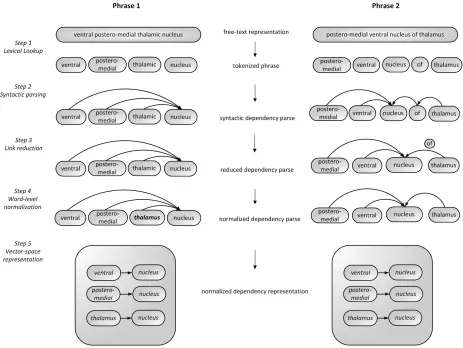
Figure 2. Example illustrating the transformation of a medical phrase from a free-text representation to a normalized syntactic dependency vector space representation.
An exercise in normalization is described in Figure 2 to illustrate how this method works. Con-sider the following phrase in a neuro-radiology report: ventral postero-medial thalamic nucleus. The corresponding concept in the target terminolo-gy is the phrase postero-medial ventral nucleus of thalamus. These phrases if compared by string matching will not result in direct matches. Permut-ing words and tryPermut-ing to compare rearrangements is complicated. In our approach, we first preprocess our terminology list and store it in a database. The preprocessing step is described in the right column (Phrase 2) of Figure 2. Starting with the phrase
postero-medial ventral nucleus of thalamus, we first tokenize the individual words (lexical analy-sis) in the first step. In the second step, we parse
the phrase to arrive at the dependency tree. In the third step, the trilexical link nuc-leus←of←thalamus is converted to a bilexical link by eliminating the word of and tagging it as the link type. In the following step, each word is nor-malized to its base form. In the fifth step, the phrase is represented as a bag-of-links and stored in a database. Similarly all the other phrases in our terminology are stored.
When the query phrase ventral postero-medial thalamic nucleus is compared against the terminol-ogy it undergoes the same processes previously described (Figure 2, Phrase 1). The importance of
con-venience of comparison Figure 2 shows together, the query phrase and target phrase undergoing the various steps starting from a bag-of-words repre-sentation to a bag-of-links representation. It is clear that both phrases look identical in the final repre-sentation. While a string comparison would have missed equating the two in their original word-level representation, a comparison in the depen-dency vector space is likely to score them as a per-fect match.
4 Experiment and Results
We obtained a set of 2500 neuro-radiology re-ports from our university medical center. Using the shallow semantic parser, we extracted a set of 2551 unique anatomical phrases. Of the 2551 phrases, 819 phrases were single worded terms. We dis-carded the single word terms. Single worded phrases do not fall into the difficult-to-map catego-ry which this method is specifically aiming to ad-dress. Moreover, a minimum of two words are required to define a syntactic dependency and thus the method is irrelevant for single worded terms. Thus we used only the 1732 multi-worded terms in our experiment. The average length of the multi-worded terms was 2.48 words.
We chose the UMLS, a coordinated repository of vocabularies as a target for concept coding. To reduce complexity, we removed non-English con-cepts and concon-cepts outside the domain of neuro-radiology by filtering out unrelated concepts. Our final terminology had a size of about 100,000 en-tries. We preprocessed the entire terminology us-ing the above mentioned steps and stored the dependency representation in a database. Every anatomy phrase was queried against this database and cosine similarity was used to measure relev-ance. No weighting system was employed although it is possible to weight links by their types. A phy-sician domain expert manually evaluated the re-sults of the 1732 queries for performance. Of the 1732 phrases, 1091 phrases (62.9% accuracy, 95% CI ±0.946%) were successfully matched. Since the target set is extremely large in size (as in any IR system), a recall analysis was not performed. A baseline comparison with MMTx (in phrase mode) resulted in 1051 phrases (60.68% accuracy, 95% CI ±0.49%) being mapped by MMTx. Table 1 summarizes the results.
5 Discussion
Analysis of the errors showed that the follow-ing error types resulted in the inability to match phrases perfectly:
Parsing without context:
A syntactic parser can parse a sentence and identify dependency relations in a sentence. How-ever, when a phrase is given as an input, it is not always easy to parse a phrase and generate a de-pendency representation. There is context (remain-ing portions of the sentence) miss(remain-ing which is needed to unambiguously parse the phrase. In the case of anatomical phrases, our system was able to parse it because the source sentences from which they were extracted were available. However, in the case of the UMLS phrases, there is no such available information. Therefore manual parsing of several UMLS phrases had to be performed. One potential solution to this problem could be to iden-tify MEDLINE sentences that contain these UMLS concepts and obtain a dependency parse tree using the context of the sentence.
Modular system architecture:
Since the system is modular, any errors in one of the modules (tokenization, word level normali-zation etc.) would result in the final dependency representation being imperfect. The specific errors we noticed were:
Parsing Errors:
Our parser has a higher accuracy for parsing phrases than whole sentences. However in this ex-periment, there were 37 instances where it failed in
MMTx Matched Phrases
Syn. Dependency Matched Phrases
1051 1091 n=1732 60.68% 62.99%
(±0.49%) (±0.49%)
assigning the correct links. This resulted in partial matches.
Word Normalization Errors:
There is a natural ambiguity introduced when words are normalized to their base forms. Words with completely different senses can have the same root form (e.g. left←leaves and left←left (spatial direction)). Similarly, a word can have different normalized forms depending on the sense (e.g.
leaf←leaves and left←leaves). A robust method for word-level normalization is desired that can also perform word-sense disambiguation. Current-ly the NLM’s word level normalization tool is be-ing used which is not perfect and therefore errors introduced due to this module result in the entire phrase being transformed incorrectly or ambi-guously. The ideal word level normalization will result in the words cancer, cancerous, carcinoma
all conflating to the same word which is beyond purely morphological analysis.
Link Reduction Errors:
Not all relations manifest as simple bilexical and trilexical links. Some relations are tetralexical and although they can be reduced effectively to bilexical links, the methodology needs to be inves-tigated. To illustrate, consider the phrases ‘mass consistent with cancer’ and ‘cancerous mass’ parsed as
mass←consistent←with←cancer cancerous→mass.
The former is parsed as four words with three links. To convert it into a bilexical link, the words ‘consistent’ and ‘with’ need to be: (1) clustered as a single token and (2) eliminated by transferring it to the link as a label. This is a more complicated process and we still haven’t explored such abstrac-tions. A robust rule based link reduction system is desired to handle such cases.
Another limitation of this method is that the heuristic rules for link reduction may not be appli-cable outside the radiology domain. Finally, syn-tactic dependency parsers are built using computationally complex algorithms. Thus while
using them can result in advanced language under-standing, they may not be suitable for real-time applications. There is always a tradeoff between accuracy and speed and it remains to be seen if robust low complexity parsers can be developed.
The inability to perform a recall analysis also make is difficult to judge the theoretical best per-formance. That is, it is quite likely that there are many phrases in our dataset that do not have a cor-responding UMLS concept. Performing a recall analysis would help in determining this.
While we noticed several areas of improvement in our system, we were encouraged by the compar-ison of the overall results of our system to that of MMTx. We did not do an error analysis of MMTx since several previous publications have docu-mented the various kinds of errors in MMTx (Ba-shyam et al., 2007; Divita et al., 2004; Meng et al., 2005). Our idea is to provide a baseline compari-son showing that our approach performs compara-bly if not better than MMTx which is the most commonly used1 tool for concept coding. To our knowledge this the first time syntactic dependen-cies have been used for this task, Previous attempts have relied purely on shallow parsers.
6 Future Work
Increasing the robustness of the individual modules is a primary requirement for further expe-riments to prevent the weakest linkeffect cascading to the final output. Specifically we plan to work towards a robust word level normalization system. Additionally, robust evaluation methods including comparisons with other techniques will be investi-gated.
7 Conclusion
Syntactic dependency based methods for med-ical concept coding show promise. While some of the described implementations are specific to do-main (radiology) and phrase type (anatomy), it is expected that the principle is general enough to be applied in other domains as well.
1 For an overview of recent applications of MMTx, see
Acknowledgements
The authors would like to thank Lew Andrada, Gregory Leazer, Jonathan Furner and Christine Borgman for several useful suggestions.
This work was supported in part by the follow-ing grants:
1. National Institute of Biomedical Imaging and Bioengineering P01-EB00216
2. National Institute of Health R01-EB002247
References
Ananiadou, S., Friedman, C., and Tsujii, J. (2004). In-troduction: named entity recognition in biomedicine. Journal of Biomedical Informatics, 37(6), 393-395. Ananiadou, Sophia, and Nenadic, Goran. (2006).
Auto-matic Terminology Management in Biomedicine. In Sophia Ananiadou and John McNaught (Eds.), Text Mining for Biology And Biomedicine. Norwood MA: Artech House.
Aronson, A. R. (2001). Effective mapping of biomedi-cal text to the UMLS Metathesaurus: the MetaMap program, AMIA Annu Symp Proc (pp. 17-21). Port-land, OR.
Bashyam, V., and Taira, R. K. (2005). Indexing Ana-tomical Phrases in Neuro-Radiology Reports to the UMLS 2005AA, American Medical Informatics As-sociation Annual Symposium (pp. 26-30). Washing-ton DC.
Bashyam, Vijayaraghavan, Divita, Guy, Bennett, David B, Browne, Allen C, and Taira, Ricky K. (2007, Au-gust 2007). A Normalized Lexical Lookup Approach to identifying UMLS concepts in free text. Paper pre-sented at the 12th World Congress on Health (Medi-cal) Informatics (MEDINFO). Brisbane, Australia. Bates, M. J. (1986). Subject access in online catalogs: A
design model. Journal of the American Society for Information Science, 37(6), 357-376.
Bates, M. J. (1989). Rethinking Subject Cataloging in the Online Environment. Library Resources and Technical Services, 33(4), p400-412.
Bates, M. J. (1998). Indexing and access for digital li-braries and the internet: Human, database, and do-main factors. Journal of the American Society for Information Science, 49(13), 1185-1205.
Berner, E. S., Detmer, D. E., and Simborg, D. (2005). Will the Wave Finally Break? A Brief View of the
Adoption of Electronic Medical Records in the Unit-ed States. J Am MUnit-ed Inform Assoc, 12(1).
Blair, David C., and Maron, M. E. (1985). An Evalua-tion of retrieval effectiveness for a full-text document retrieval system. Communications of the ACM, 28(3), 289-299.
College of American Pathologists. (July 2003). SNOMED Clinical Terms ® Technical Reference Guide.
Cooper, G. F., and Miller, R. A. (1998). An Experiment Comparing Lexical and Statistical Methods for Ex-tracting MeSH Terms from Clinical Free Text, Pro-ceedings of the American Medical Informatics Association Annual Symposium.
Croft, W. B., Turtle, H. R., and Lewis, D. D. (1991). The use of phrases and structured queries in informa-tion retrieval. Paper presented at the Proc of the 14th Annu Intnl ACM SIGIR Conf on R&D in Informa-tion Retrieval.
Divita, Guy, Tse, Tony, and Roth, Laura. (2004). Fail-ure analysis of MetaMap transfer (MMTx). In M Fie-schi et. al. (Ed.), Proceedings of the 11 World Congress on Health Informatics (MEDINFO 2004). Eisner, J. (1996). Three new probabilistic models for
dependency parsing: An exploration. Paper presented at the Proc COLING.
Friedman, C., Shagina, L., Lussier, Y., and Hripcsak, G. (2004). Automated Encoding of Clinical Documents Based on Natural Language Processing. Journal of the American Medical Informatics Association, 11(5), 392.
Funk, M. E., and Reid, C. A. (1983). Indexing consis-tency in MEDLINE. Bulletin of the Medical Library Association, 71(2), 176-183.
Furnas, G. W., Landauer, T. K., Gomez, L. M., and Dumais, S. T. (1984). Statistical semantics: analysis of the potential performance of keyword information systems. In Human factors in computer systems (pp. 187-242): Ablex Publishing Corp. Norwood, NJ, USA.
Gao, J., Nie, J. Y., Wu, G., and Cao, G. (2004). Depen-dence language model for information retrieval. Pa-per presented at the Proc ACM SIGIR.
Gonzalez, M., Strube De Lima, V. L., and Valdeni De Lima, J. (2005). Binary Lexical Relations for Text Representation in Information Retrieval. In Natural Language Processing and Information Systems (Vol. 3513, pp. 21-31). Berlin / Heidelberg: Springer Hall, F. (2000). Language of the radiology report.
American Journal of Roentology, 175, 1239-1241. Humphreys, B. L., and Lindberg, D. A. B. (1993). The
UMLS project: making the conceptual connection between users and the information they need. Bulle-tin of the Medical Library Association, 81(2), 170. Jha, Ashish K., Ferris, Timothy G., Donelan, Karen,
DesRoches, Catherine, Shields, Alexandra, Rosen-baum, Sara, and Blumenthal, David. (2006). How Common Are Electronic Health Records In The United States? A Summary Of The Evidence. Health Affairs, doi: 10.1377/hlthaff.25.w496.
Kudo, T., and Matsumoto, Y. (2000). Japanese depen-dency structure analysis based on support vector ma-chines. Paper presented at the Proc International Conference On Computational Linguistics.
Lin, D. (1997). Using syntactic dependency as local context to resolve word sense ambiguity, Proceedings of the 35th Annual Meeting of the Association for ComputationalLinguistics and 8th Conference of the European Chapter of the Association for Com-putational Linguistics. Madrid, Spain.
Lin, D. (1998). Automatic retrieval and clustering of similar words. Paper presented at the Proc 36th Annu Meeting of the ACL and 17th Intnl Conf on Comp Ling.
McCray, AT, Srinivasan, S, and Browne, AC. (1994). Lexical methods for managing variation in biomedi-cal terminologies. Paper presented at the Proceedings of the Annual Symposium on Computer Applications in Medical Care.
Meng, F., D'Avolio, L. W., Chen, A. A., Taira, R. K., and Kangarloo, H. (2005). Generating Models of Surgical Procedures using UMLS Concepts and Mul-tiple Sequence Alignment, AMIA Annu Symp Proc (Vol. 520, pp. 4). Washington, DC.
Nadkarni, P., Chen, R., and Brandt, C. (2001). UMLS Concept Indexing for Production Databases: A Fea-sibility Study. Journal of the American Medical In-formatics Association, 8(1), 80.
National Library of Medicine. MEdical Subject Head-ings. www.nlm.nih.gov/mesh/ meshhome.html Last Accessed 09 March 2007 Bethesda, MD.
Nivre, J., and Scholz, M. (2004). Deterministic depen-dency parsing of English text. Paper presented at the Proc COLING.
Oliver, D. E., and Altman, R. B. (1994). Extraction of SNOMED concepts from medical record texts, Proc of the 18th Annual SCAMC (Vol. 17983). Washing-ton: McGraw Hill.
Romacker, M., Schulz, S., and Hahn, U. (1999). Streamlining semantic interpretation for medical narratives. Paper presented at the AMIA Annu Symp Proc.
Ruch, P., Baud, R., and Geissbühler, A. (2003). Learn-ing-free Text Categorization, Proc of 9th Conf on Ar-tificial Intelligence in Medicine (pp. 199–204). Smeaton, A. F. (1986). Incorporating syntactic
informa-tion into a document retrieval strategy: an investiga-tion. Paper presented at the Proc of the 1986 ACM Conf on R&D in Information Retrieval, Pisa, Italy. Steimann, F. (1998). Dependency parsing for medical
language and concept representation. Artificial Intel-ligence in Medicine, 12(1), 77-86.
Taira, R. K., Soderland, S. G., and Jakobovits, R. M. (2001). Automatic Structuring of Radiology Free-Text Reports. Radiology, 21, 237-245.
Taira, Ricky K, Bashyam, Vijayaraghavan, and Kangar-loo, Hooshang. (2007). A Field Theoretical Approach for Medical Natural Language Processing. IEEE Transactions on IT in Biomedicine, 11(4), 364-375. Tange, H.J., Schouten, H.C., Kester, A.D.M., and
Has-man, A. (1998). The Granularity of Medical Narra-tives and Its Effect on the Speed and Completeness of Information Retrieval. J Am Med Inform Assoc, 5(6), 571-582.
World Health Organization.
http://www.who.int/classifications/icd/en/ Last Ac-cessed 09 March 2007.
Yamada, H., and Matsumoto, Y. (2003). Statistical de-pendency analysis with support vector machines. Pa-per presented at the Proceedings of the 8th International Workshop on Parsing Technologies (IWPT).