Phrase Based Decoding using a Discriminative Model
Prasanth Kolachina
LTRC, IIIT-Hyderabad
{prasanth k}@research.iiit.ac.in
Sriram Venkatapathy
LTRC, IIIT-Hyderabad
{sriram}@research.iiit.ac.in
Srinivas Bangalore
AT&T Labs-Research, NY
{srini}@research.att.com
Sudheer Kolachina
LTRC, IIIT-Hyderabad
{sudheer.kpg08}@research.iiit.ac.in
Avinesh PVS
LTRC, IIIT-Hyderabad
{avinesh}@research.iiit.ac.in
Abstract
In this paper, we present an approach to statistical machine translation that com-bines the power of a discriminative model (for training a model for Machine Transla-tion), and the standard beam-search based decoding technique (for the translation of an input sentence). A discriminative ap-proach for learning lexical selection and reordering utilizes a large set of feature functions (thereby providing the power to incorporate greater contextual and linguis-tic information), which leads to an effec-tive training of these models. This model is then used by the standard state-of-art Moses decoder (Koehn et al., 2007) for the translation of an input sentence.
We conducted our experiments on Spanish-English language pair. We used maximum entropy model in our exper-iments. We show that the performance of our approach (using simple lexical features) is comparable to that of the state-of-art statistical MT system (Koehn et al., 2007). When additional syntactic features (POS tags in this paper) are used, there is a boost in the performance which is likely to improve when richer syntactic features are incorporated in the model.
1 Introduction
The popular approaches to machine translation use the generative IBM models for training (Brown et al., 1993; Och et al., 1999). The param-eters for these models are learnt using the stan-dard EM Algorithm. The parameters used in these models are extremely restrictive, that is, a simple, small and closed set of feature functions is used to represent the translation process. Also, these feature functions are local and are word based. In spite of these limitations, these models perform very well for the task of word-alignment because of the restricted search space. However, they per-form poorly during decoding (or translation) be-cause of their limitations in the context of a much larger search space.
Bangalore, 2009).
However, the limitation of global lexical se-lection models has been sentence construction. In global lexical selection models, lattice con-struction and scoring (LCS) is used for the pur-pose of sentence construction (Bangalore et al., 2007; Venkatapathy and Bangalore, 2009). In our work, we address this limitation of global lexi-cal selection models by using an existing state-of-art decoder (Koehn et al., 2007) for the purpose of sentence construction. The translation model used by this decoder is derived from a discrimina-tive model, instead of the usual phrase-table and reordering-table construction algorithms. This al-lows us to use the effectiveness of an existing phrase-based decoder while retaining the advan-tages of the discriminative model. In this paper, we compare the sentence construction accuracies of lattice construction and scoring approach (see section 4.1 for LCS Decoding) and the phrase-based decoding approach (see section 4.2).
Another advantage of using a discriminative ap-proach to construct the phrase table and the re-ordering table is the flexibility it provides to in-corporate linguistic knowledge in the form of ad-ditional feature functions. In the past, factored phrase-based approaches for Machine Translation have allowed the use of linguistic feature func-tions. But, they are still bound by the local-ity of context, and definition of a fixed struc-ture of dependencies between the factors (Koehn and Hoang, 2007). Furthermore, factored phrase-based approaches place constraints both on the type and number of factors that can be incorpo-rated into the training. In this paper, though we do not extensively test this aspect, we show that us-ing syntactic feature functions does improve the performance of our approach, which is likely to improve when much richer syntactic feature func-tions (such as information about the parse struc-ture) are incorporated in the model.
As the training model in a standard phrase-based system is relatively impoverished with re-spect to contextual/linguistic information, integra-tion of the discriminative model in the form of table and reordering-table with the phrase-based decoder is highly desirable. We propose to do this by defining sentence specific tables. For
example, given a source sentence s, the
phrase-table contains all the possible phrase-pairs
condi-tioned on the context of the source sentences.
In this paper, the key contributions are,
1. We combine a discriminative training model
with a phrase-based decoder. We
ob-tained comparable results with the state-of-art phrase-based decoder.
2. We evaluate the performance of the lattice construction and scoring (LCS) approach to decoding. We observed that even though the lexical accuracy obtained using LCS is high, the performance in terms of sentence con-struction is low when compared to phrase-based decoder.
3. We show that the incorporation of syntactic information (POS tags) in our discriminative model boosts the performance of translation. In future, we plan to use richer syntactic fea-ture functions (which the discriminative ap-proach allows us to incorporate) to evaluate the approach.
The paper is organized in the following sec-tions. Section 2 presents the related work. In section 3, we describe the training of our model. In section 4, we present the decoding approaches (both LCS and phrase-based decoder). We de-scribe the data used in our experiments in section 5. Section 6 consists of the experiments and re-sults. Finally we conclude the paper in section 7.
2 Related Work
In this section, we present approaches that are di-rectly related to our approach. In Direct Trans-lation Model (DTM) proposed for statistical ma-chine translation by (Papineni et al., 1998; Och and Ney, 2002), the authors present a discrimi-native set-up for natural language understanding (and MT). They use a slightly modified equation (in comparison to IBM models) as shown in equa-tion 1. In equaequa-tion 1, they consider the translaequa-tion
model from f → e(p(e|f)), instead of the
the-oretically sound (after the application of Bayes’
rule), e → f (p(f|e)) and use grammatical
verbs forms etc.
ˆ
e= arg max
e pT M(e|f)∗pLM(e) (1)
In their model, they use generic feature func-tions such as language model, cooccurence fea-tures such as presence of a lexical relationship in the lexicon. Their search algorithm limited the use of complex features.
Direct Translation Model 2 (DTM2) (Itty-cheriah and Roukos, 2007) expresses the phrase-based translation task in a unified log-linear prob-abilistic framework consisting of three compo-nents:
1. a prior conditional distributionP0
2. a number of feature functionsΦi()that
cap-ture the effects of translation and language model
3. the weights of the features λi that are
esti-mated using MaxEnt training (Berger et al., 1996) as shown in equation 2.
P r(e|f) = P0(e, j|f)
Z exp
X
i
λiΦi(e, j, f) (2)
In the above equation, j is the skip reordering
factor for the phrase pair captured byΦi()and
rep-resents the jump from the previous source word.
Z represents the per source sentence
normaliza-tion term (Hassan et al., 2009). While a
uni-form prior on the set of futures results in a
max-imum entropy model, choosing other priors
out-put a minimum divergence models. Normalized
phrase count has been used as the priorP0 in the
DTM2 model.
The following decision rule is used to obtain opti-mal translation.
ˆ
e= arg max
e P r(e|f)
= arg max
e M X
m=1
λmΦm(f, e)
(3)
The DTM2 model differs from other phrase-based SMT models in that it avoids the redun-dancy present in other systems by extracting from
a word aligned parallel corpora a set of minimal phrases such that no two phrases overlap with each other (Hassan et al., 2009).
The decoding strategy in DTM2 (Ittycheriah and Roukos, 2007) is similar to a phrase-based de-coder except that the score of a particular transla-tion block is obtained from the maximum entropy model using the set of feature functions. In our approach, instead of providing the complete scor-ing function ourselves, we compute the parame-ters needed by a phrase based decoder, which in turn uses these parameters appropriately. In com-parison with the DTM2, we also use minimal non-overlapping blocks as the entries in the phrase ta-ble that we generate.
Xiong et al. (2006) present a phrase reordering model under the ITG constraint using a maximum entropy framework. They model the reordering problem as a two-class classification problem, the
classes beingstraightandinverted. The model is
used to merge the phrases obtained from trans-lating the segments in a source sentence. The decoder used is a hierarchical decoder motivated from the CYK parsing algorithm employing a beam search algorithm. The maximum entropy model is presented with features extracted from the blocks being merged and probabilities are es-timated using the log-linear equation shown in (4). The work in addition to lexical features and collocational features, uses an additional metric called the information gain ratio (IGR) as a fea-ture. The authors report an improvement of 4% BLEU score over the traditional distance based distortion model upon using the lexical features alone.
pλ(y|x) =
1
Zλ(x)
exp(X
i
λiΦi(x, y)) (4)
3 Training
The training process of our approach has two steps:
1. training the discriminative models for trans-lation and reordering.
The input to our training step are the word-alignments between source and target sentences obtained using GIZA++ (implementation of IBM, HMM models).
3.1 Training discriminative models
We train two models, one to model the transla-tion of source blocks, and the other to model the reordering of source blocks. We call the transla-tion model a ‘context dependent block translatransla-tion model’ for two reasons.
1. It is concerned with the translation of mini-mal phrasal units called blocks.
2. The context of the source block is used dur-ing its translation.
The word alignments are used to obtain the set of possible target blocks, and are added to the
tar-get vocabulary. A tartar-get blockbis a sequence ofn
words that are paired with a sequence ofmsource
words (Ittycheriah and Roukos, 2007). In our ap-proach, we restrict ourselves to target blocks that are associated with only one source word. How-ever, this constraint can be easily relaxed.
Similarly, we call the reordering model, a ‘con-text dependent block distortion model’. For train-ing, we use the maximum entropy software library Llama presented in (Haffner, 2006).
3.1.1 Context Dependent Block Translation Model
In this model, the goal is to predict a target block given the source word and contextual and syntactic information. Given a source word and its lexical context, the model estimates the probabil-ities of the presence or absence of possible target blocks (see Figure 1).
The probabilities of the candidate target blocks are obtained from the maximum entropy model.
The probabilitypei of a candidate target blockei
is estimated as given in equation 5
pei =P(true|ei, fj, C) (5)
where fj is the source word corresponding to ei
andCis its context.
Using the maximum entropy model, binary classifiers are trained for every target block in the
context window
source word
word syntactically dependent SOURCE SENTENCE
[image:4.595.304.547.72.190.2] [image:4.595.303.523.589.674.2]target word 1 prob p1
...
target word 2 prob p2
prob pK target word K
on source word
Figure 1: Word prediction model
vocabulary. These classifiers predict if a particu-lar target block should be present given the source word and its context. This model is similar to the global lexical selection (GLS) model described in (Bangalore et al., 2007; Venkatapathy and Banga-lore, 2009) except that in GLS, the predicted tar-get blocks are not associated with any particular source word unlike the case here.
For the set of experiments in this paper, we used a context of size 6, containing three words to the left and three words to the right. We also used the POS tags of words in the context window as features. In future, we plan to use the words syn-tactically dependent on a source word as global context(shown in Figure 1).
3.1.2 Context Dependent Block Distortion Model
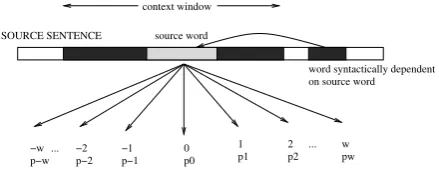
An IBM model 3 like distortion model is trained to predict the relative position of a source word in the target given its context. Given a source word and its context, the model estimates the probability of particular relative position be-ing an appropriate position of the source word in the target (see Figure 2).
context window
source word SOURCE SENTENCE
0 p0
1 p1
2 p2
w pw −1
p−1 −2 p−2 −w p−w
... ...
word syntactically dependent on source word
Figure 2: Position prediction model
the one described in the context dependent block translation model, binary classifiers are trained for every possible relative position in the target. These classifiers output a probability distribution over various relative positions given a source word and its context.
The word alignments in the training corpus are used to train the distortion model. While comput-ing the relative position, the difference in sentence lengths is also taken into account. Hence, the rela-tive position of the target block located at position
icorresponding to the source word located at
po-sitionjis given in equation 6.
r=round(i∗m
n −j) (6)
where,mis the length of source sentence andnis
the number of target blocks.roundis the function
to compute the nearest integer of the argument. If the source word is not aligned to any target word, a special symbol ‘INF’ is used to indicate such a case. In our model, this symbol is also a part of the target distribution.
The features used to train this model are the same as those used for the block translation model. In order to use further lexical information, we also incorporated information about the target word for predicting the distribution. The informa-tion about possible target words is obtained from the ‘context dependent block translation model’. The probabilities in this case are measured as shown in equation 7
pr,ei =P(true|r, ei, fj, C) (7)
3.2 Integration with phrase-based decoder
The discriminative models trained are sentence specific, i.e. the context of the sentence is used to make predictions in these models. Hence, the phrase-based decoder is required to use in-formation specific to a source sentence. In order to handle this issue, a different phrase-table and reordering-table are constructed for every input sentence. The phrase-table and reordering-table are constructed using the discriminative models trained earlier.
In Moses (Koehn et al., 2007), the phrase-table contains the source phrase, the target phrase and the various scores associated with the phrase
pair such as phrase translation probability, lexical weighting, inverse phrase translation probability, etc.1
In our approach, given a source sentence, the following steps are followed to construct the phrase table.
1. Extract source blocks (’words’ in this work) 2. Use the ‘context dependent block translation
model’ to predict the possible target blocks. The set of possible blocks can be predicted using two criteria, (1) Probability threshold, and (2) K-best. Here, we use a threshold value to prune the set of possible candidates in the target vocabulary.
3. Use the prediction probabilities to assign scores to the phrase pairs.
A similar set of steps is used to construct the reordering-table corresponding to an input sen-tence in the source language.
4 Decoding
4.1 Decoding with LCS Decoder
The lattice construction and scoring algorithm, as the name suggests, consists of two steps,
1. Lattice construction
In this step, a lattice representing various possible target sequences is obtained. In the approach for global lexical selection (lore et al., 2007; Venkatapathy and Banga-lore, 2009), the input to this step is a bag of words. The bag of words is used to construct an initial sequence (a single path lattice). To this sequence, deletion arcs are added to in-corporate additional paths (at a cost) that fa-cilitate deletion of words in the initial se-quence. This sequence is permuted using a permutation window in order to construct a lattice representing possible sequences. The permutation window is used to control the search space.
In our experiments, we used a similar process for sentence construction. Using the con-text dependent block translation algorithm,
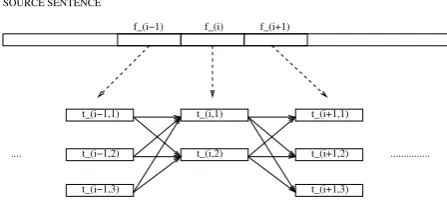
we obtain a number of translation blocks for every source word. These blocks are inter-connected in order to obtain the initial lattice (see figure 3).
f_(i−1) f_(i) f_(i+1)
t_(i−1,1)
t_(i−1,2)
t_(i−1,3)
t_(i,2)
t_(i,1) t_(i+1,1)
t_(i+1,2)
t_(i+1,3)
.... ... SOURCE SENTENCE
INTIAL TARGET LATTICE
Figure 3: Lattice Construction
To control deletions at various source posi-tions, deletion nodes may be added to the initial lattice. This lattice is permuted us-ing a permutation window to construct a lat-tice representing possible sequences. Hence, the parameters that dictate lattice construc-tion are, (1) Threshold for lexical selecconstruc-tion, (2) Using deletion arcs or not, and (3) Per-mutation window.
2. Scoring
In this step, each of the paths in the lattice constructed in the earlier step is scored us-ing a language model (Haffner, 2006), which is same as the one used in the sentence con-struction in global lexical selection models. It is to be noted that we do not use the dis-criminative reordering model in this decoder, and only the language model is used to score various target sequences.
The path with the lowest score is considered the best possible target sentence for the given source sentence. Using this decoder, we con-ducted experiments on the development set by varying threshold values and the size of the per-mutation window. The best parameter values ob-tained using the development set were used for de-coding the test corpus.
4.2 Decoding with Moses Decoder
In this approach, the phrase-table and the reordering-table are constructed using the
dis-criminative model for every source sentence (see section 3.2). These tables are then used by the state-of-art Moses decoder to obtain correspond-ing translations.
[image:6.595.71.295.137.243.2]The various training and decoding parameters of the discriminative model are computed by ex-haustively exploring the parameter space, and cor-respondingly measuring the output quality on the development set. The best set of parameters were used for decoding the sentences in the test corpus. We modified the weights assigned by MOSES to the translation model, reordering model and lan-guage model. Experiments were conducted by performing pruning on the options in the phrase table and by using the word penalty feature in MOSES.
We trained a language model of order 5 built on the entire EUROPARL corpus using the SRILM package. The method uses improved Kneser-Ney smoothing algorithm (Chen and Goodman, 1999) to compute sequence probabilities.
5 Dataset
The experiments were conducted on the Spanish-English language pair. The latest version of the Europarl corpus(version-5) was used in this work. A small set of 200K sentences was selected from the training set to conduct the experiments. The test and development sets containing 2525 sen-tences and 2051 sensen-tences respectively were used, without making any changes.
Corpus No. of sentences Source Target
Training 200000 59591 36886
Testing 2525 10629 8905
Development 2051 8888 7750
Monolingual 200000 n.a 36886
[image:6.595.306.519.510.575.2]English (LM)
Table 1: Corpus statistics for Spanish-English cor-pus.
6 Experiments and Results
against the unordered bag of words in the hypoth-esized translation. Lexical accuracy is a measure of the fidelity of lexical transfer from the source to the target sentence, independent of the syntax of the target language (Venkatapathy and Banga-lore, 2009). We report lexical accuracies to show the performance of LCS decoding in comparison with the baseline system.
We first present the results of the state-of-art phrase-based model (Moses) trained on a paral-lel corpus. We treat this as our baseline. The re-ordering feature used is msd-bidirectional, which allows for all possible reorderings over a speci-fied distortion limit. The baseline accuracies are shown in table 2.
Corpus BLEU Lexical Accuracy
Development 0.1734 0.448
Testing 0.1823 0.492
Table 2: Baseline Accuracy
We conduct two types of experiments to test our approach.
1. Experiments using lexical features (see sec-tion 6.1), and
2. Experiments using syntactic features (see section 6.2).
6.1 Experiments using Lexical Features
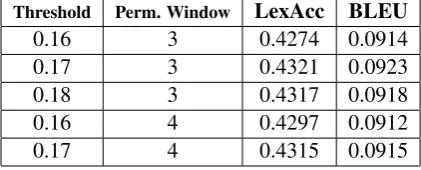
In this section, we present results of our exper-iments that use only lexical features. First, we measure the translation accuracy using LCS de-coding. On the development set, we explored the set of decoding parameters (as described in sec-tion 4.1) to compute the optimal parameter val-ues. The best lexical accuracy obtained on the
de-velopment set is0.4321and the best BLEU score
obtained is0.0923at a threshold of 0.17 and a
per-mutation window size of value 3. The accuracies corresponding to a few other parameter values are shown in Table 3.
On the test data, we obtained a lexical
accu-racy of0.4721and a BLEU score of 0.1023. As
we can observe, the BLEU score obtained using the LCS decoding technique is low when com-pared to the BLEU score of the state-of-art sys-tem. However, the lexical accuracy is comparable
Threshold Perm. Window LexAcc BLEU
0.16 3 0.4274 0.0914
0.17 3 0.4321 0.0923
0.18 3 0.4317 0.0918
0.16 4 0.4297 0.0912
[image:7.595.306.517.72.157.2]0.17 4 0.4315 0.0915
Table 3: Lexical Accuracies of Lattice-Output us-ing lexical features alone for various parameter values
to the lexical accuracy of Moses. This shows that the discriminative model provides good lexical se-lection, while the sentence construction technique does not perform as expected.
Next, we present the results of the Moses based decoder that uses the discriminative model (see section 3.2). In our experiments, we did not use MERT training for tuning the Moses parameters. Rather, we explore a set of possible parameter val-ues (i.e. weights of the translation model, reorder-ing model and the language model) to check the performance. We show the BLEU scores obtained on the development set using Moses decoder in Table 4.
Reordering LM Translation BLEU
weight(d) weight(l) weight(t)
0 0.6 0.3 0.1347
0 0.6 0.6 0.1354
0.3 0.6 0.3 0.1441
0.3 0.6 0.6 0.1468
Table 4: BLEU for different weight values using lexical features only
On the test set, we obtained a BLEU score of
0.1771. We observe that both the lexical accuracy and the BLEU scores obtained using the discrim-inative training model combined with the Moses decoder are comparable to the state-of-art results. The summary of the results obtained using three approaches and lexical feature functions is pre-sented in Table 5.
6.2 Experiments using Syntactic Features
Approach BLEU LexAcc
State-of-art(MOSES) 0.1823 0.492
LCS decoding 0.1023 0.4721
Moses decoder trained
using a discriminative 0.1771 0.4841
[image:8.595.81.283.71.155.2]model
Table 5: Translation accuracies using lexical fea-tures for different approaches
translation accuracies. Table 6 presents the results of our approach that uses syntactic features at dif-ferent parameter values. Here, we can observe that the translation accuracies (both LexAcc and BLEU) are better than the model that uses only lexical features.
Reordering LM Translation BLEU
weight(d) weight(l) weight(t)
0 0.6 0.3 0.1661
0 0.6 0.6 0.1724
0.3 0.6 0.3 0.1780
[image:8.595.72.299.311.397.2]0.3 0.6 0.6 0.1847
Table 6: BLEU for different weight values using syntactic features
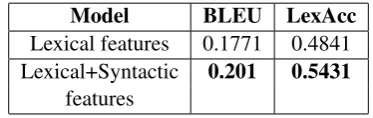
Table 7 shows the comparative performance of the model using syntactic as well as lexical fea-tures against the one with lexical feafea-tures func-tions only.
Model BLEU LexAcc
Lexical features 0.1771 0.4841
Lexical+Syntactic 0.201 0.5431
[image:8.595.86.273.521.580.2]features
Table 7: Comparison between translation accura-cies from models using syntactic and lexical fea-tures
On the test set, we obtained a BLEU score of
0.20which is an improvement of2.3 points over
the model that uses lexical features alone. We also
obtained an increase of6.1%in lexical accuracy
using this model with syntactic features as com-pared to the model using lexical features only.
7 Conclusions and Future Work
In this paper, we presented an approach to statisti-cal machine translation that combines the power of a discriminative model (for training a model for Machine Translation), and the standard beam-search based decoding technique (for the transla-tion of an input sentence). The key contributransla-tions are:
1. We incorporated a discriminative model in a phrase-based decoder. We obtained com-parable results with the state-of-art phrase-based decoder (see section 6.1). The ad-vantage in using our approach is that it has the flexibility to incorporate richer contextual and linguistic feature functions.
2. We show that the incorporation of syntac-tic information (POS tags) in our discrimina-tive model boosted the performance of trans-lation. The lexical accuracy using our
ap-proach improved by 6.1% when syntactic
features were used in addition to the lexi-cal features. Similarly, the BLEU score
im-proved by2.3points when syntactic features
were used compared to the model that uses lexical features alone. The accuracies are likely to improve when richer linguistic fea-ture functions (that use parse strucfea-ture) are incorporated in our approach.
In future, we plan to work on:
1. Experiment with rich syntactic and structural features (parse tree-based features) using our approach.
2. Experiment on other language pairs such as Arabic-English and Hindi-English.
3. Improving LCS decoding algorithm using syntactic cues in the target (Venkatapathy and Bangalore, 2007) such as supertags.
References
Bangalore, S., P. Haffner, and S. Kanthak. 2007. Statistical machine transla-tion through global lexical selectransla-tion and sentence reconstructransla-tion. In An-nual Meeting-Association for Computational Linguistics, volume 45, page 152.
Brown, P.F., V.J.D. Pietra, S.A.D. Pietra, and R.L. Mercer. 1993. The mathe-matics of statistical machine translation: Parameter estimation. Computa-tional linguistics, 19(2):263–311.
Chen, S.F. and J. Goodman. 1999. An empirical study of smoothing techniques for language modeling. Computer Speech and Language, 13(4):359–394.
Haffner, P. 2006. Scaling large margin classifiers for spoken language under-standing.Speech Communication, 48(3-4):239–261.
Hassan, H., K. Sima’an, and A. Way. 2009. A syntactified direct translation model with linear-time decoding. InProceedings of the 2009 Conference on Empirical Methods in Natural Language Processing: Volume 3-Volume 3, pages 1182–1191. Association for Computational Linguistics.
Ittycheriah, A. and S. Roukos. 2007. Direct translation model 2. In Proceed-ings of NAACL HLT, pages 57–64.
Koehn, P. and H. Hoang. 2007. Factored translation models. In Pro-ceedings of the 2007 Joint Conference on Empirical Methods in Natu-ral Language Processing and Computational NatuNatu-ral Language Learning (EMNLP-CoNLL), pages 868–876.
Koehn, P., F.J. Och, and D. Marcu. 2003. Statistical phrase-based transla-tion. InProceedings of the 2003 Conference of the North American Chap-ter of the Association for Computational Linguistics on Human Language Technology-Volume 1, pages 48–54. Association for Computational Lin-guistics.
Koehn, P., H. Hoang, A. Birch, C. Callison-Burch, M. Federico, N. Bertoldi, B. Cowan, W. Shen, C. Moran, R. Zens, et al. 2007. Moses: Open source toolkit for statistical machine translation. InAnnual meeting-association for computational linguistics, volume 45, page 2.
Och, F.J. and H. Ney. 2002. Discriminative training and maximum entropy models for statistical machine translation. InProceedings of ACL, vol-ume 2, pages 295–302.
Och, F.J., C. Tillmann, H. Ney, et al. 1999. Improved alignment models for statistical machine translation. InProc. of the Joint SIGDAT Conf. on Empirical Methods in Natural Language Processing and Very Large Corpora, pages 20–28.
Papineni, KA, S. Roukos, and RT Ward. 1998. Maximum likelihood and discriminative training of directtranslation models. InAcoustics, Speech and Signal Processing, 1998. Proceedings of the 1998 IEEE International Conference on, volume 1.
Papineni, K., S. Roukos, T. Ward, and W.J. Zhu. 2002. BLEU: a method for automatic evaluation of machine translation. InProceedings of the 40th annual meeting on association for computational linguistics, pages 311– 318. Association for Computational Linguistics.
Venkatapathy, S. and S. Bangalore. 2007. Three models for discriminative machine translation using Global Lexical Selection and Sentence Recon-struction. InProceedings of the NAACL-HLT 2007/AMTA Workshop on Syntax and Structure in Statistical Translation, pages 96–102. Association for Computational Linguistics.
Venkatapathy, Sriram and Srinivas Bangalore. 2009. Discriminative Machine Translation Using Global Lexical Selection. ACM Transactions on Asian Language Information Processing, 8(2).