Derivative-driven window-based regression method for gas
turbine performance prognostics
TSOUTSANIS, Elias <http://orcid.org/0000-0001-8476-4726> and MESKIN,
Nader
Available from Sheffield Hallam University Research Archive (SHURA) at:
http://shura.shu.ac.uk/16175/
This document is the author deposited version. You are advised to consult the
publisher's version if you wish to cite from it.
Published version
TSOUTSANIS, Elias and MESKIN, Nader (2017). Derivative-driven window-based
regression method for gas turbine performance prognostics. Energy, 128, 302-311.
Copyright and re-use policy
See
http://shura.shu.ac.uk/information.html
Sheffield Hallam University Research Archive
Derivative-driven window-based regression method for gas turbine
performance prognostics
Elias Tsoutsanisa,∗, Nader Meskinb
a
School of Engineering, Emirates Aviation University, Dubai, United Arab Emirates
b
Department of Electrical Engineering, College of Engineering, Qatar University, Doha, Qatar
Abstract
The domination of gas turbines in the energy arena is facing many challenges from environmental regulations
and the plethora of renewable energy sources. The gas turbine has to operate under demand-driven modes
and its components consume their useful life faster than the engines of the base-load operation era. As a
result the diagnostics and prognostics tools should be further developed to cope with the above operation
modes and improve the condition based maintenance (CBM).
In this study, we present a derivative-driven diagnostic pattern analysis method for estimating the
per-formance of gas turbines under dynamic conditions. A real time model-based tuner is implemented through
a dynamic engine model built in Matlab/Simulink for diagnostics. The nonlinear diagnostic pattern is then
partitioned into data-windows. These are the outcome of a data analysis based on the second order
deriva-tive which corresponds to the acceleration of degradation. Linear regression is implemented to locally fit
the detected deviations and predict the engine behavior. The accuracy of the proposed method is assessed
through comparison between the predicted and actual degradation by the remaining useful life (RUL) metric.
The results demonstrate and illustrate an improved accuracy of our proposed methodology for prognostics
of gas turbines under dynamic modes.
Keywords: Derivative-Driven Analysis, Window-Based Regression, Gas Turbine Prognostics, Condition Based Maintenance
Highlights
• A data-based method for gas turbine performance prognostics is developed.
• The proposed method takes into account dynamic operating modes and employs a derivative-driven diagnostic pattern analysis.
• Linear regression is performed on a local data window manner to detect degradation.
∗Corresponding author
• The accuracy of the method is tested under transient operating conditions and compared to an earlier method.
• The proposed method is capable of detecting accurately the evolution of compressor fouling.
Nomenclature
Symbols
A acceleration of component performance degradation ∆X g1−2 coefficients of linear regression
k acceleration threshold
L width of window ˙
m mass flow rate
n total number of operating points
N corrected shaft rotational speed
P total pressure
q total number of windows
T total temperature
u ambient and operating conditions vector
W useful power output
x component performance parameter
X component characteristics vector
Y measurement vector
Greek
Γ mass flow capacity
ǫ prediction error ∆ deviation
η isentropic efficiency
π pressure ratio
σ spread
Subscript
c compressor
d degraded
f fuel
lreg linear regression
pt power turbine r reference engine
t turbine
th thermal
1−6 engine gas path location
1. Introduction
1
The continuously growing energy demand along with the challenging aspect of reducing greenhouse
2
emissions has transformed the power generation sector. Nowadays, the conventional fossil-fuelled power
3
plants are required to work in partnership with the intermittent renewable energy plants for maintaining
4
the stability and reliability of the electricity grid. This has reformed the gas turbine powered plants. The
5
gas turbines are currently required to start up and shut down faster for satisfying the energy demand that
6
fluctuates according to the intermittent character of the renewables energy sources. An emerging group of
7
works in the literature has addressed the challenging aspect of the part-load performance behavior of gas
8
turbines both at steady state [1, 2] and dynamic/transient conditions [3, 4, 5, 6] for optimizing the energy
9
production and the stability of the electricity grid [7, 8].
10
Under such dynamic conditions and grid-following modes both the renewable and gas turbine subsystems
11
are expected to degrade at different rates [9, 10] and more importantly to consume their useful life faster
12
than that of a system operating at base-load conditions. Therefore, the CBM of gas turbine systems is going
13
to be affected by this recent shift in the engine operating profile.
14
By principle, the diagnostic and prognostic tools [11, 12, 13, 14, 15] not only improve our understanding
15
for complex and nonlinear systems such as the gas turbines but their accuracy and reliability are transferable
16
to the effectiveness of the CBM. An example of the impact that these decision making tools have in the CBM
17
can be found in the latest GE Digital Twin and Predix technologies [16]. It follows that the gas turbine
18
community is faced with the challenging aspect of improving the accuracy of diagnostics and especially
19
prognostics solutions for engines operating under dynamic conditions. Apart from a limited number of
20
works available in the literature [17, 18, 19, 20, 21], the majority of the existing diagnostic methods are
21
based on steady state operation. Subsequently, the majority of the existing prognostics methods have been
22
developed and tested by taking into consideration diagnostic information that was primarily based on the
23
steady state conditions .
24
The ever growing development of prognostic schemes for gas turbine engines has resulted into a large
25
number of prognostic solutions. Generally, these schemes can be divided into two categories, such as
based and model-based approaches. Amongst the data-based prognostic methods the most popular are
27
neural networks [22, 23] and bayesian networks [24, 25]. A subgroup of the data-based methods are the
28
statistical approaches [26, 27] in which their primary focus is that of forecasting the behavior of a system
29
without necessarily evaluating the remaining useful life of the component.
30
Model-based methods rely heavily on engine model diagnosis which is directly coupled to the prognosis
31
process. For the model-based approaches the most commonly used method is that of trending the available
32
diagnostic information through linear and nonlinear regression models [28, 29]. Another popular
model-33
based prognostic solution is based on the particle filtering [30, 31, 32, 33, 34] methods. Finally, there is a
34
family of hybrid prognostic approaches [35, 10] that combine algorithms coming from the model-based and
35
data-based groups. From the numerous methods employed for gas turbine prognostics only a few examples
36
in the literature [28, 10] have employed dynamic/transient operational modes for diagnosis [18, 32, 36] and
37
prognosis.
38
Therefore, the development of a prognostic system capable of taking into account the dynamic gas
39
turbine operation is fundamental for an effective and successful CBM. Dynamic operating gas turbines have
40
to be monitored at an increased frequency rate which results in a vast amount of data for the gas turbine
41
operators to process, analyze and interpret towards to facilitating the maintenance and operation of the
42
engines. In addition, the fast and highly nonlinear engine dynamics make the interpretation of the gas path
43
information a very complex task since it moves away from the common practice of the industry to forecast
44
the behavior of the engine based on its entire operational history. It would be more practical to focus the
45
prognostic analysis for such dynamic gas turbines in the short-term since the electricity demand dominated
46
by the intermittent character of the renewables affects the operating profile of the gas turbines and alters
47
significantly the degradation pattern of its components. Within this context and taking into consideration
48
the vast amount of engine monitored information contained in data lakes the aim of this study is to develop
49
a method for accurately forecasting the engine component degradation into the future by examining the
50
rate by which the degradation changes with respect to time.
51
Generally, the gas turbine engine performance depends on its components behavior. In our recent
52
study [37], an advanced model-based adaptation method was combined with a dynamic gas turbine model
53
developed in Matlab/Simulink. The outcome of this process was a uniquely tuned set of engine component
54
maps that empowered the engine model to match the performance measurements of a reference engine
55
operating under transient diagnostics.
56
From our recent work [10] on prognostics we utilized an adaptive diagnostic process [18] for a number of
57
sliding windows capturing the entire degraded measurements. Subsequently, the detected degradation was
58
used for a linear regression towards prognostics. In contrast to our earlier study, the proposed method
em-59
ploys a real time data-driven tuner that performs the diagnosis online and each operating point corresponds
60
to a different set of component maps. The information containing the diagnostic data is then divided into
smaller time segments referred to as windows. The time range of each window, referred to as width, depends
62
on the time data series distribution. Specifically, the data distribution examined refers to the acceleration
63
of degradation which is represented as the second order derivative of the predicted deviations. It follows,
64
that the bank of data encapsulated in the collection of windows are utilized in a local linear window-based
65
manner for predicting the future behavior of the engine components. The current work is an extension of
66
our recent work [38] which includes a comparison of the proposed method with the one presented in [10].
67
The accuracy improvement of the proposed method is tested for evaluating the level of compressor fouling
68
when the engine experiences concurrently multiple component degradations. At the same time the engine
69
operates under dynamic/transient conditions for a period of time that corresponds to 25,000 h. The metrics
70
of RUL and the PDF [39, 40, 41] have been utilized to assess and evaluate the accuracy improvement of
71
the proposed method over the one developed earlier by the authors [10]. Finally, this prognostic tool can
72
facilitate the gas turbine operators to increase their awareness for the performance of their gas turbine assets
73
when these operate under transient conditions and enable them to optimize the operation of their plants.
74
To summarize the main contributions of this paper can be listed as follows:
75
1. The problem of fault prognosis of an industrial gas turbine under transient conditions is investigated by
76
using a regression method which is activated by a derivative-driven criterion of detected degradations.
77
2. Compared to the previous related works, the proposed method represents a powerful tool for
forecast-78
ing the evolution of degraded component performance without taking into account the entire diagnostic
79
history of the equipment. This is achieved by splitting the detected component degradation pattern
80
into smaller increments where the evolutions of degradation can be assumed to be linear with respect
81
to time.
82
3. Moreover, the distribution of diagnostic data is examined based on a second order derivative
crite-83
rion which corresponds to the acceleration of degradation. Upon this criterion the diagnostic pattern
84
is partitioned into smaller segments that we refer to as windows and the contained information is
85
implemented for performing short-term prognostics. This is the first time in the literature that the
86
acceleration of the diagnostic data is utilized for simplifying the prognostic process.
87
4. Furthermore, we compare the proposed method with the one developed earlier by the authors [10] in
88
order to demonstrate and illustrate the prediction accuracy improvement through the use of PDF and
89
RUL metrics.
90
5. The main benefit of the proposed prognostic method is its ability to simplify the nonlinear time evolving
91
component degradation into a simple local and linear process for which meaningful prognostic results
92
can be easily interpreted. Using the proposed technique, the prognosis is generalized for gas turbine
93
dynamic operating modes and can be further employed for other demand-driven energy equipment.
The remainder of this paper is organized as follows. In Section 2, the proposed prognostic method along
95
with the concept of performance adaptation used for diagnostics and its integration with a dynamic engine
96
model are described. The description of the case studies are presented in Section 3. Simulation results of
97
the proposed approach are presented in Section 4, followed by the conclusions in Section 5.
98
2. Methodology
99
2.1. Assumptions
100
The component performance degradation of gas turbines is mainly attributed to the ambient conditions,
101
the operating mode and the manufacturing tolerances. These factors increase the complexity of the
diagnos-102
tics and subsequently the prognostics tasks. This is evident by the numerous existing prognostic solutions
103
proposed for gas turbines. In this study several assumptions have been made, for facilitating the application
104
of the proposed method to service engines, as follows:
105
• Only incipient component performance faults (no abrupt) are considered for prognostics.
106
• All the engine components are experiencing performance degradations simultaneously.
107
• The performance degradation of each component corresponds to deviations of the mass flow capacity
108
and isentropic efficiency from their clean/healthy values.
109
• The pattern of degradations examined are monotonical.
110
• The operating conditions are varying with respect to time.
111
The above assumptions rely on the fact that modern gas turbine that operate under dynamic conditions
112
maintain a monotonically pattern of degradation even if regular maintenance actions such as online and/or
113
offline compressor washings are performed. As far as the gas path information provided by the
instrumen-114
tation set we assume that there is no presence of noise and bias. The reason for this lies in the fact that
115
the main aim of this study is to focus purely on the capability of the developed method to deal effectively
116
with the estimation of the component degradation pattern and not on the validity of the sensor
informa-117
tion. Other approaches for data-smoothing and noise-filtering could be performed prior to diagnostics and
118
prognostics for ensuring a good quality data set for the above purposes.
119
2.2. Model Tuning
120
The frequently performed maintenance actions in industrial gas turbines (such as online/offline
compres-121
sor washing, replacement of inlet filtration systems, fuel nozzles and sensors) and the evolving performance
122
degradation of their components alter the performance and health signature of the engine. Therefore, gas
123
turbine users have to progressively refine and update their engine models for improving the accuracy of
the performance prediction based on available service engine data. This process is commonly referred to as
125
model-based performance adaptation and deals with the optimization of component-based parameters such
126
as mass flow capacities and efficiencies so that the service engine measurable performance parameters such
127
as gas path temperatures and pressures are properly matched. This is a minimization problem since its goal
128
is to mimimize the observed residuals between the model predictions and the engine test data. This process
129
establishes the data-set that corresponds to the healthy engine condition. It follows that data from a family
130
of adapted engine models can be implemented for performance-based diagnostic analysis.
131
Model
Map
Th/cs
Reference Engine
OF
Min?
Stop
Yes
No
u
X
Y
Y
r
[image:8.595.71.531.243.520.2]Map Tuning
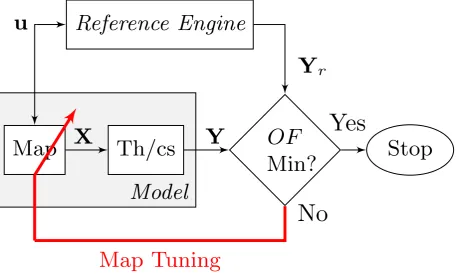
Figure 1: The flow chart of the proposed performance adaptation. Th/cs andOFdenote the thermodynamic computations and the objective function eq. 2, respectively.
A recently developed adaptation method [18, 37] is implemented for this study. A brief description of
132
this method follows. The behavior of a gas turbine engine may be represented as follows:
133
Y=f(X,u), (1)
where Y, Xand u denote the measurable performance, the component and the operating conditions
pa-134
rameters, respectively.
135
The performance of the engine can be captured by the information of the condition monitoring system of
136
a service engine or via simulated gas turbine measurements available from an engine model. For testing our
proposed method two gas turbine models are used. The gas turbine model that implements the component
138
characteristics of PROOSIS [42] simulation software is referred to as thereference engineand acts as the test
139
engine in this study. The second model, which is going to be referred to as the engine model, implements
140
the recently developed adaptation concept [37].
141
The deviations between the engine modelpredictions Y and the reference engineobservations Yr are
142
evaluated by the Objective Function (OF) as follows:
143 OF = v u u t n X i=1 Y
i−Yri
Yri
2
, (2)
wherendenotes the number of the operating points andYiandYri denote thei-th predicted and observable
144
performance parameter, respectively.
145
For initial engine model adaptation the data generated by thereference engineare matched by theengine
146
model on a global scale i.e. a single set of component maps is progressively tuned in order minimize the
147
observed residuals. For a more detailed description and analysis of the adaptation concept the reader is
148
prompted to our earlier works [18, 37].
149
Degraded
Reference Engine
5 10 15 20 25 30 35 5
10
Corrected Mass Flow Rate,mc
P re ss u re R at io, π c
Component map
5,000 10,000 15,000 20,000 25,000 −4 −3 −2 −1 0 Time (h) In je ct ed d ev iat ion in com p re ss or effi ci en cy (% )Injected degradation
Thermodynamic
Computations
u
t
X
r
∆
X
r
inj
X
r
[image:9.595.73.523.394.660.2]d
Y
r
d2.3. Diagnostics
150
Generally the performance deterioration of engine components is oftenly represented by the component
151
parameter deviation ∆X from its nominal/clean value and given by:
152
∆X= 100×(Xd−X)/X. (3)
whereX andXd denote the clean and degraded component parameter, respectively.
153
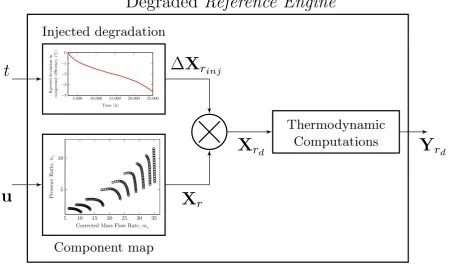
For representing the time evolving performance degradation, the component maps of thereference engine
154
are injected with deviation signals which alter the mass flow capacity and efficiency outputs of each
com-155
ponent. Consequently, the initial healthy parameter of thereference engine Xr is deviated by the injected
156
signal ∆Xrinj resulting in a fault-contaminated component map outputXrd. This in turn is reflected in the
157
measurable parameterYrd of the reference engine which corresponds to degraded conditions, as seen from
158
Fig. 2.
159
The component degradation ∆Xrinj with respect to time t may be represented as a function g, i.e.
160
∆Xrinj(t) = g(t). The mathematical form of the function g depends on the injected deviation signal. In
161
practise, the evolution of component degradation can be captured by a variety of functions however the
162
most common approach is data-trending through linear and polynomial regression models.
163
At this stage the objective of the diagnosis task deals with estimating the level of the component
degra-164
dation of thereference engine. The performance adaptation is once again implemented for performing the
165
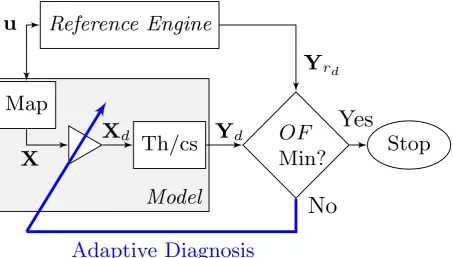
diagnostic task. However, there is a major difference in the way that the adaptation is implemented here
166
for the diagnostic purpose. The initial adapted component maps remain unaffected and only their output,
167
as shown in Fig. 3, is further tuned. This process can be performed real time by employing the algebraic
168
constraint function of Matlab/Simulink. In contrary to our earlier works, where the adaptation concept
169
was implemented for diagnostics on a global scale, this approach is performed locally for every operating
170
point and the corresponding generated component maps are utilized for matching the evolving degraded
171
measurements.
172
The accuracy of the diagnostic task is evaluated by the Diagnostic Index (DI) [37] as follows:
173
DI= 100
1
1 +ǫ
, (4)
whereǫis the detected residual for the component parameterXas follows:
174
ǫ=
n
P
i=1
∆Xi−∆Xrinji
∆Xrinji
n . (5)
At this point it should be pointed out that the accuracy of the diagnostic and subsequently the
prog-175
nostic processes is relying heavily on the capability of theengine modelto adapt its component parameters
Model
Map
Th/cs
Reference Engine
OF
Min?
Stop
Yes
No
u
X
X
d
Y
d
Y
r
d
[image:11.595.74.528.110.368.2]Adaptive Diagnosis
Figure 3: The flow chart of the proposed adaptive diagnostics.
in order to match the operating data of the reference engine. The engine measurement data are feeding
177
the tuning process of the gas turbine model towards to minimizing the residuals between the predicted and
178
actual measurements. For the initial adaptation of the engine modelto the reference enginethe entire set
179
of operating data is used for establishing a benchmark model that represents the clean/healthy condition of
180
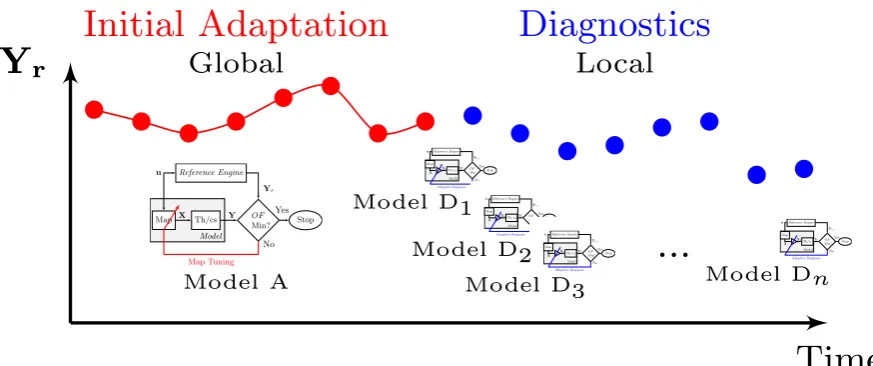
thereference engine. For diagnostic purposes the above tuning process is performed discretely for every new
181
set of engine measurement data as seen from Fig. 4. This results in a group of adapted models for which
182
the degraded engine performance of the reference engine is accurately matched. Collating the estimated
183
component performance of each uniquely adapted model represents the evolving component degradation of
184
thereference engine.
185
The set of discretely estimated diagnostic information is consequently feeding the window based
re-186
gression and prognostic process. A reliable, accurate, robust and flexible gas turbine model facilitates the
187
performance evaluation of progressively degrading engine components.
188
2.4. Window-Based Analysis
189
Upon completion of the diagnosis task the next step involves the interpretation of this information
190
towards facilitating the task of prognosis. Specifically, we suggest to partition the global nonlinear diagnostic
191
information into smaller time segments, that we refer to as windows.
Model Map Th/cs Reference Engine OF Min? Stop Yes No u X Y Yr Map Tuning Model Map Th/cs Reference Engine OF
Min?YesStop
No
u X
Xd Yd
Yrd
Adaptive Diagnosis Model Map Th/cs Reference Engine OF
Min?YesStop
No
u X
Xd Yd
Yrd
Adaptive Diagnosis Model Map Th/cs Reference Engine OF
Min?YesStop
No
u X
Xd Yd
Yrd
Adaptive Diagnosis Model Map Th/cs Reference Engine OF
Min?YesStop
No
u X
Xd Yd
Yrd
Adaptive Diagnosis
Initial Adaptation
Global
Model ADiagnostics
Local
Model D1 Model D2 Model D3...
Model Dn
Y
r
[image:12.595.77.514.113.296.2]Time
Figure 4: Representation of the engine models implemented for the initial global adaptation and the adaptive local diagnosis processes performed for thereference enginemeasurements.
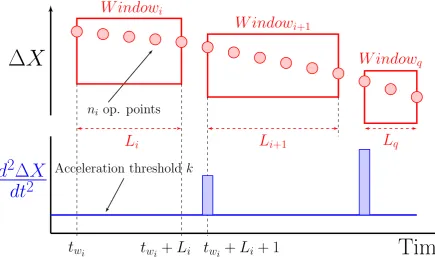
From the diagnostic results, the degradation pattern is then partitioned into a numberqof windows that
193
encapsulate the entire diagnostic information. As shown in Fig. 5 a window activated attwi containsni
194
operating points for a time range/width ofLi. In contrary to our recent work [10], whereLi was constant,
195
the window width in this study varies with respect to the distribution of data. The widthLi is adjusted
196
based on the degradation acceleration. The second derivative of the component parameter deviation ∆X
197
represents the performance degradation acceleration, as follows:
198
At=
d2∆X
t
dt2 (6)
The reason for this criterion selection lies in our initial assumption that for every window the engine
199
component degradation propagates linear with respect to time. Therefore, the second derivative of a linear
200
function is equal to zero and this enables the activation/deactivation of windows according to the distribution
201
of the diagnostic results.
202
Now let us assume that for window activated attwi the component parameter deviation is ∆Xtwi and its
203
accelerationAtwi. If the absolute deviation among the acceleration observed intwi+Li andtwi+Li+ 1 is
204
exceeding a specific limit/thresholdki.e. |Atwi+Li+1−Atwi+Li| ≤kthen this window should be terminated
205
at twi+Li and a new one should be activated at twi+Li+ 1. A schematic representation of the above
206
condition is shown in Fig. 5.
207
The specification ofkdepends on the degradation pattern examined. On a local window-based level the
∆
X
d
2
∆
X
dt
2
Time
n
iop. points
Acceleration threshold
k
W indow
i
L
i
W indow
i
+1
L
i
+1
W indow
q
L
q
t
w
it
w
i+
L
i
t
w
[image:13.595.76.512.113.370.2]i
+
L
i
+ 1
Figure 5: The partition of the diagnostic information into windows of variable width depending on the acceleration of the component degradation.
degradation can be expressed as a linear function with respect to time as follows:
209
g(t) =g1t+g2, t∈[twi, twi+Li], (7)
whereg1andg2are the coefficients of the function. Since the second derivative of the initially assumed linear
210
function in eq. (7) is equal to zero it follows thatk is specified to be zero. Therefore, if any acceleration
211
change is detected a new window will be activated. This data processing approach is performed for the
212
entire diagnostic information which results inqwindows.
213
2.5. Prognostics
214
Generally, the prognosis is the process of estimating the evolution of gas turbine performance degradation
215
for a specified time period. Given that the proposed window-based process divides the pattern of component
216
degradation into smaller time increments, this enables prognosis to be carried out locally for every window.
217
Consequently, a linear regression approach [29, 43] may be implemented to estimate the time evolving
218
degraded component parameter ∆Xlreg(t) as follows:
219
Once the localized degradation pattern is approximated by the regression model, the component
perfor-220
mance is predicted for a time widthM, which is referred to as the prognostic window. At this stage the
221
reference enginedegradation ∆Xrinj is used to assess the prognosis accuracy.
222
t
w
it
w
i+
L
i
, t
p
it
p
i+
M
Window
Time
∆
X
(%
)
Actual Degradation
Accuracy Bounds
Linear Regression
[image:14.595.67.521.168.582.2]Diagnostic Results
Prognostic Results
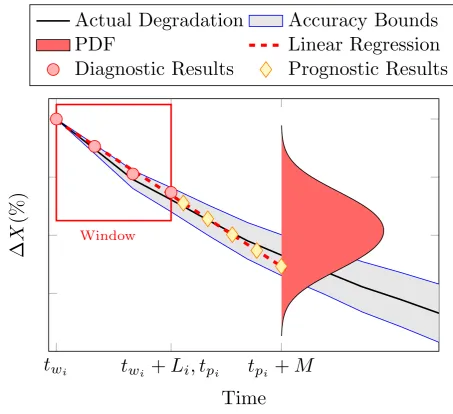
Figure 6: The distribution of the prognostic results, obtained through linear regression of the local diagnostic information, with respect to the actual degradation.
Furthermore, the Probability Density Function (PDF) of normal/gaussian distribution is implemented for
223
determining the probability of the prognosis results to take any given value. The PDF of the normal/gaussian
224
distribution ofxis as follows:
225
f(x) =
1
σ√2π
e−12( x−µ
σ ) 2
wherexdenotes the degraded component parameter ∆Xlreg of standard deviationσ.
226
The PDF of the linearly regressed component parameter ∆Xlreg information along with the diagnostic
227
predictions ∆X and the actual degradation ∆Xrinj with its corresponding accuracy bounds is shown in Fig.
228
6. The final step of the prognosis task is RUL estimation for the component.
229
The majority of the performance-based prognostic algorithms for rotating machinery [29, 28] evaluate
230
RUL by projecting the diagnostic predictions into time and assigning a probability of these predictions to
231
reach a certain threshold. The proposed prognosis is adopting another logic since its main focus is the
inves-232
tigation of the degradation pattern itself and how it evolves over time. The localized linear window-based
233
analysis facilitates the short-term performance prediction of degraded components and the Equivalent RUL
234
(ERUL) metric suggested by the authors is implemented for determining the evolution of the degradation
235
in short-term intervals.
236
Finally, accuracy bounds similar to the diagnostic accuracy bounds are implemented for the true ERUL.
237
The true ERUL is determined by the injected degradation to the engine component parameters ∆Xrinj. As
238
a result the comparison between estimated ERUL and true ERUL provides an insight to the performance
239
capability of the proposed method. The ERUL represents the rate at which the component of the engine
240
system ‘consumes’ its useful life according to the mode of operation.
241
3. Case Study Description
242
The proposed adaptive and window-based methods for prognostics approaches are integrated into a an
243
industrial gas turbine model that is developed in MATLAB/Simulink environment. It is worth mentioning
244
that the MATLAB/Simulink environment is becoming very popular for the analysis of energy systems
245
dynamics and the design of controllers [44, 45, 46, 47]. Our developed model has been validated towards
246
PROOSIS [42] simulation software. The engine model is similar to the GE LM2500+ aero derivative gas
tur-247
bine [48] which is a two-shaft industrial gas turbine that consists of a compressor, a combustor, a compressor
248
turbine and a power turbine as schematically represented in Fig 7. The design performance specifications of
249
the engine are tabulated in Table 1.
250
The control input of the gas turbine model configuration is the fuel flow rate ˙mf. A detailed description
251
of the gas turbine model can be found in our recent works in [49, 37]. The objective of the case studies
252
is to evaluate the accuracy improvement of our prognostic method in comparison to the earlier prognostic
253
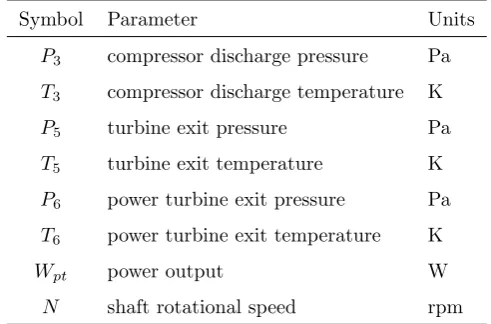
scheme developed where fixed width windows were implemented. The selected measurable parameters for
254
the diagnostic and prognostic tasks are listed in Table 2.
255
Now let us describe the reference engine data generation process. The time step of the simulation
256
procedure is 1 ms. For 100 s simulation time a total of 100,000 data samples are generated. The above data
257
should be mapped to the examined component degradations that are typical for 25,000 h of operation. This
1 2
3
4
5
6
C
om
p
re
ss
or
Combustor
T
u
rb
in
e
P
ow
er
T
u
rb
in
e
[image:16.595.77.527.120.283.2]Load
[image:16.595.177.416.369.475.2]Figure 7: The engine model schematic layout representing a two shaft gas turbine.
Table 1: Design performance specifications of GE LM2500+ [48].
Symbol Parameter Value Units
πc pressure ratio 23.1
˙
mexh exhaust mass flow rate 85.9 kg/s
Texh exhaust gas temperature 791 K
ηth thermal efficiency 41 %
Wpt power output 31 MW
Table 2: The engine performance measurable parameters.
Symbol Parameter Units
P3 compressor discharge pressure Pa
T3 compressor discharge temperature K
P5 turbine exit pressure Pa
T5 turbine exit temperature K
P6 power turbine exit pressure Pa
T6 power turbine exit temperature K
Wpt power output W
[image:16.595.174.420.548.710.2]0
5
,
000
10
,
000
15
,
000
20
,
000
25
,
000
0
.
65
0
.
9
1
.
15
Time (h)
F
u
el
fl
ow
rat
e
˙
m
f
/
˙
m
f
d
[image:17.595.74.521.113.297.2]es
Figure 8: The variation of the fuel flow rate with respect to time.
means that 4 data samples are mapped to 1 h of operation. The size of the data samples is adequate for
259
capturing the nonlinearity of the engine performance. The dynamic aspect of the fuel flow rate which acts
260
as the control input of the engine model is shown in Fig. 8.
261
Data implemented for the case studies are thereference engine degraded simulated measurements and
262
the prognosis process is performed at various time instants. The degraded measurements are generated
263
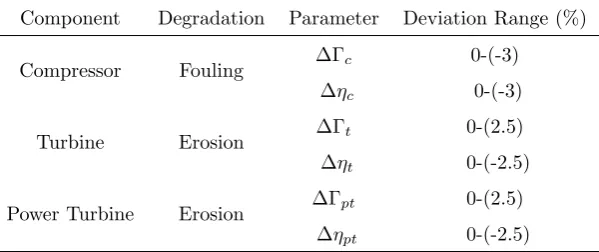
by injecting deviation signals in the component parameters of the reference engine. A summary of the
264
aforementioned deviations is given in Table 3.
265
Table 3: Injected deviations of the component parameters.
Component Degradation Parameter Deviation Range (%)
Compressor Fouling ∆Γc ∆ηc
0-(-3)
0-(-3)
Turbine Erosion ∆Γt ∆ηt
0-(2.5)
0-(-2.5)
Power Turbine Erosion ∆Γpt ∆ηpt
0-(2.5)
0-(-2.5)
In this study two test cases are carried out. The first case study objective is to assess the prediction
266
accuracy for the proposed real-time adaptive diagnostic method. It follows that for the second case study
267
the objective is to predict the evolution of the compressor degradation by implementing both the
window-268
based analysis and the linear regression methods. Moreover, the comparison of the prognostic method with
[image:17.595.149.449.508.634.2]the one earlier developed by the authors will give an insight of the accuracy improvement by the variable
270
window-width activation introduced. Towards this end the common metrics of PDF and ERUL are utilized
271
for assessing the accuracy of the prognosis.
272
It should be noted that the earlier prognostic method will implement the diagnostic results on a different
273
manner than in [10]. In the earlier study [10] the fixed width method was employed for both the diagnostic
274
and prognostic process. The diagnosis in that case was carried out in a sliding window-based manner and
275
for each diagnostic window the suite of engine model component maps were optimized and degradations
276
were detected on a local window level. Consequently, the diagnostic information was the outcome of collated
277
data from the detected degradations of each window. That approach had the advantage of partly filtering
278
out the time component from the degradation so that the prognosis could be performed on a linear
fixed-279
width window-based method. In contrast to our earlier work, this study waives off the added advantage of
280
performing diagnosis in a window based fashion and only prognosis is performed on local window level.
281
4. Results
282
4.1. Diagnosis
283
The model-based performance adaptation and the adaptive diagnostic method, are implemented for
284
detecting the degradation of each component. The process commenced by initially adapting the engine
285
model to the clean/nominal condition of reference engine for an operational profile that included both
286
steady state and transient operating points. Then degradations were injected to the compressor, turbine
287
and power turbine attd=2,500 h. The first bank of data up to td is utilized forengine model adaptation
288
and denote the clean/nominal/healthy condition of the engine.
289
Diagnostic tasks are initiated at td and carried out real time by tuning the output of each component
290
map that has been initially optimized by the earlier adaptation process. The detected compressor fouling
291
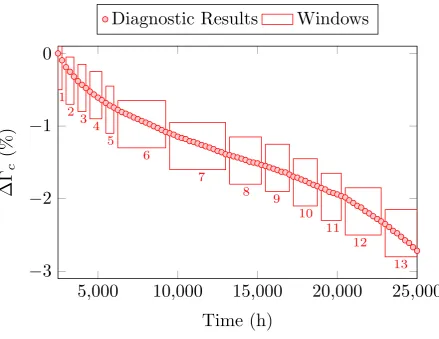
which is represented by the deviated mass flow component parameter is shown in Fig. 9. The diagnostic
292
results indicated an improved accuracy in the diagnosis and in case of the compressor mass flow capacity
293
the DI is 0.99 which implies that the diagnosis is 99% effective. It should be noted that all the
compo-294
nent degradations have been detected with the same level of accuracy, but only the results concerning the
295
compressor degradation are presented here.
296
Prior to performing prognostics, the diagnostic information encapsulated by the detected deviations is
297
split into a number of windows as seen from Fig. 9. For this case their time width Li relies solely on the
298
distribution of the component degradation acceleration. The outcome of the above process resulted in a set
299
ofq=13 windows of variable widthLi spanning from 250 h to 5,000 h.
300
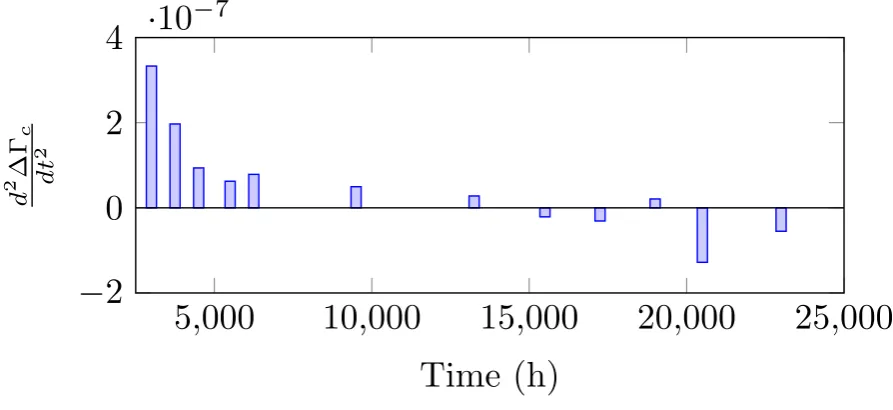
The acceleration of compressor degradation is represented by the second derivative of mass flow
capac-301
ity with respect to time as seen from Fig. 10. At specific time instants, the acceleration of compressor
5
,
000
10
,
000
15
,
000
20
,
000
25
,
000
−
3
−
2
−
1
0
1
2
3
4
5
6
7
8
9
10
11
12
13
Time (h)
∆
Γ
c
(%
)
[image:19.595.77.517.107.446.2]Diagnostic Results
Windows
Figure 9: Predicted compressor degradation represented by the deviation of the mass flow capacity. Diagnostic information is splitted into 13 windows where their width is variable and dependent on the acceleration of degradation.
degradation exceeds the threshold valuek=0 which leads to the termination of the existing window and the
303
activation of a new one so that the initially assumed linear propagation is satisfied. It is also noted from
304
Fig. 10 that for the initial and final stages of the assumed degradation pattern the diagnostic information
305
has to be segmented into several windows due to an increased rate of degradation.
306
For demonstrating the advantages of the proposed method in terms of the prediction accuracy, the earlier
307
fixed width window-based method developed by the authors [10] is also implemented. The results of this
308
fixed width window-based method are illustrated in Fig. 11 where a number ofq=9 windows are utilized to
309
capture the diagnostic data and their widthLiis fixed at 2,500 h.
310
For facilitating the comparison of both window-based linear regression methods in terms of the
prognos-311
tics accuracy, the proposed variable width and the earlier fixed width window-based methods are going to
312
be referred to as Method A and Method B, respectively.
5
,
000
10
,
000
15
,
000
20
,
000
25
,
000
−
2
0
2
4
·
10
−
7
Time (h)
d
2
∆
Γ
cd
t
[image:20.595.73.520.111.316.2]2
Figure 10: Acceleration of compressor degradation represented by deviation of the mass flow capacity.
4.2. Prognosis
314
The objective of this case study is to evaluate the improved accuracy of our proposed method for
315
prognostics. The time instants when prognosis is initiated are different for Method A and Method B since
316
each one uses a different approach in partitioning the diagnostic information. A direct comparison between
317
the predicted and actual compressor degradation forms the means by which the prognostic accuracy is
318
determined.
319
For Method A the prognosis is initiated at time instant 2,750 h until the 22,500h. The prognostic window
320
width spans from M=0.5 to 1 month of operation, i.e. 360 to 720 h. In case of Method B the prognosis
321
is initiated at tp=4,750 h and the prognostic window width is constant at M=1 month. The number of
322
operating points corresponding to the diagnostic data of each window is denoted byni and depends on the
323
time widthLi of each window.
324
The deviation in compressor mass flow capacity as predicted by the Methods A and B is shown in
325
Figs. 12 and 13, respectively. In the proposed method the prognosis task is performed more frequently
326
than Method B. This is due to the number of windows used for capturing the diagnostic information. It is
327
clear from Fig. 12, than the normal data distribution of the proposed prognostic method predictions fall
328
within the accuracy bounds that were set at 90% of the actual degradation. On the other hand Method
329
B presents similar performance with Method A apart from the first and final stages of the degradation
330
pattern. One major advantage of the data-driven partitioning of the diagnostic pattern is that of linearizing
331
the degradation trend and applying a local linear regression model for prognostics.
332
The spread of the predicted mass flow capacity distribution depends on the gradient characterizing the
333
diagnostic data that are contained in each window. As a result it is observed from Figs. 12 and 13 that
5
,
000
10
,
000
15
,
000
20
,
000
25
,
000
−
3
−
2
−
1
0
1
2
3
4
5
6
7
8
9
Time (h)
∆
Γ
c
(%
)
[image:21.595.72.514.109.448.2]Diagnostic Results
Windows
Figure 11: Predicted compressor degradation represented by the deviation of the mass flow capacity. Diagnostic information is splitted into 9 windows where their width is fixed.
especially for the first and last stages of the degradation pattern the spread is relatively higher than the
335
ones for the mid stages.
336
An additional metric that facilitates the evaluation of the prognostic accuracy is that of the ERUL of
337
the component based on its degradation. The predicted ERUL based on the compressor mass flow capacity
338
is shown in Fig. 14 where the accuracy bounds refer to the true ERUL of the component. It is evident from
339
Fig. 14 that the estimated ERUL falls within the accuracy bounds for all the local prognostic tasks for both
340
Methods A and B. However, it is noticed from Fig. 14 that there is a small deviation in terms of ERUL
341
between the two methods. The former observation can be amplified by examining the ERUL error of each
342
method.
343
As expected the ERUL error of the Method A predictions lies consistently within the accuracy levels for
344
all the time instants and ranges from 0% to 1.6%. On the other hand the error of Method B predictions
345
might initially lie within the accuracy levels but at the final stages of the degradation pattern, where one
346
would expect convergence to the true ERUL, the error increases. A closer look to Fig. 15 reveals that for
5
,
000
10
,
000
15
,
000
20
,
000
25
,
000
−
2
−
1
0
Time (h)
∆
Γ
c
(%
)
Actual Degradation
Accuracy Bounds
Diagnostic Results
Prognostic Results
Figure 12: The deviation of compressor mass flow capacity as predicted by variable width window-based Method A.
both the initial and final stages of the prognosis task Method B has a prediction error in the range of -5%
348
to 5%. Although both Methods A and B initially seemed to perform similarly in terms of the prognostic
349
accuracy it was found that Method B is characterized by under and over-predictions for the initial and
350
final stages of the examined degradation pattern, respectively. Finally, it should be pointed out that by
351
principle Method B is a method most suitable for application in which both the diagnosis and the prognosis
352
are performed with the same local window-based approach. In contrast to Method B, Method A is purely
353
data-driven and relies solely on the diagnostic information. Selection of one method over the other depends
354
upon the objective of the investigation and the method selected for the diagnosis process.
5
,
000
10
,
000
15
,
000
20
,
000
25
,
000
−
2
−
1
0
Time (h)
∆
Γ
c
(%
)
Actual Degradation
Accuracy Bounds
Diagnostic Results
Prognostic Results
Figure 13: The deviation of compressor mass flow capacity as predicted by fixed width window-based Method B.
5. Conclusions
356
In this paper, a data-based prognostics approach is proposed for estimating the performance of gas
357
turbine engine operating in dynamic conditions. A real time adaptive diagnostic approach and a
window-358
based prognostic method are coupled with a MATLAB/Simulink gas turbine model.
359
Testing of the proposed methods was based on simulated measurements of an engine model that
rep-360
resented 25,000 h of gas turbine operation subject to multiple component degradations. The compressor
361
degradation is accurately predicted by locally fitting a linear regression model which predicts the
perfor-362
mance behavior of the engine. This is accomplished by utilizing a local linear window-based approach which
363
splits the diagnostic pattern into several smaller segments in which the progression of degradation can be
364
approximated by linear functions. The window width is adjusted according to the degraded data
accel-365
eration. Moreover, the useful life of the compressor is estimated and compared to the its true life within
5
,
000
10
,
000
15
,
000
20
,
000
25
,
000
0
10
,
000
20
,
000
Time (h)
E
R
UL
(h
)
Accuracy Bounds
True ERUL
[image:24.595.77.514.109.445.2]Method B
Method A
Figure 14: The predicted ERUL based on compressor mass flow capacity.
90% accuracy bounds by using the PDF and ERUL metrics. The performance of the engine component is
367
accurately predicted for prognostic windows that vary from 0.5 to 1 month of operation. The comparison of
368
the proposed method with an earlier prognostic method, that utilizes a fixed width window-based analysis
369
of the diagnostic information, highlighted the advantage of the proposed method in dealing with component
370
degradations that have an increased rate of progression.
371
The proposed method has demonstrated the capability to predict at a computational efficient and
accu-372
rate manner the gas turbine component degradation for engines operating under dynamic operating modes.
373
Our proposed method can support the condition based maintenance of gas turbine powered plants since it
374
provides an improved judgment for the gas turbine short-term performance status.
375
Acknowledgment
376
This publication was supported in part by NPRP grant No. 4-195-2-065 from the Qatar National
377
Research Fund (a member of Qatar Foundation). The statements made herein are solely the responsibility
5
,
000
10
,
000
15
,
000
20
,
000
25
,
000
−
10
−
5
0
5
10
Time (h)
E
R
UL
E
rr
or
(%
)
[image:25.595.75.519.107.405.2]Accuracy Bounds
Method B
Method A
Figure 15: The predicted ERUL error based on compressor mass flow capacity.
of the authors.
379
[1] G. Zhang, J. Zheng, A. Xie, Y. Yang, W. Liu, Thermodynamic analysis of combined cycle under design/off-design
condi-380
tions for its efficient design and operation, Energy Conversion and Management 126 (2016) 76–88.
381
[2] F. Haglind, B. Elmegaard, Methodologies for predicting the part-load performance of aero-derivative gas turbines, Energy
382
34 (10) (2009) 1484–1492.
383
[3] A. Benato, A. Stoppato, S. Bracco, Combined cycle power plants: A comparison between two different dynamic models
384
to evaluate transient behaviour and residual life, Energy Conversion and Management 87 (2014) 1269–1280.
385
[4] N. Hadroug, A. Hafaifa, A. Kouzou, A. Chaibet, Dynamic model linearization of two shafts gas turbine via their
in-386
put/output data around the equilibrium points, Energy.
387
[5] X. Xu, K. Li, F. Qi, H. Jia, J. Deng, Identification of microturbine model for long-term dynamic analysis of distribution
388
networks, Applied Energy.
389
[6] S. Bracco, F. Delfino, A mathematical model for the dynamic simulation of low size cogeneration gas turbines within
390
smart microgrids, Energy.
391
[7] S. Obara, J. Morel, M. Okada, K. Kobayashi, Study on the load following characteristics of a distributed igcc for
inde-392
pendent microgrid, Energy 115 (2016) 13–25.
393
[8] C. V. Ponce, D. S´aez, C. Bordons, A. N´u˜nez, Dynamic simulator and model predictive control of an integrated solar
394
combined cycle plant, Energy 109 (2016) 974–986.
395
[9] V. Zaccaria, D. Tucker, A. Traverso, Operating strategies to minimize degradation in fuel cell gas turbine hybrids, Applied
396
Energy.
[10] E. Tsoutsanis, N. Meskin, M. Benammar, K. Khorasani, A dynamic prognosis scheme for flexible operation of gas turbines,
398
Applied Energy 164 (2016) 685–701.
399
[11] A. Volponi, Gas turbine engine health management: Past, present, and future trends, Journal of Engineering for Gas
400
Turbines and Power 136 (5) (2014) 051201.
401
[12] J. Sun, H. Zuo, W. Wang, M. G. Pecht, Application of a state space modeling technique to system prognostics based
402
on a health index for condition-based maintenance, Mechanical Systems and Signal Processing 28 (2012) 585 – 596,
403
interdisciplinary and Integration Aspects in Structural Health Monitoring. doi:http://dx.doi.org/10.1016/j.ymssp.
404
2011.09.029.
405
URLhttp://www.sciencedirect.com/science/article/pii/S0888327011003979
406
[13] D. Zhou, H. Zhang, Y.-G. Li, S. Weng, A dynamic reliability-centered maintenance analysis method for natural gas
407
compressor station based on diagnostic and prognostic technology, Journal of Engineering for Gas Turbines and Power
408
138 (6) (2016) 061601.
409
[14] M. Y. Asr, M. M. Ettefagh, R. Hassannejad, S. N. Razavi, Diagnosis of combined faults in rotary machinery by non-naive
410
bayesian approach, Mechanical Systems and Signal Processing 85 (2017) 56–70.
411
[15] E. Mohammadi, M. Montazeri-Gh, Active fault tolerant control with self-enrichment capability for gas turbine engines,
412
Aerospace Science and Technology 56 (2016) 70–89.
413
[16] GE, Transforming GE to Digital Industrial, see alsohttp://www.ge.com/(2016).
414
[17] Y. G. Li, A gas turbine diagnostic approach with transient measurements, Proceedings of the Institution of Mechanical
415
Engineers, Part A: Journal of Power and Energy 217 (2) (2003) 169–177.
416
[18] E. Tsoutsanis, N. Meskin, M. Benammar, K. Khorasani, Transient gas turbine performance diagnostics through nonlinear
417
adaptation of compressor and turbine maps, Journal of Engineering for Gas Turbines and Power, GTP-14-1630 137.
418
[19] G. Merrington, O. K. Kwon, G. Goodwin, B. Carlsson, Fault detection and diagnosis in gas turbines, Journal of Engineering
419
for Gas Turbines and Power 113 (2) (1991) 276–282.
420
[20] M. Amozegar, K. Khorasani, An ensemble of dynamic neural network identifiers for fault detection and isolation of gas
421
turbine engines, Neural Networks 76 (2016) 106–121.
422
[21] E. Mohammadi, M. Montazeri-Gh, A fuzzy-based gas turbine fault detection and identification system for full and part-load
423
performance deterioration, Aerospace Science and Technology 46 (2015) 82–93.
424
[22] A. Vatani, K. Khorasani, N. Meskin, Health monitoring and degradation prognostics in gas turbine engines using dynamic
425
neural networks, in: ASME Turbo Expo, GT2015-4401, ASME, 2015.
426
[23] J. Szoplik, Forecasting of natural gas consumption with artificial neural networks, Energy 85 (2015) 208 – 220.doi:http:
427
//dx.doi.org/10.1016/j.energy.2015.03.084.
428
URLhttp://www.sciencedirect.com/science/article/pii/S036054421500393X
429
[24] M. A. Zaidan, R. F. Harrison, A. R. Mills, P. J. Fleming, Bayesian hierarchical models for aerospace gas turbine engine
430
prognostics, Expert Systems with Applications 42 (1) (2015) 539 – 553.
431
[25] M. A. Zaidan, A. R. Mills, R. F. Harrison, P. J. Fleming, Gas turbine engine prognostics using bayesian hierarchical
432
models: A variational approach, Mechanical Systems and Signal Processing 7071 (2016) 120 – 140. doi:http://dx.doi.
433
org/10.1016/j.ymssp.2015.09.014.
434
URLhttp://www.sciencedirect.com/science/article/pii/S0888327015004094
435
[26] D. Zhou, H. Zhang, S. Weng, A novel prognostic model of performance degradation trend for power machinery maintenance,
436
Energy 78 (2014) 740 – 746. doi:http://dx.doi.org/10.1016/j.energy.2014.10.067.
437
URLhttp://www.sciencedirect.com/science/article/pii/S0360544214012171
438
[27] D. Feng, M. Xiao, Y. Liu, H. Song, Z. Yang, L. Zhang, A kernel principal component analysis–based degradation
439
model and remaining useful life estimation for the turbofan engine, Advances in Mechanical Engineering 8 (5) (2016)
1687814016650169.
441
[28] E. Tsoutsanis, N. Meskin, M. Benammar, K. Khorasani, Performance-based prognosis scheme for industrial gas turbines,
442
in: Prognostics and Health Management (PHM), 2015 IEEE Conference on, IEEE, 2015, pp. 1–8.
443
[29] Y. G. Li, P. Nilkitsaranont, Gas turbine performance prognostic for condition-based maintenance, Applied Energy 86 (10)
444
(2009) 2152–2161.
445
[30] N. Daroogheh, N. Meskin, K. Khorasani, A novel particle filter parameter prediction scheme for failure prognosis, in:
446
American Control Conference (ACC), 2014, IEEE, 2014, pp. 1735–1742.
447
[31] N. Daroogheh, A. Baniamerian, N. Meskin, K. Khorasani, A hybrid prognosis and health monitoring strategy by integrating
448
particle filters and neural networks for gas turbine engines, in: Prognostics and Health Management (PHM), 2015 IEEE
449
Conference on, 2015, pp. 1–8. doi:10.1109/ICPHM.2015.7245020.
450
[32] H. Hanachi, J. Liu, A. Banerjee, Y. Chen, Sequential state estimation of nonlinear/non-gaussian systems with stochastic
451
input for turbine degradation estimation, Mechanical Systems and Signal Processing 72 (2016) 32–45.
452
[33] Q. Wang, J. Huang, F. Lu, An improved particle filtering algorithm for aircraft engine gas-path fault diagnosis, Advances
453
in Mechanical Engineering 8 (7) (2016) 1687814016659602.
454
[34] D. E. Acu˜na, M. E. Orchard, Particle-filtering-based failure prognosis via sigma-points: Application to lithium-ion battery
455
state-of-charge monitoring, Mechanical Systems and Signal Processing 85 (2017) 827–848.
456
[35] D. Zhou, Z. Yu, H. Zhang, S. Weng, A novel grey prognostic model based on markov process and grey incidence analysis
457
for energy conversion equipment degradation, Energy 109 (2016) 420 – 429.doi:http://dx.doi.org/10.1016/j.energy.
458
2016.05.008.
459
URLhttp://www.sciencedirect.com/science/article/pii/S0360544216305606
460
[36] B. Pourbabaee, N. Meskin, K. Khorasani, Robust sensor fault detection and isolation of gas turbine engines subjected
461
to time-varying parameter uncertainties, Mechanical Systems and Signal Processing (2016) –doi:http://dx.doi.org/10.
462
1016/j.ymssp.2016.02.023.
463
URLhttp://www.sciencedirect.com/science/article/pii/S0888327016000741
464
[37] E. Tsoutsanis, N. Meskin, M. Benammar, K. Khorasani, A component map tuning method for performance prediction
465
and diagnostics of gas turbine compressors, Applied Energy 135 (2014) 572–585.
466
[38] E. Tsoutsanis, N. Meskin, Forecasting the health of gas turbine components through an integrated performance-based
467
approach, in: Prognostics and Health Management (ICPHM), 2016 IEEE International Conference on, IEEE, 2016, pp.
468
1–8.
469
[39] A. Saxena, Prognostics the science of prediction, in: Proc. PHM Conference, Portland, OR, 2010.
470
[40] Y. Cheng, C. Lu, T. Li, L. Tao, Residual lifetime prediction for lithium-ion battery based on functional principal component
471
analysis and bayesian approach, Energy 90, Part 2 (2015) 1983 – 1993.doi:http://dx.doi.org/10.1016/j.energy.2015.
472
07.022.
473
URLhttp://www.sciencedirect.com/science/article/pii/S0360544215009172
474
[41] K.-C. Yung, B. Sun, X. Jiang, Prognostics-based qualification of high-power white leds using l´evy process approach,
475
Mechanical Systems and Signal Processing.
476
[42] PROOSIS, Propulsion Object-Oriented Simulation Software, see alsohttp://www.proosis.com/(2016).
477
[43] D. C. Montgomery, G. C. Runger, Applied statistics and probability for engineers, John Wiley & Sons, 2010.
478
[44] L. Barelli, G. Bidini, A. Ottaviano, Integration of sofc/gt hybrid systems in micro-grids, Energy.
479
[45] R. Chacartegui, D. S´anchez, A. Mu˜noz, T. S´anchez, Real time simulation of medium size gas turbines, Energy Conversion
480
and Management 52 (1) (2011) 713–724.
481
[46] M. Sharifzadeh, M. Meghdari, D. Rashtchian, Multi-objective design and operation of solid oxide fuel cell (sofc) triple
482
combined-cycle power generation systems: Integrating energy efficiency and operational safety, Applied Energy 185 (2017)
345–361.
484
[47] Y. Yu, L. Chen, F. Sun, C. Wu, Matlab/simulink-based simulation for digital-control system of marine three-shaft
gas-485
turbine, Applied Energy 80 (1) (2005) 1–10.
486
[48] GE, The LM2500+ Engine, see alsohttp://www.ge.com/(2017).
487
[49] E. Tsoutsanis, N. Meskin, M. Benammar, K. Khorasani, Dynamic performance simulation of an aeroderivative gas turbine
488
using the matlab simulink environment, in: Proc. ASME IMECE, IMECE2013-64102, Vol. 4, San Diego, USA, 2013, p.
489
V04AT04A050.